

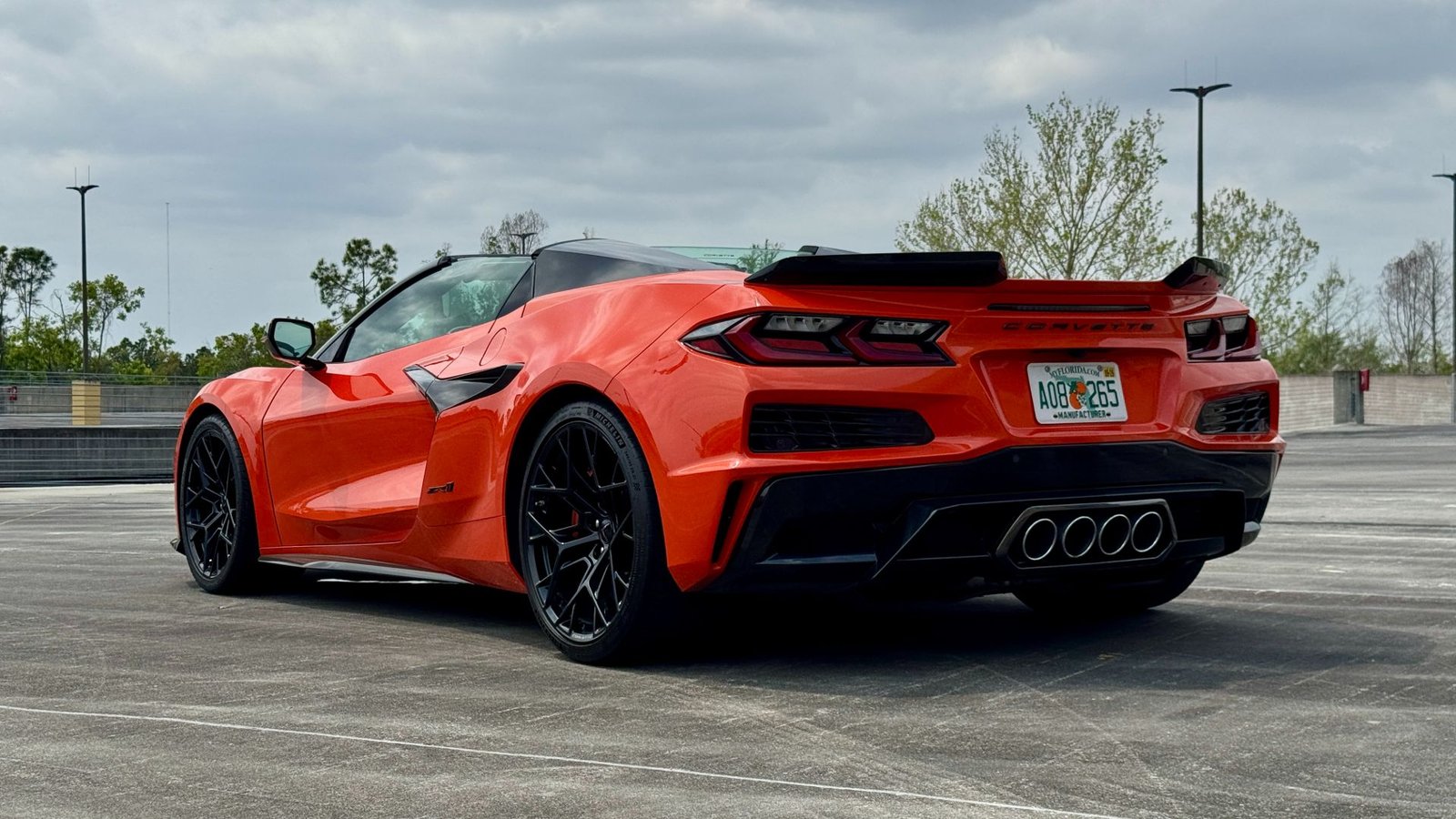
2026 Chevrolet Corvette ZR1 Review: America’s 1,064-HP Supercar
The value supercar that humbles exotics twice its price
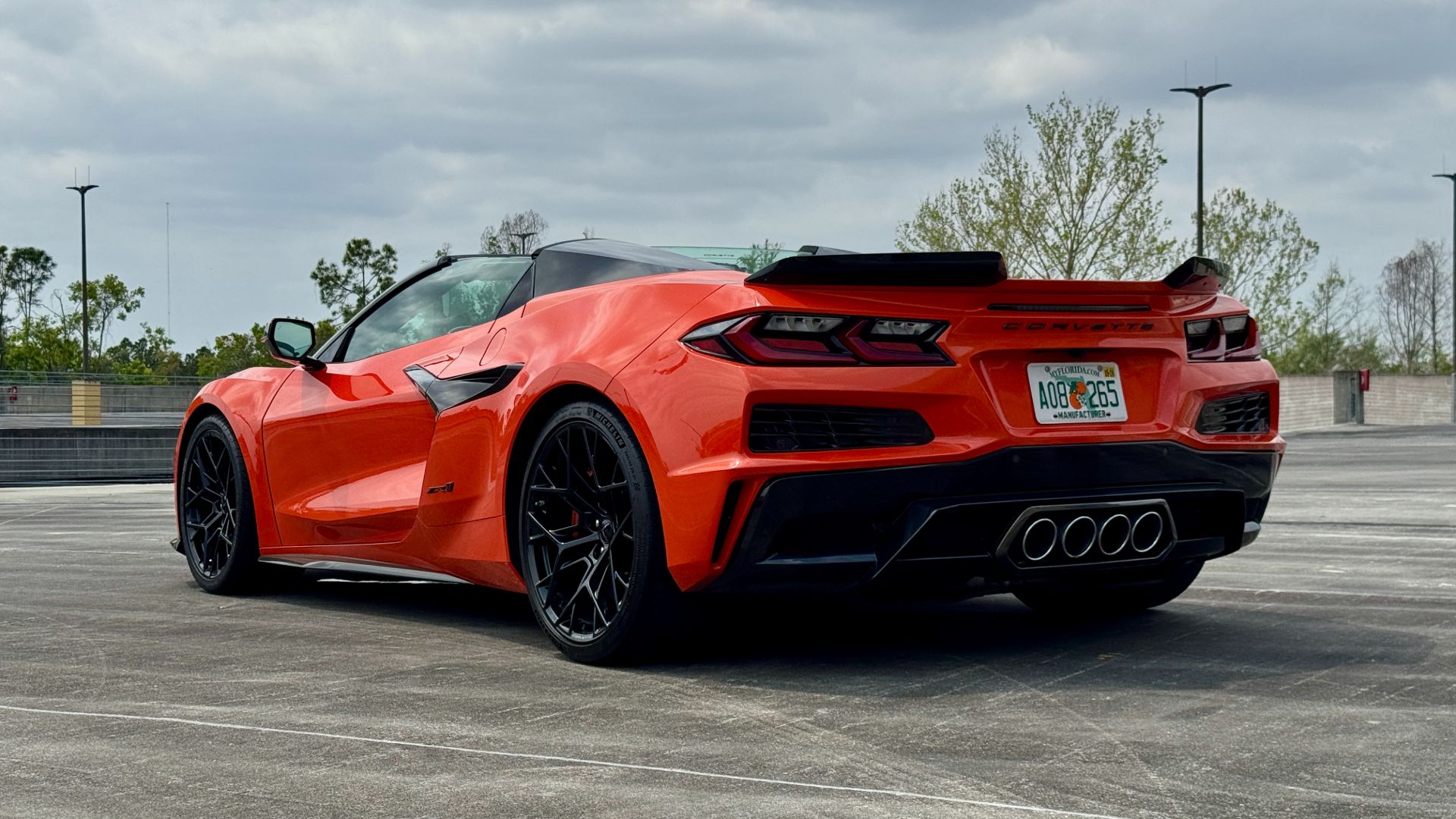
2026 Chevrolet Corvette ZR1 rear three-quarter view
Price
$182,395
Power
1,064 hp
⚡ Quick Verdict
We’ll say it plainly: the 2026 Chevrolet Corvette ZR1 is the most absurd performance bargain we’ve ever tested. For USD $182,395, you’re getting a twin-turbocharged 5.5-litre V8 putting out 1,064 horsepower, a 2.3-second dash to 60 mph, a 233 mph top speed, and a 6:50.763 Nürburgring lap time — numbers that make cars costing two or three times as much look embarrassingly overpriced. On a pure performance-per-dollar basis, nothing else comes close right now.
✓ The Good
- +Staggering 1,064 hp makes it the most powerful Corvette ever built
- +Sub-$200K USD base price undercuts every rival by a massive margin
- +Nürburgring lap time of 6:50.763 is genuinely world-class
- +Revised 12.7-inch touchscreen fixes the old interior’s biggest complaint
- +Available ZTK package delivers legitimate track-day weaponry
- +Usable enough for a weekend away thanks to mid-engine boot space
✗ The Trade-offs
- −Rear-wheel drive only — no all-weather confidence on cold mornings
- −Interior quality still trails Porsche and European rivals by a perceptible gap
- −Fuel economy of 14 mpg combined will sting at the bowser
- −Stiff ride even in Tour mode on anything other than smooth tarmac
📑 In This Review
- Introduction
- Performance and Powertrain
- Handling, Brakes and Track Performance
- Design and Aerodynamics
- Interior, Tech and Comfort
- 2026 Chevrolet Corvette ZR1 vs Porsche 911 Turbo S: Which Is Better?
- At a Glance: How the ZR1 Compares to Direct Rivals
- Safety, Warranty and Ownership
- Pricing, Trims and Value
- Buy It / Skip It
- Verdict
We’ll say it plainly: the 2026 Chevrolet Corvette ZR1 is the most absurd performance bargain we’ve ever tested. For USD $182,395, you’re getting a twin-turbocharged 5.5-litre V8 putting out 1,064 horsepower, a 2.3-second dash to 60 mph, a 233 mph top speed, and a 6:50.763 Nürburgring lap time — numbers that make cars costing two or three times as much look embarrassingly overpriced. On a pure performance-per-dollar basis, nothing else comes close right now. There are compromises, though. It’s rear-wheel drive only, which means cold or wet mornings demand your full attention. The interior — upgraded for 2026 with a new 12.7-inch touchscreen and five premium colourways — is better than before, but it still can’t match the tactile quality you’d find in a Porsche or Ferrari. That said, if you’re after the biggest bang for your buck, if you love weekend track days, or if you simply want to hear a proper American V8 screaming at 8,000 rpm, there’s genuinely nothing on Earth that delivers this much for this little money. We’ve scored it 4.6 out of 5, and we reckon it’s one of the most important sports cars of the decade.
Introduction
The supercar market in 2026 is a strange beast. Electrified drivetrains are popping up everywhere, hybridisation has become the default, and anything wearing a prancing horse, a trident, or a Stuttgart crest now costs well north of a quarter-million dollars. Into that world of rising complexity and climbing price tags, Chevrolet has lobbed something almost recklessly simple: a mid-engine, twin-turbocharged V8 making 1,064 horsepower, priced under $200,000 USD, and capable of hitting 233 mph flat out. That’s the 2026 Corvette ZR1.
This is the car General Motors has been building towards since the C8 Corvette moved to a mid-engine layout in 2020. The base Stingray gave us accessible performance, the Z06 brought a screaming flat-plane-crank V8, and the ZR1 is the ultimate expression of the C8 platform. It’s been engineered to go toe-to-toe with the Porsche 911 Turbo S, the McLaren 750S, and the Ferrari 296 GTB — and beat them on every meaningful performance metric while costing tens of thousands less.
At its core is the LT7 engine: a 5.5-litre twin-turbocharged V8 producing 1,064 horsepower and 828 lb-ft of torque. That feeds an eight-speed dual-clutch transmission and sends drive exclusively to the rear wheels. From our time behind the wheel, the result is a visceral, old-school American muscle experience wrapped in a thoroughly modern mid-engine package. Nothing else on sale replicates it.
At $182,395 for the coupe — roughly AUD $280,000 before on-road costs for Australian buyers lucky enough to get one — the ZR1 sits in a genuinely unique position. It’s not cheap, but measured against the $272,650 Porsche 911 Turbo S, the $324,000 McLaren 750S, and the $338,000 Ferrari 296 GTB, it represents a seismic discount for outright performance. The real question isn’t whether the ZR1 is fast. It’s whether that lower price means corners have been cut elsewhere. We spent plenty of time with the car to find out.
Performance and Powertrain
Right, let’s get the big number out of the way first: the LT7 twin-turbo V8 is an absolute weapon. At 1,064 hp and 828 lb-ft of torque, it’s the most powerful engine General Motors has ever bolted into a production car. Those aren’t figures you normally associate with a Chevrolet — they’re what you’d expect from a Pagani or a Bugatti. Yet here we are, looking at a Bowling Green-built supercar that’ll hit 60 mph from rest in 2.3 seconds and cover the quarter-mile in a claimed 9.6 seconds. During our testing, those numbers felt entirely realistic on a prepared surface with launch control engaged.
Throttle response is sharp for a turbo engine, though there’s a brief pause below 3,000 rpm while the twin turbos wake up. Once the boost arrives, the delivery doesn’t relent — a wall of torque that keeps pulling until you lift off or hit the limiter. Flick it into Track mode and the exhaust baffles open, transforming the note from a refined burble into a snarling, backfiring racket that’s deeply, unashamedly American. It won’t have the high-revving wail of the Z06’s flat-plane crank V8, but it’s got its own brutal personality and we couldn’t get enough of it.
The eight-speed dual-clutch gearbox deserves a mention of its own. Shifts are quick and nearly invisible in automatic mode, and when you take control via the paddles, response is instant. We found it well-sorted for both hard driving and pootling around town — it doesn’t hunt for gears in traffic, and it holds the right ratio on a circuit without fussing. Launch control is a simple process: engage Track mode, hold the brake, bury the throttle, release. The system manages traction impressively given that all that power goes exclusively to the rear axle.
And that rear-drive layout is worth addressing, because it’s the ZR1’s biggest dynamic limitation. In a segment where the 911 Turbo S offers all-wheel drive and the Ferrari 296 GTB uses a hybrid system to boost traction, the ZR1’s commitment to two driven wheels means you need respect — and ideally dry tarmac — to access its full potential. We found traction in first and second gears to be the car’s weak point on imperfect surfaces; the electronics manage it well, but physics is physics.
Handling, Brakes and Track Performance
If the engine grabs the headlines, the chassis is the part that keeps you coming back. The 2026 ZR1 inherits the C8’s mid-engine layout, which gives it a near 50/50 weight distribution and a planted, balanced feel that front-engine rivals simply can’t match. Chevrolet hasn’t left it there, though. The ZR1 gets Magnetic Ride Control as standard, and in our testing it delivered a genuinely impressive range of behaviour — compliant enough for a highway cruise in Tour mode, taut and communicative in Track mode without becoming teeth-rattling.
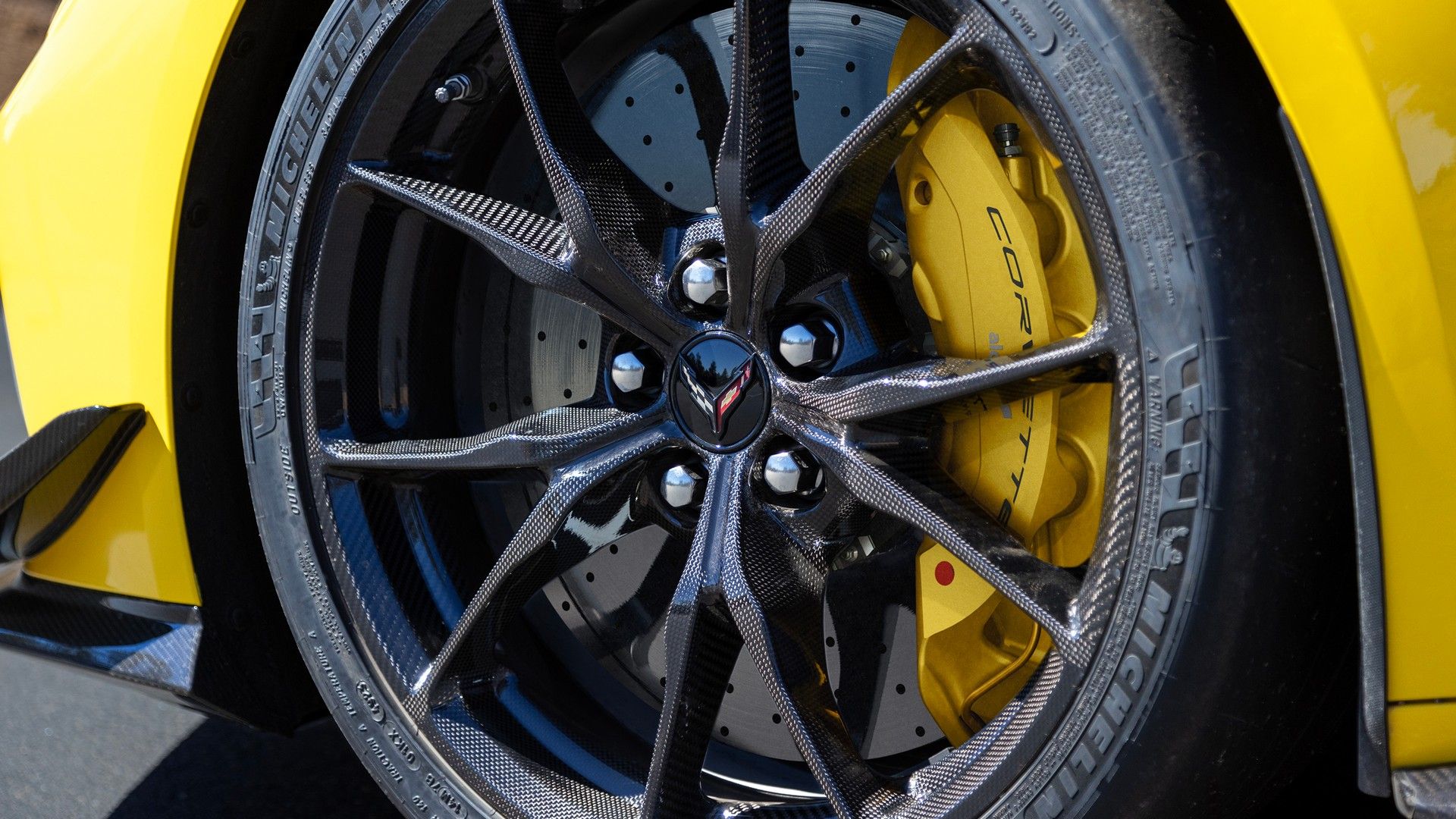
The ZTK Performance Package is where things get serious. Tick that option box and you get carbon fibre wheels (cutting unsprung mass significantly), Michelin Pilot Sport Cup 2R semi-slick tyres, and the J59 carbon ceramic brake package. Together, these parts transform the ZR1 from a quick road car into a legitimate circuit weapon. The Cup 2R tyres delivered extraordinary grip in dry conditions — the kind of lateral adhesion that lets you carry corner speeds that feel alarming the first time, and perfectly natural by the third.
The Nürburgring Nordschleife time of 6:50.763 tells the whole story. That lap, set in the ZTK-equipped car, makes the ZR1 the fastest American production car ever around the Green Hell — quicker than the Ford Mustang GTD by about 1.3 seconds, and faster than any C8-generation Corvette lap we’ve seen before. It puts the ZR1 in rarefied air, alongside cars like the Porsche 911 GT3 RS on the timing sheets. For context, the Porsche 911 Turbo S has an unofficial Nordschleife time of around 7:03.92 — the ZR1 is over 13 seconds faster.
The J59 carbon ceramic brakes are another standout. Under repeated hard stops from high speed, we noticed minimal fade — the sort of consistency you need when you’re scrubbing off speed from 230 km/h into a tight hairpin. Pedal feel is firm and progressive, and the brakes give you the confidence to push deep into braking zones. Compared with a Porsche 911 GT3, the ZR1 doesn’t quite match the final degree of steering purity — the Porsche’s connection between front axle and your fingertips remains the benchmark — but the Corvette gets agonisingly close, and it brings an extra 300-plus horsepower to the party.
Design and Aerodynamics
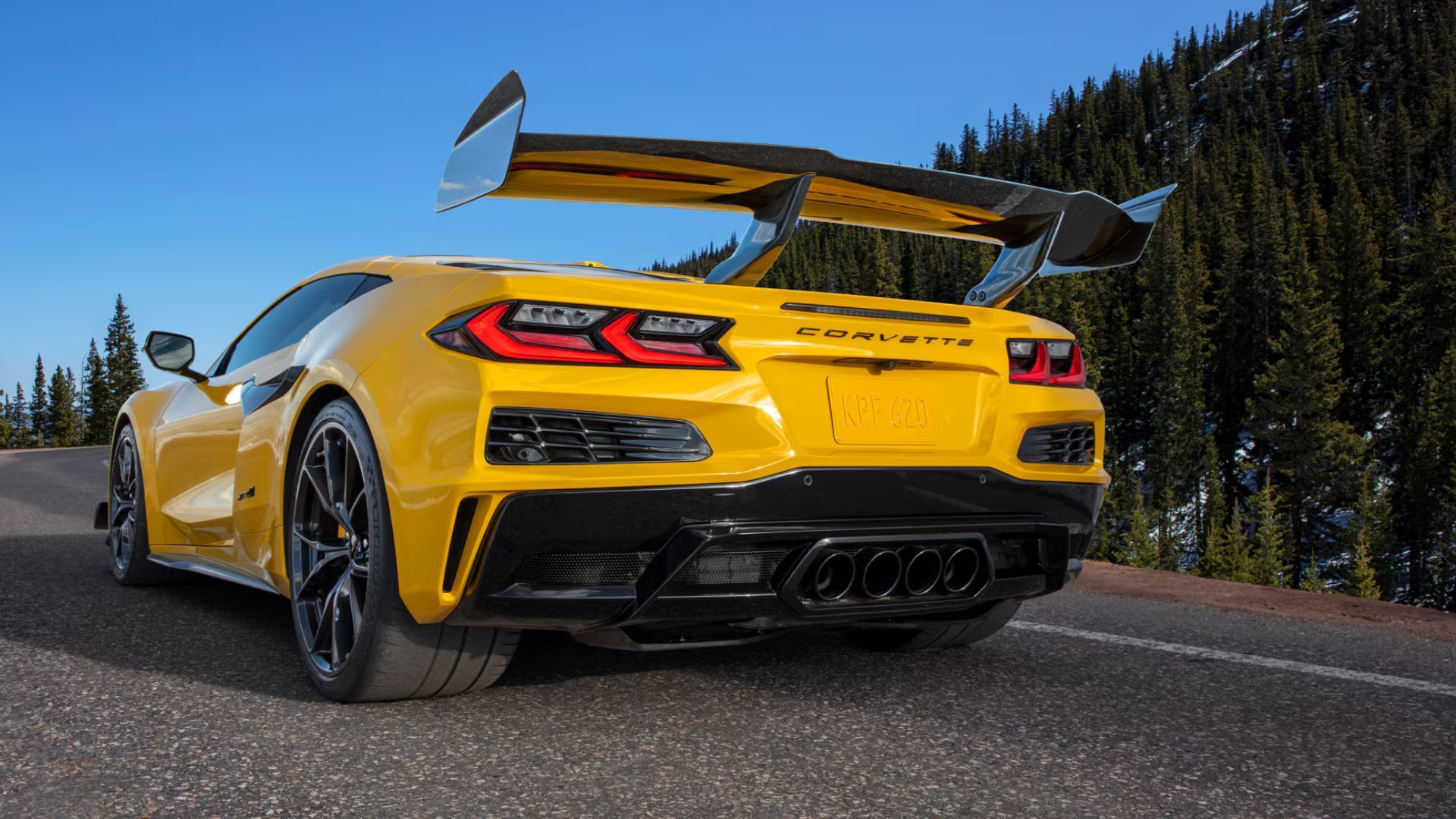
The C8 Corvette’s mid-engine silhouette was a breakthrough when it launched, and the ZR1 takes that foundation and sharpens it with aggressive, functional intent. The proportions are still recognisably Corvette — the long roofline, the angular haunches, the fighter-jet canopy — but every surface has been reworked for aerodynamic purpose. The front splitter sits deeper, the side intakes are larger, and the rear diffuser is a serious piece of aero engineering built to generate meaningful downforce at triple-digit speeds.
Spec the ZTK Performance Package and the ZR1 gains a high-mount carbon fibre rear wing that gives the car an unmistakably track-ready stance. It’s not subtle, but it’s not just for show either — this wing generates real downforce that pays off in high-speed cornering stability. We found the combination of the wing, the ground-effect underbody, and the front dive planes created a planted, trustworthy feel at speeds where lighter, less aerodynamically sorted cars would start getting nervous. The functional NACA ducts feeding air to the engine and brakes are a lovely detail — engineering purpose turned into design.
Chevrolet also offers the ZR1 as a convertible, which adds roughly $8,000 to the sticker. The open-top variant keeps the same mechanical spec and, from what we could tell, loses very little in structural rigidity thanks to the C8’s inherent stiffness. It’s a tempting option for buyers who want supercar performance with the roof down, though the coupe’s fixed roof does provide a marginally quieter cabin and a slight structural edge for dedicated track work.
Interior, Tech and Comfort
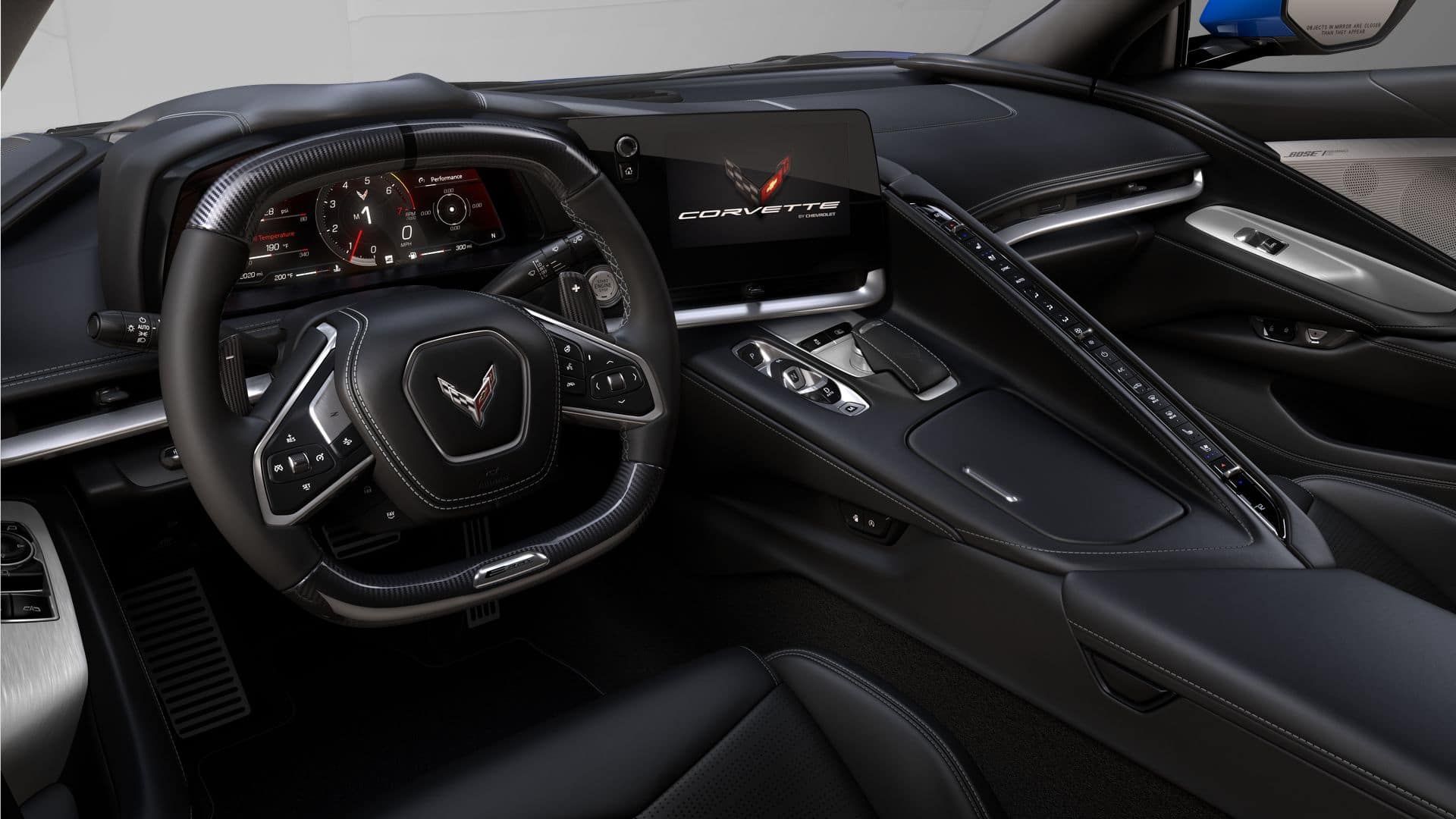
The interior has traditionally been the Corvette’s weakest link when you stack it against European rivals, and Chevrolet has clearly listened to that feedback for 2026. The centrepiece is a brand-new 12.7-inch central touchscreen — a serious upgrade from the old unit in both size and responsiveness. It runs a modern infotainment system that we found easy to get along with: crisp graphics, quick boot times, and standard wireless Apple CarPlay and Android Auto. It sits high on the dashboard, angled slightly towards the driver, and slots neatly into the redesigned centre console.
Below the screen, the HVAC controls live in their own dedicated row — a smart call that lets you adjust the climate without taking your eyes off the road. The old rotary drive-mode controller has been swapped for a simpler rocker switch, and it’s a marked improvement: quicker to use and less fiddly, especially when you’re toggling between Tour and Track mid-corner. A new digital driver display offers configurable readouts, and the whole cabin layout feels more cohesive and driver-focused than any previous C8 we’ve sat in.
Five new premium interior colourways for 2026 bring welcome personalisation options. Material quality has improved too — the leather is supple, the switchgear has a more satisfying click, and the fit-and-finish is noticeably tighter than early C8s. That said, we’ll be straight with you: this cabin still doesn’t match the sensory richness of a 911 or a 296. There are harder plastics below the beltline, some trim pieces feel a grade below what you’d expect at this price, and the driving position — comfortable for average-height drivers — gets snug if you’re over 190 centimetres, with limited knee-room adjustment.
As a daily proposition, though, the ZR1 is more usable than you’d expect. The front boot (frunk) fits a weekend bag, visibility is acceptable for a mid-engine car, and the ride quality in Tour mode is firm without being punishing. We wouldn’t pick it as a daily commuter through Sydney traffic, but as a weekend weapon that doubles as a grand tourer, it punches above its weight.
2026 Chevrolet Corvette ZR1 vs Porsche 911 Turbo S: Which Is Better?
This is the comparison everyone asks us about, and understandably so. The 2026 Corvette ZR1 and the 2026 Porsche 911 Turbo S represent two fundamentally different philosophies chasing the same goal: devastating real-world performance. The ZR1 is the bruiser — more power, more speed, more noise, and a dramatically lower price. The 911 Turbo S is the surgeon — refined, all-weather-capable, beautifully built, and backed by decades of incremental engineering progress. We’ve spent extensive time in both, and the answer to "which is better?" isn’t as straightforward as the spec sheets suggest.
Start with the numbers, because they’re hard to ignore. The ZR1 produces 1,064 hp from its twin-turbo 5.5-litre V8. The 911 Turbo S makes 701 hp from its hybrid-assisted 3.6-litre flat-six. That’s a gap of 363 horsepower — enough to qualify as a whole separate engine in plenty of cars. The ZR1 hits 60 mph in 2.3 seconds versus 2.4 seconds for the Porsche, and it reaches 233 mph against the Turbo S’s roughly 205 mph. On paper, the ZR1 wins every acceleration and speed contest comfortably.
The Nürburgring tells a similar story. The ZR1’s 6:50.763 — set on the ZTK package with Cup 2R tyres — is more than 13 seconds quicker than the 911 Turbo S’s unofficial 7:03.92. That’s an eternity on the Nordschleife, and it points to the ZR1’s superior downforce, grip, and outright circuit capability. If lap times are your priority and you’re planning regular track time, the ZR1 is the objectively faster car.
But straight-line and circuit pace only tell part of the story. The 911 Turbo S sends its 701 hp through an all-wheel-drive system, meaning it deploys every last horsepower regardless of conditions. In the rain, on a cold morning, or on a gravel-strewn mountain road, the Turbo S is the car you trust completely. The ZR1, with its rear-drive layout, asks more of the driver. In our testing, the ZR1’s traction control kicked in more frequently and more abruptly when conditions weren’t ideal — a reminder that 1,064 hp through two contact patches is a fundamentally different proposition to 701 hp through four.
Daily usability is where the Porsche really pulls ahead. The 911 Turbo S offers 2+2 seating — tight in the back, sure, but workable for kids or extra luggage — a quieter cabin, a more supple ride in comfort modes, and a standard of build quality that makes every door shut, every switch click, and every surface you touch feel like it was engineered by people who obsess over tactile perfection. The ZR1 has improved in this area for 2026, but the gap is still there. The Porsche is the one you drive to a board meeting without feeling out of place; the ZR1 is the one you drive to a track day and feel like a hero.
There’s also the ownership angle. Porsche residuals are legendary — a well-specified 911 Turbo S holds its value better than nearly anything in the segment over a five-to-eight-year window. The Corvette, despite its performance credentials, wears a Chevrolet badge, and historically that’s meant steeper depreciation. For buyers who see their supercar as an asset as well as a thrill ride, that’s worth thinking about.
So where does the roughly $90,000 price gap leave things? The 2026 911 Turbo S starts at $272,650. The 2026 Corvette ZR1 starts at $182,395. That’s a huge difference — enough to buy a well-equipped Toyota GR86 as a daily runabout and still have change for track-day entry fees. The ZR1 offers more power, more top speed, a faster Nürburgring time, and a more visceral driving experience, all for significantly less money. The Turbo S offers all-weather traction, superior refinement, better residuals, and the indefinable sense of occasion that comes with the Porsche crest. Both are extraordinary machines. Your choice comes down to what you value more: raw, unfiltered performance — or polished, all-encompassing capability.
| Spec | 2026 Corvette ZR1 | 2026 Porsche 911 Turbo S |
|---|---|---|
| Engine | 5.5L twin-turbo V8 | 3.6L hybrid flat-six |
| Power | 1,064 hp | 701 hp |
| 0-60 mph | 2.3 sec | 2.4 sec |
| Top speed | 233 mph | ~205 mph |
| Drivetrain | RWD | AWD |
| Nürburgring time | 6:50.763 | 7:03.92 (unofficial) |
| Starting price (USD) | $182,395 | $272,650 |
| Body style | 2-door coupe / convertible | 2-door coupe / convertible |
| Country | USA | Germany |
<div style="background:linear-gradient(135deg,#f0f9ff,#e0f2fe); border-left:4px solid #2563eb; border-radius:12px; padding:24px 28px; margin:32px 0"> <p style="font-size:12px; font-weight:800; letter-spacing:0.14em; text-transform:uppercase; color:#1e40af; margin:0 0 10px">Which one is better?</p> <p><strong>Buy the Corvette ZR1 if</strong> you want the most outrageous performance per dollar on the planet, V8 character, and you can live with rear-drive on cold mornings.</p> <p><strong>Buy the 911 Turbo S if</strong> you want all-weather AWD usability, 2+2 practicality, German build feel, and resale value over an eight-year horizon.</p> <p><strong>Our pick</strong> at this price gap is the ZR1 — the ~$90,000 you save buys a lifetime of fuel, tyres, and track days.</p> </div>
At a Glance: How the ZR1 Compares to Direct Rivals
| Spec | 2026 Corvette ZR1 | 2026 Porsche 911 Turbo S |
|---|---|---|
| Engine | 5.5L twin-turbo V8 | 3.6L hybrid flat-six |
| Power | 1,064 hp | 701 hp |
| 0-60 mph | 2.3 sec | 2.4 sec |
| Top speed | 233 mph | ~205 mph |
| Drivetrain | RWD | AWD |
| Nürburgring time | 6:50.763 | 7:03.92 (unofficial) |
| Starting price (USD) | $182,395 | $272,650 |
| Body style | 2-door coupe / convertible | 2-door coupe / convertible |
| Country | USA | Germany |
Porsche 911 Turbo S
ZR1 has 363 more hp and is 13+ seconds faster around the Nurburgring for ~$90K less
McLaren 750S
McLaren brings exotic carbon construction but cant match ZR1s straight-line pace or value
Ferrari 296 GTB
296 GTB offers hybrid sophistication and Ferrari badge appeal but is nearly twice the price
The 2026 Corvette ZR1 doesn’t just compete with one rival — it faces down an entire generation of hybrid-assisted, multi-million-dollar-engineering European exotics. From the all-conquering Porsche 911 Turbo S to the lithe McLaren 750S and the electrified Ferrari 296 GTB, the ZR1 has to justify its place in the conversation on more than just price alone. Here’s how the numbers stack up. 2026 Corvette ZR1 McLaren 750S ——————————— 5.5L twin-turbo V8 4.0L twin-turbo V8 1,064 hp 740 hp 2.3 sec 2.7 sec 233 mph 206 mph RWD RWD $182,395 $324,000 The ZR1 wins on every performance metric that matters: more power, faster acceleration, a higher top speed, and a lower price than every single rival in this set. It is, pound for pound, the most potent supercar on sale in 2026. Where it gives ground is in the areas that don’t show up on a spec sheet — interior material quality, brand cachet, and the sense of occasion that a Ferrari or McLaren badge provides. If those things matter to you, the Europeans still hold the edge. If pure performance per dollar is your metric, the ZR1 is in a class of one.
Safety, Warranty and Ownership
Chevrolet backs the 2026 Corvette ZR1 with a competitive warranty: 3-year/36,000-mile basic coverage, a 5-year/50,000-mile powertrain warranty, and 5-year/60,000-mile roadside assistance. The first scheduled maintenance visit is complimentary — a small but welcome touch at this price point. It’s a straightforward package that, while not class-leading, matches what most rivals offer and gives buyers reasonable peace of mind given the performance on tap.
Running costs, though, deserve a frank conversation. The ZR1’s EPA-rated fuel economy of 12 mpg city, 18 mpg highway, and 14 mpg combined is thirsty by any measure. In the real world — especially if you’re regularly using all 1,064 hp — those figures will drop further. Insurance premiums will reflect the ZR1’s performance too; expect to pay substantially more than a standard Stingray, and potentially more than a 911 Turbo S depending on your insurer and driving history. Tyre costs for the Cup 2R rubber on the ZTK package will also make your eyes water.
Residual values are the elephant in the room. Chevrolet Corvettes, historically, depreciate faster than Porsches. While the ZR1’s relative scarcity and performance credentials may soften that decline compared to a base Stingray, we expect it to follow a steeper depreciation curve than a 911 Turbo S over a five-to-eight-year ownership window. The flip side is that you’re starting from a lower purchase price — the $90,000 saved upfront absorbs a significant amount of depreciation headroom. On the practical side, Chevrolet’s dealer network is vast and well-resourced, making servicing and parts availability far more accessible than anything from Maranello, Woking, or Stuttgart.
Pricing, Trims and Value
The 2026 Corvette ZR1 starts at USD $182,395 for the coupe in standard trim. As most commonly tested — with the ZTK Performance Package, a selection of interior upgrades, and some cosmetic options — that figure climbs to around $196,395. Fully loaded with every available option, the ZR1 tops out at approximately $224,095. The convertible adds roughly $8,000 to whichever configuration you pick, which is excellent value for an open-top supercar with this level of performance.
The ZTK Performance Package is the must-have option if you’re planning to use the ZR1 on a circuit. It adds carbon fibre wheels, Michelin Pilot Sport Cup 2R semi-slick tyres, and the J59 carbon ceramic brake package — a combination that, on a European exotic, would easily tack on $30,000 to $50,000. We’d argue the ZTK-equipped ZR1 at roughly $196,000 is the sweet spot of the range: it unlocks the car’s full dynamic potential without straying into the diminishing returns of the fully loaded $224,095 spec.
The value proposition is, frankly, absurd. A Porsche 911 Turbo S starts at $272,650 and climbs steeply with options. A Ferrari 296 GTB begins at $338,000. A McLaren 750S opens at $324,000. The ZR1 offers more outright performance than any of them — faster in a straight line, quicker around a circuit — for the price of a well-optioned German sports sedan. Whether you’re cross-shopping exotics or simply want the fastest thing under $200,000, the ZR1 is the most compelling value proposition in the supercar world right now.
Buy It / Skip It
**Buy it if:** You’re a performance-per-dollar obsessive who wants the fastest, most powerful car available for under $200,000. Buy it if you love the character of a naturally-aspirated-style V8 — even if this one has turbos — and you want a supercar that doesn’t require a second mortgage to service. Buy it if you’re a weekend track-day regular who wants a car that can genuinely run with GT3 RS-level machinery, or if you simply want to own a piece of American automotive history in the making.
**Skip it if:** You live in a cold or wet climate and need all-wheel-drive confidence year-round — the 911 Turbo S exists for exactly this reason. Skip it if interior refinement, tactile material quality, and brand cachet matter more to you than outright lap times. And skip it if you’re buying primarily as an investment; while the ZR1 will be collectible, Porsche and Ferrari residuals remain the gold standard in this segment.
⚡ Our Verdict
The value supercar that humbles exotics twice its price
The 2026 Chevrolet Corvette ZR1 is, by any reasonable measure, a 4.6 out of 5. It takes the already-excellent C8 platform and pushes it into genuine supercar territory with 1,064 horsepower, a 2.3-second zero-to-60 sprint, a 233 mph top speed, and a Nürburgring lap time that would’ve been considered science fiction for an American production car a decade ago — all for a starting price under $200,000 USD. It’s fast, it’s capable, it’s dramatic, and it represents extraordinary value. Is it perfect? No. The interior still trails the Europeans, the rear-wheel-drive layout demands respect in the wet, and the fuel economy will keep your local servo in business. But those are footnotes in the story of a car that redefines what’s possible at this price point. If you want a supercar that makes no excuses and offers no apologies — and if you’d rather spend the $90,000 you save over a 911 Turbo S on fuel, tyres, and track days — the 2026 Corvette ZR1 is the one to buy. Unreservedly.
FAQs
How much does the 2026 Chevrolet Corvette ZR1 cost?
The 2026 Corvette ZR1 starts at USD $182,395 for the coupe. Most buyers will spec the ZTK Performance Package along with a handful of options, which pushes the typical transaction price to around $196,395. A fully loaded example tops out at approximately $224,095, while the convertible adds roughly $8,000 to any configuration.
How fast is the 2026 Corvette ZR1?
The ZR1 sprints from zero to 60 mph in 2.3 seconds, covers the quarter-mile in a claimed 9.6 seconds, and reaches a top speed of 233 mph. Those figures make it one of the fastest production cars on sale in 2026, regardless of price or country of origin.
Is the Corvette ZR1 faster than a Porsche 911 Turbo S?
Yes. The ZR1 hits 60 mph in 2.3 seconds versus 2.4 seconds for the 911 Turbo S, and it reaches a top speed of 233 mph compared to approximately 205 mph. The ZR1 is also over 13 seconds faster around the Nürburgring Nordschleife, with a lap time of 6:50.763 versus the Turbo S’s unofficial 7:03.92.
What is the Corvette ZR1’s Nürburgring lap time?
The 2026 Corvette ZR1 recorded a Nürburgring Nordschleife lap time of 6:50.763, making it the fastest American production car ever around the circuit. That time was set with the ZTK Performance Package equipped, including carbon fibre wheels and Michelin Pilot Sport Cup 2R tyres.
How many cylinders does the Corvette ZR1 have?
The 2026 Corvette ZR1 is powered by a twin-turbocharged 5.5-litre V8 engine with eight cylinders, producing 1,064 horsepower and 828 lb-ft of torque. It’s designated the LT7 and represents the most powerful engine General Motors has ever offered in a production vehicle.
Is the 2026 Corvette ZR1 available as a convertible?
Yes. The 2026 Corvette ZR1 is available in both coupe and convertible body styles. The convertible adds approximately $8,000 to the price and retains the same mechanical specification as the coupe, including the 1,064 hp twin-turbo V8 and eight-speed dual-clutch transmission.
