


2026 Nissan Leaf Review: The Affordable EV Leader?
A practical, well-rounded value champion.

2026 Nissan Leaf front three-quarter exterior
Price
$31,485
Battery
75 kWh
Peak Power
214 hp
⚡ Quick Verdict
The 2026 Nissan Leaf has reset the bar for affordable electric cars. Kicking off just north of $31,000 and offering up to 303 miles of range, it’s a smart, practical pick for anyone who prioritises value and easy home charging. Its biggest win is a well-rounded package that doesn’t feel like a compromise. The main trade-offs are the absence of all-wheel drive and a DC fast-charging speed that’s fine for occasional trips but not for constant road warriors.
## How Much Does the 2026 Nissan Leaf Cost?
The range opens with the S+ trim at $31,485, including delivery. We reckon that’s a sharp entry point, especially when you consider the average new car transaction is hovering around fifty grand. The sweet spot for most will be the SV+ at $36,500, which blends features and range nicely. Our top-spec Platinum+ test car, with a few options, stickered just over $41,000.
✓ The Good
- +Excellent value proposition with strong standard range.
- +Native NACS port for easy Tesla Supercharger access.
- +Intuitive tech suite with both Google Built-in and smartphone mirroring.
- +Comfortable, quiet ride perfect for daily commuting.
- +Supportive seats and a clever, practical cargo area.
✗ The Trade-offs
- −No all-wheel drive option is available.
- −DC fast-charging speed is merely average.
- −Suspension can feel bouncy over broken pavement.
- −Missed IIHS Top Safety Pick award.
📑 In This Review
- How Much Does the 2026 Nissan Leaf Cost?
- Powertrain, Battery and Performance
- Range and Real-World Efficiency
- Charging — and Why the NACS Port Matters
- On-Road Manners and Driver Assistance
- Interior, Tech and Cargo
- At a Glance: 2026 Nissan Leaf vs Affordable EV Rivals
- 2026 Nissan Leaf vs 2027 Chevrolet Bolt: Which Is Better?
- Safety and Warranty
- Who Should Buy the 2026 Nissan Leaf?
- Buy it if…
- Skip it if…
- The Verdict
- Frequently Asked Questions
The 2026 Nissan Leaf has reset the bar for affordable electric cars. Kicking off just north of $31,000 and offering up to 303 miles of range, it’s a smart, practical pick for anyone who prioritises value and easy home charging. Its biggest win is a well-rounded package that doesn’t feel like a compromise. The main trade-offs are the absence of all-wheel drive and a DC fast-charging speed that’s fine for occasional trips but not for constant road warriors.
How Much Does the 2026 Nissan Leaf Cost?
The range opens with the S+ trim at $31,485, including delivery. We reckon that’s a sharp entry point, especially when you consider the average new car transaction is hovering around fifty grand. The sweet spot for most will be the SV+ at $36,500, which blends features and range nicely. Our top-spec Platinum+ test car, with a few options, stickered just over $41,000.
That pricing puts the Leaf right at the pointy end of the affordable EV market. It undercuts key rivals like the Hyundai Kona Electric. The field will get even tougher in 2026 with the sub-$30,000 Chevrolet Bolt arriving. For now, though, the Leaf delivers serious value. It makes you think twice about buying used when you can get a capable, modern EV for this kind of money.
Powertrain, Battery and Performance
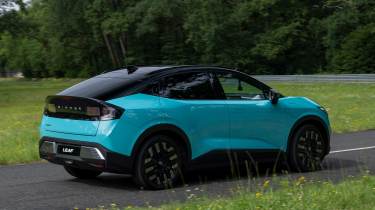
Every 2026 Leaf+ uses a single motor driving the front wheels, pumping out 214 horsepower and 261 lb-ft of torque. There’s no all-wheel drive option, which will rule it out for some buyers who regularly face snowy or slippery conditions. The single-speed transmission is operated by buttons on the centre console. It feels nippy and responsive in traffic, and it’ll even scrabble for traction at the front if you’re keen off the line.
The 75 kWh battery is now liquid-cooled, a big step up for long-term durability. In our testing, the dash to 60 mph takes about 7 seconds—plenty for merging and overtaking. The driving experience is smooth and linear, focused on relaxed cruising rather than sporty handling. It’s a perfect fit for the daily grind, though if you’re after sharp dynamics, you’ll need to look elsewhere.
Range and Real-World Efficiency
The EPA rates the 2026 Leaf’s range from 259 miles on the loaded Platinum+ up to a very impressive 303 miles on the efficient S+ trim. During our mixed driving in temperatures around the low 50s, the Platinum+ model gave us roughly 230 miles before we felt the need to plug in. It’s worth remembering our testing involves frequent stops for photos with the systems on, which probably saps an estimated 10-20 miles of stationary range.
The key point is that the Leaf’s real-world range holds up well against its EPA numbers in moderate conditions. The standard heat-pump HVAC is a big help in colder weather, keeping efficiency up. For the vast majority of daily driving, even the 259-mile estimate provides more than enough buffer.
Charging — and Why the NACS Port Matters
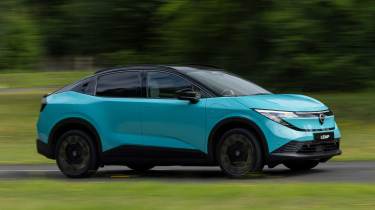
The 2026 Leaf has a clever dual-port setup. On the driver’s side, a J1772 port handles Level 1 and Level 2 AC charging at home. On the passenger-side front guard, there’s a native NACS port dedicated solely to DC fast charging. This makes the Leaf the most affordable EV with direct, adapter-free access to the massive Tesla Supercharger network—a huge convenience win.
DC fast charging tops out at 150 kW, good for a 10-80% top-up in about 35 minutes. That’s fine for the occasional road trip but not class-leading. At home on a 240-volt Level 2 charger, a full charge takes just over six hours. If you’re only doing 30-50 kilometres a day, a standard 120-volt household outlet will do the job if you plug in each night. The seamless NACS integration future-proofs the Leaf and takes the headache out of public charging.
On-Road Manners and Driver Assistance
The Leaf is tuned for comfort, and it shows. The suspension soaks up big bumps well but can feel bouncy and jittery over repeated sharp imperfections. There’s noticeable body roll in bends, and the steering doesn’t offer much feedback. It’s a setup that prioritises a quiet, relaxing commute—great for city and suburban work—and the cabin stays impressively hushed at highway speeds.
Nissan’s ProPilot Assist is standard, but it’s the basic version that needs your hands on the wheel. It’s a competent highway helper but not as advanced as some systems from rivals. Regenerative braking is adjustable via paddles on the steering wheel, and the e-Step mode provides strong lift-off deceleration. However, unlike true one-pedal driving, e-Step won’t bring you to a complete halt; you’ll still need the brake pedal for the last few km/h.

Interior, Tech and Cargo
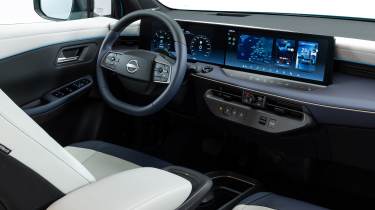
Nissan’s added some personality with purple accents, fabric panels, and interesting textures. The dual-screen setup is responsive, running Google Built-in (with a subscription) while also keeping wireless Apple CarPlay and Android Auto—a big advantage over GM’s EVs. A head-up display, a proper volume knob, and supportive heated front seats make daily life easier. The rear seat fits adults comfortably as long as they’re not too tall.
Cargo space is a strong suit. With the seats up, there’s 20 cubic feet under the adjustable tonneau cover. Fold the 60/40 rear seats, and a flat floor reveals 55 cubic feet of space. The adjustable floor panel can act as a divider to stop your shopping from sliding around. Our Platinum+ test car even had a handy 120-volt household outlet in the cargo area. There’s no spare tyre, though, just a repair kit.
At a Glance: 2026 Nissan Leaf vs Affordable EV Rivals
| Spec | 2026 Nissan Leaf S+ | 2027 Chevrolet Bolt | 2026 Hyundai Kona Electric | 2025 Kia Niro EV Wind |
|---|---|---|---|---|
| Starting Price | $31,485 | ~$29,990 | $34,470 | $39,600 |
| Battery | 75 kWh | ~65 kWh | 64 kWh | 64.8 kWh |
| Peak Power | 214 hp | 210 hp | 201 hp | 201 hp |
| EPA Range | 303 mi | ~255 mi | 261 mi | 253 mi |
| DC Fast Peak | 150 kW | TBD (est. 150 kW+) | 100 kW | 85 kW |
| Drive Layout | FWD | FWD | FWD | FWD |
| Cargo (seats up) | 20 cu ft | ~16 cu ft | 25.5 cu ft | 22.8 cu ft |
| Warranty (battery) | 8yr/100k | 8yr/100k | 10yr/100k | 10yr/100k |
| Notable Feature | Native NACS port | Price leader, Google Built-in | 800V architecture (pricier trims) | More cargo room |
2027 Chevrolet Bolt
Closest direct rival — undercuts on price but trails on range and lacks NACS native
2026 Hyundai Kona Electric
Sharper interior, slicker design, but priced above Leaf S+
2025 Kia Niro EV Wind
More cargo and rear-seat room — at a notable price premium
The affordable EV segment is no longer a niche—it’s where the mainstream buyer is shopping. The Nissan Leaf enters this fray as a value-focused, practical hatchback, prioritising range and everyday usability over flashy performance. It competes in a tight field against established players and exciting new entrants, each with a slightly different take on the electric formula. 2026 Nissan Leaf S+ 2026 Hyundai Kona Electric ————————————————- $31,485 $34,470 75 kWh 64 kWh 214 hp 201 hp 303 mi 261 mi 150 kW 100 kW FWD FWD 20 cu ft 25.5 cu ft 8yr/100k 10yr/100k Native NACS port 800V architecture (pricier trims) These rivals define the segment’s boundaries. The upcoming Bolt promises to be the value king, the Kona Electric offers a sharper design, and the Niro EV provides more space. The Leaf counters with its range, NACS advantage, and a well-rounded package.
2026 Nissan Leaf vs 2027 Chevrolet Bolt: Which Is Better?
The fight for the affordable EV crown comes down to two key players: the all-new 2026 Nissan Leaf and the returning 2027 Chevrolet Bolt. The Bolt is expected to undercut the Leaf on price, starting just under $30,000, while the Leaf S+ begins at $31,485. That’s a close race, but the Bolt might pinch the initial price advantage.
Under the skin, they’re very similar. Both use single electric motors driving the front wheels—the Leaf makes 214 hp, the Bolt 210 hp. Their performance will feel nearly identical in daily driving. The critical difference is charging. The Leaf has a native NACS port for easy Tesla Supercharger access and a 150 kW DC fast-charge rate. The old Bolt was stuck at 55 kW; the new model needs a big improvement to compete.
Range favours the Nissan. The Leaf S+ is EPA-rated at 303 miles, while the Bolt is targeting around 255 miles. Inside, both offer modern tech with Google Built-in, but the Nissan includes wireless Apple CarPlay and Android Auto, which the Bolt misses out on. Cargo space is close, with the Leaf holding a slight edge. On the road, the Leaf prioritises comfort, while early reports suggest the Bolt might be a bit more agile.
| Spec | 2026 Nissan Leaf S+ | 2027 Chevrolet Bolt |
|---|---|---|
| Price (incl. dest.) | $31,485 | ~$29,990 |
| Battery | 75 kWh | ~65 kWh |
| Power | 214 hp | 210 hp |
| Torque | 261 lb-ft | 266 lb-ft |
| EPA Range | 303 mi | ~255 mi |
| DC Fast Charge | 150 kW (10-80% ~35 min) | TBD (est. >100 kW) |
| Drive | FWD | FWD |
| Cargo (seats up) | 20 cu ft | ~16 cu ft |
| Notable Tech | Google Built-in, CarPlay/Android Auto, NACS port | Google Built-in, Ultifi platform |
Buy the Nissan Leaf if maximum range, access to the Tesla Supercharger network, and the inclusion of Apple CarPlay/Android Auto are your top priorities. It’s the more complete, road-trip-ready package today.
Buy the Chevrolet Bolt if securing the lowest possible purchase price is your primary goal, and you can accept slightly less range and await confirmed details on its improved charging speed.
**Our pick** is the Nissan Leaf S+. For a modest premium, it delivers substantially more range and the game-changing NACS port, which together eliminate more daily and occasional-use anxieties. It feels like the more future-proofed choice.
Safety and Warranty
The 2026 Leaf earns “Good” ratings in IIHS small overlap front and side crash tests, but only “Acceptable” in the updated moderate overlap front test. This stopped it from getting Top Safety Pick status. A full suite of standard driver-assistance features includes automatic emergency braking, lane departure warning, and blind-spot monitoring.
Regarding the recent recall (26V188) for a potential thermal event in the battery pack, Nissan says there have been no reported accidents or injuries. The company has issued a software update to fix it. On the warranty front, Nissan provides a 3-year/36,000-mile basic warranty, 5-year/60,000-mile powertrain coverage, and an 8-year/100,000-mile battery warranty. Notably, it also includes 3 years of free scheduled maintenance—a standout perk in this segment.
Who Should Buy the 2026 Nissan Leaf?
Buy it if…
You want an affordable, no-drama electric commuter with excellent real-world range. You value practicality, comfortable seats, and a hatchback body style. Home charging access is a given, and you love the idea of plugging into Tesla Superchargers on road trips without an adapter. Tech like a head-up display and smartphone integration matters to you.
Skip it if…
You need all-wheel drive for challenging weather. You frequently take long road trips where minimising charging time is critical. You prioritise a sporty, connected driving experience with firm suspension and sharp steering. You’re holding out for the absolute lowest entry price in the segment.
⚡ Our Verdict
A practical, well-rounded value champion.
The 2026 Nissan Leaf is a tremendous achievement in affordable electric motoring. It takes the pioneering spirit of the original and wraps it in a modern, practical, and genuinely appealing package. With over 300 miles of range available for just over $31,000, integrated Tesla Supercharger access, and a thoughtful interior, it addresses the core needs of most drivers. It’s not exciting in a sporty sense, but it excels at being a quiet, refined, and cost-effective daily tool. For these reasons, it earns our strong recommendation as the new benchmark for value-focused EVs.
Frequently Asked Questions
How much does the 2026 Nissan Leaf cost?
The 2026 Nissan Leaf starts at $31,485 for the S+ trim, including destination. The mid-level SV+ is $36,500, and the top Platinum+ is $38,990 before options. This makes it one of the most affordable new EVs on sale.
What is the real-world range of the 2026 Nissan Leaf?
In our mixed driving with temperatures in the low 50s, the Platinum+ model delivered about 230 miles. The more efficient S+ trim should see real-world results closer to its 303-mile EPA rating. The heat-pump HVAC helps maintain range in cold weather.
Does the 2026 Nissan Leaf have a NACS port for Tesla Superchargers?
Yes. The 2026 Leaf features a native NACS port on the passenger-side front fender, dedicated to DC fast charging. This allows direct, adapter-free access to the Tesla Supercharger network, a major advantage for public charging convenience.
How fast can the 2026 Nissan Leaf DC fast-charge?
The Leaf’s DC fast-charging peaks at 150 kW. This enables a 10-80% charge in approximately 35 minutes under ideal conditions. It’s adequate for occasional road trips but not the fastest in its class.
Is all-wheel drive available on the 2026 Nissan Leaf?
No. The 2026 Nissan Leaf is exclusively front-wheel drive. There is no all-wheel drive option available, which may be a consideration for buyers in regions with frequent snow or heavy rain.
How does the 2026 Nissan Leaf compare to the new Chevrolet Bolt?
The Bolt is expected to start slightly cheaper, but the Leaf offers significantly more range (303 vs ~255 miles) and includes a native NACS port for Tesla Supercharging. Both are excellent values, but the Leaf’s greater range and charging access give it an edge for many buyers.
What warranty does the 2026 Nissan Leaf come with?
It includes a 3-year/36,000-mile basic warranty, 5-year/60,000-mile powertrain warranty, and an 8-year/100,000-mile battery warranty. Additionally, Nissan provides 3 years of free scheduled maintenance, a notable perk in this segment.
