

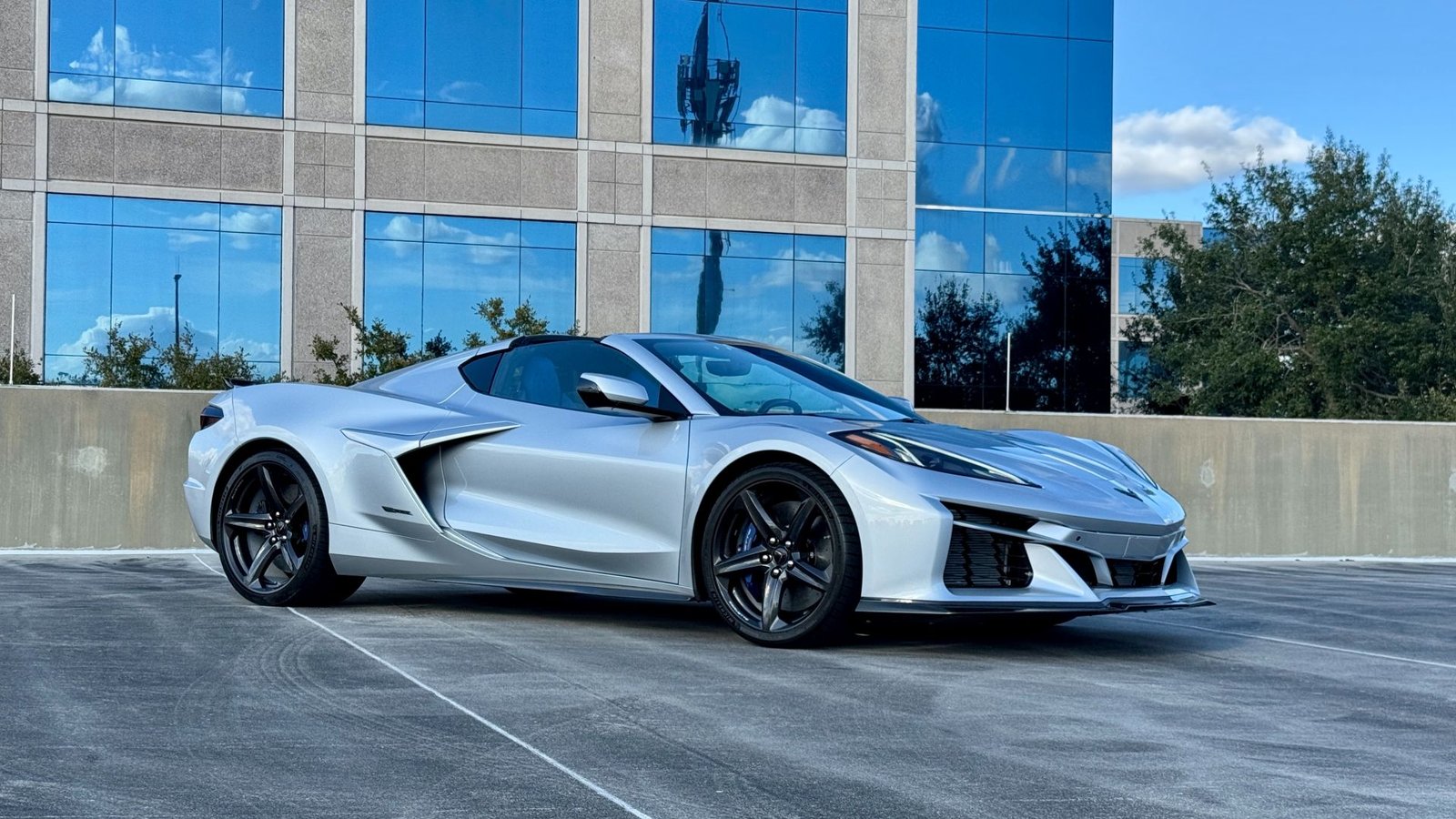
2026 Corvette E-Ray Review: The Hybrid Game-Changer
Supercar pace meets daily-driver tech in Chevy’s hybrid marvel.
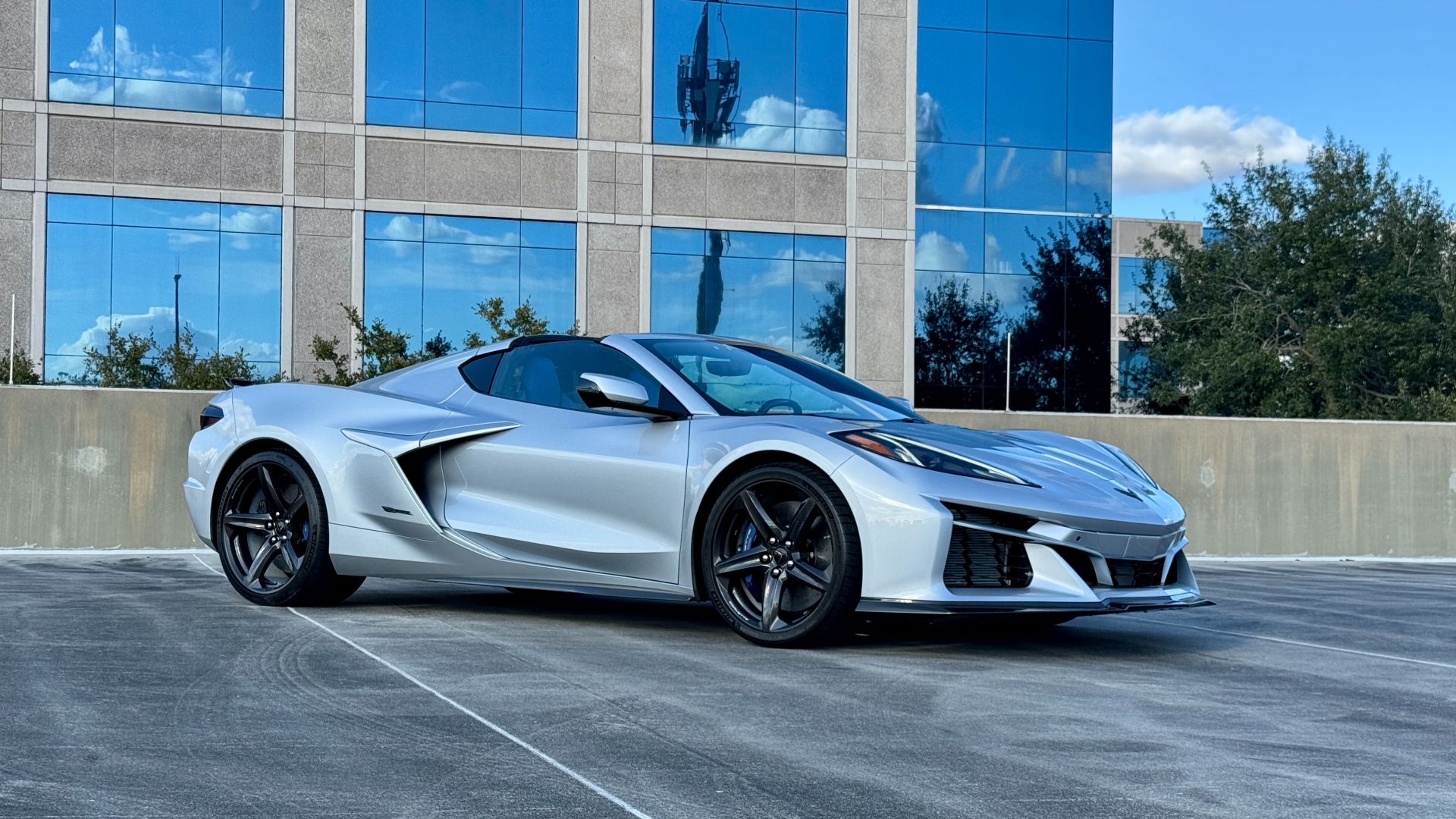
2026 Chevrolet Corvette E-Ray front three-quarter in Riptide Blue Metallic
Price
$108,600
Powertrain
6.2L V8 + front e-motor
⚡ Quick Verdict
:** Forget what you think you know about hybrids. The 2026 E-Ray isn’t about saving fuel; it’s about savagely quick acceleration wrapped in a car you can use every day. Chevy’s bolted an electric motor to the front axle of the mighty Stingray V8, creating a 655-hp all-wheel-drive weapon that’ll hit 60 mph in about 2.5 seconds. For around $108,600, you get a cabin that’s finally been fixed, all-weather grip, and hypercar-rivaling pace. It’s the clever, brutally fast, and shockingly good-value hero the C8 range was missing.
## Introduction
✓ The Good
- +Mind-bending 2.5-second 0-60 mph acceleration with eAWD traction.
- +Charismatic V8 soundtrack blended with an electric supercharger whine.
- +The 2026 interior refresh finally feels worthy of the six-figure price.
- +Stealth and Shuttle modes add genuine, quiet convenience.
- +Over $40,000 cheaper than its closest AWD rival, the Porsche 911.
✗ The Trade-offs
- −No plug-in capability; EV range is minimal and weather-dependent.
- −GT2 seat bolsters can be uncomfortably tight for larger drivers.
- −Left-side visibility is hampered by a thick B-pillar.
- −Understated styling doesn’t scream its six-figure price tag to onlookers.
📑 In This Review
- Introduction
- Design and Exterior
- Interior and Technology
- Performance and Driving Experience
- Stealth Mode, Shuttle Mode and the Hybrid System
- At a Glance: How the E-Ray Stacks Up
- 2026 Corvette E-Ray vs Porsche 911 Carrera 4S: Which Is Better?
- Safety and Warranty
- Pricing and Value
- Verdict: Should You Buy the 2026 Corvette E-Ray?
- Frequently Asked Questions
:** Forget what you think you know about hybrids. The 2026 E-Ray isn’t about saving fuel; it’s about savagely quick acceleration wrapped in a car you can use every day. Chevy’s bolted an electric motor to the front axle of the mighty Stingray V8, creating a 655-hp all-wheel-drive weapon that’ll hit 60 mph in about 2.5 seconds. For around $108,600, you get a cabin that’s finally been fixed, all-weather grip, and hypercar-rivaling pace. It’s the clever, brutally fast, and shockingly good-value hero the C8 range was missing.
Introduction
The Corvette’s always been a bit of a rebel, but the 2026 model year sees it pull off its most audacious stunt yet. Slotting between the Stingray and the track-hungry Z06, the E-Ray is the first hybrid Vette in history. More importantly, it’s the first-ever all-wheel-drive Corvette. Don’t go thinking this is some eco-warrior special, though. Chevy’s built this hybrid for one thing: shattering acceleration records and delivering rock-solid, all-seasons performance.
For 2026, the E-Ray also scores the C8’s much-needed interior overhaul. That old, confusing wall of buttons is gone, replaced by a tech-rich cabin that finally feels like it belongs in a six-figure car. The E-Ray occupies a unique spot. It packs more instant, accessible grunt than the Z06 but adds a layer of silent, sophisticated tech that its gas-only siblings and many rivals simply can’t match.
We spent a week with a Riptide Blue Metallic example, kitted out to a whisker over $123,000, and it proved the hype is real. This isn’t just a car that looks good on paper. It’s a monumentally usable, savagely quick, and surprisingly nuanced machine. One minute it’s whispering along, the next it’s firing you toward the horizon with shocking violence.
Design and Exterior
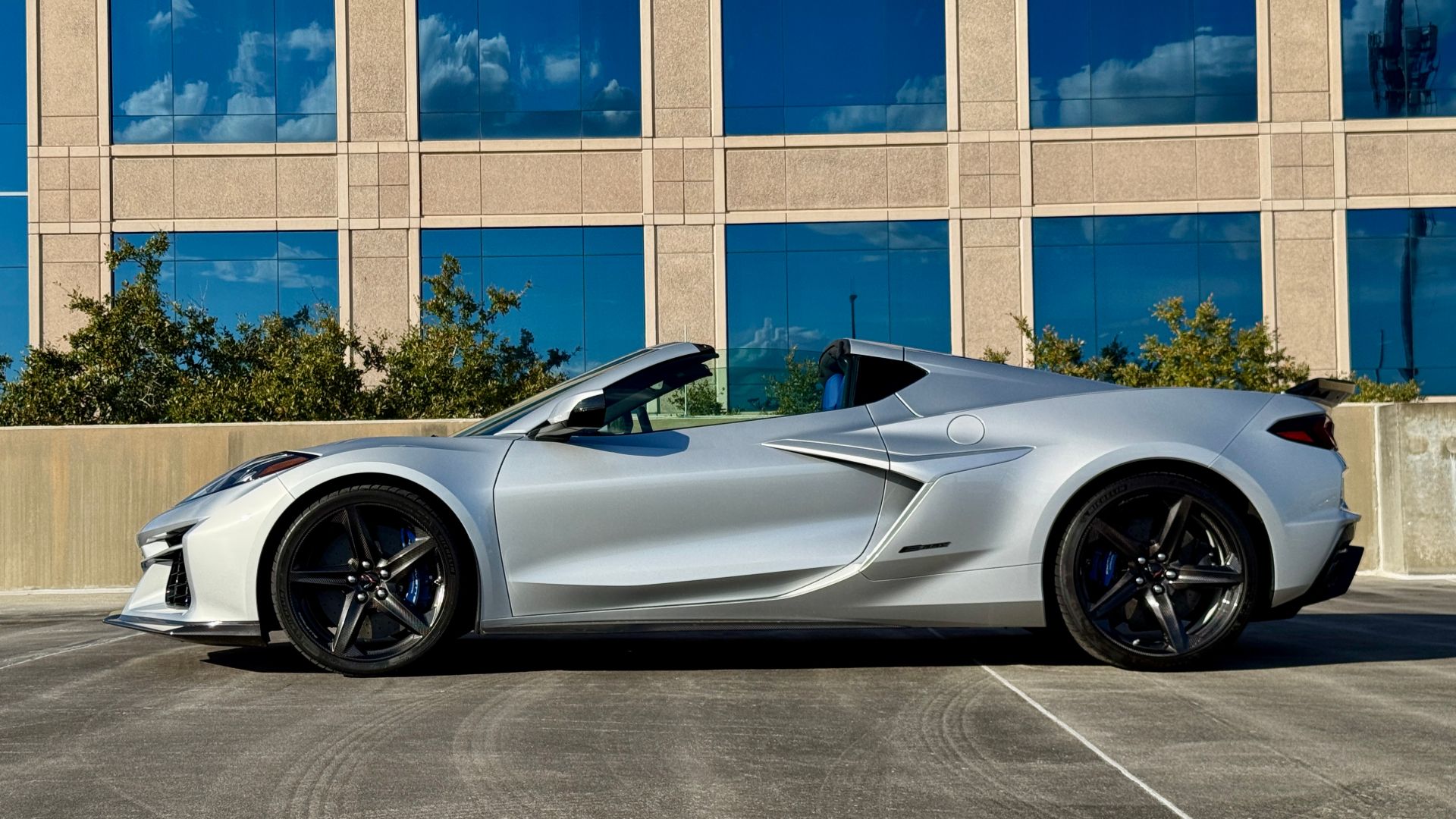
Visually, the 2026 E-Ray borrows the wide-body haunches from the Z06, sitting about three inches broader across the hips than a standard Stingray. This isn’t just for show. The extra girth is needed to house the massive 345-section rear tires and gives the car the planted stance required to control 655 horsepower. Our test car’s blue paint really highlighted the dramatic lines, with a body-coloured front splitter and side rockers creating an unbroken, aggressive profile that looks like it’s hunkered down on the tarmac.
The details are subtle if you don’t know what to look for. It gets the Z06’s distinctive Y-shaped vent behind the front wheels, though ours was finished in body colour rather than the usual black. The staggered 20-inch front and 21-inch rear wheels fill the guards perfectly, and the rear end is finished with a ducktail spoiler and the familiar Stingray badge—now with two little cutouts hinting at the electric eyes peering from the front axle. The twin side exhausts, instead of the Z06’s central quad pipes, are another quiet tell.
From most angles, though, your average punter would struggle to pick an E-Ray from a regular C8. It doesn’t have the ZR1’s wild venting or the Z06’s centre-exit exhausts. Whether that’s a good or bad thing depends on if you want your $123k purchase to shout about itself. To us, it feels like quiet confidence. The performance is for the person behind the wheel, not for the bloke in the next lane.
Interior and Technology
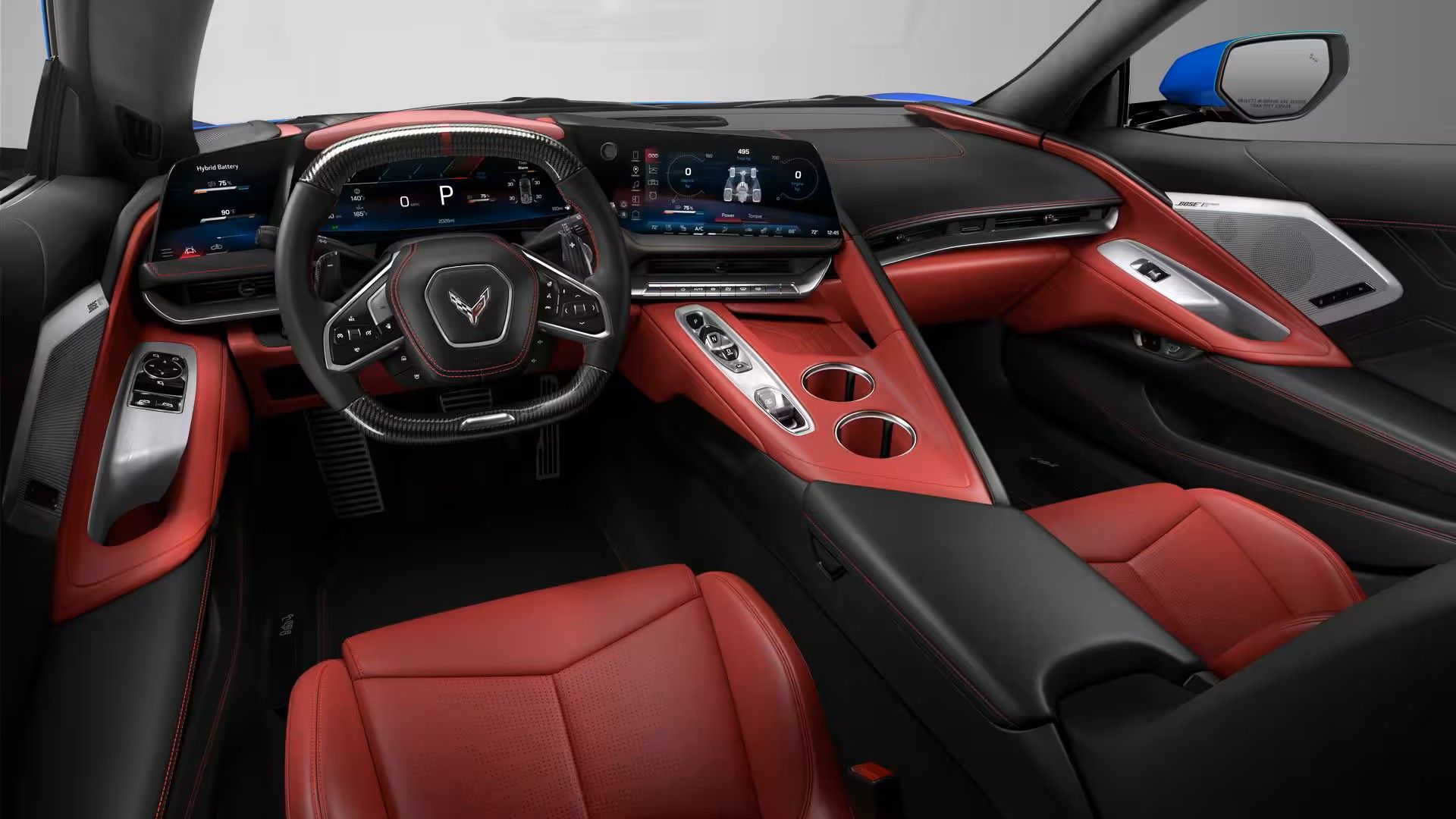
The 2026 cabin refresh is a game-changer. That baffling wall of buttons that used to separate driver and passenger is finally gone. In its place is a clean, driver-focused cockpit with a new 14-inch configurable digital dash, a 12.7-inch central touchscreen, and a clever 6.6-inch display for the passenger. The layout makes sense, with a slim row of physical climate controls and a new wireless charging pad that, oddly, lifts the corner of your phone as it charges—a trick that proved a bit finicky in daily use.
Our car had the optional GT2 carbon-fibre bucket seats. They look a million bucks with their contrast stitching and embossed logos, and they’re both heated and ventilated. The catch? The aggressive side bolsters are a tight squeeze for bigger fellas. Even at six-foot-two, we found them pressing uncomfortably against our legs. Once you’re in, the support is brilliant, but larger-framed buyers absolutely must try before they buy. The drive-mode selector is now a more logical panel, with a dedicated “Z mode” button for your personalised max-attack setting.
The overall feel is of a cabin that’s finally caught up to the car’s price and pace. The materials feel properly premium, the tech is sharp and responsive, and the ergonomics, apart from some visibility quirks, are sorted. The front-axle lift button is a lifesaver for tackling driveways and speed bumps. It’s a tech-forward space that properly frames the hybrid driving experience.
Performance and Driving Experience
The specs only tell half the story: a 6.2-liter LT2 V8 with 495 horsepower, a 160-horsepower electric motor on the front axle, and a combined 655 horsepower channelled through an 8-speed dual-clutch box to all four wheels. In our testing, the 0-60 mph sprint is a neck-snapping, breath-holding affair that Chevy quotes at around 2.5 seconds. The sensation isn’t so much acceleration as being launched from a cannon. Your head gets pinned back as the world turns to a blur.
The eAWD system gives you a planted, unshakeable confidence that rear-drive Vettes can’t match, especially when the road’s less than perfect. The soundtrack is a fascinating mix: the classic, deep-chested rumble of the V8 is layered with a supercharger-like whine from the front motor, creating a unique voice. It might not scream like the Z06’s flat-plane crank V8, but the E-Ray makes up for it with a broader, more accessible wave of torque. The sweet spot is between 30 and 60 mph, where a gentle prod of the right pedal unleashes an immediate, ferocious shove.
The paddle shifters are mounted to the wheel (as they should be) and deliver crisp, satisfying downshifts. Magnetic Ride Control 4.0 is standard, and it walks a brilliant tightrope between control and comfort, making the E-Ray a genuinely comfortable daily driver. It’s a car that flatters you immensely, using its hybrid tech not to save gas, but to deliver traction and instant, predictable power whenever you ask.
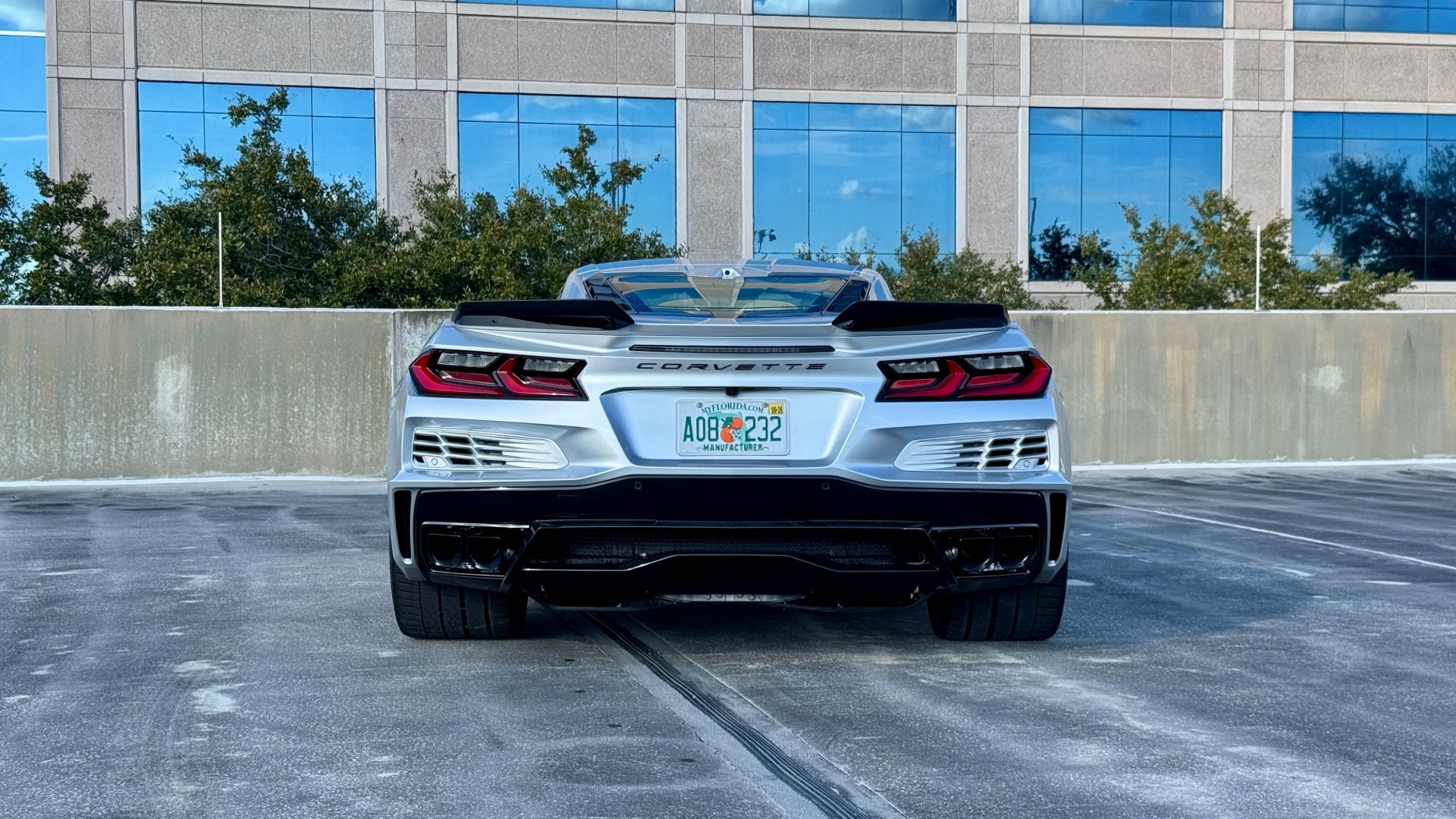
Stealth Mode, Shuttle Mode and the Hybrid System
The E-Ray’s hybrid system is built for performance first, economy a distant second. Its small 1.9 kWh battery isn’t a plug-in; it self-charges through regenerative braking and can be topped up manually via a “Charge” button on the console that ups the regen intensity. This setup tells you everything: the mission here is about boosting power, not chasing economy—its 16 city / 24 highway mpg is decent but not the point.
The two key electric-only features are Stealth Mode and Shuttle Mode. Stealth Mode lets you run on pure electric power up to 45 mph for an estimated 4-5 miles, perfect for sneaking out of your street in the morning. The catch is it’s disabled in cold weather, which limits its use in a Chicago winter. Shuttle Mode, which works in the cold, lets you creep the car forward or back silently without starting the V8—ideal for shuffling it in the garage.
Buyers expecting a plug-in with meaningful EV range will be surprised. The E-Ray’s electric capability is a tactical tool for specific jobs, not a primary way to get around. It’s a clever, performance-focused system that adds a layer of sophistication and quiet convenience to the traditional muscle-car formula.
At a Glance: How the E-Ray Stacks Up
| Spec | 2026 Corvette E-Ray | Porsche 911 Carrera 4S | BMW M4 Competition xDrive | Mercedes-AMG GT 63 |
|---|---|---|---|---|
| Starting MSRP | $108,600 | ~$148,395 | ~$87,000 | ~$148,000 |
| Powertrain | 6.2L V8 + front e-motor | 3.0L twin-turbo flat-six | 3.0L twin-turbo I6 | 4.0L twin-turbo V8 |
| Total Output | 655 hp | 473 hp | 523 hp | 577 hp |
| Drivetrain | eAWD | AWD | AWD | AWD |
| 0–60 mph | ~2.5 s | ~3.2 s | ~3.4 s | ~3.1 s |
| Layout | Mid-engine | Rear-engine | Front-engine | Front-engine |
| EPA City/Hwy | 16 / 24 mpg | 18 / 25 mpg | 16 / 22 mpg | 14 / 21 mpg |
| Curb Weight | ~3,774 lb | ~3,500 lb | ~4,000 lb | ~4,400 lb |
Porsche 911 Carrera 4S
Polished, prestigious and refined — but the E-Ray is quicker and $40K cheaper.
BMW M4 Competition xDrive
Sharper price, but down 130 hp and lacks the E-Ray’s exotic mid-engine layout.
Mercedes-AMG GT 63
More of a luxury GT than a pure sports car — heavier and slower to 60 mph.
The E-Ray enters a fiercely competitive segment, but its blend of price, power, and hybrid AWD tech gives it a unique position. It undercuts established German rivals on price while delivering significantly more punch and quicker acceleration. Here’s how the numbers compare to its most direct competitors. 2026 Corvette E-Ray BMW M4 Competition xDrive — — $108,600 ~$87,000 6.2L V8 + front e-motor 3.0L twin-turbo I6 655 hp 523 hp eAWD AWD ~2.5 s ~3.4 s Mid-engine Front-engine 16 / 24 mpg 16 / 22 mpg ~3,774 lb ~4,000 lb
2026 Corvette E-Ray vs Porsche 911 Carrera 4S: Which Is Better?
This is the big one. The Porsche 911 Carrera 4S has long been the default choice for an all-weather, daily-drivable sports car. The 2026 E-Ray doesn’t just challenge it; it tears up the playbook on value and performance. The first thing you’ll notice is the price: a well-specced E-Ray will save you over $40,000 compared to a similarly optioned 911 4S. That’s a colossal gap that buys an awful lot of performance.
And performance is where the E-Ray dominates. With 655 hp against the 911 4S’s 473 hp, the Vette is in a different league off the line, hitting 60 mph nearly a full second quicker. The characters of the powertrains are polar opposites: the E-Ray’s charismatic, rumbling V8 mixed with an electric whine versus the 911’s more clinical, high-tech flat-six. Both offer superb all-wheel-drive traction, but the 911’s system has decades of polish behind it, giving it an edge in nuanced, on-the-limit handling confidence.
Inside, the 2026 refresh finally puts the Corvette’s cabin on a par with the Porsche’s for design and tech, though the 911’s material quality and ergonomic perfection still set a benchmark. The 911 also traditionally smashes the Corvette on resale value, making it the safer bet long-term. Brand cachet is personal, but a 911 buyer is often buying the badge and heritage as much as the car. The E-Ray buyer is buying modern performance tech.
Daily driveability is a close call. Both are remarkably usable, but the 911’s better visibility, slightly easier ingress/egress, and more polished overall feel give it a narrow win for commuting duties. That said, if your priority is the most thrilling, technologically advanced performance per dollar, the E-Ray has no equal.
| Spec | 2026 Corvette E-Ray | Porsche 911 Carrera 4S |
|---|---|---|
| Starting MSRP | $108,600 | ~$148,395 |
| Engine | 6.2L NA V8 + front e-motor | 3.0L twin-turbo flat-six |
| Combined Output | 655 hp | 473 hp |
| Torque | 595 lb-ft combined | 420 lb-ft |
| Transmission | 8-speed dual-clutch | 8-speed PDK |
| 0–60 mph | ~2.5 s | ~3.2 s |
| Top Speed | 183 mph | 191 mph |
| Layout | Mid-engine eAWD | Rear-engine AWD |
| EPA Combined | 19 mpg | 21 mpg |
<div style="background:linear-gradient(135deg,#f0f9ff,#e0f2fe); border-left:4px solid #2563eb; border-radius:12px; padding:24px 28px; margin:32px 0"> <p style="font-size:12px; font-weight:800; letter-spacing:0.14em; text-transform:uppercase; color:#1e40af; margin:0 0 10px">Which one is better?</p> <p><strong>Buy the Corvette E-Ray if</strong> you want the quickest-accelerating, best-value AWD sports car on sale — supercar pace at midsize-luxury money, with a charismatic V8 soundtrack and a hybrid trick the 911 cannot match.</p> <p><strong>Buy the Porsche 911 Carrera 4S if</strong> you value engineering polish, blue-chip residual value, daily-driver ergonomics, and the badge — the 911 is the safer, more refined long-term ownership pick.</p> <p><strong>Our pick</strong> is the E-Ray on pure performance-per-dollar — but the 911 still wins for buyers who plan to keep their car for a decade.</p> </div>
Safety and Warranty
As a low-volume, high-performance sports car, the 2026 Corvette E-Ray hasn’t been crash-tested by the NHTSA or IIHS, which is normal for this segment. However, it comes with a solid suite of standard Advanced Driver-Assistance Systems (ADAS). You get forward-collision warning, automatic emergency braking with pedestrian and cyclist detection, lane-departure warning, lane-keep assist, and a following-distance indicator. A high-definition surround-vision camera system is on the options list.
Chevrolet backs the E-Ray with a 3-year/36,000-mile bumper-to-bumper warranty and a 5-year/60,000-mile powertrain warranty. Most crucially for a hybrid, the battery and electric components are covered by an 8-year/100,000-mile warranty. That’s the longest coverage on the car and provides serious peace of mind for buyers worried about the new hybrid system’s longevity. It’s a strong vote of confidence from Chevrolet in the tech’s durability.
Pricing and Value
The value argument is the E-Ray’s ace card. With a starting MSRP of $108,600, it delivers supercar-rivaling acceleration for the price of a well-specced luxury sedan. Our test car, with the must-have GT2 seats and that stunning blue paint, landed at a whisker over $123,000. That puts it in a fascinating spot: it’s pricier than a base Z06, but it offers all-wheel drive and a hybrid punch the Z06 can’t match.
Across the broader $80,000 to $150,000 sports coupe segment, the E-Ray’s value is untouchable. It offers more power and quicker acceleration than the BMW M4 xDrive for a moderate premium, and it absolutely smashes the Porsche 911 Carrera 4S and Mercedes-AMG GT on a pure performance-for-dollar basis. The question isn’t whether the E-Ray is worth its price. It’s whether you can find a better performance bargain anywhere on the market. Right now, the answer is no.
Verdict: Should You Buy the 2026 Corvette E-Ray?
The 2026 Corvette E-Ray is a landmark car. It’s successfully woven hybrid tech into the muscle-car formula not as an eco-penalty, but as a performance weapon, delivering brutal acceleration, all-weather confidence, and surprising daily usability. The 2026 cabin finally feels like it justifies the price tag, and the hybrid-specific features like Stealth and Shuttle modes add genuine, thoughtful utility.
It’s not perfect. The lack of plug-in charging, the tight GT2 seats for some, and limited visibility are real drawbacks. And if your heart is set on the Z06’s screaming flat-plane crank symphony, the E-Ray’s more synthesised soundtrack might leave you a bit cold.
But for the driver who prioritises accessible, world-beating acceleration, modern tech, and year-round drivability, the E-Ray isn’t just a great Corvette—it’s one of the most compelling performance cars on sale at any price. It democratises hypercar-adjacent speed in a way only the Corvette can. The 2026 Chevrolet Corvette E-Ray is a ripper success and our top pick in the C8 range for the modern performance enthusiast.
Frequently Asked Questions
How much does the 2026 Corvette E-Ray cost?
The 2026 Corvette E-Ray starts at $108,600 for the coupe. With popular options like the GT2 bucket seats and premium paint, most as-tested prices will land between $115,000 and $125,000. Convertible models start around $115,600.
Is the Corvette E-Ray a plug-in hybrid?
No, it is not a plug-in hybrid. The E-Ray uses a small 1.9 kWh battery that self-charges through regenerative braking and a manual “Charge” button on the console. There is no external charging port. The hybrid system is designed for performance augmentation, not extended electric-only range.
How fast is the 2026 Corvette E-Ray 0 to 60?
Chevrolet quotes a 0-60 mph time of approximately 2.5 seconds. In our testing, this figure feels entirely achievable thanks to the instant torque from the electric motor and the unwavering traction of the eAWD system.
What is the difference between the Corvette E-Ray and the Z06?
The E-Ray is a hybrid with a traditional 6.2L V8 and electric front-axle motor for AWD, focusing on all-weather traction and brutal low-end torque. The Z06 has a high-revving 5.5L flat-plane crank V8, is rear-wheel drive, and prioritises a screaming soundtrack and track-focused agility. The E-Ray is quicker off the line; the Z06 is more visceral.
Does the Corvette E-Ray have all-wheel drive?
Yes, the E-Ray is the first-ever all-wheel-drive Corvette. It uses a system called eAWD, where the rear wheels are powered by the V8 engine and the front wheels are powered exclusively by a 160-hp electric motor.
What is Stealth Mode in the Corvette E-Ray?
Stealth Mode allows the E-Ray to operate on pure electric power at speeds up to 45 mph for an estimated 4–5 miles, ideal for quietly leaving a neighborhood. It is disabled in cold temperatures. Shuttle Mode, which works in the cold, allows for silent low-speed manoeuvring, like moving the car in a driveway.
How does the Corvette E-Ray compare to the Porsche 911 Carrera 4S?
The E-Ray is significantly quicker and over $40,000 less expensive, offering unparalleled performance-per-dollar. The 911 Carrera 4S counters with superior engineering polish, higher residual value, better daily ergonomics, and stronger brand cachet. The E-Ray wins on thrill and value; the 911 wins on refinement and long-term ownership.
