

Ferrari 12Cilindri Review 2026: The Last Great V12 Grand Tourer
.jpg)
2026 Ferrari 12Cilindri front three-quarter in yellow
Price
GBP 336,500
0-100 km/h
2.9 s
Power
819 hp
⚡ Quick Verdict
:
We’ve driven a lot of front-engined GTs over the years, and the Ferrari 12Cilindri sits right at the top. It makes every outing feel like a celebration of what a combustion engine can do when it’s allowed to breathe freely. If you care about throttle response, noise, and a chassis that talks to you, nothing turbocharged comes close. It starts at GBP 336,500 in the UK, USD 554,439 in the US, and AUD 803,500 here in Australia.
## Introduction
✓ The Good
- +Sublime naturally aspirated V12 revs to 9,500 rpm
- +Near-perfect blend of ride comfort and agility
- +One of the smoothest dual-clutch gearboxes ever made
- +Analog, event-like character despite electronic chassis tech
- +Seven-year complimentary maintenance program included
✗ The Trade-offs
- −No hybrid assistance means poor fuel economy
- −Cabin quality trails the Aston Martin Vanquish
- −Two-seat layout limits grand touring practicality
📑 In This Review
We’ve driven a lot of front-engined GTs over the years, and the Ferrari 12Cilindri sits right at the top. It makes every outing feel like a celebration of what a combustion engine can do when it’s allowed to breathe freely. If you care about throttle response, noise, and a chassis that talks to you, nothing turbocharged comes close. It starts at GBP 336,500 in the UK, USD 554,439 in the US, and AUD 803,500 here in Australia.
Introduction
Very few cars arriving in 2026 genuinely make us sad about where the industry is heading. The Ferrari 12Cilindri is one of them — not because it’s flawed, but because it represents a type that’s disappearing fast. This is a front-engined, naturally aspirated V12 grand tourer at a time when every major manufacturer is downsizing, slapping on turbos, or wiring in electric motors. Ferrari itself has already hybridised the 296 GTB and the SF90. So the 12Cilindri feels like a magnificent two-finger salute to the direction of travel.
It replaces the 812 Superfast, which was a deeply impressive machine but one that could feel almost too extreme for the grand touring brief. The 12Cilindri takes a different tack. It’s calmer, more refined, and easier to live with day to day, yet during our time with it the driving experience proved more rewarding than its predecessor in nearly every scenario. The name — twelve cylinders, in Italian — leaves no mystery about what’s lurking under that sculpted bonnet.
Its closest rival is the Aston Martin Vanquish. The two arrive at almost the same price, with near-identical power, and an entirely different philosophy. Where the Ferrari screams to 9,500 rpm on atmospheric lungs, the Aston uses twin turbos to churn out a monstrous 1,000 Nm of torque. They’ll be cross-shopped relentlessly, and we’ll cover them head-to-head later in this review.
Beyond the Vanquish, you’ve got the hybrid-powered Lamborghini Revuelto, the luxury-focused Bentley Continental GT Speed, and — if we’re stretching — the Porsche 911 Turbo S for buyers who’d rather have point-to-point pace than emotional drama. None of them replicate what the 12Cilindri delivers. This is a car for people who reckon how an engine sounds matters just as much as how fast it goes.
Design and Exterior
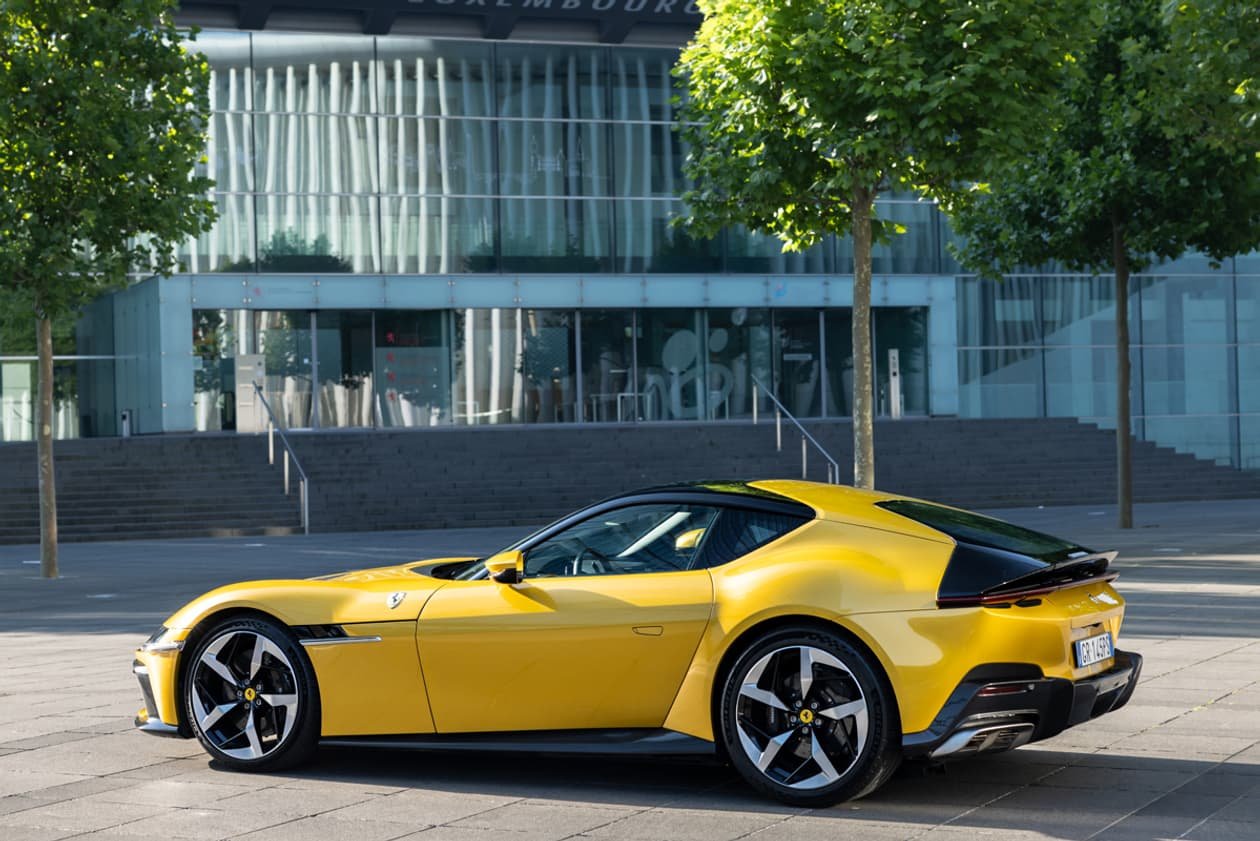
During our time photographing the car, the 12Cilindri drew more lingering stares than any Ferrari we’ve tested in recent memory. The front end is the headline act: a wide, low-slung face inspired by Ferrari’s grand touring icons of the 1960s, with a blacked-out bonnet panel that visually links the two headlamp units and gives the nose a distinctive, almost retro graphic. It’s a conscious departure from the 812 Superfast’s sharper, more angular look, and it works beautifully.
Park it next to its predecessor and the differences are immediately apparent. The 812 was all sharp creases and aerodynamic slashes; the 12Cilindri is smoother, more flowing, with a longer bonnet line that emphasises the front-engined proportions. The roofline tapers gently toward a Kamm tail — a design cue borrowed from classic Ferraris — and the overall silhouette reads as a proper two-seat grand tourer rather than a thinly disguised supercar.
The proportions are fundamentally elegant. Long bonnet, short rear deck, wide haunches — the car sits low and planted without resorting to the cartoonish exaggeration that plagues some rivals. From the rear, the quad taillights and clean surface treatment are restrained by modern Ferrari standards, which suits the GT brief perfectly.
.jpg)
Engine and Performance
At the heart of the 12Cilindri sits Ferrari’s F140 family V12, displacing 6,496 cc and producing 830 PS — that’s 819 hp — at a heady 9,250 rpm. Peak torque of 678 Nm arrives at 7,250 rpm, and the engine will happily spin all the way to a 9,500 rpm redline. In 2026, this powertrain isn’t merely impressive; it’s an anomaly. Every major competitor has either added turbos, hybridisation, or both. Ferrari has done neither.
The result is an engine that responds to your right foot with an immediacy turbocharged rivals simply can’t match. No lag, no waiting for boost to build, no artificial flatness in the mid-range. Power delivery is linear, progressive, and relentless, pulling harder the closer you get to that stratospheric redline. The sound — a wailing, metallic scream above 7,000 rpm — is one of the great automotive experiences still available in a new car.
Straight-line performance is formidable. The 12Cilindri hits 100 km/h from rest in 2.9 seconds and dispatches 0 to 200 km/h in 7.9 seconds. Top speed is 340 km/h, or 211 mph. Those figures put it within a whisker of cars costing significantly more, and they’re achieved without forced induction or electric torque fill of any kind.
The eight-speed dual-clutch automatic is one of the smoothest, fastest gearboxes we’ve experienced in a road car. Shifts are near-instantaneous under full throttle and imperceptibly smooth during gentle driving — exactly the dual personality a grand tourer needs. The calibration feels honed to a degree few manufacturers can match.
Why does an atmospheric V12 still matter in 2026? Because the driving experience it provides is irreplaceable. Turbocharging delivers speed. Electrification delivers efficiency. But neither delivers the sensory connection that comes from an engine spinning freely to 9,500 rpm with nothing between your right foot and twelve combustion chambers. The 12Cilindri proves the old formula still works — magnificently.
.jpg)
Driving Experience
Ferrari has equipped the 12Cilindri with a formidable suite of chassis tech: active rear steering, an electronically controlled limited-slip differential, and a brake-by-wire system. Any one of these could feel intrusive or artificial in isolation. What impresses us most is how invisibly they work together. The transition between rear-steer assistance at low speed and high-speed stability is smooth. The brake-by-wire delivers consistent, reassuring pedal feel. The electronic differential deploys torque with a subtlety that makes the rear axle feel telepathically connected to your intentions.
During our time behind the wheel, the 12Cilindri struck a balance between agility and compliance that the 812 Superfast never quite managed. The older car was thrilling but could feel tense on broken surfaces, as though it was always looking for an excuse to attack. The 12Cilindri is calmer. It absorbs undulations and imperfections with genuine composure, yet it changes direction with a crispness and immediacy that belies its grand touring remit. This is a car you could drive for six hours across the continent and arrive feeling fresh.
Compared directly with the 812 Superfast, the 12Cilindri feels less extreme but more rewarding. The aluminium spaceframe is 15 percent stiffer than its predecessor’s, yet the suspension tuning prioritises flow over force. You can lean on the car through a series of sweeping bends and feel the chassis working with you rather than trying to overwhelm you. It’s a more mature, more complete driving experience.
What surprised us most is the analog quality of the whole affair. Despite the electronic rear steering, the brake-by-wire, the digital differential, and the eight-speed dual-clutch, the 12Cilindri feels like a machine with genuine mechanical integrity. The steering has real weight and texture. Throttle response is instant. Body roll is progressive and communicative. Ferrari has used technology to enhance the driving experience rather than dilute it, and the result is a car that feels connected and alive in a way very few modern GTs manage.
.jpg)
Interior, Tech and Cabin
The cabin is dominated by a triple-screen layout that represents a big step forward from the 812 Superfast’s more conventional setup. The driver faces a 15.6-inch configurable display that replaces traditional instruments, while a 10.25-inch central touchscreen handles infotainment. A dedicated passenger display sits ahead of the co-driver, letting them manage navigation, media, or vehicle information without distracting the person behind the wheel.
Wireless Apple CarPlay and Android Auto come standard, and there’s a wireless phone charging pad on the central tunnel. The infotainment system is responsive and logically laid out, though it lacks the intuitive simplicity of the best systems from Porsche or BMW. It’s a clear improvement over previous Ferrari interiors, and most buyers will find it perfectly adequate for daily use.
Material quality is high throughout. The seats are supportive and trimmed in rich leather, the switchgear has a satisfying tactile weight, and the low driving position feels suitably dramatic. That said, we should be honest: the 12Cilindri’s cabin doesn’t feel as solidly built or as sumptuously appointed as the Aston Martin Vanquish’s interior, which has been praised by both Top Gear and Autocar for its hand-stitched detailing and sense of occasion. The Ferrari is driver-focused and purposeful; the Aston is more indulgent.
The two-seat layout and 270-litre boot are adequate for a grand touring weekend — two carry-on bags and a soft holdall will fit without difficulty — but this isn’t a car for families or extended luggage. Buyers who need more practicality will find the Bentley Continental GT Speed a more versatile proposition.
.jpg)
At a Glance: How the 12Cilindri Compares
| Specification | Ferrari 12Cilindri | Aston Martin Vanquish | Lamborghini Revuelto | Bentley Continental GT Speed |
|---|---|---|---|---|
| Engine | 6.5L NA V12 | 5.2L TT V12 | 6.5L V12 hybrid | 4.0L V8 hybrid |
| Power | 819 hp | 824 hp | 1,015 PS | 771 hp |
| Torque | 678 Nm | 1,000 Nm | 793 Nm | 1,000 Nm |
| 0-100 km/h | 2.9 s | 3.3 s | 2.5 s | 3.1 s |
| Top speed | 340 km/h | 345 km/h | 350 km/h | 335 km/h |
| Drivetrain | RWD | RWD | AWD | AWD |
| UK price (approx) | GBP 336,500 | GBP 333,000 | GBP 450,000 | GBP 240,000 |
Aston Martin Vanquish
Lamborghini Revuelto
Bentley Continental GT Speed
Porsche 911 Turbo S
The table below positions the 12Cilindri against its three most relevant rivals across key specifications and pricing. Ferrari 12Cilindri Lamborghini Revuelto —— 6.5L NA V12 6.5L V12 hybrid 819 hp 1,015 PS 678 Nm 793 Nm 2.9 s 2.5 s 340 km/h 350 km/h RWD AWD GBP 336,500 GBP 450,000 What this table shows is that the 12Cilindri sits in a remarkably tight pricing cluster with the Aston Martin Vanquish. The two are separated by roughly GBP 3,500 — essentially a rounding error at this level — yet they could hardly be more different in character. The Lamborghini Revuelto offers more power and all-weather grip but costs over GBP 100,000 more and uses a mid-engine layout that makes it a fundamentally different proposition. The Bentley Continental GT Speed undercuts all three significantly and prioritises luxury over outright driver engagement. The 12Cilindri’s ace in this company is its naturally aspirated engine. No other car on this list — or at this price point — offers a free-breathing V12 spinning to 9,500 rpm. That alone makes it a singular machine.
Ferrari 12Cilindri vs Aston Martin Vanquish: Which Is Better?
This is the question every prospective buyer will ask, and the answer is more nuanced than a spec-sheet comparison suggests. The two arrive at almost identical prices — GBP 336,500 for the Ferrari, approximately GBP 333,000 for the Aston Martin — and produce nearly identical peak power. On paper they look like direct substitutes. On the road they feel like they were designed on different planets.
Straight-line performance favours the Ferrari at the stopwatch level. The 12Cilindri reaches 100 km/h in 2.9 seconds against the Vanquish’s 3.3 seconds, a meaningful gap that reflects the Ferrari’s superior launch traction and sharper throttle response. The Aston Martin, though, counters with a crushing mid-range advantage. Its 5.2-litre twin-turbo V12 produces 1,000 Nm of torque — nearly 50 percent more than the Ferrari’s 678 Nm — and that torque arrives much lower in the rev range. In real-world overtaking, the Vanquish’s ability to surge forward from low revs without requiring a downshift is a genuinely compelling asset.
Engine character is where the two diverge most dramatically. The Ferrari’s atmospheric V12 builds power progressively, rewarding you for revving it hard and delivering a rising mechanical scream above 7,000 rpm that’s among the most intoxicating sounds in the modern automotive world. The Aston Martin’s twin-turbo unit produces a deep, muscular growl — impressive in its own right, but a fundamentally different auditory experience. There’s less drama in how the Vanquish delivers its performance, but there is more ease. It simply picks up and goes, regardless of gear or engine speed.
Interior craftsmanship is an area where the Vanquish holds a clear advantage. Both Top Gear and Autocar have highlighted the Aston’s cabin for its sumptuous materials, hand-stitched leather, and sense of occasion that borders on bespoke. The Ferrari’s interior is well-built and purposeful, but it prioritises the driver over indulgence. If you judge a grand tourer partly by the quality of the environment it wraps around you, the Aston Martin makes a stronger emotional case.
Dynamically, the Ferrari is the sharper, more engaging car. Its steering has more texture, its chassis is more communicative, and its active rear steering gives it an agility through tight corners that the Vanquish can’t match. The Aston, conversely, is the more relaxing car to cover distance in. It rides with greater suppleness, its cabin is quieter at a cruise, and its torque-rich engine means you rarely need to work the gearbox. For a 500-kilometre cross-continental blast, the Vanquish is arguably the better tool. For a Sunday morning blast on your favourite road, the Ferrari wins convincingly.
There’s also the question of exclusivity. The Aston Martin Vanquish is capped at 1,000 units globally, giving it an inherent rarity that the Ferrari, with its open production numbers, can’t match. For collectors who value scarcity as part of a car’s appeal, that’s a meaningful differentiator. Whether that exclusivity justifies the slightly less engaging driving experience is a question only the individual buyer can answer.
What the numbers don’t capture is the emotional dimension. The 12Cilindri makes every drive feel like an event. Blipping the throttle, hearing the V12 spin up to 9,500 rpm, feeling the chassis respond to your inputs with mechanical honesty — it’s deeply satisfying in a way that transcends specification sheets. The Vanquish is an extraordinary grand tourer. The Ferrari is an extraordinary experience.
| Specification | Ferrari 12Cilindri | Aston Martin Vanquish |
|---|---|---|
| Engine | 6.5L NA V12 | 5.2L twin-turbo V12 |
| Power | 819 hp at 9,250 rpm | 824 bhp |
| Torque | 678 Nm at 7,250 rpm | 1,000 Nm |
| 0-100 km/h | 2.9 seconds | 3.3 seconds |
| Top speed | 340 km/h (211 mph) | 345 km/h (214 mph) |
| Transmission | 8-speed DCT | 8-speed automatic |
| Drivetrain | Rear-wheel drive | Rear-wheel drive |
| UK price (approx) | GBP 336,500 | GBP 333,000 |
| Production cap | Open production | 1,000 units global |
<div style="background:linear-gradient(135deg,#fef2f2,#fee2e2); border-left:4px solid #dc2626; border-radius:12px; padding:24px 28px; margin:32px 0"> <p style="font-size:12px; font-weight:800; letter-spacing:0.14em; text-transform:uppercase; color:#991b1b; margin:0 0 10px">Which one is better?</p> <p><strong>Buy the Ferrari 12Cilindri if</strong> you want the sharpest atmospheric V12 driving experience on sale today, value the 9,500 rpm scream, and want every drive to feel like an event.</p> <p><strong>Buy the Aston Martin Vanquish if</strong> you cover long continents, prefer a more sumptuous cabin with hand-stitched detailing, and want the exclusivity of a 1,000-unit production cap.</p> <p><strong>Our pick</strong> is the Ferrari 12Cilindri — at near-identical money it offers a more rewarding drive and an engine that simply will not exist in five years’ time.</p> </div>

Safety and Warranty
Standard safety equipment includes front, side, and head airbags, ABS with electronic brake distribution, electronic stability control, and traction slip control. The brake-by-wire system adds an extra layer of stopping precision that we found confidence-inspiring during hard driving, though some traditionalists will prefer the feel of a conventional hydraulic setup.
Ferrari backs the 12Cilindri with a three-year unlimited-kilometre factory warranty, which is competitive for the segment. More impressive is the seven-year complimentary maintenance program, covering scheduled servicing costs and representing a genuine ownership benefit few rivals match. An extended warranty option is available for up to 15 years at additional cost, providing long-term peace of mind for buyers who plan to keep the car in their collection.
Ownership and Running Costs
The seven-year complimentary maintenance program is a standout feature in the luxury sports car segment. Servicing a V12 Ferrari isn’t inexpensive, and having those costs absorbed for the first seven years of ownership removes a significant financial variable from the equation. It’s a programme that reflects Ferrari’s confidence in the powertrain’s durability.
Fuel economy is, predictably, poor. An 819 hp naturally aspirated 6.5-litre V12 revving to 9,500 rpm was never going to be parsimonious, and buyers should budget accordingly. Official combined-cycle figures will be modest at best; real-world consumption during spirited driving will be significantly worse. This is the unavoidable cost of atmospheric performance, and every buyer at this price point understands that.
Insurance premiums will be substantial, and depreciation — while historically kinder to Ferrari V12s than to many rivals — remains a factor. That said, the naturally aspirated V12’s endangered status may well support residual values over the medium term, particularly as the industry accelerates toward electrification.
Who Should Buy It
The 12Cilindri is for a specific kind of buyer. It’s for the driver who already owns a comfortable daily and wants a weekend grand tourer that makes every outing feel significant. It’s for the collector who understands that naturally aspirated V12s aren’t being developed any more, and that the 12Cilindri may well represent the closing chapter of a lineage stretching back decades. It’s for the enthusiast who values throttle response and engine sound above lap times and spec-sheet bragging rights.
Buyers who prioritise a sumptuous, cosseting cabin above all else should look more closely at the Aston Martin Vanquish or the Bentley Continental GT Speed. Those who want the security of all-wheel drive and hybrid efficiency will find the Lamborghini Revuelto or the Continental GT Speed better suited to their needs. And those who want the absolute last word in point-to-point pace at a lower price should consider the Porsche 911 Turbo S, though it offers a fundamentally different and less emotionally charged experience.
The 12Cilindri isn’t the car for everyone. It’s the car for someone who’s driven enough fast cars to know that speed alone isn’t enough — that the way a car delivers its performance matters as much as the performance itself. For that buyer, there’s nothing else quite like it.
⚡ Our Verdict
Final Take
The Ferrari 12Cilindri is one of the last great atmospheric V12 grand tourers, and it may well be the finest one ever made. It takes the raw intensity of the 812 Superfast and refines it into something more usable, more rewarding, and more emotionally complete. The 6.5-litre V12 is a masterpiece — free-revving, responsive, and possessed of a soundtrack no turbocharged engine can replicate. The chassis is sophisticated without being clinical, and the overall driving experience strikes a balance between excitement and composure that few grand tourers achieve. It’s sharper than the Aston Martin Vanquish in a corner, more visceral at the redline, and priced within one percent of its closest rival. The Aston counters with a more luxurious cabin and a production cap of just 1,000 units, which will appeal to collectors. But for the pure driving enthusiast — for the person who wants to feel every revolution of twelve cylinders and hear every note of an engine approaching 9,500 rpm — the Ferrari is the clear choice. We award the 2026 Ferrari 12Cilindri a rating of 4.7 out of 5. It loses half a point only for its cabin’s inability to match the Vanquish’s sense of occasion and its poor fuel economy — both forgivable sins in a car that delivers so much joy. If this is indeed the twilight of the atmospheric V12, it’s going out on the highest possible note.
FAQ
What engine does the Ferrari 12Cilindri use?
The Ferrari 12Cilindri uses a 6.5-litre (6,496 cc) naturally aspirated V12 from Ferrari’s F140 family. It produces 830 PS (819 hp) at 9,250 rpm and 678 Nm of torque at 7,250 rpm, with a redline of 9,500 rpm.
How fast is the Ferrari 12Cilindri?
The 12Cilindri reaches 100 km/h from rest in 2.9 seconds, covers 0 to 200 km/h in 7.9 seconds, and has a top speed of 340 km/h — that’s 211 mph.
How much does the Ferrari 12Cilindri cost?
Pricing starts at GBP 336,500 in the UK and USD 554,439 in the United States for the coupe. In Australia, the coupe costs AUD 803,500 and the Spider variant is priced at AUD 886,800. European pricing starts at approximately EUR 395,000.
Is the Ferrari 12Cilindri better than the Aston Martin Vanquish?
The two are remarkably closely matched. The Ferrari offers a sharper, more engaging driving experience and a naturally aspirated V12 that screams to 9,500 rpm. The Aston Martin Vanquish counters with a more luxurious cabin, nearly 50 percent more torque, and a production cap of just 1,000 units. At near-identical pricing, the choice comes down to whether you value driving engagement or grand touring refinement.
Does the Ferrari 12Cilindri replace the 812 Superfast?
Yes. The 12Cilindri is the direct successor to the 812 Superfast in Ferrari’s front-engined V12 grand tourer lineage. It uses a revised version of the same F140 V12 engine but features a stiffer chassis, updated technology, and a more refined driving character.
What is the warranty on the Ferrari 12Cilindri?
Ferrari provides a three-year unlimited-kilometre factory warranty as standard. The car also comes with a seven-year complimentary maintenance program covering scheduled servicing. An extended warranty is available for up to 15 years at additional cost.
Is the Ferrari 12Cilindri available with a hybrid powertrain?
No. The 12Cilindri is powered exclusively by a naturally aspirated V12 engine with no hybrid or electric assistance. That makes it one of the very few non-hybrid V12 grand tourers available in 2026, a distinction that’s central to its appeal and increasingly rare in the modern automotive world.
