

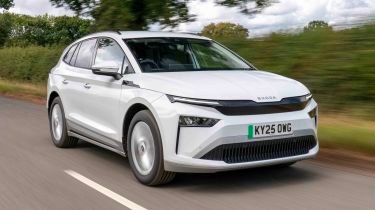
2026 Skoda Enyaq Review: The Electric SUV That Finally Makes Sense
A polished, family-first electric SUV that punches above its price tag.
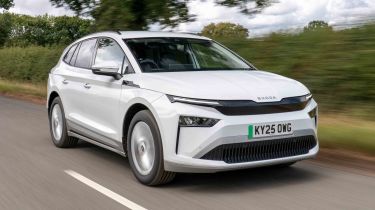
2026 Skoda Enyaq Edition 60 front three-quarter exterior
Price
£44,300
Battery (usable)
77 kWh
Power
286 PS
✓ The Good
- +Segment-leading 585-litre boot beats every direct rival
- +Interior quality and material finish punch well above the price
- +Supple, comfort-biased ride makes long journeys effortless
- +Generous standard kit even on entry-level SE L trim
- +Strong range figures — up to 359 miles WLTP in the 85
✗ The Trade-offs
- −No one-pedal drive mode at launch (expected later in 2026)
- −Infotainment still suffers occasional glitches despite software refresh
- −DC peak charge rates trail 800 V Hyundai/Kia rivals
- −Heat pump is a paid optional extra rather than standard fit
📑 In This Review
- Quick Verdict
- What’s New for 2026
- Pricing and Range Lineup
- Performance and Driving Impressions
- Battery, Range and Real-World Efficiency
- Charging Performance
- Interior, Tech and Cabin Materials
- Practicality, Space and Family Use
- At a Glance: How It Stacks Up
- 2026 Skoda Enyaq vs Volkswagen ID.4: Which Is Better?
- Safety and Warranty
- Should You Buy It?
- Our Verdict
- Frequently Asked Questions
META_DESC: Read our full 2026 Skoda Enyaq review. From £39,010 with up to 359 mi range, a 585 L boot and premium cabin. See how it stacks up against the Tesla Model Y, Kia EV6 and VW ID.4. SLUG: 2026-skoda-enyaq-review RATING: 4.3/5 RATING_HEADLINE: A polished, family-first electric SUV that punches above its price tag. PROS: – Segment-leading 585-litre boot beats every direct rival – Interior quality and material finish punch well above the price – Supple, comfort-biased ride makes long journeys effortless – Generous standard kit even on entry-level SE L trim – Strong range figures — up to 359 miles WLTP in the 85 CONS: – No one-pedal drive mode at launch (expected later in 2026) – Infotainment still suffers occasional glitches despite software refresh – DC peak charge rates trail 800 V Hyundai/Kia rivals – Heat pump is a paid optional extra rather than standard fit
Quick Verdict
The 2026 Skoda Enyaq is a mid-size electric SUV built on Volkswagen Group’s MEB platform, updated with a cleaner face, smarter cabin materials and a trimmed-down model range. It’s aimed squarely at families who want Volkswagen Group solidity and space without stumping up for Audi or VW money, and by and large it delivers. That 585-litre boot is the biggest in class. The cabin feels properly upmarket when you tick the box for the optional Design Selections. The ride? It’s tuned for comfort, not backroad heroics. There are compromises, though. DC charging peaks trail behind 800-volt Korean rivals, one-pedal drive isn’t available at launch, and the infotainment still throws up the occasional lag. For buyers in the £40–55k bracket who care most about space, refinement and a no-fuss ownership experience, the Enyaq makes a strong case.
What’s New for 2026
The most obvious change is at the nose, where Skoda has ditched the original’s gaping radiator grille in favour of a cleaner, more cohesive panel. The new "Tech Deck Face" integrates radar and sensor hardware behind a smooth, body-coloured surface, flanked by slim LED light signatures that double as indicators. A full-width light bar, revised air curtains and a subtle lip diffuser round out the look, trimming aero drag slightly in the process. Inside, the dashboard carries over the larger 13.0-inch central touchscreen running refreshed software, paired with a compact 5.0-inch driver display and an optional augmented-reality head-up display that projects navigation arrows onto the road ahead. New "Design Selections" themed interiors — Loft, Lounge, Lodge, Suite and Eco Suite — introduce sustainable materials including recycled PET fabrics, Econyl and vegan-friendly microsuede. The trim walk has been simplified to four tiers: SE L, Edition, Sportline and vRS, each with a clearly defined equipment spread. A heated steering wheel is now standard across the range, wearing the new Skoda wordmark instead of the old emblem. Three-zone climate control, adaptive cruise, keyless entry and blind-spot warning come as standard even on the entry SE L. Under the skin, battery pre-conditioning is included on all 77 kWh variants, and the chassis calibration has been lightly revised for improved ride compliance over rough surfaces. One-pedal drive and a small front storage compartment (frunk) are expected to arrive on later 2026 production cars, but neither is available at launch.
Pricing and Range Lineup
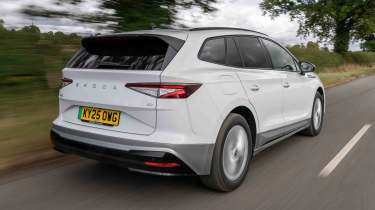
The 2026 range opens with the Enyaq 60, priced from £39,010 in the UK. That’s a significant threshold, as it undercuts the £40k mark that keeps the car clear of the UK’s expensive-vehicle supplement for road tax. The 60 runs a 59 kWh (usable) battery, a single rear motor producing 201 bhp and returns a WLTP range of 268 miles, with 0–62 mph dispatched in 8.7 seconds. The long-range sweet spot is the Enyaq 85, from £44,300. It steps up to a 77 kWh pack, 286 PS, rear-wheel drive and a WLTP figure of 359 miles, comfortably the best in the range. It reaches 60 mph in approximately 6.5 seconds. Adding a front motor for all-wheel drive brings the Enyaq 85x, from £48,750, with 332 miles of WLTP range. The flagship vRS, at £51,660, delivers 335 bhp and a 0–62 time of 5.4 seconds, though range drops to 344 miles due to the performance bias. Every 77 kWh model is capable of DC fast charging at peaks between 135 and 185 kW, and the 60 hits 165 kW. Skoda’s Czech-led pricing strategy for this generation means the entry-level 60 slides convincingly under £40k, giving the Enyaq a genuine value advantage over the Tesla Model Y and Kia EV6, both of which start higher.
Performance and Driving Impressions
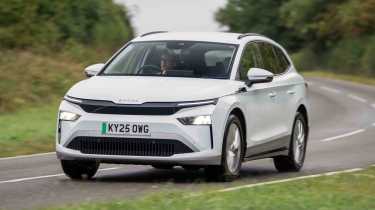
The Enyaq’s rear-wheel-drive layout in single-motor form gives it a more balanced, engaging feel than the front-drive EVs that dominate this price bracket. During our testing, the 286 PS Enyaq 85 delivered brisk, confidence-inspiring acceleration. It won’t snap your neck back, but it’s more than adequate for motorway merging and overtaking. The steering is naturally weighted and offers more feedback through the rim than we’d typically expect from a Volkswagen Group product. It’s light and easy at low speed, but firms up convincingly on a B-road. Body control is tuned firmly toward comfort, with a softly sprung chassis that absorbs imperfections and potholes with real composure. At nearly two tonnes, you’re always aware of the mass, but it doesn’t feel like it’s about to wash wide either. Braking performance impressed us. The pedal offers genuine progression and resists the wooden, digital feel that plagues many EVs. Stacked against the Tesla Model Y, which rides stiffly and transmits every cat’s eye into the cabin, the Enyaq is a far more relaxing companion. The Kia EV6 feels looser and more playful at the rear end. The Enyaq trades that outright fun for a planted, secure sense of refinement. The Sportline’s firmer suspension and 20-inch wheels tighten things up noticeably, though we’d caution that some buyers may find the ride too busy on Britain’s cratered tarmac. The vRS, with its 5.4-second sprint to 62 mph, feels rapid in a straight line. It’s no hot hatch, but it covers ground with a muscular urgency that belies its family-SUV shape. In twisty sections, the rear-drive push is palpable. The car feels like it’s being propelled rather than dragged, and the weight distribution inspires confidence under braking. Our only real dynamic gripe is the absence of a one-pedal drive mode. The regen-paddle adjustment works well enough, but town driving would benefit from stronger, progressive deceleration that lets you almost forget the brake pedal exists.
Battery, Range and Real-World Efficiency
Two battery packs serve the range: a 59 kWh (usable) unit in the 60 and a 77 kWh pack across all 85, 85x and vRS variants. WLTP ratings stand at 268 miles for the 60, 359 miles for the 85, 332 miles for the 85x and 344 miles for the vRS. In real-world driving, expect the 85 to comfortably exceed 280–300 miles on a mixed cycle, dropping to around 260–270 on a sustained motorway run at 70 mph in temperate conditions. The 60, with its smaller pack, will realistically deliver 200–220 miles in normal use. That’s enough for daily commuting, less reassuring for longer trips. Battery pre-conditioning is fitted across all 77 kWh models, meaning the pack warms itself en route to a rapid charger, preserving peak charge rates even on cold days. During our testing in mild UK autumn weather, the 85 consistently showed energy consumption figures in the 3.3–3.6 miles/kWh range around town, dipping to around 2.8–3.0 on the motorway. The three-zone climate system draws relatively efficiently, though the heat pump is frustratingly a cost option rather than standard. In urban environments, where regenerative braking does the heavy lifting, range anxiety evaporates. We saw the range estimator hold up far better in stop-start traffic than on a sustained 70 mph cruise. For most families, the 85’s 359-mile WLTP figure provides sufficient buffer for a week of commuting plus a weekend trip without needing a top-up.

Charging Performance
The Enyaq 60 accepts up to 165 kW on DC, while the single-motor 85 peaks at 135 kW, a figure that looks modest alongside the 250 kW of a Tesla Model Y or the 240 kW of a Kia EV6. The dual-motor 85x raises that to 175 kW, and the vRS tops out at 185 kW. With battery pre-conditioning engaged, the 77 kWh cars complete a 10–80% charge in approximately 28 minutes in ideal conditions. On an 11 kW AC wallbox, a full charge of the 77 kWh pack takes around seven to eight hours, perfectly suited to overnight home charging. The car supports ISO 15118 plug-and-charge, so compatible public chargers will authenticate and bill automatically without fumbling for apps or cards. That said, 800-volt rivals from Hyundai and Kia still out-pace the Enyaq at the charger. The Ioniq 5 and EV6, with their 800-volt architecture, sustain higher peak rates for longer and reach 80% a few minutes quicker. For most Enyaq owners who’ll charge overnight at home the vast majority of the time, this gap is academic. But for regular long-distance drivers who rely on public rapid charging, the Korean cars retain a meaningful edge.
Interior, Tech and Cabin Materials
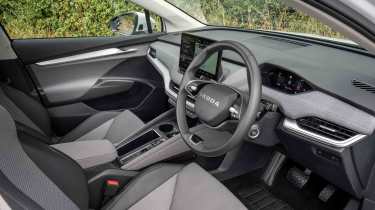
This is where the 2026 Enyaq comes into its own. The 13.0-inch central touchscreen is sharp, responsive and laid out more intuitively than the equivalent system in the Volkswagen ID.4. Below it, a 5.0-inch driver display relays key information — speed, range, traffic-sign recognition — in a clean, distraction-free format, supplemented by the optional augmented-reality head-up display that projects navigation arrows directly onto the road. Physical shortcut buttons for drive modes, parking assist and safety systems sit below the screen, preserving a degree of tactile control that touchscreen-only rivals lack. Skoda’s "Design Selections" bring real character to the cabin. The Lounge interior, with its microsuede and contrast stitching, makes the cabin feel closer to an Audi than its price tag has any right to. The Lodge selection leans into sustainability with recycled Econyl and PET-based fabrics, while Suite and Eco Suite offer yet more variety. Material quality throughout is impressive. Soft-touch plastics on the dash, padded surfaces on the doors and centre console, and a steering wheel wrapped in perforated leather all feel decidedly upmarket. A heated steering wheel is standard on every model, as is three-zone climate control. The infotainment isn’t flawless, though. We experienced occasional lag when swiping between menus and brief freezes during Apple CarPlay sessions. Skoda has confirmed a transition to a Google Android-based operating system in the next-generation model, which should address these niggles. For now, the system remains usable and far better than the capacitive-slider setup in the ID.4. The wireless phone charger occupies a single slot, and the cupholders are small and awkwardly positioned — minor irritations in an otherwise superbly finished cabin.
Practicality, Space and Family Use
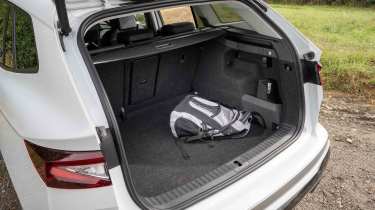
The headline figure is 585 litres of boot space, comfortably the largest in this segment. For context, the Volkswagen ID.4 offers 543 litres, the Hyundai Ioniq 5 manages 527 litres, and the Kia EV6 trails at 490 litres. Even the Tesla Model Y, with its total 854 litres including the front storage compartment, can’t match the Enyaq’s usable, squared-off cargo area for loading bulky items. The boot floor is completely flat with no load lip, making it effortless to slide heavy boxes or pushchairs in and out. Skoda has added clever touches throughout: pull-down shopping hooks, a 12-volt socket, a hard-shell storage bag for the charging cable, tie-down points and a cargo net that clips into dedicated anchors. The rear seats split 60/40 and fold via quick-release tabs accessible from the boot, so there’s no need to clamber into the back seat. A ski hatch passes through the centre armrest, which itself houses pop-out cupholders and USB-C ports. Rear legroom and headroom are generous, even in the coupé variant. At six feet tall, we found ample space to sit behind our own driving position with room to spare. The seat base is raked steeply upward, providing genuine thigh support, a thoughtful touch for taller passengers. ISOFIX points are covered by flip-down plastic tabs rather than removable covers, which is a small but welcome detail that prevents damage to the leather. There’s no frunk at launch, though one is expected on later 2026 production cars. Towing capacity reaches 1,400 kg on the dual-motor 85x and vRS, making it a viable option for small caravan or trailer duties.
At a Glance: How It Stacks Up
| Spec | Skoda Enyaq 85 | VW ID.4 Pro | Tesla Model Y LR | Kia EV6 GT-Line |
|---|---|---|---|---|
| Price (UK, from) | £44,300 | £42,985 | £46,990 | £49,395 |
| Battery (usable) | 77 kWh | 77 kWh | 75 kWh | 77.4 kWh |
| Power | 286 PS | 282 PS | 300+ PS | 325 PS |
| 0-62 mph | 6.7 s | 6.7 s | 4.8 s | 5.2 s |
| WLTP range | 359 mi | 352 mi | 373 mi | 324 mi |
| DC peak | 135 kW | 175 kW | 250 kW | 240 kW |
| Boot | 585 L | 543 L | 854 L | 490 L |
| Warranty | 3 yr / 60k mi | 3 yr / 60k mi | 4 yr / 50k mi | 7 yr / 100k mi |
Volkswagen ID.4 Pro
MEB platform twin — cheaper entry but Enyaq adds boot space and standard kit
Tesla Model Y Long Range
Faster, longer-range and 971 L total storage but a stiffer ride and minimalist cabin
Hyundai Ioniq 5
800 V architecture means much faster DC charging but boot trails Enyaq by 60 L
Kia EV6 GT-Line
Sharper handling and 240 kW DC peak but tighter boot and pricier on entry
The Enyaq occupies a sweet spot in the electric SUV market: more affordable than a Tesla Model Y, more practical than a Kia EV6, and better finished inside than a Volkswagen ID.4. Here’s how the key specs compare across the segment’s most closely matched contenders. Skoda Enyaq 85 Tesla Model Y LR ———————————- £44,300 £46,990 77 kWh 75 kWh 286 PS 300+ PS 6.7 s 4.8 s 359 mi 373 mi 135 kW 250 kW 585 L 854 L 3 yr / 60k mi 4 yr / 50k mi The Tesla Model Y leads on outright range, acceleration and charging speed, plus its cavernous total storage. The Kia EV6 counters with a seven-year warranty and 800-volt charging that genuinely reduces stop times. The Volkswagen ID.4 undercuts the Enyaq on list price but carries less standard equipment. The Skoda, meanwhile, wins the boot-space contest hands down, offers the most convincing cabin quality in this group, and undercuts both the Model Y and EV6 on price. For families who value space and interior ambience above raw pace, the Enyaq is the one to shortlist.
2026 Skoda Enyaq vs Volkswagen ID.4: Which Is Better?
This is the one that matters most if you’re cross-shopping within the Volkswagen Group. Both cars share the same MEB platform, come off related production lines and run near-identical battery packs and electric motors. The choice usually boils down to brand perception, standard equipment and how each is priced, and Skoda’s made some smart moves here.
Price and value
The entry-level ID.4 undercuts the Enyaq 60 by a few hundred pounds, so it’s technically the cheapest way onto the MEB platform in the UK. Start matching equipment levels, though, and the gap narrows. In some trims it flips entirely. The Enyaq SE L throws in three-zone climate, adaptive cruise, keyless entry and a heated steering wheel as standard. The equivalent ID.4 often wants you to tick option boxes for the same kit. Spec-for-spec, the Enyaq delivers noticeably better value.
Performance and feel
Both produce around 286 PS in single-motor, rear-drive trim and hit 62 mph in 6.7 seconds. The distinction lies in calibration. The Enyaq feels more composed over rough surfaces, with a plusher low-speed ride and better bump absorption. The ID.4 is marginally firmer at low speed and can feel unsettled on broken urban tarmac. Neither is remotely sporty, but the Enyaq’s steering offers more natural feedback, making it the more enjoyable car to steer along a country lane.
Battery, range and charging
Both run the same 77 kWh battery in long-range guise, and their WLTP figures are nearly identical: 359 miles for the Enyaq, 352 for the ID.4. Real-world range is much the same, too. The ID.4 does claim a higher DC peak of 175 kW against the Enyaq’s 135 kW, which on paper translates to a 10–80% time a couple of minutes shorter. In practice the difference is marginal. Both cars settle into a similar charging curve after the initial peak, and overall session times are within two to three minutes of each other.
Interior and cabin tech
This is where the Enyaq pulls clearly ahead. Its 13.0-inch touchscreen runs software that’s more intuitive and better laid out than the ID.4’s setup. More importantly, Skoda keeps physical shortcut buttons for key functions. The ID.4 leans heavily on its controversial capacitive sliders, a design choice that’s frustrated owners and reviewers since day one. The Enyaq’s optional Design Selections, particularly the Lounge and Lodge themes, bring a richness and character to the cabin that the ID.4 simply can’t match.
Practicality
The numbers do the talking: 585 litres for the Enyaq, 543 for the ID.4. A 42-litre advantage sounds modest on paper, but in practice it’s an extra carry-on suitcase or a couple of shopping bags. The Enyaq also gets more thoughtful boot accessories — shopping hooks, a cable storage bag, quick-release seat-fold tabs — that bring Skoda’s "Simply Clever" tagline to life.
| Spec | Skoda Enyaq 85 | VW ID.4 Pro |
|---|---|---|
| Price (UK, from) | £44,300 | £42,985 |
| Battery (usable) | 77 kWh | 77 kWh |
| Power | 286 PS | 282 PS |
| 0-62 mph | 6.7 s | 6.7 s |
| WLTP range | 359 mi | 352 mi |
| DC peak | 135 kW | 175 kW |
| Boot | 585 L | 543 L |
| Warranty | 3 yr / 60k mi | 3 yr / 60k mi |
Which one is better?
Buy the Skoda Enyaq if you want the bigger boot, more standard kit, a classier cabin and a touchscreen layout that doesn't infuriate you.
Buy the VW ID.4 if the lowest possible entry price on the MEB platform matters most, and you can live with the capacitive sliders.
Our pick is the Skoda Enyaq. For the same money, you get more boot, more kit and a cabin that's genuinely nicer to live with.
Safety and Warranty
The Enyaq retains its five-star Euro NCAP rating, retested under the stricter 2025 criteria and still coming through with strong scores: 94% for Adult Occupant Protection, 89% for Child Occupant Protection, 71% for Vulnerable Road Users and 82% for Safety Assist. Every model comes with an extensive ADAS suite as standard, including adaptive cruise control, blind-spot monitoring, lane-keeping assist, front-collision warning with autonomous emergency braking and traffic-sign recognition. Higher trims add a 360-degree camera system and the augmented-reality head-up display. On the warranty front, Skoda offers a three-year / 60,000-mile vehicle warranty, the industry standard for European manufacturers, backed by an eight-year / 100,000-mile battery warranty that provides real long-term peace of mind. This doesn’t match Kia’s class-leading seven-year / 100,000-mile vehicle warranty on the EV6, but the battery cover is competitive and Skoda’s dealer network in the UK is extensive and well-regarded.
Should You Buy It?
✓ Buy the 2026 Skoda Enyaq if
you’re a family buyer in the £40–55k electric SUV market who values a spacious, premium-feeling cabin and a boot big enough for pushchairs, luggage and a weekly shop. The Enyaq delivers Volkswagen Group build quality and motorway refinement at a price that undercuts the Tesla Model Y and Kia EV6. The range is more than adequate for everyday use.
**Skip it if** you need quick 800-volt DC charging for regular long-distance trips, or if you’d rather have a sportier, rear-biased driving character with one-pedal drive as standard. The Hyundai Ioniq 5 and Kia EV6 charge faster, the Tesla Model Y goes further on a charge, and all three feel sharper from behind the wheel.
⚡ Our Verdict
A polished, family-first electric SUV that punches above its price tag.
The 2026 Skoda Enyaq is, without fanfare, one of the most convincing electric family SUVs on sale. It doesn’t trumpet its strengths. There’s no headline-grabbing acceleration figure, no gimmicky yoke steering wheel, no 800-volt architecture to brag about at the pub. What it offers instead is arguably more useful: a spacious interior that feels properly premium, a ride quality that cossets rather than punishes, and a boot that swallows everything you throw at it. The facelift sharpens the exterior. The new Design Selections interiors lift the cabin considerably. The simplified trim walk takes the guesswork out of buying. Yes, the infotainment still stutters occasionally. The lack of one-pedal drive at launch is a frustration. And the DC charge peaks can’t match the Korean 800-volt cars. But for the majority of British families who charge at home overnight, commute during the week and take the kids to the coast at weekends, none of those are deal-breakers. Skoda’s built an electric SUV that prioritises the things real families actually care about, and it’s done so at a price that’s hard to argue with. Final score: 8.5/10. A polished, family-first electric SUV that punches above its price tag.
Frequently Asked Questions
How much does the 2026 Skoda Enyaq cost in the UK?
The range kicks off at £39,010 for the Enyaq 60 with its 59 kWh battery and 268-mile WLTP range. The long-range Enyaq 85 starts at £44,300, the all-wheel-drive 85x from £48,750, and the performance vRS tops out at £51,660.
What is the WLTP range of the Skoda Enyaq 85?
The Enyaq 85 pairs a 77 kWh battery with a single rear motor for a WLTP-rated 359 miles, the best in the range and right alongside the Tesla Model Y Long Range. In real-world mixed driving, you’re looking at 280–300 miles depending on conditions and how you drive.
How fast does the Skoda Enyaq DC charge?
The Enyaq 60 tops out at 165 kW on DC, the 85 at 135 kW, the 85x at 175 kW and the vRS at 185 kW. With battery pre-conditioning active, the 77 kWh models go from 10–80% in roughly 28 minutes on a suitable rapid charger. For context, 800-volt rivals like the Kia EV6 peak at 240 kW.
Is the Skoda Enyaq better than the VW ID.4?
For most buyers, yes. The Enyaq gives you a larger 585-litre boot versus 543, more standard equipment at equivalent trim levels, a nicer cabin with physical shortcut buttons rather than capacitive sliders, and a plusher ride. The ID.4 is cheaper to start with, but once you match spec, the Enyaq is the better value.
Does the 2026 Enyaq have a 5-star Euro NCAP rating?
It does. The Enyaq keeps its five-star Euro NCAP rating under the stricter 2025 testing criteria: 94% for Adult Occupant Protection, 89% for Child Occupant Protection, 71% for Vulnerable Road Users and 82% for Safety Assist. Every safety system, including adaptive cruise control and blind-spot monitoring, comes standard across the range.
What is the boot size of the Skoda Enyaq?
The standard Enyaq SUV boots 585 litres, the largest in its class. The coupé variant loses a small amount to its sloping roofline, but it’s still practical. Fold the rear seats via the quick-release tabs and the load area extends substantially, lying virtually flat.
How long is the warranty on the Skoda Enyaq?
Skoda provides a three-year / 60,000-mile vehicle warranty as standard, along with an eight-year / 100,000-mile battery warranty. The vehicle warranty is standard for European manufacturers, but it doesn’t match Kia’s seven-year / 100,000-mile cover on the EV6.
