

2026 Porsche Macan EV Review: The Electric SUV That Drives Like a Porsche
)
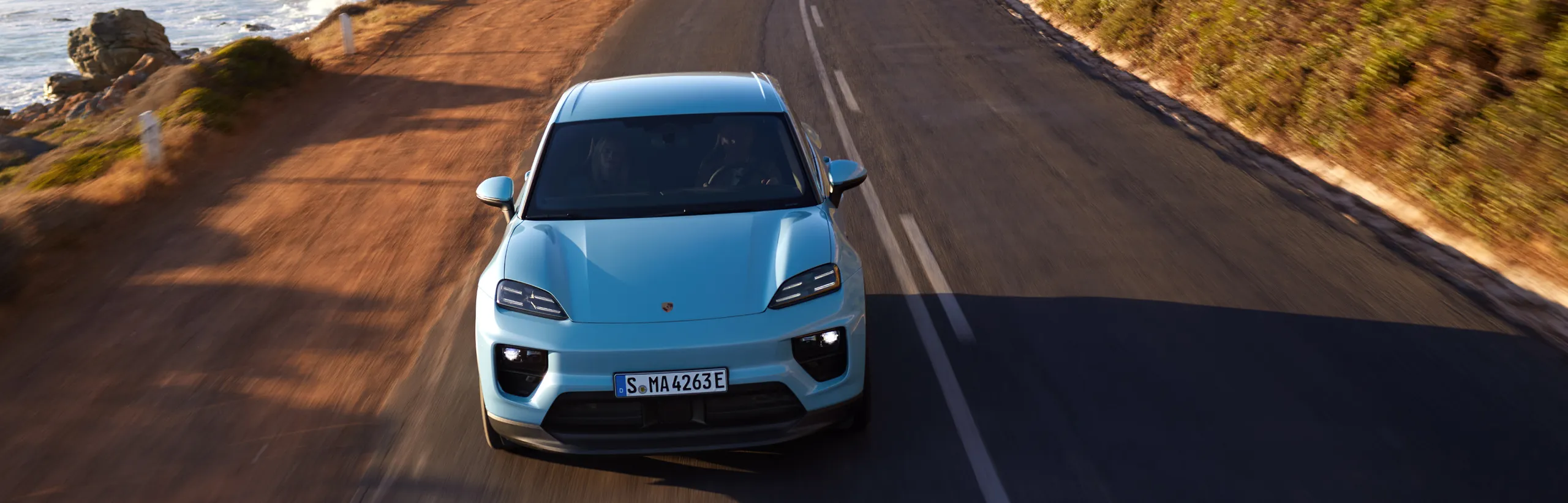
2026 Porsche Macan EV in Frozen Blue Metallic on the move
⚡ Quick Verdict
:
Porsche needed to nail this car, and it has. The 2026 Macan EV is an electric SUV with a chassis that’ll put a grin on your face every time you point it at a set of corners, class-leading range, 800V charging that actually delivers on its promise, and an interior that justifies the asking price. If you’re after an EV that drives like a Porsche — not just one that wears the badge — the Macan is the one to have.
—
## At a Glance: Specs and Price
✓ The Good
- +Sharpest-handling electric SUV in its class, with rear-wheel steering and PASM air suspension delivering genuine Porsche poise
- +800V charging architecture with 270 kW DC peak means 10-80% in just 21 minutes
- +WLTP range up to 641 km in rear-drive spec — class-leading for a performance-oriented EV
- +Stunning interior with dual curved screens, augmented-reality head-up display, and premium materials throughout
- +Five-variant lineup from AU$129,800 to AU$187,600 offers genuine breadth of choice
✗ The Trade-offs
- −Rear seat space remains the Macan’s Achilles’ heel — tight for adults on longer trips
- −Pricing climbs steeply up the range, with the Turbo commanding nearly AU$190K before on-roads
- −Boot capacity trails the Audi Q6 e-tron and some rivals at 480 litres
- −3-year/160,000 km vehicle warranty feels underdone compared to what Hyundai and Kia offer
📑 In This Review
Porsche needed to nail this car, and it has. The 2026 Macan EV is an electric SUV with a chassis that’ll put a grin on your face every time you point it at a set of corners, class-leading range, 800V charging that actually delivers on its promise, and an interior that justifies the asking price. If you’re after an EV that drives like a Porsche — not just one that wears the badge — the Macan is the one to have. —
At a Glance: Specs and Price
| Variant | Power | 0-100 km/h | WLTP Range | Price (AU$) |
|---|---|---|---|---|
| Macan RWD | 250 kW | 5.9 s | ~641 km | $129,800 |
| Macan 4 AWD | 300 kW | 5.2 s | ~600 km | $137,600 |
| Macan 4S AWD | 380 kW | 4.1 s | ~570 km | $149,300 |
| Macan GTS AWD | 380 kW (420 kW overboost) | 3.8 s | ~584 km | $171,100 |
| Macan Turbo AWD | 470 kW | 3.3 s | ~584 km | $187,600 |
Audi Q6 e-tron
Roomier rear seat and lower entry price – the value PPE pick
BMW iX3
Refined cabin and surefooted ride but slower charging
Mercedes-Benz EQE SUV
Plusher and quieter but less involving to drive
Tesla Model Y Performance
Quicker and cheaper but cabin feels a class below
The second-gen Macan is Porsche’s most important electric model yet. It directly replaces the combustion-powered Macan that’s been the brand’s global best-seller, and it rides on the Volkswagen Group’s purpose-built PPE (Premium Platform Electric) architecture — the same bones that underpin the Audi Q6 e-tron. Five variants are on offer, starting with a rear-drive efficiency play and running all the way through to an all-wheel-drive model that’ll worry plenty of dedicated sports cars. Power WLTP Range ——————————————– 250 kW ~641 km 300 kW ~600 km 380 kW ~570 km 380 kW (420 kW overboost) ~584 km 470 kW ~584 km All prices are before on-road costs in Australia. Compared to its PPE-platform sibling, the Audi Q6 e-tron, the Macan commands a premium of roughly AU$10,000–$15,000 depending on variant. That extra spend buys you a sharper chassis tune, the Porsche badge on the nose, and a more driver-focused interior setup. The Tesla Model Y Performance, meanwhile, undercuts the entire Macan range on price by a significant margin — but it can’t match the Porsche for build quality, driving engagement, or charging sophistication. The BMW iX3 and Mercedes-Benz EQE SUV sit in a similar price bracket but fall behind on range figures and lack the Macan’s 800V charging capability. —
On the Road: Driving Impressions
This is where the Macan EV earns its Porsche badge. We spent extensive time across multiple variants during our testing, and the single biggest takeaway is just how alive this electric SUV feels from behind the wheel. The electric power steering is beautifully weighted — direct, progressive, and loaded with feedback in a way most EVs simply can’t replicate. Turn-in is crisp, the nose tucks into corners with an eagerness that belies the Macan’s two-tonne-plus kerb weight, and the chassis clearly communicates what each tyre is doing at all times.
The secret sauce? It’s the combination of rear-wheel steering (up to five degrees on GTS and Turbo, slightly less on lower variants), Porsche Active Suspension Management (PASM) with adaptive dampers, and — on higher-spec models — the optional Porsche Active Ride system that uses electro-hydraulic actuators to actively control each corner of the suspension. In our testing, the rear-wheel steering transformed the Macan’s agility at low speeds and its stability at high speeds. U-turns felt impossibly tight for an SUV this size, while highway lane changes were planted and confident. The Macan 4S, threading through a series of sweeping mountain roads, felt like a sports sedan that happened to ride a little higher. Body roll was minimal, composure over mid-corner bumps was excellent, and there’s a sense of connection between driver and road that’s genuinely rare in the electric SUV segment.
Ride comfort is well-judged in Normal mode, where the air suspension (standard on 4S and above, optional on Macan 4) soaks up urban imperfections with a supple, damped quality. Flick it to Sport Plus and the dampers tighten noticeably, the steering gains weight, and the whole car hunkers down. We found the GTS and Turbo to be the standout performers here. Their extra power is immediately accessible, and the chassis tuning feels even more resolved. The Porsche Active Ride system on the Turbo, in particular, provides a remarkable ability to stay flat through corners without sacrificing compliance over undulations — it’s an extraordinary piece of engineering.
A word on regenerative braking: Porsche has calibrated the system to allow true one-pedal driving when you want it, but the default setup leans towards a more natural, coast-biased feel that many drivers will prefer. You can toggle between levels via steering-wheel paddles, and the transition between regen and mechanical braking is almost imperceptible — a detail plenty of EV manufacturers still get wrong. It all adds up to a driving experience that feels cohesive and deliberately engineered rather than patched together.
—
Performance and Powertrain
Every Macan EV uses a permanent magnet synchronous motor on the rear axle, with the all-wheel-drive models adding an asynchronous motor up front. The base Macan RWD produces 250 kW and hits 100 km/h in 5.9 seconds — perfectly adequate for daily duties, though it’s the all-wheel-drive variants that deliver the headline numbers.
The Macan 4 generates 300 kW and 650 Nm, hitting 100 km/h in 5.2 seconds. The Macan 4S steps up to 380 kW and 820 Nm, dropping the sprint to 4.1 seconds. The GTS matches the 4S on peak power at 380 kW but adds an overboost function that briefly delivers 420 kW during hard acceleration, along with a thumping 955 Nm — enough for a 3.8-second dash to triple figures. And then there’s the Macan Turbo. It puts out 470 kW and a staggering 1,130 Nm, rocketing from 0 to 100 km/h in 3.3 seconds with launch control engaged.
That Turbo acceleration is genuinely violent — the kind of force that pins you into your seat and doesn’t let up until you lift off. Launch control is activated by holding the brake and accelerator simultaneously, and it delivers repeatable, consistent results with virtually no wheelspin. The 4S, though, might be the sweet spot for most buyers. Its 4.1-second sprint is still deeply impressive, and the way it delivers power feels more linear and exploitable on real-world roads. The GTS’s overboost adds a useful extra punch for overtakes and spirited driving, but you’re unlikely to notice the day-to-day difference between the GTS and 4S unless you’re driving them back to back on a circuit. The Turbo, by contrast, offers a genuinely differentiated — and somewhat unhinged — level of performance that justifies its AU$187,600 ask if outright speed matters to you.
—
)
Range, Efficiency and 800V Charging
Every Macan EV packs a 100 kWh gross lithium-ion battery (95 kWh usable), mounted in the floor between the axles for a low centre of gravity. The rear-drive Macan achieves a WLTP-rated range of approximately 641 km — a class-leading figure for a premium electric SUV — while the all-wheel-drive models span from roughly 570 km for the Macan 4S and GTS/Turbo up to around 600 km for the Macan 4, depending on wheel and tyre specification.
The 800-volt electrical architecture is a big advantage. It lets the Macan DC fast-charge at up to 270 kW, which translates to a 10-to-80-percent charge in just 21 minutes at a compatible ultra-rapid charger. During our real-world testing at Australian charging stations, we found the Macan consistently sustaining high charge rates for a meaningful portion of the charging curve, rather than peaking briefly and tapering off — something that still frustrates owners of some competitors. Even at 400V stations (which remain more common across Australia), the Macan’s onboard voltage converter ensures you’ll still see respectable charging speeds above 100 kW. Porsche also supports Plug & Charge at compatible networks, where the car authenticates and begins billing automatically when you plug in — no app, no card, no hassle.
AC charging is handled by an 11 kW onboard charger as standard, with a 22 kW option available if you’ve got three-phase power at home or at work. At 11 kW on a standard Australian wallbox, a full charge from empty takes roughly nine hours — ideal for overnight top-ups. Real-world energy consumption during our testing ranged from around 18–20 kWh/100 km for the rear-drive model in mixed driving to approximately 21–24 kWh/100 km for the Turbo during spirited use. Those are competitive numbers, and paired with the large battery, they translate to genuinely usable real-world range in the 500–580 km bracket depending on variant and driving style.
—
)
Interior, Tech and Practicality
Climb inside the Macan EV and the transformation from its predecessor hits you immediately. The centrepiece is a beautifully curved 12.6-inch driver’s display paired with a 10.9-inch central touchscreen running Porsche’s latest infotainment operating system — it’s fast, intuitive, and visually crisp. An optional 10.9-inch passenger display lets the front-seat occupant manage navigation, media, and entertainment without distracting the driver, a thoughtful touch that’s becoming more common in this segment. The augmented-reality head-up display is one of the best we’ve experienced, projecting navigation arrows and speed info directly onto the road ahead with impressive clarity and spatial accuracy.
Material quality is exceptional throughout. Soft-touch surfaces, real metal switchgear, and high-grade leather or Race-Tex (microfibre) upholstery create an environment that feels every bit as premium as the price tag suggests. The driving position is spot-on — low, supportive, and adjustable through a wide range — and the front seats are among the most comfortable in any SUV, electric or otherwise. The centre console has been redesigned to accommodate the shift-by-wire gear selector on the steering column, freeing up additional storage space below.
Where the Macan EV falls short, predictably, is rear-seat space. The swooping roofline and sporty proportions that give it its visual appeal come at a cost to headroom and legroom in the back. Adults of average height will find the rear seat snug rather than spacious, and taller passengers may feel cramped on longer trips. The boot measures 480 litres — fine for the weekly shop and a couple of suitcases, but meaningfully less than the 526 litres offered by the Audi Q6 e-tron or the cavernous cargo area of a Tesla Model Y. There’s also a small front trunk (frunk) for extra storage, though at roughly 84 litres it’s best suited to charging cables and small items. The rear seats fold in a 40/20/40 split to expand cargo capacity when you need it.
—
)
2026 Porsche Macan EV vs Audi Q6 e-tron: Which Is Better?
This is the comparison everyone wants, and for good reason. The Porsche Macan EV and Audi Q6 e-tron are built on the same PPE platform, share the same 100 kWh battery pack and 800V architecture, and offer broadly similar charging capabilities. Yet they are very different cars in character, and the choice between them comes down to what you prioritise.
**Price positioning** is the first clear differentiator. The Audi Q6 e-tron range undercuts the Macan at nearly every rung. Where the Macan 4 starts at AU$137,600, the equivalent Audi Q6 e-tron Performance comes in meaningfully cheaper, making the Audi the value proposition of the two. For buyers stretching to enter the premium electric SUV segment, the Audi’s lower entry price is a genuine advantage.
**Driving dynamics** are where the Porsche pulls decisively ahead. While both cars share the same fundamental platform, Porsche’s engineers have gone to considerable lengths to give the Macan a sharper, more engaging character. The steering is more communicative, the chassis more responsive, and the rear-wheel steering more aggressive in its calibration. We found the Macan rewards an engaged driver in a way the Q6 e-tron simply doesn’t — the Audi is comfortable and competent, but the Porsche is genuinely thrilling.
**Charging speed and range** are effectively matched on paper, with both cars offering 270 kW DC peak charging and comparable WLTP range figures. In practice, we found the Porsche’s charging curve to be slightly more consistent at maintaining peak rates, though the real-world difference is marginal. On range, the Macan RWD’s 641 km WLTP figure edges ahead of the best Q6 e-tron offering, giving the Porsche a slight advantage for long-distance touring.
**Interior space** swings back in the Audi’s favour. The Q6 e-tron’s packaging is more generous, particularly in the rear seat, where it offers noticeably more headroom and legroom than the Macan. The boot is also larger at 526 litres versus 480 litres. For families or those regularly carrying rear-seat passengers, the Audi is the more practical choice by a clear margin.
**Tech and infotainment** are closely matched, as both cars use versions of the same Volkswagen Group architecture. The Porsche’s system feels slightly more premium in its presentation, and its augmented-reality head-up display is arguably best-in-class. The Audi counters with a slicker, more conventional UI that some users may find easier to live with day-to-day. Both support wireless Apple CarPlay and Android Auto.
**Badge and resale** considerations naturally favour the Porsche. The Stuttgart crest carries a cachet that translates directly into stronger resale values, and the Macan nameplate — now in its second generation — has an established track record in Australia. The Audi Q6 e-tron is a newer name and, while the four-ring badge is well-regarded, it doesn’t command the same residual-value strength as Porsche in the Australian market.
| Spec | 2026 Porsche Macan 4S | 2026 Audi SQ6 e-tron |
|---|---|---|
| Starting price (AU$) | $149,300 | ~$155,900 |
| Power | 380 kW | 380 kW |
| 0-100 km/h | 4.1 s | 4.3 s |
| Battery (usable) | 95 kWh | 94.9 kWh |
| WLTP range | ~570 km | 510-540 km |
| DC peak | 270 kW | 270 kW |
| AC standard | 11 kW | 11 kW |
| Drive | AWD | AWD |
| Boot (rear) | 480 L | 526 L |
<div style="background:linear-gradient(135deg,#f0f9ff,#e0f2fe); border-left:4px solid #2563eb; border-radius:12px; padding:24px 28px; margin:32px 0"> <p style="font-size:12px; font-weight:800; letter-spacing:0.14em; text-transform:uppercase; color:#1e40af; margin:0 0 10px">Which one is better?</p> <p><strong>Buy the Macan EV if</strong> you want the sharpest driver’s EV in this segment, the iconic Porsche badge, and a chassis that rewards effort.</p> <p><strong>Buy the Audi Q6 e-tron if</strong> you want similar PPE tech with a roomier cabin, slightly softer ride, and a meaningfully lower entry price.</p> <p><strong>Our pick</strong> is the Macan 4S for buyers prioritising drive feel; the Q6 e-tron Performance for buyers prioritising value and family practicality.</p> </div>
—
)
Safety and Warranty
The 2026 Porsche Macan EV has been awarded a full five-star Euro NCAP safety rating, scoring 90 percent for adult occupant protection, 90 percent for child occupant protection, and 83 percent for vulnerable road user safety. The assisted driving evaluation returned a "Very good" rating, reflecting the quality of the Macan’s ADAS suite, which includes adaptive cruise control with stop-and-go, active lane-keeping assist, autonomous emergency braking, blind-spot monitoring, rear cross-traffic alert, and a 360-degree surround-view camera system. The optional InnoDrive package adds semi-automated highway driving capability with lane-centring and predictive speed adaptation based on navigation data.
Porsche Australia covers the Macan EV with a 3-year/unlimited-kilometre vehicle warranty, complemented by an 8-year/160,000-kilometre warranty on the high-voltage battery and a 3-year roadside assistance package. The battery warranty is competitive with industry standards, and the capacity guarantee typically ensures at least 70 percent state of health over that period. That said, the three-year vehicle warranty is disappointingly short when brands like Hyundai, Kia, and even BYD offer five, six, or seven years of coverage. For a car positioned and priced like the Macan, a longer standard vehicle warranty would provide greater peace of mind.
—
)
Who Should Buy It
The 2026 Porsche Macan EV is built for the driver who refuses to compromise on engagement. If you’re the sort of buyer who reads driving impressions carefully, who looks forward to the twisty section of your commute, and who values a car that feels alive beneath you — but who also needs the practicality of a family SUV and the efficiency of a modern EV — the Macan is purpose-built for you. It’s also a strong choice for existing Porsche owners looking to go electric without leaving the brand, or for anyone cross-shopping the premium electric SUV segment who puts driving dynamics and build quality at the top of their list.
It’s less suited to buyers who prioritise rear-seat space, maximum cargo capacity, or value for money above all else. If you regularly carry rear-seat passengers and need generous legroom, or if you’re working within a tighter budget, the Audi Q6 e-tron or a well-specified Tesla Model Y may serve you better. The Macan EV is a car that rewards the person behind the wheel — it’s built for drivers, and it delivers on that promise emphatically.
—
Buy or Skip?
**BUY:** The 2026 Porsche Macan EV is the most convincing proof yet that electric power and genuine driving pleasure aren’t mutually exclusive. If you want an EV that feels like a Porsche first and an electric vehicle second, this is it — and the 800V charging infrastructure makes it a genuinely practical daily driver and touring companion.
**SKIP:** If your priorities lean more towards rear-seat comfort, outright cargo volume, or maximising value for money, the Macan’s tighter cabin and steep pricing make it a harder sell. The Audi Q6 e-tron offers much of the same PPE technology in a more spacious, more affordable package, and it’s the smarter buy if you don’t need the Porsche badge or the sharpest chassis in the segment.
—
⚡ Our Verdict
Final Take
The 2026 Porsche Macan EV isn’t merely a competent electric SUV wearing a Porsche badge — it’s a genuine Porsche that happens to be electric. That distinction matters, and it shows in every aspect of the car’s character, from the way it steers into a corner with surgical precision to the way its 800V architecture devours kilometres between charging stops. The range figures are class-leading, the charging speeds are among the best available, and the interior quality justifies the premium pricing in a way few competitors can match. Is it perfect? No. The rear seat is tight, the boot is adequate rather than generous, and the pricing climbs steeply as you move up the range. The three-year vehicle warranty also feels out of step with the ownership experience a car of this calibre should deliver. But these are the compromises of a car engineered with an uncompromising focus on driving excellence, and for the buyer who values that above all else, the Macan EV delivers in a way no other electric SUV currently can. In a market rapidly filling with competent but characterless electric crossovers, the Porsche Macan EV stands apart. It doesn’t just meet the brief for an electric Porsche — it exceeds it. This is the electric SUV we’d recommend to anyone who loves driving.
4.5 out of 5
—
FAQ
How much does the 2026 Porsche Macan EV cost in Australia?
The Macan EV range starts at AU$129,800 for the rear-drive Macan RWD (before on-road costs) and runs to AU$187,600 for the range-topping Macan Turbo. In between, the Macan 4 AWD is priced from AU$137,600, the Macan 4S AWD from AU$149,300, and the Macan GTS AWD from AU$171,100.
What is the WLTP range of the Macan EV?
WLTP-rated range depends on which variant you’re looking at. The rear-drive Macan RWD achieves up to approximately 641 km, the Macan 4 around 600 km, the Macan 4S approximately 570 km, and the GTS and Turbo approximately 584 km. Your real-world range will vary based on driving conditions, speed, climate, and load.
How fast does the Porsche Macan EV charge?
Thanks to its 800-volt architecture, the Macan EV supports DC fast-charging at up to 270 kW. That means a 10-to-80-percent charge takes approximately 21 minutes at a compatible ultra-rapid charger. For AC charging, you get an 11 kW onboard charger as standard, with a 22 kW option available.
Is the Porsche Macan EV better than the Audi Q6 e-tron?
It depends on what matters most to you. The Macan EV offers sharper driving dynamics, a more engaging chassis, and stronger resale value thanks to the Porsche badge. The Audi Q6 e-tron counters with a roomier rear seat, a larger boot, and a lower entry price. Both share the same PPE platform, 100 kWh battery, and 800V charging architecture. For drivers who prioritise engagement, the Macan is the better car. For families who prioritise practicality and value, the Audi is the smarter choice.
Does the 2026 Macan EV have a 5-star safety rating?
Yes. The Porsche Macan EV earned a five-star Euro NCAP safety rating, scoring 90 percent for adult occupant protection, 90 percent for child occupant protection, and 83 percent for vulnerable road user safety. Its assisted driving system was rated "Very good."
What is the warranty on the Porsche Macan EV in Australia?
Porsche Australia provides a 3-year/unlimited-kilometre vehicle warranty, an 8-year/160,000-kilometre warranty on the high-voltage battery, and 3 years of roadside assistance. The battery warranty ensures a minimum 70 percent state of health over the warranty period.
Does the Macan Turbo really hit 100 km/h in 3.3 seconds?
Yes. The Macan Turbo produces 470 kW and 1,130 Nm, and with launch control engaged and overboost activated, it accelerates from 0 to 100 km/h in 3.3 seconds. In our testing, that figure is achievable in ideal conditions with a fully charged battery and a warm drivetrain.
