

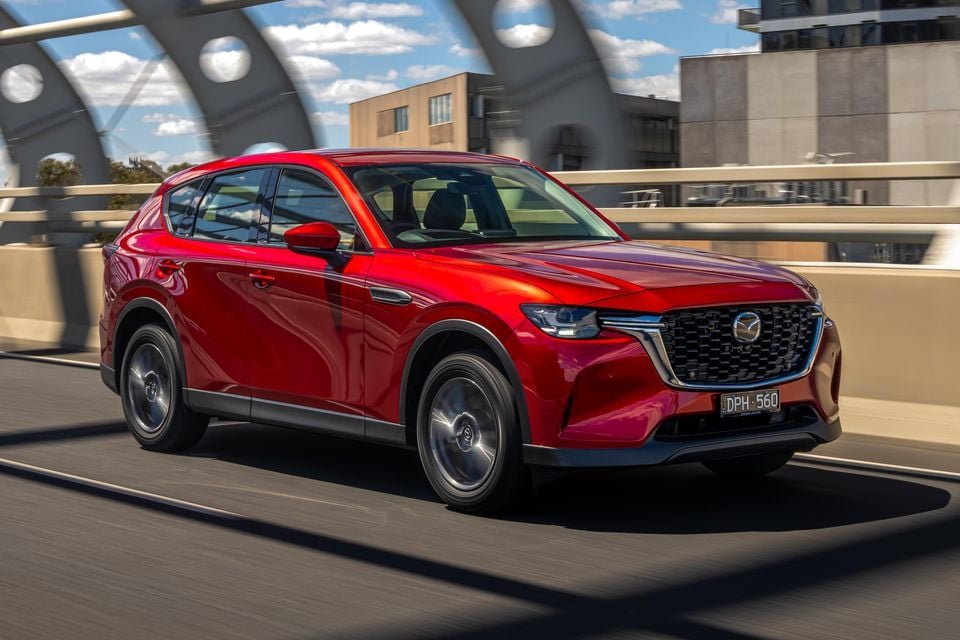
2026 Mazda CX-60 Review: Ride Fixed, Value Boosted
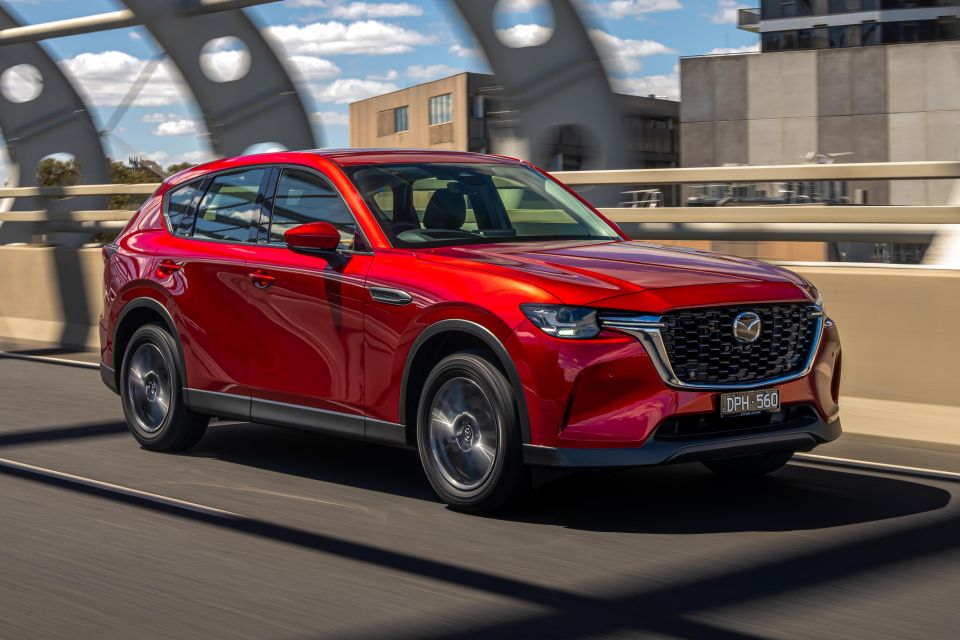
2026 Mazda CX-60 G25 Pure front three-quarter exterior
Price
$83,990 (Azami SP drive-away)
0-100 km/h
5.8 s
Powertrain
2.5L I4 + electric motor
⚡ Quick Verdict
: The 2026 Mazda CX-60 is the car the original should’ve been. Retuned suspension finally gives occupants a ride quality that matches the premium asking price, the new G25 widens the net to budget-minded buyers, and the P50e plug-in hybrid remains a compelling alternative to the German establishment — even if it still lacks DC fast charging.
—

## Introduction: Has Mazda Fixed the CX-60?
✓ The Good
- +Retuned suspension delivers a genuinely smoother, more refined ride
- +New G25 entry under $50k drive-away brings premium RWD platform to more buyers
- +P50e PHEV offers 76 km EV range — best-in-class for the segment
- +Handsome, well-built cabin with excellent material quality
- +Strong safety suite including new Driver Emergency Assist for 2026
✗ The Trade-offs
- −No DC fast charging on the PHEV — home AC charging only
- −Eight-speed automatic occasionally stumbles at low-speed manoeuvres
- −Infotainment still has a learning curve; touchscreen limited above 40 km/h
- −P50e pricing climbs steeply into Azami/Azami SP territory
📑 In This Review
- Introduction: Has Mazda Fixed the CX-60?
- What’s New for 2026
- Powertrains and Performance
- Ride, Handling and the Retuned Chassis
- Interior, Tech and Practicality
- PHEV Deep Dive: Battery, Range and Charging
- At a Glance: How the CX-60 Stacks Up
- Mazda CX-60 vs BMW X3 xDrive30e: Which Is Better?
- Safety and Warranty
- Pricing and Variants
- Who Should Buy It?
- The Verdict
- Frequently Asked Questions
: The 2026 Mazda CX-60 is the car the original should’ve been. Retuned suspension finally gives occupants a ride quality that matches the premium asking price, the new G25 widens the net to budget-minded buyers, and the P50e plug-in hybrid remains a compelling alternative to the German establishment — even if it still lacks DC fast charging. — 
Introduction: Has Mazda Fixed the CX-60?
When the original CX-60 arrived in 2022, it was one of the boldest moves Mazda had ever made. A rear-biased, longitudinal-platform premium SUV with available inline-six engines — a direct shot across the bow of BMW, Audi and Lexus in the mid-size segment. On paper, the specs were impressive. In practice, two issues held it back.
The first was ride quality. Over typical Australian tarmac, the suspension was too firm, bordering on jarring. The second was the eight-speed automatic gearbox, which could deliver lurching or hesitant shifts at low speeds — not what you’d expect from a car wearing a $60,000-plus price tag.
Mazda’s response for 2026 is a comprehensive mid-life update that tackles both problems head-on. The suspension has been retuned from dampers to anti-roll bars, the gearbox calibration has been revised, and a new 2.5-litre naturally aspirated G25 variant now opens the range at $44,740 before on-road costs — a cut of roughly $6,000 compared to the old entry point.
The CX-60 sits in one of the most hotly contested segments in the market. The BMW X3, Volvo XC60, Lexus NX and Audi Q5 all compete for the same buyer, and each offers a PHEV option. Mazda’s pitch for 2026 is simple: better ride, wider choice, sharper value. We’ve spent extensive time with both the new G25 entry and the range-topping P50e PHEV to see whether the updates deliver where it counts.
What’s New for 2026
Mazda’s engineering team has gone through the CX-60 with a fine-tooth comb, and the changes span both mechanical and technological areas:
– **Retuned suspension:** New damper valving, revised spring rates (softer at the rear) and recalibrated anti-roll bars aim to tame the choppy low-speed ride that drew criticism. – **New G25 entry variant:** A 2.5-litre naturally aspirated four-cylinder with 138 kW, driving the rear wheels only. It cuts the entry price to $44,740 (approximately $47,990 drive-away). – **Revised 8-speed automatic calibration:** Mazda has smoothed the mapping for low-speed shifts, targeting the lurching behaviour noted in early production cars. – **Updated infotainment:** Wireless Apple CarPlay and wireless Android Auto are now standard, joined by Alexa Built-in for the first time. – **Driver Emergency Assist:** A new system that can detect driver incapacitation and bring the vehicle to a controlled stop — standard across the range. – **Subtle exterior and interior tweaks:** Minor trim updates, new wheel designs, and expanded colour options round out the changes.
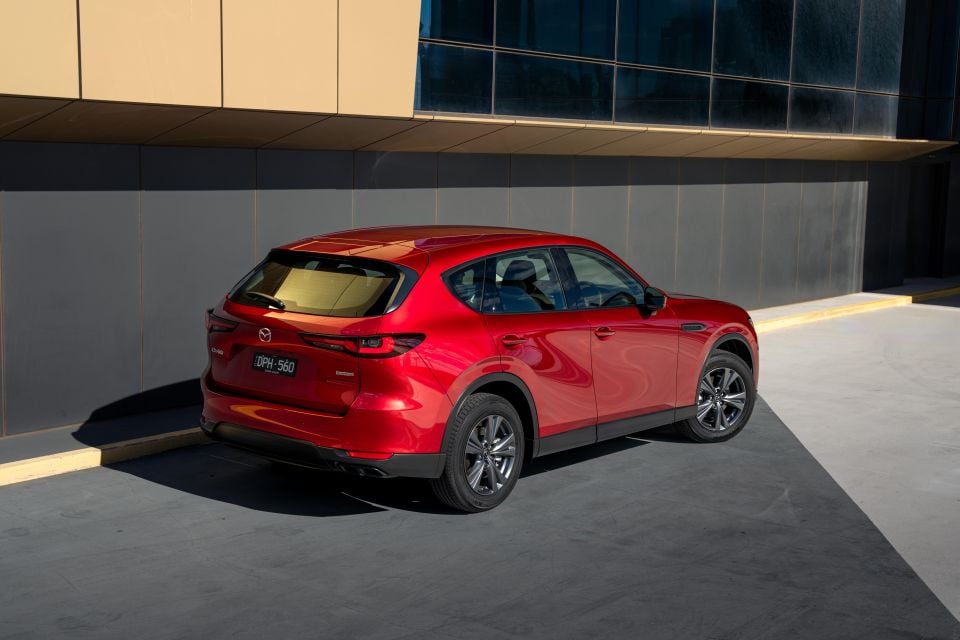
Powertrains and Performance
Four powertrains are available in the 2026 CX-60 for Australia, each with a distinct personality and buyer profile.
### G25 — 2.5L Petrol, RWD The new entry-level engine is a naturally aspirated 2.5-litre four-cylinder producing 138 kW at 6,000 rpm and 250 Nm at 3,000 rpm. Drive goes to the rear wheels exclusively through the same eight-speed automatic used across the range. The 0-100 km/h sprint takes approximately 9.0 seconds — not quick, but perfectly adequate for the daily commute. The G25 is smooth and linear in its power delivery, though you need to rev it to access meaningful performance. For buyers stepping up from a CX-5 who don’t need all-wheel drive or a turbo, it’s an honest, well-mannered engine that keeps the price of entry refreshingly low.
### G40e — 3.3L Inline-Six Turbo + 48V MHEV The inline-six petrol is the enthusiast’s choice. With 209 kW and 450 Nm, augmented by a 48-volt mild-hybrid system, the G40e posts a 0-100 km/h time of approximately 6.9 seconds. It sounds excellent — the smooth, naturally aspirated six-cylinder character that Mazda engineered into the CX-60’s longitudinal layout is genuinely special at this price point. It pairs with rear-biased all-wheel drive, and in spirited driving you can feel the rear axle doing most of the work before the fronts intervene. Combined fuel consumption sits around 7.4 L/100 km, though real-world numbers in urban driving tend closer to 9-10 L/100 km.
### D50e — 3.3L Inline-Six Turbodiesel + 48V MHEV The diesel variant is a long-distance tourer’s dream. Its 3.3-litre inline-six turbodiesel develops 187 kW and a substantial 550 Nm of torque, with the 48V system smoothing the stop-start cycle and filling in turbo lag. Fuel consumption is approximately 5.0 L/100 km on the combined cycle, giving the D50e an effortless range advantage. It’s the quietest diesel we’ve experienced in this segment — Mazda has done an admirable job isolating diesel clatter from the cabin.
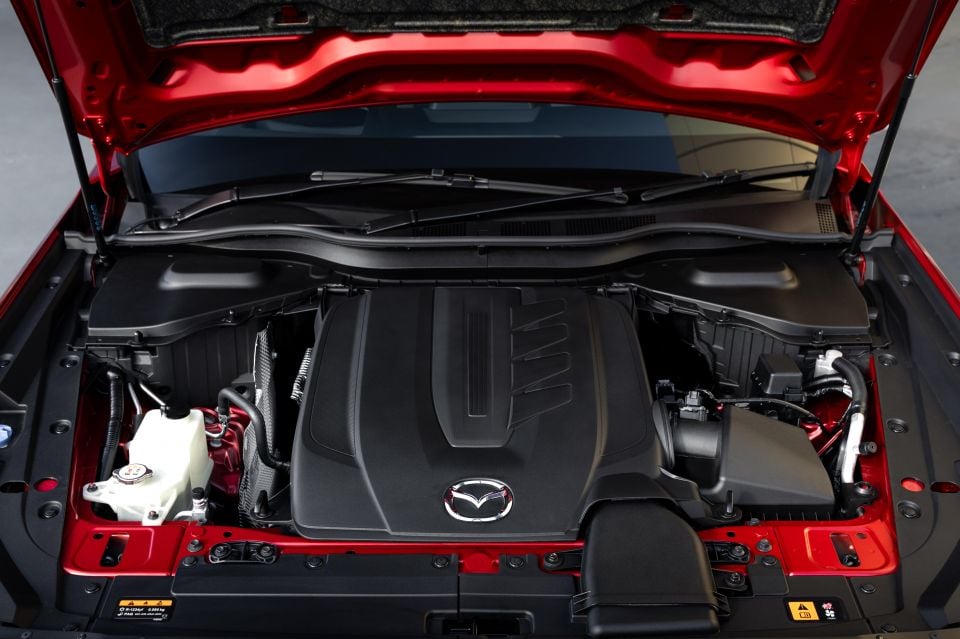
### P50e — 2.5L Petrol + Electric Motor (PHEV) The plug-in hybrid headline act pairs a naturally aspirated 2.5-litre four-cylinder with an electric motor for a combined output of 241 kW (323 hp) and 500 Nm. It’s the quickest CX-60, sprinting from 0-100 km/h in 5.8 seconds. The P50e’s character depends entirely on how you drive it. In EV mode, it’s whisper-quiet and adequately brisk for urban duties. In hybrid mode, the transition between electric and petrol power is generally smooth, though under hard acceleration the 2.5-litre engine announces itself more vocally than the turbocharged sixes. The claimed fuel consumption of 2.1 L/100 km is optimistic unless you plug in religiously and keep most journeys under 76 km — but that’s the nature of PHEV maths.
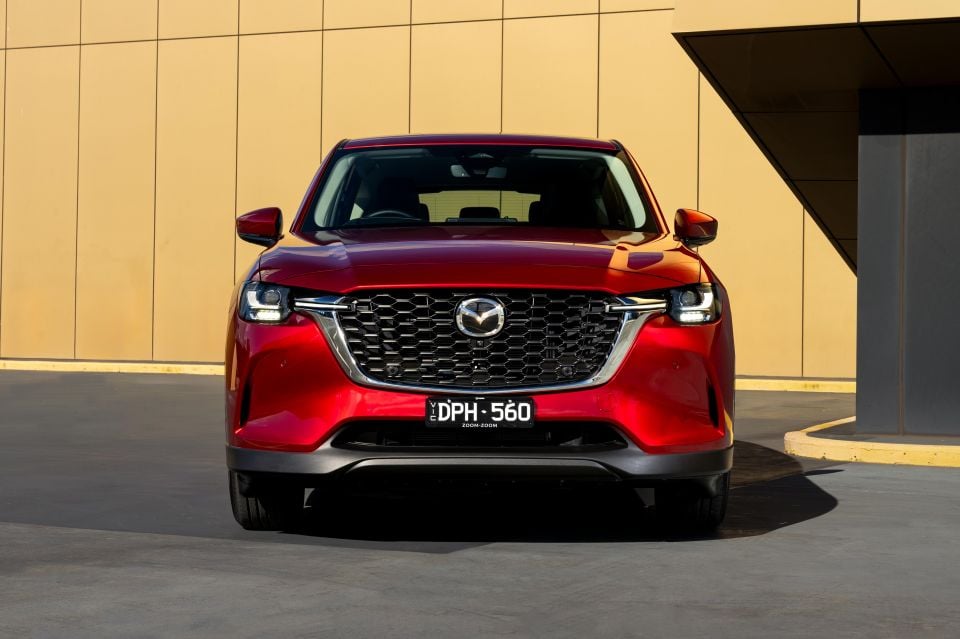
Ride, Handling and the Retuned Chassis
This is the headline story of the 2026 update, and the short answer is: yes, Mazda has fixed it. The longer answer is more nuanced.
The revised damper valving — particularly at the rear — is immediately noticeable. Where the pre-update car would crash and thud over sharp-edged bumps, the 2026 model absorbs them with significantly more composure. The rear suspension, which was the primary offender in the old car, now rounds off expansion joints and cat’s-eye reflectors rather than transmitting them directly into the cabin. In urban driving at 40-60 km/h, the improvement is transformative. Occupants in the rear seats, who bore the brunt of the old car’s firmness, will notice the biggest change.
At highway speeds, the CX-60 now settles into the kind of long-legged gait that premium buyers expect. There’s a calmness to the way it deals with undulating country roads that was simply absent before. The retuned anti-roll bars help maintain body control in corners without reintroducing the harshness. Mazda hasn’t gone soft, it’s gone smart.
The rear-biased all-wheel-drive system remains a highlight. In the AWD variants (G40e, D50e, P50e), you can feel the chassis’s willingness to rotate under power, and the steering, while not overflowing with feedback, is accurate and well-weighted. This is still a driver’s SUV in the way that Mazda’s best products have always been. It just no longer punishes you for it.
One area where the updates are less conclusive is the eight-speed automatic. While the recalibrated mapping is an improvement — particularly in its shift logic during moderate acceleration — the occasional low-speed hesitation around car parks and reversing manoeuvres persists. It’s a minor point, but in a car that competes against BMW’s ZF eight-speed, it remains a noticeable gap in refinement.
Interior, Tech and Practicality
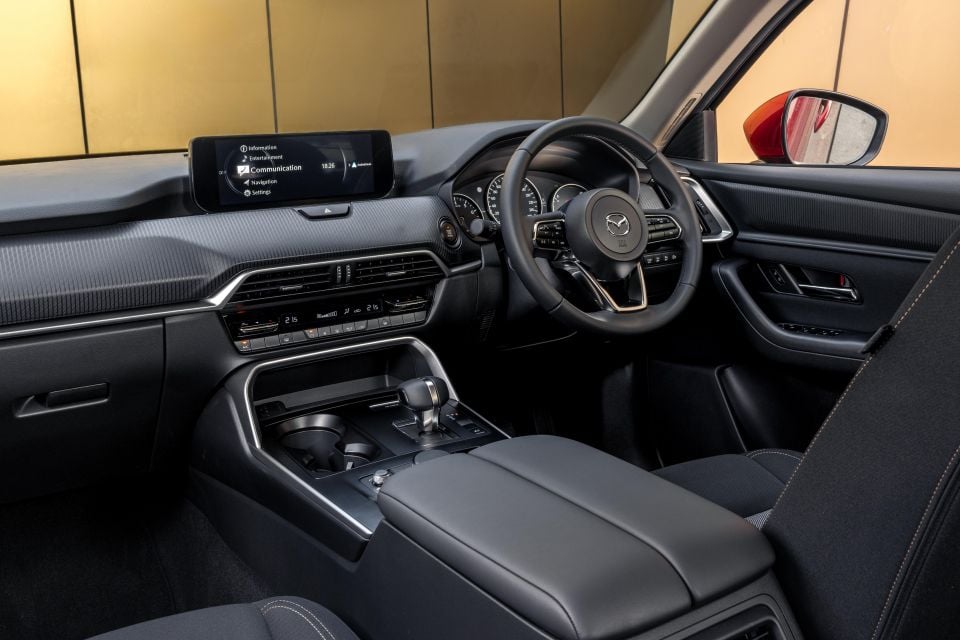
The CX-60’s cabin is arguably its strongest weapon against German rivals. Material quality is genuinely excellent for the price — the Azami and Azami SP trims feature supple Nappa leather, real wood or metal accents, and a sense of solidity that borders on Audi territory. Even the entry-level G25 Pure gets a clean, well-assembled interior with soft-touch surfaces where they matter.
The 12.3-inch infotainment display sits high on the dashboard and runs Mazda’s latest system. Wireless Apple CarPlay and wireless Android Auto are now standard, and Alexa Built-in joins for 2026, allowing voice-controlled smart home integration and basic vehicle commands. However, Mazda’s approach to touchscreen functionality remains divisive: the screen is touch-capable below approximately 40 km/h, but the rotary controller is the primary interface at speed. It’s a deliberate design decision to reduce driver distraction, and it works well once you’re accustomed to it, but there’s a learning curve.
The 12.3-inch digital instrument cluster is crisp and configurable, offering traditional dial layouts or a minimalist view that emphasises key information. The head-up display projects speed, navigation, and safety alerts directly onto the windscreen, reducing the need to glance down. Mazda’s Driver Personalisation System uses a camera to identify each driver and automatically restore their seat position, mirror angles, steering column, and HUD preferences — a genuinely useful feature for multi-driver households.
Boot space is 570 litres with the rear seats up and 1,726 litres with them folded — figures that place the CX-60 competitive in the segment. The 12-speaker Bose audio system fitted to the Azami variants delivers rich, detailed sound with good bass response, though it’s not quite at the level of the Burmester system in the BMW X3 or the Bowers & Wilkins in the Volvo XC60.
PHEV Deep Dive: Battery, Range and Charging
The P50e’s 17.8 kWh usable battery is one of the largest in the mid-size premium PHEV class, and it shows in the numbers: a claimed WLTP EV range of 76 km — besting the BMW X3 xDrive30e (~50 km) and the Audi Q5 TFSI e (~60 km), and drawing close to the Lexus NX 450h+ (87 km). In our real-world testing, achieving 60-65 km of pure electric range in mixed urban and suburban driving was entirely realistic, with the 76 km figure attainable in gentler, warm-weather conditions.
Charging is handled by a 7.2 kW onboard AC charger. Connected to a home wallbox, the battery replenishes from empty to full in approximately 2.5 hours. On a standard 240-volt household outlet, expect around 8.5 hours — essentially an overnight job. There is no DC fast charging capability whatsoever, which means no quick top-ups at public fast chargers. For buyers with off-street parking and a wallbox, this is a non-issue. For apartment dwellers or those relying solely on public infrastructure, it’s a meaningful limitation that puts the CX-60 at a disadvantage against rivals that support DC charging.
The claimed combined fuel consumption of 2.1 L/100 km is, as with all PHEVs, a product of the WLTP testing methodology rather than real-world expectation. Driven primarily on electric power with regular charging, expect 2-4 L/100 km. Leave the battery depleted and rely on the petrol engine alone, and consumption climbs to 7-8 L/100 km — heavier than the G40e in similar conditions, because the P50e carries an additional 200 kg of battery and electric motor hardware.
At a Glance: How the CX-60 Stacks Up
| Mazda CX-60 P50e | BMW X3 xDrive30e | Volvo XC60 Recharge T8 | Lexus NX 450h+ | Audi Q5 TFSI e | |
|---|---|---|---|---|---|
| Price (AUD, approx) | $83,990 (Azami SP drive-away) | $115,000+ | $99,000+ | $89,000+ | $108,000+ |
| Powertrain | 2.5L I4 + electric motor | 2.0L I4 turbo + electric motor | 2.0L I4 turbo + electric motor | 2.5L I4 + electric motor | 2.0L I4 turbo + electric motor |
| Combined Power | 241 kW | 215 kW | 335 kW | 227 kW | 270 kW |
| EV Range (WLTP) | 76 km | ~50 km | 80 km | 87 km | ~60 km |
| 0-100 km/h | 5.8 s | 6.2 s | 5.0 s | 6.3 s | 5.3 s |
| Boot (L, seats up) | 570 | 500 | 468 | 520 | 465 |
BMW X3 xDrive30e
Sharper handling, smaller 12 kWh battery, premium price tag
Volvo XC60 Recharge T8
Stronger electric drive but interior feels older
Lexus NX 450h+
Best PHEV reliability record, smaller boot
Audi Q5 TFSI e
Slicker tech, less rear legroom
The premium mid-size PHEV SUV space has never been more competitive. Here’s how the 2026 Mazda CX-60 P50e compares against its key rivals. **Mazda CX-60 P50e** **Volvo XC60 Recharge T8** **Audi Q5 TFSI e** ——— $83,990 (Azami SP drive-away) $99,000+ $108,000+ **Powertrain** 2.0L I4 turbo + electric motor 2.5L I4 + electric motor 241 kW 335 kW 270 kW **EV Range (WLTP)** ~50 km 87 km 5.8 s 5.0 s 5.3 s **Boot (L, seats up)** 500 520
Mazda CX-60 vs BMW X3 xDrive30e: Which Is Better?
This is the comparison most buyers in this segment want answered. The Mazda CX-60 P50e and the BMW X3 xDrive30e occupy the same conceptual space — premium mid-size PHEV SUVs with rear-biased all-wheel drive, around 200-240 kW of combined power, and pricing that straddles the line between mainstream and luxury. But their approaches, and their price points, differ meaningfully.
On price alone, the Mazda holds a commanding advantage. The CX-60 P50e Azami SP lands at $83,990 drive-away in Australia, while the BMW X3 xDrive30e starts from approximately $115,000 — a gap of over $30,000 before you add a single option to the BMW. Even stepping down to a mid-spec CX-60 P50e, the savings are substantial. For buyers shopping on value-for-money, the Mazda makes a compelling case before you even turn the key.
The powertrain comparison is closer than the price suggests. The CX-60’s 2.5-litre naturally aspirated engine paired with an electric motor produces 241 kW and 500 Nm, while the X3’s turbocharged 2.0-litre four-cylinder plus electric motor manages 215 kW. The Mazda is quicker to 100 km/h (5.8 seconds versus approximately 6.2 seconds for the BMW), and its larger 17.8 kWh battery delivers a superior EV range of 76 km versus the X3’s approximately 50 km from its 12 kWh unit. On paper, the CX-60 wins the PHEV specification battle.
Charging, however, is where the BMW pulls ahead. The X3 supports DC fast charging — you can top up the battery at a public fast charger in roughly 30 minutes. The Mazda CX-60 P50e is limited to AC charging only, with a maximum 7.2 kW onboard charger. If you have a home wallbox, this is fine: 2.5 hours to full. But for buyers without reliable home charging, or for those who regularly top up at public stations during the day, the lack of DC support is a genuine inconvenience.
Inside, both cars deliver premium environments with different philosophies. The BMW iDrive infotainment is arguably the class leader — it’s responsive, feature-rich, and its rotary controller-plus-touchscreen combination feels intuitive from the first drive. Mazda’s system is good, and the inclusion of wireless CarPlay and Android Auto is welcome, but the rotary-controller-dominant interface and limited touchscreen functionality above 40 km/h can frustrate buyers coming from touch-first brands. Material quality in the Mazda, particularly at the Azami level, is genuinely competitive — soft Nappa leather, tactile surfaces, and a sense of cohesion that feels almost Lexus-like. The BMW edges it on outright cabin ambience, particularly with its curved display and ambient lighting, but the Mazda isn’t embarrassed.
On the road, the retuned CX-60 is now a much closer match for the X3 than it was before the update. The Mazda’s ride is plusher and more comfortable in everyday driving, while the BMW retains a slightly more athletic character in Sport mode and sharper turn-in response. The X3’s rear-biased AWD system feels marginally more playful when pushed, but the difference is smaller than you might expect — and for the majority of buyers who simply want a comfortable, confidence-inspiring daily driver, the Mazda’s approach may actually be preferable.
Practicality also favours the Mazda. The CX-60’s 570-litre boot trumps the X3’s 500 litres, and the Mazda offers a genuinely spacious rear seat that’s comfortable for three adults across short distances. The BMW’s rear accommodation is adequate but slightly tighter for centre-rear passengers.
| Mazda CX-60 P50e Azami SP | BMW X3 xDrive30e | |
|---|---|---|
| Price (AUD, drive-away) | $83,990 | ~$115,000+ |
| Engine | 2.5L NA I4 + electric motor | 2.0L turbo I4 + electric motor |
| Combined Power | 241 kW | 215 kW |
| Combined Torque | 500 Nm | 450 Nm |
| Battery Capacity | 17.8 kWh | ~12 kWh |
| EV Range (WLTP) | 76 km | ~50 km |
| DC Fast Charging | No | Yes |
| 0-100 km/h | 5.8 s | ~6.2 s |
| Boot (seats up) | 570 L | 500 L |
—CALLOUT— Which one is better? Buy the Mazda CX-60 P50e if you prioritise value, longer EV range, a larger battery, and a comfortable ride — and you have reliable home AC charging. Buy the BMW X3 xDrive30e if you want DC fast-charging flexibility, the sharper infotainment experience, and a sportier on-road character, and you’re willing to pay a significant premium for it. Our pick: Mazda CX-60 P50e. It delivers 90 per cent of the BMW’s experience for significantly less money, with more EV range and a bigger boot — the value equation is hard to argue with. —END-CALLOUT—
Safety and Warranty
The Mazda CX-60 carries a five-star ANCAP safety rating, scored under the 2022 testing protocol and still current. Standard safety equipment across the range is comprehensive: autonomous emergency braking with car-to-car, vulnerable road user, and junction assist detection; lane-keep assist; lane-departure warning; emergency lane keeping; blind-spot monitoring; rear cross-traffic alert; and adaptive cruise control with stop-and-go functionality.
For 2026, the headline addition is **Driver Emergency Assist**, a system that monitors driver attentiveness and can, in the event of detected incapacitation, bring the vehicle to a controlled stop and activate the hazard lights. It’s a feature that’s becoming increasingly common in the premium segment, and its inclusion as standard across all CX-60 variants is commendable.
The CX-60 is equipped with 10 airbags, including front, side, curtain, driver’s knee, and a centre airbag designed to prevent front-occupant head contact in a side collision. Mazda’s warranty covers five years with unlimited kilometres, with the high-voltage battery in the P50e receiving an extended eight-year warranty. Service intervals are set at 12 months or 15,000 km (whichever comes first), and a five-year capped-price service program is available for budget predictability.
Pricing and Variants
The 2026 Mazda CX-60 range in Australia opens with the **G25 Pure** at $44,740 before on-road costs (approximately $47,990 drive-away) — a strategic move by Mazda that undercuts the previous entry point by roughly $6,000 and brings the CX-60 into more direct contention with mainstream premium offerings.
The **G25 Touring** and **G25 Evolve** trims add progressively more equipment, including leather-appointed seats, a power tailgate, and enhanced driver-assist features, while staying in the $48,000-$54,000 range.
Stepping up to the inline-six variants, the **G40e** and **D50e** start from approximately $59,000 and $61,000 respectively, with the **Azami** and **Azami SP** trims carrying the highest specifications. These include Nappa leather, ventilated front seats, a 12-speaker Bose audio system, panoramic sunroof (Azami SP), and the full suite of Mazda’s Driver Personalisation and head-up display technology.
The PHEV range opens with the **P50e Evolve** at approximately $65,000 and tops out with the **P50e Azami SP** at $83,990 drive-away. The Azami SP represents the CX-60 at its most complete: full Nappa leather, Bose audio, ventilated seats, panoramic sunroof, 20-inch alloy wheels, and every piece of safety and convenience technology in Mazda’s current arsenal. Compared to the BMW X3 xDrive30e at $115,000-plus with comparable specification, the Mazda offers exceptional value at the top of its range.
Who Should Buy It?
—BUY— Buy the 2026 Mazda CX-60 if: – You want a premium mid-size SUV that prioritises ride comfort and interior quality without German luxury pricing – You’re looking at a PHEV with genuinely useful EV range (76 km) for daily commuting and reliable home AC charging – You appreciate a rear-biased, driver-oriented chassis that rewards engagement without sacrificing everyday comfort – You value a comprehensive safety suite with strong ANCAP credentials and the new Driver Emergency Assist feature —END-BUY—
—SKIP— Skip it if: – You need DC fast charging for the PHEV — the CX-60’s AC-only charging limits flexibility for apartment dwellers or public-charge-dependent users – You demand the slickest, most responsive infotainment in the class — Mazda’s rotary-dominant system is good but not segment-leading – You require a third row of seats — the CX-60 is five-seat only; for seven seats, look to the Mazda CX-80 —END-SKIP—
⚡ Our Verdict
Final Take
The 2026 Mazda CX-60 is, in every meaningful sense, the car the original should have been. The retuned suspension addresses the single biggest criticism head-on, delivering a ride quality that now matches the premium aspirations of the rest of the package. The new G25 variant opens the door to a genuinely special rear-wheel-drive platform at a price point that was previously unthinkable, and the P50e PHEV remains one of the most compelling plug-in hybrids in the mid-size premium class, offering best-in-class EV range and a combined output that shames its more expensive German rivals. It’s not perfect. The eight-speed automatic still has moments of indecision at low speeds, the infotainment requires patience to master, and the lack of DC fast charging on the PHEV is a missed opportunity. But these are nits to pick on a car that gets so much right — and that does so at a price that undercuts the competition by tens of thousands of dollars. We rate the 2026 Mazda CX-60 **4.2 out of 5**. It’s a genuinely excellent premium SUV that now rides like one, offers an impressively broad powertrain lineup, and represents outstanding value in its segment. Mazda set out to fix the CX-60’s flaws and widen its appeal. On both counts, they’ve succeeded.
Frequently Asked Questions
Has Mazda fixed the CX-60’s ride for 2026?
Yes — substantially. The retuned dampers, revised spring rates (particularly at the rear) and recalibrated anti-roll bars deliver a noticeably smoother, more composed ride at both urban and highway speeds. The improvement over the pre-update car is significant.
What is the EV range of the Mazda CX-60 P50e?
The CX-60 P50e has a claimed WLTP EV range of 76 km from its 17.8 kWh battery. In real-world mixed driving, expect 60-65 km of pure electric range, with the full 76 km achievable in warm, gentle conditions.
Does the CX-60 PHEV support DC fast charging?
No. The CX-60 P50e is equipped with a 7.2 kW onboard AC charger only. It can fully recharge in approximately 2.5 hours on a home wallbox or around 8.5 hours on a standard 240V household outlet. There is no DC fast-charging capability.
How much does the 2026 Mazda CX-60 cost in Australia?
The range starts at $44,740 before on-road costs (approximately $47,990 drive-away) for the G25 Pure and extends to $83,990 drive-away for the P50e Azami SP PHEV. The inline-six G40e and D50e variants start from approximately $59,000 and $61,000 respectively.
Is the Mazda CX-60 better than the BMW X3?
It depends on priorities. The CX-60 P50e offers more EV range, a larger boot, and significantly better value — roughly $30,000 less than an equivalent X3 xDrive30e. The BMW counters with DC fast charging, a more refined infotainment system, and slightly sharper dynamic handling. For most buyers, the Mazda represents the smarter purchase.
What is the ANCAP safety rating of the 2026 CX-60?
The Mazda CX-60 holds a five-star ANCAP safety rating (tested 2022, current). It comes standard with 10 airbags, comprehensive active safety systems, and the new-for-2026 Driver Emergency Assist feature.
How long is the warranty on the Mazda CX-60?
Mazda offers a five-year, unlimited-kilometre warranty on the CX-60. The high-voltage battery in the P50e PHEV receives an extended eight-year warranty. Service intervals are 12 months or 15,000 km, with a five-year capped-price service program available.
