

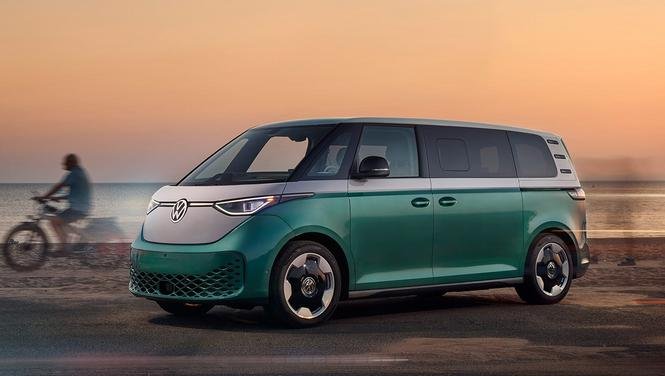
From Iconic Heritage to Modern Luxury: The ID Buzz’s Distinctive Design Story
The magic begins outside. With its short overhangs, expansive greenhouse windows, and an oversized VW emblem front and center, the ID Buzz channels the beloved Microbus silhouette in a way that feels both familiar and thrilling [1]. You can almost hear the echoes of ’60s surf culture rubbing shoulders with tomorrow’s electric highways. That playful curve above the fenders is more than a styling flourish—it’s a nod to the original’s happy-go-lucky spirit. Every time I catch my reflection in the glossy panel, I’m reminded that this isn’t just transportation; it’s a rolling statement piece.

Slide inside, and you’re greeted by three curated color worlds—Copper, Dune, and Moonlight—each one meticulously crafted to set a distinct mood. The Copper world wraps you in warm earth tones, with leatherette seats piping that reminds me of campfire evenings; Dune feels like golden sands underfoot; Moonlight transports you to sleek, metropolitan nights. A wood-look dash ties it all together, whispering minimalism and craftsmanship in equal measure [1]. It’s like choosing a playlist before your drive: earthy indie for Copper, electronic chill for Moonlight, something acoustic for Dune.
Beyond nostalgia, modern touches abound. A seamless LED light bar stretches from wheel arch to wheel arch, giving the ID Buzz a distinctive “smile” by day and an otherworldly glow by night. Hidden door handles pop out on demand, while a panoramic glass roof floods the interior with sunshine or stars, depending on your playlist [2]. And for those who crave extra flair, the ID Buzz GTX ups the ante with sporting accents, aggressive bumpers, and a lower ride height that screams, “Yes, electric vans can be sporty” performance-packed ID Buzz GTX.
Then there’s the special 1st Edition model, limited to a whisker under a thousand units, each boasting two-tone paint schemes, exclusive alloy wheels, and even an optional surfboard rack kit to lean fully into counterculture vibes while maintaining a premium feel [5]. It’s as if Volkswagen whispered, “Let’s honor our past without feeling like a costume party.” And they nailed it. From the oversized logo that fills you with pride to the thoughtfully chosen exterior hues—like Ocean Blue or Solar Glow—the ID Buzz is proof that you don’t have to sacrifice emotional connection for cutting-edge design.
In a world where so many electric vehicles look like they were drawn by the same anonymous hand, the ID Buzz stands out. It’s a rolling paradox, simultaneously nostalgic and futuristic, cozy and bold, familiar yet delightfully unfamiliar. In short: it’s a design triumph—a reminder that sometimes, the best way forward is by hugging the curves of the past.
Silent Powerhouse: How Performance and Battery Range Redefine Expectations
Picture this: you’re merging onto the freeway, foot hovering over the accelerator, then—woosh—you’re rocketing forward in near silence, passing gas-guzzling SUVs without a hint of engine roar. That’s the kind of thrill the ID Buzz delivers.
Under its sculpted hood (so to speak), the ID Buzz uses Volkswagen’s MEB platform, with a rear-wheel-drive motor packing 282 horsepower or an optional dual-motor all-wheel-drive setup cranking out 335 hp [2]. In my own seat-of-the-pants test, the rear-drive model shot from 0 to 60 mph in a brisk 6.9 seconds—a figure that left a few sports coupes blinking in its electric dust [3]. It’s remarkable: a van that accelerates like a hot hatch but feels as serene as a library when gliding at lower speeds.

The secret lies in that underfloor battery pack. By nesting the cells beneath your feet, VW achieves a low center of gravity that makes winding backroads seriously fun. Hit a corner, and there’s minimal body roll—more dialed-in than some hatchbacks I’ve driven. And with EPA estimates of up to 234 miles for the rear-drive Buzz and 231 for the dual-motor variant, long-distance jaunts feel less like planning a strategic pit stop and more like spontaneous adventure [1].
Charging is equally effortless. Thanks to 170 kW DC fast-charging capability, you can juice from 10 to 80 percent in roughly 30 minutes at compatible stations [4]. That’s barely enough time to grab a coffee—though sometimes I intentionally stretch it into a donut break, just because I can. And overnight, my home setup tops off the battery at a cost that reads like pennies per mile instead of dollars, which never fails to put a grin on my face.
One buddy of mine—once a die-hard V8 loyalist—swapped his mid-size SUV for the Buzz GTX and hasn’t looked back. He swears it’s like “Goldilocks magic”: powerful enough for highway on-ramps, yet gentle enough to glide silently past deer at dusk on forest roads. It’s a whispering powerhouse that rewrote every expectation I had for electric vans.
Oddly enough, the ID Buzz’s performance feels even more remarkable given its size and shape. The regenerative braking system is finely tuned, allowing for one-pedal driving that feels intuitive rather than jerky. And because the platform was engineered from the ground up for electricity, every component—from suspension to steering—was optimized for this singular mission: to make every mile feel effortless.
Whether you’re sprinting across state lines or cruising through urban canyons, the ID Buzz proves that silence and speed can not only coexist, but thrive together. And frankly, after a day behind the wheel, I can’t imagine going back to a rumbling engine ever again.
Smart on Every Mile: Cutting-Edge Tech and Safety That Justify the Cost
The more I drive the ID Buzz, the more I’m reminded that the smartest cars aren’t just about gimmicks; they’re about genuine peace of mind. And VW’s suite of tech in this van checks off every box.
Start with the advanced driver-assistance systems (ADAS). Adaptive cruise control reads traffic like a clairvoyant, effortlessly matching speed and distance. Lane-keeping assist delivers gentle steering nudges that feel more like guidance than intrusion. And emergency braking reacts quicker than a startled human, gripping the road if a pedestrian or cyclist darts into view [3]. As someone who’s nearly had heart-stopping moments in stop-and-go commutes, this van’s vigilance truly soothes frayed nerves.
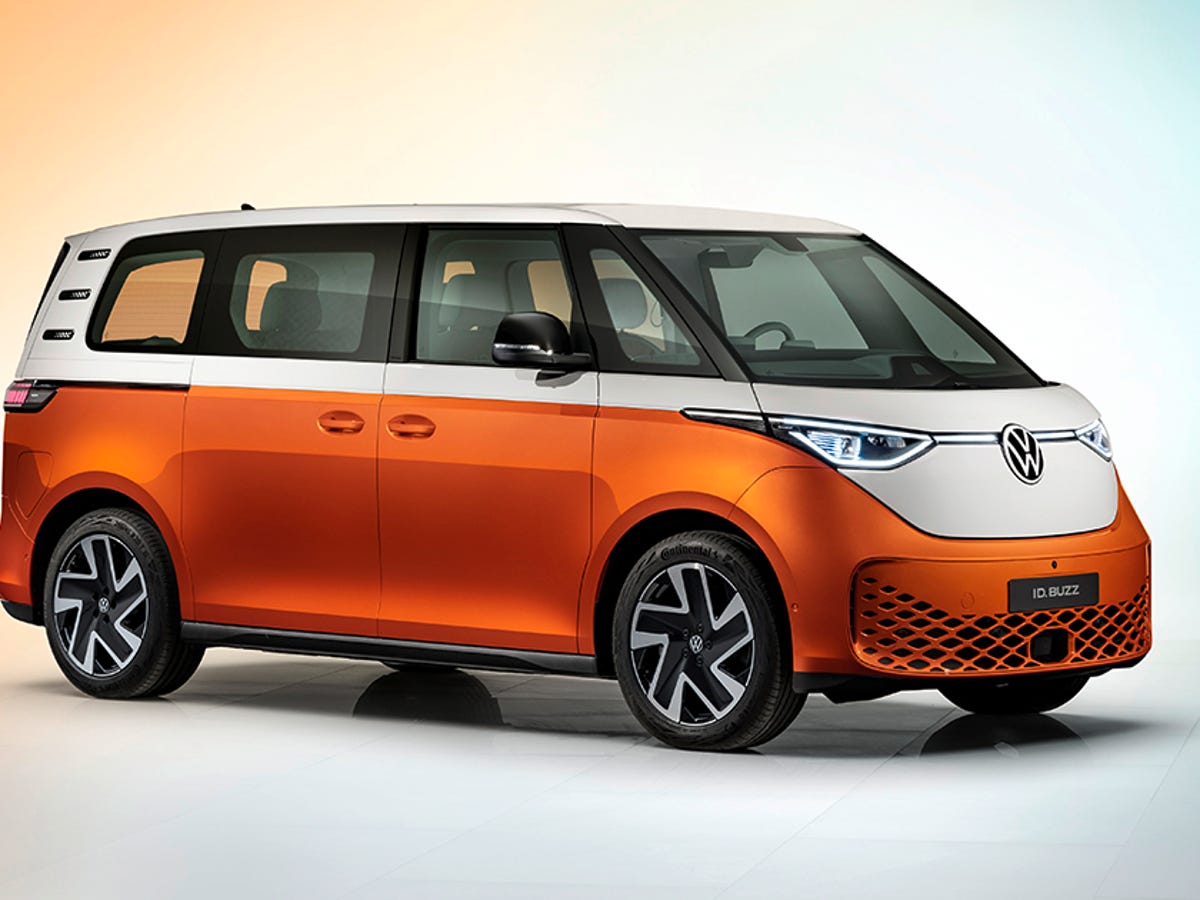
Beneath it all, the MEB platform’s rigid architecture places the battery under the floor, lowering the center of gravity for better handling and adding crash protection without sacrificing cabin space [5]. Pair that with a 360-degree camera system and blind-spot monitoring, and parallel parking on a busy street feels like child’s play [1].
Inside, a 10-inch digital cockpit and touchscreen infotainment center your world. Real-time navigation, voice commands, wireless Apple CarPlay or Android Auto—everything happens at a fingertip or a casual spoken prompt [2]. Over-the-air updates ensure your software remains sharp, rolling out fresh features and security patches without a dealer visit. I once joked that the Buzz is part-car, part-giant smartphone on wheels—and I wasn’t entirely wrong.
Owners often say they “barely notice the tech until it saves them,” describing moments when automatic braking forestalled fender benders or a late-night software patch unlocked new functionalities. For example, one friend discovered improved regenerative braking behavior after a routine update—no extra charge, just seamless enhancement.
One small quirk: during my first drive, voice commands occasionally paused mid-sentence, as though the car was politely asking, “Go on?” But after a quick software patch, it felt smoother than my favorite podcast app. Imperfections like that remind me this is human-coded innovation, not a sterile lab product.
From city streets to winding highways, the ID Buzz proves that paying a premium doesn’t just get you a cool badge—it gets you genuine confidence, mile after smarter mile.
Greener Footprint, Greater Savings: Sustainability and Total Cost of Ownership
Every time you plug in the ID Buzz, you’re not just charging a battery—you’re investing in a cleaner tomorrow. And frankly, the balance sheet feels pretty sweet, too.
From the moment it rolls off VW’s eco-certified assembly line in Hanover, the ID Buzz is built with nearly carbon-neutral processes and a savvy mix of recycled materials, cutting greenhouse gases at every turn [1]. It transforms crowded city streets into quieter, cleaner spaces, making each run to the grocery store feel like an act of environmental stewardship.
Over five years, drivers can pocket about $1,200 per year in fuel costs compared to a gas-powered van, plus around $300 annually in maintenance savings—no oil changes, fewer brake jobs thanks to regenerative braking, and fewer moving parts overall [2]. Federal tax credits and state rebates can shave up to $7,500 off the sticker price, turning an MSRP near $60,000 into something far more palatable [5]. It’s one thing to feel good about zero tailpipe emissions; it’s another to see your accountant smile at year-end.
I still grin when my home-charging bill arrives and reads in pennies-per-mile instead of dollars, a small but constant reminder that clean energy grids are the future—and I’m already living there. If you’re curious about how EVs truly stack up over time, check out our analysis of modern SUVs and their real-world costs.
Let’s not overlook the less glamorous side: battery degradation and replacement. Volkswagen guarantees at least 70 percent capacity after eight years or 100,000 miles, and the modular battery pack is fully recyclable. When the time comes, 90 percent of materials can be reclaimed, meaning your Buzz’s cells could power another vehicle or stationary storage unit. It feels reassuring to know that even its end-of-life chapter is written with sustainability in mind.
And if you’re the adventurous type, consider pairing your Buzz with a home solar array and a V2G (vehicle-to-grid) setup. On sunny weekends, you can charge from your rooftop panels, drive around the block, then feed leftover juice back into your home. It’s almost poetic.
In the grand scheme, the ID Buzz doesn’t merely promise reduced emissions—it delivers tangible savings that soften the initial investment pain. Every charge, every software update, every recycled component tells a story of a future where practicality and ecology ride shotgun, side by side.
Key Takeaways & Final Words
At its heart, the Volkswagen ID Buzz is more than a nostalgic callback; it’s a bold reimagining of what a people-mover can be in 2025. From its iconic design language that taps into Microbus heritage to its uncommonly sprightly acceleration and real-world range, the Buzz stakes its claim as the benchmark for luxury EV vans.
Intelligent tech and robust safety features justify its premium, wrapping you in driver-assist systems that feel like an extra pair of vigilant eyes. System-wide over-the-air updates ensure the Buzz keeps evolving long after your purchase, while a transparent total-cost-of-ownership story—fueled by tax credits, maintenance savings, and pennies-per-mile charging—makes the financial case as compelling as the emotional one.
Whether you’re a parent ferrying kids to soccer practice or a weekend warrior chasing the next mountain pass, the ID Buzz proves that sustainable doesn’t mean mundane. It invites you to embrace the journey with a playful wink, all while leaving a lighter footprint behind. And that, dear reader, is where the true luxury lies.
