

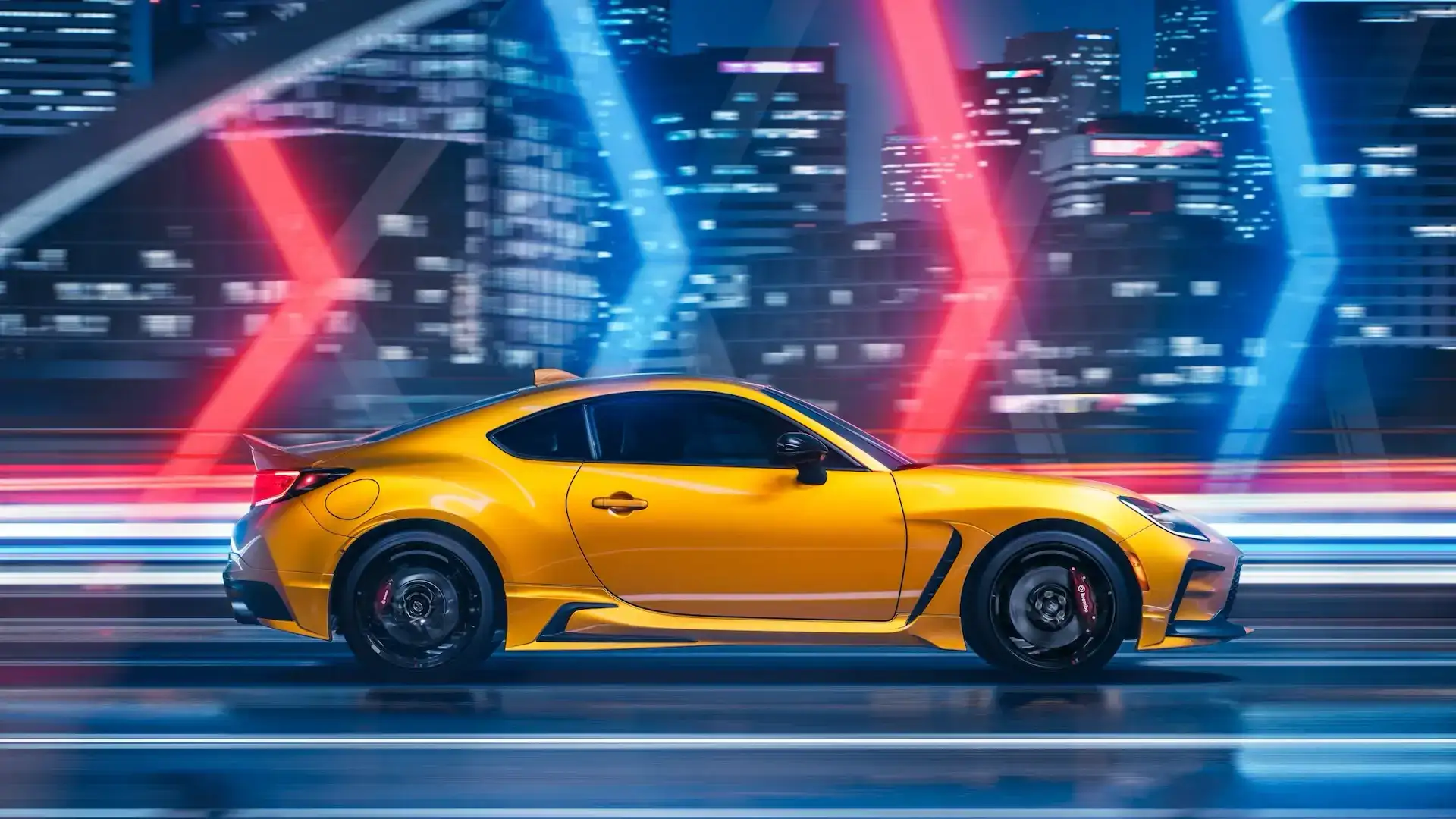
2026 Toyota GR86 Review: Last Affordable Sports Coupe?
2026 Toyota GR86 Premium in Trueno Blue, front three-quarter studio shot
⚡ Quick Verdict
The 2026 Toyota GR86 is a rear-drive, naturally aspirated sports coupe for people who’d rather have steering feel and chassis poise than headline lap times. It rewards finesse over brute force. Cross-shop the Subaru BRZ and you’re looking at a mechanical twin. Consider the Mazda MX-5 Miata and you’re swapping a fixed roof for open air. Tempted by the Nissan Z? That’s a different price bracket entirely.
✓ The Good
- +One of the last naturally aspirated, manual, rear-drive sports coupes under $31,000
- +Sharply balanced chassis with a Torsen limited-slip differential standard
- +Yuzu Edition adds genuine personality without breaking the bank
- +Toyota Audio Multimedia system with wireless Apple CarPlay finally modernises the cabin
- +Fixed-roof body is rigid enough for serious track use
✗ The Trade-offs
- −Manual transmission limits you to a reduced ADAS suite — no adaptive cruise
- −Coarse-surface road noise and tyre roar make long highway stints tiring
- −Rear seats are cargo-only; 6.3 cu ft trunk is tiny by class standards
📑 In This Review
The 2026 Toyota GR86 is a rear-drive, naturally aspirated sports coupe for people who’d rather have steering feel and chassis poise than headline lap times. It rewards finesse over brute force. Cross-shop the Subaru BRZ and you’re looking at a mechanical twin. Consider the Mazda MX-5 Miata and you’re swapping a fixed roof for open air. Tempted by the Nissan Z? That’s a different price bracket entirely. Changes for 2026 are modest rather than transformative. The big news is the Yuzu Edition — bright yellow, black accents, $36,365. Toyota also carries over the Hakone Edition in Ridge Green. Mechanically, nothing’s changed: same 2.4-litre flat-four, same six-speed manual or automatic, same Torsen limited-slip diff. Tech gets a welcome nudge forward, with the 8-inch Toyota Audio Multimedia touchscreen now featuring wireless Apple CarPlay across every trim. The headline figures: 228 horsepower at 7,000 rpm, 184 lb-ft of torque at 3,700 rpm, and a 0-60 mph sprint of roughly 6.0 seconds with the manual. Pricing opens at $30,800 in the United States before destination. In a market drowning in turbocharging, electrification and ever-heavier regulation, the GR86 remains one of the last genuinely honest sports cars. Our verdict? If an affordable, engaging, rear-drive coupe has ever been on your wish list, grab one before the chance is gone.
What’s New for 2026
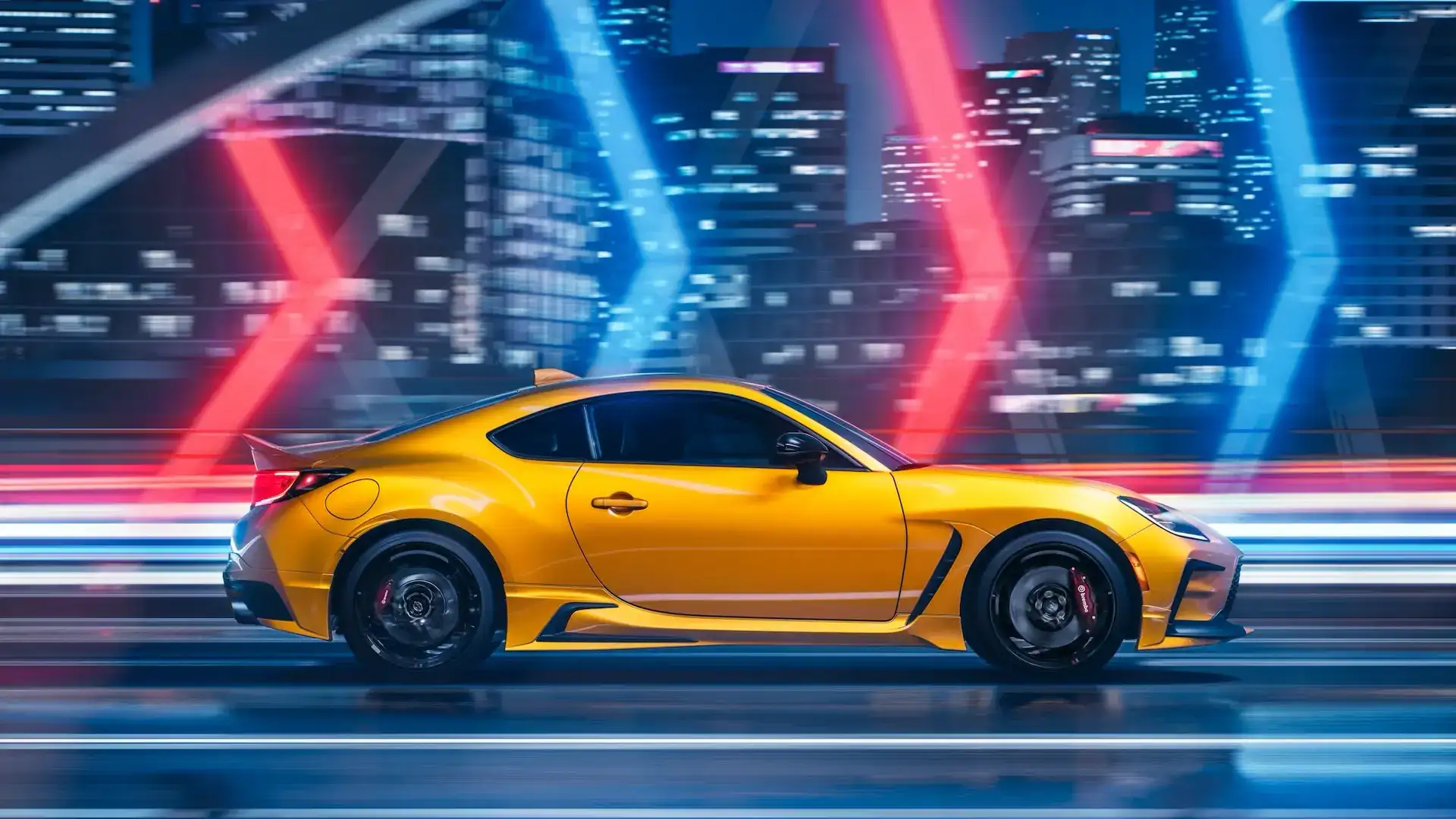
The Yuzu Edition is the most obvious addition to the 2026 lineup. Painted in a vivid yellow Toyota named after the Japanese citrus fruit, it pairs that colour with black 18-inch alloys, a black rear ducktail spoiler, black mirror caps and an interior trimmed in black Ultrasuede with yellow stitching. At $36,365 it’s the priciest GR86 you can buy, and it’s offered with either the six-speed manual or the six-speed auto. Park one on a crowded dealer lot and nothing else at this money turns heads the same way.
The Hakone Edition carries over in Ridge Green — a nod to the famous driving road southwest of Tokyo. Beneath these cosmetic packages, the mechanical story is unchanged from 2025. The 2.4-litre FA24 flat-four, both six-speed gearboxes, the Torsen limited-slip differential, MacPherson-strut front and double-wishbone rear suspension are all carry-over. The one notable cabin update is Toyota Audio Multimedia’s expanded availability on an 8-inch touchscreen; it now supports wireless Apple CarPlay on every variant (Android Auto is still wired only). A 7-inch digital instrument cluster with a configurable Track view is also fitted as standard.
Driving Impressions
Press the clutch, twist the key and the GR86’s 2.4-litre flat-four fires with a boxer burble that’s entirely real. No synthetic noise piped through the speakers, no exhaust-note enhancement tricks — just honest mechanical sound. At idle it has that characteristic flat-four lumpiness; wind it past 4,000 rpm and it builds to a purposeful snarl that climbs cleanly toward the 7,400-rpm redline. It won’t win any singing competitions, but the honesty is part of what makes it endearing.
The six-speed manual is one of the best shift mechanisms at any price. Throws are short and precise, gates are well defined, and the clutch take-up is linear enough that you can feel exactly where the bite point sits. We found ourselves heel-toeing downshifts without thinking — the pedal spacing is good enough that rev-matching becomes second nature within the first hour. Rowing through the gears on a winding road, the GR86 is a timely reminder of why three pedals and a stick shift still matter.
With 228 horsepower hauling roughly 1,275 kilograms, the GR86 won’t pin you to your seat. We measured 6.0 seconds to 60 mph — brisk, not blistering. In practice, the figure matters far less than the way the power arrives. The naturally aspirated flat-four builds thrust progressively: no turbo surge, no mid-range wallop, just a linear swell that begs you to keep the engine singing. That predictability makes the car incredibly trustworthy mid-corner. You always know how much throttle will rotate the rear end, and the Torsen diff makes sure the inside wheel doesn’t spin uselessly when you’re hard on the power at corner exit.
Chassis balance is where this car earns its reputation. The steering is direct and well-weighted, with enough feedback through the rim to let you place the car within inches of your intended line. The suspension is tuned firmer than the Subaru BRZ twin — not harsh, but taut — and body roll stays minimal even during aggressive directional changes. On a tight, undulating back road, the GR86 felt alive in a way that heavier, more powerful sports cars often don’t. It doesn’t hide your mistakes and it won’t do the driving for you. What it does is communicate — constantly, clearly, and in a way that makes you a better driver every time you get behind the wheel.
Performance and Specifications
The 2026 Toyota GR86 is powered by the Subaru-developed FA24 2.4-litre naturally aspirated flat-four. Displacing 2,387 cc, it produces 228 hp at 7,000 rpm and 184 lb-ft of torque at 3,700 rpm — a meaningful step up from the old 2.0-litre unit, especially in the mid-range where the previous engine ran out of breath. Power reaches the rear wheels through either a standard six-speed manual or an optional six-speed automatic, and a Torsen limited-slip differential comes fitted as standard whichever gearbox you choose.
In manual-gearbox trim, the GR86 weighs approximately 1,275 kilograms (roughly 1,286 kg with the automatic), giving it a power-to-weight ratio that punches above its price tag. Top speed is electronically limited to around 225 km/h. Fuel economy, according to the EPA, sits at 11.8 L/100 km city, 8.7 L/100 km highway and 9.8 L/100 km combined for the manual — figures we found broadly achievable in mixed real-world driving, though spirited use will nudge consumption into the low 11s.
<table> <thead> <tr><th>Specification</th><th>2026 Toyota GR86</th></tr> </thead> <tbody> <tr><td>Engine</td><td>2.4L naturally aspirated flat-four (FA24)</td></tr> <tr><td>Power</td><td>228 hp @ 7,000 rpm</td></tr> <tr><td>Torque</td><td>184 lb-ft @ 3,700 rpm</td></tr> <tr><td>0-60 mph</td><td>~6.0 s (manual) / ~6.6 s (automatic)</td></tr> <tr><td>Top Speed</td><td>~140 mph (electronically limited)</td></tr> <tr><td>Transmission</td><td>6-speed manual (std) / 6-speed automatic (opt)</td></tr> <tr><td>Drive Layout</td><td>Front-engine, rear-wheel drive</td></tr> <tr><td>Curb Weight</td><td>~2,811 lbs (manual) / ~2,835 lbs (automatic)</td></tr> <tr><td>Fuel Economy (combined)</td><td>24 mpg (manual) / 25 mpg (automatic)</td></tr> <tr><td>Fuel Type</td><td>Premium unleaded (91+ octane required)</td></tr> </tbody> </table>

At a Glance: How the GR86 Stacks Up
The affordable sports car segment is shrinking, but it’s far from dead. The GR86’s closest rival is its platform twin, the Subaru BRZ — mechanically identical yet subtly different in ride tuning, styling and special-edition offerings. Drop the roof entirely and you land at the Mazda MX-5 Miata, which trades fixed-roof rigidity for open-air theatre and a lighter kerb weight. Step up in both power and outlay and the Nissan Z enters the picture: a twin-turbo V6 coupe with dramatically more straight-line speed and a dramatically higher buy-in. For buyers drawn to front-drive dynamics and a turbocharged engine, the Hyundai Elantra N is worth a look, though it’s a different kind of car philosophically.
The table below puts the key numbers side by side. Price, performance and drivetrain layout vary enough that the "right" choice depends entirely on what matters most to you — lightweight engagement, open-top fun, or outright horsepower.
<table> <thead> <tr><th>Vehicle</th><th>Power</th><th>0-60 mph</th><th>Price (USD)</th><th>Drive</th></tr> </thead> <tbody> <tr><td>2026 Toyota GR86</td><td>228 hp</td><td>~6.0 s</td><td>$30,800</td><td>RWD</td></tr> <tr><td>2026 Subaru BRZ</td><td>228 hp</td><td>~6.0 s</td><td>$31,315</td><td>RWD</td></tr> <tr><td>2026 Mazda MX-5 Miata</td><td>181 hp</td><td>~5.7 s</td><td>$29,530</td><td>RWD</td></tr> <tr><td>2026 Nissan Z</td><td>400 hp</td><td>~4.5 s</td><td>$43,970</td><td>RWD</td></tr> </tbody> </table>
Toyota GR86 vs Subaru BRZ: Which Is Better?
It’s the question every GR86 shopper eventually asks, and the answer is more nuanced than you might expect. On paper, the two share everything that matters: the same FA24 engine, the same gearboxes, the same Torsen limited-slip differential, the same fundamental platform. They roll off the same assembly line at Subaru’s Gunma plant in Japan. Where they part ways is in calibration, styling and packaging — differences that are small in isolation but together give each car its own personality.
Let’s start with pricing. The 2026 GR86 opens at $30,800, undercutting the 2026 BRZ’s $31,315 entry point by $515. That gap narrows further up the range, but it exists across the board. For buyers shopping at the base level, the GR86 offers marginally more bang for your buck — though neither car is expensive in absolute terms. Toyota also tends to run more aggressive financing and lease offers through its larger dealer network, which can tip the effective monthly cost further in the GR86’s favour.
Suspension tuning is where the two cars feel most distinct from the driver’s seat. The GR86’s dampers are calibrated slightly firmer than the BRZ’s, which means flatter cornering and a more connected feel on smooth tarmac. The trade-off is a ride that’s a touch busier over broken pavement. The BRZ, by contrast, absorbs low-frequency impacts with a bit more composure, making it the more relaxed cruiser on a long highway run. On a circuit or a well-surfaced canyon road, the GR86’s tautness works in its favour; on a potholed daily commute, the BRZ’s compliance is welcome. Neither setup is wrong — it really depends on where and how you drive.
Styling is subjective, but the differences are worth walking through. The GR86 wears a larger, more aggressive grille opening and a front fascia that looks wider and more planted. The BRZ’s face is cleaner, with a slimmer grille that some buyers prefer. Out back, both share a similar profile, though the GR86’s available ducktail spoiler on the Yuzu and Hakone editions gives it a racier silhouette. Inside, the cabins are essentially identical aside from badge placement and colour choices.
Special editions further separate the two. Toyota offers the Hakone Edition in Ridge Green and the new Yuzu Edition in bright yellow, each with unique interior trim and wheel finishes. Subaru counters with the tS trim — bringing Sachs dampers, Brembo front brakes and a more track-focused spec — and the Series.Yellow, a vivid colour-matched special. If you want the most capable hardware straight off the showroom floor, the BRZ tS’s upgraded brakes and dampers are a strong draw. If you’d rather have visual flair and a collector-car vibe, the GR86 Yuzu is tough to pass up.
Dealer experience is the wildcard. Toyota’s dealer network in the United States is substantially larger than Subaru’s, which translates to more options for test drives, servicing and warranty work. ToyotaCare — two years of complimentary scheduled maintenance — sweetens the ownership deal. Subaru’s dealers, on the other hand, tend to cultivate a more enthusiast-oriented atmosphere and are often praised for transparency and no-haggle pricing. Markups on both cars have largely subsided from the post-pandemic peak, but availability of special editions can be limited at either brand.
Brand identity plays a role, too. Toyota’s Gazoo Racing badge carries global motorsport credibility stretching from Le Mans to the World Rally Championship. Subaru’s identity is rooted in rally-inspired all-wheel-drive engineering — a philosophy that surfaces in the BRZ only through its boxer engine, since the car itself sends power exclusively to the rear wheels. Neither badge is wrong on this car, but the Toyota nameplate brings stronger resale recognition and a slightly broader halo.
<table> <thead> <tr><th>Specification</th><th>2026 Toyota GR86</th><th>2026 Subaru BRZ</th></tr> </thead> <tbody> <tr><td>Base Price (USD)</td><td>$30,800</td><td>$31,315</td></tr> <tr><td>Engine</td><td>2.4L FA24 flat-four</td><td>2.4L FA24 flat-four</td></tr> <tr><td>Power</td><td>228 hp @ 7,000 rpm</td><td>228 hp @ 7,000 rpm</td></tr> <tr><td>Torque</td><td>184 lb-ft @ 3,700 rpm</td><td>184 lb-ft @ 3,700 rpm</td></tr> <tr><td>Transmission</td><td>6MT / 6AT</td><td>6MT / 6AT</td></tr> <tr><td>0-60 mph (manual)</td><td>~6.0 s</td><td>~6.0 s</td></tr> <tr><td>Curb Weight</td><td>~2,811 lbs</td><td>~2,815 lbs</td></tr> <tr><td>Damper Tune</td><td>Firmer, sportier</td><td>Slightly more compliant</td></tr> <tr><td>Standout Edition</td><td>Yuzu (Yellow, $36,365)</td><td>Series.Yellow (~$36,000)</td></tr> </tbody> </table>
<div style="background:linear-gradient(135deg,#f0f9ff,#e0f2fe); border-left:4px solid #2563eb; border-radius:12px; padding:24px 28px; margin:32px 0"> <p style="font-size:12px; font-weight:800; letter-spacing:0.14em; text-transform:uppercase; color:#1e40af; margin:0 0 10px">Which one is better?</p> <p><strong>Buy the GR86 if</strong> you prefer slightly firmer damping, want the Hakone or Yuzu special editions, and like Toyota’s dealer footprint plus warranty package.</p> <p><strong>Buy the BRZ if</strong> you want a marginally more compliant ride, prefer Subaru’s clean styling, and value the tS trim’s track-focused brakes and dampers.</p> <p><strong>Our pick</strong> is the GR86 Premium 6MT for its blend of fixed-roof rigidity, naturally aspirated character, and the Yuzu Edition’s playful colour palette — but the BRZ is essentially the same car and the better dealer experience should decide it.</p> </div>

Interior, Tech and Daily Usability
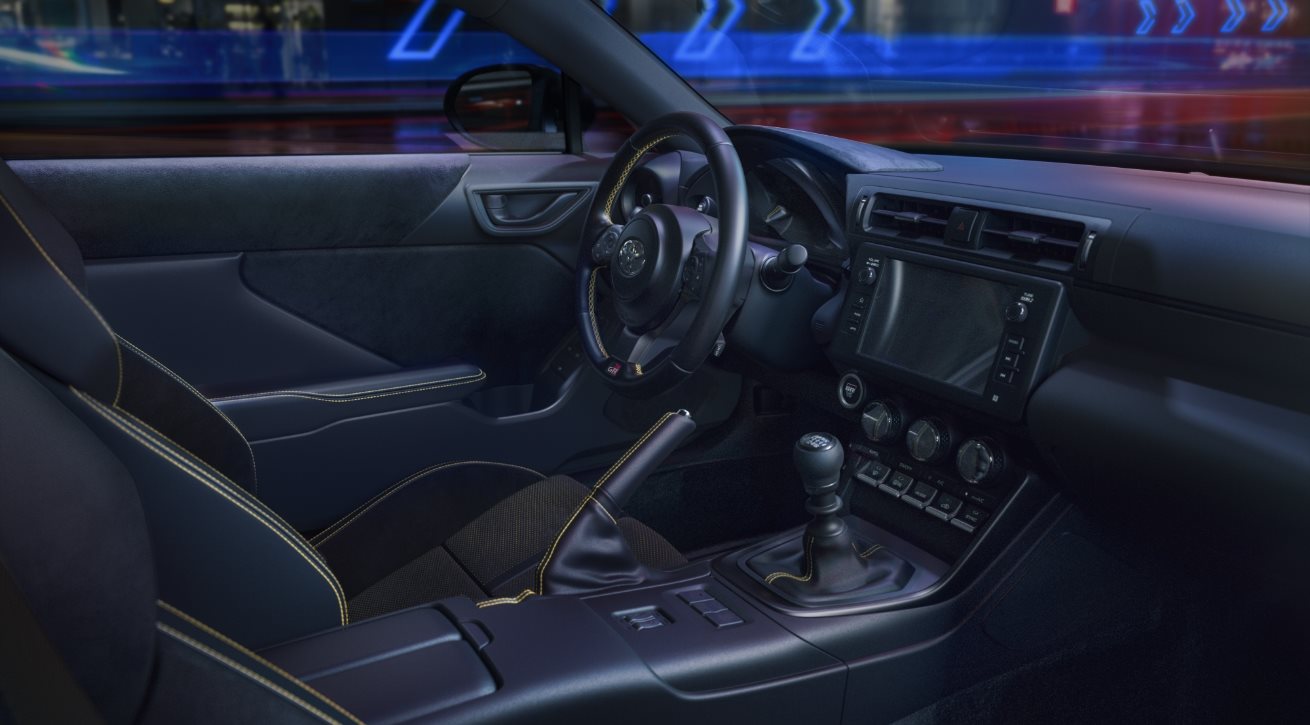
The GR86’s cabin is a lesson in purposeful simplicity. Front and centre is an 8-inch Toyota Audio Multimedia touchscreen that’s clean, responsive and — at last — supports wireless Apple CarPlay (Android Auto is still wired). The system won’t win any design awards, but it’s intuitive, with physical volume and tuning knobs flanking the display. Behind the steering wheel sits a 7-inch digital instrument cluster with a configurable Track view that puts the tachometer and gear indicator front and centre while hiding gauges you don’t need. We found the Track layout genuinely handy during spirited drives, and the default view is perfectly clear for commuting.
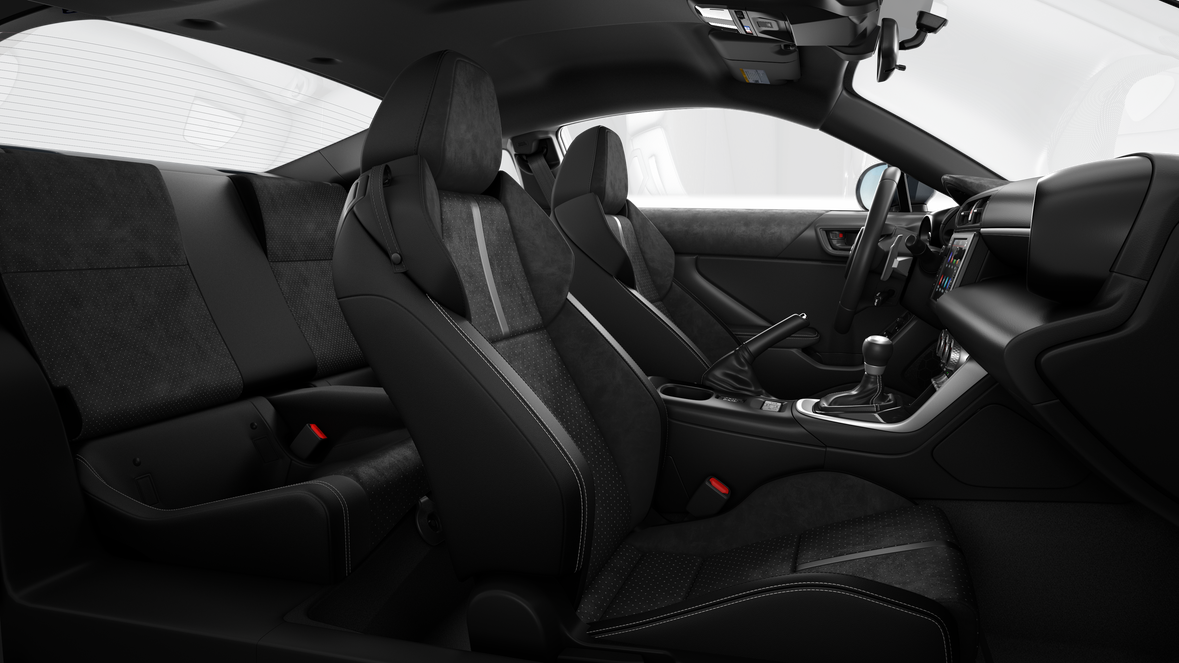
Seating is comfortable for two adults and compromised for anyone else. The sport seats on the Premium and above are heated and offer solid bolstering without feeling restrictive; they held us securely through long canyon sessions without causing fatigue. Material quality varies by trim. The Base gets durable cloth, the Premium gets a leather and Alcantara blend, and the Hakone and Yuzu editions feature unique Alcantara-and-leather combos with contrast stitching. Hard plastics still occupy the lower dash and door cards, but at this price point the cabin feels appropriate rather than cheap.
The rear seats are nominally a 2+2 arrangement but in practice serve as extra cargo space. With the rear seatbacks folded flat, the GR86’s 6.3-cubic-foot boot is just big enough to swallow a set of four track-day tyres — something that’s become something of a legend among owners. With the seats up, the boot handles a week’s groceries or a couple of carry-on bags, but don’t plan on weekend-trip practicality for more than two. Road and tyre noise on coarse surfaces is the daily-driving compromise: the GR86’s thin glass and minimal sound deadening keep weight down but let a constant drone in on rough highways. It’s livable, but it’s the first thing you’ll notice coming from a mainstream sedan.
Safety and Warranty
The GR86’s underlying structure earned an IIHS Top Safety Pick+ in 2022, and that rating carries through to the 2026 model year thanks to unchanged crash structures and airbag configurations. It received Good ratings in both the moderate overlap front and side impact tests — the highest tier the agency awards. Seven airbags are standard across the range, including a driver’s knee airbag and front-seat-mounted side airbags.
Toyota Safety Sense 3.0 is fitted as standard on automatic-transmission models and bundles adaptive cruise control, pre-collision braking with pedestrian and cyclist detection, lane departure warning with steering assist, and automatic high beams. Manual cars get a reduced suite — adaptive cruise isn’t available with three pedals — but still include pre-collision braking and lane departure warning. It’s a reasonable trade-off, and one most enthusiast buyers will happily accept in exchange for the more engaging driving experience.
Warranty coverage is competitive for the segment. Toyota backs the GR86 with a 3-year/60,000-kilometre basic warranty and a 5-year/100,000-kilometre powertrain warranty. ToyotaCare, covering two years of scheduled maintenance at no extra cost, adds further peace of mind. For a car many owners will take to the track, the warranty terms don’t explicitly exclude circuit use, though any damage resulting from competition or abuse is subject to the usual dealer discretion.
Who Should Buy the 2026 Toyota GR86
<div style="display:grid;grid-template-columns:1fr 1fr;gap:20px;margin:24px 0"> <div style="background:#f0fdf4;border-left:4px solid #16a34a;border-radius:12px;padding:20px 24px"> <p style="font-size:12px;font-weight:800;letter-spacing:0.14em;text-transform:uppercase;color:#15803d;margin:0 0 10px">Buy if</p> <ul style="margin:0;padding-left:18px;line-height:1.7"> <li>You want a manual, NA, rear-drive sports coupe and there are barely any left at this price</li> <li>You autocross, trackday or canyon-carve and need lightweight feedback over outright horsepower</li> <li>You value Toyota reliability and dealer reach</li> <li>You’ll only carry one or two adults; rear seats are cargo</li> </ul> </div> <div style="background:#fef2f2;border-left:4px solid #dc2626;border-radius:12px;padding:20px 24px"> <p style="font-size:12px;font-weight:800;letter-spacing:0.14em;text-transform:uppercase;color:#b91c1c;margin:0 0 10px">Skip if</p> <ul style="margin:0;padding-left:18px;line-height:1.7"> <li>You need adaptive cruise — only the automatic gets it</li> <li>You want a turbo and effortless mid-range torque</li> <li>Daily comfort, quiet cabins or rear-passenger room matter</li> <li>You’d rather have a convertible — pick the Miata instead</li> </ul> </div> </div>
⚡ Our Verdict
Final Take
The 2026 Toyota GR86 earns its 8.7 out of 10 by being exactly what an affordable sports car should be: light, communicative, rear-driven and uncompromised in its mission. It’s not trying to be a grand tourer or a luxury coupe. It’s a focused driver’s car that happens to cost less than a well-equipped family sedan. The Yuzu Edition brings welcome colour to the lineup, the mechanical package remains one of the best in the business at any price, and the fixed-roof body gives it a rigidity edge over open-top rivals. Buy it if you value steering feel, chassis balance and the irreplaceable connection of a naturally aspirated engine paired with a manual gearbox. Skip it if you need a quiet cabin, adaptive cruise control or back seats that actually fit adults. The straightforward truth is that cars like the GR86 are disappearing. Tightening emissions rules, rising material costs and the industry’s push toward electrification mean an affordable, naturally aspirated, rear-drive sports coupe might not survive another generation. The 2026 GR86 is a reminder of what driving used to feel like — and what it still can, if you pick the right car.
Frequently Asked Questions
How much does the 2026 Toyota GR86 cost?
The 2026 GR86 starts at $30,800 for the Base model with a six-speed manual. The Premium trim comes in around $34,000, the Hakone Edition at approximately $35,500, and the new Yuzu Edition tops the range at $36,365. All prices are MSRP before destination charges. The six-speed automatic adds $1,100 to the Base and Premium trims.
Is the 2026 GR86 reliable?
The second-generation GR86 has proven reliable since its 2022 launch. Toyota’s warranty — a 5-year/60,000-mile powertrain guarantee — backs the Subaru-built FA24 flat-four, and early ownership data suggests fewer oil-consumption concerns than the old 2.0-litre engine. You will need premium 91-octane fuel, which adds to running costs. ToyotaCare covers two years of scheduled maintenance at no charge, further trimming ownership expenses.
GR86 or Subaru BRZ — which is better?
Mechanically, they’re identical: same engine, same transmissions, same Torsen differential, same platform. The GR86’s dampers are tuned slightly firmer, which suits spirited driving; the BRZ’s marginally softer setup favours daily comfort. Toyota offers the Yuzu and Hakone special editions; Subaru counters with the tS and Series.Yellow. The real tiebreaker is your local dealer experience and whichever styling you prefer.
How fast is the 2026 Toyota GR86?
The manual-transmission GR86 accelerates from 0 to 60 mph in approximately 6.0 seconds. The automatic is slightly slower at around 6.6 seconds. The quarter mile arrives in roughly 14.4 seconds at 99 mph, and top speed is electronically limited to approximately 225 km/h. These are respectable rather than extraordinary numbers — the GR86’s appeal lies in how it delivers them, not the figures themselves.
Is the GR86 good as a daily driver?
It depends on your priorities. The ride is firm but not punishing in base form, and the sport seats are supportive enough for extended commutes. Real-world fuel economy sits around 9.8 to 10.7 L/100 km combined, which is reasonable for a sports car. The compromises are road and tyre noise on coarse highways, a small boot (6.3 cu ft), and rear seats that can’t fit adults. If two seats and a compact boot work for your lifestyle, the GR86 is an engaging daily.
Does the 2026 GR86 have a manual transmission?
Yes. A six-speed manual is the standard transmission on every 2026 GR86 trim, and it’s the enthusiast’s pick. A six-speed automatic is available as an option across the range. The manual is preferred by the majority of buyers and delivers the more connected driving experience. Note that adaptive cruise control is only available with the automatic; manual cars get a reduced Toyota Safety Sense suite.
What rivals should I cross-shop?
The Subaru BRZ is the GR86’s mechanical twin and the most obvious comparison. The Mazda MX-5 Miata offers a convertible alternative with a lighter kerb weight and sharper turn-in, but less power and no back seats. The Nissan Z brings dramatically more horsepower (400 hp) from a twin-turbo V6 but costs over $13,000 more. For front-wheel-drive enthusiasts, the Hyundai Elantra N delivers turbocharged punch and daily-friendly practicality in a different package. *Based on hands-on observations and independent publications including IIHS, Edmunds and Car and Driver.*
