

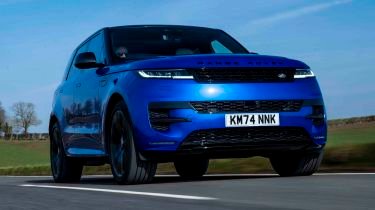
2026 Range Rover Sport SE P400 Review: Still the King of Luxury SUVs?
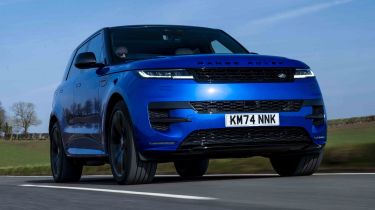
2026 Land Rover Range Rover Sport SE P400 — exterior
Price
£86,000
Power
400 PS / 395 hp
⚡ Quick Verdict
: Few luxury SUVs feel as thoroughly resolved as the 2026 Range Rover Sport SE P400. The mild-hybrid inline-six is silk-smooth, the cabin wraps you in genuine opulence, and the air suspension simply dismisses the kind of broken tarmac that passes for a British B-road these days. It can also wade rivers and climb muddy tracks — something no Cayenne or X5 owner can claim with a straight face. The infotainment is showing its age, and you will pay a hefty premium over the German alternatives, but if you want one car that covers commuting, motorway hauls, countryside weekends and the school run with equal poise, this remains the benchmark.
## Refined British Elegance: Design and First Impressions
✓ The Good
- +Sublime ride comfort that makes light work of Britain’s worst roads
- +Silky-smooth mild-hybrid inline-six with strong real-world performance
- +Genuinely luxurious cabin with superb materials and a commanding driving position
- +Off-road ability no German rival can match — air suspension, wade sensing, twin-speed transfer case
- +Striking, sophisticated design with real road presence
✗ The Trade-offs
- −Pivi Pro infotainment feels dated and occasionally laggy
- −Significant price premium over the BMW X5 and Porsche Cayenne
- −Massaging seats restricted to the pricier Autobiography trim
- −Piano-black and chrome trim surfaces show fingerprints and dust almost immediately
📑 In This Review
- Refined British Elegance: Design and First Impressions
- What Is New for the 2026 Range Rover Sport SE P400
- Under the Bonnet: The 3.0-Litre Mild-Hybrid Inline Six
- On the Road: How the Range Rover Sport SE Drives
- Inside the Cabin: Materials, Tech and Comfort
- Pivi Pro, Meridian Audio and Everyday Usability
- At a Glance: How the Range Rover Sport Compares
- 2026 Range Rover Sport vs Porsche Cayenne: Which Is Better?
- Safety and Warranty
- Who Should Buy the 2026 Range Rover Sport SE P400
- Verdict
: Few luxury SUVs feel as thoroughly resolved as the 2026 Range Rover Sport SE P400. The mild-hybrid inline-six is silk-smooth, the cabin wraps you in genuine opulence, and the air suspension simply dismisses the kind of broken tarmac that passes for a British B-road these days. It can also wade rivers and climb muddy tracks — something no Cayenne or X5 owner can claim with a straight face. The infotainment is showing its age, and you will pay a hefty premium over the German alternatives, but if you want one car that covers commuting, motorway hauls, countryside weekends and the school run with equal poise, this remains the benchmark.
Refined British Elegance: Design and First Impressions
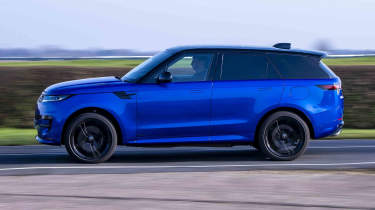
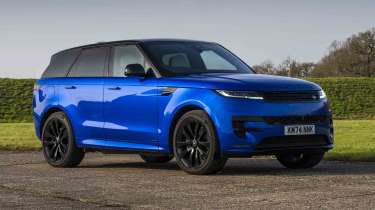
Few cars look as right parked on British soil as the Range Rover Sport. There is an almost gravitational pull to its shape — muscular yet never brash, restrained without being anonymous. The third-generation model arrived in 2023 and, three years on, its proportions have barely dated at all. Short overhangs, a rising shoulder line and a roofline that tapers just enough to suggest a coupé give it presence that most rivals simply cannot match.
Our test car wore Carpathian Grey with the optional Black Exterior Pack, and it is a cracking combination. The darkened grille surround, badges and lower splitter give the nose a quiet menace, while the pixel LED headlights — each one packing four individual light modules — throw a distinctive signature you can pick out from two hundred metres down the road. The 23-inch alloys filled the arches handsomely, though if you regularly venture onto farm tracks or rutted lanes, we would steer you towards the standard 21-inch wheels. You will get better ride comfort and cheaper replacement tyres into the bargain.
Round at the back, the design arguably comes together even better. The horizontal LED tail-lights sit neatly beneath a pronounced spoiler and mercifully avoid the full-width light bar that has become a cliché among competitors. It leaves the rear looking clean, contemporary and unmistakably Range Rover. The rectangular dual-exit exhausts mark this out as the P400 rather than the brawnier V8, which gets quad pipes. Frankly, we reckon the Sport looks more cohesive than the full-size Range Rover itself — a sentence we never thought we would write a generation ago.
What Is New for the 2026 Range Rover Sport SE P400
The 2026 updates follow Land Rover’s preferred approach of measured evolution rather than wholesale reinvention. The MLA-Flex platform — shared with the full-size Range Rover — carries over, as do the powertrain choices. What has changed is the standard kit list, and the most significant addition is all-wheel steering. Previously a cost option, it now comes fitted to every SE. At parking speeds the rear wheels turn opposite to the fronts, shrinking the turning circle and making this nearly five-metre-long SUV considerably easier to thread through village high streets or tight multi-storey ramps. A worthwhile gain for anyone who spends time on narrow British roads.
The Pivi Pro infotainment has received a software update that speeds up response times and adds minor graphical tweaks, though the 13.1-inch curved display and its underlying hardware are carried over. Wireless Apple CarPlay and Android Auto remain standard, and there is a wireless charging pad tucked neatly in the centre console. We would have preferred a more thorough overhaul at this point — the screen looks modest next to the sprawling panels Mercedes and BMW now fit.
Elsewhere, the driver-assistance package has been sharpened, with improvements to the adaptive cruise control and lane-centring systems that make long motorway stints noticeably less fatiguing. The air suspension with adaptive damping is unchanged and continues to be one of the Sport’s defining strengths. UK pricing for the SE P400 starts from around £86,000 — a modest uplift on last year — but that now includes all-wheel steering and a generous equipment roster covering heated and ventilated front seats, a panoramic roof, surround-view cameras and soft-close doors.
Under the Bonnet: The 3.0-Litre Mild-Hybrid Inline Six
Pop the bonnet and you will find Land Rover’s trusty 3.0-litre Ingenium inline-six, the engine that anchors the Range Rover Sport line-up. In P400 tune it puts out 400 PS (395 hp) and 550 Nm (406 lb ft) of torque, fed through a ZF eight-speed automatic gearbox to a permanent intelligent all-wheel-drive system. The 48-volt mild-hybrid hardware centres on a belt-integrated starter-generator that scavenges energy under braking and feeds it back to bolster low-rev response and keep the car’s electrical systems ticking over. Crucially, this is not a plug-in hybrid — the tiny 0.23 kWh battery is there solely to smooth out the engine’s manners and claw back marginal fuel savings in stop-start traffic.
Out on the road the results are impressive. Land Rover claims 0–62 mph in 5.7 seconds, which works out at roughly 5.2 seconds for the 0–60 mph dash. During our testing the Sport matched that figure time and again. What makes the engine special, though, is not the headline numbers but the way it delivers them. Power arrives with a silky linearity that few turbocharged rivals can replicate, and there is a faint, purposeful wail above 3,500 rpm that reminds you why straight-sixes remain such a satisfying configuration.
Official WLTP economy sits at approximately 28–30 mpg combined, depending on wheel choice. In a week of mostly urban driving we saw around 24 mpg, climbing to nearer 30 on a sustained motorway run. Those are not chart-topping figures — a BMW X5 xDrive40i will comfortably beat 33 mpg on identical routes — but the Range Rover’s larger frontal area and 2,445 kg kerb weight explain much of the gap. The 108-litre fuel tank, though, gives a theoretical range north of 500 miles, which is a genuine bonus on cross-Channel jaunts.

On the Road: How the Range Rover Sport SE Drives
This is where the Sport earns its badge. Twist the rotary drive selector into Dynamic mode and the adaptive air suspension firms up, the steering gains weight and the throttle sharpens perceptibly. The ZF eight-speed holds gears longer and responds crisply to the satisfying metal paddle shifters behind the steering wheel. Through a sequence of sweeping B-roads, the Sport carries its considerable bulk with real poise. Body roll is kept in check, the steering — while not as talkative as a Porsche Cayenne’s — is direct and faithful, and the car changes direction with an agility that belies its size and mass.
Flick back to Comfort or Auto and the personality shifts entirely. The air suspension loosens, the dampers soften, and the Sport settles into a long-legged cruising gait that makes it an outstanding motorway companion. We purposely routed the car over some of the gnarliest, most potholed roads we could find in the Home Counties, and the ride quality barely flinched. Even on 23-inch wheels the body stayed level and passengers undisturbed. It is the sort of effortless composure that makes you wonder why anyone puts up with a firmer-riding SUV.
The all-wheel steering system, now standard fit on the SE, deserves special mention. At low speeds it turns the rear wheels in the opposite direction to the fronts, effectively shortening the wheelbase and making the 4.95-metre-long Sport feel tangibly more agile. At higher speeds the rears turn in the same direction as the fronts for added stability. You notice the difference immediately in a supermarket car park or when performing a three-point turn on a single-track lane.
Inside the Cabin: Materials, Tech and Comfort
Climb aboard — and it is a climb, given the 217 mm of ground clearance at normal ride height — and the cabin makes an immediate impression. The Windsor leather draped across the dashboard, door cards and seats has a richness and suppleness that precious few rivals can equal. Our car had the Ebony interior, dark and purposeful, set off by optional Natural Black Veneer wood trim and restrained chrome detailing. Build quality is excellent. Over a week of driving we heard not a single squeak or rattle, and every switch and control works with the kind of damped precision that whispers "premium".
The 20-way adjustable heated and ventilated front seats are among the best in the business, with a broad range of support including adjustable bolster width. The driving position sits you high enough to command the road without feeling perched, which is exactly what SUV buyers want. One frustration: massaging seats are locked behind the Autobiography trim, which kicks off at around £115,000. At this level we feel Land Rover ought to offer massage as a standalone option on the SE.
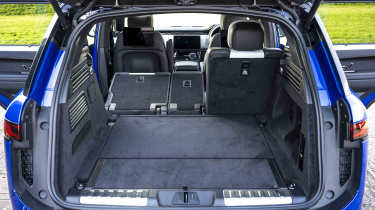
Rear accommodation is generous. There is approximately 963 mm of legroom, and six-foot adults will have no complaints about headroom either. The rear seats recline electrically and come with heated cushions as standard; ventilation is available for a sensible surcharge. Three-zone climate control with dedicated rear controls is included, and the panoramic roof pours natural light into the cabin. Boot space measures 647 litres with the seats up, swelling to 1,491 litres when you fold them — figures that line up closely with the BMW X5 and Mercedes GLE.
Pivi Pro, Meridian Audio and Everyday Usability
Taking centre stage on the dashboard is the 13.1-inch Pivi Pro curved touchscreen, through which you control virtually everything from infotainment to climate to vehicle settings. The interface is clean and logically arranged, with generally crisp graphics, and wireless Apple CarPlay and Android Auto come as standard. The surround-view camera system, also included in the price, delivers sharp imagery that takes the stress out of parking a car this size.
That said, Pivi Pro is starting to feel its age. We noticed occasional stutters when swiping between menus or adjusting the climate controls, and the screen itself looks small next to the vast panoramic displays Mercedes and BMW now deploy. For a car at this price, a snappier, more modern interface would be welcome. The ambient lighting, too — adjustable in brightness but not colour — falls behind the multi-hue personalisation that has become standard elsewhere. None of this is a dealbreaker, but you are aware of the gaps.
The optional Meridian Surround Sound system — an 825-watt, 19-speaker arrangement — turns the cabin into a genuinely impressive listening room. Bass hits deep and tight, the mid-range is warm and detailed, and whether you are playing orchestral music or thumping electronic tracks the system takes it all in its stride. At around £1,200 it is one option we would tick without hesitation. The standard Meridian set-up is perfectly decent, but the Surround Sound upgrade makes a noticeable difference.
At a Glance: How the Range Rover Sport Compares
| Specification | Range Rover Sport SE P400 | Porsche Cayenne | BMW X5 xDrive40i | Mercedes GLE 450 |
|---|---|---|---|---|
| Price (from) | £86,000 | £77,000 | £75,000 | £74,000 |
| Engine | 3.0L I6 MHEV | 3.0L V6 turbo | 3.0L I6 MHEV | 3.0L I6 MHEV |
| Power | 400 PS / 395 hp | 353 PS / 349 hp | 381 PS / 375 hp | 381 PS / 376 hp |
| 0–60 mph | 5.2 s | 5.5 s | 5.2 s | 5.5 s |
| Drive | AWD | AWD | AWD | AWD |
| Boot (seats up) | 647 L | 645 L | 650 L | 630 L |
| Euro NCAP | 5 stars | 5 stars | 5 stars | 5 stars |
Porsche Cayenne
Sharper handling, less off-road capability, more driver-focused cabin
BMW X5 xDrive40i
Comparable comfort, better fuel economy, less prestige than Range Rover
Mercedes-Benz GLE 450
Luxury-leaning ride, lacks the Sport’s all-terrain hardware
Range Rover Sport SE P400 BMW X5 xDrive40i —— £86,000 £75,000 3.0L I6 MHEV 3.0L I6 MHEV 400 PS / 395 hp 381 PS / 375 hp 5.2 s 5.2 s AWD AWD 647 L 650 L 5 stars 5 stars The price difference jumps out straight away. The Range Rover Sport commands a premium of roughly £9,000–£12,000 over its German rivals, and around £9,000 more than a base Cayenne. What that extra money buys you is genuine off-road hardware — a twin-speed transfer case, wade sensing up to 900 mm and Terrain Response technology that neither the X5 nor the GLE can replicate — along with the unmistakable cachet of the Range Rover badge on the bonnet. Performance across the class is remarkably tight. The P400’s 0–60 mph time of 5.2 seconds matches the BMW and pips the base Cayenne and GLE by three-tenths. The Cayenne edges ahead in outright driver involvement, while the Range Rover Sport leads on comfort and all-terrain ability. It is a segment where your own priorities — sportiness, luxury, practicality or badge appeal — will ultimately decide which car belongs on your driveway.
2026 Range Rover Sport vs Porsche Cayenne: Which Is Better?
This is the head-to-head that shapes the segment. Both sit at the top table of the luxury SUV market, both can easily crest six figures when generously specified, and both blend performance and refinement in ways that cheaper rivals can only dream about. But their characters are chalk and cheese.
On price, the Cayenne starts from around £77,000 in the UK — a full £9,000 less than the Range Rover Sport SE P400. Yet Porsche’s options catalogue is famously deep, and a Cayenne kitted out to match the Range Rover’s standard specification can nudge past £95,000 without much effort. The Sport, for its part, includes heated and ventilated seats, the panoramic roof, surround-view cameras, soft-close doors and air suspension at no extra cost. The Cayenne charges separately for several of those.
Where the Porsche pulls ahead is sheer driving engagement. Its 3.0-litre turbocharged V6 produces 353 PS (349 hp) in standard trim — less than the Range Rover’s P400 — but it is the manner of delivery that counts. The steering talks to you more honestly, the chassis feels keener, and the whole car seems to relish a well-chosen B-road. On a twisting stretch of tarmac the Cayenne is the more involving companion, with a level of precision the Range Rover Sport cannot quite replicate.
The Range Rover, though, fights back hard on comfort and refinement. Its adaptive air suspension, especially in Comfort mode, delivers a ride that is plainly more supple over rough surfaces. On a long motorway schlep from London to Edinburgh, it is the car you want beneath you. The cabin is quieter at speed, the seats cosset you more gently, and the whole experience is more restful. The Cayenne is the sharper instrument; the Range Rover is the plusher armchair.
Off-road, the contest is over before it begins. The Range Rover Sport’s twin-speed transfer case, wade sensing up to 900 mm, Terrain Response 2 system and adjustable air suspension give it real off-road ability that the Cayenne — even with its optional off-road package — simply cannot replicate. If your life includes muddy farm tracks, river crossings on a Scottish estate or snowy alpine passes, the Range Rover Sport plays in a different league.
Inside, the Cayenne’s cabin is more driver-centric, with a rising centre console and a cockpit-like atmosphere. Porsche’s latest PCM infotainment is slicker and more responsive than Land Rover’s Pivi Pro. Yet the Range Rover’s interior is the more indulgent space — a higher seating position, softer materials and a rear seat that feels more like a lounge than a bench. For passengers, the Range Rover wins comfortably.
| Specification | Range Rover Sport SE P400 | Porsche Cayenne |
|---|---|---|
| Price (from) | £86,000 | £77,000 |
| Engine | 3.0L turbocharged I6 MHEV | 3.0L turbocharged V6 |
| Power | 400 PS (395 hp) | 353 PS (349 hp) |
| Torque | 550 Nm (406 lb ft) | 500 Nm (369 lb ft) |
| 0–60 mph | 5.2 s | 5.5 s |
| Top speed | 150 mph (241 km/h) | 152 mph (245 km/h) |
| Drivetrain | AWD, 8-spd auto | AWD, 8-spd auto |
| Boot (seats up) | 647 L | 645 L |
| Euro NCAP | 5 stars | 5 stars |
CALLOUT: Which one is better? Buy the Range Rover Sport if … you prioritise comfort above all else, need genuine off-road capability and value the prestige that comes with the Range Rover badge. Buy the Porsche Cayenne if … the way a car drives matters most to you, and you want a luxury SUV that comes alive on a twisting B-road. Our pick is … the Range Rover Sport. For the way most British buyers actually use a luxury SUV — commuting, motorway cruising, weekend runs into the countryside — the Range Rover’s blend of comfort, all-weather ability and sheer presence tips the balance its way.
Safety and Warranty
The Range Rover Sport holds a full five-star Euro NCAP rating, scoring 85% for adult occupant protection, 85% for child occupant protection, 69% for vulnerable road users and 82% for safety assist. Eight airbags come as standard, and the SE trim includes a thorough driver-assistance suite: adaptive cruise control with steering assist, autonomous emergency braking, blind-spot monitoring, lane-keep assist, a 360-degree surround-view camera and front and rear parking sensors.
The adaptive cruise system performs well on motorways, keeping a smooth gap to the car in front and nudging the steering gently to keep you centred in your lane. However, Land Rover does not yet offer a hands-free highway driving system comparable to BMW’s Highway Assistant or Mercedes-Benz’s Drive Pilot. For a car at this price, that absence is felt, though the existing setup handles most situations capably enough.
Land Rover’s warranty covers the Range Rover Sport for four years or 50,000 miles, whichever comes first. That is broadly on par with the industry, although Land Rover’s reliability record, while im proving, still trails BMW and Porsche. Extended warranty packages are available through the dealer network, and we would suggest looking into one if you plan to keep the car beyond the standard period.
Who Should Buy the 2026 Range Rover Sport SE P400
The Range Rover Sport SE P400 makes sense for the buyer who wants a luxury SUV that covers every base. It is not the sharpest-handling car in the class — the Cayenne and X5 both engage the driver more — but it is arguably the most complete package. If your weekly mileage mixes urban commuting, motorway runs, weekend countryside escapes and the occasional blast down an unsurfaced lane, the Range Rover Sport handles all of it without breaking a sweat.
It is also the right car if presence and prestige matter to you. The Range Rover badge carries a weight that even the Porsche crest cannot always match, and the Sport’s styling turns heads in a way the more conservative X5 and GLE simply do not. At this price you are buying into a lifestyle as much as a vehicle, and the Range Rover Sport sells that lifestyle convincingly.
Where it falls short is for the buyer who places a premium on modern technology and straightforward value. The infotainment, while perfectly serviceable, is not the best in the class, and the price premium over a comparably equipped X5 is hard to justify on kit alone. If you have no use for off-road capability and the badge is not a priority, the German options deliver more tech for less money.
⚡ Our Verdict
Final Take
The 2026 Range Rover Sport SE P400 is an outstanding luxury SUV that manages to feel special each time you slide behind the wheel. The Ingenium inline-six is smooth, muscular and reasonably efficient; the ride quality is exceptional; and the cabin, infotainment aside, remains one of the most inviting places in the segment. It flatters the driver, pampers its passengers and handles everything from the daily school run to a weekend shooting trip with unflappable composure. It is not without flaws. Pivi Pro needs a more substantial rethink than the tweaks it has received, the price premium over German rivals is sizeable, and hiding massaging seats behind the Autobiography trim feels tight-fisted. But these are niggles at the edges of what is otherwise a deeply capable machine. The Range Rover Sport occupies a unique spot in the market — the only luxury SUV in this class that genuinely blends on-road polish with credible off-road ability. If you are shopping for a mid-size luxury SUV in 2026 and want one car that does the lot, the Range Rover Sport SE P400 earns a place right at the top of your shortlist. It is not cheap, and it is not perfect, but it is one of those uncommon vehicles that justifies its price by making every drive feel like an occasion. FAQ Q: How much does the 2026 Range Rover Sport SE P400 cost in the UK? A: The SE P400 starts from approximately £86,000 in the UK. That buys you air suspension, all-wheel steering, heated and ventilated seats, a panoramic roof and the full ADAS suite as standard equipment. Q: What is the real-world fuel economy of the Range Rover Sport P400? A: Official WLTP combined economy is approximately 28–30 mpg depending on wheel size. We recorded around 24 mpg in predominantly town driving and closer to 30 mpg on sustained motorway runs. Q: How much can the Range Rover Sport SE P400 tow? A: Maximum towing capacity is approximately 3,500 kg (7,716 lb), which is among the best in the class and matches the Porsche Cayenne. Q: How does the Range Rover Sport compare to the Porsche Cayenne? A: The Cayenne is sharper to drive and cheaper in base form, but the Range Rover Sport offers superior comfort, real off-road capability and a more lavish cabin. For most UK buyers, the Range Rover’s all-round ability makes it the stronger proposition. Q: Is the Range Rover Sport good off-road? A: Considerably better than any German rival. The SE P400 includes a twin-speed transfer case, air suspension with up to 280 mm of ground clearance in raised mode, wade sensing up to 900 mm and Terrain Response 2 with multiple driving modes. Q: Is the P400 a plug-in hybrid? A: No. The P400 uses a 48-volt mild-hybrid system with a small 0.23 kWh battery that assists the engine during stop-start driving and harvests deceleration energy. It cannot run on electric power alone. Land Rover offers plug-in hybrid P440e and P550e variants separately. Q: What warranty does Land Rover offer on the Range Rover Sport? A: The standard warranty covers four years or 50,000 miles, whichever comes first. Extended warranty packages are available through Land Rover dealers for those planning longer-term ownership. BUY: If you want a luxury SUV that pairs genuine off-road ability with limousine-level comfort and the prestige of the Range Rover badge, the Sport SE P400 is one of the strongest options on the market. The inline-six is superb, the ride quality is exceptional, and the cabin feels special enough to justify the premium. SKIP: If you value driving engagement, the latest infotainment or outright value for money, the Porsche Cayenne or BMW X5 will serve you better for less. The ageing Pivi Pro system and the absence of massaging seats at this price point are frustrations that may wear thin over time.
