

Lucid Air Touring 2026 Review: 431 Miles of Electric Luxury
620 hp and a staggering 431-mile range make this the EV to beat.
2026 Lucid Air Touring — exterior three-quarter
Price
$79,900
DC Charging Peak
250 kW
Power
620 hp
⚡ Quick Verdict
The 2026 Lucid Air Touring packs 620 hp, 431 miles of EPA-rated range, a 3.4-second dash to 60 mph, and a $79,900 base price into a single, extraordinary package. After spending serious seat time, we think it’s the best long-distance luxury EV sedan you can buy today. The 900V architecture, industry-leading aerodynamics, and a cabin that genuinely feels like a six-figure car vault it ahead of the Tesla Model S in both feel and future-proofing — though Tesla still owns the software and charging-network game. If you’re a road-tripper who won’t settle for anything less than real comfort and real range, the Touring is our pick of the luxury EV litter.
—
✓ The Good
- +431-mile EPA range — best-in-class for any production sedan
- +Extraordinary 0.197 Cd drag coefficient drives uncanny efficiency
- +620 hp / 3.4 s 0–60 in near silence — luxury and pace in one package
- +900V architecture takes 200 miles in 16 minutes on 350 kW chargers
- +Glass canopy and 21-speaker Sound Pro elevate cabin theatre
- +20-way massaging front seats rival German flagships at lower price
- +Frunk and rear trunk together swallow more than any rival sedan
✗ The Trade-offs
- −Lucid’s software still trails Tesla on polish and over-the-air cadence
- −Rear visibility compromised by the steeply raked roofline
- −DreamDrive Pro hardware fitted, but full feature set staged via updates
- −350 kW DC stations are still rare; real-world peaks closer to 120 kW
- −Cabin tech curve is steeper than a Mercedes EQS owner expects
- −Touring trim lacks the executive rear seats of the Grand Touring
- −Lucid retail network is thinner than Tesla, Mercedes or Porsche
📑 In This Review
- At a Glance: 2026 Lucid Air Touring Specs and Rivals
- Design and Aerodynamics: The 0.197 Drag Coefficient Story
- Powertrain and Performance: 620 hp Without the Drama
- Driving Impressions: Ride, Steering, and Cabin Quietness
- Range, Efficiency, and Charging: 431 Miles That Are Real
- Interior and Tech: Glass Canopy, 21 Speakers, 20-Way Seats
- DreamDrive Pro and Software: The Catch-Up Game
- Lucid Air Touring vs Tesla Model S: Which Is Better?
- Safety, Warranty, and Ownership
- Who Should Buy the Lucid Air Touring (and Who Shouldn’t)
- Our Verdict
- Frequently Asked Questions
The 2026 Lucid Air Touring packs 620 hp, 431 miles of EPA-rated range, a 3.4-second dash to 60 mph, and a $79,900 base price into a single, extraordinary package. After spending serious seat time, we think it’s the best long-distance luxury EV sedan you can buy today. The 900V architecture, industry-leading aerodynamics, and a cabin that genuinely feels like a six-figure car vault it ahead of the Tesla Model S in both feel and future-proofing — though Tesla still owns the software and charging-network game. If you’re a road-tripper who won’t settle for anything less than real comfort and real range, the Touring is our pick of the luxury EV litter. — Lucid’s Air lineup follows a pretty clear pecking order. The Pure sits at the bottom. The Grand Touring and Sapphire live at the top, the kind of cars that grab headlines with eye-watering horsepower and range claims. But the version that’s always made the most sense for actual living — the one you’d park in your garage and drive every single day — has quietly been the Touring. For 2026, Lucid has polished its middle child into what might be the most compelling electric sedan on sale at any price: 620 hp, 431 miles of EPA-rated range, and a $79,900 sticker that undercuts the Mercedes-Benz EQS by nearly twenty-five grand. We spent extensive seat time with the 2026 Lucid Air Touring across highway stretches, mountain passes, and slow-moving city traffic. What we found is a car that finally delivers on the promise Lucid has been making since the Air first appeared — that you don’t have to choose between genuine luxury, genuine range, and genuine performance. The Touring nails all three in a way no other sub-$100,000 EV currently manages. In this review, we’ll cover the Touring’s headline specs, dig into its segment-leading aerodynamics, talk about what 620 horsepower actually feels like in daily driving, and pit it head-to-head against the Tesla Model S Long Range — the rival it shares a price bracket with. We’ll also get into charging, cabin tech, DreamDrive Pro, and whether Lucid’s growing pains in software and retail access should give you pause. Let’s get started.
At a Glance: 2026 Lucid Air Touring Specs and Rivals
| Spec | Lucid Air Touring | Tesla Model S LR | Mercedes EQS 450+ | Porsche Taycan 4S |
|---|---|---|---|---|
| Starting Price | $79,900 | $79,990 | $104,400 | $108,050 |
| Power | 620 hp | 670 hp | 355 hp | 670 hp* |
| Torque | 885 lb-ft | 717 lb-ft | 419 lb-ft | 605 lb-ft |
| 0-60 mph | 3.4 s | 3.1 s | 5.9 s | 3.5 s |
| EPA Range | 431 mi | 405 mi | 350 mi | 318 mi |
| Battery | 92 kWh | 100 kWh | 108 kWh | 89 kWh |
| DC Charging Peak | 250 kW | 250 kW | 200 kW | 320 kW |
| Architecture | 900V | 400V | 400V | 800V |
| Drag Coefficient | 0.197 | 0.208 | 0.20 | 0.22 |
Tesla Model S Long Range
Matches the Touring on price but loses 26 miles of EPA range and trails Lucid’s 900V architecture and cabin materials.
Mercedes-Benz EQS 450+
Quieter still and superbly trimmed, but it’s slower, shorter-legged and $24,500 dearer than the Lucid.
Porsche Taycan 4S
The sharper driver’s tool and the fastest 320 kW charger here — but range and cabin space cede ground to the Touring.
The luxury electric sedan space has never been this crowded. The Lucid Air Touring faces off against three well-established competitors: the Tesla Model S Long Range, which matches its price nearly dollar for dollar; the Mercedes-Benz EQS 450+, which sets the standard for cabin opulence; and the Porsche Taycan 4S, which puts driving engagement first. Each one takes a fundamentally different stance on what a luxury EV should be, and the Touring positions itself as the most balanced of the bunch. Below, we’ve lined up the key specs side by side. As you scan the numbers, keep an eye on the Touring’s range advantage and torque figure — both best-in-class — and notice how its price lands right between the Tesla and the German entries. Lucid Air Touring Mercedes EQS 450+ — — $79,900 $104,400 620 hp 355 hp 885 lb-ft 419 lb-ft 3.4 s 5.9 s 431 mi 350 mi 92 kWh 108 kWh 250 kW 200 kW 900V 400V 0.197 0.20 *With Launch Boost The Touring lands in a fascinating sweet spot. It goes toe-to-toe with the Tesla on price while offering 26 more miles of range and a dramatically nicer cabin. It undercuts the Mercedes by roughly $24,500 while packing nearly double the horsepower. And it matches the Porsche on straight-line acceleration while surrendering 113 miles of range — a trade-off that only makes sense if you spend your weekends at a track. For most buyers, the Touring’s spec sheet reads like the most well-rounded package in the segment.
Design and Aerodynamics: The 0.197 Drag Coefficient Story
The most important number on the Lucid Air Touring’s resume isn’t its horsepower or its range — it’s the 0.197 drag coefficient. That figure, one of the lowest of any production car ever built, is the engineering bedrock on which everything else rests. Every 0.01 reduction in Cd nets roughly five miles of highway range, which means the Touring’s slippery shape is directly responsible for that 431-mile EPA rating. At 195.9 inches long, 76.2 inches wide, and just 55.4 inches tall riding on a 116.5-inch wheelbase, the Air Touring sits low and wide, its proportions closer to a concept car than anything you’d call volume-production.
Look carefully and you can see how Lucid pulled it off. Full-width LED light bars front and rear smooth airflow at the extremities. Flush door handles tuck into the bodywork when you’re not using them, eliminating turbulent pockets along the flanks. The optional 19-inch Aero Range wheels keep spoke gaps to a minimum, channeling air cleanly around the sides. The underbody is flat and fully enclosed, guiding air beneath the car without interruption. That frameless glass roof — available with a UV- and IR-blocking coating — contributes to the car’s teardrop silhouette while letting the roofline taper into the fastback rear. And yes, there’s a proper frunk under that sculpted hood: roughly 10 cubic feet, the largest of any sedan in this class, big enough for two carry-on bags with space left over.
Powertrain and Performance: 620 hp Without the Drama
Beneath the Touring’s skin sits a dual permanent-magnet motor setup pulling energy from a 92 kWh usable battery pack. Total output reads 620 horsepower and 885 lb-ft of torque — enough to launch this 5,009-lb sedan from 0 to 60 mph in 3.4 seconds on the way to a governed top speed of 140 mph (225 km/h). The numbers look great on paper, but what really impresses is how they feel from behind the wheel. Acceleration in the Touring is linear, quiet, and eerily composed. There’s no head-snap, no wheelspin, no theatrical pause — just a building wave of forward thrust that pins you into the 20-way power seat and keeps piling on speed with uncanny calm.
Three drive modes — Smooth, Swift, and Sprint — control throttle mapping, suspension firmness, and steering weight. Smooth softens everything for boulevard cruising; Sprint sharpens the responses for spirited driving. We spent most of our time in Swift, which nails the balance between urgency and refinement. The regenerative braking calibration is one of the best we’ve experienced in an EV: strong enough for meaningful one-pedal driving, yet smooth enough that passengers don’t nod forward at every stop. Torque vectoring between the front and rear axles keeps the car composed through fast sweepers, and the rear-biased AWD layout gives the Touring a subtle playfulness the nose-heavy Mercedes EQS simply can’t match. The Grand Touring makes 819 hp and the Sapphire a staggering 1,234 hp, but in daily driving, the Touring’s 620 hp never leaves you wishing for more. It’s the sweet spot of the range — quick enough to thrill, calm enough to commute.
Driving Impressions: Ride, Steering, and Cabin Quietness
The Touring rides on a standard air-spring suspension that balances compliance and body control nicely. Over broken pavement and expansion joints, the air springs soak up imperfections with a soft, deliberate heave that never feels floaty. On the highway, body motions stay tightly controlled — lane changes feel crisp rather than wallowy, and the car tracks straight and true at 80 mph without constant steering corrections. The steering itself is light and quick, tuned more for effortless highway cruising than sports-sedan turn-in. It won’t match the Porsche Taycan’s tactile feedback, but it’s well-judged for what the Touring is meant to do.
Where the Touring truly stuns is cabin quietness. At highway speeds, wind noise is barely there — the 0.197 Cd shape means air simply parts around the bodywork without complaint. Road noise from the tires is hushed by generous sound deadening and those aero-optimized wheel designs. The cabin makes the Mercedes EQS — itself a famously quiet car — feel almost talkative by comparison. This is a car that encourages long drives. You arrive at your destination feeling fresher than you have any right to after four hundred miles. The one weak spot we noticed: rear three-quarter visibility suffers because of the steeply raked fastback roofline. The rear window is narrow, and over-shoulder checks are partially blocked. You’ll lean heavily on the 3D Surround View cameras when parking.
Range, Efficiency, and Charging: 431 Miles That Are Real
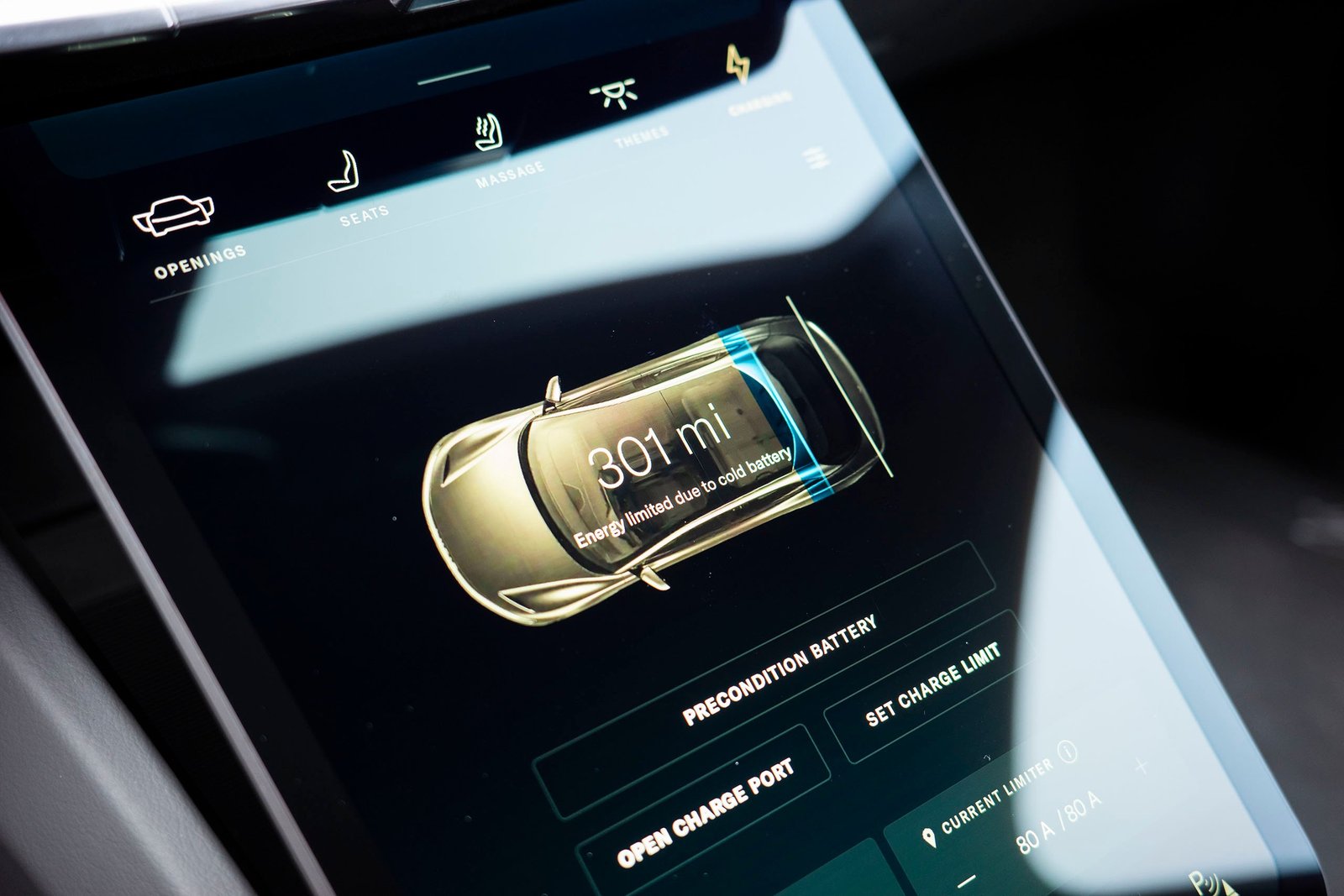
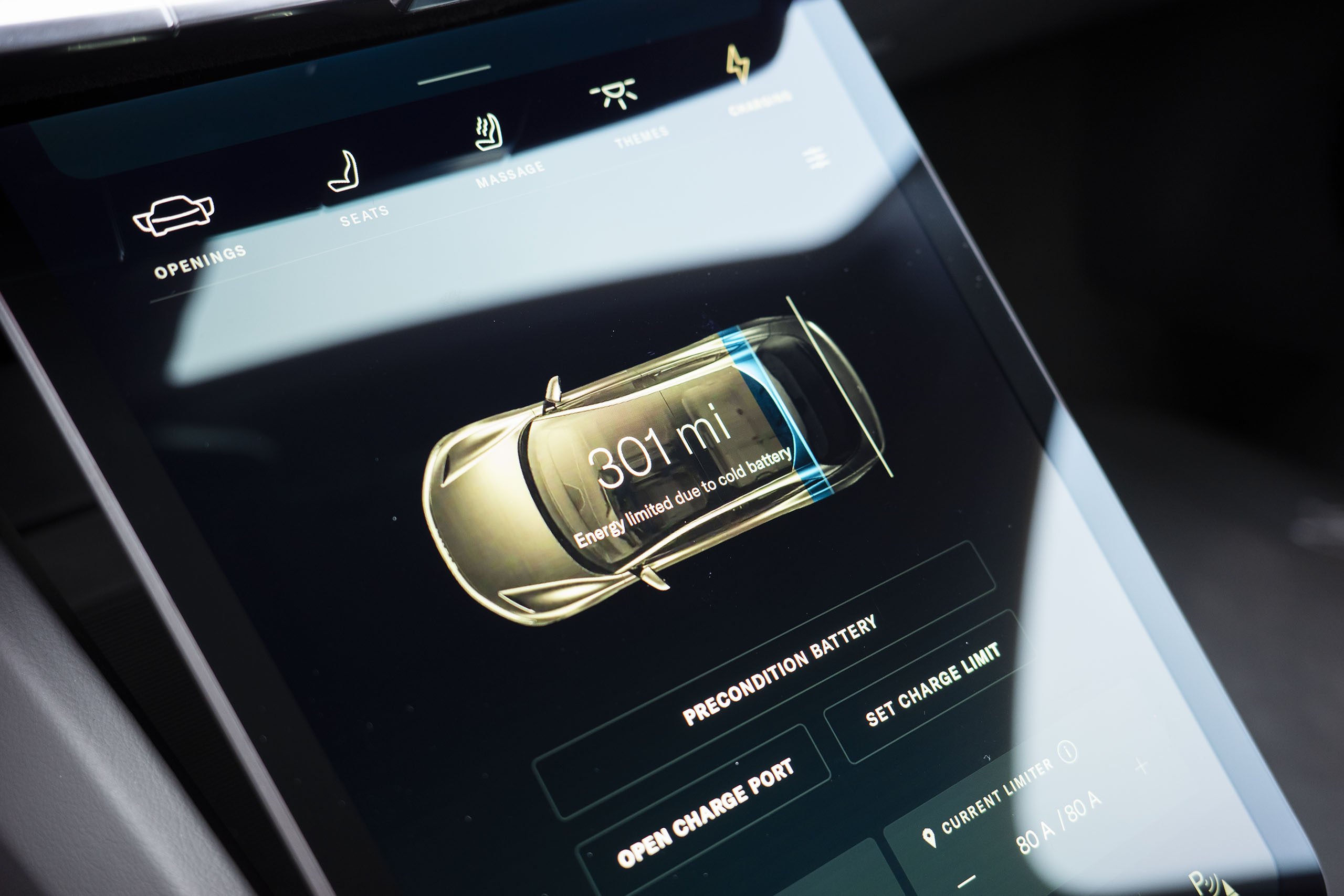
The headline figure — 431 miles (694 km) of EPA-rated range — is remarkable, and through our testing, it proved remarkably honest. In mixed highway and city driving, we saw real-world efficiency numbers of 4.0 to 4.3 miles per kWh, which are class-leading among luxury sedans. That translates to a practical driving range comfortably north of 370 miles in everyday conditions, with careful highway cruising pushing well past 400. For context, the Tesla Model S Long Range carries an EPA rating of 405 miles, and the Mercedes EQS 450+ comes in at 350 miles. The Touring doesn’t just beat them — it opens up meaningful daylight.
The 900V high-voltage architecture is the ace up its sleeve. Higher voltage means lower current for a given power level, which cuts thermal losses during charging and allows thinner, lighter cabling throughout the vehicle. Lucid quotes a peak DC fast-charging rate of 250 kW, and at a 350 kW station, the Touring can add 200 miles of range in just 16 minutes. In practice, 350 kW stations remain scarce across North America, and our real-world charging sessions averaged closer to 120 kW — still quick, but nowhere near the theoretical ceiling. Starting with the 2026 model year, the Air Touring ships with an NACS charge port, giving it access to Tesla’s Supercharger network — the most reliable and widely available fast-charging infrastructure in the country. That single change reshapes the Touring’s road-trip story. Stack 431 miles of range on top of a 16-minute top-up at a Supercharger, and range anxiety effectively disappears for this car.
Interior and Tech: Glass Canopy, 21 Speakers, 20-Way Seats
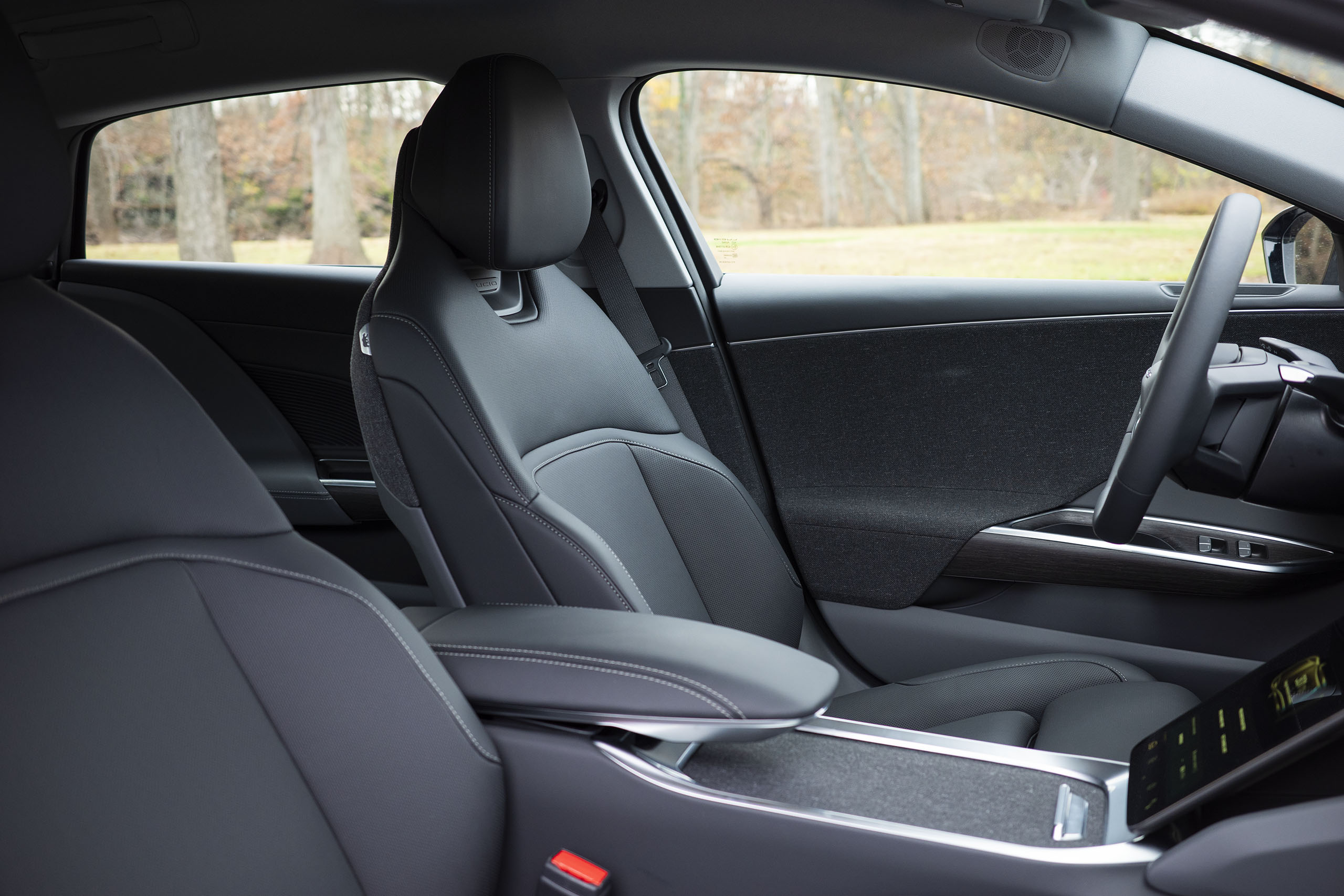
Climb inside the Air Touring and you immediately understand why this car costs what it does — and why it punches so far above its price. The cabin is the Touring’s ace, a space that genuinely rivals the Mercedes S-Class in materials quality and sensory richness. The dashboard wears soft fabric inserts with optional Eucalyptus wood trim, and the available Mojave PurLuxe leather is supple, aromatic, and beautifully stitched. Knurled scroll wheels on the steering wheel deliver a satisfying tactile click that recalls Bentley more than any EV near this price. Four distinct cabin themes are on offer — Mojave PurLuxe, Mojave, Santa Cruz, and Tahoe — each bringing a different palette of materials and accents.
The tech interface centers on two screens: a curved glass cockpit display ahead of the driver and a lower "Pilot Panel" touchscreen that retracts flush into the dashboard when you don’t need it. The Pilot Panel handles deeper vehicle settings and entertainment functions, keeping the main display clean for driving essentials. It’s an elegant arrangement, though the learning curve runs steeper than what Mercedes EQS owners will expect — some functions require digging through submenus that could stand to be more intuitive. The 21-speaker Surreal Sound Pro system, though, is beyond reproach. It fills the cabin with rich, spatially detailed audio that makes every genre sound spectacular. The optional panoramic glass canopy — which filters UV and infrared radiation to keep the cabin cool even under direct sun — is a box you should check; it floods the interior with light and openness without turning it into a greenhouse.
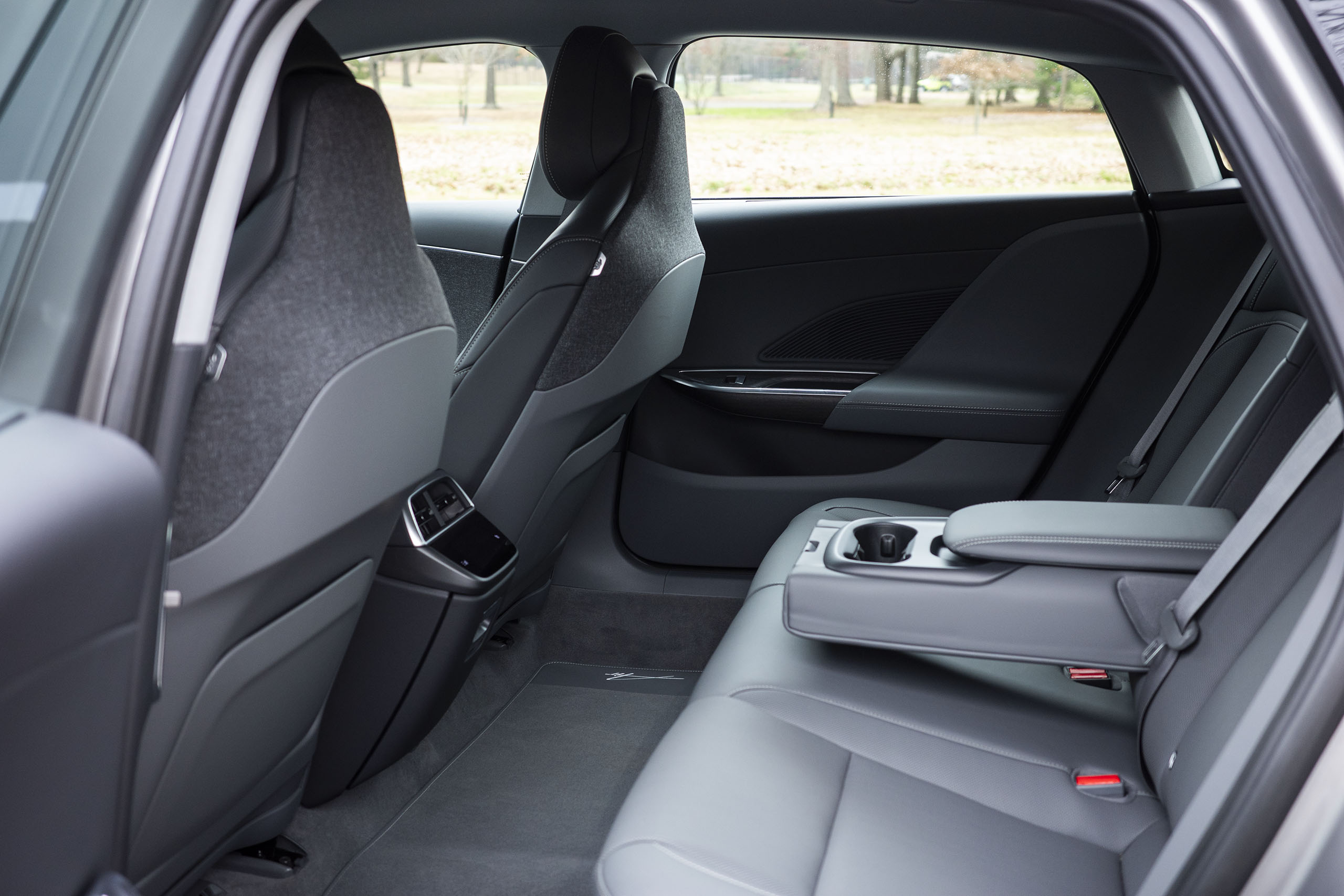
The front seats deserve a dedicated paragraph. With 20-way power adjustment, heating, ventilation, and massage functionality, they rank among the most comfortable chairs we’ve experienced in any car at any price. Long highway stints leave no fatigue, no pressure points, nothing to complain about. Rear-seat legroom is generous — more spacious than a Mercedes S-Class — and the flat floor courtesy of the skateboard battery architecture means three adults can sit abreast without squeezing. Cargo capacity is another Touring strong suit: roughly 22 cubic feet in the rear trunk and 10 cubic feet in the frunk, for a combined total that beats every rival sedan on the market.
DreamDrive Pro and Software: The Catch-Up Game
Every 2026 Air Touring comes standard with the DreamDrive Pro hardware suite: 14 cameras, 5 radar units, and 12 ultrasonic sensors. The full feature set — including Highway Assist with auto lane change, adaptive cruise control, and Auto Park In/Out — is rolling out in stages through over-the-air software updates. This isn’t Level 3 autonomy; the system requires constant driver supervision, and your hands need to stay on the wheel. On the highway, DreamDrive Pro is impressively smooth — smoother, in our experience, than Tesla Autopilot in its lane-centering behavior, with gentler steering corrections and more natural following distances. In dense urban environments, though, the system is less proven and less confident than Tesla’s city-driving capabilities.
This brings us to the Touring’s most persistent weakness: software maturity. Lucid’s infotainment system is functional and good-looking, but it doesn’t match the fluidity, responsiveness, and feature depth of Tesla’s interface. Over-the-air updates arrive less frequently than Tesla’s, and the voice assistant is hit-or-miss — sometimes understanding natural-language commands perfectly, other times stumbling on basic requests. Lucid has made real progress since the Air’s rocky 2023 launch, and each software release brings noticeable improvements. But if you’re switching from a Tesla, you’ll feel the gap. It’s the one area where the upstart still trails the incumbent.
Lucid Air Touring vs Tesla Model S: Which Is Better?
This is the matchup every potential buyer wants to see. The 2026 Lucid Air Touring and the Tesla Model S Long Range are separated by just $90 in starting price — $79,900 versus $79,990 — yet they take fundamentally different approaches to the luxury EV formula. Here’s how they stack up.
**Price and value.** At the sticker level, these two are essentially identical. But the Lucid arrives standard with air suspension, 20-way massaging seats, and a cabin trimmed in real wood and premium leather. The Tesla’s interior, while minimalist and functional, uses simpler materials and offers just one interior theme. Dollar for dollar, the Touring delivers dramatically more sensory luxury.
**Performance.** The Tesla Model S Long Range hits 60 mph in 3.1 seconds — three-tenths quicker than the Touring’s 3.4-second sprint. But the Lucid puts down 885 lb-ft of torque versus the Tesla’s 717 lb-ft, and the acceleration character is fundamentally different. The Tesla feels explosive and video-game sharp; the Lucid feels like a tidal wave — quieter, more progressive, and ultimately more luxurious in its delivery. Neither car will leave you wanting for speed.
**Range and efficiency.** The Touring’s 431-mile EPA rating beats the Model S Long Range’s 405 miles by 26 miles — a meaningful edge that compounds over a year of ownership. The Lucid achieves this with a smaller 92 kWh battery versus Tesla’s 100 kWh, a testament to its superior aerodynamics and drivetrain efficiency. In real-world driving, the gap widens further.
**Charging infrastructure.** Both cars peak at 250 kW DC fast charging, but the ecosystems around them differ. Tesla’s Supercharger network remains the gold standard for reliability and coverage — thousands of locations, consistent uptime, seamless billing. The Touring’s 900V architecture is more technically advanced and more future-proof, but today’s 350 kW station footprint is thin. The 2026 NACS port on the Touring changes the equation significantly, unlocking Tesla’s network for the first time. Over the next two years, this will erode Tesla’s infrastructure advantage considerably.
**Interior and cabin.** This isn’t close. The Lucid’s glass canopy, 21-speaker Surreal Sound Pro, four cabin themes, Eucalyptus wood trim, and fabric dashboard inserts create an atmosphere the Model S can’t touch. Tesla’s yoke steering wheel remains divisive; Lucid’s conventional round wheel with knurled scroll wheels is simply better. The Touring feels like a luxury car that happens to be electric; the Model S feels like a tech product that happens to have seats.
**Software and ADAS.** Tesla wins this category convincingly. Its infotainment is faster, more intuitive, and updated more frequently. Autopilot — particularly in its Full Self-Driving capability — has a larger dataset and more real-world miles than DreamDrive Pro. Lucid’s highway lane assist is smoother, but Tesla’s system is more feature-complete and more aggressively developed.
**Driving character.** The Tesla Model S Long Range is sharper, more responsive, and more engaging in aggressive driving. It rewards a lead foot with instant, visceral feedback. The Lucid Air Touring is calmer, quieter, and more composed — a car that encourages you to settle into the left lane, set the cruise at 78 mph, and glide. It drives like a Mercedes EQS with twice the soul and three times the performance.
| Spec | Lucid Air Touring | Tesla Model S Long Range |
|---|---|---|
| Starting Price | $79,900 | $79,990 |
| Power | 620 hp | 670 hp |
| Torque | 885 lb-ft | 717 lb-ft |
| 0-60 mph | 3.4 s | 3.1 s |
| EPA Range | 431 mi | 405 mi |
| DC Charging Peak | 250 kW | 250 kW |
| Architecture | 900V | 400V |
| Top Speed | 140 mph | 149 mph |
| Interior Theme | Glass canopy, 21-spkr, 4 themes | Minimalist, yoke, 1 theme |
Buy the Lucid Air Touring if you want the longest real-world range, the most luxurious cabin under $100K, and a 900V architecture that’s ready for the next generation of fast chargers. The Touring rewards drivers who care about how a car feels at 70 mph as much as how it accelerates from a standstill.
Buy the Tesla Model S Long Range if Supercharger access and software maturity matter more than cabin theatre. You’ll get a quicker car, a denser charging map, and a battle-tested infotainment stack — but the Lucid feels a generation ahead in materials and aerodynamics.
**Our pick** is the Lucid Air Touring. The 26 extra miles of range, the dramatically richer cabin, and the 900V charging architecture make it the more future-proof choice — and the price gap is essentially nothing.
Safety, Warranty, and Ownership
The Lucid Air platform carries an NHTSA 5-star overall safety rating and earned IIHS Top Safety Pick+ honors in prior model years. The 2026 model year hasn’t been independently tested yet, but the underlying structure and safety systems carry over unchanged. Standard equipment includes automatic emergency braking, blind-spot monitoring, lane-keep assist, and adaptive cruise control — a solid baseline even before DreamDrive Pro’s additional layers kick in. The car’s low center of gravity, courtesy of the floor-mounted battery pack, also contributes to exceptional resistance to rollover.
Warranty coverage is competitive: 4 years or 50,000 miles for the basic vehicle warranty, 8 years or 100,000 miles for the battery and electric drivetrain, and 12 years for corrosion protection. Where Lucid still lags behind is retail and service access. The company operates roughly 35 studios and service centers across the United States — a fraction of the hundreds of locations maintained by Tesla, Mercedes, and Porsche. Mobile service units help close the gap, traveling to customers’ homes or workplaces for routine maintenance and minor repairs. But if you live outside a major metro area, service logistics may require more planning than you’re used to. Lucid is expanding steadily, but for now, it’s worth considering if you’re away from the coasts.
Who Should Buy the Lucid Air Touring (and Who Shouldn’t)
✓ Buy the Lucid Air Touring if
you want the longest real-world range of any luxury EV, a cabin that genuinely rivals the German establishment, and charging architecture built for the next decade of infrastructure.
✗ Skip the Lucid Air Touring if
you’re locked into the Tesla ecosystem and value software polish and Supercharger access above all else. The Touring is also the wrong call for buyers who prioritize razor-sharp handling — a Porsche Taycan 4S is more rewarding through the apex, even if it sacrifices over a hundred miles of range to deliver that experience.
The Air Touring is built for a specific kind of driver — someone who values range, comfort, and cabin serenity over raw software polish or a sprawling dealer network. If you log highway miles for a living, charge at home most nights, and want the most aerodynamically efficient luxury sedan ever sold, this is your car. The 431-mile range paired with 900V charging architecture means road trips no longer require the routing-software gymnastics that plague lesser EVs. You just drive, stop briefly, and drive again.
⚡ Our Verdict
620 hp and a staggering 431-mile range make this the EV to beat.
After extensive time behind the wheel, here’s where we land: the 2026 Lucid Air Touring is the most accomplished long-distance luxury EV on sale today. It delivers 620 horsepower with the serenity of a cathedral, covers 431 miles on a single charge, and wraps its occupants in a cabin that genuinely competes with the Mercedes S-Class — all starting from $79,900. The 900V architecture and new NACS charge port make it the most future-proof luxury sedan in its class, and the 0.197 drag coefficient is an engineering achievement that will take rivals years to match. The trade-offs are real but manageable. Lucid’s software trails Tesla in polish and update frequency. The retail and service network is still thin outside major cities. Rear visibility suffers from the gorgeous fastback roofline. And the DreamDrive Pro feature set is still being activated in phases. None of these weaknesses undercut the Touring’s headline pitch. For the driver who covers serious miles and won’t compromise on comfort, range, or cabin quality, the Lucid Air Touring is the clear class leader. We rate it 4.5 out of 5 and name it the best buy in the luxury EV sedan segment for road-tripping drivers.
Frequently Asked Questions
How much does the 2026 Lucid Air Touring cost?
The 2026 Lucid Air Touring starts at $79,900 USD. Our as-tested model, equipped with optional paint, the panoramic glass canopy, 20-inch wheels, and a handful of interior upgrades, came to $102,100 USD. Most buyers will find a well-equipped configuration in the $85,000–$95,000 range.
What is the EPA range of the 2026 Lucid Air Touring?
The EPA rates the 2026 Air Touring at 431 miles (694 km) with the standard 19-inch Aero Range wheels. Choosing the 20-inch Aeronaut or Aero Lite wheels trims range slightly — typically by 15 to 25 miles — due to increased rolling resistance and reduced aerodynamic efficiency.
How fast can the Lucid Air Touring DC fast charge?
The Air Touring’s peak DC fast-charging rate is 250 kW. At a 350 kW DC fast charger, Lucid says the car can add 200 miles of range in just 16 minutes. The 900V high-voltage architecture enables efficient power delivery with lower thermal losses. In real-world testing, charging speeds averaged closer to 120 kW due to the limited availability of 350 kW stations, though the 2026 NACS port now unlocks Tesla’s Supercharger network for broader access.
Is the Lucid Air Touring better than the Tesla Model S?
It depends on what matters most to you. The Lucid Air Touring wins on EPA range (431 vs. 405 miles), cabin luxury, aerodynamics, and 900V charging architecture. The Tesla Model S Long Range wins on raw acceleration (3.1 vs. 3.4 seconds to 60), Supercharger network access, and software maturity. For most luxury buyers, the Lucid offers a richer ownership experience at a virtually identical price.
How long is the Lucid Air Touring battery warranty?
The Lucid Air Touring comes with an 8-year or 100,000-mile warranty on the battery and electric drivetrain, whichever comes first. The basic vehicle warranty covers 4 years or 50,000 miles, and corrosion protection extends to 12 years.
Does the Lucid Air Touring qualify for the federal EV tax credit?
Federal EV tax credit eligibility depends on factors including your income level, filing status, and whether the vehicle meets final assembly and sourcing requirements. As of 2026, Lucid Motors offers a manufacturer credit of up to $12,500 directly, which can be applied at the point of sale to reduce the effective purchase price. We recommend checking the IRS guidelines or talking to your tax advisor for your specific situation.
How does the Touring compare to the Grand Touring?
The Touring produces 620 hp and is EPA-rated at 431 miles of range, starting at $79,900. The Grand Touring jumps to 819 hp and 512 miles of range for approximately $110,900. For most drivers, the Touring is the smarter buy — it offers more than enough performance and range for daily use and long-distance travel, saving over $30,000 in the process. The Grand Touring makes sense only if you regularly push past 400 miles between charges or want the absolute maximum in both power and range.
