

2026 Kia EV4 Review: The Affordable Electric Sedan the Market Needed
A value-focused electric sedan that finally makes mainstream sense.
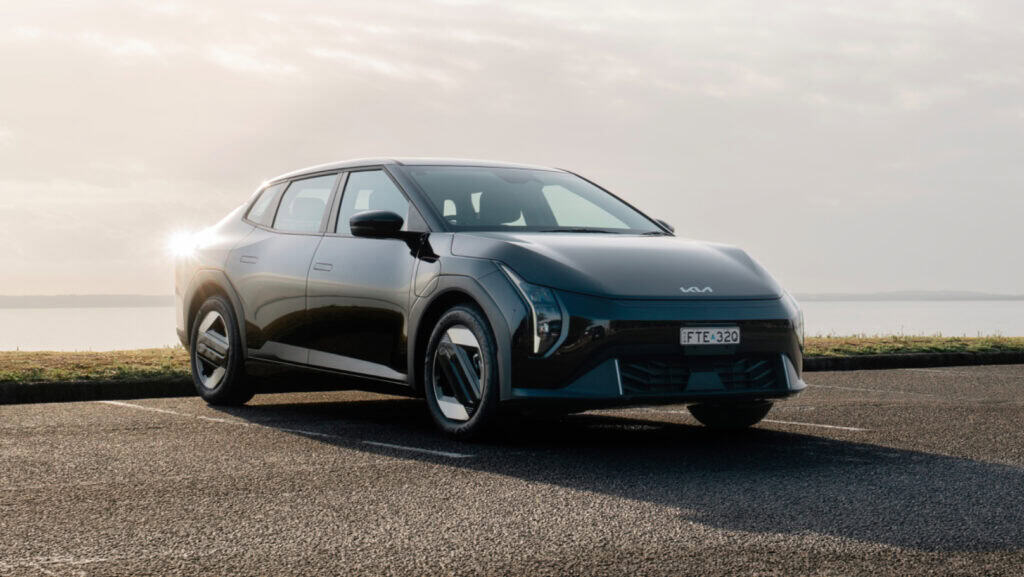
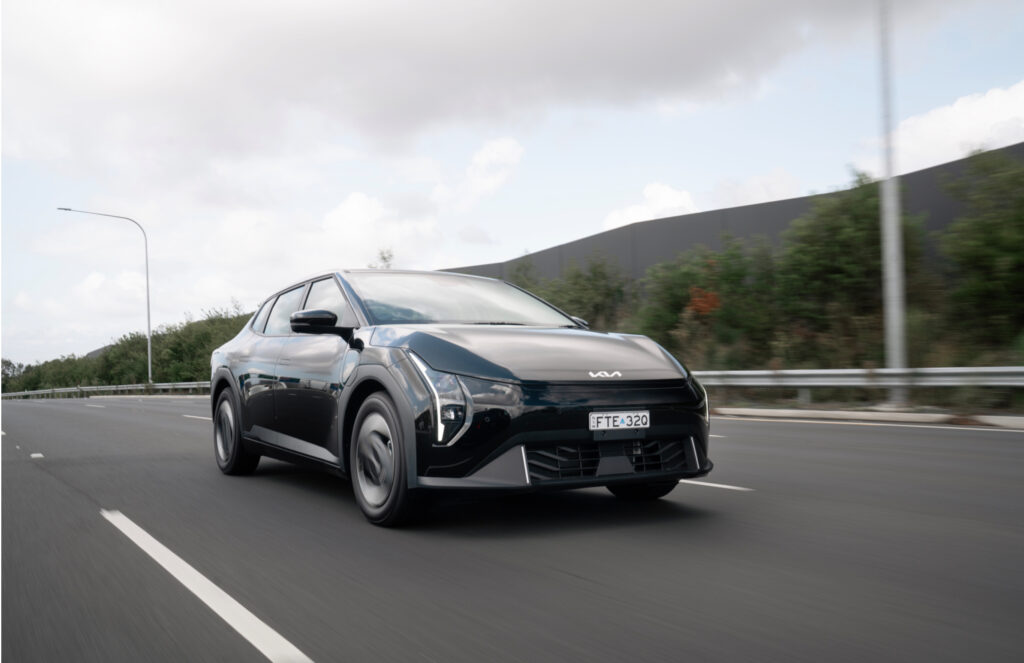
2026 Kia EV4 front three-quarter exterior
Price
A$54,990
Battery Capacity
81.4 kWh
Power Output
150 kW (201 hp)
⚡ Quick Verdict
Kia’s EV4 is the affordable electric sedan we’ve been waiting for. It pairs competitive range with a well-sorted cabin, sharp pricing, and a warranty nobody else can match. It won’t set driving enthusiasts’ hearts alight, but for families shopping their first EV, it’s a compelling package that’s very hard to fault.
—
## Design and First Impressions
✓ The Good
- +Competitive pricing significantly undercuts most electric sedan rivals
- +Up to 552 km WLTP range from the long-range battery pack
- +Refined ride quality and excellent improved i-Pedal v3 system
- +Generous standard equipment even on the base Air trim
- +Industry-leading ten-year powertrain warranty for long-term peace of mind
✗ The Trade-offs
- −400-volt architecture caps DC charging speed below segment best
- −Touch-sensitive HVAC panel lacks satisfying tactile feedback
- −No all-wheel-drive option available until late 2026
- −Rear headroom slightly compromised by the fastback roofline
📑 In This Review
- Design and First Impressions
- Inside the Cabin
- Battery, Range and Charging
- On the Road
- Technology and Driver Assistance
- 2026 Kia EV4 vs Tesla Model 3: Which Is Better?
- How It Compares to the Wider Field
- Safety and Warranty
- Pricing and Trims
- Who Should Buy the 2026 Kia EV4
- Buy it if:
- Skip it if:
- Verdict
- Frequently Asked Questions
Kia’s EV4 is the affordable electric sedan we’ve been waiting for. It pairs competitive range with a well-sorted cabin, sharp pricing, and a warranty nobody else can match. It won’t set driving enthusiasts’ hearts alight, but for families shopping their first EV, it’s a compelling package that’s very hard to fault. —
Design and First Impressions
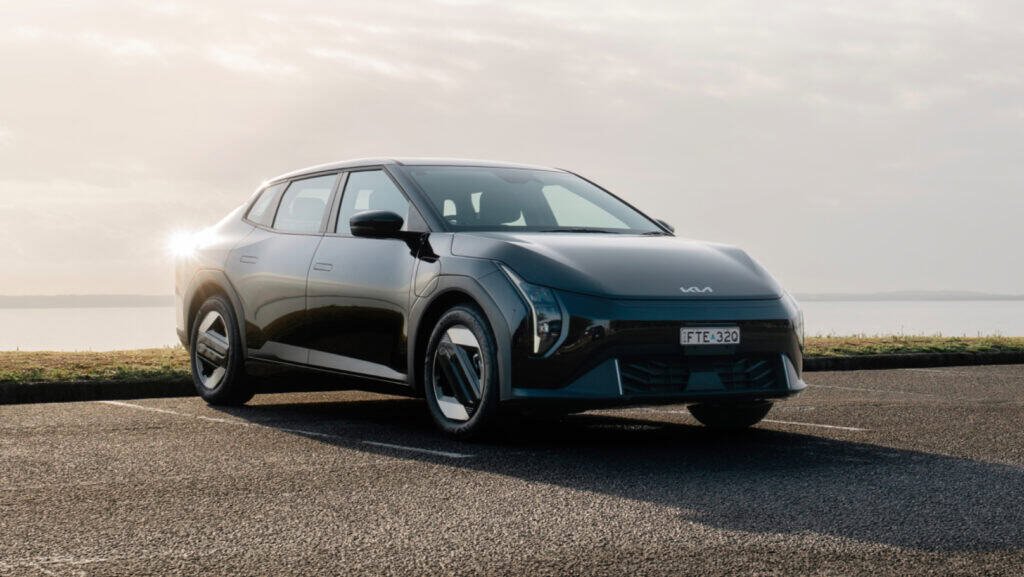
At 4,730 mm long, 1,860 mm wide, and 1,480 mm tall, the EV4 slots neatly into the compact sedan segment. It’s roughly the footprint of a Corolla sedan but dressed in distinctly modern sheet metal. Kia’s Opposites United design language has been dialled back here compared with the EV6 and EV9, and the result is a clean, aerodynamic shape that reads purposeful rather than polarising.
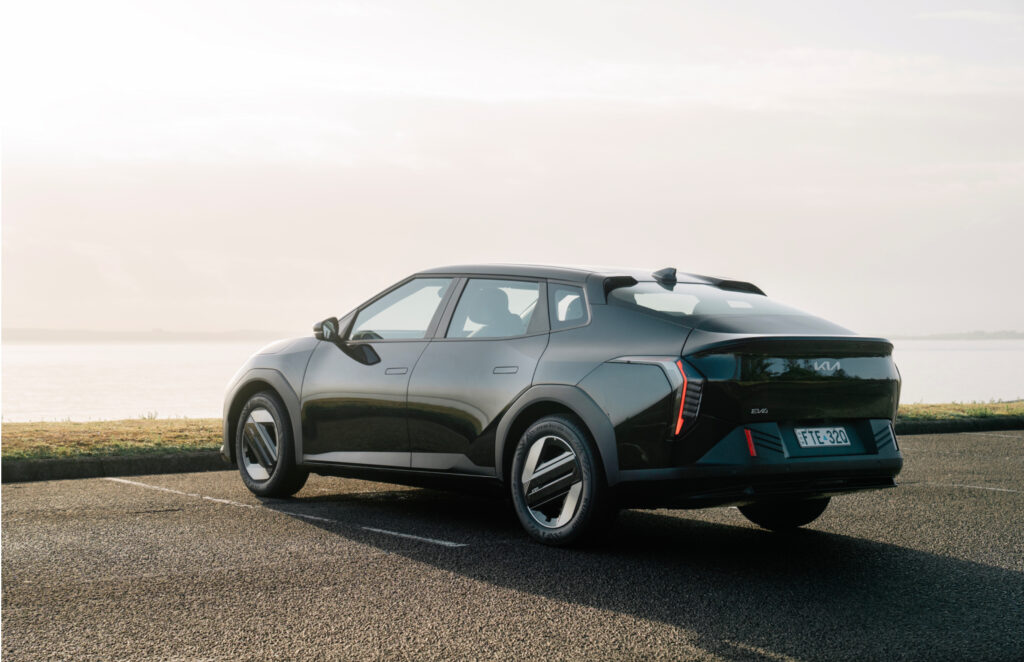
Up front, Kia’s Digital Tiger Face takes centre stage. Slim LED daytime running lights sweep into the bonnet line, and there’s a body-coloured panel where a grille would normally sit. In profile, the long wheelbase and short overhangs give it a planted stance, while a gently sloping roofline — available as either a fastback or conventional hatchback depending on market — adds a sporty touch. Around back, a full-width light bar and a subtle lip spoiler tidy up the airflow.
Our GT-Line test car ran 18-inch two-tone alloys, black mirror caps, and a more aggressive front bumper that adds visual punch without going over the top. Paint choices cover a sensible spread of whites, greys, blacks, and a striking Gravity Blue that looks cracking in photos. Fit and finish on the pre-production cars we sampled in Spain were consistently tight — panel gaps were even and the whole car felt like it belonged in a higher price bracket. It’s designed to look more expensive than it is, and in the metal it pulls it off.
—
Inside the Cabin
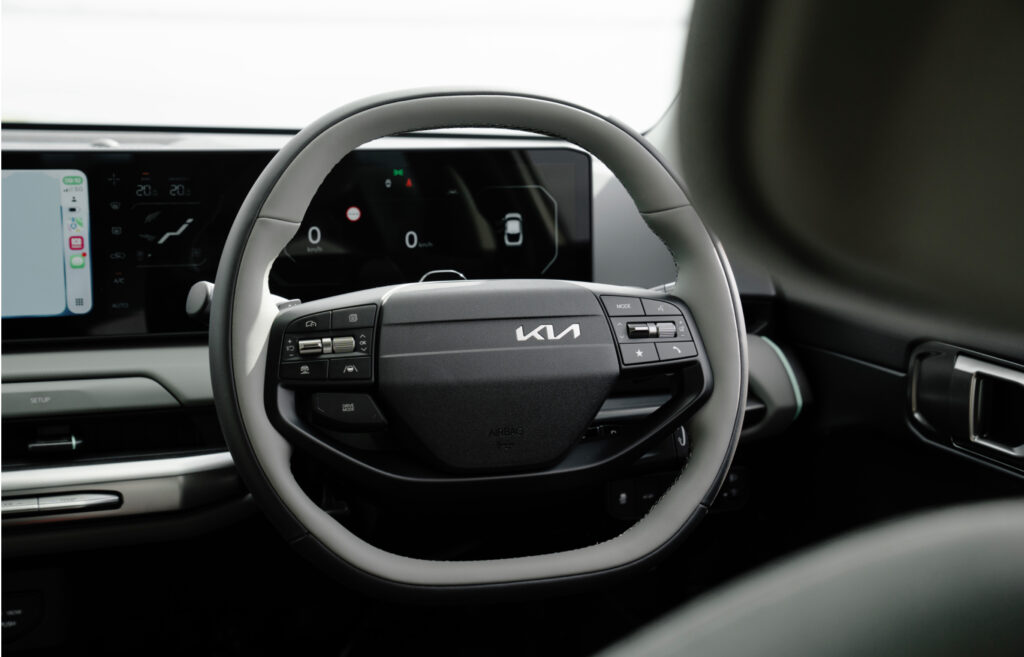
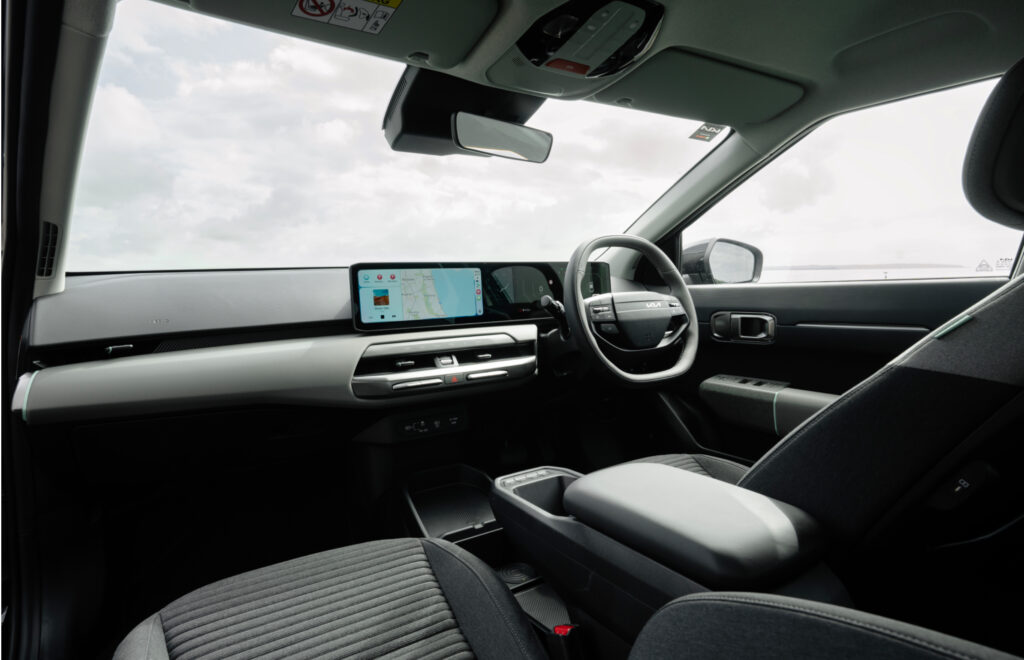
Climb in and the first thing that grabs you is the twin 12.3-inch displays stretched across the dashboard. One acts as the digital instrument cluster, the other handles infotainment duties. They sit beneath a single curved glass panel, giving the cabin a clean, tech-heavy look that feels thoroughly modern. Wireless Apple CarPlay and Android Auto come standard across the range — a welcome touch that plenty of competitors still charge extra for or leave out entirely.
Below the main screen is a 5-inch HVAC touch panel. It looks sleek but lacks the satisfying click of physical buttons, and we found ourselves glancing down more than we’d like to adjust temperature on the move. It’s our one consistent ergonomic gripe in an otherwise well-thought-out cabin. Kia has at least kept physical shortcut keys flanking the panel for commonly used functions.
The centre console gets a clever rotating armrest and a sliding storage bin with genuine day-to-day flexibility. Higher trims pick up ambient lighting that casts a soft glow across the doors and dash, lifting the cabin atmosphere after dark. Material quality mixes soft-touch surfaces in high-contact spots with harder plastics lower down, which is perfectly reasonable for the price point.
Rear-seat legroom impresses for a compact sedan, thanks to that long wheelbase and a flat floor courtesy of the skateboard battery platform. Adults up to around 180 cm will sit comfortably enough, though the fastback roofline does eat into headroom for taller passengers. Boot space measures 490 litres in the fastback and 435 litres in the hatch, with a handy under-floor compartment for stashing charging cables. The 60/40 split-fold rear seats open up considerably more room when you need it.
—
Battery, Range and Charging
Two battery packs are on offer, and your pick here is the single biggest decision in the configurator. The standard 58.3 kWh unit delivers a WLTP-rated 391 km of range — perfectly fine for urban commuters and anyone with regular charging access. Step up to the 81.4 kWh long-range battery and that figure jumps to 552 km WLTP, putting the EV4 in the same league as the Tesla Model 3 and Hyundai Ioniq 6.
Both packs feed a single front-mounted electric motor making 150 kW (201 hp) and 310 Nm of torque. Kia’s gone with a 400-volt electrical architecture rather than the 800-volt system in the EV6 and EV9. That’s a deliberate, cost-driven choice, and it’s the right one for this car. An 800-volt setup adds expense at every level, from the battery cells to the onboard charger to the power electronics. For a vehicle positioned as an affordable entry point, the incremental charging speed benefit doesn’t justify the price premium.
Peak DC fast-charging speed tops out at 127 kW, which gets you from 10 to 80 percent in roughly 29 minutes on the standard battery and 31 minutes on the long-range pack under ideal conditions. The EV4 works fine with higher-rated chargers including 350 kW units, but it’ll only draw up to its rated maximum. On AC, the onboard charger supports up to 11 kW, so a full charge from empty takes about five to six hours on a home wallbox — comfortably an overnight job.
In real-world driving during our time in southern Spain, energy consumption settled around 14.5 kWh/100 km in mixed conditions with the long-range battery. That translates to a practical range comfortably north of 450 km, which is a strong result for this class.
—
On the Road
The EV4’s on-road character puts refinement ahead of outright performance, and that’s exactly the right call for this segment. With 201 hp driving the front wheels and a kerb weight kept in check by the compact battery packs, it feels brisk rather than fast. The 0–100 km/h dash takes 7.4 seconds in the Air and 7.8 seconds in the slightly heavier GT-Line. Adequate for merging and overtaking, but it won’t pin you to your seat. An all-wheel-drive variant with a dual-motor setup is confirmed for late 2026 and should deliver noticeably quicker acceleration.
On the smooth, sun-baked roads around our Spanish test route, the EV4 rode with a composure that surprised us given its price tag. The suspension — MacPherson struts up front, multi-link at the rear — absorbed imperfections without complaint, and body roll through corners stayed well controlled. The steering is light and accurate, tuned more for ease around town than backroad involvement. It works. The EV4 isn’t trying to be a sports sedan. It’s a comfortable, quiet commuter that happens to run on electricity.
And quiet it certainly is. Wind noise and tyre roar are impressively suppressed at highway speeds, helped along by the slippery bodywork and generous sound-deadening. The EV4’s relatively low mass works in its favour dynamically too — at roughly 1,600–1,700 kg depending on spec, it changes direction with more willingness than many heavier EVs.
The standout dynamic feature is Kia’s i-Pedal v3 regenerative braking system. Three regen levels are selectable via paddle shifters behind the steering wheel, and the system now includes a memory function — something EV owners have been asking for for years. The car remembers your preferred setting between drive cycles instead of defaulting to the weakest level. There’s also a new reverse i-Pedal mode that enables one-pedal driving even when backing up, holding the car on inclines without brake pedal input. It takes a few minutes to get used to, but quickly becomes second nature.
—

Technology and Driver Assistance
The twin 12.3-inch displays run Kia’s latest infotainment software, which is responsive, logically laid out, and benefits from over-the-air update capability. A natural-language voice assistant handles climate, navigation, and media commands without needing rigid phrasing, though it does struggle occasionally with more complex multi-step requests. As noted, wireless Apple CarPlay and Android Auto are standard across the range, letting you bypass the native system entirely if you prefer.
The driver-assistance lineup is generous. Autonomous emergency braking with junction-turning assist and cyclist detection is standard, alongside lane-keep assist, lane-follow assist, and adaptive cruise control with stop-and-go. Blind-spot collision avoidance, rear cross-traffic collision avoidance, driver attention monitoring, and a safe-exit warning that alerts you to approaching traffic before you open a door round out the active safety suite.
The systems worked unobtrusively during our drive. Lane-centring held the car confidently on well-marked roads without the constant micro-corrections that annoy in some rivals, and the adaptive cruise managed following distances smoothly. This isn’t a hands-free system and Kia makes no claims to that effect, but as a set of aids that reduce fatigue on longer drives, it does the job admirably.
—
2026 Kia EV4 vs Tesla Model 3: Which Is Better?
This is the comparison most buyers want to see. The Tesla Model 3 is the benchmark for affordable electric sedans globally, and the EV4 enters the market with a clear mandate to challenge it on value, warranty, and everyday usability.
On price, the EV4 holds a meaningful advantage. In Australia, the entry-level EV4 Air starts at A$49,990, while the long-range variant comes in at A$54,990 — directly matching the Model 3 RWD at A$54,900. In Canada, the EV4 opens at approximately CA$41,145 with destination, positioning it several thousand dollars below a comparably equipped Model 3 before government incentives.
Range is closer than the price gap suggests. The EV4 Long Range delivers 552 km WLTP on its 81.4 kWh battery, compared to the Model 3 RWD’s 513 km. That said, real-world testing consistently shows Tesla vehicles achieving a higher percentage of their WLTP figures, so the practical gap may be narrower depending on conditions and driving style.
Performance is where the Model 3 pulls clearly ahead. Its 208 kW motor and lighter construction deliver a 0–100 km/h time of 6.1 seconds, a full 1.7 seconds quicker than the EV4 Long Range’s 7.8-second sprint. If acceleration matters to you, the Tesla’s advantage is unambiguous.
Charging infrastructure is another Tesla strength. The Supercharger network remains the most reliable and widely available fast-charging system, though the EV4’s CCS compatibility and Tesla’s opening of Superchargers to non-Tesla vehicles narrows the gap. The EV4’s 127 kW peak DC charge rate does trail the Model 3’s 170 kW, meaning slightly longer stops on road trips.
Inside, the EV4 takes a decisive lead for buyers who prefer conventional controls. Physical buttons, a dedicated instrument cluster, and wireless CarPlay and Android Auto contrast sharply with the Model 3’s single-screen, button-free approach. Rear-seat space and boot capacity are broadly comparable, though the EV4’s available hatchback body style adds cargo flexibility.
On the road, the two cars feel quite different. The Model 3 is sportier, with sharper steering and a firmer ride. The EV4 is more relaxed, more comfortable, and quieter at highway speed. Better suited to the daily commute than weekend spirited drives.
| Spec | 2026 Kia EV4 Long Range | 2025 Tesla Model 3 RWD |
|---|---|---|
| Starting Price (Aus.) | A$54,990 | A$54,900 |
| Battery Capacity | 81.4 kWh | 60 kWh |
| Power Output | 150 kW (201 hp) | 208 kW (283 hp) |
| WLTP Range | 552 km | 513 km |
| 0–100 km/h | 7.8 s | 6.1 s |
| Max DC Charge Rate | 127 kW | 170 kW |
| Drive Layout | FWD | RWD |
| Warranty (Basic / Powertrain) | 5 yr / 10 yr | 4 yr / 8 yr |
| Wireless CarPlay / Android Auto | Yes | No |
> **WHICH ONE IS BETTER?** > > **Buy the Kia EV4 if** you want a value-focused, family-friendly electric sedan with proper physical controls, wireless CarPlay/Android Auto, and Kia’s class-leading 5-year/10-year warranty. > > **Buy the Tesla Model 3 if** you prioritise outright range, the Supercharger network, and the quickest 0–100 km/h time for the money. > > **Our pick** is the Kia EV4. For most mainstream buyers, the warranty, dealer network, physical controls, and lower price more than offset the Model 3’s range advantage.
—
How It Compares to the Wider Field
The EV4 doesn’t exist in a vacuum. The compact-to-mid-size electric sedan segment has become fiercely competitive, and Kia’s newest entry needs to hold its own against several strong rivals.
The BYD Seal is arguably the most direct threat on price. Starting at A$46,990 in Premium guise, it undercuts the EV4 on entry cost while offering a larger 82.6 kWh battery, 570 km WLTP range, and a punchier 230 kW motor that sprints to 100 km/h in just 5.9 seconds. On paper it’s the better value proposition, but BYD’s dealership network is still building out in many markets and its warranty doesn’t match Kia’s decade-long powertrain coverage.
The Hyundai Ioniq 6 shares the EV4’s E-GMP-derived platform but stretches it into a sleeker, more aerodynamic body that returns up to 614 km WLTP — the longest range in this comparison. It costs more and sits in a slightly more premium space, but its fastback shape limits rear headroom more than the EV4.
Polestar 2 remains a left-field pick with Scandinavian design flair and engaging dynamics, though its pricing has crept upward and it trails on range and warranty.
For buyers cross-shopping against internal combustion, the Kia K4 — the EV4’s petrol-powered sibling — offers a lower entry price and the convenience of existing refuelling infrastructure. The EV4 closes the running-cost gap quickly, though, with electricity costs roughly half those of petrol per kilometre in most markets.
| Model | Starting Price | Power | WLTP Range | 0–100 km/h |
|---|---|---|---|---|
| 2026 Kia EV4 Air | A$49,990 | 150 kW | 391 km | 7.4 s |
| 2026 Kia EV4 Long Range | A$54,990 | 150 kW | 552 km | 7.8 s |
| Tesla Model 3 RWD | A$54,900 | 208 kW | 513 km | 6.1 s |
| BYD Seal Premium | A$46,990 | 230 kW | 570 km | 5.9 s |
| Hyundai Ioniq 6 | A$53,500 | 168 kW | 614 km | 7.4 s |
—
Safety and Warranty
The EV4 has picked up a five-star safety rating from Euro NCAP, matching the result from Latin NCAP’s independent testing. Individual category scores came in at 84 percent for adult occupant protection, 85 percent for child occupants, 77 percent for vulnerable road users, and 78 percent for safety assist systems. Those are strong numbers for the segment and reflect a body structure built with high-strength steel, multiple load paths, and a battery pack integrated into the floor for a low centre of gravity.
Standard passive safety covers front, side, curtain, and centre airbags — seven in most configurations. The active-safety suite, detailed in our Technology section above, is well-specced and fitted across the range rather than locked behind expensive option packs.
Where the EV4 really sets itself apart is warranty coverage. Kia backs the vehicle with a five-year or 60,000-mile basic warranty and a ten-year or 100,000-mile powertrain warranty — the latter among the longest in the industry for any powertrain type. The high-voltage battery gets an eight-year warranty with capacity retention guarantees. That level of cover provides a genuine safety net that meaningfully reduces long-term ownership risk, particularly for first-time EV buyers understandably nervous about battery degradation. Few competitors come close to matching it, and for cost-conscious families weighing up the switch to electric, the peace of mind alone could be the deciding factor.
—
Pricing and Trims
The EV4 launches in three trim levels: Air, Earth, and GT-Line. In Canada, the range starts at approximately CA$41,145 including destination for the Air with the 58.3 kWh battery, making it one of the most affordable electric sedans on the market. Stepping up to the Earth trim brings the 81.4 kWh long-range battery for roughly CA$4,000 more, adding ventilated front seats, heated rear seats, an eight-speaker audio system, and wireless phone charging.
The GT-Line sits at the top of the range at around CA$49,000–$55,000 depending on market and options. It adds 18-inch alloy wheels, sportier exterior styling, a flat-bottom steering wheel, upgraded interior trim, and the full driver-assistance suite. In Australia, pricing spans A$49,990 for the Air to A$59,990 for the GT-Line Long Range, placing the EV4 squarely in the mainstream sweet spot.
The US launch remains delayed due to ongoing tariff considerations affecting Korean-manufactured vehicles. Kia hasn’t confirmed a revised US on-sale date but is actively evaluating production strategies that could include North American assembly to sidestep import duties.
Running costs should be low. Service intervals are set at 12 months or 15,000 km, and with far fewer moving parts than a combustion equivalent, maintenance is limited mainly to brake fluid, cabin air filter, tyre rotation, and coolant checks. Insurance and registration costs will vary by jurisdiction but generally come in below equivalent-price combustion sedans.
—
Who Should Buy the 2026 Kia EV4
The EV4 is built for a specific buyer: someone who wants electric motoring without the premium price tag or a steep learning curve. If you’re coming from a Corolla, Civic, or Cerato, the EV4 will feel immediately familiar. The controls are intuitive, the screens are informative without being overwhelming, and the driving experience requires zero adaptation beyond plugging in at night.
It also makes a strong case for families. The rear seat handles child seats and growing teenagers comfortably, the boot swallows a weekly shop with ease, and the full safety suite provides reassurance when your most precious cargo is strapped in the back. Where the EV4 falls short is for buyers who demand maximum performance, the fastest possible charging, or the slickest software ecosystem. It’s a fundamentally sensible car. That’s its greatest strength and, in some ways, the limit of its appeal.
Buy it if:
– You want an affordable, well-equipped electric sedan as your first EV – Long-term warranty coverage and dealer support are high priorities – You prefer physical controls and wireless CarPlay over a screen-only interface
Skip it if:
– You need all-wheel-drive capability before late 2026 – Sub-6-second acceleration is a must-have requirement – You rely on the fastest DC charging speeds for frequent road trips
—
⚡ Our Verdict
A value-focused electric sedan that finally makes mainstream sense.
The 2026 Kia EV4 arrives at a critical moment. The affordable electric sedan market has thinned out in recent years as manufacturers chased higher-margin SUVs and crossovers, leaving budget-conscious buyers with fewer choices than ever. Kia’s identified that gap and filled it with a car that nails the fundamentals — competitive range, a well-sorted cabin, strong safety credentials, and pricing that doesn’t require a spreadsheet to justify. It’s not perfect. The 400-volt charging architecture caps peak speed, the HVAC touch panel will frustrate button purists, and the lack of AWD at launch may put off buyers in cooler climates. But these are compromises made with purpose, each one serving the goal of keeping the sticker price accessible and the ownership proposition straightforward. For the majority of mainstream buyers looking at their first electric sedan, the EV4 does exactly what it needs to do. It removes barriers. It normalises the switch. And it backs the whole package with a warranty no direct rival can match. The 2026 Kia EV4 earns a strong 8.4/10 — proof that affordable electric sedans still have a future. —
Frequently Asked Questions
What is the real-world range of the 2026 Kia EV4?
The standard-battery EV4 delivers a WLTP-estimated 391 km, while the long-range model claims 552 km. In our testing with the 81.4 kWh pack in mixed driving conditions, we’d call 450–480 km a realistic figure, depending on speed, climate, and how heavy your right foot is.
How long does it take to charge the Kia EV4?
On a DC fast charger at the EV4’s peak 127 kW rate, you’re looking at roughly 29 minutes for a 10-to-80-percent charge on the standard battery and about 31 minutes on the long-range pack. Plug into an 11 kW home wallbox and a full charge from empty takes around five to six hours — easily an overnight affair.
Will the 2026 Kia EV4 be sold in the United States?
The US launch has been delayed due to tariff considerations affecting Korean-manufactured vehicles. Kia’s confirmed it’s evaluating potential North American production strategies, but no revised on-sale date has been announced. Canadian and Australian deliveries are proceeding as scheduled, with first customer cars arriving in early 2026.
Is all-wheel drive available on the Kia EV4?
Not at launch. Every EV4 variant ships with front-wheel drive and a single electric motor. An all-wheel-drive dual-motor version is confirmed for late 2026, offering improved traction and quicker acceleration at the cost of some range efficiency.
What warranty does Kia offer on the EV4?
Kia provides a five-year or 60,000-mile basic warranty, a ten-year or 100,000-mile powertrain warranty, and an eight-year high-voltage battery warranty with capacity retention guarantees. It’s among the strongest coverage packages available in the EV segment.
What is the starting price of the 2026 Kia EV4?
In Canada, the EV4 Air starts at approximately CA$41,145 including destination. In Australia, pricing begins at A$49,990 for the Air and goes up to A$59,990 for the GT-Line Long Range. US pricing hasn’t been announced due to the delayed market launch.
