

2026 BMW M5 Review: The Plug-In Hybrid Super Sedan Returns
Brutal pace, clever tech — the weight is the compromise

2026 BMW M5 Sedan in Sepia Metallic — front three-quarter studio press shot
Price
~USD $121,900 / AUD ~$259,900
Powertrain
4.4L TT V8 + e-motor (PHEV)
⚡ Quick Verdict
— Quick Verdict
✓ The Good
- +Staggering 717 hp combined output delivers savage straight-line performance
- +40-45 km EV range makes short urban commutes genuinely emission-free
- +Chassis technology — adaptive dampers, electronic anti-roll, rear-wheel steering — disguises the mass brilliantly
- +Interior quality, tech and comfort are flagship-grade throughout
- +M xDrive with selectable 2WD drift mode adds playful versatility
✗ The Trade-offs
- −Kerb weight of approximately 2,400 kg is a genuine dynamic penalty on tight roads
- −No DC fast-charging capability limits plug-in convenience on longer trips
- −Loss of the sunroof due to the standard M Carbon roof may disappoint some buyers
- −Australian pricing at $259,900 places it firmly in exotic territory
- −—
📑 In This Review
- Design & First Impressions
- Powertrain & Performance
- Hybrid System, EV Range & Efficiency
- Interior, Tech & Comfort
- On-Road Feel & Handling
- At a Glance: 2026 BMW M5 vs Key Rivals
- 2026 BMW M5 vs Cadillac CT5-V Blackwing: Which Is Better?
- Safety & Warranty
- Who Should Buy the 2026 BMW M5?
- Verdict
- Frequently Asked Questions
BMW’s first plug-in hybrid M5 pairs a 4.4-litre twin-turbo V8 with an electric motor for a combined 535 kW (717 hp) and 1,000 Nm. It hits 100 km/h in roughly 3.5 seconds, tops out at 305 km/h with the M Driver’s Package, and will cruise up to 45 km on electricity alone. At approximately AUD $259,900 before on-road costs here in Australia, it’s aimed squarely at buyers who want ballistic straight-line pace paired with genuine daily-driver usability. The 2,400 kg kerb weight is the obvious compromise, but BMW’s chassis engineers have thrown everything they’ve got at disguising it. If you’re after a brutally fast sedan that can silently glide through school zones on battery power before firing a twin-turbo V8 up a mountain road, the G90 M5 was built for exactly that. —
Design & First Impressions
The 2026 M5 doesn’t exactly whisper about its intentions. The G90 generation brings BMW’s latest design language to the 5 Series shape, and in full M5 trim the car looks wider, lower and considerably angrier than anything that’s come before. The kidney grille is large but well-proportioned here, arguably one of the cleaner takes on BMW’s polarising recent grille direction. It sits flush with the bodywork, flanked by slim laser headlights and L-shaped LED daytime running lamps that give the nose real presence, particularly at dusk.
Below the bumper line, the functional air intakes are enormous, feeding cooling air to the heat exchangers and front brakes. Every aero element is integrated into the fascia rather than bolted on as an afterthought, which keeps the design cohesive. The optional Speed Yellow finish you’ll see at motor shows divides opinion, but in more restrained Sepia Metallic or Isle of Man Green the M5 looks properly menacing without trying too hard.
Along the side, carbon-fibre mirror caps, a deep lower sill extension and doors that angle inward toward the sill create visual movement even when parked. The standard M Carbon roof — there’s no sunroof option — saves roughly 15 kg over a conventional glass panel and gives the roofline a taut, coupe-like tension. Staggered 20-inch front and 21-inch rear alloy wheels in gloss black fill the arches, wrapped in Michelin Pilot Sport 5 S rubber. Cross-drilled rotors and six-piston Brembo calipers are barely hidden behind the spokes.
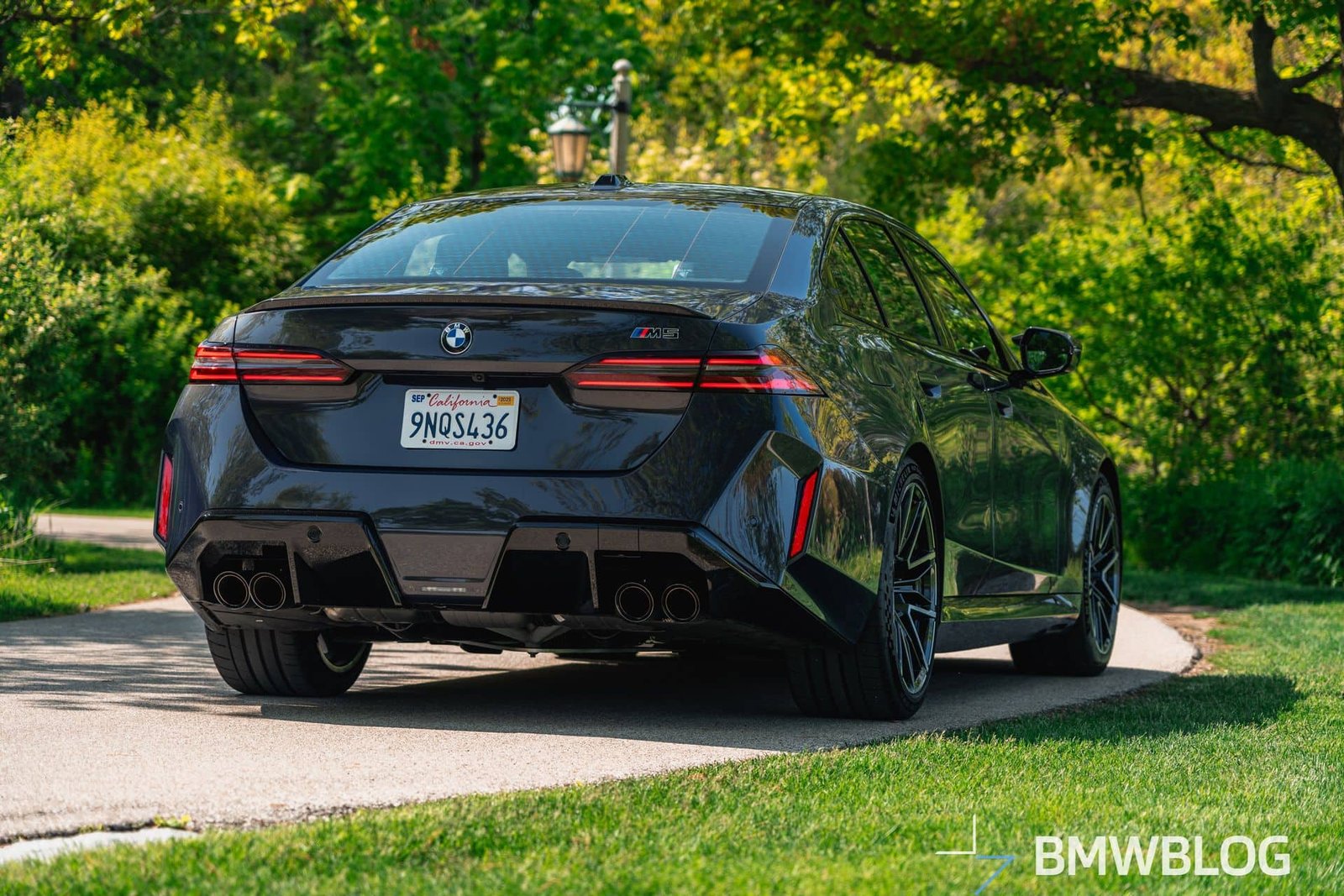
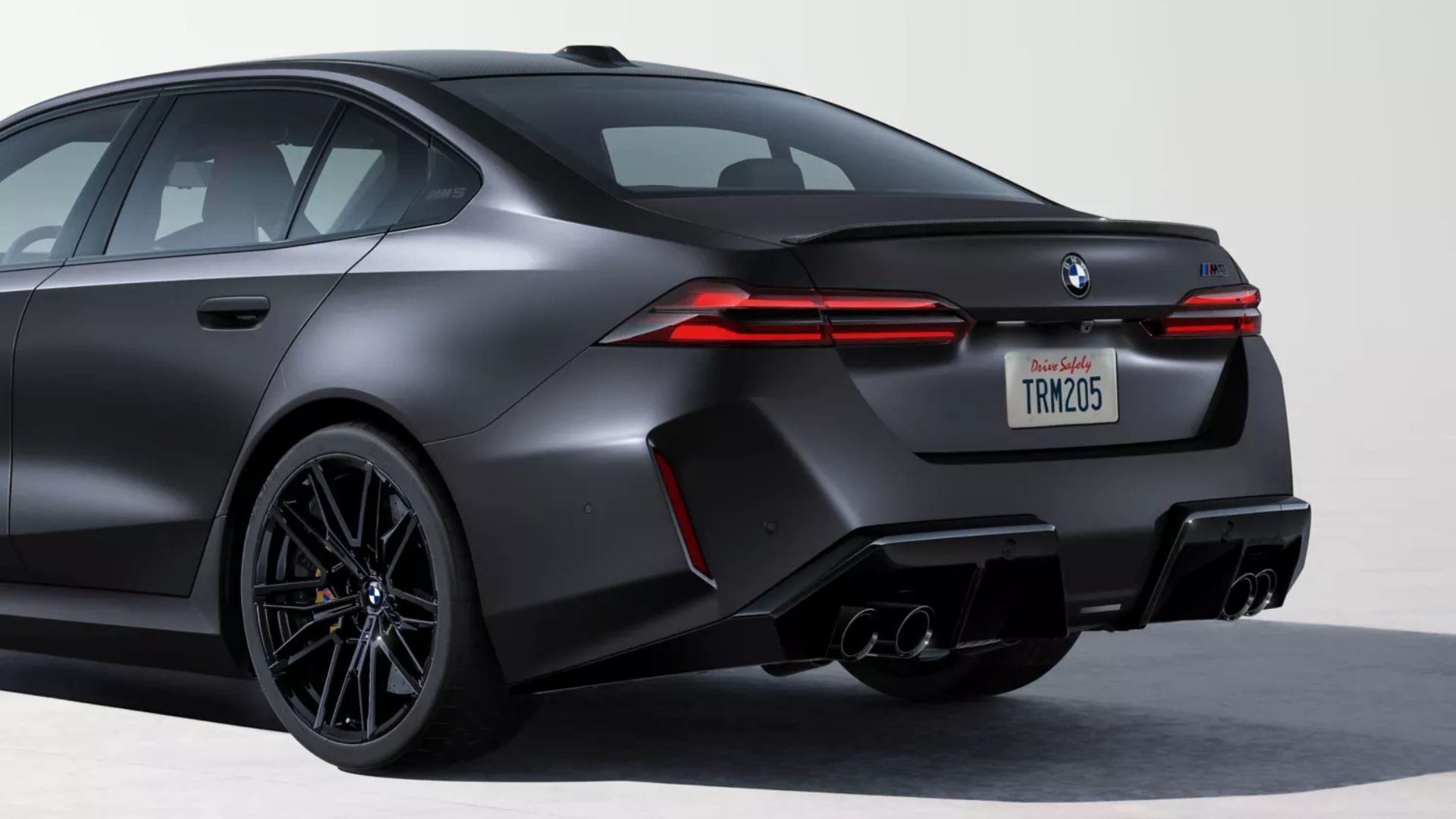
Around back, a carbon-fibre lip spoiler sits on the boot lid and the rear bumper houses a diffuser that looks like it was lifted from a GT racing car. Quad exhaust tips, oval, gloss-black, staggered, complete the look. The LED tail-lights are slim and elegant, with just the M5 badge providing the branding. For road presence, the G90 M5 has it in spades.
—
Powertrain & Performance
Under the M5’s long, sculpted bonnet sits BMW’s S68 4.4-litre twin-turbocharged V8, paired with an electric motor integrated into the ZF 8HP eight-speed automatic. The V8 alone produces 577 hp (430 kW). The e-motor adds a peak 194 hp (145 kW), and when both power sources work together the combined output reaches 535 kW (717 hp) and a thumping 1,000 Nm (738 lb-ft) of torque. That’s more grunt than any previous M5, and by a considerable margin.
Stomp the accelerator with launch control engaged and the M5 covers 0–100 km/h in approximately 3.5 seconds, though some independent testers have recorded figures closer to 3.2–3.4 seconds in ideal conditions. The standing quarter-mile disappears in roughly 10.9 seconds at an exit speed around 209 km/h. Flat out, the M Driver’s Package unlocks a top speed of 305 km/h, firmly in supercar territory. These are extraordinary numbers for a four-door, five-seat sedan.
Drive modes change the car’s character significantly. In Hybrid mode, the V8 and e-motor work cooperatively, with the electric motor filling torque gaps during gear changes and providing instant off-the-line shove. Electric mode runs silently on battery power alone, which is ideal for early-morning departures or crawling through traffic. Dynamic and Dynamic Plus modes sharpen throttle response, stiffen the dampers, open exhaust baffles and allow more rear-axle slip before the stability systems intervene.
M xDrive sends torque to all four corners by default but includes a selectable 2WD mode that directs drive exclusively to the rear axle. Activate this in a controlled environment and the M5 becomes a genuine drift machine, a party trick few rivals can match. The ZF eight-speed shifts with characteristic crispness, whether you leave it in full-auto or trigger it via the carbon-fibre paddle shifters.
The trade-off for all this hardware is mass. At approximately 2,400 kg (5,290 lb), the G90 M5 is substantially heavier than the outgoing F90, the hybrid battery and e-motor adding well over 200 kg. BMW’s engineers have worked overtime to disguise that weight, and on fast, flowing roads they’ve largely succeeded. But the physics are hard to argue with. In tight, technical sections, the M5’s kerb weight shows up in transitions and under hard braking, despite the enormous braking hardware on offer.
—

Hybrid System, EV Range & Efficiency
The G90 M5’s plug-in hybrid setup centres on a 14.8 kWh lithium-ion battery pack mounted beneath the boot floor. On the WLTP cycle, it delivers an electric-only range of approximately 40–45 km, enough for most daily commutes, school runs and suburban errands without burning a drop of petrol. In real-world driving, expect closer to 35–40 km depending on speed, how hard you’re running the climate control and the terrain.
For 2026, BMW has upgraded the onboard AC charger from 7.4 kW to 11 kW, meaning a full recharge from a wallbox takes roughly 1.5 hours. There’s no DC fast-charging capability, so highway top-ups at CCS stations are off the table. Most owners will charge overnight at home or top up at the office, which suits the car’s electric range perfectly.
Drive modes include a dedicated Electric setting for pure EV running, Hybrid mode that lets the car intelligently split power between the V8 and e-motor, and an eControl mode that preserves battery charge for later use. That last one’s handy if you know you’ll be entering a low-emission zone further down the road. The system also harvests energy under braking and coasting to keep the battery topped up.
Official combined fuel consumption figures place the M5 around 2.0–2.5 L/100 km on the WLTP PHEV cycle, though that number is largely academic and depends heavily on how often you plug in. Driven predominantly in Hybrid mode with regular charging, owners can realistically expect 5–7 L/100 km on urban commutes. Unplugged and driven with any enthusiasm, the twin-turbo V8 will happily consume 15–18 L/100 km or more. The hybrid system’s real gift is flexibility: silent electric running in town, unrestricted V8 fury on the open road.
—

Interior, Tech & Comfort
Slide into the M5’s cabin and it immediately feels special. The dashboard is dominated by BMW’s curved display, a 12.3-inch digital instrument cluster joined to a 14.9-inch central touchscreen running the latest iDrive 8.5 operating system. It’s crisp, responsive and deeply configurable, with augmented-reality navigation overlays that project directional prompts onto a live camera feed of the road ahead. Wireless Apple CarPlay and Android Auto come standard, and there’s also a suite of native apps spanning everything from YouTube and weather to a built-in drive recorder for track-day data logging.
Audio duties are handled by a Bowers & Wilkins Diamond surround-sound system with 18 speakers and approximately 1,500 watts of amplification. It’s outstanding — detailed, powerful and perfectly suited to the hushed EV mode or the roaring V8 soundtrack in Dynamic mode. The speaker grilles feature a dark aluminium finish that catches the ambient lighting beautifully.
The M Multi-function front seats are trimmed in Merino leather — a new Taupe Grey/Deep Lagoon combination is available for MY26 alongside the established black options — and offer deep bolstering, full electric adjustment and heating. The illuminated M5 logo in each front seatback is a theatre-piece touch that’ll delight passengers and owners alike. Carbon-fibre trim is applied liberally across the dashboard, centre console and door cards, with tasteful ambient lighting providing a warm glow at night.
Climate control is managed entirely through the touchscreen, with no physical knobs or dials. It works well once you’re used to it, but demands more attention than a tactile dial would. Wireless charging, multiple USB-C ports (including in the rear seatbacks), heated rear seats and a dual-zone rear climate touchscreen round out the spec. Ventilated rear seats aren’t offered, which is a curious omission at this price point.
Rear passenger space is generous thanks to the battery pack being positioned entirely beneath the boot floor, preserving legroom and headroom. Boot capacity is 466 litres, adequate for a couple of large suitcases, though there’s no spare wheel — run-flat tyres are your only puncture solution. The M Carbon roof means there’s no sunroof or panoramic glass panel, which does darken the cabin slightly. For most buyers in this segment, the 15 kg weight saving is a worthwhile trade-off.
—
On-Road Feel & Handling
On the move, the 2026 M5 makes a strong case that weight can be managed, if not entirely erased, through sheer engineering effort. The adaptive dampers adjust continuously, reading the road surface and modulating firmness in milliseconds. The electronically controlled anti-roll bars virtually eliminate body roll through corners, while rear-wheel steering turns the rear wheels in the opposite direction to the fronts at low speeds (up to about 3.2 degrees) for tighter turning, and in the same direction at higher speeds for greater stability.
The result is a car that feels far lighter than its 2,400 kg kerb weight would suggest on fast, sweeping roads. The steering is precise if not overflowing with feedback, the turn-in is eager, and the chassis settles quickly over mid-corner bumps. For most spirited road driving, the M5 disguises its mass convincingly.
Where the weight shows up is in hard, repeated braking and in tight direction-change situations, the kind you’d encounter on a challenging mountain pass or a technical circuit. Here, the sheer inertia is harder to mask. The optional carbon-ceramic brakes offer exceptional fade resistance and a firm, confidence-inspiring pedal, but even the standard six-piston Brembo setup with cross-drilled rotors provides strong stopping power for road use.
Tyre grip from the Michelin Pilot Sport 5 S set — 285/40 R20 up front and 295/35 R21 at the rear — is superb, offering dry-weather traction that borders on astonishing given the torque being channelled through them. In the wet, the all-wheel-drive system provides a reassuring safety net that rear-drive rivals simply can’t match. For Australian conditions, unpredictable weather, coarse chip surfaces and long distances between fuel stops, the M5’s combination of AWD security, adaptive suspension and available EV running makes it a remarkably versatile grand tourer.
—

At a Glance: 2026 BMW M5 vs Key Rivals
| Specification | 2026 BMW M5 | Cadillac CT5-V Blackwing | Mercedes-AMG E63 S E Performance | Audi RS7 Sportback performance |
|---|---|---|---|---|
| Powertrain | 4.4L TT V8 + e-motor (PHEV) | 6.2L supercharged V8 | 4.0L TT V8 + e-motor (PHEV) | 4.0L TT V8 (mild-hybrid) |
| Power | 535 kW (717 hp) | 498 kW (668 hp) | 585 kW (791 hp) | 463 kW (621 hp) |
| Torque | 1,000 Nm | 893 Nm (659 lb-ft) | 1,000 Nm+ | 850 Nm |
| 0–100 km/h | ~3.5 s | ~3.6 s (auto) | ~3.3 s | ~3.4 s |
| Top speed | 305 km/h | 322 km/h | 300 km/h | 305 km/h |
| Transmission | 8-speed auto (ZF) | 10-speed auto / 6-speed manual | 9-speed auto (AMG Speedshift) | 8-speed auto (ZF) |
| Drive | AWD (M xDrive) | RWD | AWD (4MATIC+) | AWD (quattro) |
| Kerb weight | ~2,400 kg | ~1,910 kg | ~2,350 kg | ~2,200 kg |
| EV range (WLTP) | 40–45 km | N/A | ~40 km | N/A |
| Starting price | ~USD $121,900 / AUD ~$259,900 | ~USD $95,000 | ~USD $125,000+ | ~USD $130,000 |
Cadillac CT5-V Blackwing
Lighter, RWD-only, available with a 6-speed manual. Purer driver focus, no hybrid efficiency.
Mercedes-AMG E63 S E Performance
The M5’s closest technical twin — also a V8 PHEV AWD super-sedan, just with more peak power.
Audi RS7 Sportback performance
Bigger fastback body, quattro AWD, less power on tap but plush GT manners.
The 2026 BMW M5 enters one of the most hotly contested segments in the performance-car market. Here’s how it stacks up against three key rivals. 2026 BMW M5 Mercedes-AMG E63 S E Performance —— 4.4L TT V8 + e-motor (PHEV) 4.0L TT V8 + e-motor (PHEV) 535 kW (717 hp) 585 kW (791 hp) 1,000 Nm 1,000 Nm+ ~3.5 s ~3.3 s 305 km/h 300 km/h 8-speed auto (ZF) 9-speed auto (AMG Speedshift) AWD (M xDrive) AWD (4MATIC+) ~2,400 kg ~2,350 kg 40–45 km ~40 km ~USD $121,900 / AUD ~$259,900 ~USD $125,000+ The BMW M5 sits in the middle of this pack for outright power but arguably offers the most complete blend of performance, technology, EV capability and all-weather security. It undercuts the Mercedes on price while matching its hybrid architecture, and it outguns the Cadillac and Audi by a meaningful margin. If you want the flexibility of electric running paired with V8 fury, the M5 and the AMG are really the only two options on the table. —
2026 BMW M5 vs Cadillac CT5-V Blackwing: Which Is Better?
This is the question that sparks heated debate in every performance-car forum, and for good reason. The Cadillac CT5-V Blackwing and the BMW M5 represent two fundamentally different philosophies of fast sedan construction, and each has a legitimate claim to greatness.
Let’s start with the powertrains. The Cadillac relies on a 6.2-litre supercharged LT4 V8 producing 498 kW (668 hp) and 893 Nm of torque, driving the rear wheels alone. No hybrid assistance, no electric motor, no battery pack. It’s a purist’s powertrain — raw, loud and unapologetically old-school. The BMW, by contrast, pairs a 4.4-litre twin-turbo V8 with an electric motor for a combined 535 kW (717 hp) and 1,000 Nm, channelled through all four wheels via M xDrive. On paper, the M5 wins the power war by 69 hp and the torque battle by 107 Nm.
Straight-line performance is remarkably close. The M5 covers 0–100 km/h in approximately 3.5 seconds; the CT5-V Blackwing, equipped with the 10-speed automatic, manages the same sprint in roughly 3.6 seconds. Opt for the Cadillac’s six-speed manual and that figure extends to around 3.9 seconds, but the engagement factor skyrockets. The Cadillac tops out at 322 km/h, 17 km/h faster than the M5’s electronically limited 305 km/h, though few owners will ever explore that territory.
Efficiency is where the two diverge most sharply. The M5’s 14.8 kWh battery and electric motor deliver 40–45 km of WLTP-rated EV range, making short urban trips emission-free and slashing fuel costs for owners who charge regularly. The Cadillac, with its thirst-for-blood supercharged V8 and no electrification whatsoever, will consume 15–20 L/100 km in mixed driving without breaking a sweat. Over the course of a year, that fuel cost difference is substantial. And in cities with low-emission zones, the M5’s EV mode could be the difference between driving in or being priced out.
Inside, the technology gap is significant. BMW’s curved dual-screen setup with iDrive 8.5, augmented-reality navigation, Bowers & Wilkins audio and a vast suite of connected services feels like a generation ahead of Cadillac’s CUE infotainment. The Cadillac’s cabin is well-appointed with quality materials and physical switchgear, and many drivers will prefer its more conventional layout. But the BMW leads decisively on digital sophistication.
Driver engagement is where the Cadillac fights back hardest. The six-speed manual gearbox option is a gift to enthusiasts that BMW simply doesn’t offer — the M5 is automatic-only. The Cadillac’s rear-drive-only configuration means it demands more skill and attention, rewarding experienced drivers with a sense of connection that the M5’s all-wheel-drive, electronically managed chassis can’t fully replicate. There’s a rawness to the Blackwing, the supercharger whine, the rear-axle shuffle under power, the physicality of a clutch pedal, that the BMW has traded for digital precision.
Running costs and resale favour the BMW in Australia. The M5 benefits from BMW’s strong resale performance in the luxury segment, a five-year unlimited-kilometre warranty and eight-year/160,000 km high-voltage battery coverage. Cadillac, while im proving, doesn’t yet have the dealer network or brand cachet in Australia to match BMW’s ownership proposition, and the CT5-V Blackwing isn’t officially sold here — you’d need to import it through specialist channels. For Australian buyers, the M5 is the easier car to buy, service and eventually sell.
| Specification | 2026 BMW M5 | Cadillac CT5-V Blackwing |
|---|---|---|
| Powertrain | 4.4L TT V8 + e-motor (PHEV) | 6.2L supercharged V8 |
| Power | 535 kW (717 hp) | 498 kW (668 hp) |
| Torque | 1,000 Nm | 893 Nm |
| 0–100 km/h | ~3.5 s | ~3.6 s (auto) / ~3.9 s (manual) |
| Top speed | 305 km/h | 322 km/h |
| Transmission | 8-speed auto (ZF) | 10-speed auto / 6-speed manual |
| Drive | AWD (M xDrive) | RWD |
| Kerb weight | ~2,400 kg | ~1,910 kg |
| Starting price | ~AUD $259,900 | ~USD $95,000 (not sold in AU) |
> **Buy the BMW M5 if…** you want a tech-laden, all-weather super sedan with plug-in hybrid efficiency, a lavish cabin and the security of all-wheel drive. > > **Buy the Cadillac CT5-V Blackwing if…** you want a manual gearbox, rear-drive purity, a characterful supercharged V8 and you’re happy to import one yourself. > > **Our pick is the BMW M5.** For Australian buyers, the combination of local warranty support, EV running costs, all-weather security and a cabin that feels a generation ahead makes the M5 the more complete and liveable ownership proposition, even if the Cadillac tugs harder at the heartstrings.
—
Safety & Warranty
The 2026 BMW M5 rides on the same G60 5 Series platform that earned a five-star Euro NCAP rating in 2023, and the M5 inherits that strong crash-protection architecture. ANCAP has assessed the broader 5 Series range favourably, and the M5 benefits from the same core structure, airbag package and safety systems.
Standard safety equipment includes front collision warning with autonomous emergency braking, lane-departure warning, blind-spot monitoring, rear cross-traffic alert and eight airbags. A surround-view 360-degree camera system with parking assistant and reversing assistant is also standard, making it far less stressful to manoeuvre the M5’s substantial footprint in tight spaces.
The optional Driving Assistant Pro package adds adaptive lane-change assist and, in markets where legislation permits, a hands-off Highway Assistant for semi-autonomous highway driving. For Australian conditions, the standard kit is thorough, and the optional Pro package adds genuine long-distance convenience on highway runs.
BMW Australia backs the M5 with a five-year, unlimited-kilometre warranty, one of the stronger programmes in the luxury segment, accompanied by five years of roadside assistance. The high-voltage battery receives separate coverage of eight years or 160,000 kilometres, whichever comes first, providing long-term peace of mind for buyers concerned about hybrid component longevity. Service intervals and costs are competitive for the class, and BMW’s dealer network in Australia is extensive.
—
Who Should Buy the 2026 BMW M5?
The ideal M5 buyer wants everything in one package: supercar-level straight-line speed, genuine luxury, the latest technology and the ability to run silently on electricity for daily errands. This is the executive who drives to the office in EV mode, takes the long way home on a twisting B-road on the weekend, and wants a car that can swallow four adults and luggage for a Sydney-to-Melbourne grand tour without breaking a sweat.
It’s also a car for the pragmatist who values the lower running costs that come with 40–45 km of electric range. Over a year of commuting, the fuel savings versus a purely combustion-powered rival are meaningful, and the ability to silently glide through residential streets at 6 am without waking the neighbours is a genuine quality-of-life improvement.
Buyers who should look elsewhere include those who prioritise lightweight agility over outright pace — at 2,400 kg, the M5 will never feel as nimble as a sports car. Purists who want a manual gearbox or rear-wheel-drive only will find the Cadillac CT5-V Blackwing more emotionally satisfying. And those who rarely plug in will carry the weight of the hybrid system without reaping its efficiency benefits, making a non-hybrid rival potentially more logical.
—
⚡ Our Verdict
Brutal pace, clever tech — the weight is the compromise
The 2026 BMW M5 is a technological tour de force that rewrites the rules for super sedans. Its hybrid powertrain delivers staggering performance, 535 kW, 1,000 Nm and a 3.5-second dash to 100 km/h, while offering the rare ability to cruise silently on battery power alone. The interior is magnificent, the chassis technology is extraordinary, and for Australian buyers the ownership proposition — warranty, resale, dealer support — is among the best in the segment. The weight is a genuine compromise, felt most keenly in tight, demanding driving, but on the fast, open roads where these cars spend most of their lives, BMW’s engineers have done a remarkable job of making 2,400 kg feel far less significant than the number suggests. At 4.3 out of 5, the G90 M5 is the most complete M5 yet. Not perfect, but deeply impressive. —
Frequently Asked Questions
Is the 2026 BMW M5 a plug-in hybrid?
It is. The G90 is the first plug-in hybrid M5 ever made. It pairs a 4.4-litre twin-turbo V8 with an electric motor and a 14.8 kWh battery, delivering up to 40–45 km of electric-only driving range on the WLTP cycle.
How fast is the 2026 BMW M5?
Properly fast. BMW quotes 0–100 km/h in 3.5 seconds, and some independent testers have recorded times as quick as 3.2–3.4 seconds. The standing quarter-mile takes approximately 10.9 seconds, and top speed is 305 km/h with the M Driver’s Package.
How much does the 2026 BMW M5 cost in Australia?
The 2026 BMW M5 is priced from approximately AUD $259,900 before on-road costs in Australia. That’s a carryover from MY25 pricing and puts it in line with the Mercedes-AMG E63 S.
What is the EV-only range?
The M5’s 14.8 kWh battery provides a WLTP-rated EV range of 40–45 kilometres. In real-world driving, expect around 35–40 km depending on speed, how hard you’re running the climate control and your driving style.
Is the M5 better than the Cadillac CT5-V Blackwing?
That depends on what you’re after. The M5 offers more power, all-wheel-drive security, plug-in hybrid efficiency and a more advanced interior. The CT5-V Blackwing is lighter, offers a six-speed manual gearbox and delivers a rawer, rear-drive-focused driving experience. For Australian buyers, the M5 is the easier car to own thanks to local warranty support and dealer access.
Does the M5 have a manual gearbox?
No. The 2026 M5 is available exclusively with an eight-speed ZF automatic. If a manual gearbox is non-negotiable for you, the Cadillac CT5-V Blackwing, which offers a six-speed manual, is the only car in this class to provide one.
What is the warranty?
BMW Australia provides a five-year, unlimited-kilometre vehicle warranty with five years of roadside assistance. The high-voltage battery is covered separately for eight years or 160,000 kilometres, whichever comes first.
