

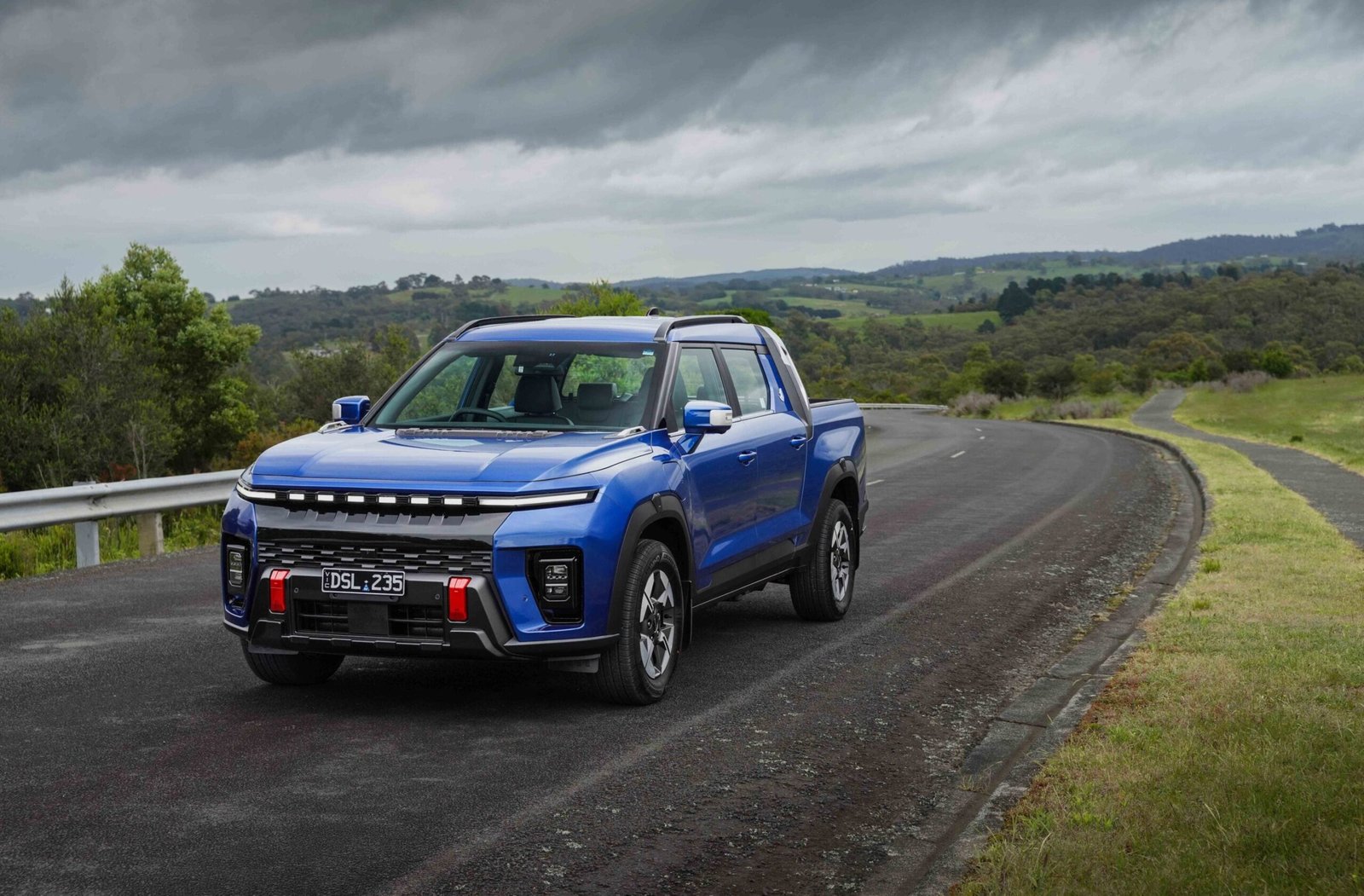
2026 KGM Musso EV Review: Australia’s Cheapest Electric Ute — Worth $64K?
Competent but compromised
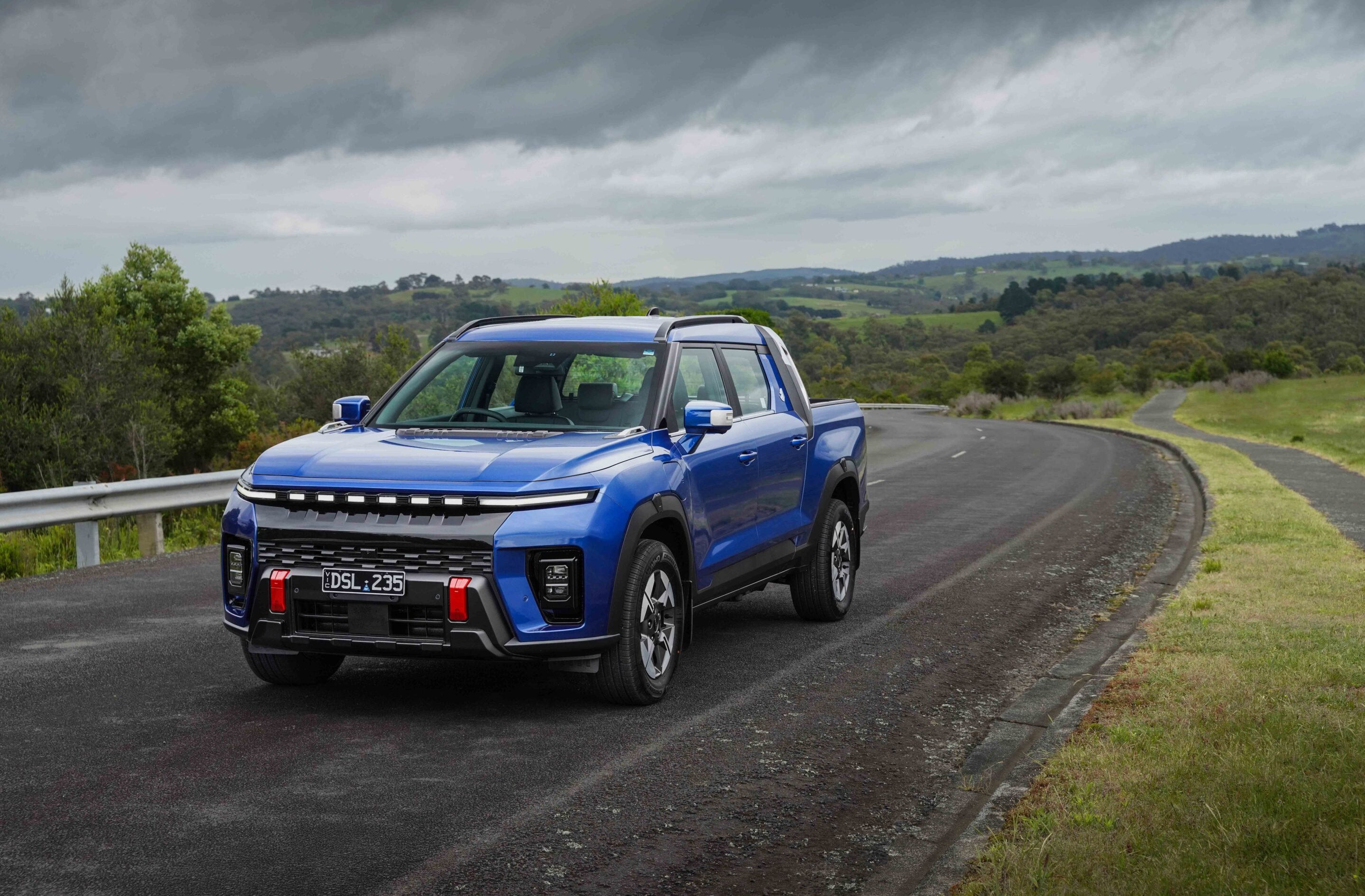
2026 KGM Musso EV blue exterior three-quarter press shot
Price
$64,000
Powertrain
Full EV, dual motor AWD
⚡ Quick Verdict
The 2026 KGM Musso EV is Australia’s cheapest fully electric dual-cab ute, and it does the fundamentals well. The cabin is quiet and comfortable, the warranty is class-leading, and for daily driving it works as a proper zero-emissions ute. But there are real trade-offs. Towing tops out at 1,800 kg, highway range sits around 280–300 km, and there’s no spare wheel — just a repair kit you wouldn’t trust out past the black stump. It makes solid sense for suburban tradies who charge at home, fleet operators on predictable routes, and rideshare drivers who stick close to the city. If you tow, tour remote, or want the best bang-for-buck, the diesel Musso or the BYD Shark 6 PHEV are still the smarter picks for most Australians.
## At a Glance
✓ The Good
- +Australia’s cheapest fully electric dual-cab ute from $60K drive-away
- +Impressively quiet, refined cabin — independent rear suspension is a game-changer for ride comfort
- +Strong warranty: 7-year vehicle / 10-year battery, both unlimited kilometres
- +V2L capability genuinely useful for worksite or campsite power
- +Payload of 805 kg (AWD) actually beats the BYD Shark 6’s 790 kg
✗ The Trade-offs
- −1,800 kg towing capacity is well below rivals and limits caravan/boat buyers
- −Real-world highway range of 280–300 km demands careful trip planning
- −No spare wheel — repair kit only is unacceptable for bush touring
- −Off-road tyres and 180 mm ground clearance limit serious 4×4 capability
- −$24K EV premium over the diesel Musso AWD is hard to justify on running costs alone
📑 In This Review
- At a Glance
- Pricing and Lineup in Australia
- Powertrain and Real-World Range
- Charging and Daily Use
- On-Road Drive Impressions
- Off-Road and Light Touring
- Interior, Comfort and Tech
- Towing, Payload and Tradie Credentials
- 2026 KGM Musso EV vs BYD Shark 6: Which Is Better?
- Safety and Warranty
- Who Should Buy It
- Verdict
- Frequently Asked Questions
At a Glance
| Spec | KGM Musso EV AWD | BYD Shark 6 Premium | LDV eT60 | Ford Ranger Sport PHEV |
|---|---|---|---|---|
| Price (drive-away est.) | $64,000 | ~$63,000 | ~$63,000 | ~$75,000 |
| Powertrain | Full EV, dual motor AWD | PHEV, dual motor AWD | Full EV, single motor RWD | PHEV, 4WD |
| Power (kW) | 266 | 321 | 150 | 220 |
| Torque (Nm) | 630 | 650 | 310 | 550 |
| Towing (kg) | 1,800 | 2,500 | 1,000 | 3,500 |
| Payload (kg) | 805 | 790 | 750 | ~1,000 |
| Range / EV range | 380 km (WLTP) | 100 km EV / 800 km combined | 330 km (WLTP) | ~45 km EV / 800+ km combined |
| 0–100 km/h | ~6.0 sec | 5.7 sec | ~9.0 sec | ~6.5 sec |
| Warranty | 7 yr / 10 yr battery | 6 yr / 8 yr battery | 5 yr / 8 yr battery | 5 yr / 8 yr battery |
BYD Shark 6 Premium
Cheaper, tows more, no charging anxiety — the obvious cross-shop
LDV eT60
Older tech, limited 1,000 kg towing — Musso EV now eclipses it on every metric
Ford Ranger Sport PHEV
Traditional ute credentials with 3.5 t towing — for buyers who still need diesel-style capability
The 2026 KGM Musso EV is Australia’s cheapest fully electric dual-cab ute. Pricing kicks off at $60,000 drive-away in two-wheel-drive form and climbs to $64,000 for the all-wheel-drive flagship we drove. It’s built around an 80.6 kWh lithium-iron-phosphate (LFP) blade battery with dual electric motors making a combined 266 kW and 630 Nm in Australian spec. WLTP range is claimed at 420 km for the 2WD and 380 km for the AWD. It’s the first fully electric ute from the brand that used to be called SsangYong, and it enters a segment that’s filling up fast — the LDV eT60 and BYD Shark 6 PHEV are already here. The real question isn’t whether the Musso EV works as an electric vehicle. It does. It’s whether the $24,000 premium over a diesel Musso AWD stacks up financially, and whether the compromises in towing and range are acceptable at this money. We spent a full day driving the AWD variant — from the Hume Highway to a 4×4 park near Goulburn — to find out.
Pricing and Lineup in Australia
The Musso EV range starts at $60,000 drive-away for the 2WD, moves to $62,000 for the Black Edge (also 2WD), and tops out at $64,000 for the AWD we tested. All three come fully loaded — there’s no options list to blow the budget out. Every variant gets twin 12.3-inch screens, wireless Apple CarPlay and Android Auto, heated and ventilated front seats, a 360-degree camera, adaptive cruise control, and the full active safety suite.
For context, the diesel-powered KGM Musso AWD — the one most buyers will cross-shop — starts at roughly $40,000 drive-away. That’s a $24,000 gap, and it’s the single biggest hurdle for anyone thinking about making the switch. At current electricity prices (20–30 cents per kWh at home), the Musso EV costs roughly $4–6 per 100 km in energy. A diesel Musso at 9 L/100 km and $1.90 per litre runs about $17 per 100 km. Over 20,000 km a year, you’re saving around $2,200 annually — which means it takes more than ten years to claw back the EV premium on fuel alone. The maths works out much better for high-mileage fleet operators, but for private buyers, the case really comes down to refinement, warranty, and emissions rather than pure cost savings.
There are no state or federal purchase rebates applicable to the Musso EV at this price point right now, and it sits comfortably below the luxury car tax threshold for fuel-efficient vehicles. KGM offers a seven-year unlimited-kilometre warranty on the vehicle and ten years unlimited kilometres on the high-voltage battery. Both figures sit above the segment average, which helps ease the ownership anxiety for buyers worried about EV longevity.
—
Powertrain and Real-World Range
Beneath the Musso EV’s floor lies an 80.6 kWh lithium-iron-phosphate (LFP) blade battery — the same cell chemistry BYD uses across its range, known for thermal stability, longevity, and resistance to degradation. In AWD form, there are dual electric motors, one per axle, producing a combined 266 kW and 630 Nm in Australian spec. That’s a big jump from the diesel Musso’s 133 kW and 400 Nm, and you feel it from the first prod of the throttle.
WLTP range is rated at 380 km for the AWD and 420 km for the 2WD. We put the AWD through a proper test — a multi-stop run from Pheasants Nest on the Hume Highway to Binna Burra 4×4 park near Goulburn. That’s roughly 200 km each way through highway, country, and dirt. Starting at 100 per cent charge with 387 km indicated, we set the nav for 192 km to destination with fan-only climate and cruise control on. At the 87 km mark on the Hume at 110 km/h, indicated range had dropped to 260 km — a loss of roughly 40 km over 87 km driven. This kind of indicated-range shortfall at highway speeds is common across all EVs; it’s a function of aerodynamic load and speed, and the Musso isn’t unique in this regard.
Highway consumption settled at 30.1 kWh/100 km on the Hume, which translates to a realistic highway range of around 270 km from a full charge in decent conditions. Flicking the air conditioner on dropped indicated range from 363 km to 337 km — a 26 km penalty. The heater produced a similar 25 km hit. On the slower 80 km/h country leg from Goulburn to Binna Burra, consumption improved to 29 kWh/100 km. Better, but not dramatically, because the Musso’s bluff ute shape and 2.2-tonne kerb weight keep efficiency in check regardless of speed.
Our takeaway: plan for 280–300 km of real-world highway range with HVAC running. That’s plenty for most daily commutes and suburban work, and it’s broadly comparable to other EVs in this class. But on longer trips, especially outside major highway corridors, you’ll need to plan your charging stops carefully.
—
Charging and Daily Use
The Musso EV is rated for up to 300 kW DC fast charging, but in practice — and this matches what other testers have found — realistic peak rates at current Australian chargers sit closer to 150 kW. At the Goulburn fast charger, the car pulled a steady 150 kW from roughly 20 to 50 per cent state of charge before tapering off. KGM quotes a 20 to 80 per cent DC charge time of approximately 31 minutes, and that’s about what we saw. On 11 kW AC, a full overnight charge from empty takes roughly eight hours — perfectly suited to a home wallbox or depot charging setup.
The cost picture gets a bit complicated. Home charging at 20–30 cents per kWh delivers energy at roughly $4–6 per 100 km — a real saving over diesel. But public DC fast charging at around 68 cents per kWh narrows that gap considerably, bringing per-kilometre costs closer to $13–14. If you can charge at home or at a depot, the running costs are genuinely good. If you’re relying on the public network, those savings erode fast.
V2L (vehicle-to-load) capability is standard, and it’s one of the Musso EV’s handiest features. The power outlet in the tub can run tools, a portable fridge, or campsite lighting straight from the battery — properly useful for tradies on a jobsite or families at a campsite. The catch, as with all EVs, is remote-area charging. Beyond the trailhead at Binna Burra, there are no chargers for 80-plus kilometres in any direction. For bush touring, that’s a real limitation.
—
On-Road Drive Impressions
The single most impressive thing about the Musso EV on the road is its ride quality. Independent rear suspension is a rarity in the dual-cab ute segment — most rivals run a live rear axle with leaf springs — and the difference is immediate. Over the patchwork tar of the Hume Highway and the cracked country roads south of Goulburn, the Musso EV stayed composed and comfortable in a way that a HiLux or Ranger simply doesn’t. It’s no luxury SUV, but it’s a genuinely pleasant thing to cover distance in.
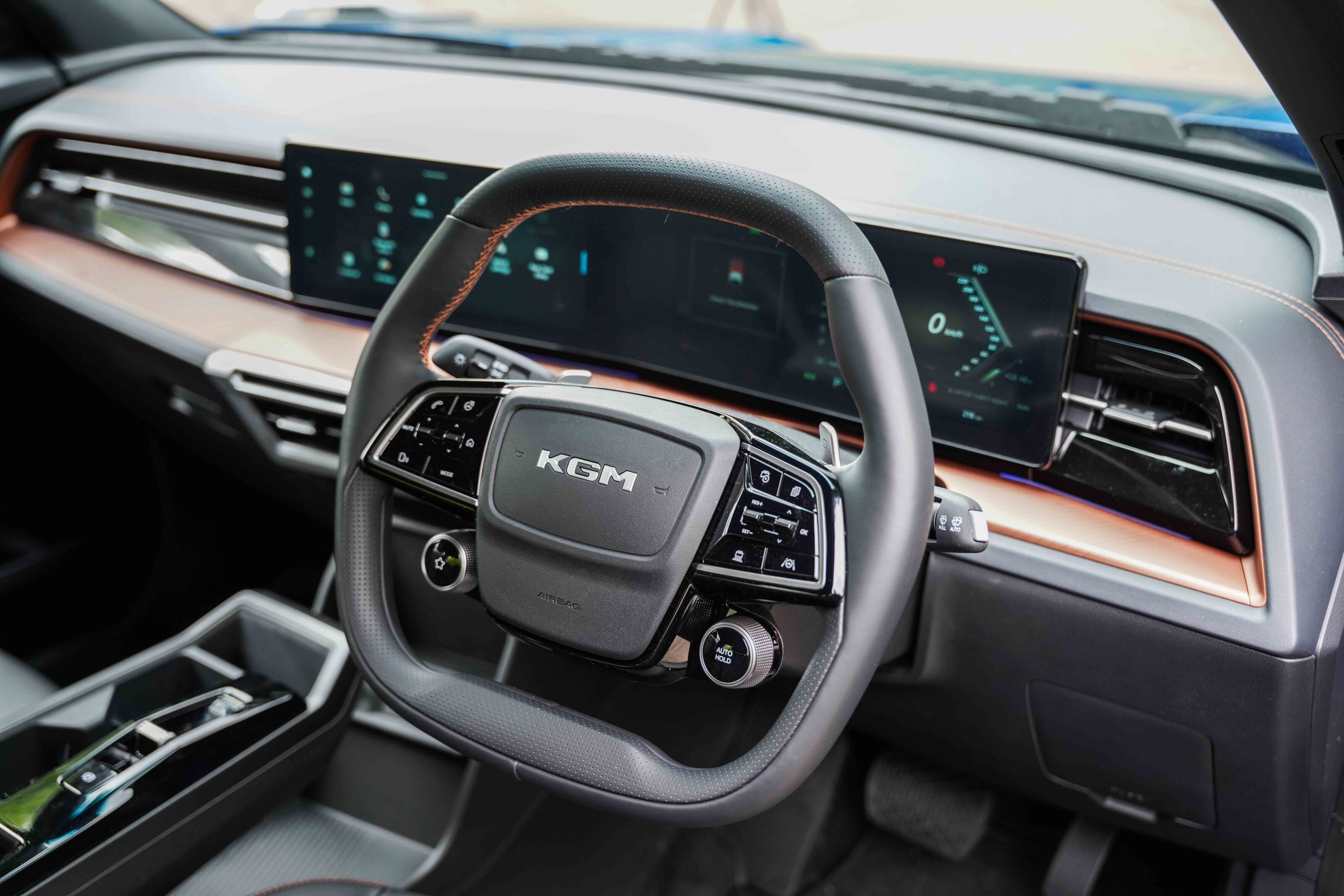
The hexagonal steering wheel takes some getting used to. It looks distinctive and feels fine at highway speed, but in tight carparks and low-speed manoeuvring it’s an acquired taste. The gear selector toggle — a small stalk on the column — requires you to hold it with deliberate pressure and a firm press to engage Drive or Reverse. Unambiguous once you’re used to it, but fiddly in a hurry. We found ourselves occasionally double-tapping to get the engagement we wanted.
Power delivery in Eco mode feels sluggish — clearly calibrated for maximum efficiency, dulling the throttle to the point where merging onto a highway takes some planning. Sport mode wakes the Musso up and delivers the kind of instant EV thrust you’d expect from 630 Nm, but there’s a curious half-second pedal hesitation before the full shove arrives. It’s not a deal-breaker, but the Musso EV never quite feels as snappy off the line as those numbers suggest.
One dynamic quirk worth noting: the power distribution feels front-biased rather than rear-biased. We confirmed this visually on the power gauge during spirited driving, and it changes the ute’s character in a way that doesn’t feel natural. In a conventional ute, power goes to the rear wheels first — that suits load-carrying and towing dynamics. The Musso EV’s front-biased delivery can make the steering feel light under hard acceleration. Three regen levels are available via steering-wheel paddles, ranging from a true coast mode to a near one-pedal experience that works well in traffic.
—
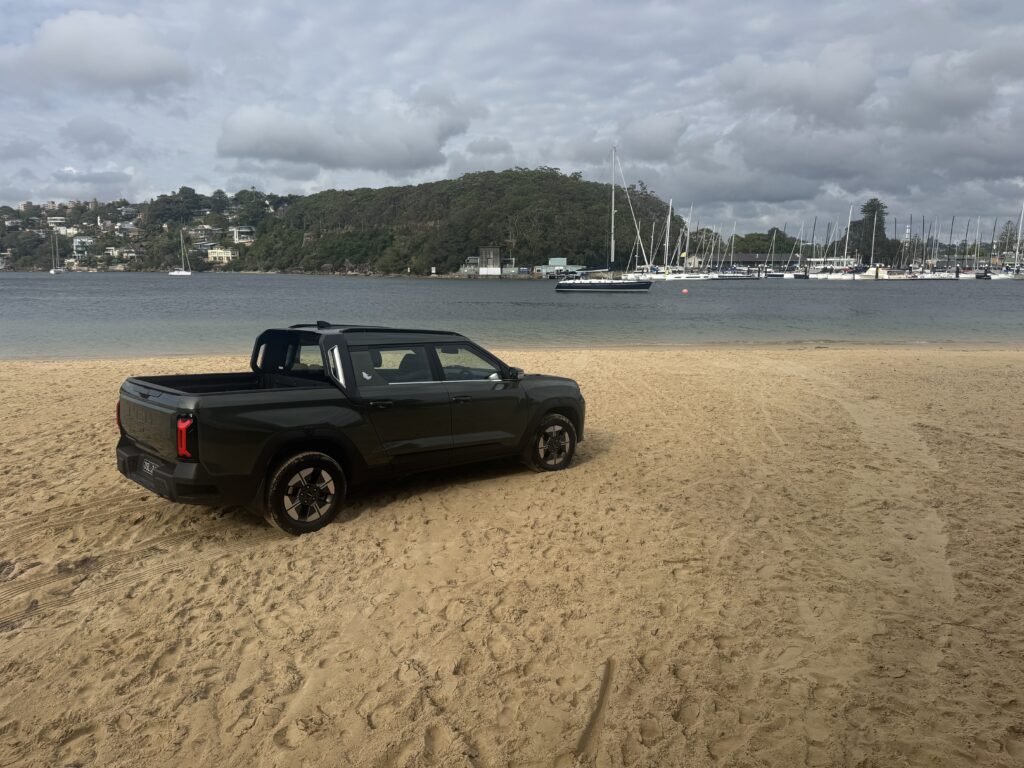
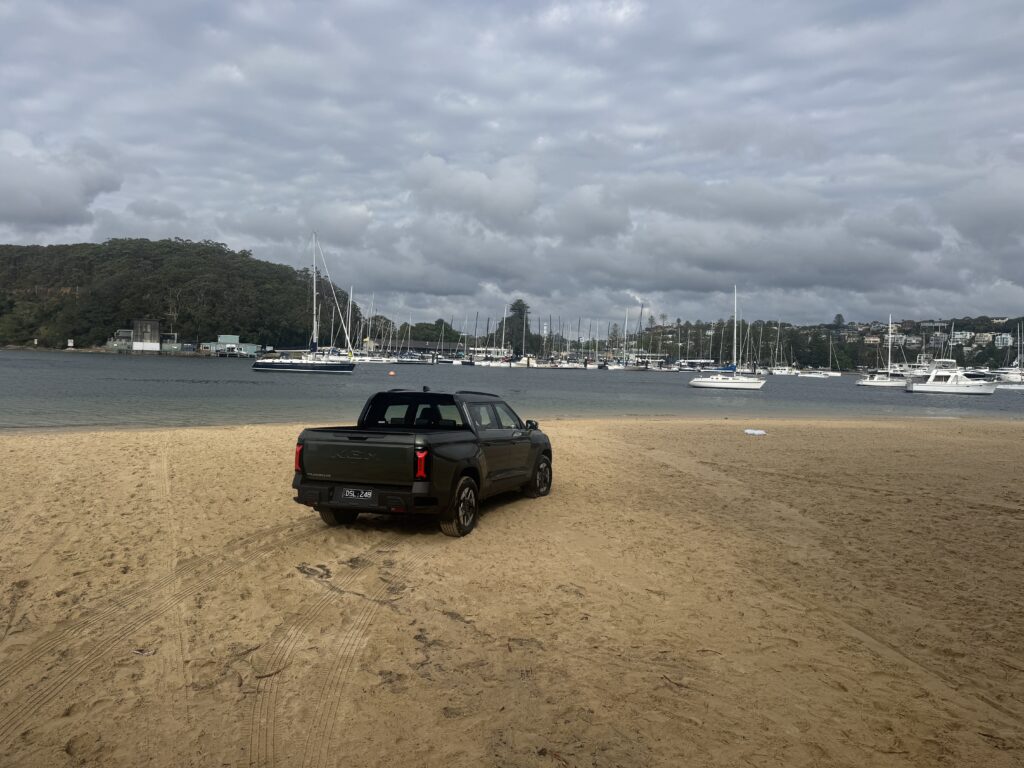
Off-Road and Light Touring
With 180 mm of ground clearance, the Musso EV isn’t a serious off-roader. That figure trails the Ranger (234 mm), the HiLux (216 mm), and even the BYD Shark 6. On graded fire trails and dirt roads into the Binna Burra 4×4 park, it coped fine. The AWD system with a 4H lock provides a constant 50/50 front-to-rear torque split, and on firm dirt it felt planted and predictable.
The weak link is the tyres. The Musso EV runs 245/60 R17 eco-biased rubber, and on gravel they’re clearly out of their depth. ABS activation under light braking comes early and abruptly, and stability control intervenes aggressively in loose-surface turns. An "Auto" or rear-biased AWD mode would suit a ute’s natural balance better than the permanent 50/50 split, but it’s not available.
Our hill climb test at Binna Burra — an easy line from a standstill on a moderate incline — exposed another limitation. There’s no low-range gearbox and no dedicated hill descent control. From a stop at full throttle, the Musso EV hesitated, rolled back briefly, then crawled up steadily. It made it, but it lacked the low-speed control a proper low-range transfer case provides. Descent was managed in maximum regen, which works but doesn’t inspire the same confidence as a mechanical hill descent system. Most critically, there is no spare wheel — only a tyre repair kit. In the Australian bush, where a puncture can leave you stranded hours from help, this is a genuine problem and one KGM needs to address.
—
Interior, Comfort and Tech
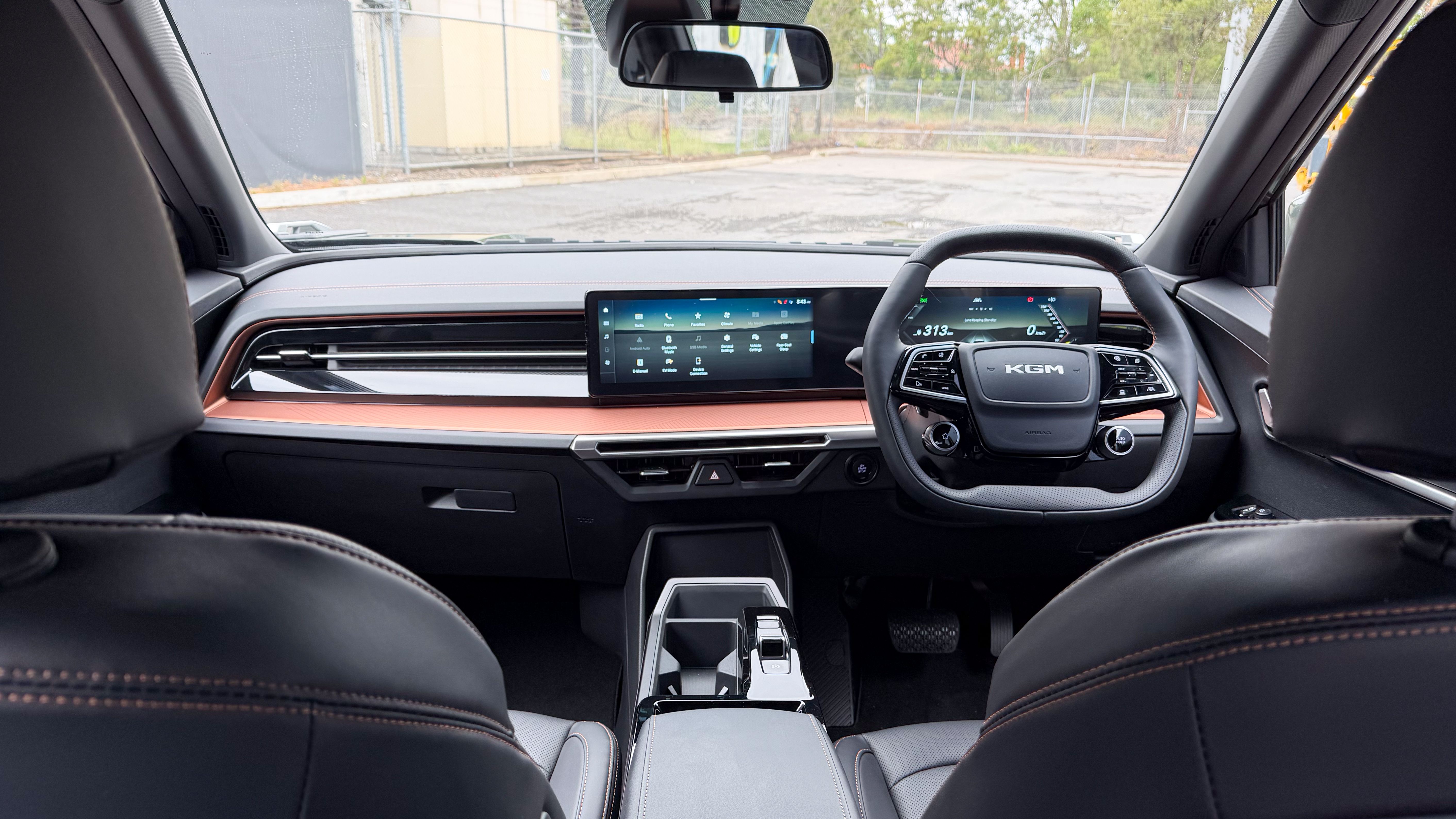
The cabin is the Musso EV’s strongest argument against its diesel sibling. Twin 12.3-inch displays sit in a clean, driver-focused layout running KGM’s Athena 2.0 operating system. Importantly, the native climate control row stays permanently visible at the bottom of the screen even when Apple CarPlay or Android Auto is running — a detail many more expensive rivals (including some from premium brands) get wrong by burying HVAC controls behind multiple menu taps.
Material quality sits a notch above the segment norm. A soft-touch dash with bronze contrast stitching and subtle ambient lighting gives the cabin a lifestyle-oriented feel closer to a mid-spec SUV than a workhorse ute. Power-adjustable front seats with mild bolstering, heating, and ventilation are standard, and the rear bench slides, reclines, and splits 60/40 — practical for families and mixed-use buyers. The hexagonal steering wheel divides opinion; it looks modern but doesn’t offer any functional benefit.
Thanks to the independent rear suspension and the absence of a diesel engine, the Musso EV’s cabin is noticeably quieter than a typical dual-cab at highway speed. Wind noise from the bluff front end is still present at 110 km/h, but road noise and drivetrain vibration are impressively suppressed. It makes long drives less fatiguing, and it’s one of the clearest tangible benefits of going electric in this segment.
—
Towing, Payload and Tradie Credentials
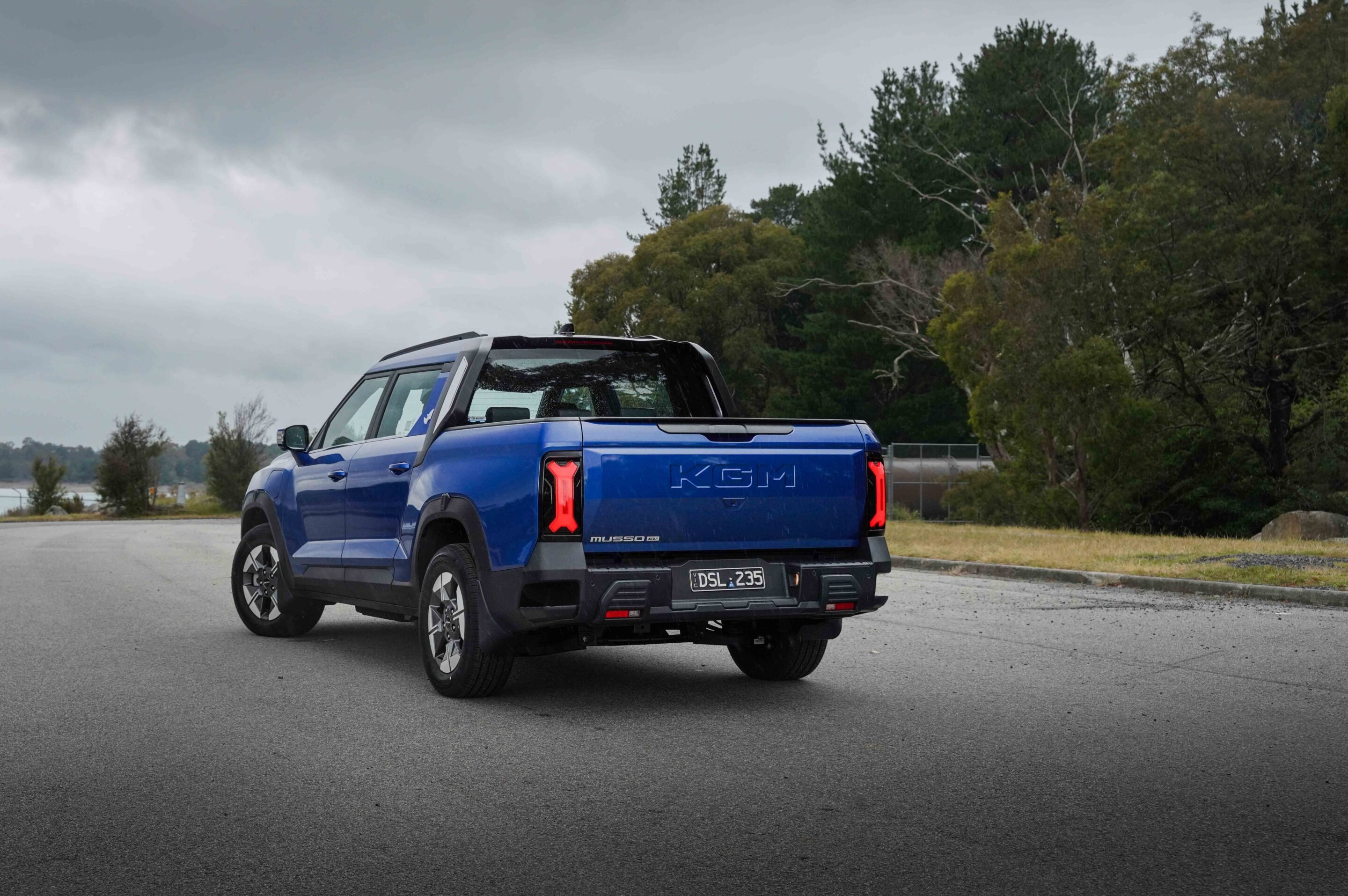
This is where the Musso EV’s compromises bite hardest. Braked towing capacity is rated at 1,800 kg — fine for a small boat, a lightweight caravan, or a work trailer, but well short of the BYD Shark 6’s 2,500 kg and the Ford Ranger PHEV’s 3,500 kg. If you regularly tow a 2-tonne-plus caravan or a heavy boat, the Musso EV simply isn’t in the conversation.
Payload of 805 kg in AWD form is more competitive — it actually beats the BYD Shark 6’s 790 kg and handles a full load of tools, materials, or camping gear without fuss. The tub, though, is shorter than most rivals; a road bike with the front wheel removed still won’t fit flat. KGM has fitted a damped tailgate (a small but welcome touch) and bed tie-down points at both top and bottom of the tub walls, which are properly handy for securing loads.
The bigger concern is what towing or a loaded tub does to range. Our testing suggests that a heavily loaded Musso EV or a 1.5-tonne trailer would push consumption well beyond 35 kWh/100 km, cutting real-world range to perhaps 200 km. For a tradie doing short urban runs with tools and a small trailer, that’s workable. For anyone towing a caravan from Sydney to the Snowy Mountains, it means multiple charging stops on a journey that a diesel ute would do on a single tank.
—
2026 KGM Musso EV vs BYD Shark 6: Which Is Better?
The BYD Shark 6 is the most direct cross-shop for the Musso EV, and it deserves a thorough look. Priced from $57,900 before on-roads in Premium trim (roughly $63,000 drive-away depending on state), the Shark 6 undercuts the Musso EV AWD on sticker price while offering more power, more towing, and — critically — no range anxiety thanks to its plug-in hybrid powertrain.
The fundamental difference is philosophical. The Musso EV is a fully electric vehicle: 80.6 kWh battery, no combustion engine, zero tailpipe emissions. The Shark 6 is a PHEV with a smaller battery (around 30 kWh) delivering roughly 100 km of EV-only range, backed by a petrol engine that provides a combined range of approximately 800 km. For a buyer in metro Sydney who charges at home every night, the Musso EV’s zero-emissions daily driving is appealing. For a buyer in regional NSW who regularly drives to Melbourne, the Shark 6’s ability to fall back on petrol removes a planning headache entirely.
On paper, the Musso EV’s 266 kW and 630 Nm sound competitive against the Shark 6’s 321 kW and 650 Nm. In practice, the Musso EV hits 100 km/h in roughly six seconds — quick for a ute — while the Shark 6 does the dash in 5.7 seconds. The difference is marginal, but the Shark 6’s extra power is noticeable when merging or overtaking at highway speed, where the Musso EV’s front-biased power delivery can feel slightly hesitant.
Towing is where the Shark 6 pulls decisively ahead. Its 2,500 kg braked towing capacity — 700 kg more than the Musso EV’s 1,800 kg — opens up serious caravan and boat towing that the Musso EV can’t match. For buyers who tow even occasionally, this alone might be the deciding factor.
Inside, the Musso EV arguably has the edge in refinement. Its cabin is quieter, the independent rear suspension delivers a more composed ride, and the material quality — while not luxury — feels a cut above the Shark 6’s more gadget-heavy but slightly less cohesive interior. The Shark 6 counters with a larger central screen and more tech features, including a rotating display.
Real-world ownership is the final and most important comparison. The Musso EV depends entirely on charging infrastructure. If you have a home wallbox and rarely drive more than 250 km in a day, it works well. If you don’t — or if your work takes you beyond reliable DC charger coverage — the Shark 6’s petrol fallback makes it the safer, more flexible choice for most Australian buyers.
| Spec | 2026 KGM Musso EV AWD | 2026 BYD Shark 6 Premium |
|---|---|---|
| Price (drive-away est.) | $64,000 | ~$63,000 |
| Powertrain | Full EV, dual motor AWD | PHEV, dual motor AWD |
| Combined power | 266 kW | 321 kW |
| Combined torque | 630 Nm | 650 Nm |
| Towing capacity | 1,800 kg | 2,500 kg |
| Payload | 805 kg | 790 kg |
| EV range | 380 km (WLTP) | ~100 km (EV only) |
| 0–100 km/h | ~6.0 sec | 5.7 sec |
| Warranty | 7 yr / 10 yr battery | 6 yr / 8 yr battery |
<div style="background:linear-gradient(135deg,#f0f9ff,#e0f2fe); border-left:4px solid #2563eb; border-radius:12px; padding:24px 28px; margin:32px 0"> <p style="font-size:12px; font-weight:800; letter-spacing:0.14em; text-transform:uppercase; color:#1e40af; margin:0 0 10px">Which one is better?</p> <p><strong>Buy the KGM Musso EV if</strong> you want a quiet, refined, fully electric daily driver that doubles as a light-duty ute, charge at home, and never want to visit a fuel pump again.</p> <p><strong>Buy the BYD Shark 6 if</strong> you need real towing capacity, regular long-distance touring, or simply can’t rely on public DC chargers where you live and work.</p> <p><strong>Our pick</strong> for most Australian buyers is the BYD Shark 6 — it removes range anxiety, tows more, and starts cheaper. The Musso EV makes more sense for fleet, suburban tradies, and rideshare/delivery operators who can charge overnight.</p> </div>
—
Safety and Warranty
The Musso EV’s ANCAP safety rating is still pending at the time of writing, and buyers should weigh that uncertainty — especially given the BYD Shark 6 has already been tested. What is confirmed is the active safety kit, which is genuinely generous for this price point: eight airbags, autonomous emergency braking (AEB), blind-spot monitoring, front and rear cross-traffic alert, lane-keep assist, lane centring, adaptive cruise control, and a 360-degree camera system. It covers the daily safety essentials without feeling intrusive.
The warranty is one of the Musso EV’s strongest selling points. Seven years with unlimited kilometres on the vehicle and ten years with unlimited kilometres on the high-voltage battery both sit above the segment average — the Ranger and HiLux offer five years, the LDV eT60 offers five years on the vehicle and eight on the battery. For buyers nervous about EV battery degradation, a decade of unlimited-kilometre coverage is meaningful reassurance.
—
Who Should Buy It
The Musso EV makes the most sense for suburban tradies with a home wallbox or depot charger, fleet operators who can predict daily routes and charge overnight, rideshare and last-mile delivery drivers who maximise per-kilometre savings, and EV-curious buyers who want zero-emissions driving but need the practicality of a ute tub. For these buyers, the quiet cabin, low running costs, V2L capability, and strong warranty add up to a convincing ownership case.
It’s not the right choice for rural buyers, long-distance tourers, anyone who tows more than 1,800 kg, or buyers comparing purely on price-per-kilometre against a sub-$45,000 diesel Musso. The absence of a spare wheel, the modest ground clearance, and the eco-biased tyres also rule it out for anyone who regularly ventures off sealed roads beyond graded fire trails. For those buyers, the diesel Musso remains better value, and the BYD Shark 6 remains more versatile.
—
⚡ Our Verdict
Competent but compromised
Competent but compromised — that’s the most honest summary of the 2026 KGM Musso EV. It is genuinely Australia’s cheapest fully electric dual-cab ute, and it gets several important things right: the cabin is quiet and genuinely refined thanks to independent rear suspension, the warranty is best-in-class, V2L adds real-world utility, and the 80.6 kWh LFP battery delivers a usable 280–300 km of real-world highway range. As a zero-emissions daily driver with a tub, it works. But the compromises are real and they define the buyer. A 1,800 kg towing limit excludes anyone with a serious caravan or boat. The lack of a spare wheel is a non-starter for bush touring. The off-road tyres and 180 mm ground clearance limit its adventurous credentials. And the $24,000 premium over a diesel Musso will take a decade of driving to recoup on energy costs alone. These aren’t small trade-offs — they’re fundamental limitations that narrow the Musso EV’s audience to buyers who can charge at home, drive predictable routes, and don’t ask much of their ute beyond carrying loads and handling the daily commute. For those buyers — suburban tradies, fleet operators, rideshare drivers — the Musso EV is a genuine, usable, well-warranted electric ute that deserves serious consideration. For everyone else, the smarter money is still on diesel or PHEV.
Frequently Asked Questions
How much is the 2026 KGM Musso EV in Australia?
The Musso EV starts at $60,000 drive-away for the 2WD, $62,000 for the Black Edge, and $64,000 for the AWD. All three are fully inclusive — there are no options to add.
What is the real-world driving range of the KGM Musso EV?
Our highway testing returned approximately 280–300 km of real-world range with the air conditioning or heater running, against the WLTP claim of 380 km for the AWD model.
Can the KGM Musso EV tow a caravan?
Its 1,800 kg braked towing capacity handles small caravans and lightweight trailers, but it falls well short of the 2,500 kg offered by the BYD Shark 6 and the 3,500 kg of the Ford Ranger PHEV.
How fast does the KGM Musso EV charge?
DC fast charging peaks at around 150 kW in practice (300 kW on paper), achieving 20–80 per cent in roughly 31 minutes. Full AC charging on an 11 kW home wallbox takes about eight hours.
Is the KGM Musso EV better than the BYD Shark 6?
The Musso EV is quieter and more refined, with a stronger warranty, but the Shark 6 tows more (2,500 kg vs 1,800 kg), has no range anxiety thanks to its PHEV powertrain, and is slightly cheaper — making it the better all-rounder for most buyers.
Does the KGM Musso EV have an ANCAP safety rating?
The ANCAP rating is pending at the time of writing. The active safety suite is comprehensive with eight airbags, AEB, blind-spot monitoring, and adaptive cruise control fitted as standard.
What warranty does the KGM Musso EV come with?
Seven years with unlimited kilometres on the vehicle and ten years with unlimited kilometres on the high-voltage battery — both above the ute segment average.
