

2026 Geely EX2 Review: The Sub-$30k EV to Beat
Geely’s tiny EV punches above its weight on space and smarts

2026 Geely EX2 front three-quarter exterior in purple
Price
$25k–$30k
Battery
40 kWh LFP
Power
85 kW / 150 Nm
⚡ Quick Verdict
Priced from an expected $25,000 to $30,000 in Australia, the 2026 Geely EX2 packs a 70 L frunk, 375 L boot, genuinely impressive rear legroom and 70 kW DC fast charging into a city-sized hatchback. Those practicality credentials comfortably outgun the BYD Dolphin. The compromise is a smaller 40 kWh battery delivering around 330 km of WLTP range, and the fact ANCAP hasn’t crash-tested it yet. For urban commuters or small families who’d rather have clever storage than headline range, the EX2 should be right at the top of your shortlist.
## At a Glance — How the EX2 Stacks Up
✓ The Good
- +Genuinely class-leading interior packaging with 36 storage compartments, a 70 L frunk and a slide-out glove box
- +Rear legroom is extraordinary for a 4.1 m hatchback — a flat floor and generous knee room make baby seats and adult passengers viable
- +70 kW DC fast charging pulls ahead of the BYD Dolphin and Atto 2 on road-trip top-ups
- +375 L boot with electric tailgate (tested trim) expands to 1320 L with the rear seats folded
- +Sharp projected pricing from $25k makes it one of the keenest-value EVs entering Australia in 2026
✗ The Trade-offs
- −No ANCAP safety rating yet — the EX2 is too new for independent crash testing in Australia
- −40 kWh LFP battery delivers a modest ~330 km WLTP range that trails some rivals
- −Faux-leather upholstery showed signs of colour transfer on our lighter-trim test car
- −Geely’s Australian dealer footprint is still growing — brand recognition lags BYD
📑 In This Review
Priced from an expected $25,000 to $30,000 in Australia, the 2026 Geely EX2 packs a 70 L frunk, 375 L boot, genuinely impressive rear legroom and 70 kW DC fast charging into a city-sized hatchback. Those practicality credentials comfortably outgun the BYD Dolphin. The compromise is a smaller 40 kWh battery delivering around 330 km of WLTP range, and the fact ANCAP hasn’t crash-tested it yet. For urban commuters or small families who’d rather have clever storage than headline range, the EX2 should be right at the top of your shortlist.
At a Glance — How the EX2 Stacks Up
| Spec | Geely EX2 | BYD Dolphin | BYD Atto 2 | MG4 Urban |
|---|---|---|---|---|
| Price (AUD est.) | $25k–$30k | ~$30k | ~$35k | ~$30k |
| Battery | 40 kWh LFP | 44.9 kWh | 45 kWh | 51 kWh |
| WLTP range | ~330 km | ~340 km | ~310 km | ~350 km |
| Power | 85 kW / 150 Nm | 70 kW / 180 Nm | 130 kW | 125 kW |
| Boot | 375 L | 250 L | 400 L | 363 L |
| DC charging | 70 kW | 60 kW | 65 kW | 88 kW |
| Length | 4135 mm | 4290 mm | 4310 mm | 4287 mm |
BYD Dolphin
Larger 44.9 kWh battery and rotating screen, but smaller 250 L boot and slower 60 kW DC charging
BYD Atto 2
Crossover stance and more power, but pricier and less efficient than the EX2
MG4 Urban
Bigger 51 kWh battery and 88 kW DC charging, but no frunk and busier styling
Leapmotor B10
SUV body and longer range, but a different size class — not a direct hatchback rival
The sub-$30,000 EV space in Australia is turning into one of the most fiercely contested corners of the new-car market. BYD got there first with the Dolphin and the newer Atto 2, MG has the well-known MG4 Urban, and Leapmotor is muscling in with the B10. Now Geely is stepping into the ring — a name that owns Volvo, Polestar and Lotus, and that shifted 465,000 EX2s in China alone during 2025. That kind of volume tells you this isn’t some unproven science project. It’s a mass-market product with millions of real-world kilometres behind it, and it’s heading our way. On paper, the EX2’s 40 kWh battery and approximately 330 km WLTP range sit at the conservative end of the group. Where it changes the conversation is packaging: a 70 L frunk, 375 litres of boot space expanding to 1,320 L with the seats folded, 36 individual storage compartments, and rear legroom that seems physically impossible given the car’s 4.1-metre footprint. It also matches or beats every rival on DC charging speed at 70 kW peak. If Geely Australia can deliver the entry trim under $30,000 as expected, this little hatchback could reset the value equation for budget EVs Down Under. Geely EX2 BYD Atto 2 —— $25k–$30k ~$35k 40 kWh LFP 45 kWh ~330 km ~310 km 85 kW / 150 Nm 130 kW 375 L 400 L 70 kW 65 kW 4135 mm 4310 mm
Design and First Impressions
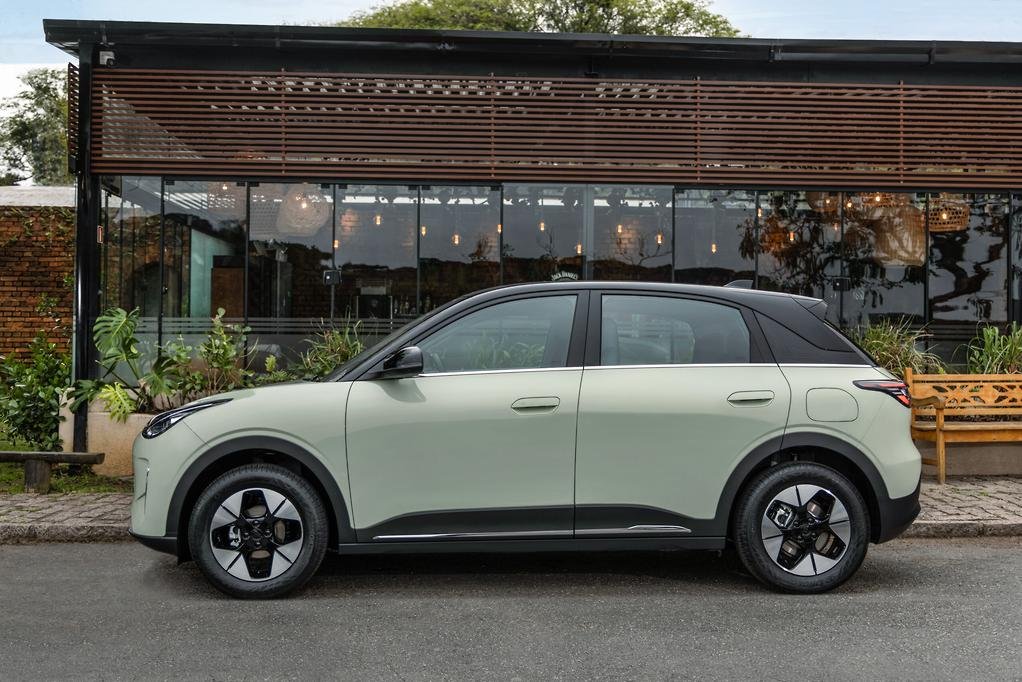
At 4,135 mm long, 1,805 mm wide and 1,580 mm tall on a 2,650 mm wheelbase, the EX2 takes up about the same kerbside real estate as a Toyota Yaris. Yet it immediately feels more substantial than those numbers suggest. Geely has pushed the wheels right out to the corners, giving the car a planted, squat stance that avoids the tall-and-tippy look some small EVs suffer from. LED projector headlights are standard across the range — a welcome touch at this price point where plenty of rivals still make do with reflector units. The front fascia is clean and contemporary without being fussy, and the overall design reads as friendly rather than aggressive. That’s exactly the right mood for a city runabout.
Our test car wore a fetching purple finish, one of six exterior colour options, and it drew more than a few curious looks during our time with it. Sixteen-inch alloys wrapped in Linglong Comfort Master tyres fill the arches neatly. The rubber is clearly chosen for efficiency and ride comfort rather than outright grip, but it suits the brief perfectly. That wheels-at-the-corners stance isn’t just an aesthetic choice, either — it’s what makes the remarkable interior space possible. From outside, the EX2 looks like a small car. Climb in, and the packaging cleverness starts revealing itself.
Interior, Tech and Practicality
Slide behind the wheel and you’re met with a cabin that punches well above its price class. The centrepiece is a 14.6-inch Flyme Auto touchscreen — Geely’s own infotainment system — paired with an 8.8-inch digital instrument display. The infotainment interface responded reasonably well during our time with it, though we’ll hold off on a final verdict about software polish until we test the Australian-spec version with local mapping and voice commands. Below the screen sit a wireless phone charging pad, a USB-A port and a USB-C port up front, while rear passengers get their own USB outlet alongside dedicated air vents. That’s a small but genuinely significant detail for families with kids during Australian summers.
The storage story is where the EX2 really pulls away from everything else in the class. Geely claims 36 individual storage compartments throughout the cabin, and we counted enough to believe it. There’s a slide-out glove box rather than a traditional flip-down unit, a design that makes it far easier to grab things from the driver’s seat. Beneath the front passenger seat, a pull-out tray provides a discreet hiding spot. It feels a touch flimsy, sure, but the space itself is genuinely handy for stashing baby wipes, nappies or a compact umbrella. A deep centre console, cupholders and door bottle holders round out the front cabin. Faux-leather upholstery is standard and feels reasonably upmarket for this price bracket, though we did notice some colour transfer on the lighter interior of our test car. Worth considering if you’re partial to indigo denim. Up front, the cabin presents well and feels more expensive than the expected price tag suggests.
The rear seat is the EX2’s party trick. Despite the car’s compact 4.1-metre length, legroom back here is genuinely extraordinary. The fully flat floor eliminates the centre-tunnel hump that plagues many ICE-derived rivals, and there’s enough knee room to make a rearward-facing baby seat a realistic proposition. That’s often a squeeze in cars this size. Headroom, though, is tighter for taller adults. Anyone past about 185 cm will find the roof lining getting familiar with their hair. The 70 L frunk under the bonnet is another standout. It’s a proper, usable space rather than a token cubby, and our test car had an optional tray that divides the frunk into compartments for groceries or smaller items. It seals neatly and feels well-finished. Round the back, the 375 L boot (with an electric tailgate on the tested trim) drops down low and offers a useful, practical load space that grows to 1,320 litres with the rear seats folded. For a car this size, the practicality credentials are outstanding.

Range, Battery and Charging
Under the floor sits a 40 kWh lithium iron phosphate battery. Geely quotes usable capacity between 39.4 kWh and 40.8 kWh depending on the specific cell supplier and ambient temperature. The WLTP-rated range lands at approximately 320–340 km, with 330 km as the nominal headline figure. In the real world, expect something closer to 280–300 km in mixed driving with the air conditioning running. That’s perfectly adequate for urban commuters who charge at home overnight, but it does sit behind the BYD Dolphin’s 44.9 kWh pack and its roughly 340 km WLTP claim.
Charging is where the EX2 claws back ground. A 70 kW DC fast-charge peak means a 30–80% top-up takes just 21–25 minutes at a compatible rapid charger, which is quicker than the Dolphin’s 60 kW peak and the Atto 2’s 65 kW. On the home front, the 6.6 kW AC onboard charger will take the battery from 10 to 100 per cent in around six and a half hours. A full overnight top-up on a standard wallbox is entirely straightforward. One key question remains unanswered for the Australian market: Geely is still deciding whether DC rapid charging will be standard equipment on the entry-level trim or offered as a low-cost option. Given how central fast-charging capability is to the EX2’s value proposition, this is a detail Geely Australia will need to lock in well before order books open.

On the Road — How It Drives
We had a brief first taste of the EX2 on Chinese roads, and the initial impressions are encouraging. The 85 kW permanent magnet synchronous motor and its 150 Nm of torque look modest on paper, but around town the EX2 feels genuinely nimble. Throttle response is linear rather than aggressive, which makes smooth, predictable progress easy. There’s none of the abrupt surge-and-lag that some budget EVs suffer from; the power delivery is well-calibrated for urban driving. The steering offers decent response off-centre and enough feedback to place the car confidently through tighter turns.
Tip the EX2 into a corner and the chassis stays composed. It’s no performance hatchback, but it remains stable and well-controlled, with body roll kept in check. The Linglong Comfort Master tyres prioritise ride comfort and low rolling resistance over outright grip, and that trade-off works well for the intended mission. Over the modest bumps and imperfections we encountered, the suspension absorbed impacts with more maturity than we expected at this price point. That said, this was only a brief outing on Chinese roads. Australian conditions — coarse-chip surfaces, higher average speeds and longer highway stints — will provide a far more thorough test. We’ll deliver a full local road test once the EX2 lands here.

Geely EX2 vs BYD Dolphin: Which Is Better?
This is the comparison every buyer considering a sub-$30,000 EV in Australia will make, and for good reason. The BYD Dolphin has been the default recommendation in this price bracket since it launched, and it’s still an excellent small EV. The Geely EX2, though, brings a different set of strengths to the table — and depending on your priorities, it might be the smarter buy.
Let’s start with pricing. Both cars are expected to land around the $30,000 mark, with Geely targeting an entry price from roughly $25,000. BYD has the advantage of an established Australian dealer network and stronger brand recognition. Geely is still building its local footprint, although the corporate parent — which owns Volvo, Polestar and Lotus — gives it more global credibility than a typical Chinese-market newcomer.
Under the skin, the Dolphin holds the battery advantage with its 44.9 kWh pack versus the EX2’s 40 kWh unit. That translates to a modest range edge: roughly 340 km WLTP for the Dolphin against approximately 330 km for the EX2. In practice, the difference is negligible for most urban commuters. Where the EX2 fights back is on DC charging speed. Its 70 kW peak comfortably outguns the Dolphin’s approximately 60 kW, shaving meaningful minutes off highway rest-stop top-ups. If you occasionally venture beyond the city for a weekend away, the faster charging could matter more than the extra 10 km of theoretical range.
Interior space is where the Geely pulls decisively ahead. The EX2’s rear legroom is class-leading, with a flat floor and generous knee room that make it genuinely comfortable for adult passengers and surprisingly accommodating for rearward-facing baby seats. The Dolphin’s rear seat is adequate but noticeably tighter. The boot space gap is even more stark: 375 litres in the EX2 versus just 250 litres in the Dolphin, expanding to 1,320 litres with the rear seats down in the Geely. Factor in the EX2’s 70 L frunk — something the Dolphin simply doesn’t offer — and the practicality advantage widens further. For small families, regular grocery haulers or anyone who values usable cargo space in a small footprint, the EX2 is operating at a different level.
Technology and infotainment present a closer contest. The Dolphin’s signature trick is its rotating 12.8-inch touchscreen, a genuinely clever bit of design that lets you switch between portrait and landscape orientations. The EX2 counters with a larger 14.6-inch fixed screen running Geely’s Flyme Auto system. We’ll need more time with both systems in Australian-spec form to pick a definitive winner on software polish and responsiveness, but the Geely’s screen is physically larger and the Flyme interface looks modern and well-organised.
On the road, both cars deliver a similar character: quiet, smooth and fundamentally urban in their demeanour. The EX2’s 85 kW output gives it a slight power advantage over the Dolphin’s 70 kW, though the Dolphin counters with more torque at 180 Nm versus 150 Nm. In practice, both feel brisk enough around town and neither is designed for spirited driving. The EX2’s steering and chassis felt well-sorted from our brief Chinese-market drive, but we’ll need to test both back-to-back on Australian roads before offering a definitive dynamic verdict.
Ultimately, the choice comes down to what matters most to you. The Dolphin offers a slightly bigger battery, proven local availability and BYD’s growing brand recognition. The EX2 delivers superior interior packaging, faster DC charging and a lower expected entry price. For many buyers, those advantages will tip the balance.
| Spec | Geely EX2 | BYD Dolphin |
|---|---|---|
| Price (AUD est.) | $25k–$30k | ~$30k |
| Battery | 40 kWh LFP | 44.9 kWh |
| WLTP range | ~330 km | ~340 km |
| Power | 85 kW | 70 kW |
| Torque | 150 Nm | 180 Nm |
| DC charging | 70 kW | 60 kW |
| Boot | 375 L | 250 L |
| Frunk | 70 L | None |
| Touchscreen | 14.6" Flyme Auto | 12.8" rotating |
<div style="background:linear-gradient(135deg,#f0f9ff,#e0f2fe); border-left:4px solid #2563eb; border-radius:12px; padding:24px 28px; margin:32px 0"> <p style="font-size:12px; font-weight:800; letter-spacing:0.14em; text-transform:uppercase; color:#1e40af; margin:0 0 10px">Which one is better?</p> <p><strong>Buy the Geely EX2 if</strong> you care about packaging cleverness — the frunk, under-seat storage, slide-out glove box and class-leading rear legroom make it the practical choice for small families and frequent grocery runs.</p> <p><strong>Buy the BYD Dolphin if</strong> you’d rather have the slightly bigger battery, a few extra kilometres of range and the confidence that comes with BYD’s established Australian dealer network.</p> <p><strong>Our pick</strong> is the Geely EX2 for buyers under $30k. The packaging is genuinely in a league of its own, and the 70 kW DC charging speed gives it an edge over the Dolphin on weekend road trips.</p> </div>

Safety and Warranty
Let’s address the elephant in the room: the Geely EX2 doesn’t have an ANCAP safety rating yet. The car is too new for independent crash testing in the Australasian market, and until those results land, we can’t assign a star score. What we can tell you is that Geely’s corporate parent owns Volvo — a brand that’s practically synonymous with safety engineering — and the group’s know-how filters through its broader product development. The EX2 is expected to arrive with a full advanced driver-assistance suite including autonomous emergency braking, lane-keeping assist, adaptive cruise control and blind-spot monitoring, though the final Australian spec is pending Geely Australia’s official launch announcement. We’d strongly recommend waiting for the ANCAP rating before signing on the dotted line, but the underlying engineering credentials are reassuring.
On the warranty front, the EX2 should carry Geely Australia’s standard five-year, unlimited-kilometre new-vehicle warranty, matching the coverage offered on the EX5 and Starray SUVs already on sale locally. The battery pack should be covered by a separate eight-year warranty, which is broadly in line with industry norms for LFP-equipped EVs. Geely’s Australian dealer network is still expanding, so prospective buyers outside major metropolitan areas should check their nearest service point before committing.

Pricing and Value
Geely Australia is targeting a price range of $25,000 to $35,000 for the EX2 lineup, with the entry-level trim expected to dip under the $30,000 mark. If that holds, the EX2 will be one of the keenest-priced quality EVs to enter the Australian market in 2026. It arrives with the credibility of 465,000 unit sales in China during 2025 alone. That volume isn’t just a number. It means the platform has been stress-tested across millions of real-world kilometres, giving Australian buyers a level of proven-reliability confidence that many first-generation EVs simply can’t match.
The single biggest question mark on pricing centres on DC fast charging. Whether the 70 kW rapid-charge capability comes standard on the entry trim or is offered as a paid option could shift the value equation significantly. If DC charging is standard at $25,000, the EX2 is a genuine bargain. If it’s locked behind a higher trim or an option pack that pushes the price past $30,000, the value proposition becomes less clear-cut against the Dolphin and MG4 Urban. We expect Geely Australia to clarify this detail closer to the official launch.
Who Should Buy the Geely EX2?
The EX2 is tailor-made for city commuters who want a fully electric hatchback that doesn’t sacrifice practicality for compactness. If you’re a parent with one or two young children — particularly if you need clearance for a rearward-facing baby seat — the rear legroom and flat floor make this one of the most family-friendly small EVs we’ve come across. Downsizers moving out of an ICE hatchback like a Mazda 2 or Toyota Yaris will find the switch to electric remarkably straightforward, with the added bonus of a frunk, a slide-out glove box and 36 storage compartments that make daily life noticeably easier.
It’s less suited to buyers who regularly cover more than 350 km in a single stint without wanting to stop and charge. The 40 kWh battery handles urban duties well enough, but it’s limited for frequent regional travel. If ANCAP certification is a deal-breaker for you, the EX2 isn’t there yet. And if brand recognition matters — if you want your neighbours to immediately clock what you’re driving — BYD’s stronger local profile might carry more weight. For everyone else, particularly those who put clever packaging and value for money first, the EX2 deserves a serious look.
⚡ Our Verdict
Geely’s tiny EV punches above its weight on space and smarts
The 2026 Geely EX2 lands in Australia as one of the most convincing arguments yet for affordable electric motoring. Its standout strengths are genuinely compelling: the interior packaging leads the class, the 70 L frunk is a feature no direct rival offers, rear legroom defies the car’s compact footprint, and the 70 kW DC charging speed puts it ahead of the BYD Dolphin and MG4 Urban where it matters. At an expected entry price below $30,000, it represents serious value. The caveats are real but manageable. A 40 kWh battery delivering roughly 330 km of WLTP range is modest — fine for urban commuting but a step behind the Dolphin’s bigger pack. The missing ANCAP rating is a genuine concern we’d like resolved before buyers commit. And the faux-leather upholstery may show wear over time, particularly on lighter colour options. Our rating of 7.9 out of 10 reflects a car that nails the fundamentals, packaged in a way that makes you wonder why no one thought of it sooner. Once Geely Australia confirms final local pricing, standard equipment and the ANCAP timeline, we’d strongly recommend booking a test drive. The EX2 could be the car that finally makes sub-$30,000 electric motoring feel properly grown-up.
Frequently Asked Questions
How much will the 2026 Geely EX2 cost in Australia?
Geely Australia is targeting $25,000 to $35,000 across the range, with the entry-level trim expected to start under $30,000.
What is the WLTP range of the Geely EX2?
The EX2’s 40 kWh LFP battery delivers approximately 320–340 km on the WLTP cycle, with 330 km as the nominal headline figure.
Does the Geely EX2 have DC fast charging?
Yes — the EX2 supports up to 70 kW DC fast charging, which means a 30–80% top-up in 21–25 minutes at a compatible rapid charger. Geely Australia is still confirming whether this will be standard on the entry trim.
How does the Geely EX2 compare to the BYD Dolphin?
The EX2 offers superior interior packaging (375 L boot, 70 L frunk, class-leading rear legroom) and faster 70 kW DC charging, while the Dolphin counters with a larger 44.9 kWh battery, roughly 10 km more WLTP range and an established Australian dealer network.
What is the boot space in the Geely EX2?
The EX2 provides 375 litres of boot space with the rear seats up, expanding to 1,320 litres with them folded. There’s also a 70 L frunk under the bonnet.
When will the Geely EX2 be on sale in Australia?
Geely Australia hasn’t confirmed an exact on-sale date, but the EX2 is expected to launch in Australia during 2026. Check with your local Geely dealer for the latest timing.
Does the Geely EX2 have an ANCAP safety rating?
Not yet. The EX2 is too new to have been independently crash-tested by ANCAP in Australia. An expected full ADAS suite includes AEB, lane-keeping assist, adaptive cruise control and blind-spot monitoring, but no star rating has been assigned.
