

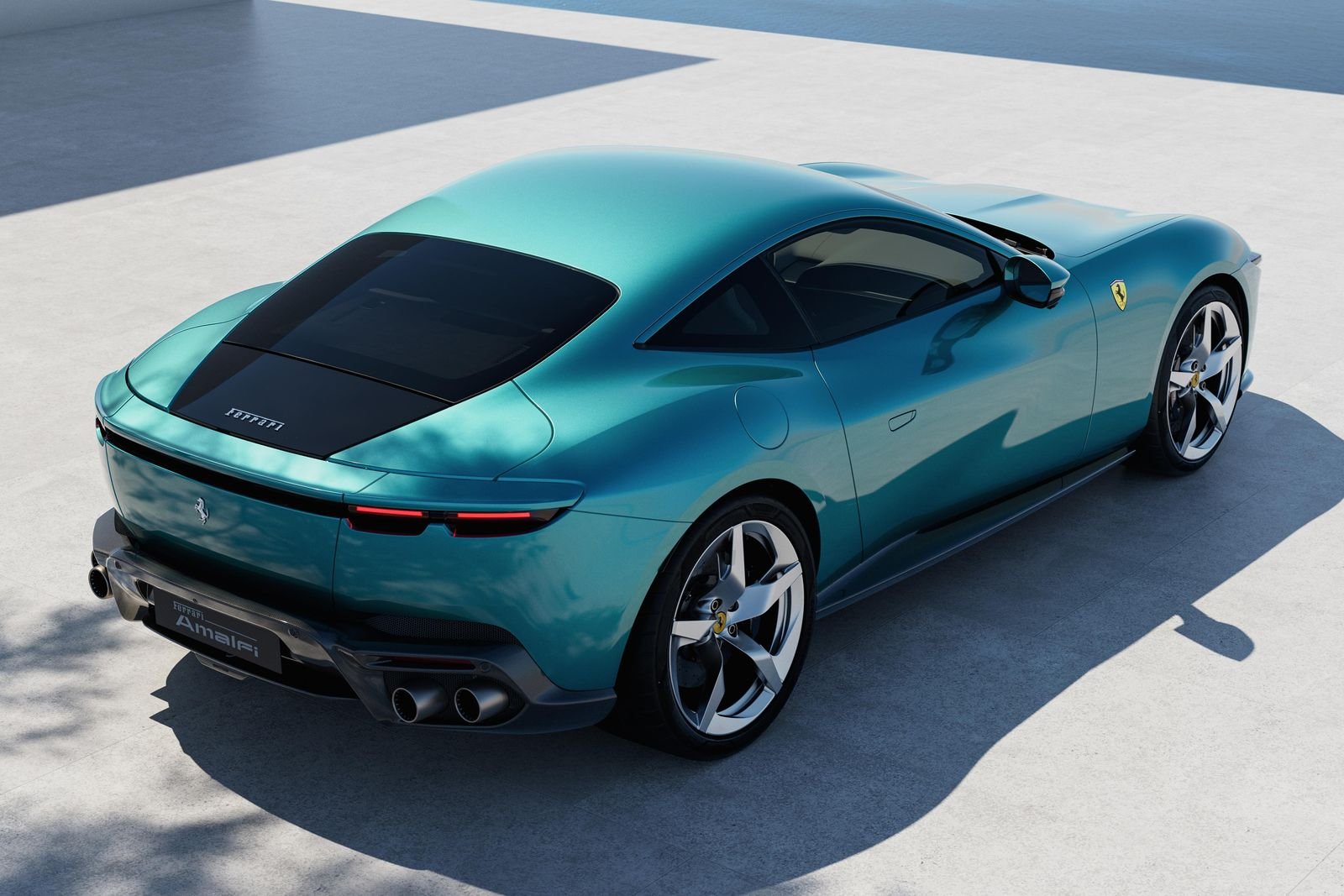
2026 Ferrari Amalfi Review: The Super-GT the Roma Should Have Been
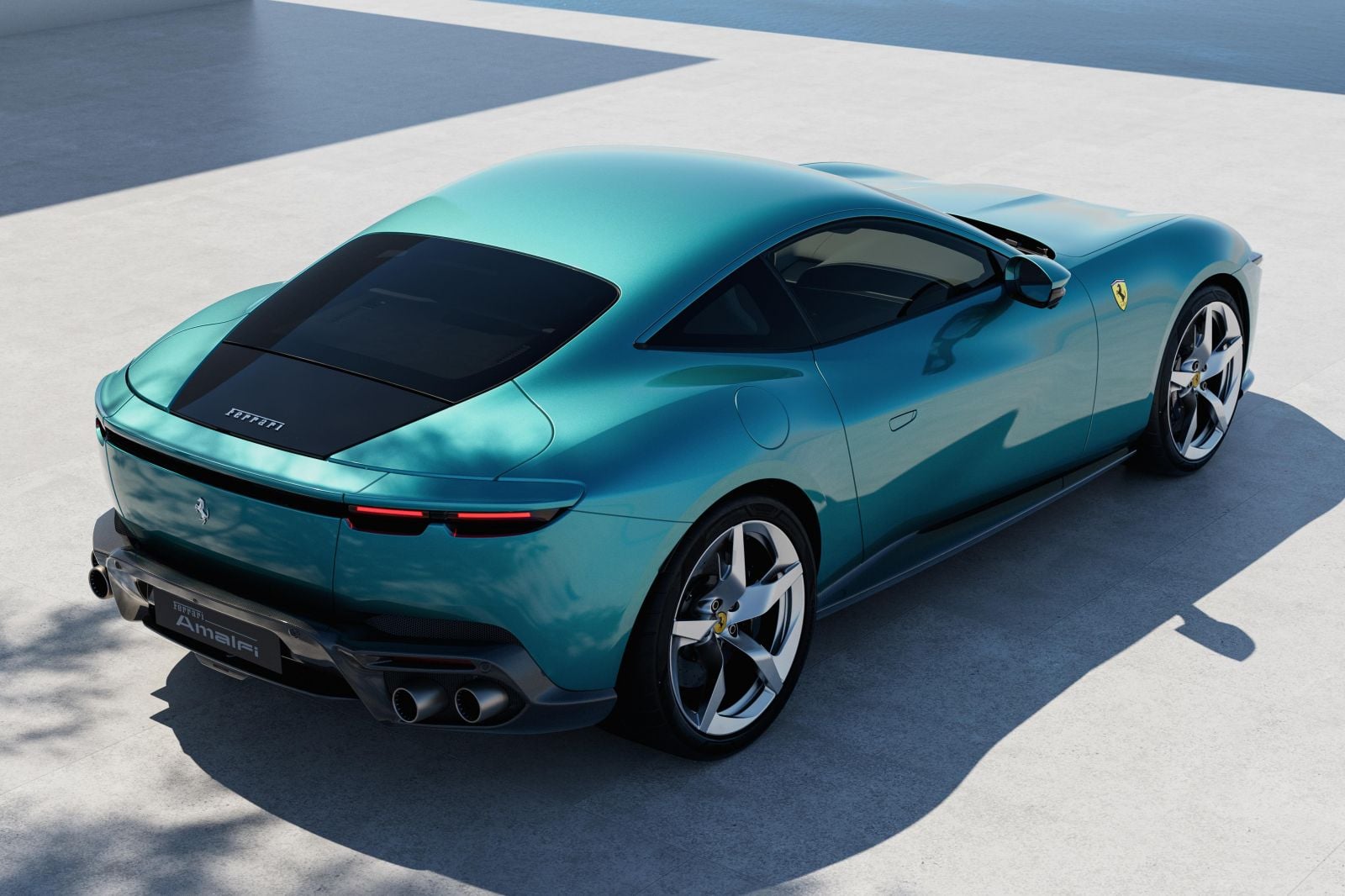
2026 Ferrari Amalfi front three-quarter studio shot
Price
GBP 222,900
0-100 km/h
3.3 s
Power
631 hp
⚡ Quick Verdict
:
The 2026 Ferrari Amalfi takes everything the Roma got right and corrects everything it didn’t. The recalibrated gearbox alone justifies the new name, and swapping those haptic controls for proper buttons turns the cabin from a frustration into something genuinely special. This is the benchmark for front-engined GTs.
## Quick verdict and where the Amalfi sits
✓ The Good
- +Reprogrammed 8-speed DCT is a night-and-day improvement over the Roma’s gearbox
- +Physical buttons return to the steering wheel — haptic controls are finally gone
- +Meatier torque delivery from idle makes it feel like a big naturally aspirated V8
- +Three-position active rear wing adds meaningful downforce with minimal drag penalty
- +Interior feels significantly more spacious despite identical chassis dimensions
✗ The Trade-offs
- −Mirror controls remain haptic on the door card — still fiddly and imprecise
- −Engine note is subdued inside the cabin; lacks the theatre you’d expect from a Ferrari
- −Rear-wheel drive only limits all-weather usability in snow markets
- −At GBP 222,900 it commands a steep premium over the DB12 and 911 Turbo S
📑 In This Review
- Quick verdict and where the Amalfi sits
- Design and that polarising front end
- Interior, screens and the return of real buttons
- Engine, transmission and the drive
- At a glance: how the Ferrari Amalfi compares
- Ferrari Amalfi vs Aston Martin DB12: Which Is Better?
- Safety, ADAS and warranty
- Running costs and what owning one actually looks like
- Other rivals worth a look
- Who should buy the Ferrari Amalfi?
- Final verdict
- Frequently asked questions
The 2026 Ferrari Amalfi takes everything the Roma got right and corrects everything it didn’t. The recalibrated gearbox alone justifies the new name, and swapping those haptic controls for proper buttons turns the cabin from a frustration into something genuinely special. This is the benchmark for front-engined GTs.
Quick verdict and where the Amalfi sits
Ferrari has a habit of reinventing its front-engined GT line through updates that sound incremental on paper but deliver a car that feels entirely new behind the wheel. The 2026 Amalfi follows that playbook — new body panels, a reworked cabin, revised aero, fresh brakes, updated turbos and a completely reprogrammed gearbox — yet the end result is anything but small change. It replaces the Roma, a car we loved for pulling Ferrari back from aggressive, overwrought styling and restoring an elegance the brand had been missing since the 550 Maranello days.
The headline figures tell part of the story: 631 hp from a 3.9-litre twin-turbo V8, 0–100 km/h in 3.3 seconds and a top speed of 320 km/h. Pricing starts at USD 283,000 in the United States, GBP 222,900 in the United Kingdom and AUD 503,261 in Australia. Those numbers place the Amalfi squarely in supercar territory, even though its mission remains firmly grand tourer.
During our drive through Portugal’s Algarve region, across roads that alternated between bone-dry mountain passes and persistently damp coastal stretches, the Amalfi never felt like a compromise. Where the Roma occasionally frustrated with its gearbox calibration and those awful capacitive controls, this car simply gets on with being magnificent. Every change Ferrari has made, from the smaller, faster-spooling turbos spinning at 171,000 rpm to the brake-by-wire system borrowed from the 296 GTB family, serves a clear purpose.
The point is simple: the Amalfi isn’t just a worthy successor to the Roma. It’s the car the Roma should have been. If you loved what the Roma stood for but winced at its haptic steering wheel or its eagerness to cruise in eighth gear at 65 km/h, the Amalfi is your vindication.
Design and that polarising front end
Let’s address the elephant in the room. The internet has decided the Ferrari Amalfi looks like a Toyota Prius. We get the comparison — there’s something about the clean, grille-free front end, the way the headlights integrate into a slim black band, and the general absence of aggressive ducting that triggers a Prius association at certain angles. But here’s the counter-argument: when the latest Prius launched, those same internet commentators said it looked like a Lamborghini. We’re comfortable with a car that supposedly looks like a Prius that supposedly looks like a Lamborghini.
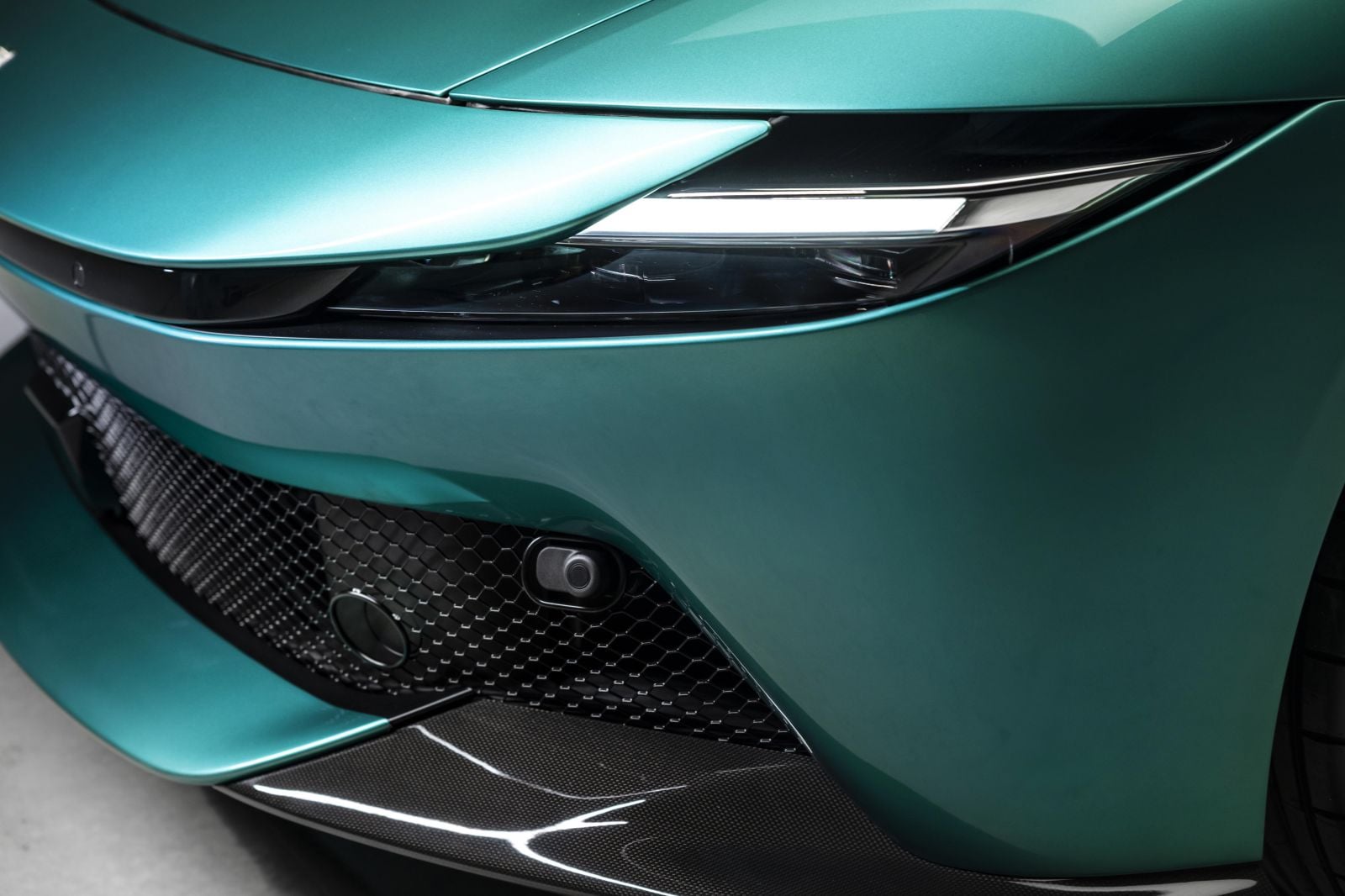
The brief Ferrari gave its Centro Stile team was deceptively simple: start with a pure, platonic form, a shape without wheels, door handles, windscreen wipers or any extraneous detail, then fight to keep that purity intact as you add the functional elements a modern car demands. Every intrusion into that clean form, headlights, cameras, radar sensors, tail lights, the rear hatch handle, sits within a black accent line that runs across the front and rear of the car. The result is an anti-grille treatment that’s vastly cleaner than the Roma’s busy, sensor-cluttered face.
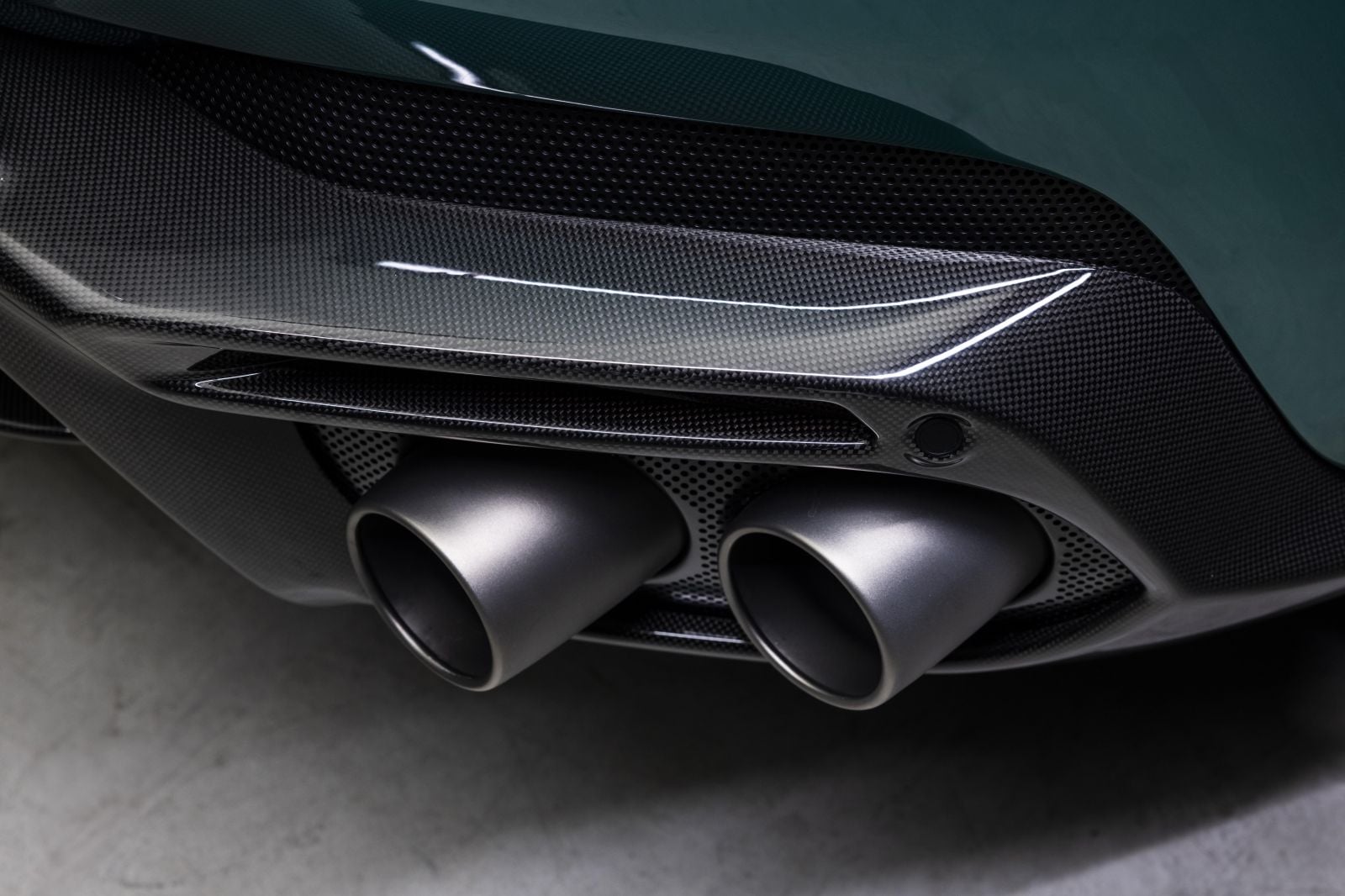
At the front, the black mesh band concealing the radar, parking sensors and forward-facing cameras creates a surface that reads as deliberately minimal rather than underfed. The integrated headlight graphic gives the Amalfi a familial resemblance to the F80 hypercar and the 12Cilindri, something the Roma never quite achieved. At the rear, the three-position active rear wing is the dominant design element, producing approximately 220 lbs of downforce at speed while adding only a 4% drag penalty at maximum deployment. The rear end has drawn comparisons to certain TVR models from the early 2000s, which isn’t a criticism; it gives the Amalfi a muscular, purposeful stance.
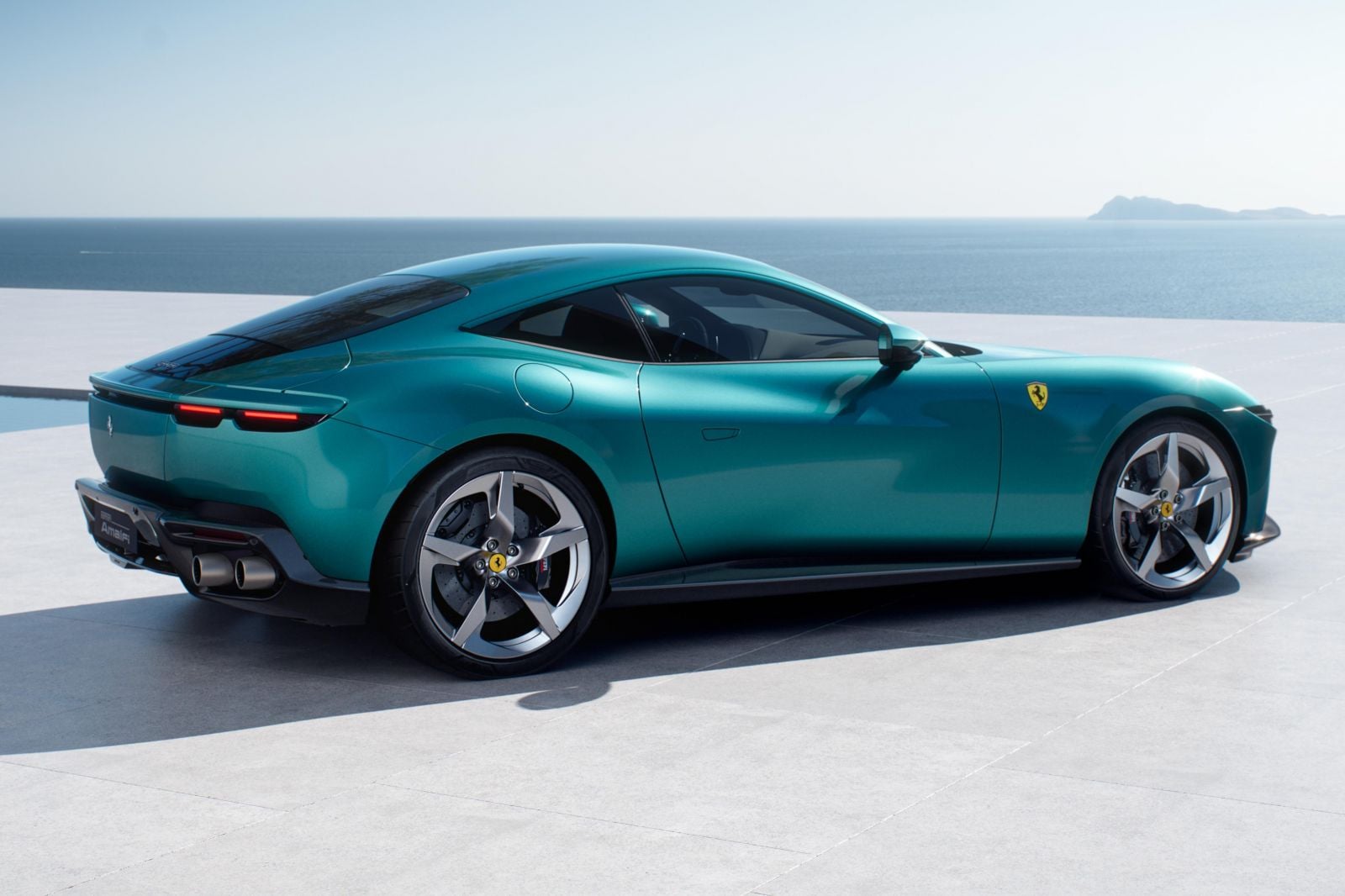
The proportions, surfacing and lighting graphic place the Amalfi firmly in the modern Ferrari family. Side-on, it reads as a proper gran turismo — 4,656 mm long, 1,974 mm wide and just 1,301 mm tall. The 2,670 mm wheelbase is identical to the Roma’s, but the new sheet metal draws your eye more deliberately along the shoulder line. Is it as classically beautiful as the Roma? That’s a matter of taste. Is it more cohesive, more modern and more recognisably Ferrari? Without question.
Interior, screens and the return of real buttons
This is where the Amalfi earns its new name. Walk around to the driver’s door, drop into the seat and the first thing you notice is that the cabin feels significantly larger and more open than the Roma’s, despite sharing identical chassis dimensions. Ferrari’s interior team has achieved this through clever visual separation of the dashboard into two distinct binnacles: one for the driver and one for the passenger. Each occupant gets their own cocoon, their own screen and a clear sense of personal space.
The driver faces a 15.6-inch instrument cluster that’s sharp, configurable and legible at a glance. Below the eyeline, tucked neatly beneath a dividing line in the dashboard, sits a new 10.25-inch landscape touchscreen. The Roma’s portrait-mode unit always felt like an iPad glued to the dash; this landscape version feels integrated and purposeful. It handles secondary controls — seat settings, HVAC adjustments, front-end-lift operation — the sort of thing you genuinely don’t need to access while driving at pace. The passenger gets their own 8-inch display, reinforcing the dual-cockpit philosophy. Software is noticeably faster and more responsive than the Roma’s system, and Apple CarPlay, Android Auto and wireless charging are all standard.
Now for the headline news: Ferrari has admitted the Roma’s haptic capacitive steering wheel was a mistake and replaced everything with proper, clicky physical buttons. The start button is now an actual button you press with a satisfying mechanical action, not a capacitive touchpad that worked roughly 60% of the time. Cruise control, volume, drive mode selection — they’re all real switches now. It’s a night-and-day change. The steering wheel feels like it belongs in a driver’s car again rather than a concept vehicle that accidentally reached production. Ferrari told us at the static launch that they were "trying to be futuristic and got it wrong," and frankly, it takes confidence to reverse course that decisively. We respect it.
The one lingering haptic irritant is the mirror adjustment controls on the door card, which remain capacitive. It’s a minor point — you set your mirrors once and largely forget about them — but if you’re the sort of driver who adjusts mirrors every single time you slide behind the wheel, you’ll find these mildly infuriating. Material quality throughout the cabin is excellent: soft-touch leather, precise stitching, real aluminium switchgear where it matters. The Amalfi’s interior is a generation ahead of the Roma’s, and it needed to be.
Engine, transmission and the drive
Beneath the Amalfi’s long bonnet sits Ferrari’s familiar 3.9-litre twin-turbo V8, designated F154 BH. In this application it produces 631 hp at 7,500 rpm and 561 lb-ft of torque at 3,000 rpm. The peak power figure represents a modest uplift over the Roma, but the real story is in the hardware changes: new, smaller turbochargers that spin at a barely believable 171,000 rpm, paired with completely reworked engine management software. The redline sits at 7,600 rpm.
The difference from idle is immediately apparent. Where the Roma’s powertrain could occasionally feel slightly asleep at low revs before the turbos woke up, the Amalfi delivers a wall of torque from the moment you brush the throttle. The feeling is almost uncanny for a turbocharged engine — there’s a meatiness, a muscularity to the low-end pull that evokes a large naturally aspirated V8. It’s entirely possible to overwhelm the rear tyres in fourth gear if you’re generous with your right foot and have the Manettino set to Race, as we discovered on damp Algarve mountain roads. The Slip Control 6.1 system saved several dramatic moments during our testing, intervening smoothly enough that the car always felt catchable rather than snappy.
The transmission is the single biggest improvement. The 8-speed dual-clutch unit (Magna 8DCL900) in transaxle configuration for optimal weight distribution has been completely reprogrammed, and the change is revelatory. In the Roma, leaving the gearbox in Comfort and Auto was an exercise in frustration: the car would slam into eighth gear before you reached 65 km/h, seemingly chasing an emissions test score rather than any semblance of driving pleasure. In the Amalfi, the same Comfort mode actually behaves like a proper GT calibration. It holds gears when it should, shifts when it makes sense and never leaves you labouring in an absurdly tall ratio at urban speeds. You can still use the paddles in Sport, of course, and the shift quality — speed, smoothness, precision — rivals anything Porsche achieves with PDK. Every time we drive a Ferrari dual-clutch, we come away thinking it might be the best in the business. The Amalfi reinforces that belief.
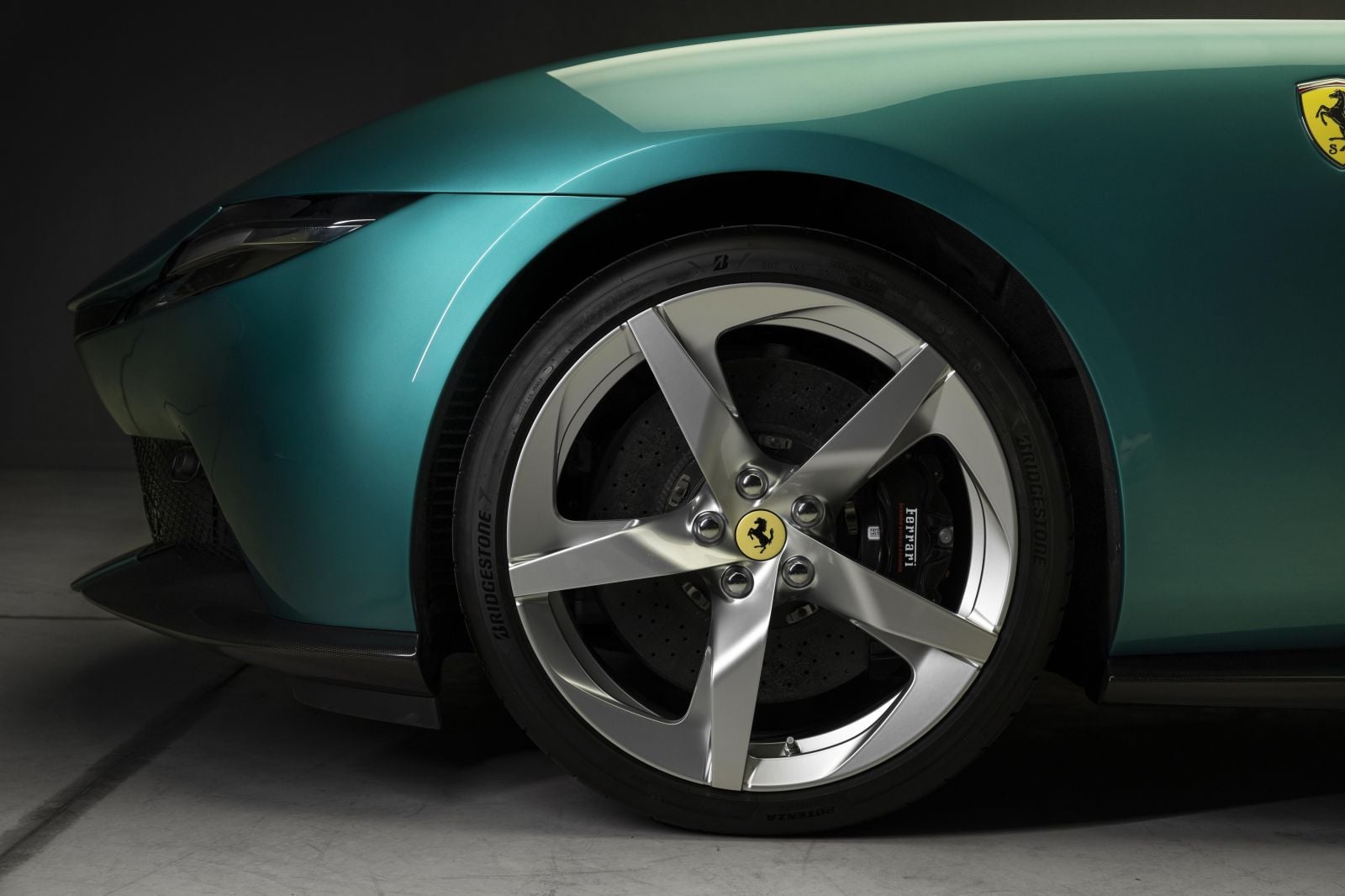
The braking system is entirely new, adopting brake-by-wire technology from the 296 GTB family. Carbon-ceramic discs are standard, and the pedal feel is firm with minimal travel. In day-to-day driving, the result is crisper, more immediate stops with less effort. On a spirited mountain-road drive, the shorter pedal travel makes modulation slightly less natural during trail-braking, there’s less physical feedback through your left foot to work with, but that’s a marginal criticism of a system that otherwise delivers excellent stopping power and enables much faster torque-vectoring response through the brake-by-wire architecture. ABS Evo has been recalibrated across all Manettino modes.
The steering deserves particular mention. It’s sharp and responsive without veering into the hyperactive territory of the F8 Tributo, which always felt slightly too darty for a car of that type. The Amalfi’s rack delivers fluid, confidence-inspiring communication that makes fast road driving genuinely intuitive. Combined with the rear-drive chassis and 1,570 kg dry weight, the steering gives you the sensation of being connected to the car rather than merely directing it. The front-end-lift system is available for speed bumps and steep driveways, activated through the centre touchscreen.
Engine noise inside the cabin is more muted than you might expect. The cross-plane crank V8 has a characterful snarl from the outside — fizzy, mid-range-heavy, more aggressive than the typical flat-plane turbo V8 — but the cabin insulation keeps it at a civilised level. That’s actually a smart decision for a car that will spend most of its life as a long-distance GT; you can always hear enough to shift by ear, and the shift lights on the steering wheel provide a visual backup. Quiet inside, characterful outside: it’s a GT calibration, and it suits the car’s mission perfectly.
At a glance: how the Ferrari Amalfi compares
| Spec | Ferrari Amalfi | Aston Martin DB12 | Porsche 911 Turbo S | AMG GT 63 |
|---|---|---|---|---|
| Engine | 3.9L TT V8 | 4.0L TT V8 | 3.7L TT flat-six | 4.0L TT V8 |
| Power | 631 hp | 680 hp | 641 hp | 577 hp |
| Torque | 561 lb-ft | 590 lb-ft | 590 lb-ft | 590 lb-ft |
| 0-100 km/h | 3.3 s | 3.6 s | 2.7 s | 3.2 s |
| Top speed | 320 km/h | 325 km/h | 330 km/h | 315 km/h |
| Drivetrain | RWD | RWD | AWD | AWD |
| Starting price (UK) | GBP 222,900 | GBP 192,900 | GBP 173,600 | GBP 162,500 |
| Starting price (US) | USD 283,000 | USD 248,000 | USD 232,200 | USD 188,500 |
Aston Martin DB12
Cheaper by ~30k GBP, richer cabin, more outright power, less dynamic edge
Porsche 911 Turbo S
2.7s to 100 km/h with AWD — faster but lacks the Italian GT theatre
Mercedes-AMG GT 63
Value play with AWD, well-equipped but lacks the Ferrari’s dynamic finesse
Aston Martin Vantage S
More focused sports-GT, tighter cabin and less pliant ride
The super-GT and sports-GT segment is more competitive than it’s ever been, with credible offerings from Aston Martin, Porsche and Mercedes-AMG all competing for the same well-heeled buyer. The Amalfi undercuts the AMG GT 63 on exclusivity and badge prestige, lines up against the Porsche 911 Turbo S on outright pace and goes head-to-head with the Aston Martin DB12 on character and desirability. Here’s how the numbers stack up across the four key rivals. Ferrari Amalfi Porsche 911 Turbo S — — 3.9L TT V8 3.7L TT flat-six 631 hp 641 hp 561 lb-ft 590 lb-ft 3.3 s 2.7 s 320 km/h 330 km/h RWD AWD GBP 222,900 GBP 173,600 USD 283,000 USD 232,200 The Amalfi commands a significant premium over every car on this list, but that premium buys you a prancing horse on the bonnet, a dual-clutch transaxle that’s among the best in the world, and a dual nature — GT comfort on the motorway, supercar pace on a mountain road — that none of the rivals quite match. The Porsche 911 Turbo S is faster off the line thanks to all-wheel drive, but it lacks the Italian grand tourer’s sense of occasion. The AMG GT 63 is the value play, but it’s also the least emotionally engaging of the four. The Aston Martin DB12 is the closest rival in both price and philosophy, and we’ll examine that matchup in detail below.
Ferrari Amalfi vs Aston Martin DB12: Which Is Better?
This is the comparison every potential Amalfi buyer will make. The Aston Martin DB12 and the Ferrari Amalfi occupy the same philosophical space: front-engined, twin-turbo V8, rear-drive grand tourers with two doors, luxurious cabins and enough performance to embarrass dedicated sports cars. They’re separated by roughly GBP 30,000 in the UK (the DB12 starts at GBP 192,900 versus the Amalfi’s GBP 222,900) and about USD 35,000 in the United States. That’s not an insignificant sum, but it’s well within the range that a buyer choosing between these two would consider reasonable for the right brand and the right character.
The powertrains tell an interesting story. The Amalfi’s 3.9-litre twin-turbo V8 produces 631 hp at 7,500 rpm and 561 lb-ft at 3,000 rpm. The DB12’s 4.0-litre twin-turbo V8, a development of the AMG-sourced unit Aston Martin has been refining for years, delivers 680 hp at 6,000 rpm and 590 lb-ft at 2,750 rpm. On paper, the Aston wins on both counts. In practice, the Ferrari’s powertrain feels more urgent and more alive, particularly from low revs. The new turbos and engine management software give the Amalfi a meatier, more immediate torque delivery that the DB12’s slightly more relaxed calibration doesn’t quite match. The Ferrari’s 8-speed dual-clutch transaxle is also a fundamentally different piece of engineering from the Aston’s conventional 8-speed ZF torque-converter automatic. The DCT shifts faster, sounds better doing it and, in the Amalfi’s latest calibration, is every bit as smooth in relaxed driving. The ZF auto in the DB12 is excellent — one of the best torque-converter units in the business — but it doesn’t have the same sense of mechanical precision when you start driving with intent.
The character difference is the most important distinction. The DB12 is, first and foremost, a grand tourer. It wants to cosset you in leather and walnut, to cross continents in supreme comfort, to arrive at a Michelin-starred restaurant looking immaculate. It does this brilliantly. The cabin ambience is arguably richer than the Ferrari’s, with a more traditional luxury feel and a sense of occasion that comes from Aston Martin’s long heritage in this space. But the DB12 is less convincing when you start asking it to be a sports car. It’s fast — 0–100 km/h in 3.6 seconds, 325 km/h top speed — but it doesn’t have the Ferrari’s sharpness, its willingness to change direction, its ability to make you forget you’re driving a grand tourer and not a mid-engined supercar.
The Amalfi, by contrast, is a super-GT in the truest sense. It wears its elegant, tailored suit during the week, but when you point it at a mountain road and set the Manettino to Sport, it rips off the jacket and reveals the supercar underneath. The kerb weight helps: at 1,570 kg dry, the Ferrari is a substantial 115 kg lighter than the DB12’s 1,685 kg. That weight advantage, combined with the sharper steering, the recalibrated brake-by-wire system and the three-position active rear wing generating approximately 220 lbs of downforce, gives the Amalfi an edge the DB12 can’t match. The Porsche 911 Turbo S might be quicker off the line, but within this direct rivalry, the Ferrari is the sharper instrument.
The touchscreen and interior tech contest is closer than you’d expect. Both cars have launched with completely new infotainment systems. The Amalfi’s 10.25-inch landscape touchscreen, supplemented by the 15.6-inch driver cluster and 8-inch passenger display, is slick and responsive. The DB12’s own all-new system is also a significant improvement over the previous Aston Martin setup. The key differentiator inside the cabin, though, is the Amalfi’s return to physical steering-wheel buttons, a change that makes daily interaction with the car’s controls feel intuitive and satisfying rather than frustrating. The DB12 uses a mix of physical and touch-based controls that is perfectly adequate but less decisive.
Residuals and brand cachet favour the Ferrari. Historically, Ferraris in this segment hold their value exceptionally well — the Roma has proven to be a strong performer in the used market, and the Amalfi’s broader improvements should only enhance that trajectory. Aston Martin values, while respectable, tend to depreciate more steeply, partly due to higher production volumes and partly due to the brand’s more turbulent financial history. The prancing horse on the Amalfi’s nose isn’t just a badge; it’s a financial instrument.
> **Which one is better?** > **Buy the Ferrari Amalfi if** you want a true super-GT that morphs into a supercar on demand, prefer the prancing-horse badge and pedigree, and value the new dual-clutch transmission and brake-by-wire integration. > **Buy the Aston Martin DB12 if** you want the more relaxed, leather-club GT character, slightly more bent-eight power, a sweeter cabin ambience and a saving of around GBP 30,000. > **Our pick** is the Amalfi if the badge and the supercar-when-you-want-it duality matter; the DB12 if you simply want the most accomplished cross-continent GT in this bracket.
Safety, ADAS and warranty
The Amalfi comes equipped with Ferrari’s current-generation ADAS suite, which includes adaptive cruise control, lane departure warning and blind-spot monitoring. These are the systems you’d expect in a modern GT, and they function with the kind of unobtrusive competence that keeps you informed without constantly interrupting your drive. The adaptive cruise works well in motorway traffic, and the lane departure system can be toggled off quickly via the Manettino or steering-wheel controls when you’re on a spirited back-road blast.
Carbon-ceramic brakes are standard fitment on the Amalfi, not an optional extra. Paired with the new brake-by-wire system, which enables significantly faster torque-vectoring response than the previous hydraulic setup, the braking package is one of the most sophisticated in the segment. The system’s ability to independently modulate brake pressure at each wheel translates directly into improved stability during hard cornering and emergency manoeuvres.
No Euro NCAP crash-test rating exists for the Amalfi, and none will be forthcoming. As a low-volume exotic, the car doesn’t fall within the consumer testing agency’s remit, and Ferrari doesn’t voluntarily submit vehicles of this type for assessment. This is standard practice across the supercar and exotic GT segment — neither the Aston Martin DB12 nor the Porsche 911 Turbo S carry a Euro NCAP rating in their performance specifications.
Warranty coverage is reassuring for a car at this price point. Ferrari provides a 36-month, unlimited-kilometre factory warranty globally. The Ferrari Genuine Maintenance Programme covers complimentary scheduled servicing for seven years, which is a genuine cost saving over the ownership period and removes a significant portion of the running-cost anxiety that comes with exotic-car ownership. After the seventh year, though, you’re on your own — and servicing a Ferrari V8 out of warranty is not a casual expense.
Running costs and what owning one actually looks like
Let’s be honest about what it costs to run a Ferrari Amalfi in the real world. The fuel tank holds 80 litres, and Ferrari doesn’t publish official WLTP fuel consumption figures for this class of vehicle. In practice, expect somewhere between 14 and 18 litres per 100 km in mixed driving, depending heavily on how much of your right foot you deploy. Driven gently on a motorway cruise, the Amalfi will be reasonably frugal for a 631-hp V8. Driven with enthusiasm on mountain roads, that 80-litre tank will empty itself with alarming efficiency.
Insurance will be the single largest annual cost outside of the vehicle itself. Group ratings for Ferraris in this power bracket sit at the very top of the scale, and the premium will vary significantly based on your age, location and claims history. In the UK, expect five-figure annual premiums for most drivers; in Australia, comprehensive cover through specialist underwriters will cost similarly. The Amalfi isn’t a car you insure through a comparison website.
The seven-year complimentary servicing programme is the financial safety net that makes Ferrari GT ownership more rational than many people assume. Routine maintenance — oil and brake-fluid changes, filter replacements, that sort of thing — is covered for the duration, and Ferrari’s dealer network is experienced in looking after these cars with minimal fuss. Tyres are another matter. The Amalfi will almost certainly ship on Michelin Pilot Sport 5 or Pilot Sport 4 S rubber, and if you drive the car with any regularity, budget for a fresh set at least once a year. Carbon-ceramic brake discs last significantly longer than steel equivalents but cost several times more to replace when they do eventually wear out.
Residuals on Ferraris in this segment have historically been strong, and the Roma provides a useful proxy. A well-specified, low-mileage Roma currently retains a higher percentage of its original value than either the Aston Martin DB12 or the AMG GT 63 at equivalent ages. The Amalfi, with its broader list of improvements and lower production numbers, should follow a similar or better trajectory. This is one of the rare cases where the purchase price, while steep, represents a reasonable long-term financial position.
Other rivals worth a look
The Porsche 911 Turbo S is the Amalfi’s most formidable performance rival. At 641 hp with all-wheel drive and a 2.7-second sprint to 100 km/h, it’s objectively faster than the Ferrari off the line. It’s also cheaper, starting at GBP 173,600 in the UK and USD 232,200 in the US. The 911 Turbo S is a clinical, devastatingly effective instrument, but it doesn’t have the Italian grand tourer’s sense of theatre or the feeling of being in something genuinely special every time you open the garage door.
The Mercedes-AMG GT 63 occupies the value end of this competitive set at GBP 162,500 in the UK and USD 188,500 in the US. Its 4.0-litre twin-turbo V8 produces 577 hp, and buyers can step up to the hybrid GT 63 S E Performance for even more. The AMG is all-wheel drive, well-appointed and fast, but it lacks the Amalfi’s finesse on a twisty road and doesn’t carry the same brand cachet among collectors and enthusiasts.
The Aston Martin Vantage S, with approximately 656 hp from its 4.0-litre twin-turbo V8, is a more focused, more sporting alternative to both the DB12 and the Amalfi. It’s worth a look if you value outright agility over grand-touring comfort, though its cabin is tighter and its ride less pliant than the Ferrari’s. The Lexus LC500, now effectively at the end of its production life, offers a similar vibe — a beautiful, relaxed GT that handles surprisingly well — but it never received the twin-turbo V8 that would have made it a true performance rival.
Who should buy the Ferrari Amalfi?
The ideal Amalfi buyer is someone who wants a supercar that can also be a daily driver — or, more precisely, a grand tourer that can also be a supercar when the mood strikes. This is the existing Ferrari client adding a second or third car to the stable for weekend drives and cross-country trips. It’s the lapsed Aston Martin or Porsche owner who wants a step up the badge ladder without sacrificing usability. It’s the buyer who values the prancing horse’s intangible qualities — its racing heritage and social cachet — but has no interest in owning something as uncompromising as a 296 GTB or F80.
It’s also, candidly, a car that rewards buyers who do their research. The haptic mirror controls on the door card are a genuine irritation for anyone who adjusts their mirrors frequently — if that describes you, try them in person before signing the order form. And if you live in a market where all-wheel drive is a seasonal necessity rather than a luxury, the Amalfi’s rear-drive layout limits its year-round usability. This isn’t a winter car. It’s not designed to be one.
What the Amalfi is designed to be is the most elegant, most capable, most enjoyable front-engined GT Ferrari has ever built. On that front, it succeeds thoroughly. If you want a car that looks beautiful in a restaurant car park, eats kilometres on a motorway without complaint and then becomes something genuinely thrilling the moment you find an empty mountain pass, the Amalfi is the best in the business right now.
⚡ Our Verdict
Final Take
The 2026 Ferrari Amalfi is a 4.5 out of 5, and it earns every tenth of that score. Every change Ferrari has made over the Roma is an improvement — the transmission calibration, the physical buttons, the new turbos, the brake-by-wire system, the active aero, the cleaner exterior design, the vastly more spacious-feeling interior. There isn’t a single area where the Amalfi is worse than the car it replaces. That’s a rare and remarkable achievement in a mid-cycle overhaul. Is it perfect? No. The mirror controls should have been physical, the engine note could be louder inside the cabin, and the GBP 222,900 starting price is a significant ask in a segment where the Aston Martin DB12 offers more power and a richer cabin ambience for roughly GBP 30,000 less. But these are quibbles rather than flaws, and none of them fundamentally undermine the car’s mission. The word that kept surfacing during our time with the Amalfi was joy. There’s a pure, uncomplicated pleasure in driving this car that goes well beyond the spec sheet. The torque arrives like a wave from idle. The steering has a fluidity to it that makes fast driving feel instinctive. And there’s the knowledge that you can cruise serenely through town in Comfort mode, then flick the Manettino to Sport and have a car that’ll genuinely keep pace with dedicated supercars. The Roma brought elegance back to the Ferrari GT lineage; the Amalfi has perfected it. Our recommendation is simple: if you’re in the market for a super-GT in this price bracket, the Amalfi should be at the top of your shortlist. It’s the car the Roma should have been, and it sets a new benchmark for what a front-engined Ferrari can be.
Frequently asked questions
How much does the 2026 Ferrari Amalfi cost?
Pricing for the 2026 Ferrari Amalfi starts at USD 283,000 in the United States, GBP 222,900 in the United Kingdom and AUD 503,261 here in Australia (roughly AUD 530,542 drive-away in Sydney). In Saudi Arabia, you’re looking at around SAR 950,000. These figures vary by market and don’t include options or destination charges.
Is the Ferrari Amalfi faster than the Roma it replaces?
Yes. The Amalfi reaches 100 km/h in 3.3 seconds compared to the Roma’s 3.4 seconds, and its top speed exceeds 320 km/h versus the Roma’s 320 km/h. The more significant gains are in mid-range response, though. The new turbos and engine management software deliver substantially meatier torque from low revs, making the Amalfi feel faster in real-world driving even where the peak numbers are only modestly improved.
Is the Amalfi all-wheel drive?
No. The 2026 Ferrari Amalfi is rear-wheel drive only, with power sent through an 8-speed dual-clutch transaxle gearbox. This configuration prioritises steering feel and driving engagement over outright traction. Buyers in snow-prone markets should think carefully about whether RWD meets their year-round needs.
Did Ferrari finally get rid of the haptic steering-wheel controls?
Yes. Ferrari has replaced all haptic capacitive controls on the steering wheel with proper, clicky physical buttons, including a conventional start button that actually works reliably. The only haptic controls that remain are the mirror adjustment switches on the driver’s door card, which is a minor irritation but not a deal-breaker for most owners.
How does the Amalfi compare to the Aston Martin DB12?
The DB12 is cheaper by approximately GBP 30,000 and offers more outright power (680 hp vs 631 hp). It’s a more relaxed, leather-club grand tourer with a richer cabin ambience. The Amalfi counters with a superior dual-clutch transmission, lighter kerb weight (1,570 kg vs 1,685 kg), sharper dynamics and the ability to genuinely behave like a supercar on a spirited drive. Both are excellent cars; the choice comes down to whether you want a GT that occasionally feels like a sports car (DB12) or a sports car that is always comfortable being a GT (Amalfi).
When does the Amalfi go on sale?
The 2026 Ferrari Amalfi goes on sale globally in Q1 2026. The Amalfi Spider convertible variant was unveiled on 12 March 2026 and is expected to follow shortly after the coupe’s market launch.
Is there a convertible version?
Yes. The Ferrari Amalfi Spider was unveiled in March 2026 and carries a premium of approximately USD 30,000–35,000 over the equivalent coupe. It shares the same powertrain, chassis and interior specification with a retractable hardtop replacing the fixed roof.
