

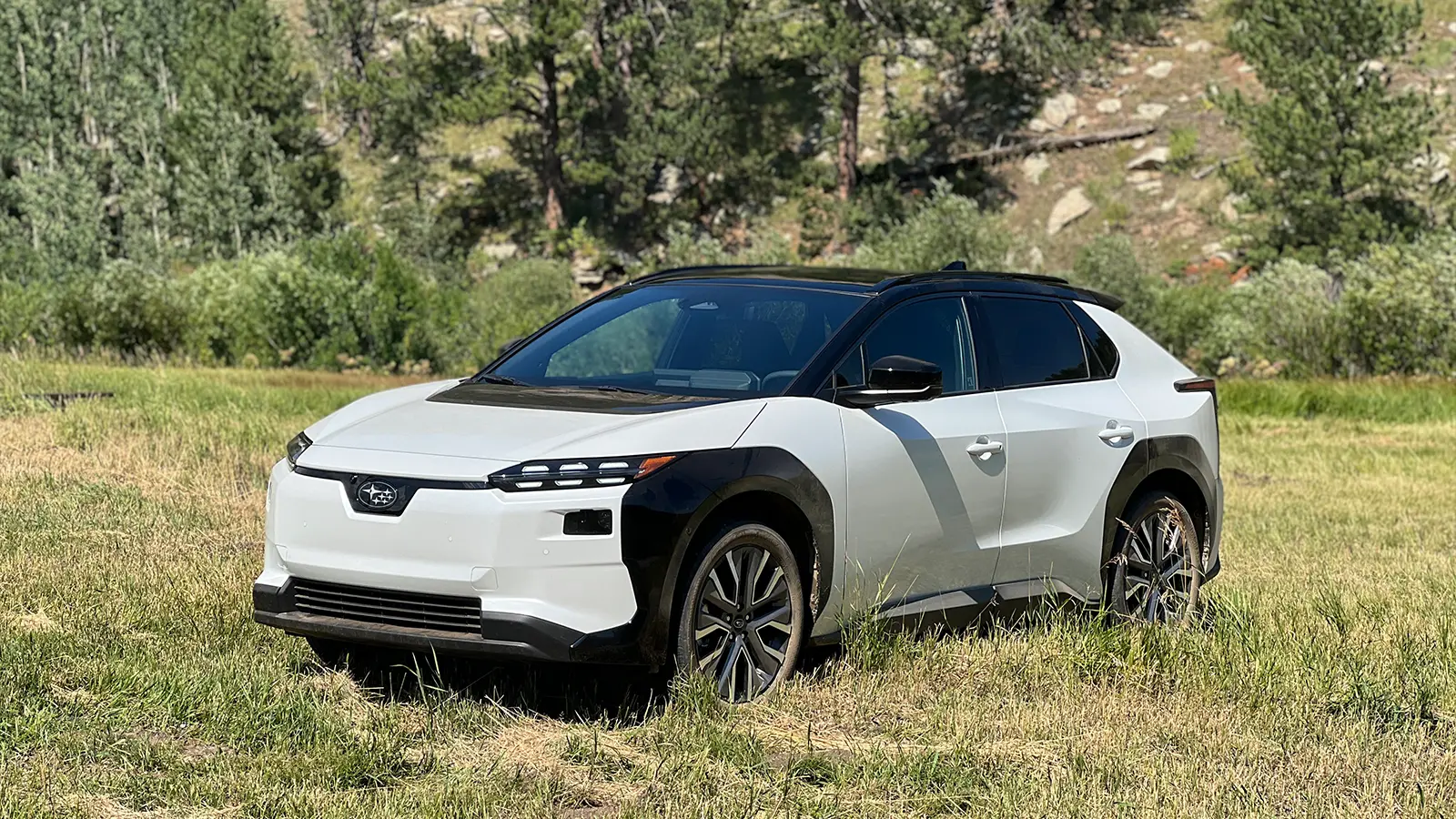
2026 Subaru Solterra Review: Finally the EV It Should Have Been
Subaru finally builds the EV it should have shipped first time

2026 Subaru Solterra front three-quarter studio shot
Price
$45,555
Battery
74.7 kWh
Power
338 hp (252 kW)
⚡ Quick Verdict
— Is the 2026 Subaru Solterra Worth Buying?
✓ The Good
- +~$6,000 price cut makes it genuinely competitive against rivals
- +25% more range with the larger 74.7 kWh battery
- +Native NACS/Tesla plug opens 25,000-plus Superchargers from the factory
- +Standard symmetrical AWD with best-in-class 8.3-inch ground clearance
- +Surprisingly fun to drive, especially in base 233 hp form
- +Range still trails the Model Y, EV6, and Ioniq 5
- +150 kW DC charging is slower than Korean 800-volt rivals
- +Interior plastics feel mid-grade in places
- +No glovebox — the storage shelf is a compromise
✗ The Trade-offs
- −Range still trails the Model Y, EV6, and Ioniq 5
- −150 kW DC charging is slower than Korean 800-volt rivals
- −Interior plastics feel mid-grade in places
- −No glovebox — the storage shelf is a compromise
📑 In This Review
- What Is New for the 2026 Subaru Solterra?
- Performance and Driving Impressions
- Range, Battery and Charging
- Interior, Tech and Practicality
- Safety and EyeSight Driver Assistance
- 2026 Subaru Solterra vs Tesla Model Y: Which Is Better?
- Which one is better?
- How Does the Solterra Compare to Other Rivals?
- Pricing, Trims and Value
- Warranty and Ownership
- Who Should Buy the 2026 Subaru Solterra?
- Final Verdict
- 4.1 / 5.0
- Frequently Asked Questions
This is the electric SUV Subaru should’ve built from the start. The bigger 74.7 kWh battery now delivers up to 463 kilometres of EPA-rated range, native NACS charging plugs you straight into over 25,000 Tesla Superchargers, and a $6,000 price cut drops the base Premium to $38,495. You’re also getting standard symmetrical AWD, 211 mm of ground clearance, and a driving character that’s more engaging than you’d expect. The underpinnings are shared with Toyota, sure, but the Solterra finally feels like a proper Subaru.
What Is New for the 2026 Subaru Solterra?
Rather than a token nip-and-tuck, the 2026 Solterra gets a meaningful mid-cycle refresh. The headline is a larger 74.7 kWh lithium-ion battery pack — up from 71.4 kWh — which unlocks roughly 25 per cent more range across the board. The base Premium and Limited trims now manage up to 288 miles (463 km) on the EPA cycle, while the more powerful XT variants come in at an estimated 272 miles (438 km).
Power comes in two flavours. Premium and Limited models run paired permanent-magnet synchronous motors from Blue Nexus, producing 233 hp and 249 lb-ft of torque. XT variants — that’s the Limited XT and Touring XT — bump things up to 338 hp, enough for a sub-5.0-second sprint to 60 mph.
Charging takes a significant step forward too. Peak DC fast-charging speed climbs from 100 kW to 150 kW, which means a 10-to-80-per-cent top-up in roughly 28 to 30 minutes with battery preconditioning active. Perhaps more importantly, every 2026 Solterra leaves the factory with a native NACS charge port. That opens the door to more than 25,000 Tesla Superchargers via the SubaruConnect app — no adapter required.
Inside, a new 14-inch Subaru Multimedia touchscreen takes centre stage on the redesigned dashboard, flanked by physical climate-control rings and a volume knob. Dual 15-watt wireless phone chargers are now standard, and options include a panoramic glass roof, Harman Kardon premium audio, and radiant leg warmers that heat your shins using surprisingly little energy.
Then there’s the price. Subaru’s slashed roughly $6,000 from every trim, pushing the entry-level Premium to $38,495 before destination. In every measurable way, it’s a better electric vehicle than what came before.
Performance and Driving Impressions
Climb into the base 233 hp Premium, and the first thing that catches you off guard is the shove. This is meant to be the entry-level model, yet the instant-on torque from the dual permanent-magnet motors delivers a linear, eager thrust that’s hard to ignore. Plant your right foot from a standstill and the Solterra squats, hooks up, and hustles forward with a composure that belies its 1,993 kg kerb weight. There’s no CVT drone, no turbo lag — just a single-speed reduction gear feeding all four wheels through Subaru’s symmetrical all-wheel-drive system.
The XT models are quicker, naturally — 338 hp and sub-5.0-second 0-60 mph times see to that — but honestly, the base car is where the value and fun intersect best. The Solterra feels playful through bends. The low-mounted battery drops the centre of gravity significantly, and the chassis rotates willingly when you tip it into a corner. Body roll is there but well-controlled, and the 235/60 R18 Toyo Open Country HT tyres on the base model deliver a compliant, comfortable ride that absorbs surface imperfections without going soggy.
Steering is accurate, though the weighting has a slightly artificial, video-gamey quality to it. The square-bottomed wheel — a platform-shared quirk — takes a few drives to feel natural, particularly when you’re wrestling it through tight parking manoeuvres. We also noticed a brief throttle hesitation immediately after braking; the drivetrain needs a beat to switch from regeneration back to power delivery. Minor quirk, not a deal-breaker.
For those heading off the tarmac, Subaru’s dual-mode X-MODE offers Snow/Dirt and Deep Snow/Mud settings that recalibrate traction control and torque distribution. Combined with 211 mm of ground clearance — best among mainstream electric SUVs — the Solterra handles gravel roads, snowy driveways, and light trail work without fuss. Paddle-mounted regen controls let you dial in braking force on the move, though the maximum setting is mild compared to true one-pedal EVs.
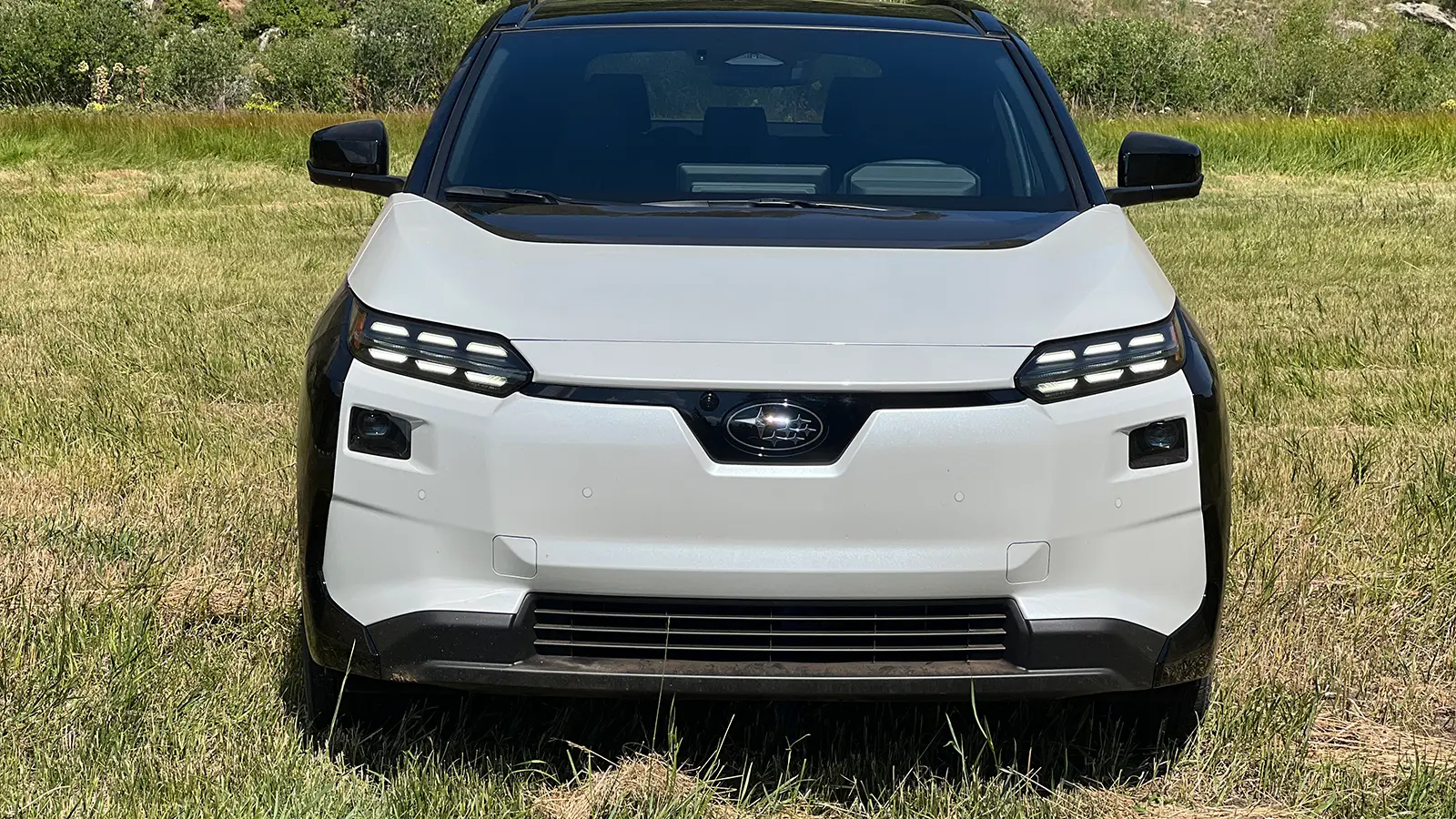
Range, Battery and Charging
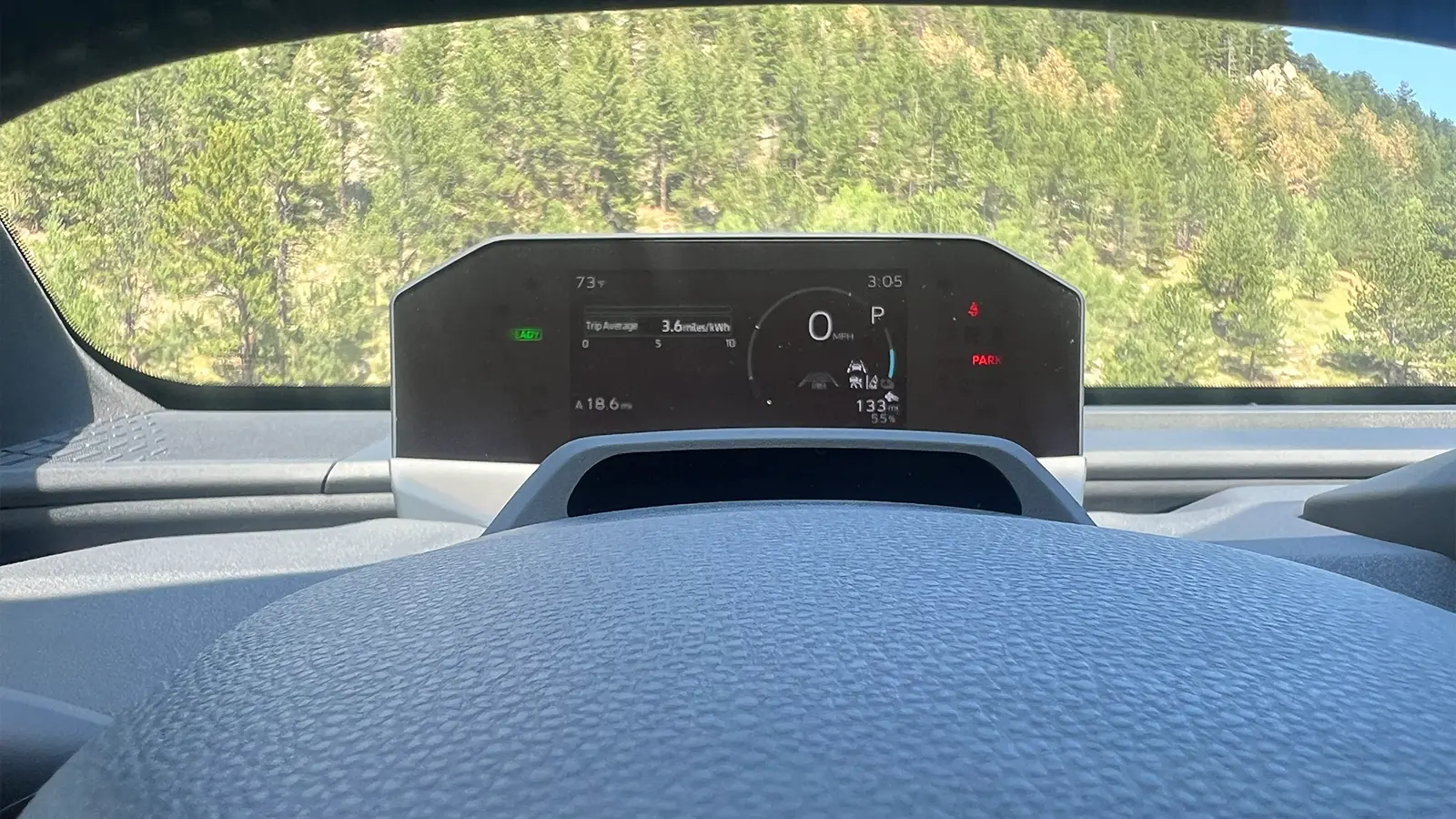
The refreshed Solterra packs a 74.7 kWh lithium-ion battery — a modest but worthwhile increase over the outgoing 71.4 kWh unit. EPA-rated range tops out at 288 miles (463 km) on the Premium and Limited trims, with the heavier, more powerful XT models estimated at around 272 miles (438 km). In our real-world testing with climate control switched off, the range display showed 301 miles at a full charge. That’s a useful benchmark for mild-weather highway running. Switch the air conditioning on, though, and that figure drops to 277 miles — a stark reminder of how much climate systems chew into EV efficiency.
DC fast charging now peaks at 150 kW, a solid improvement over the previous 100 kW ceiling. With battery preconditioning engaged — and it works reliably even in cold ambient temperatures — you’re looking at a 10-to-80-per-cent charge in approximately 28 to 30 minutes. That’s competitive for the segment, though the Hyundai Ioniq 5 and Kia EV6, running their 800-volt architecture and 240-plus kW peaks, still set the benchmark for rapid top-ups.
The biggest charging story, though, is the native NACS port. Every 2026 Solterra leaves the factory with a Tesla-compatible connector, doing away with adapters at the more than 25,000 Superchargers now open to non-Tesla vehicles. Access is managed through the SubaruConnect app, and for anyone living outside dense CCS networks, it fundamentally changes the ownership experience.
On Level 2 AC, the onboard 11 kW charger will refill the battery overnight on a typical home wallbox. For most owners covering average daily distances, plugging in overnight is all you’ll ever need.
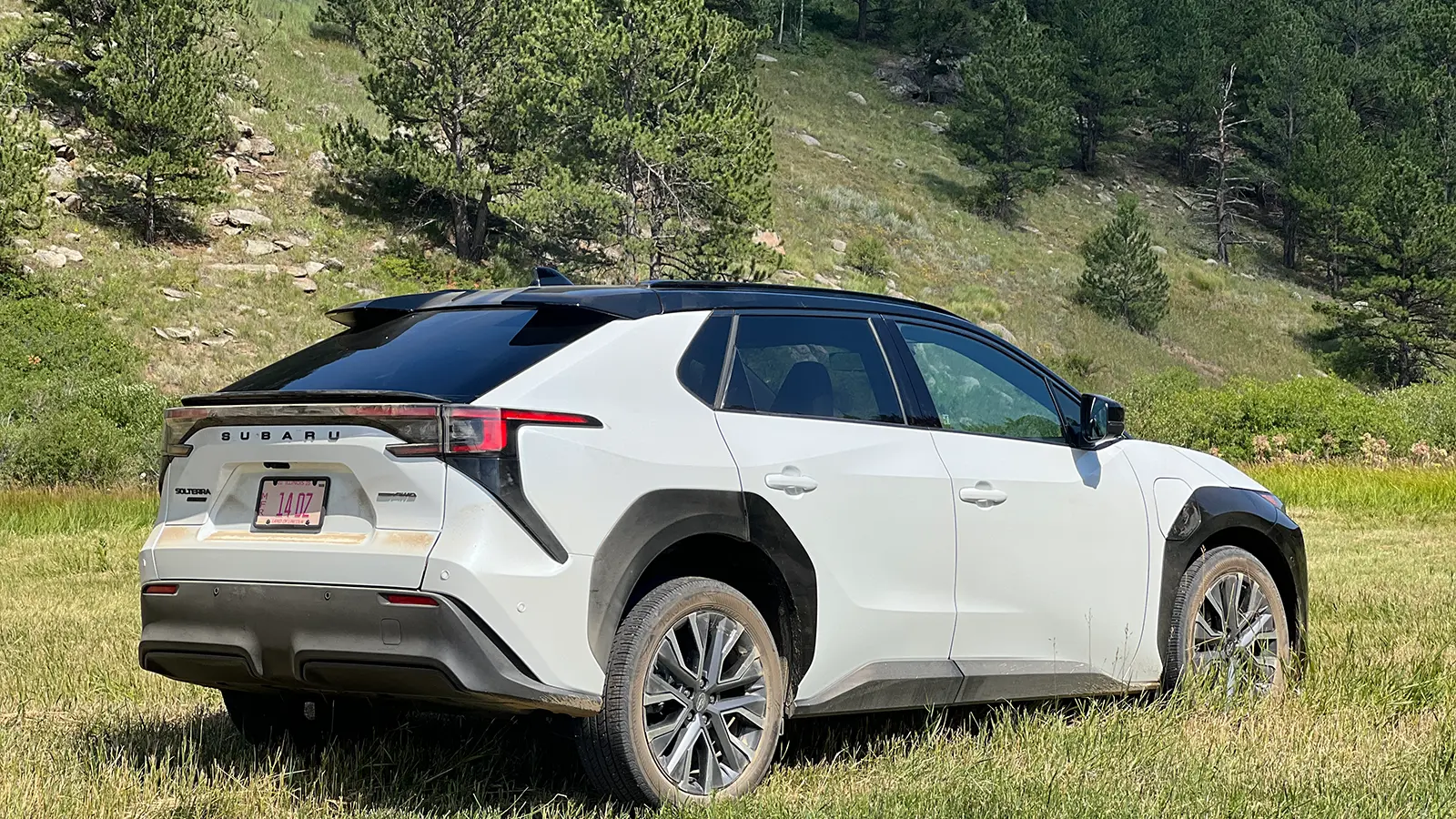
Interior, Tech and Practicality
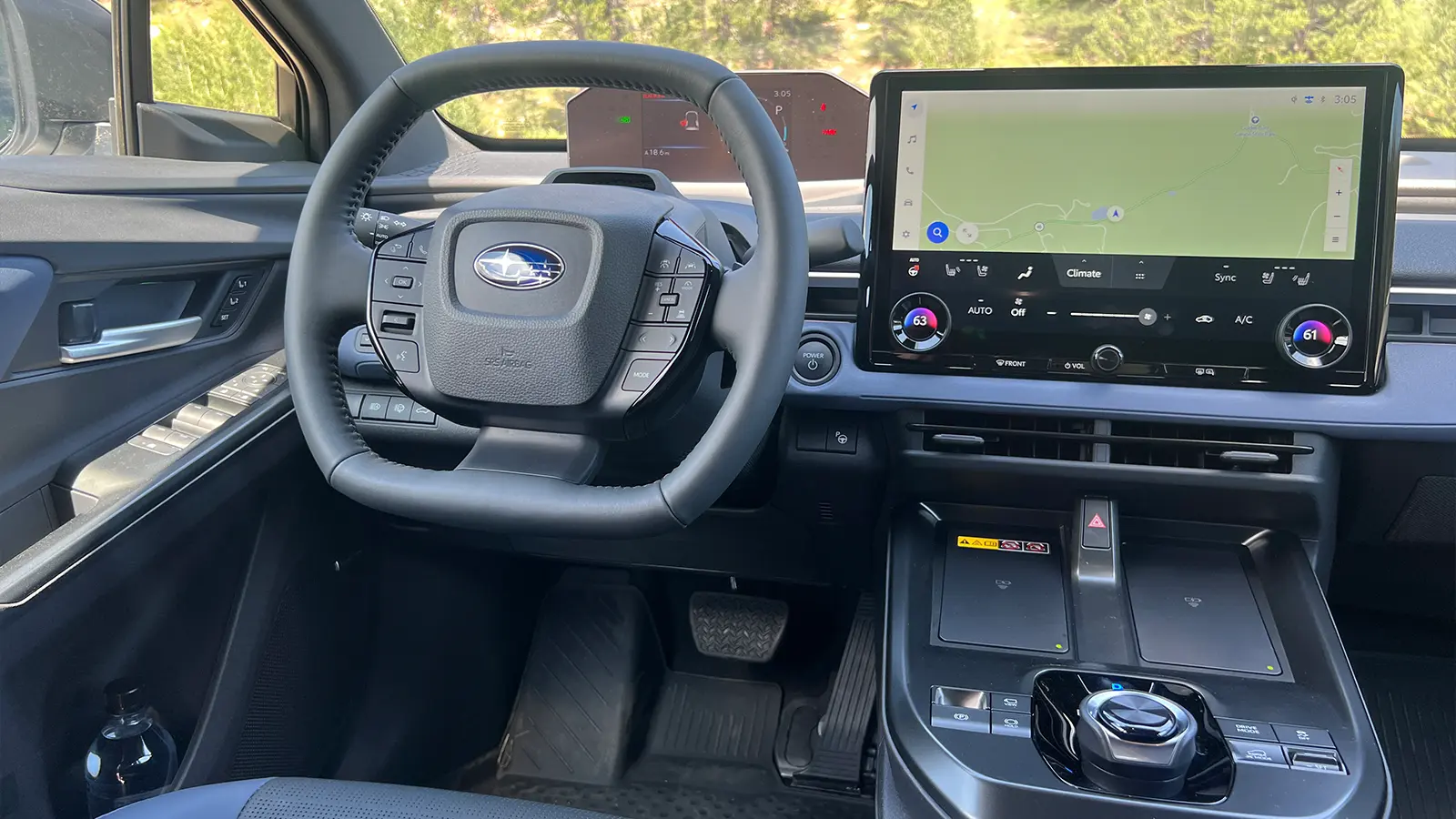
The cabin is where the 2026 refresh is most visible. A new 14-inch Subaru Multimedia touchscreen sits prominently atop a redesigned horizontal dashboard, running wireless Apple CarPlay and Android Auto as standard. The interface leans heavily on Toyota’s software architecture — menus will feel familiar if you’ve recently driven a bZ4X or RAV4 — but it’s responsive and logically arranged.
Crucially, Subaru’s kept physical controls where they matter. Rotary dials for temperature adjustment and a tactile volume knob sit below the screen, alongside dedicated defrost buttons. The steering wheel carries physical thumb controls rather than touch-sensitive pads, and we reckon that’s the right call. Behind the wheel, a fully digital instrument cluster shifts the speedometer to the outer edge of the display, echoing the Lexus layout. It takes a moment to adjust, but it keeps essential speed data within your natural sightline.
Dual 15-watt wireless phone chargers sit ahead of the centre console, and there’s a pair of USB-C ports for rear passengers. One quirk worth flagging: there’s no traditional glovebox. Subaru’s fitted a concealed shelf beneath a hinged panel instead, with additional charge ports built in. It works, but it’s a compromise you should know about before you test-drive.
Seating is finished in two-tone perforated leatherette with heating on all outboard positions. Available upgrades include a Harman Kardon premium audio system — which sounds genuinely impressive, even on the base stereo we sampled — a panoramic glass roof, ambient lighting, and those quirky radiant leg warmers.
Cargo space measures 63.5 cubic feet with the rear seats folded, and the low load floor makes it easy to slide in bulkier items. An underfloor storage tray hides the charge cable, and a hands-free power tailgate is available on higher trims. Rear-seat space is generous, with a flat floor thanks to the absent driveshaft, and rear passengers get their own USB-C ports and air vents.
Safety and EyeSight Driver Assistance
The 2026 Solterra carries over a strong safety record. Euro NCAP awarded it a maximum five-star rating in its 2025 testing cycle, and the IIHS Top Safety Pick+ designation carries forward. ANCAP has also assigned five stars, taking advantage of the shared platform architecture with the Toyota bZ4X.
Every Solterra ships with Subaru’s full EyeSight driver-assistance suite as standard. The package includes Pre-Collision Braking with pedestrian and cyclist detection, Emergency Steering Assist, Lane Departure Prevention, and Dynamic Radar Cruise Control with stop-and-go functionality. DriverFocus, Subaru’s infrared camera-based driver monitoring system, watches for signs of distraction or drowsiness and issues audible and visual alerts.
Blind-Spot Monitoring with rear cross-traffic alert rounds out the standard kit, and the system performed consistently during our testing — intervening smoothly rather than abruptly. There’s no hands-free highway driving mode; Subaru isn’t chasing that particular headline. But the breadth and calibration of the standard suite is impressive for a vehicle at this price point.
For families prioritising passive safety, the reinforced battery-pack structure, eight airbags, and low centre of gravity all contribute to a secure, planted feel. By any objective measure, it’s one of the safest electric SUVs on the market.

2026 Subaru Solterra vs Tesla Model Y: Which Is Better?
This is the comparison most shoppers will make, so let’s lay it out honestly.
**Pricing.** The Solterra Touring XT stickers at $45,555, while the 2026 Tesla Model Y Long Range AWD starts at approximately $49,990. That’s a $4,435 advantage for the Subaru, and the gap widens further down the range — the base Solterra Premium undercuts the base Model Y Long Range by roughly $11,000. On price alone, the Solterra is the more accessible family EV.
**Power and acceleration.** The Touring XT produces 338 hp from its dual-motor set-up and sprints to 60 mph in under 5.0 seconds. The Model Y Long Range counters with 384 hp and a claimed 4.8-second dash. The Tesla is marginally quicker, but in daily driving the difference is negligible. Both deliver the instant, seamless thrust that defines the electric SUV experience.
**Range.** Here the Model Y pulls ahead. Tesla quotes approximately 310 to 330 miles of EPA range depending on wheel size, versus 272 miles for the Solterra Touring XT. For road-trippers who regularly push beyond 250 miles between charges, the Tesla’s buffer is meaningful.
**Charging.** The Model Y supports 250 kW at V3 Superchargers and up to 325 kW at newer V4 stalls. The Solterra peaks at 150 kW. On a long highway run, the Tesla will recover range faster during each stop.
**Off-road and AWD philosophy.** The Solterra’s 211 mm of ground clearance is a full 43 mm taller than the Model Y’s 168 mm. That gap matters on rutted fire roads, snowy driveways, and uneven trailheads. Subaru’s dual-mode X-MODE system — with dedicated Snow/Dirt and Deep Snow/Mud settings — recalibrates traction control and torque split for loose surfaces, and in our testing the Solterra felt genuinely confident on gravel and packed snow. The Model Y’s all-wheel-drive system is competent on wet tarmac and light snow, but it lacks off-road drive modes and its lower ride height limits any serious unpaved ambitions. For rural properties, mountain commutes, or simply driving to a ski lodge without white-knuckling it, the Subaru is the better tool.
**Interior.** The Solterra’s cabin has come a long way. The new 14-inch touchscreen is sharp, wireless smartphone charging is standard, and available niceties like Harman Kardon audio, a panoramic glass roof, and those quirky radiant leg warmers give it genuine character. Physical climate controls and steering-wheel buttons are welcome additions. The Model Y’s minimalist cabin still feels more cohesive, though. Tesla’s materials quality on touchpoints is marginally better, the central display is larger and more intuitive, and the overall design feels more resolved. The Solterra’s square-bottomed steering wheel remains an acquired taste, and the absence of a traditional glovebox — replaced by a shelf — is a compromise not every buyer will accept.
**Cargo.** The Model Y wins this category outright. Including the frunk, it offers roughly 76 cubic feet (2,150 litres) of total cargo space, versus the Solterra’s 63.5 cubic feet (1,798 litres). That’s a meaningful 352-litre advantage. Both vehicles have flat rear floors and low load lips, making it easy to slide in bulky items. The Solterra counters with an underfloor storage tray for the charge cable and an available hands-free power tailgate, but for families who regularly fill the boot with luggage, prams, or sporting gear, the Tesla’s extra volume is the more practical proposition.
—
| Metric | 2026 Subaru Solterra Touring XT | 2026 Tesla Model Y Long Range AWD |
|---|---|---|
| Starting price (US) | $45,555 | ~$49,990 |
| Power | 338 hp (252 kW) | 384 hp (286 kW) |
| 0-60 mph | <5.0 s | ~4.8 s |
| Range (EPA) | ~272 mi (438 km) | ~310-330 mi (500-531 km) |
| Battery | 74.7 kWh | ~75 kWh |
| Peak DC charging | 150 kW | 250 kW (V3) / 325 kW (V4) |
| Ground clearance | 8.3 in (211 mm) | 6.6 in (168 mm) |
| Cargo volume | 63.5 cu ft (1,798 L) | 76 cu ft (2,150 L) with frunk |
| Drive | Dual-motor AWD standard | Dual-motor AWD |
Which one is better?
Buy the Solterra if you want genuine all-wheel-drive capability, 211 mm of ground clearance, and the peace of mind that comes with Subaru’s established dealer network and off-road heritage. It’s the smarter choice for families on rural properties, mountain commutes, or anyone who regularly encounters unpaved roads and snow.
Buy the Model Y if range and charging speed are non-negotiable. The Tesla’s 310-to-330-mile EPA range and 250 kW-plus Supercharger access mean fewer stops and shorter ones — a genuine advantage on road trips. It also offers more cargo space and a more polished tech ecosystem.
**Our pick** is the Solterra for most buyers. At $45,555, it undercuts the Model Y by roughly $4,435, delivers standard AWD with real off-road credibility, and retains a 74.7 kWh battery that’s perfectly adequate for daily use. The Tesla’s range advantage is meaningful, but for the majority of families who charge at home overnight and rarely exceed 250 miles in a single day, the Subaru’s combination of value, capability, and practicality makes it the smarter overall package.
—
How Does the Solterra Compare to Other Rivals?
The Tesla Model Y isn’t the Solterra’s only competitor. Three other electric SUVs deserve a close look before you sign anything: the Kia EV6, the Hyundai Ioniq 5, and the Toyota bZ4X.
The **Kia EV6** is the Solterra’s most dynamic rival. Its 800-volt architecture enables DC fast-charging speeds up to 240 kW or more, meaning a 10-to-80-per-cent charge can happen in under 20 minutes at the right stall. The GT-Line AWD produces 320 hp and sprints to 60 mph in roughly 4.5 seconds — quicker than the Solterra Touring XT. Range tops out at approximately 310 miles (499 km) on the EPA cycle. The EV6 also offers a sportier, lower-slung driving character. Its starting price, however, climbs higher; the GT-Line AWD stickers around $52,600, and the base Light RWD begins at $42,900. If ultra-fast charging and sharp handling top your priority list, the EV6 is compelling.
The **Hyundai Ioniq 5** shares the EV6’s 800-volt platform but wraps it in a more family-friendly package. Its boxy, retro-inspired body delivers generous interior space — more rear legroom than the Solterra — and a flat floor that makes three-across seating genuinely comfortable. The AWD model produces 320 hp and achieves roughly 303 miles (488 km) of EPA range. Pricing starts around $42,500 for the base SE Long Range RWD, with AWD models from approximately $49,000. It’s a strong alternative for buyers prioritising interior volume and 800V charging, though it lacks the Solterra’s off-road ground clearance and X-MODE capability.
The **Toyota bZ4X** is the Solterra’s corporate twin, built on the same e-TNGA platform. It shares the same battery, motors, and basic suspension architecture. The key differences are Subaru-specific: the Solterra gets standard Symmetrical AWD, X-MODE off-road modes, 211 mm of ground clearance, and — for 2026 — the larger 74.7 kWh battery and native NACS port. The bZ4X starts at $37,070 in FWD form and offers AWD with 215 hp. For buyers who want the Solterra’s platform but don’t need AWD or off-road credentials, the bZ4X can save a few thousand dollars. For everyone else, the Subaru is the better package.
Here’s how these five electric SUVs stack up at a glance:
| Model | Starting Price (US) | Power | Range (EPA) | 0-60 mph |
|---|---|---|---|---|
| 2026 Subaru Solterra Premium AWD | $38,495 | 233 hp (174 kW) | ~288 mi (463 km) | ~6.4 s |
| 2026 Tesla Model Y Long Range AWD | ~$49,990 | 384 hp (286 kW) | ~310-330 mi (500-531 km) | ~4.8 s |
| 2026 Kia EV6 GT-Line AWD | ~$52,600 | 320 hp (239 kW) | ~310 mi (499 km) | ~4.5 s |
| 2026 Hyundai Ioniq 5 AWD | ~$49,000 | 320 hp (239 kW) | ~303 mi (488 km) | ~4.8 s |
| 2026 Toyota bZ4X AWD | ~$41,000 | 215 hp (160 kW) | ~252 mi (406 km) | ~4.4 s |
—
Pricing, Trims and Value
Subaru has dropped roughly $6,000 across the Solterra line-up for 2026, and the result is a range that finally stacks up financially. Here’s what each trim costs and what you’re getting.
The **Premium** is the entry point at **$38,495**. It includes the 74.7 kWh battery, dual-motor Symmetrical AWD, 233 hp, 288 miles (463 km) of EPA range, 150 kW DC fast charging, the native NACS port, the full 14-inch touchscreen with wireless Apple CarPlay and Android Auto, dual wireless phone chargers, heated outboard seats, and the complete EyeSight driver-assistance suite. For most buyers, this is all the Solterra you need.
The **Limited** at **$41,395** adds leather-trimmed upholstery, a heated steering wheel, upgraded audio, and additional driver-assist features. It shares the Premium’s 233 hp drivetrain and 288-mile range. The $2,900 premium is justified if you value those comfort upgrades.
The **Limited XT** jumps to **$42,895** and unlocks the 338 hp dual-motor tune with a sub-5.0-second 0-60 mph time. Range drops slightly to approximately 272 miles (438 km) thanks to the more powerful motors. This is the sweet spot for buyers who want genuine performance without paying top dollar.
The **Touring XT** tops the range at **$45,555** and adds a panoramic glass roof, Harman Kardon premium audio, hands-free power tailgate, ambient lighting, and the available radiant leg warmers. It retains the 338 hp drivetrain and 272-mile range.
Every trim includes standard Symmetrical AWD, the 74.7 kWh battery, 150 kW DC fast charging, the NACS charge port, and the full EyeSight safety suite. There are no penalties for choosing the base model.
**Our best-value pick** is the **Premium at $38,495**. It delivers 288 miles of range, standard AWD, and the full technology and safety package for thousands less than most competitors’ entry-level AWD models. The 233 hp drivetrain is genuinely enjoyable, and the savings can go toward optional accessories, home charging equipment, or simply stay in your pocket. If you want the extra punch, the Limited XT at $42,895 is the next-best step up.
—
Warranty and Ownership
Subaru backs the 2026 Solterra with a straightforward warranty package. The basic limited warranty covers **3 years or 36,000 miles** (58,000 km), whichever comes first. The powertrain and advanced driver-assist systems are protected for **5 years or 60,000 miles** (96,500 km). The battery pack and electric drive units carry an **8-year or 100,000-mile** (160,000 km) warranty — the minimum mandated by US federal regulation for high-voltage EV components.
These figures are competitive, though not class-leading. Hyundai and Kia both offer 5-year/60,000-mile basic and 10-year/100,000-mile powertrain coverage on the Ioniq 5 and EV6 respectively. Toyota matches Subaru’s basic warranty but extends its powertrain coverage to the same 5-year term.
Where Subaru distinguishes itself is dealer network and reliability. With more than 600 franchised dealerships across the United States, finding a service centre is rarely a challenge — a genuine advantage over newer EV-only brands. Subaru’s broader reliability reputation has improved steadily in recent years, and the Solterra’s shared Toyota platform architecture provides additional peace of mind. For buyers who value after-sales support and a familiar ownership experience, Subaru’s network is a meaningful selling point.
—
Who Should Buy the 2026 Subaru Solterra?
The 2026 Solterra is built for a specific buyer: an outdoorsy family that wants a capable, affordable electric SUV with genuine all-wheel-drive credentials and no pretensions of being a sports car. If you live somewhere that sees real winter weather, commute on roads that occasionally turn to gravel, or simply want an EV that can handle a ski trip without drama, the Solterra delivers where the Tesla Model Y and Hyundai Ioniq 5 can’t.
It’s also the right choice for buyers who value dealer accessibility. Subaru’s extensive US network means warranty work, recalls, and routine servicing are handled close to home — a practical advantage over newer EV-only brands with sparser coverage. The roomy interior, flat rear floor, and 63.5 cubic feet (1,798 litres) of cargo space make it a genuinely family-friendly vehicle.
Where the Solterra falls short is for hyper-mile commuters who need 330-plus miles of range between charges, or buyers who prioritise 800-volt ultra-fast charging and want to minimise time at the charger. The Model Y and Korean 800-volt rivals are better suited to those use cases. The Solterra also lacks a hands-free highway driving mode, so if that’s a priority, look elsewhere.
Ultimately, the Solterra is the electric vehicle that drives like a proper Subaru. If that’s what you’ve been waiting for, it’s worth your time.
—
⚡ Our Verdict
Subaru finally builds the EV it should have shipped first time
The 2026 Subaru Solterra is the electric SUV Subaru should’ve shipped from day one. The roughly $6,000 price cut transforms it from an overpriced curiosity into a genuinely competitive family EV. The larger 74.7 kWh battery unlocks real-world range improvements, 150 kW DC fast charging is adequate for most road trips, and the native NACS port eliminates the adapter headache that plagued the original model. Add standard Symmetrical AWD, best-in-class 211 mm of ground clearance, the full EyeSight safety suite, and a driving character that’s genuinely enjoyable — particularly in the base 233 hp Premium — and you’ve got an electric Subaru that finally earns the badge. It’s not perfect. Range still trails the Model Y and Korean 800-volt rivals. Charging speeds remain modest by contemporary standards. Interior plastics in certain areas still feel mid-grade, and the absent glovebox is an odd compromise. But at $38,495 for a standard-AWD electric SUV with 288 miles of range and a five-star safety rating, the value proposition is hard to argue with. For families who want an electric SUV that can handle a gravel driveway and a mountain pass as confidently as a school run, the Solterra is the right vehicle at the right price. This is the EV Subaru should’ve shipped from day one.
4.1 / 5.0
—
Frequently Asked Questions
How far can the 2026 Subaru Solterra travel on a full charge?
The Premium and Limited trims achieve up to 288 miles (463 km) on the EPA cycle. The more powerful XT models manage approximately 272 miles (438 km). In our real-world testing with climate control off, we saw over 300 miles displayed at a full charge.
How long does it take to charge the Solterra at a DC fast charger?
With battery preconditioning active, you’re looking at a 10-to-80-per-cent charge in approximately 28 to 30 minutes at the Solterra’s peak 150 kW rate. That’s competitive for the segment, though Korean 800-volt rivals can do it faster.
Can the 2026 Solterra use Tesla Superchargers?
Yes. Every 2026 Solterra ships with a native NACS charge port, granting direct access to more than 25,000 Tesla Superchargers across North America. Access is managed through the SubaruConnect app — no adapter required.
Can the Solterra tow?
Subaru hasn’t published an official US towing rating for the Solterra. The related Toyota bZ4X is rated at approximately 2,000 lbs (907 kg) in some markets, and the Solterra should be broadly similar. It’s suitable for light trailers and small loads, but not heavy hauling.
What warranty does Subaru offer on the Solterra?
The basic limited warranty covers 3 years or 36,000 miles (58,000 km). The powertrain and driver-assist systems are covered for 5 years or 60,000 miles (96,500 km). The battery and electric drive units are protected for 8 years or 100,000 miles (160,000 km).
Is the 2026 Solterra available outside the United States?
Yes. The Solterra is sold in North America, Europe, Australia, Japan, and other markets, though specifications, pricing, and trim levels vary by region. Availability of certain features — such as the native NACS port — is specific to North American models.
How is the Solterra different from the Toyota bZ4X?
The Solterra and bZ4X share the same platform, battery, motors, and basic suspension. The Solterra adds Subaru’s Symmetrical AWD as standard, X-MODE off-road drive modes, 211 mm of ground clearance, and — for 2026 — the larger 74.7 kWh battery and native NACS port. Subaru also applies its own tuning to the steering and chassis for a more engaging driving feel.
