

2026 Nissan Rogue Review: A Sensible Compact SUV That’s Easier to Like Than Love
A Sensible Compact SUV Outpaced by Sharper Rivals
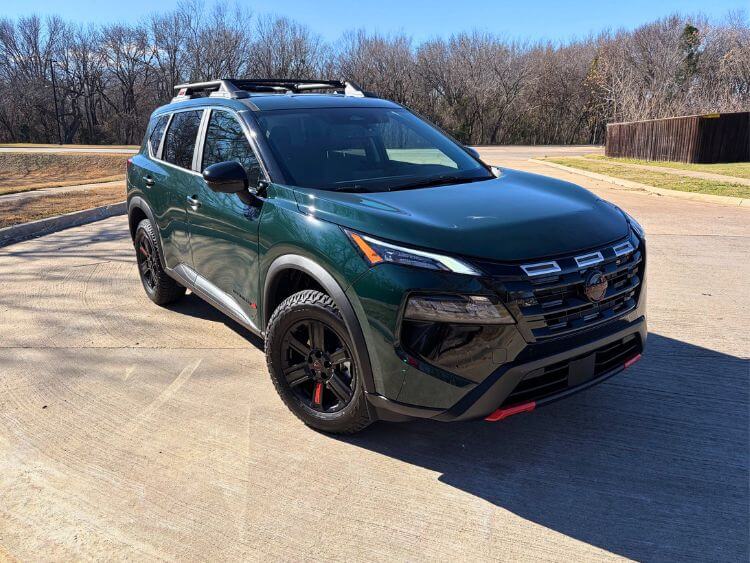
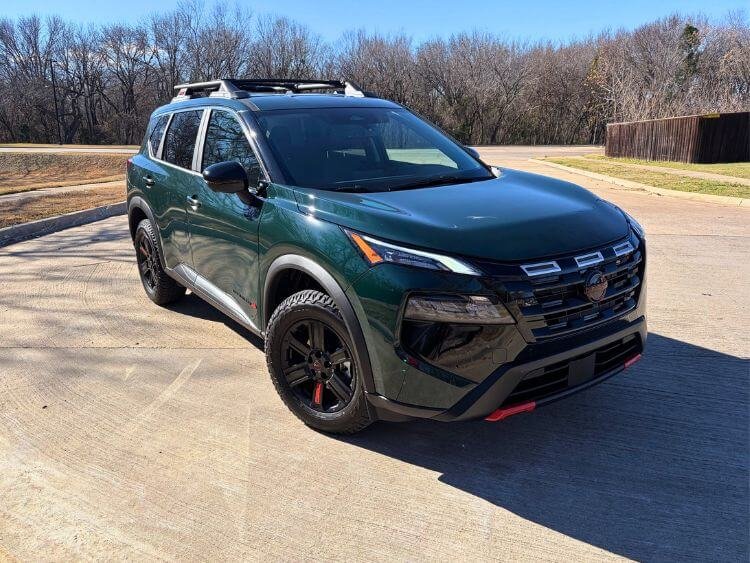
2026 Nissan Rogue Rock Creek exterior three-quarter front in natural light
⚡ Quick Verdict
: The 2026 Rogue is a compact SUV that gets the fundamentals right. It’s spacious, cleverly packaged, and undercuts the Toyota RAV4 on price. The 1.5-litre VC-Turbo three-cylinder delivers adequate performance, though fuel economy of 32 mpg combined in FWD trim is acceptable rather than standout. The Rock Creek genuinely earns its keep if you regularly tackle gravel roads or snowy driveways. Where it falls short? The CVT surges, the steering wanders on-centre at highway speed, and the ride loses composure over rough surfaces. From $30,180 to $40,380 for the Platinum, it’s a sensible family-friendly package that’s easier to like than to love.
================ BODY ================
## A Familiar Face With Subtle 2026 Updates
✓ The Good
- +Clever interior storage solutions throughout the cabin
- +Comfortable seats with excellent lateral support
- +Standard spare tyre under the cargo floor
- +Rock Creek adds genuine all-terrain capability for weekend adventures
- +Competitive pricing undercuts key rivals by a meaningful margin
✗ The Trade-offs
- −CVT behaviour feels like a CVT, not a convincing automatic
- −Fuel economy trails the RAV4 Hybrid by a wide margin
- −Steering has noticeable on-centre deadness during highway cruising
- −Ride gets unsettled over choppy pavement at speed
📑 In This Review
- A Familiar Face With Subtle 2026 Updates
- Inside the Cabin: Storage Wins, Materials Mostly Hold Up
- On the Road: VC-Turbo Three-Cylinder Delivers Adequate Pace
- Tech and Infotainment: Functional, Not Flashy
- Cargo and Practicality: 31.6 to 74 Cubic Feet
- Rock Creek: What the Adventure Trim Actually Adds
- 2026 Nissan Rogue vs Toyota RAV4: Which Is Better?
- How the Rogue Stacks Up Against the Rest of the Class
- Safety, Warranty and Ownership
- Who Should Buy the 2026 Nissan Rogue
- Verdict: 7.8 / 10 — Solid Without Being Sensational
: The 2026 Rogue is a compact SUV that gets the fundamentals right. It’s spacious, cleverly packaged, and undercuts the Toyota RAV4 on price. The 1.5-litre VC-Turbo three-cylinder delivers adequate performance, though fuel economy of 32 mpg combined in FWD trim is acceptable rather than standout. The Rock Creek genuinely earns its keep if you regularly tackle gravel roads or snowy driveways. Where it falls short? The CVT surges, the steering wanders on-centre at highway speed, and the ride loses composure over rough surfaces. From $30,180 to $40,380 for the Platinum, it’s a sensible family-friendly package that’s easier to like than to love. ================ BODY ================
A Familiar Face With Subtle 2026 Updates
The Rogue’s been a quiet achiever in the compact SUV segment for years, consistently landing near the top of the sales charts without ever generating the kind of buzz that follows the RAV4 or CR-V. For 2026, Nissan’s opted for evolution over revolution. Same platform, same 1.5-litre VC-Turbo three-cylinder, same five-trim lineup running from $30,180 for the base S to $40,380 for the fully loaded Platinum.
The main novelty this year is the new Dark Armor trim, slotted between the SV and the Rock Creek. It brings darkened exterior accents and a handful of features aimed at buyers who want a tougher look without the adventure hardware of the Rock Creek. Everything else, S, SV, Rock Creek, SL, and Platinum, returns with minor equipment shuffles.
We focused most of our testing on the Rock Creek, which at $35,080 with standard AWD sits right in the thick of the Rogue’s pricing range. This is where the compact SUV market gets cutthroat. The RAV4, CR-V, Mazda CX-5, Hyundai Tucson, Kia Sportage, and Subaru Forester all crowd the $29,000 to $41,000 corridor, each with its own distinct personality. The Rogue’s job has always been to carve out space that feels differentiated rather than merely competent, and for 2026 the pitch hasn’t changed much: give families a polished, practical package at a price that leaves room in the budget.
Inside the Cabin: Storage Wins, Materials Mostly Hold Up
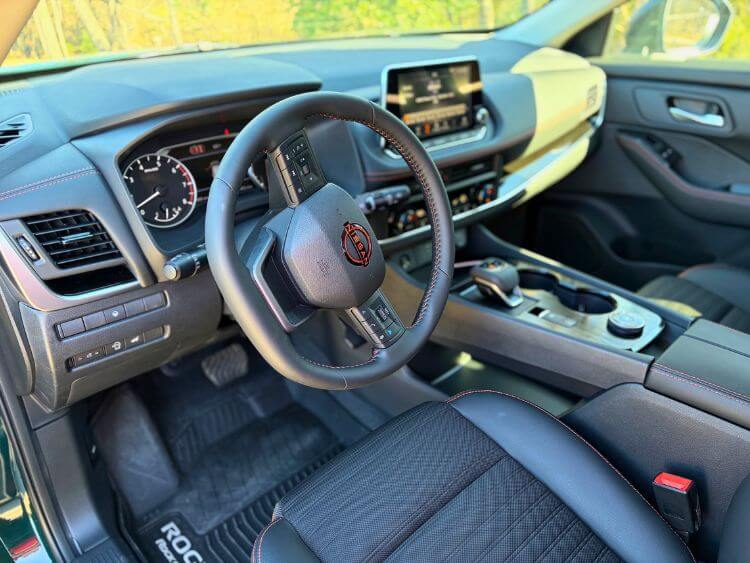
Slide into the Rogue and the first thing you’ll notice is how thoughtfully Nissan has approached everyday storage. The door pockets are split into upper and lower sections, each deep enough to swallow a large water bottle without it rattling around. The centre console uses a split-armrest design with two small doors, so the driver can rest their elbow while the passenger grabs something from the compartment beneath. It’s a small detail, but it makes a genuine difference on a long haul.
Below the console sits an open storage bin handy for tucking away smaller items like a wallet or sunnies. It’s not quite big enough for a handbag, but it keeps clutter out of sight. The main console bin is deep, and next to it you’ll find two cupholders, a phone slot with optional wireless charging, and a pair of USB-C ports. Rear passengers get their own USB-C ports on every trim except the base S, plus dedicated air vents, something not every rival offers as standard.
Our Rock Creek test car featured lava-red contrast stitching against piano-black trim and textured brushed-black surfaces on the dash. Credit where it’s due: Nissan’s design team has restrained their use of glossy piano-black plastic. Where it does appear, it’s confined to a relatively small area of the dash. The textured finish elsewhere resists fingerprints and dust far better, a practical touch owners will appreciate after a few months of daily use.
In the back seat, we found generous legroom behind an ideal front seating position, a low and flat centre hump that genuinely works as a third-seat perch, and near-90-degree rear door openings. That last detail makes loading child seats dramatically easier. With three top tethers and lower anchors in all three rear positions, the Rogue handles family duties without complaint. During our testing, a rear-facing child seat fit without requiring the front seat to be pushed uncomfortably forward.
On the Road: VC-Turbo Three-Cylinder Delivers Adequate Pace
Under the bonnet, every 2026 Rogue packs the same 1.5-litre VC-Turbo inline-three: a variable-compression turbocharged engine producing 201 hp and 225 lb-ft of torque. It pairs with a continuously variable transmission, and in FWD configuration returns an EPA-rated 32 mpg combined. Our all-wheel-drive Rock Creek test car, burdened with chunkier all-terrain tyres and a modest suspension lift, manages an estimated 27 mpg city and 32 mpg highway.
The three-cylinder character is impossible to ignore. There’s a distinctive, guttural rumble at idle and under acceleration that’ll sound coarse to anyone stepping out of a four-cylinder engine. We found it oddly charming, the sort of mechanical personality a turbo three-cylinder naturally delivers. During highway merging, burying the throttle produces a gruff, almost industrial surge of power that gets the job done without much finesse. The 201-hp output is adequate for the class, but the CVT colours the experience more than the engine itself.
The transmission behaves like a CVT because it is one. It surges subtly during part-throttle acceleration, and while some manufacturers programme simulated shift points that convincingly mimic a traditional automatic, the Rogue’s unit doesn’t bother with that pretence. You feel the rubber-band effect, and during a long highway stint we noticed the engine note rising and falling in a way that was occasionally dissonant. It’s the sort of thing owners acclimatise to over time, but you’ll notice it on a test drive.
Where the Rogue impressed us was seat comfort. The front chairs offer excellent lateral support for mountain-road cornering without restricting arm movement, and a pleasant squish factor that moulds to the body on longer drives. Ride compliance is generally good, though over broken pavement at highway speeds the chassis felt a little unsettled, the body moving around more than we’d like. The steering has a balanced ratio for easy manoeuvring, but a persistent deadness on-centre means highway cruising requires more frequent small corrections than it should.
Tech and Infotainment: Functional, Not Flashy
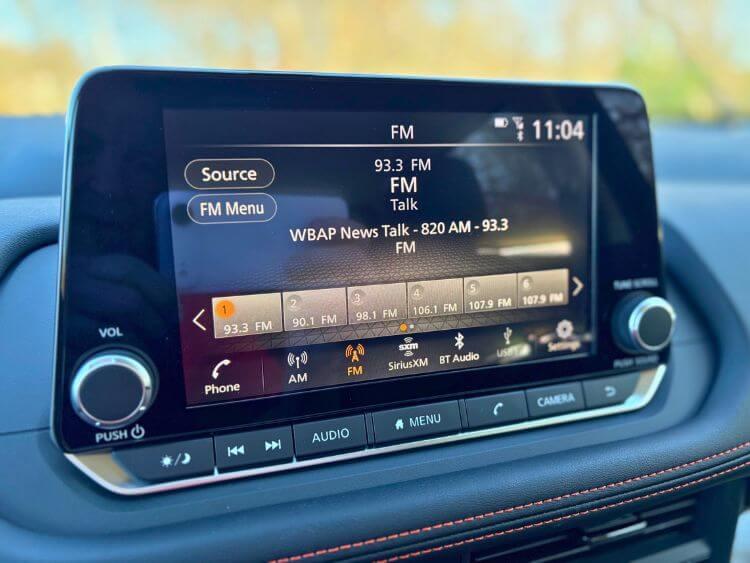
The Rogue’s infotainment follows a two-tier approach. Lower trims, S, SV, Dark Armor, and Rock Creek, get an 8-inch touchscreen with wired Apple CarPlay and Android Auto. The SL and Platinum upgrade to a 12.3-inch dual-screen layout with wireless smartphone connectivity. In our Rock Creek test car, the smaller screen proved perfectly usable. Text is large and legible, the interface responds without frustrating lag, and physical shortcut buttons plus a volume knob mean you’re not entirely at the mercy of touch inputs for basic functions.
Graphically, the system looks a generation behind the best in class. The Honda CR-V’s 9-inch standard screen and the Hyundai Tucson’s wide-format display both feel more contemporary. But usability matters more than aesthetics in a family vehicle, and on that count the Rogue scores well. We had no trouble accessing menus on the move, and wireless CarPlay paired quickly once connected.
The six-speaker audio system in our Rock Creek was a mild disappointment. Treble frequencies sounded harsh to our ears, and we ended up turning the treble down three notches trying to tame some of that sharpness. Stepping up to the SL or Platinum gets you a 10-speaker Bose system that should sort that out.
On the driver-assistance front, ProPILOT Assist, Nissan’s adaptive cruise control with lane-centring, is standard on the SV trim and above. It worked competently during our highway driving, keeping speed and the Rogue centred in its lane without drama. The Platinum adds ProPILOT Assist 2.1, a hands-off highway driving system for compatible roads, plus a 10.8-inch head-up display. The 360-degree Around View Monitor, standard on Rock Creek and above, proved invaluable during tight parking manoeuvres.
Cargo and Practicality: 31.6 to 74 Cubic Feet
Behind the rear seats, the Rogue offers 31.6 cubic feet of cargo space, a mid-pack figure for the segment. Fold the rear seats and that climbs to approximately 74 cubic feet on Platinum trims equipped with the Divide-N-Hide adjustable cargo floor. That system lets you lower the floor for extra depth or raise it to create a hidden storage compartment beneath. It’s exclusive to the Platinum and can’t be optioned on other trims.
What the numbers don’t capture are the small, thoughtful details. The cargo area’s side panels feature recessed jug holders: shallow cradles designed to keep a gallon of milk or a jug of washer fluid from rolling around in transit. It’s a minor touch that speaks to Nissan’s understanding of how people actually use their vehicles.
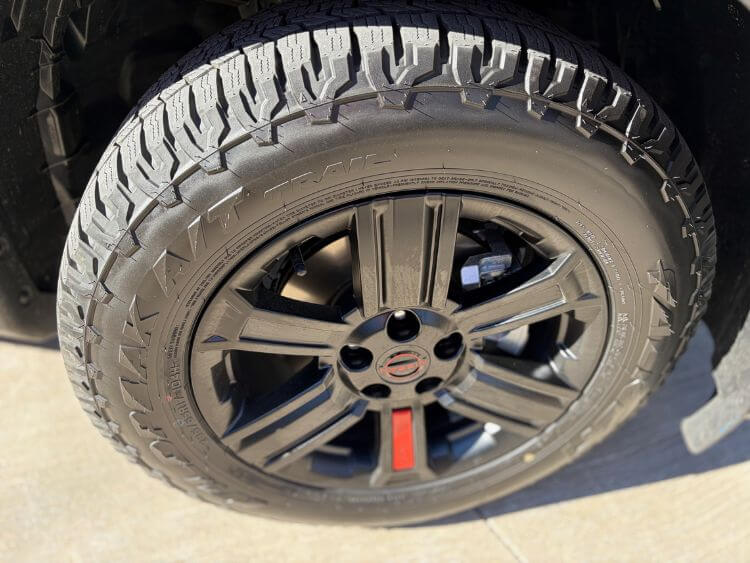
Beneath the cargo floor lives a full-size spare tyre. In a segment where many competitors have switched to tyre-inflation kits or temporary spares, this is a genuine differentiator. We’re always relieved to find a real spare under the floor, and buyers who venture beyond the city limits will share that feeling.
We did run into one quirk during testing: the power liftgate on our Rock Creek has a foot-activated opening function, and on more than one occasion we accidentally triggered it while walking past the back of the vehicle. It’s a genuinely useful feature when your hands are full of groceries, but it takes some getting used to before you stop setting it off unintentionally.
Rock Creek: What the Adventure Trim Actually Adds
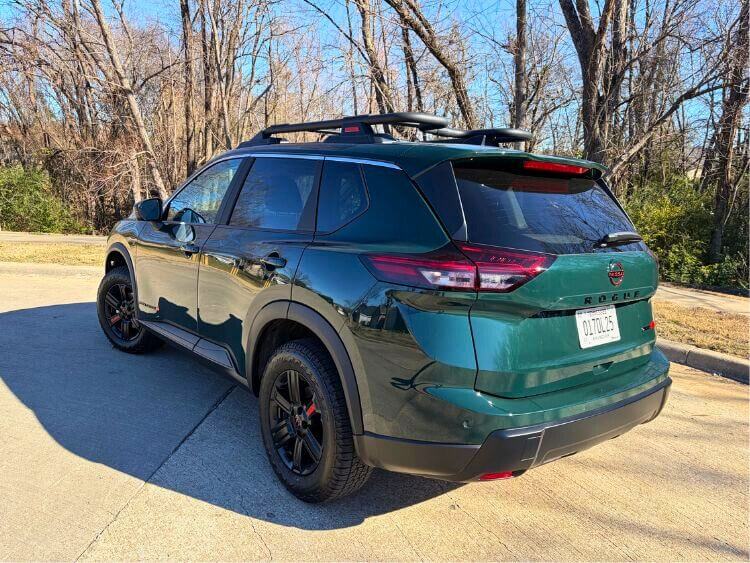
The Rock Creek isn’t trying to be a Wrangler, and we appreciate that honesty. What it offers is a modest, practical uplift in capability for buyers who regularly deal with unsealed roads, gravel driveways, or snowy mountain passes. The formula is straightforward: a half-inch suspension lift, all-terrain General Grabber tyres in a 235/60R18 size, standard intelligent AWD, a tubular roof rack, body-cladding accents, and water-repellent leatherette upholstery with ballistic nylon inserts and lava-red stitching.
During our testing, the Rock Creek proved its worth in a very specific scenario. Returning from a holiday trip, we hit a major highway traffic jam. The all-terrain tyres gave us the confidence to detour onto an unexplored dirt trail, something we’d have been reluctant to attempt on standard all-season rubber. That’s the ideal use case for the Rock Creek: not rock crawling or trail-rated adventures, but the everyday reality of unsealed roads, construction detours, and winter conditions where a little extra grip translates directly into peace of mind.
The tubular roof rack adds visual ruggedness and genuine utility for mounting a cargo box or a couple of kayaks. Inside, the leatherette-and-nylon upholstery wipes clean easily and feels appropriately durable for a vehicle that might see muddy boots and sandy gear. Fuel economy takes a small hit, expect around 31 mpg combined versus 32 for the FWD Rogue, but the sacrifice is modest given the added capability.
2026 Nissan Rogue vs Toyota RAV4: Which Is Better?
This is the question every compact SUV shopper asks, and for good reason. The Rogue and RAV4 target nearly identical buyers: families who want a practical, efficient, and well-equipped five-seat crossover. Their pricing bands overlap almost exactly. For 2026, Toyota has made the RAV4 hybrid-only, a bold move that changes the competitive calculus significantly.
Pricing favours the Rogue at the entry point. The base Rogue S starts at $30,180, while the least expensive RAV4 opens at around $31,900. That roughly $1,800 gap holds through the trim walk: compare our recommended Rogue SV at $31,180 against the RAV4 LE Hybrid, and the Rogue is consistently cheaper for a comparable level of equipment. For buyers who prioritise a lower monthly payment, that matters.
The powertrain comparison tells a different story. The Rogue’s 1.5-litre VC-Turbo three-cylinder produces 201 hp and 225 lb-ft of torque, paired with a CVT. The RAV4 Hybrid combines a 2.5-litre four-cylinder with electric motors for a combined 226 hp in FWD or 236 hp in AWD configuration. The Toyota is both more powerful and dramatically more efficient: 39 mpg combined for the RAV4 Hybrid versus 32 mpg combined for the Rogue FWD (or 31 mpg for AWD). Over a five-year ownership period, the fuel savings from the RAV4 Hybrid can easily offset the higher purchase price.
Inside, the Rogue counters with slightly more overall passenger volume and notably more rear-seat legroom. The RAV4, however, offers more rear headroom and significantly more maximum cargo space. Both vehicles offer modern infotainment with wireless CarPlay and Android Auto on upper trims, though the Rogue’s lower trims still use wired connectivity while the RAV4 includes a 9-inch touchscreen across the range.
On the road, the RAV4 Hybrid feels more planted and confident, with a powertrain that is both smoother and quieter than the Rogue’s three-cylinder CVT combination. The Rogue, however, has the more comfortable front seats for long-distance driving. As for resale value, Toyota’s traditionally stronger residual values mean the RAV4 typically holds its worth better over time, further narrowing the Rogue’s upfront price advantage.
Warranty coverage is essentially a wash. Both offer three years and 36,000 miles of bumper-to-bumper protection, and both extend to five years and 60,000 miles on the powertrain. Nissan sweetens the deal with two years of complimentary maintenance: Toyota doesn’t match that.
<table style="width:100%; border-collapse:collapse; margin:24px 0; font-size:14px"> <thead> <tr style="background:#1e293b; color:#fff"> <th style="padding:10px 12px; text-align:left">Specification</th> <th style="padding:10px 12px; text-align:center">2026 Nissan Rogue</th> <th style="padding:10px 12px; text-align:center">2026 Toyota RAV4 Hybrid</th> </tr> </thead> <tbody> <tr style="background:#f8fafc"><td style="padding:8px 12px">Starting Price</td><td style="padding:8px 12px; text-align:center">$30,180</td><td style="padding:8px 12px; text-align:center">$31,900</td></tr> <tr style="background:#fff"><td style="padding:8px 12px">Power</td><td style="padding:8px 12px; text-align:center">201 hp</td><td style="padding:8px 12px; text-align:center">226 hp (FWD)</td></tr> <tr style="background:#f8fafc"><td style="padding:8px 12px">Torque</td><td style="padding:8px 12px; text-align:center">225 lb-ft</td><td style="padding:8px 12px; text-align:center">163 lb-ft (engine only)</td></tr> <tr style="background:#fff"><td style="padding:8px 12px">Drivetrain</td><td style="padding:8px 12px; text-align:center">FWD / AWD opt.</td><td style="padding:8px 12px; text-align:center">FWD / AWD opt.</td></tr> <tr style="background:#f8fafc"><td style="padding:8px 12px">Fuel Economy Combined</td><td style="padding:8px 12px; text-align:center">32 mpg (FWD)</td><td style="padding:8px 12px; text-align:center">39 mpg (FWD)</td></tr> <tr style="background:#fff"><td style="padding:8px 12px">Cargo Behind Rear Seats</td><td style="padding:8px 12px; text-align:center">31.6 cu ft</td><td style="padding:8px 12px; text-align:center">37.6 cu ft</td></tr> <tr style="background:#f8fafc"><td style="padding:8px 12px">Standard Touchscreen</td><td style="padding:8px 12px; text-align:center">8-inch</td><td style="padding:8px 12px; text-align:center">9-inch</td></tr> <tr style="background:#fff"><td style="padding:8px 12px">Standard ADAS</td><td style="padding:8px 12px; text-align:center">Safety Shield 360</td><td style="padding:8px 12px; text-align:center">Toyota Safety Sense 3.0</td></tr> <tr style="background:#f8fafc"><td style="padding:8px 12px">Warranty (Bumper-to-Bumper)</td><td style="padding:8px 12px; text-align:center">3 yr / 36,000 mi</td><td style="padding:8px 12px; text-align:center">3 yr / 36,000 mi</td></tr> </tbody> </table>
<div style="background:linear-gradient(135deg,#f0f9ff,#e0f2fe); border-left:4px solid #2563eb; border-radius:12px; padding:24px 28px; margin:32px 0"><p style="font-size:12px; font-weight:800; letter-spacing:0.14em; text-transform:uppercase; color:#1e40af; margin:0 0 10px">Which one is better?</p><p><strong>Buy the 2026 Nissan Rogue if</strong> you want a polished, family-friendly cabin with clever storage, a straightforward petrol drivetrain that doesn’t lecture you about plug-in cables, and a lower entry price.</p><p><strong>Buy the 2026 Toyota RAV4 if</strong> you value strong hybrid fuel economy, traditionally bulletproof resale, and a punchier hybrid powertrain. Just be prepared to accept a busier interior and a pricier sticker.</p><p><strong>Our pick</strong> is the RAV4 for outright value over a 5-year hold, but the Rogue Rock Creek genuinely earns its place for buyers who tackle unsealed weekend driving and want a calmer cabin.</p></div>
How the Rogue Stacks Up Against the Rest of the Class
The compact SUV segment is the most hotly contested battlefield in the industry, and the Rogue faces no fewer than six or seven strong rivals depending on how you count. Beyond the RAV4, the Honda CR-V, Mazda CX-5, and Hyundai Tucson are the names that come up most often when buyers start cross-shopping.
The Honda CR-V, starting at $30,920, pairs a 190-hp turbocharged engine with 30 mpg combined fuel economy and the segment’s best cargo volume. Its handling is also sharper than the Rogue’s, and a 9-inch touchscreen is standard across the range. For buyers who value driving engagement, the CR-V is the class benchmark. The Rogue counters with a more comfortable ride and a lower base price, but the Honda’s refinement and practicality make it a formidable competitor.
The Mazda CX-5 enters 2026 as an all-new generation starting at $29,990. Its 187-hp naturally aspirated engine is less powerful than the Rogue’s turbo, and fuel economy of 28 mpg combined trails the Nissan’s 32 mpg. What the Mazda brings is a cabin that feels a full class above, premium materials, tight panel gaps, and a sense of occasion the Rogue can’t match. If interior ambience is your priority, the CX-5 is the one to test-drive.
The Hyundai Tucson, at $29,450, offers the segment’s boldest design and an industry-leading 10-year/100,000-mile powertrain warranty. Its 187-hp engine returns 28 mpg combined, and cargo space of 38.7 cubic feet is among the best in class. The Rogue has a quieter cabin and better front-seat comfort, but the Tucson’s warranty coverage and striking styling give it a distinct appeal for buyers who want something that stands out.
<table style="width:100%; border-collapse:collapse; margin:24px 0; font-size:13px"> <thead> <tr style="background:#1e293b; color:#fff"> <th style="padding:10px 10px; text-align:left">Vehicle</th> <th style="padding:10px 10px; text-align:center">Starting Price</th> <th style="padding:10px 10px; text-align:center">Power</th> <th style="padding:10px 10px; text-align:center">Combined MPG</th> <th style="padding:10px 10px; text-align:center">Cargo (cu ft)</th> <th style="padding:10px 10px; text-align:left">Standout</th> </tr> </thead> <tbody> <tr style="background:#f8fafc"><td style="padding:8px 10px">2026 Nissan Rogue Rock Creek</td><td style="padding:8px 10px; text-align:center">$35,080</td><td style="padding:8px 10px; text-align:center">201 hp</td><td style="padding:8px 10px; text-align:center">31</td><td style="padding:8px 10px; text-align:center">31.6</td><td style="padding:8px 10px">Adventure-ready trim with AWD</td></tr> <tr style="background:#fff"><td style="padding:8px 10px">2026 Toyota RAV4 Hybrid</td><td style="padding:8px 10px; text-align:center">$34,000</td><td style="padding:8px 10px; text-align:center">226 hp</td><td style="padding:8px 10px; text-align:center">39</td><td style="padding:8px 10px; text-align:center">37.6</td><td style="padding:8px 10px">Hybrid economy leader</td></tr> <tr style="background:#f8fafc"><td style="padding:8px 10px">2026 Honda CR-V</td><td style="padding:8px 10px; text-align:center">$30,920</td><td style="padding:8px 10px; text-align:center">190 hp</td><td style="padding:8px 10px; text-align:center">30</td><td style="padding:8px 10px; text-align:center">39.3</td><td style="padding:8px 10px">Best cargo, sharpest handling</td></tr> <tr style="background:#fff"><td style="padding:8px 10px">2026 Mazda CX-5</td><td style="padding:8px 10px; text-align:center">$29,990</td><td style="padding:8px 10px; text-align:center">187 hp</td><td style="padding:8px 10px; text-align:center">28</td><td style="padding:8px 10px; text-align:center">30.8</td><td style="padding:8px 10px">Most premium interior feel</td></tr> <tr style="background:#f8fafc"><td style="padding:8px 10px">2026 Hyundai Tucson</td><td style="padding:8px 10px; text-align:center">$29,450</td><td style="padding:8px 10px; text-align:center">187 hp</td><td style="padding:8px 10px; text-align:center">28</td><td style="padding:8px 10px; text-align:center">38.7</td><td style="padding:8px 10px">Boldest design + 10/100k warranty</td></tr> </tbody> </table>
Safety, Warranty and Ownership
The 2026 Rogue earns an IIHS Top Safety Pick rating for 2025 and a five-star overall score from NHTSA. Safety Shield 360, Nissan’s suite of active safety technologies, is standard across the range. It includes automatic emergency braking with pedestrian detection, blind-spot monitoring, rear cross-traffic alert, lane departure warning, and high-beam assist. Lane-keeping assist, which actively steers the vehicle back into its lane, is added from the SV trim up.
ProPILOT Assist, Nissan’s adaptive cruise control with lane-centring, is standard on SV and above. The Platinum’s ProPILOT Assist 2.1 system enables hands-off highway driving on compatible roads: a feature that positions the Rogue ahead of several rivals that still require hands on the wheel at all times.
Warranty coverage matches the segment standard: three years or 36,000 miles of bumper-to-bumper protection and five years or 60,000 miles on the powertrain. Nissan sweetens the deal with two years or 24,000 miles of complimentary scheduled maintenance, a perk Toyota and Honda don’t match at this price point. Eight airbags are standard, with a ninth centre airbag between the front seats available on the Platinum.
Nissan’s reliability track record has been trending upward in recent years, and the company’s extensive dealer network across North America means service access is rarely a concern. The Rogue may not carry Toyota’s bulletproof reputation, but it’s a known quantity with a solid ownership history.
Who Should Buy the 2026 Nissan Rogue
The Rogue makes the most sense for families who want a quiet, well-packaged compact SUV under $40,000 without the complexity of hybrid or plug-in powertrain technology. The petrol-only VC-Turbo engine is straightforward: no batteries to degrade, no charging infrastructure to worry about. Just fill the tank and drive. For buyers who don’t cover massive annual mileage, the fuel economy gap versus a hybrid may never offset the hybrid’s higher purchase price.
The Rock Creek trim specifically appeals to buyers who encounter light unsealed driving: gravel roads to a weekend cabin, snowy mountain passes, unpaved parking lots at trailheads, without wanting or needing the compromises of a true off-road vehicle. Its all-terrain tyres, modest lift, and standard AWD provide genuine incremental capability in a package that still rides comfortably on the highway and parks easily in a suburban garage.
Commuters who spend significant time on the motorway should look at the Platinum trim, which adds ProPILOT 2.1 hands-off driving, a head-up display, and the Bose audio system. The combination of reduced driver fatigue and better audio quality makes the premium worthwhile for high-mileage drivers.
Verdict: 7.8 / 10 — Solid Without Being Sensational
The 2026 Rogue is a competent, well-thought-out compact SUV that does most things well and nothing poorly. Its interior packaging is genuinely clever, its seats are among the most comfortable in the segment, and its pricing gives it a meaningful advantage over the RAV4 at the point of purchase. The Rock Creek adds real-world capability for buyers who need it, and the Platinum’s ProPILOT 2.1 system is a genuine differentiator for highway commuters.
Where the Rogue falls short is in the details that separate good from great. The CVT’s surging behaviour, the steering’s on-centre deadness, and the ride’s occasional composure loss over rough pavement aren’t dealbreakers, but they’re reminders that the Rogue hasn’t fully closed the refinement gap with the segment’s best. And for buyers who prioritise fuel economy above all else, the RAV4 Hybrid’s 39 mpg combined rating makes a compelling financial case that the Rogue’s lower sticker price alone can’t counter.
At its price sweet spot, the SV at $31,180 or the Rock Creek at $35,080, the Rogue earns its place in the conversation. It’s a solid, sensible choice that rewards buyers who value clever packaging and a calm, comfortable cabin. It’s just not the kind of vehicle that makes you look forward to the drive itself.
================ AFTER THE BODY ================
BUY_IF: – You want a calm, family-friendly cabin with clever storage tricks – You’d rather skip hybrid complexity for a familiar petrol turbo – You do light unsealed driving and the Rock Creek trim appeals
SKIP_IF: – You want best-in-class fuel economy — the RAV4 Hybrid wins – You want sharp handling — the Honda CR-V or Mazda CX-5 are sharper – You want a premium-feeling interior — the CX-5 outclasses it
FAQ: Q: How much is the 2026 Nissan Rogue? A: The 2026 Rogue starts at $30,180 for the base S trim in FWD configuration and climbs to $40,380 for the fully loaded Platinum with standard AWD. The popular SV sits at $31,180, and the adventure-oriented Rock Creek with AWD lists for $35,080.
Q: Is the 2026 Nissan Rogue a hybrid? A: In the United States, the 2026 Rogue is petrol-only, powered by a 1.5-litre VC-Turbo three-cylinder engine with a CVT. A 2.4-litre plug-in hybrid version is available in Canada with 38 miles of electric range, but it’s a separate model not currently offered in the U.S. market.
Q: Is the Rogue Rock Creek good off-road? A: The Rock Creek isn’t a serious off-roader, but it’s genuinely capable for light unsealed duties. Its all-terrain General Grabber tyres, modest half-inch suspension lift, and standard AWD provide added confidence on gravel roads, snowy passes, and unpaved trails. Think weekend cabin access, not rock crawling.
Q: What’s the difference between the 2026 Rogue and the 2025 Rogue? A: The 2026 Rogue adds a new Dark Armor trim with darkened exterior accents and a handful of feature additions. Otherwise, the powertrain, interior, and overall packaging carry over largely unchanged from 2025. It’s a minor model-year update rather than a significant refresh.
Q: Is the Nissan Rogue or Toyota RAV4 better? A: The RAV4 wins on fuel economy with 39 mpg combined from its hybrid powertrain versus 32 mpg for the Rogue, and it traditionally holds stronger resale value. The Rogue counters with a lower entry price, more rear-seat legroom, cleverer interior storage, and the adventure-ready Rock Creek trim. For total ownership cost, the RAV4 edges ahead; for upfront value, the Rogue has the advantage.
Q: How reliable is the Nissan Rogue? A: The Rogue has a solid reliability track record with im proving scores in recent years. Nissan backs it with a three-year/36,000-mile bumper-to-bumper warranty and two years of complimentary maintenance. It doesn’t carry Toyota’s legendary reliability reputation, but it’s a dependable choice with an extensive dealer network for service access.
Q: What’s the cargo capacity of the 2026 Nissan Rogue? A: The 2026 Rogue offers 31.6 cubic feet of cargo space behind the rear seats. Fold the rear seats down and capacity expands to approximately 74 cubic feet on Platinum trims with the Divide-N-Hide adjustable cargo floor. A full-size spare tyre sits under the floor, which is uncommon in the compact SUV segment.
