

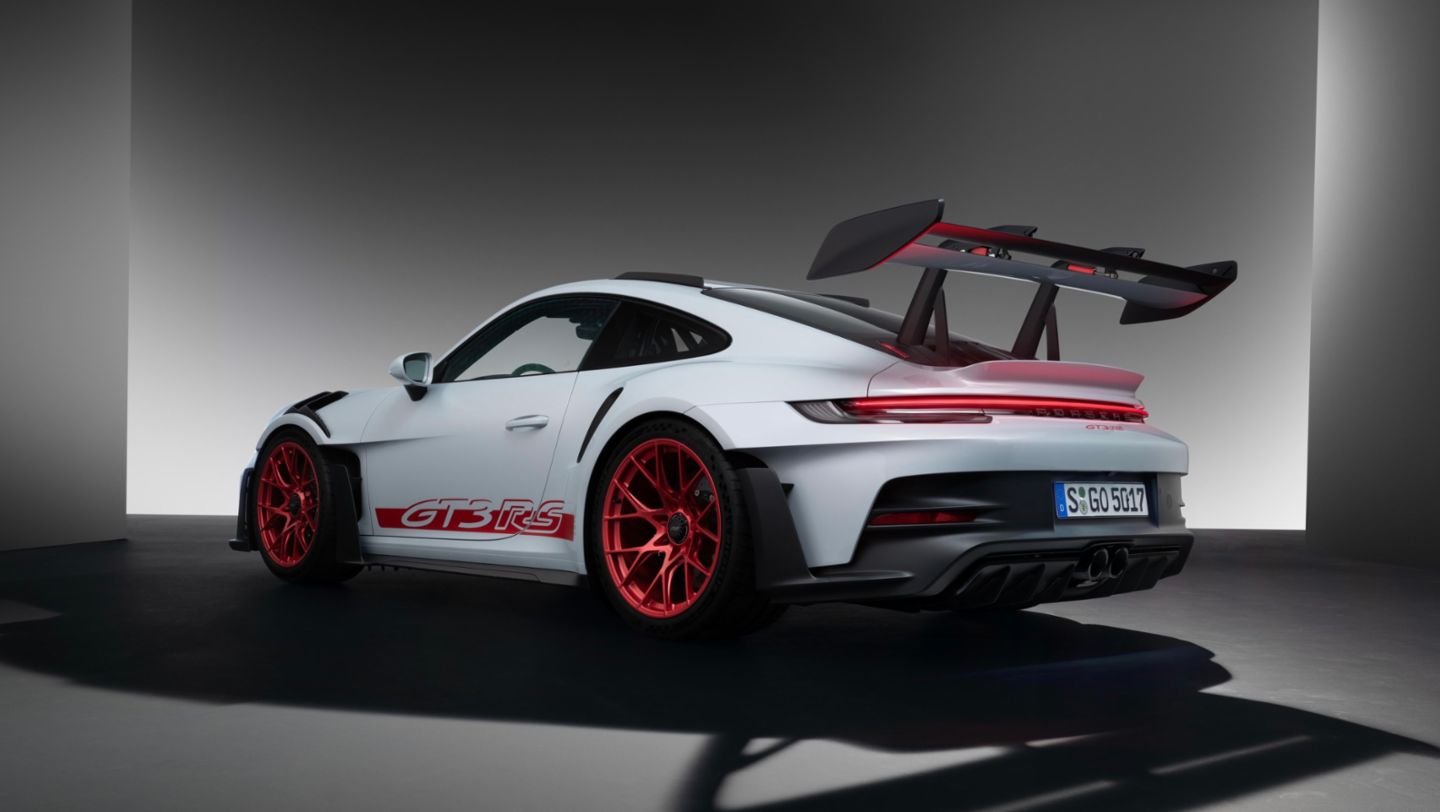
2026 Porsche 911 GT3 RS Review — The Nürburgring Benchmark
A track weapon you can drive home
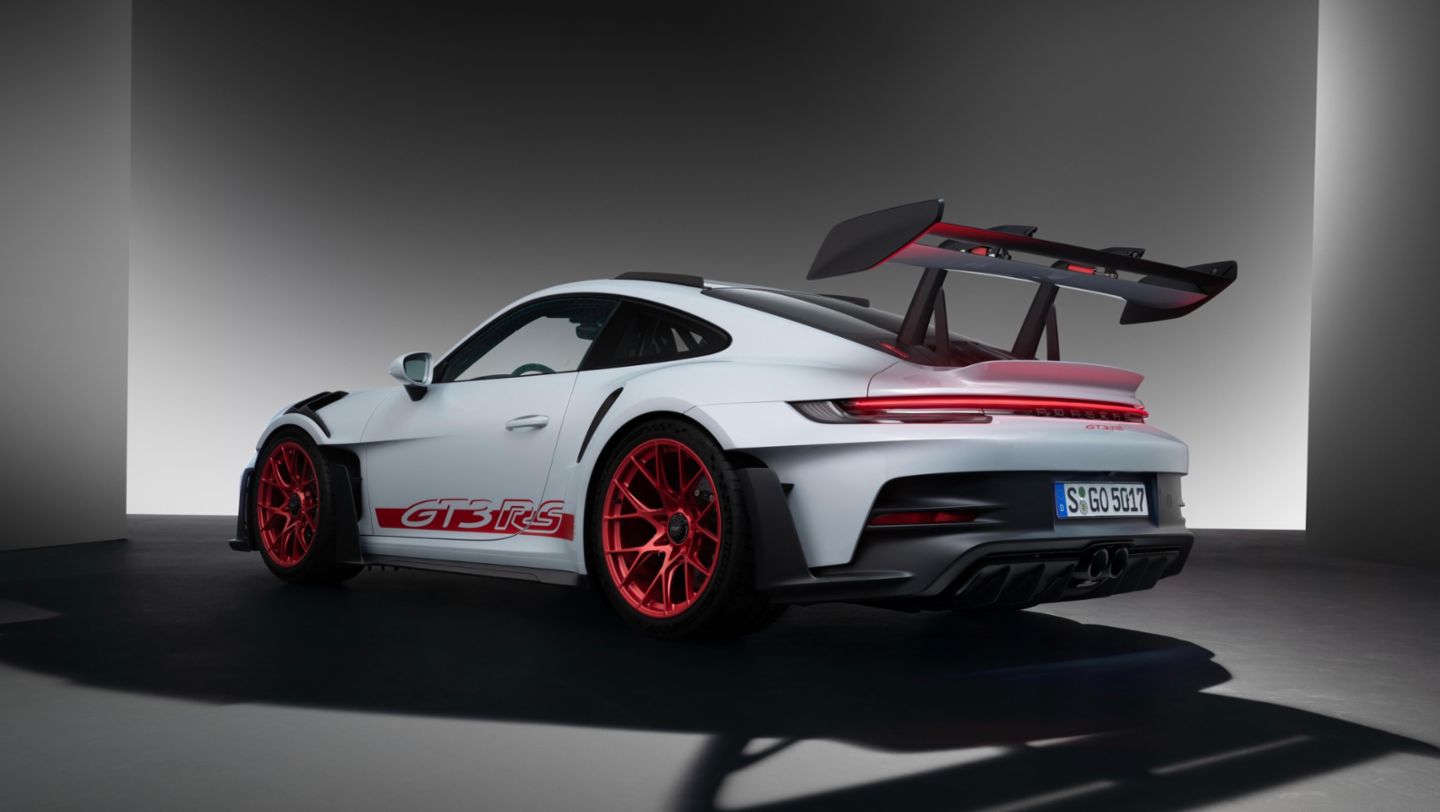
2026 Porsche 911 GT3 RS rear three-quarter studio shot
Price
US$241,300
0-100 km/h
3.2 s
Power
518 hp (525 PS)
⚡ Quick Verdict
Porsche has built the most extreme naturally aspirated 911 we’ve ever driven. The 2026 GT3 RS pairs 518 hp from a 9,000-rpm flat-six with 860 kg of active aero downforce, including a world-first production DRS system. It set a 6:44.848 Nürburgring lap and kicks off from US$241,300. On circuit it’s devastatingly effective — raw, mechanical, and ruthlessly fast. At town speeds, it’s more liveable than its wild aero hardware suggests. Nothing else on sale blends track precision and road compliance quite like it.
## At a Glance: 2026 Porsche 911 GT3 RS Specs
✓ The Good
- +Best-in-class steering feel and precision of any modern sports car
- +860 kg of downforce at 285 km/h from world-first production DRS system
- +4.0L flat-six revs to 9,000 rpm with intoxicating naturally aspirated wail
- +Surprisingly compliant at low speed despite extreme aero hardware
- +6:44.848 Nürburgring lap cements it as the NA benchmark
- +Rear-drive only layout rewards skilled drivers with unmatched engagement
✗ The Trade-offs
- −Cabin drone above 100 mph is genuinely deafening on long highway stints
- −Seven-speed PDK missing an eighth gear hurts highway refinement
- −No way to fully close exhaust valves for quieter cruising
- −Pricing climbs rapidly with Weissach Package and individual options
- −Two-seat only with zero frunk storage limits everyday utility
📑 In This Review
- At a Glance: 2026 Porsche 911 GT3 RS Specs
- Design and Active Aerodynamics
- Engine, Performance and Drive
- Interior, Tech and Day-to-Day Usability
- 2026 Porsche 911 GT3 RS vs Ferrari 296 GTB: Which Is Better?
- Safety and Warranty
- Running Costs, Fuel and Servicing
- Who Should Buy the 2026 Porsche 911 GT3 RS
- Buy if:
- Skip if:
- Verdict
- Frequently Asked Questions
Porsche has built the most extreme naturally aspirated 911 we’ve ever driven. The 2026 GT3 RS pairs 518 hp from a 9,000-rpm flat-six with 860 kg of active aero downforce, including a world-first production DRS system. It set a 6:44.848 Nürburgring lap and kicks off from US$241,300. On circuit it’s devastatingly effective — raw, mechanical, and ruthlessly fast. At town speeds, it’s more liveable than its wild aero hardware suggests. Nothing else on sale blends track precision and road compliance quite like it.
At a Glance: 2026 Porsche 911 GT3 RS Specs
| Specification | Porsche 911 GT3 RS | Ferrari 296 GTB | McLaren 750S | Lamborghini Huracán STO |
|---|---|---|---|---|
| Price (from) | US$241,300 | US$329,000 | US$330,000 | US$327,000 |
| Engine | 4.0L NA flat-six | 3.0L TT V6 + hybrid | 4.0L TT V8 | 5.2L NA V10 |
| Power | 518 hp (525 PS) | 819 hp combined | 740 hp | 631 hp |
| 0-100 km/h | 3.2 s | 2.9 s | 2.8 s | 3.0 s |
| Top Speed | 296 km/h | 330 km/h | 332 km/h | 310 km/h |
| Weight (DIN) | 1,450 kg | 1,470 kg | 1,389 kg | 1,339 kg |
| Downforce | 860 kg @ 285 km/h | Not published | ~210 kg @ 240 km/h | ~420 kg @ 280 km/h |
| Transmission | 7-speed PDK | 8-speed DCT | 7-speed SSG | 7-speed ISR |
| Drive | Rear-wheel | Rear-wheel | Rear-wheel | Rear-wheel |
Ferrari 296 GTB
Plug-in hybrid V6 — quicker in a straight line, heavier and less raw than the Porsche.
McLaren 750S
Lightest of the group with a carbon tub — turbo response not as linear as Porsche’s NA flat-six.
Lamborghini Huracán STO
Atmospheric V10 spiritually close — loses on downforce and active aero.
The GT3 RS sits in a narrow band of the sports-car world — a road-registered machine designed from the ground up to be a circuit tool. Its nearest rivals each take a different philosophical route to the same destination. Ferrari pairs hybrid punch with Italian theatre, McLaren leans on carbon-tub weight savings, and Lamborghini sticks a screaming naturally aspirated V10 behind the cabin. Here’s how the numbers compare. Porsche 911 GT3 RS McLaren 750S —— US$241,300 US$330,000 4.0L NA flat-six 4.0L TT V8 518 hp (525 PS) 740 hp 3.2 s 2.8 s 296 km/h 332 km/h 1,450 kg 1,389 kg 860 kg @ 285 km/h ~210 kg @ 240 km/h 7-speed PDK 7-speed SSG Rear-wheel Rear-wheel
Design and Active Aerodynamics
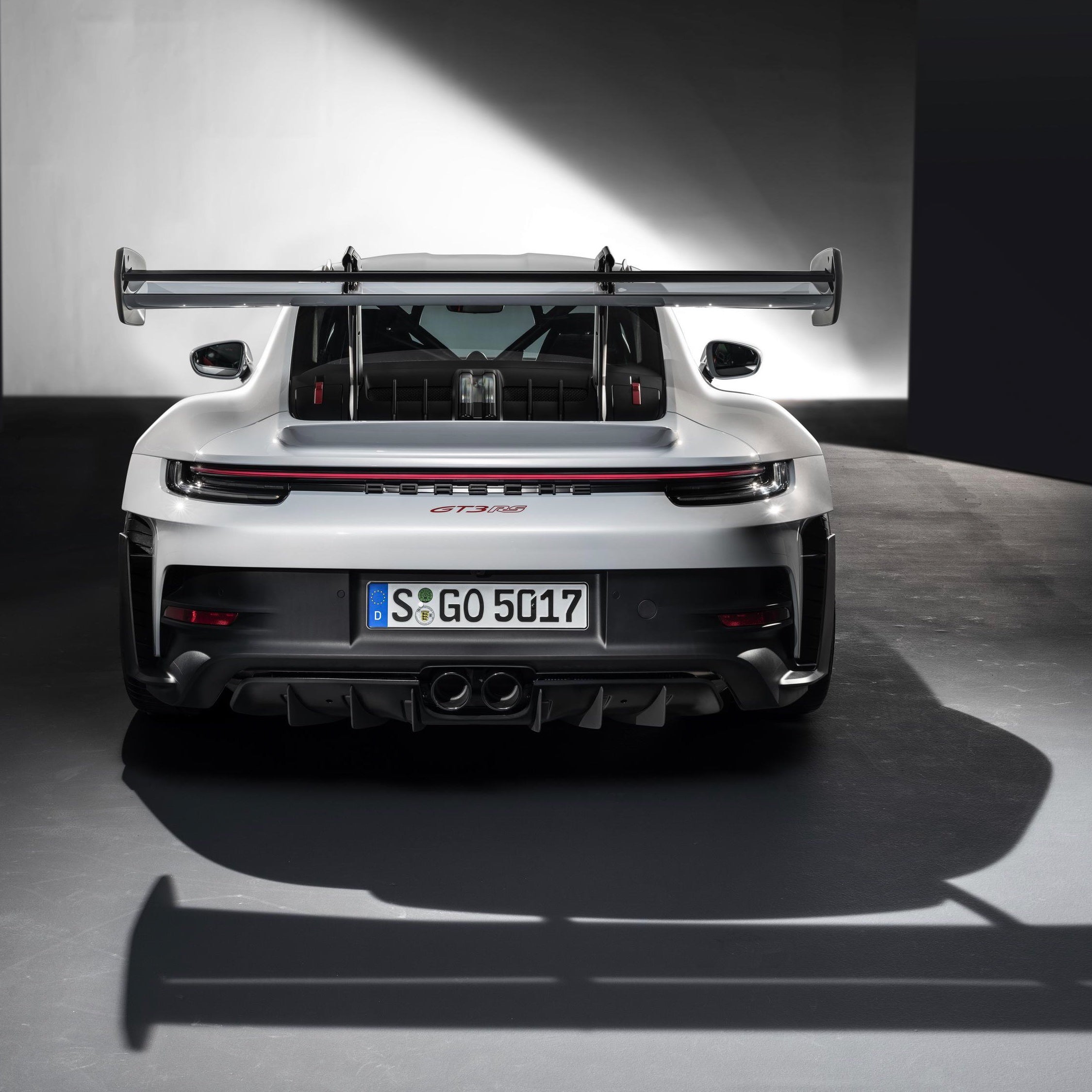
The 2026 GT3 RS doesn’t look like a sports car. It looks like a DTM racer that took a wrong turn onto a public road. Every surface was shaped in the wind tunnel before anyone worried about aesthetics. The bulging front fenders, the deep side blades funnelling air rearward, and that massive swan-neck rear wing — wider than the roofline — all exist for one reason: generating downforce. At 285 km/h, the car produces 860 kg of aerodynamic load. The outgoing 991.2 GT3 RS managed less than half that figure. It’s a generational leap, not an incremental update.
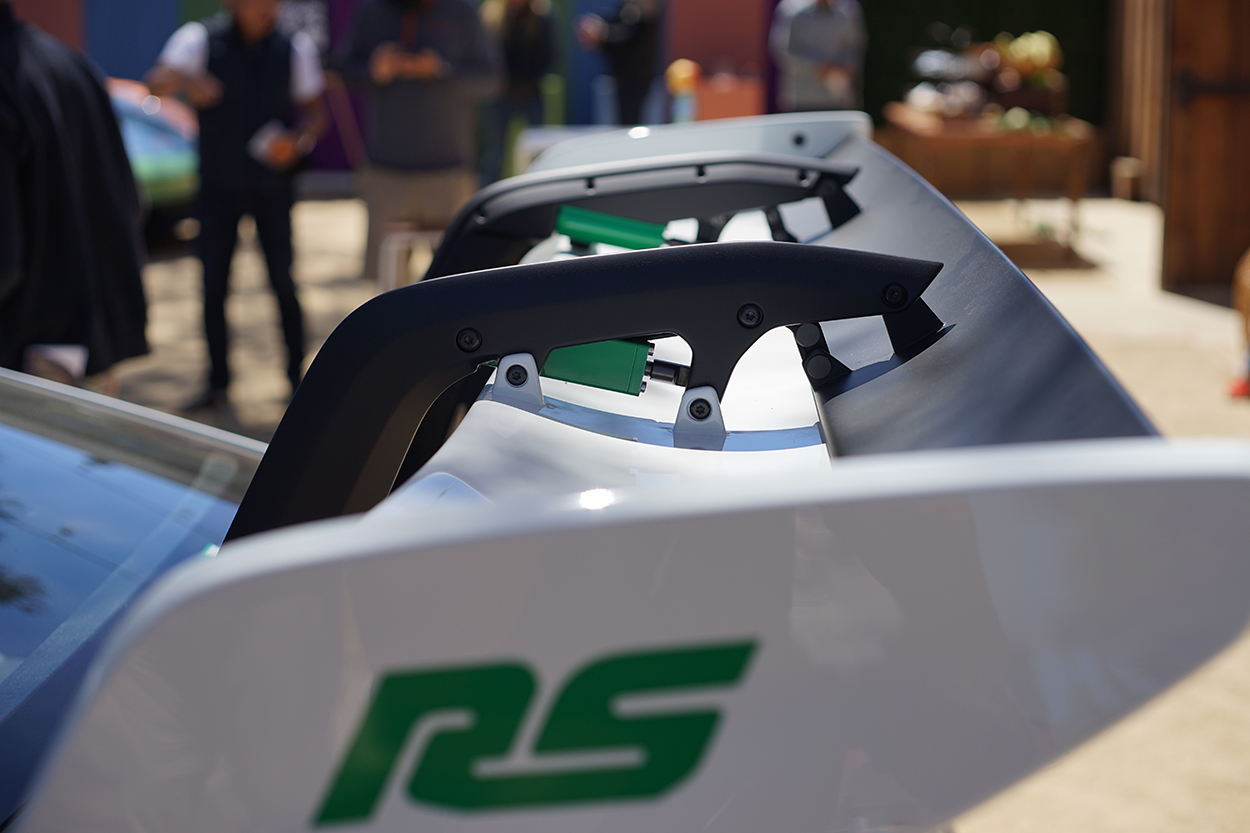
The centrepiece is that rear wing. Mounted on inverted aluminium swan-neck struts in proper motorsport fashion, it houses the world’s first production-car DRS (Drag Reduction System) hydraulic mechanism. In Performance mode, the wing sits at its maximum angle of attack, pinning the rear axle to the tarmac with all 860 kg available at top speed. Hit the DRS button on the steering wheel — or let the car decide in Auto mode — and a hydraulic actuator flattens the wing in an instant. Rear downforce drops to 306 kg at the same speed, and the effect on straight-line velocity is immediate. Up front, adjustable flaps in the front lip spoiler and active side blades on the fenders work alongside the rear element, constantly managing the aero balance between both axles. No other production car offers this level of active aerodynamic adjustability.
The packaging trade-off is significant. Porsche has moved the main radiator to a central position ahead of the front axle — a layout borrowed from the 919 Hybrid Le Mans programme — which frees the side intakes to function purely as aero ducts. The consequence? There’s no front trunk at all. If you were planning to toss a weekend bag under the bonnet, you’ll need the optional roof-rack mounts instead. The Weissach Package, which costs roughly US$32,500, offsets some of the burden by swapping several body panels and the anti-roll bars for carbon-fibre-reinforced plastic, adding a CFRP roll cage, and unlocking the option of forged magnesium wheels. Our test car wore the Weissach spec and looked every bit the circuit refugee — purposeful, aggressive, and completely unapologetic about what it’s built to do.
Engine, Performance and Drive
Pop the rear deck and you’ll find Porsche’s masterpiece: a 4.0-litre naturally aspirated flat-six that screams to 9,000 rpm and produces 518 hp at 8,500 rpm. Peak torque is 343 lb-ft at 6,300 rpm. In an era obsessed with turbocharging and electrification, this engine is an act of defiance — and it’s magnificent. Power delivery is perfectly linear. No turbo surge, no flat spot, just a progressive building wave of thrust that rewards drivers who hold gears and chase redline. The seven-speed PDK dual-clutch shifts with rifle-bolt precision, and although we’ll get to the missing eighth gear shortly, the ratios are beautifully matched to the engine’s breathing range. On a fast road, you find yourself reaching for the paddle, blipping the throttle, and grinning every single time.
What caught us off guard most was how two-faced this car is. At 80 km/h on a country backroad, the GT3 RS is genuinely composed. The adaptive dampers absorb imperfections with more grace than you’d expect from anything wearing Cup 2 R tyres and generating triple-digit kilograms of downforce. The steering — hydraulically assisted and dripping with feedback — is simply the best in any production car on sale right now. Every texture, every camber change, every ripple of tarmac comes straight through to your fingertips. We drove the car on our regular evaluation loop through undulating back roads and kept marvelling at how approachable the chassis felt at seven-tenths. It flatters the driver instead of intimidating them.
Wind it up past 135 km/h and the transformation kicks in. The aero starts working, the wing loads the rear axle, and the GT3 RS settles into a different state — planted, purposeful, almost predatory. Above 160 km/h, cabin noise escalates dramatically. A combination of Cup 2 R rubber, exposed aero hardware, and what seem to be deliberate exhaust valves channelling intake and exhaust note into the cabin produces a noise level that borders on fatiguing on long highway stints. During our motorway evaluation above 160 km/h, we found it genuinely hard to hold a conversation without shouting. There’s no quiet mode, no button to close the valves and hush the experience, and no eighth gear to drop the revs at cruising speed. These are real compromises if you’re thinking of the GT3 RS as a cross-country tourer.
On a circuit, though, every one of those complaints vanishes. The 6:44.848 Nürburgring Nordschleife production-car lap record tells you everything about what this chassis can do when the road is closed and the speeds climb. The aero platform locks the car to the surface in a way no amount of mechanical grip alone could replicate. The brakes — 408 mm front steel discs as standard, with carbon-ceramics available — resist fade with astonishing tenacity. And that engine, singing its naturally aspirated aria at 9,000 rpm, delivers a sensory experience no turbocharged rival can touch. You can use most of the power most of the time. That’s the GT3 RS’s secret weapon against more powerful competitors. Where a thousand-horsepower machine overwhelms its chassis and demands respect, the Porsche invites you to exploit every last horsepower with confidence. In every measurable sense, it’s a race car with number plates.
?dpl=dpl_FFCXzWQk3dMf7U5zNBWvpbzr2JKF)
Interior, Tech and Day-to-Day Usability
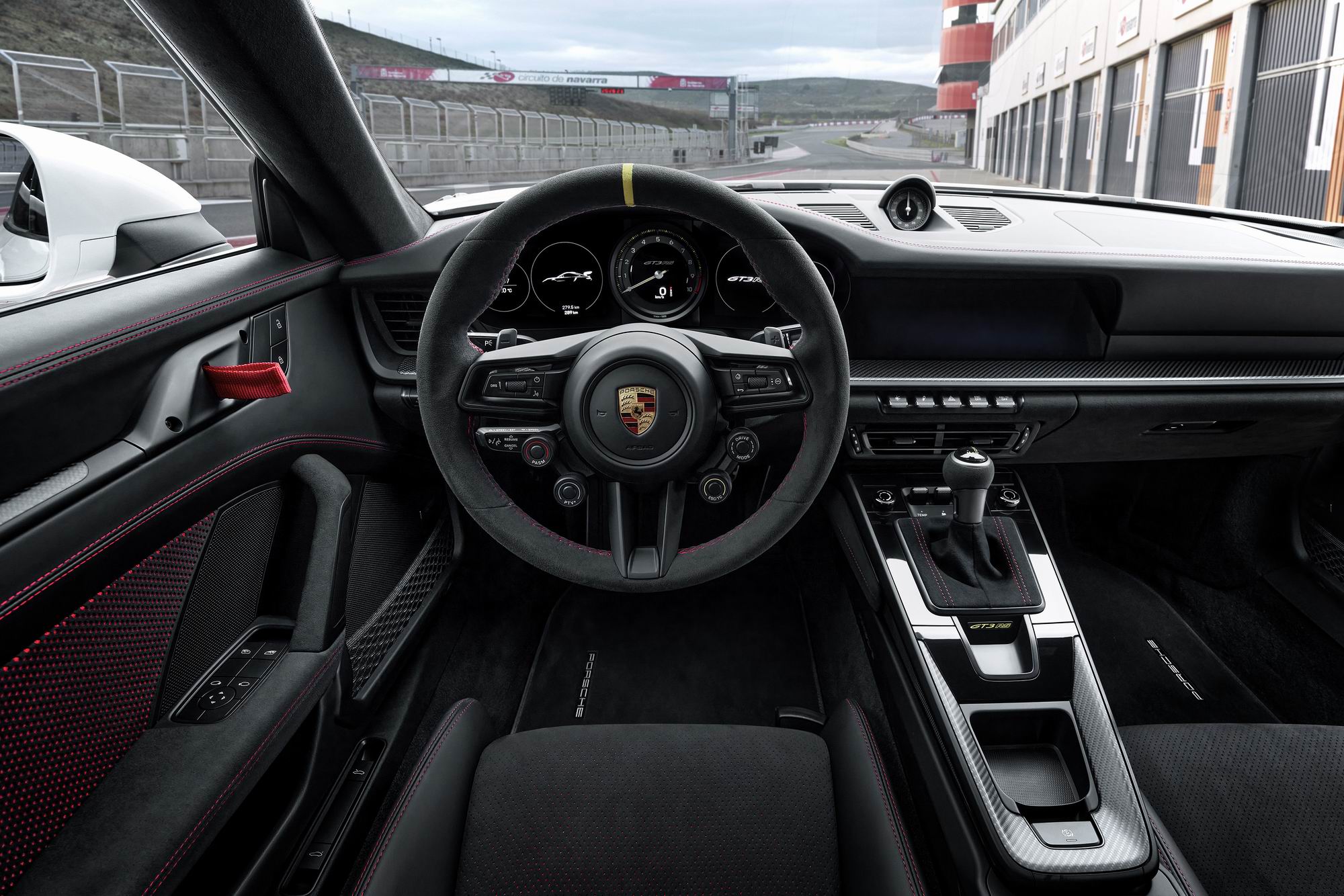
Step inside and the motorsport intent hits you immediately. The cabin is a strict two-seater — the rear bench has been deleted entirely — and the dominant visual feature is a pair of full carbon-fibre bucket seats that hold you like a tailored glove. They’re surprisingly comfortable over extended distances, with enough bolstering to pin you firmly through high-G corners without digging into your ribs during a three-hour highway run. Six-point harness mounting points come standard, and the optional roll cage (part of the Weissach Package) turns the interior into something approaching a proper cockpit.
The steering wheel carries Porsche’s manettino-style rotary controllers, which let you toggle damper compression, damper rebound, traction control and drive mode without taking your hands off the rim. It’s an intuitive system once you learn the positions, and it puts a remarkable degree of chassis tuning at your fingertips — far more accessible than buried infotainment menus. The 12.3-inch curved digital instrument cluster offers a dedicated Track Screen layout that prioritises a central tachometer, gear indicator and lap timer. It’s legible even through a helmet visor at speed. The infotainment touchscreen handles Apple CarPlay and Android Auto, but let’s be honest — nobody’s buying this car for its streaming app integration.
In day-to-day terms, the GT3 RS is more usable than its wild aero suggests, provided you calibrate your expectations. Ride quality at urban speeds is genuinely compliant — the adaptive dampers soften enough to absorb speed bumps and rough tarmac without punishing your spine. The boot behind the engine offers just enough space for a soft bag or two. But there’s no frunk, the cabin is loud above 130 km/h even in the most relaxed settings, and that enormous rear wing attracts stares from every bystander, petrolhead or otherwise. If your daily commute involves highway speeds above 100 km/h, you’ll want noise-cancelling earbuds or a different car for Tuesday mornings. For weekend canyon carving and monthly track days, though, the interior hits every note perfectly.

2026 Porsche 911 GT3 RS vs Ferrari 296 GTB: Which Is Better?
This is the comparison the sports-car world has been waiting for. The GT3 RS and the Ferrari 296 GTB are the highest expressions of their manufacturers’ road-car philosophies, and they arrive at the same destination — a devastatingly fast, track-capable supercar — via fundamentally different routes. Porsche has doubled down on atmospheric purity and aerodynamic engineering. Ferrari has embraced electrification as a performance multiplier. The result is two machines that feel nothing alike despite overlapping in price, mission and buyer profile.
The powertrain is where the philosophical divide is widest. The GT3 RS runs a 4.0-litre naturally aspirated flat-six producing 518 hp, revving to 9,000 rpm with a linearity and throttle response no forced-induction engine can match. The Ferrari counters with a 3.0-litre twin-turbocharged V6 supplemented by a plug-in hybrid electric motor, producing a combined 819 hp — a staggering 301 hp more than the Porsche. On paper, the 296 GTB is in a different league. In practice, the hybrid system adds weight, complexity and a layer of digital intervention between your right foot and the rear tyres. It’s brilliantly executed, but it’s never entirely invisible. The Porsche’s connection is direct, mechanical and analogue. The Ferrari’s is fast, sophisticated and augmented. Which you prefer is as much about philosophy as it is about performance.
The performance numbers tell an interesting story. The 296 GTB dispatches 0-100 km/h in 2.9 seconds — three tenths quicker than the GT3 RS’s 3.2-second claim — and its 330 km/h top speed eclipses the Porsche’s 296 km/h. But those figures need context. The Ferrari’s advantage is concentrated in straight-line acceleration and outright velocity. On a tight circuit where aero, braking and chassis balance matter more than peak power, the GT3 RS’s 860 kg of downforce and sub-1,500 kg kerb weight give it a weapon the 296 simply can’t counter. Ferrari doesn’t publish a comparable downforce figure for the 296 GTB, and the car’s passive aero — while effective — lacks the active adjustability of the Porsche’s DRS system and continuously variable front flaps. In a Nürburgring shoot-out, the GT3 RS would hold a commanding advantage through the fast sections.
Weight is another battleground. The GT3 RS tips the scales at 1,450 kg (DIN), while the 296 GTB comes in at 1,470 kg dry — and that’s without the 7.45 kWh battery at full charge. The Ferrari is well-packaged and its carbon-fibre tub keeps mass centred, but the hybrid hardware — battery, electric motor, power electronics — adds mass in places that affect moment of inertia. The Porsche, with its rear-mounted flat-six and no electrification, carries its weight exactly where a 911 always has: mostly behind the rear axle. The result is a rear-drive character that demands commitment from the driver and rewards it with an intensity the more forgiving Ferrari rarely matches.
Inside, the contrast is stark. The 296 GTB offers a luxurious, leather-lined cabin with a fully digital passenger display, elegant Italian switchgear and a level of material quality that justifies its higher price. The GT3 RS cabin, by contrast, is functional to the point of austerity — carbon-fibre bucket seats, pull-strap door handles on Weissach cars, rotary controllers and a fire extinguisher. There’s a beauty in that simplicity, but it’s the beauty of a surgical instrument, not a gentleman’s club. If you want to arrive at the circuit feeling pampered, the Ferrari is the better companion. If you want to arrive ready to drive, the Porsche sets the mood from the moment you drop into the seat.
Pricing closes the gap further. The GT3 RS starts at approximately US$241,300 in the United States, while the 296 GTB opens at around US$329,000 — a difference of nearly US$88,000 before options. Add the Weissach Package, magnesium wheels and a few individual touches to the Porsche and you’ll still likely undercut a modestly specced 296 GTB. For the buyer who values pure driving engagement per dollar, the Porsche offers a staggering proposition. The Ferrari justifies its premium with hybrid versatility, electric-only urban running and a broader dynamic bandwidth that includes genuine comfort GT duties.
| Specification | Porsche 911 GT3 RS | Ferrari 296 GTB |
|---|---|---|
| Price (from) | US$241,300 | US$329,000 |
| Engine | 4.0L NA flat-six | 3.0L TT V6 + hybrid |
| Power | 518 hp (525 PS) | 819 hp combined |
| 0-100 km/h | 3.2 s | 2.9 s |
| Top Speed | 296 km/h | 330 km/h |
| Weight (DIN) | 1,450 kg | 1,470 kg |
| Downforce | 860 kg @ 285 km/h | Not published |
| Transmission | 7-speed PDK | 8-speed DCT |
| Drive | Rear-wheel | Rear-wheel |
> **Buy the GT3 RS if** you want the most connected, analogue, aerodynamically advanced naturally aspirated track car on the planet — and you want to save nearly US$90,000 over the Ferrari in the process. > > **Buy the 296 GTB if** you want a supercar that doubles as a refined daily driver with electric-only city capability, a plusher interior and outright straight-line superiority. > > **Our pick is the GT3 RS.** On a circuit, nothing with a number plate generates this kind of confidence at this price. The Ferrari is the better car on a Sunday morning espresso run; the Porsche is the better car every other moment.
Safety and Warranty
As a low-volume sports car, the 2026 Porsche 911 GT3 RS is exempt from formal crash-testing by NHTSA, Euro NCAP and ANCAP. No star rating exists, and none is likely to be assigned. That said, Porsche hasn’t skimped on passive safety: the body structure incorporates a magnesium and steel safety cell, six airbags are fitted as standard, and the optional Weissach Package adds a bolt-in CFRP roll cage for track use. Porsche Stability Management (PSM) comes standard, with a dedicated track mode that relaxes intervention thresholds without fully disabling the system. It lets experienced drivers explore the chassis limits while retaining a safety net.
Warranty coverage follows Porsche’s standard terms: four years or 50,000 miles (whichever comes first) in the United States and Australia, and three years with unlimited mileage in the United Kingdom and across the European Union. Four years of roadside assistance is included in the US; European buyers get 24/7 Porsche Assistance for the duration of the warranty. Given the GT3 RS’s track-day mission, owners should be aware that warranty claims arising from circuit use may face scrutiny — a common industry position for performance-tuned variants.
Running Costs, Fuel and Servicing
Porsche claims a combined fuel consumption figure of 13.2 litres per 100 kilometres for the GT3 RS. That’s optimistic for any car with a 9,000-rpm redline and a habit of being driven enthusiastically. In mixed road driving, expect figures closer to 16–17 L/100 km. On a circuit, consumption climbs quickly to 18 L/100 km and beyond, depending on pace and session length. The 64-litre fuel tank gives you roughly 350–400 km of mixed driving range — enough for a track day, but you’ll be watching the gauge during longer sessions.
Servicing is required every 20,000 kilometres or annually, whichever comes first. Porsche’s maintenance costs are premium but predictable, and the flat-six engine’s proven mechanical simplicity — no turbos, no hybrid system — reduces the likelihood of expensive out-of-warranty surprises. The Michelin Pilot Sport Cup 2 R tyres, while extraordinary on circuit, wear quickly: a full set costs approximately A$5,000 (US$3,200) and track-day regulars report needing fresh rubber every three to four sessions depending on circuit and driving style. Brake pads are a consumable on any track-focused car, but the standard steel discs are far cheaper to replace than the optional PCCB ceramics — a factor worth weighing if circuit days are a regular calendar fixture.
Who Should Buy the 2026 Porsche 911 GT3 RS
The GT3 RS occupies a very specific niche: it’s the car for the enthusiast who spends more time thinking about apexes than about badge prestige. It rewards drivers who value steering feel and chassis feedback above outright straight-line speed, and who are willing to accept the NVH compromises that come with an 860-kg downforce package on the public road. If your calendar includes regular track days, weekend canyon drives and a deep appreciation for naturally aspirated engines in their twilight era, this is your car.
Buy if:
– You want the most aerodynamically advanced and engaging naturally aspirated track car on sale today. – Regular circuit days are a core part of your ownership plan, not an afterthought. – You appreciate hydraulic steering feel and analogue driver feedback above all else.
Skip if:
– You need a supercar that doubles as a quiet, comfortable daily commuter. – Highway drone and cabin noise above 100 mph are dealbreakers for your driving habits. – You want outright straight-line speed or hybrid-assisted acceleration — rivals deliver more power.
⚡ Our Verdict
A track weapon you can drive home
The 2026 Porsche 911 GT3 RS isn’t a perfect car. It’s too loud at highway speeds, it lacks an eighth gear that would transform its touring manners, and its zero-frunk packaging is a genuine inconvenience. But perfection measured in isolation misses the point. This is a machine engineered from its first CAD sketch to be the fastest, most connected, most confidence-inspiring naturally aspirated 911 the laws of physics allow. And on that brief, it delivers with absolute authority. We’ve driven faster cars, more luxurious cars and quieter cars. We haven’t driven a car that offers this combination of circuit ferocity and road compliance at this price, with this level of engineering transparency. The dual personality — compliant and almost gentle at 80 km/h, savage and deafening above 160 km/h — isn’t a flaw. It’s the very essence of what makes the GT3 RS unique. At 4.7 out of 5, it stands as the most complete track-and-road 911 ever built, and a fitting monument to the naturally aspirated era as the industry hurtles toward electrification.
Frequently Asked Questions
How much does the 2026 Porsche 911 GT3 RS cost?
Pricing starts at approximately US$241,300 in the United States, £196,000 in the UK, A$521,500 in Australia and EUR 248,000 in Germany. The Weissach Package adds roughly US$32,500, and options such as magnesium wheels, PCCB ceramics and individual paint can push the total well beyond US$300,000.
What is the 0-100 km/h time for the GT3 RS?
Porsche quotes 3.2 seconds from standstill to 100 km/h. Independent testing by several publications has recorded times closer to 3.0 seconds under optimal conditions, reflecting the conservative nature of the manufacturer’s claim.
What is the Nürburgring Nordschleife lap record for the GT3 RS?
The production 911 GT3 RS lapped the Nürburgring Nordschleife in 6 minutes and 44.848 seconds, making it one of the fastest naturally aspirated production cars ever timed on the circuit. This figure was achieved on standard Michelin Pilot Sport Cup 2 R tyres.
Is a manual gearbox available for the GT3 RS?
No. The 2026 GT3 RS is offered exclusively with the seven-speed PDK dual-clutch automatic transmission. Porsche has indicated that the shift speeds and precision required for the car’s track mission necessitate the automated gearbox, and a manual option isn’t available in any market.
Can the GT3 RS be used as a daily driver?
At urban and suburban speeds, the GT3 RS is surprisingly compliant thanks to its adaptive dampers and comfortable carbon bucket seats. However, the cabin becomes genuinely loud above 160 km/h, there’s no front trunk and the aerodynamic hardware draws constant attention. It’s a viable occasional daily, but most owners will want a second car for commuting duties.
How does the GT3 RS differ from the standard 911 GT3?
The GT3 RS produces 518 hp versus the GT3’s 502 hp, but the critical differences are aerodynamic and chassis-related. The RS generates up to 860 kg of downforce — roughly triple the GT3’s figure — through its active aero package including the DRS rear wing, adjustable front flaps and central radiator layout. It also features a wider body, stiffer suspension tuning and a more aggressive tyre specification. The trade-off is increased cabin noise, no rear seats and reduced road comfort.
Is the Weissach Package worth the extra cost?
For track-focused buyers, yes. The Weissach Package adds a CFRP roll cage, carbon-fibre anti-roll bars, lighter interior trim, and opens the option of forged magnesium wheels — collectively saving meaningful weight in the areas that matter most for circuit performance. For road-biased owners who value comfort and simplicity, the standard GT3 RS is already an extraordinary machine without the additional spend.
