

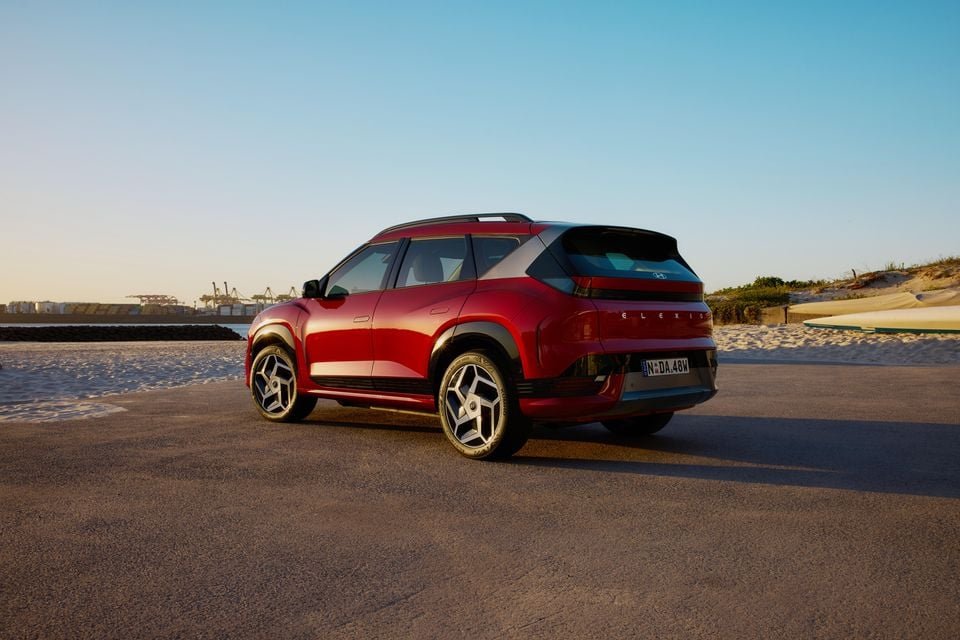
2026 Hyundai ELEXIO Elite Review — Range, Tech and Comfort Redefined
A genuinely impressive family EV with one of the most useable cabins in the segment
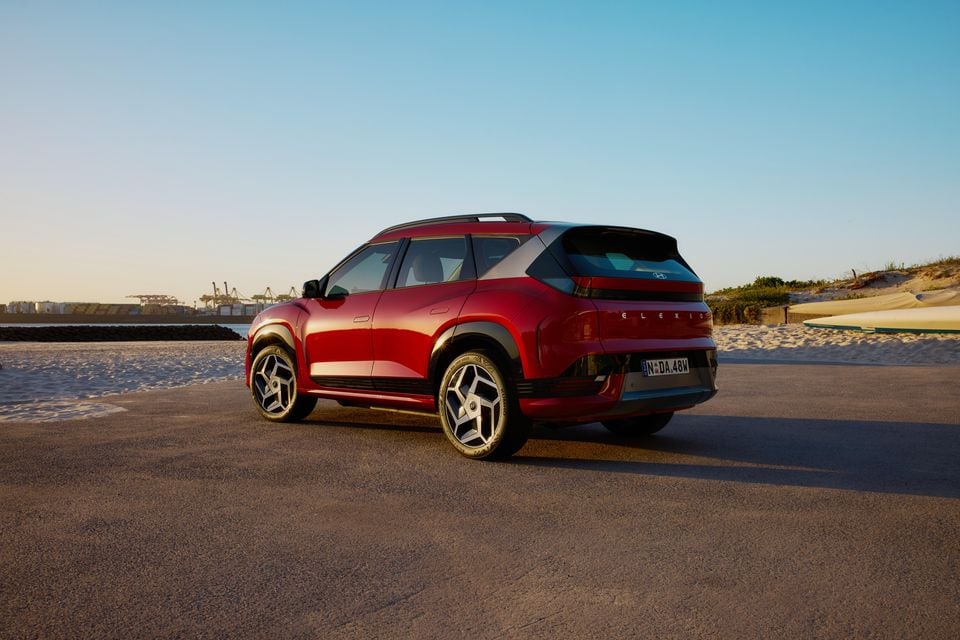
2026 Hyundai ELEXIO Elite electric family SUV side profile
⚡ Quick Verdict
:** Hyundai’s ELEXIO Elite nails the basics Australian families actually care about — range, cabin tech, back-seat space and ride comfort. The 546 km WLTP rating is legit, the 27-inch display is a genuine showpiece, and there’s more rear legroom than you’ll find in the pricier IONIQ 5. It’s not flawless: front-wheel drive only will rule it out for some, the 150 kW DC ceiling is disappointing given the platform’s capability, and we hit a couple of software gremlins that need an OTA fix. But for the money, it’s a seriously well-rounded electric SUV.
—
## What Is the 2026 Hyundai ELEXIO?
✓ The Good
- +546 km WLTP range from the 88.1 kWh LFP battery — a class-leading number for this price
- +27-inch panoramic 4K display with Snapdragon 8295 chip — fast, smooth and genuinely premium
- +1,040 mm rear legroom — actually more than an IONIQ 5
- +7-year unlimited-km warranty plus 8 years on the high-voltage battery
- +Australian-tuned suspension delivers a composed, long-distance ride
- +Strong standard safety kit including Highway Driving Assist that is calibrated well, not intrusive
- +506 L boot with a 250 V three-pin V2L outlet built in
- +Heat pump as standard for cold-weather efficiency
✗ The Trade-offs
- −Front-wheel drive only — no AWD option at launch
- −150 kW peak DC charging is slower than the 800 V-capable hardware suggests
- −Blind-spot camera drops out when Apple CarPlay is running (software bug)
- −In-call display covers the climate controls in the top-right of the screen
- −Regen braking is soft out of the box even on the strongest setting
- −Ride is tuned for comfort rather than the sharp planted feel of an IONIQ 5 or EV6
- −No front boot (frunk)
- −—
📑 In This Review
- What Is the 2026 Hyundai ELEXIO?
- Design and Exterior
- Powertrain, Range and Charging
- On the Road
- Interior, Tech and Practicality
- Safety and Smart Sense
- At a Glance — How the ELEXIO Compares
- 2026 Hyundai ELEXIO Elite vs Kia EV5: Which Is Better?
- Who Should Buy the 2026 Hyundai ELEXIO Elite?
- BUY IF:
- SKIP IF:
- Pricing, Warranty and Running Costs
- Verdict
- Frequently Asked Questions
:** Hyundai’s ELEXIO Elite nails the basics Australian families actually care about — range, cabin tech, back-seat space and ride comfort. The 546 km WLTP rating is legit, the 27-inch display is a genuine showpiece, and there’s more rear legroom than you’ll find in the pricier IONIQ 5. It’s not flawless: front-wheel drive only will rule it out for some, the 150 kW DC ceiling is disappointing given the platform’s capability, and we hit a couple of software gremlins that need an OTA fix. But for the money, it’s a seriously well-rounded electric SUV. —
What Is the 2026 Hyundai ELEXIO?
The ELEXIO is Hyundai’s new midsize electric SUV, slotted between the Kona Electric and the flagship IONIQ 5. You could call it the Goldilocks pick — more room and range than the Kona, considerably cheaper than the IONIQ 5. Underneath, it rides on Hyundai-Kia’s well-proven E-GMP platform, the same bones that support the IONIQ 5 and, more directly relevant here, the Kia EV5. This is also Hyundai’s 35th year building electric vehicles, and that experience shows the moment you settle into the cabin.
At launch there’s just the one grade: the ELEXIO Elite, priced at $59,990 drive-away as a promotional offer running through 31 March 2026. Once that window closes, the Elite reverts to $61,990 plus on-road costs. A cheaper base ELEXIO is expected to follow in the second quarter of 2026, listed at $58,990 before on-roads. It’s a simple line-up — one fully-loaded variant to launch the nameplate, with a value-focused entry point close behind.
Design and Exterior
Hyundai calls the ELEXIO’s look "movement in stillness", and standing next to one, that phrase tracks. This isn’t a car that screams for attention. The silhouette is clean and low, quietly confident in a way that should still look fresh in five years rather than dating itself after two. There’s enough tension in the body panels to keep things interesting without resorting to fussy creases or exaggerated scoops.
Up front, the quad daytime running lights spell out "H" in Morse code — a nice detail that rewards a closer look. Out back, a full-width light bar ties the ELEXIO into Hyundai’s broader EV styling family. On the Elite grade, 20-inch turbine-style alloys fill the wheel arches well and give the whole package a planted, grounded stance.
You can choose from five colours: Crystal White, Medium Grey, Pebble Blue, Dragon Red and Phantom Black. Every one is a metallic mica finish, which catches sunlight nicely. Premium paint adds $750, which is pretty standard for this segment.
One thing we did miss: a front boot. No frunk at all. That’s a notable gap when rivals like the Tesla Model Y offer under-bonnet storage, and it’s the kind of thing that comes in handy on a long weekend away.
Powertrain, Range and Charging
Under the bonnet (or what’s left of it, given the absence of a frunk) sits a single permanent-magnet motor driving the front axle. It produces 160 kW and 310 Nm — identical to the Kia EV5 Air Long Range. Straight-line pace is adequate rather than electrifying. Hyundai claims 0–100 km/h in roughly 8.4 seconds, which is firmly in family-hauler territory rather than hot-hatch.
The number that matters more here is 546 km. That’s the WLTP-rated range from the 88.1 kWh lithium iron phosphate battery on the Elite’s 20-inch wheels. The upcoming base ELEXIO, riding on smaller wheels, should push that to 562 km. During our mixed loop — suburban arterials, motorway cruising, inner-city crawling — we saw consumption averaging around 18.2 kWh/100 km. That lines up neatly with the official claim, so the quoted range is realistic if you drive with a bit of restraint.
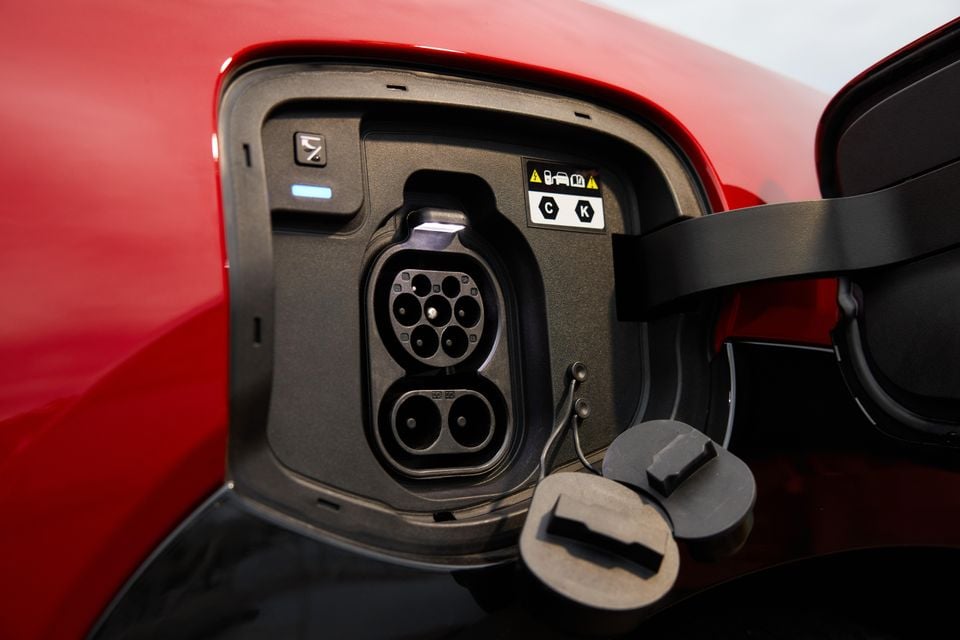
Charging-wise, the ELEXIO handles both 400 V and 800 V infrastructure, so it’ll plug into anything from a 50 kW unit to the newest ultra-rapid posts. The catch is the 150 kW peak DC rate. For a platform that supports 800 V charging, that’s underwhelming. A 10–80% top-up on a fast charger takes 38 minutes. That’s fine for a coffee stop on a road trip, but it puts the ELEXIO behind the Tesla Model Y at 175 kW and well adrift of the IONIQ 5 and EV6, which can pull 235 kW or more. It’s probably the car’s biggest hardware compromise.
On the positive side, a heat pump is fitted as standard, which makes a real difference to efficiency when the mercury drops. The V2L system also deserves a mention: it delivers 3.6 kW through a standard 250 V three-pin socket in the cargo area. You can run a camping fridge off it, charge an e-bike, or power a drop saw on site without needing a generator.
On the Road
This is where the ELEXIO Elite really shows its hand. The suspension has been tuned specifically for Australian conditions, and the result is a car that puts comfort ahead of everything else. Over our test route — coarse-chip regional highways, patched suburban streets, undulating back roads — the ELEXIO shrugged off surface imperfections without complaint. It doesn’t crash over sharp edges, and it doesn’t float around at speed either. It’s just… comfortable. Properly comfortable.
That comfort-first tuning does come at a cost. If you’re stepping out of an IONIQ 5 or a Kia EV5 expecting that same taut, connected feel, you’ll feel the difference straight away. The ELEXIO rides softer, more laid-back. It leans into the comfort brief so willingly that it can feel a bit detached on a twisting mountain pass. The steering is accurate enough, but it’s light, and the chassis doesn’t encourage you to push on the way its siblings do.
The regen braking is worth talking about too. Even in its strongest setting, it feels gentle — more of a noticeable coast-down than genuine one-pedal driving. That’s great for people who are new to EVs or prefer a more traditional brake feel. For experienced EV owners who want strong regen to cut brake wear and maximise efficiency, it’ll feel like a missed trick. We’d love to see a more aggressive mode added via a future OTA update.
So who does this suit? Families. Couples heading from Melbourne to Sydney. Anyone who’d rather arrive at their destination feeling relaxed than arrive with a grin and a stiff neck. The ELEXIO is an electric long-distance cruiser, and on that score it delivers.
Interior, Tech and Practicality
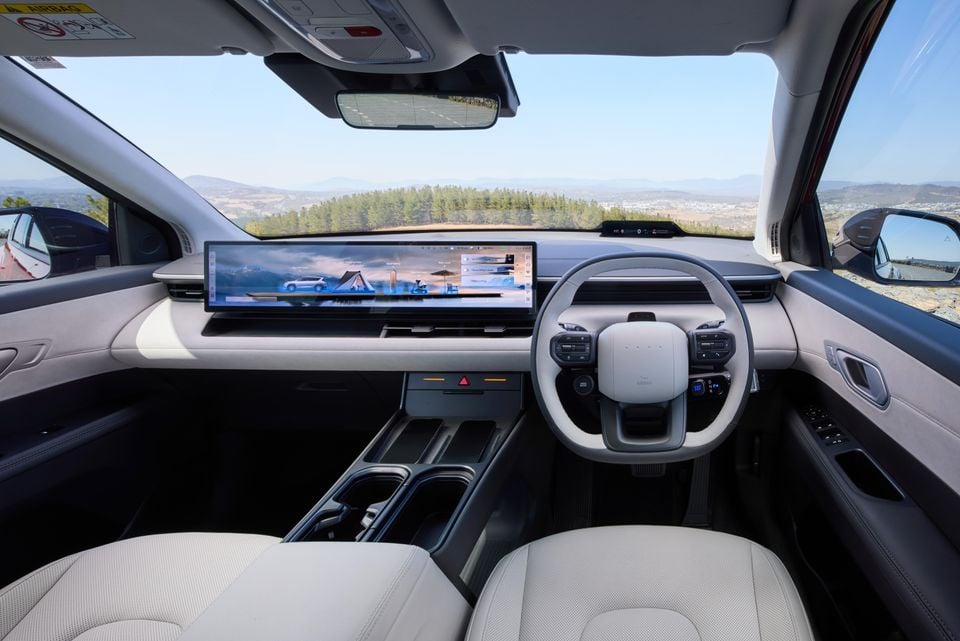
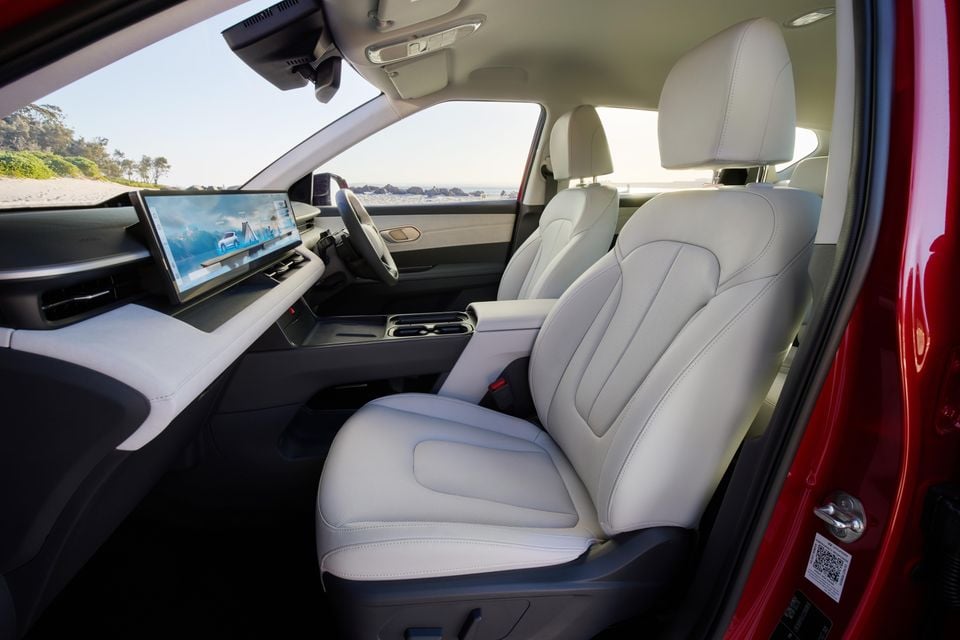
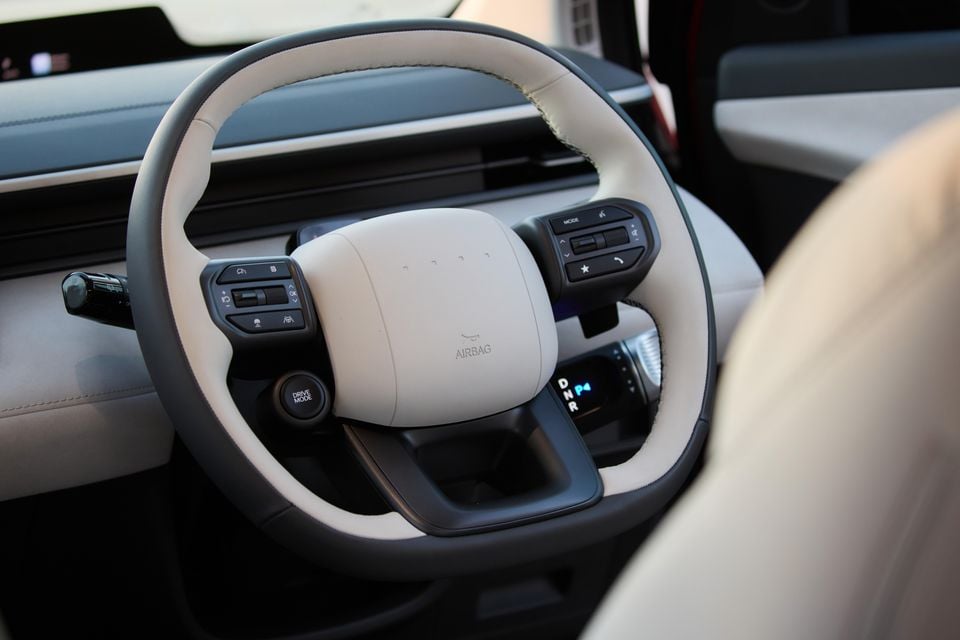
The cabin is where the ELEXIO Elite really shines. Front and centre is a 27-inch panoramic display stretching the full width of the dashboard — 4K resolution, 1,000 nits of brightness, powered by a Qualcomm Snapdragon 8295 chip running an Android-based system. It’s one of the smoothest, sharpest infotainment setups you’ll find at this price. Menus open instantly, the map rendering is razor-crisp, and even harsh midday sun can’t wash it out. There’s also a head-up display to keep speed and nav info in your eyeline.
Standard equipment on the Elite reads like something from a $90K luxury car: 14-way power-adjustable driver seat with memory, heated and ventilated front seats, heated steering wheel, dual-zone climate, two wireless phone chargers and five USB-C ports spread across both rows. You won’t find yourself ticking option boxes because there aren’t many left to tick.
Space is a genuine strength. The rear seat offers 1,040 mm of legroom — more than the already-roomy IONIQ 5 — and a completely flat floor means three adults across the back row can actually sit without fighting over foot space. The boot measures 506 litres with a useful, square shape, growing to 1,540 litres with the rear seats folded. That 250 V V2L socket in the cargo area is a practical inclusion rather than a marketing gimmick.
Bluelink connected services, Digital Key 2 and over-the-air software updates are all bundled in, so the ELEXIO should get better over time without a dealership visit.
We did run into two software frustrations. The blind-spot camera feed, which normally pops up in the instrument cluster when you indicate, cuts out entirely when Apple CarPlay is active. Separately, incoming phone calls plaster a notification over the top-right corner of the panoramic display, which is exactly where the climate controls live. Both are annoying in daily use, but both feel like the sort of bugs a targeted OTA patch could squash. Given the ELEXIO’s launch profile, we’d expect Hyundai to sort them quickly.
Safety and Smart Sense
Hyundai’s full Smart Sense suite is standard on the ELEXIO Elite. That covers forward collision avoidance assist with junction-turning detection, Highway Driving Assist (Level 2 semi-autonomous tech combining adaptive cruise control and lane centring), lane following assist, blind-spot monitoring with collision avoidance, rear cross-traffic alert and remote smart parking assist. The Highway Driving Assist calibration deserves a specific call-out — it nudges the wheel smoothly and predictably rather than yanking it, which makes long motorway stints noticeably less tiring.
The ELEXIO has picked up a five-star ANCAP rating: 88% for Adult Occupant Protection, 86% for Child Occupant Protection, 85% for Safety Assist and 84% overall. Those figures put it among the safest options in the segment.
At a Glance — How the ELEXIO Compares
| Vehicle | Price (AUD) | Power | Range (WLTP) | DC Peak | 0–100 |
|---|---|---|---|---|---|
| 2026 Hyundai ELEXIO Elite | $59,990 d/a | 160 kW / 310 Nm | 546 km | 150 kW | ~8.4 s |
| Kia EV5 Air Long Range | $56,770 + ORC | 160 kW / 310 Nm | 555 km | 140 kW | ~8.5 s |
| Tesla Model Y RWD | $58,900 + ORC | 255 kW / 450 Nm | 466 km | 175 kW | 5.9 s |
| BYD Sealion 7 Premium | $54,990 + ORC | 230 kW / 380 Nm | 482 kW | 150 kW | 6.7 s |
Kia EV5 Air LR
E-GMP twin with firmer chassis and slightly longer range — the closest direct rival.
Tesla Model Y RWD
Quicker (5.9 s 0-100) and faster 175 kW charging but shorter range and a less premium cabin.
BYD Sealion 7 Premium
Cheaper and quicker but lower range and shorter warranty than the ELEXIO.
The midsize electric SUV space is getting crowded, and the ELEXIO Elite walks into some stiff competition. Here’s how the headline numbers compare against its key rivals. Price (AUD) Range (WLTP) 0–100 — — — $59,990 d/a 546 km ~8.4 s Kia EV5 Air Long Range 160 kW / 310 Nm 140 kW $58,900 + ORC 466 km 5.9 s BYD Sealion 7 Premium 230 kW / 380 Nm 150 kW Range is the ELEXIO’s trump card — 546 km on the WLTP cycle gives it breathing room over the Tesla and the BYD, and it runs the EV5 nearly neck and neck. Where it gives up ground is straight-line performance and peak charging speed, both of which favour the Tesla and, to a lesser degree, the BYD.
2026 Hyundai ELEXIO Elite vs Kia EV5: Which Is Better?
It’s the question you’ll ask if you’re shopping in this bracket, and fair enough too. The ELEXIO and the EV5 are E-GMP siblings sharing the same 88.1 kWh LFP battery, the same 160 kW / 310 Nm front-drive motor and a lot of the same engineering DNA. The differences are in the details — but they’re details that matter.
On price, they’re practically neck and neck. The ELEXIO Elite’s $59,990 drive-away promo price sits right alongside the EV5 Air Long Range at $56,770 plus on-roads (realistically landing around $60,000 drive-away depending on your state). The ELEXIO manages a slightly quicker 10–80% DC charge at 38 minutes versus roughly 42 minutes for the EV5, courtesy of a more optimised charge curve — even though its peak rate is 150 kW versus the EV5’s 140 kW.
Where the ELEXIO pulls clear is cabin technology. That 27-inch panoramic 4K display is a genuine differentiator — bigger, brighter and more visually striking than the EV5’s conventional pair of 12.3-inch screens. The ELEXIO also gets a 250 V three-pin V2L outlet in the boot, which is more versatile than the EV5’s 3.6 kW setup that needs an adapter. Hyundai backs the ELEXIO with an 8-year battery warranty too, compared with Kia’s 7-year coverage.
The EV5 fights back on two fronts. Its 555 km WLTP range edges out the ELEXIO’s 546 km by a slim margin, and its slightly firmer chassis tune gives it a more connected, engaging feel when the road gets twisty.
| Spec | Hyundai ELEXIO Elite | Kia EV5 Air LR |
|---|---|---|
| Drive-away price | $59,990 | ~$60,000 |
| Battery | 88.1 kWh LFP | 88.1 kWh LFP |
| Motor | 160 kW / 310 Nm FWD | 160 kW / 310 Nm FWD |
| Range (WLTP) | 546 km | 555 km |
| DC peak charge | 150 kW | 140 kW |
| 10–80% time | 38 min | ~42 min |
| Display | 27-inch panoramic 4K | Dual 12.3-inch |
| V2L outlet | Yes (3.6 kW + 250 V plug) | Yes (3.6 kW) |
| Warranty | 7-yr + 8-yr battery | 7-yr + 7-yr battery |
Buy the ELEXIO if you want the bigger, brighter screen, the slightly faster charge curve and the longer battery warranty.
Buy the Kia EV5 if you prefer a firmer chassis tune, the slightly longer WLTP range figure, and a more conventional dual-screen layout.
**Our pick** is the ELEXIO Elite for buyers who value cabin tech and ride comfort. The Kia stays the pick for keen drivers who travel long distances regularly.
Who Should Buy the 2026 Hyundai ELEXIO Elite?
BUY IF:
– You’re a family of four or five wanting genuine EV range without anxiety – You value a premium cabin and a big, sharp display that feels like technology from a more expensive car – You spend your driving life on a mix of suburban and highway roads and want a comfortable, composed ride – You want long warranty cover — seven years on the car, eight on the battery
SKIP IF:
– You need all-wheel drive or towing capacity above 1,650 kg – You’re cross-shopping a performance EV and care deeply about 0–100 times – You live somewhere with abundant 350 kW chargers and want to exploit them fully – You want a frunk for extra storage on road trips
Pricing, Warranty and Running Costs
The 2026 Hyundai ELEXIO Elite starts at $59,990 drive-away as a promotional offer through 31 March 2026. From 1 April 2026, it reverts to $61,990 plus on-road costs. A base ELEXIO will follow in the second quarter of 2026, priced from $58,990 manufacturer’s list price.
There are only two options: premium paint for $750 and a Dove Grey interior trim for $295. Both are reasonable asks.
Hyundai’s warranty is one of the best in the business — seven years with unlimited kilometres on the vehicle, eight years on the high-voltage battery. Servicing through a Hyundai dealer also unlocks five years of complimentary roadside assistance. Capped-price servicing applies for the full warranty period, which takes the guesswork out of long-term ownership costs.
⚡ Our Verdict
A genuinely impressive family EV with one of the most useable cabins in the segment
The 2026 Hyundai ELEXIO Elite earns its 4.2 out of 5 by excelling at the things Australian families actually prioritise. The 546 km WLTP range makes range anxiety a non-issue for daily commutes and weekend escapes alike. The 27-inch panoramic display is a genuine headline act — fast, bright and sharp enough to make rival systems feel a generation older. Rear-seat space is outstanding, the ride is cosseting, and the standard kit leaves almost nothing to add. It’s not without flaws. The front-drive-only layout will put off buyers in regional or alpine areas who need four-wheel traction. The 150 kW peak DC charge rate feels conservative for an 800 V-capable platform. And the two software bugs we found — the CarPlay blind-spot dropout and the call-display overlay — need fixing sooner rather than later. But none of these are dealbreakers, and Hyundai’s OTA capability means it can push fixes directly to your car. For families making the switch to electric — or stepping up from a smaller EV — the ELEXIO Elite is one of the most convincing, well-rounded packages on the Australian market right now. It’s comfortable, spacious, long-legged and packed with technology that genuinely improves the ownership experience. We’d park one in our driveway without a second thought.
Frequently Asked Questions
How long does the 2026 Hyundai ELEXIO Elite take to charge?
**A:** On a 150 kW DC fast charger, you’re looking at roughly 38 minutes from 10% to 80%. Plug it into a standard 11 kW home wallbox and a full charge from empty takes around eight to nine hours — perfect for an overnight top-up.
What is the WLTP range of the ELEXIO Elite?
**A:** The Elite, rolling on 20-inch wheels, is rated at 546 kilometres on the WLTP cycle. The upcoming base ELEXIO with smaller wheels is expected to nudge that out to 562 km.
Is the Hyundai ELEXIO front-wheel drive or all-wheel drive?
**A:** Front-wheel drive only. There’s no all-wheel-drive variant available at this stage. The single motor puts out 160 kW and 310 Nm.
How does the ELEXIO compare to the Kia EV5?
**A:** Both share the same E-GMP platform, 88.1 kWh LFP battery and 160 kW motor. The ELEXIO brings a larger 27-inch panoramic display, a marginally faster charge curve (38 min versus roughly 42 min) and an 8-year battery warranty. The EV5 counters with a slightly longer 555 km WLTP range, a firmer ride and a more conventional dual-screen interior.
Does the ELEXIO have a five-star ANCAP rating?
**A:** It does. The ELEXIO earned a five-star ANCAP rating with scores of 88% for Adult Occupant Protection, 86% for Child Occupant Protection, 85% for Safety Assist and 84% overall.
What warranty does Hyundai offer with the ELEXIO?
**A:** Hyundai covers the ELEXIO with a 7-year unlimited-kilometre warranty on the vehicle and an 8-year warranty on the high-voltage battery. Servicing through the Hyundai dealer network also includes five years of complimentary roadside assistance.
