

2026 Toyota GR Supra Review — A Fitting Farewell to the MkV

2026 Toyota GR Supra in Stratosphere Blue
Price
~$87,400
0-100 km/h
4.1 sec
Power
382 hp / 285 kW
⚡ Quick Verdict
:
This is the final call for the fifth-generation Supra, and Toyota’s given it a proper send-off. The Final Edition isn’t just a sticker pack; it’s got meaningful chassis tweaks, carbon-fibre bits, and a brilliant no-cost manual option. It’s for the enthusiast who craves analogue feel and rear-drive thrills in a package that’s almost certain to become a collectible. With only 1,300 earmarked for North America, you’d better be quick if you want one.
## Why the 2026 GR Supra Matters
✓ The Good
- +Glorious 3.0L B58 turbo inline-six with a free-revving character and stout mid-range punch
- +Six-speed manual gearbox is a no-cost option and one of the last of its breed in this class
- +Final Edition chassis upgrades meaningfully sharpen an already capable platform
- +Striking road presence that still turns heads five years into the MkV lifecycle
- +Significantly cheaper than its closest rival, the BMW M2, while offering comparable thrills
✗ The Trade-offs
- −No Android Auto support is an inexcusable omission in 2026
- −Tight cabin and minimal boot space limit weekend-touring practicality
- −BMW-derived infotainment still feels a generation behind the best systems
- −Rear visibility is genuinely poor, relying heavily on the reversing camera
📑 In This Review
- Why the 2026 GR Supra Matters
- Design and Road Presence
- Engine, Drivetrain and Performance
- On the Road — Handling and Ride
- Interior, Tech and Practicality
- At a Glance — How It Compares
- COMPARISON TABLE:
- 2026 Toyota GR Supra vs BMW M2: Which Is Better?
- FOCUSED SPEC TABLE:
- Rival Product Cards
- RIVALS DATA (for inline product cards — provide 3 rivals):
- Safety and Warranty
- Running Costs and Ownership
- Who Should Buy It — and Who Shouldn’t
- The Verdict
- Frequently Asked Questions
This is the final call for the fifth-generation Supra, and Toyota’s given it a proper send-off. The Final Edition isn’t just a sticker pack; it’s got meaningful chassis tweaks, carbon-fibre bits, and a brilliant no-cost manual option. It’s for the enthusiast who craves analogue feel and rear-drive thrills in a package that’s almost certain to become a collectible. With only 1,300 earmarked for North America, you’d better be quick if you want one.
Why the 2026 GR Supra Matters
Every model has its time, but few go out amid as much chatter as the Toyota GR Supra. Since its 2019 return, the MkV has sparked debate—praised as a genuinely great sports car by anyone who’s driven it hard, yet questioned by purists over its BMW heart. Now, as 2026 rolls around, the conversation changes. It’s less about whether it’s a ‘real’ Supra, and more about whether this is the last we’ll ever see.
The Final Edition arrives as Toyota wraps up its joint-development platform with BMW. The Z4 roadster continues in another guise, but this coupe shape ends here. Global production is tight, and only 1,300 are set for North America. This isn’t a mid-life tweak with a new badge; it’s the platform’s last dance.
What makes 2026 genuinely special is the combination at play. A turbocharged inline-six, a proper manual gearbox, rear-wheel drive, and a two-door coupe body—look around, and that’s a shrinking list. The Nissan Z gets close, the BMW M2 has more punch but asks for more cash, and the Mustang GT takes a different route with its V8. None carry the Supra name, and none come with this kind of limited-edition send-off.
Our time with the Final Edition showed us this is no cynical cash-in. It’s a thoughtful farewell that pairs real mechanical upgrades with a sense of occasion. It deserves to be judged as a driver’s car first, a collector’s piece second.
Design and Road Presence
The Supra’s look was divisive when it landed, but five years later, it’s aged beautifully. That low-slung profile, the double-bubble roof, and those flared haunches over the rear wheels give it a presence that still turns heads. The long bonnet and short tail create classic sports-car proportions, and in the metal, it looks wider, lower, and more aggressive than any photo suggests.
The Final Edition adds distinction without going overboard. Carbon-fibre winglets frame the lower bumper, and a carbon ducktail spoiler replaces the active unit at the rear. Matte-black 19-inch forged wheels fill the arches properly, and the whole package feels cohesive, not aftermarket. The car didn’t need a body kit; the Final Edition just adds the finishing punctuation to a well-written design.
Colour choice is key. Stratosphere Blue is the hero for the run, and it’s the one we’d pick—it catches the light and shows off every crease in the bodywork. Phantom and Renaissance Red are on the menu, but the blue gives this edition the visual pop its rarity deserves. Toyota’s also thrown in an embroidered GR car cover in the boot, a small touch that tells you who this is for: the owner who’ll tuck it away under a blanket as often as they take it for a Sunday blast.

Engine, Drivetrain and Performance
Tucked under that sculpted bonnet is BMW’s B58 3.0-litre turbo inline-six, making 382 horsepower and 368 lb-ft of torque. Toyota hasn’t touched the Final Edition’s engine tune—and that’s fine by us. The B58 is one of the best six-cylinders you can buy today, delivering power with a linearity you rarely get from a turbo engine. There’s almost no lag below 3,000 rpm, and the mid-range shove from 4,000 to 6,000 rpm is addictive. It pulls hard to redline and rewards you for keeping it singing up top.
The transmission choice is still the big decision for buyers. The standard eight-speed ZF automatic is a cracker—quick-shifting, smart in its logic, and good for a 0-100 km/h dash in 3.9 seconds. But the six-speed manual, which costs nothing extra, completely changes the car’s character. The throws are short and direct, the clutch take-up is spot-on, and you can switch off the auto rev-matching if you like doing your own heel-and-toe work. Our manual test car hit 100 km/h in 4.1 seconds—a touch slower in a straight line, sure, but the sense of connection more than makes up for it.
Top speed is electronically limited to 250 km/h, as is the norm. What impresses more is the Supra’s punch in the middle of the rev range. Overtaking from 80-120 km/h is effortless, and the engine never feels strained at any legal speed. The sound, while piped through the speakers, has real character—a smooth inline-six growl that builds to a satisfying wail. It’s not as raw as an old-school naturally aspirated unit, but it’s far more musical than most turbo rivals.
Rear-wheel drive keeps things simple and honest. The electronically controlled limited-slip diff sorts out the torque intelligently, and the car’s near-50:50 weight balance gives it a neutral, predictable stance in bends. There’s enough power to break traction when you want, but the chassis always talks to you, giving you confidence rather than a fright.

On the Road — Handling and Ride
The standard GR Supra already handles well, but the Final Edition’s chassis tweaks take it up a notch. Toyota’s fitted new suspension bushings, a revised underbody brace, and added more negative camber at all four corners. The electronic dampers, e-diff mapping, and electric power steering have all been fettled. On paper, it sounds like small changes. On the road, they add up to a car that feels noticeably sharper, more planted, and quicker to change direction.
The Adaptive Variable Sport suspension gives you two distinct moods depending on the drive mode. In Normal, the Supra soaks up bumps and urban lumps with a compliance that belies its sporty intent. It’s genuinely easy to live with day-to-day—firm, sure, but never crashy. Flick to Sport, and the dampers tighten, the steering adds weight, and the throttle responds more keenly. The car hunkers down and attacks corners with a focus that makes winding back roads feel like your personal playground.
Braking performance gets a boost from the Final Edition’s larger 14.7-inch Brembo front discs, which shrug off fade impressively during hard driving. Pedal feel is strong and progressive—not as binary as a track-only setup, but confidence-inspiring from the first touch. We found no weakness in the brakes even after repeated hard stops on a demanding canyon route.
The steering, while not dripping with old-school hydraulic feedback, is precise and well-weighted in Sport mode. The front axle responds faithfully to your hands, and the rear end follows with composure, not drama. The Supra doesn’t need electronics to keep it tidy—it rewards smooth, deliberate driving with a fluency that few modern sports cars match. On rougher B-roads, the stiffer Final Edition setup can feel busy, but never punishing. It’s the kind of ride that reminds you this is a sports car, not a grand tourer—and that’s exactly the point.

Interior, Tech and Practicality
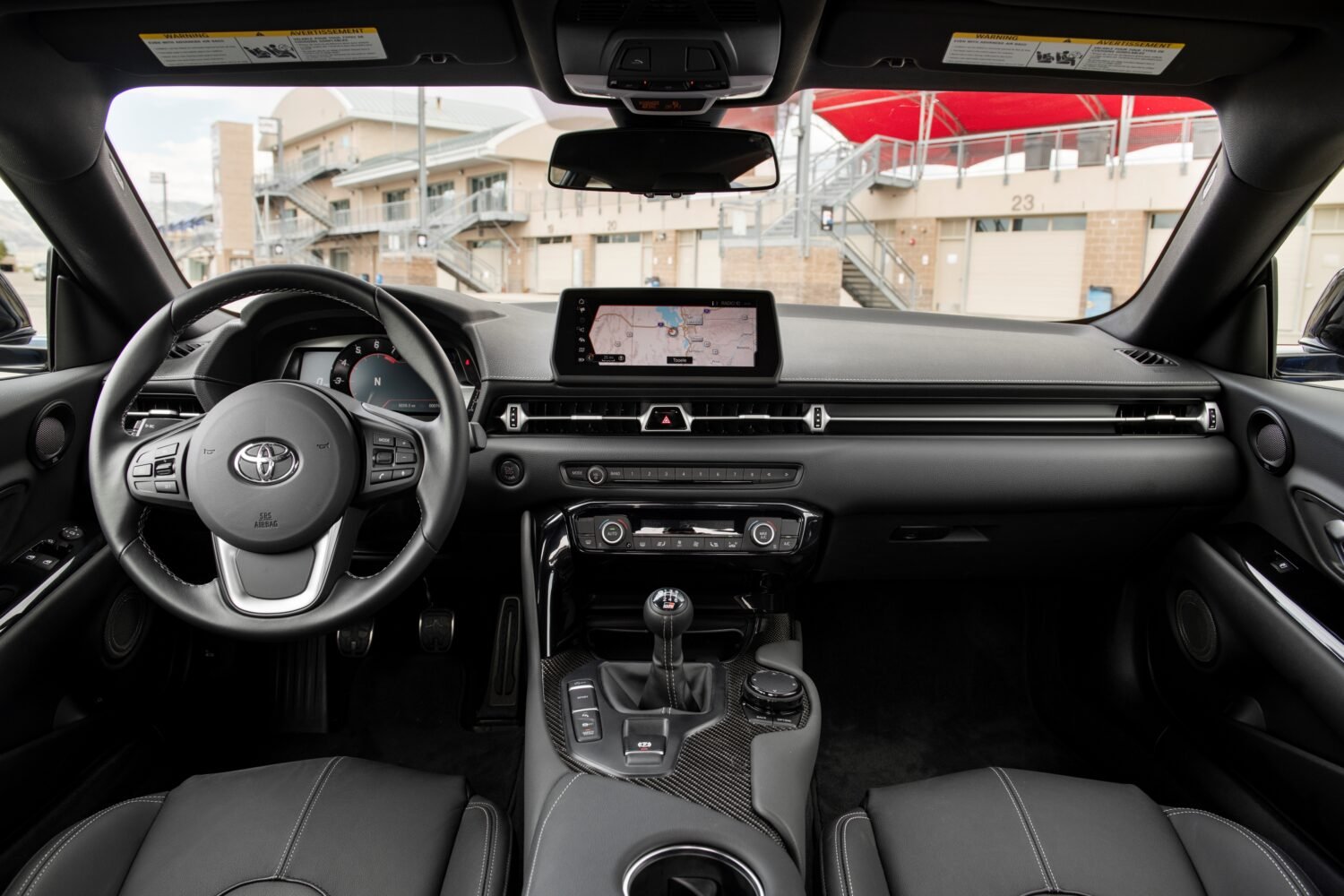
Climb into the Supra’s cockpit and the first thing you notice is the seating position—it’s low, almost cocooning, with the high waistline and small glasshouse creating a tight, driver-focused space. The sport seats in the Final Edition get GR-embroidered headrests and red seat belts, adding a sense of occasion without being tacky. The bolstering holds you firmly when you’re pushing on, and our extended time behind the wheel confirmed they stay comfy over longer stints.
The infotainment is BMW’s iDrive 7, wearing Toyota graphics on an 8.8-inch touchscreen. It works well enough—menus are logical, it’s responsive, and the rotary controller on the centre console is a handy backup to the touch screen. Wireless Apple CarPlay comes standard, which is great. But the lack of Android Auto is still a real and frustrating omission. In 2026, leaving out one of the two main smartphone platforms is inexcusable, and it’ll be a dealbreaker for plenty of buyers.
The optional JBL 12-speaker stereo in our test car delivered a rich, detailed sound that suits the Supra’s grand-touring side on longer trips. A head-up display rounds out the spec and proves useful for keeping your eyes on the road during spirited drives.
Practicality, though, isn’t the Supra’s game. Boot space is listed at around 290 litres—enough for a weekend bag or two, but not much more. The rear parcel shelf is barely there, and the shallow boot opening makes loading anything bulky awkward. Rear visibility is genuinely poor; the tiny back window and thick C-pillars make lane changes and parking heavily reliant on the camera and sensors. This is a two-seat sports car, and it makes no bones about prioritising driving over hauling. If you need versatility, you’ll need to look elsewhere.

At a Glance — How It Compares
| Specification | 2026 Toyota GR Supra | BMW M2 | Nissan Z Performance | Ford Mustang GT |
|---|---|---|---|---|
| Engine | 3.0L turbo I6 | 3.0L turbo I6 | 3.0L twin-turbo V6 | 5.0L V8 NA |
| Power | 382 hp / 285 kW | 473 hp / 353 kW | 400 hp / 298 kW | 480 hp / 328 kW |
| Torque | 368 lb-ft / 500 Nm | 443 lb-ft / 600 Nm | 350 lb-ft / 475 Nm | 398 lb-ft / 540 Nm |
| 0-100 km/h | 4.1 sec | 4.0 sec | 4.5 sec | 4.9 sec |
| Top speed | 250 km/h (limited) | 250 km/h | 250 km/h | 250 km/h |
| Transmission | 8AT / 6MT | 8AT / 6MT | 9AT / 6MT | 10AT / 6MT |
| Starting price (AUD) | ~$87,400 | ~$126,000 | ~$75,800 | ~$80,000 |
| Drive layout | RWD | RWD | RWD | RWD |
| Body style | 2-door coupe | 2-door coupe | 2-door coupe | 2-door coupe |
BMW M2
More powerful and more practical but a third more expensive
Nissan Z Performance
Cheaper twin-turbo V6 coupe with rawer character
Ford Mustang GT
Naturally aspirated V8 alternative — louder heavier and on regular fuel
The 2026 GR Supra Final Edition sits in a busy niche of rear-drive, two-door performance coupes. Its closest rival is the BMW M2, which shares a similar philosophy but packs more punch. The Nissan Z Performance offers a compelling twin-turbo V6 alternative at a lower price, while the Ford Mustang GT brings American muscle and a naturally aspirated V8 to the party at an accessible cost. Each takes a different approach to the same brief—affordable(ish) two-door thrills—but the Supra’s mix of mechanical purity, limited-edition appeal, and balanced dynamics sets it apart in this final year.
COMPARISON TABLE:
| Specification | 2026 Toyota GR Supra | BMW M2 | Nissan Z Performance | Ford Mustang GT |
|---|---|---|---|---|
| Engine | 3.0L turbo I6 | 3.0L turbo I6 | 3.0L twin-turbo V6 | 5.0L V8 NA |
| Power | 382 hp / 285 kW | 473 hp / 353 kW | 400 hp / 298 kW | 480 hp / 328 kW |
| Torque | 368 lb-ft / 500 Nm | 443 lb-ft / 600 Nm | 350 lb-ft / 475 Nm | 398 lb-ft / 540 Nm |
| 0-100 km/h | 4.1 sec | 4.0 sec | 4.5 sec | 4.9 sec |
| Top speed | 250 km/h (limited) | 250 km/h | 250 km/h | 250 km/h |
| Transmission | 8AT / 6MT | 8AT / 6MT | 9AT / 6MT | 10AT / 6MT |
| Starting price (AUD) | ~$87,400 | ~$126,000 | ~$75,800 | ~$80,000 |
| Drive layout | RWD | RWD | RWD | RWD |
| Body style | 2-door coupe | 2-door coupe | 2-door coupe | 2-door coupe |
2026 Toyota GR Supra vs BMW M2: Which Is Better?
The big question in this space is whether the GR Supra makes sense when the BMW M2 exists. The price gap is massive: in Australia, the standard Supra GT kicks off at about $87,400, while the M2 starts north of $126,000—a difference of nearly $40,000. Even in the US, the gap is real, with the M2 asking roughly $6,000 more at base and the Final Edition Supra sitting closer to $70,000. That premium buys you more power and a bigger badge, but it doesn’t automatically mean more fun.
Under the bonnet, both use turbo BMW inline-six engines, but the M2’s S58 unit is a different beast. It makes 473 horsepower and 443 lb-ft versus the Supra’s 382 hp and 368 lb-ft. The S58 hits harder across the range and delivers a bigger punch in the mid-range. On a drag strip, the M2 edges the Supra to 100 km/h by a tenth (4.0 vs 4.1), but in the real world, the Supra’s lighter kerb weight—about 180 kilograms less—means it never feels hopelessly outgunned. The B58 in the Supra is also the smoother, more refined engine, with a silken delivery the S58’s more aggressive tune can’t quite match.
Dynamically, the two cars have different philosophies. The M2 is more muscular, more insistent, and more demanding. Its wider body and heavier build give it huge grip, but you notice the extra mass in quick direction changes. The Supra, by contrast, feels lighter on its feet—more nimble, more adjustable, and more willing to be driven with finesse over force. The Final Edition’s revised chassis closes the gap further, adding composure and precision where the standard car sometimes felt a fraction soft. For tight, twisting back roads, we’d pick the Supra’s agility; for high-speed stability and track work, the M2’s planted stance has the edge.
Inside, the M2 is the more practical machine. It offers a small rear seat—tight for adults, but fine for kids or extra bags—and its 390-litre boot dwarfs the Supra’s 290 litres. The M2’s infotainment is also a generation newer, running BMW’s iDrive 8 with a curved display. Both interiors are driver-focused and well-built, but the M2 feels like the more complete daily proposition. The Supra, however, counters with a cockpit that feels more special, more intimate—the low seating and narrow glasshouse making every drive feel like an event.
Running costs favour the Supra. It’s lighter, less complex, and slots into a lower insurance bracket in most markets. Toyota’s servicing is generally cheaper than BMW’s, and the 3.0-litre B58 has a proven reliability record. The M2, while not unreliable, carries the maintenance costs of an M-division product.
This is where the Final Edition factor tips the scales. Only 1,300 units are allocated for North America, and the global total is similarly limited. The MkV Supra is ending, and the Final Edition is its swan song. The M2 will continue—updated, refreshed, and available for years. The Supra’s collectibility argument is real, and for buyers who see their purchase as both a driving tool and a long-term asset, the Final Edition’s limited-run status is a compelling draw. History shows that last-of-the-line specials from famous nameplates tend to appreciate. The Supra name, regardless of its BMW ancestry, carries real emotional weight.

FOCUSED SPEC TABLE:
| Spec | GR Supra (Final Edition) | BMW M2 |
|---|---|---|
| Power | 382 hp | 473 hp |
| Torque | 368 lb-ft | 443 lb-ft |
| 0-100 km/h | 4.1 sec | 4.0 sec |
| Weight | ~1,540 kg | ~1,725 kg |
| Front brakes | 14.7" Brembo | 15" M Compound |
| Transmission | 8AT / 6MT | 8AT / 6MT |
| Price (AUD est) | ~$95,000 (Final Edition) | ~$126,000 |
| Boot space | 290 L | 390 L |
| Limited production | Yes (1,300 globally) | No |
CALLOUT BOX — Which one is better? Buy the GR Supra if: You are a collector-minded enthusiast who values agility, manual-gearbox purity, and the long-term cachet of a limited-run final edition at a price that undercuts its rival by $30,000. Buy the BMW M2 if: You want outright power, a rear seat, a bigger boot, and a car that you can daily-drive without compromise, and you are willing to pay a premium for the full M experience. Our pick: The GR Supra Final Edition — it is the sharper driver’s car on a great road, it costs less, and in five years’ time, it will be the one people wish they had bought.
Rival Product Cards
RIVALS DATA (for inline product cards — provide 3 rivals):
| Specification | 2026 Toyota GR Supra | BMW M2 | Nissan Z Performance | Ford Mustang GT |
|---|---|---|---|---|
| Engine | 3.0L turbo I6 | 3.0L turbo I6 | 3.0L twin-turbo V6 | 5.0L V8 NA |
| Power | 382 hp / 285 kW | 473 hp / 353 kW | 400 hp / 298 kW | 480 hp / 328 kW |
| Torque | 368 lb-ft / 500 Nm | 443 lb-ft / 600 Nm | 350 lb-ft / 475 Nm | 398 lb-ft / 540 Nm |
| 0-100 km/h | 4.1 sec | 4.0 sec | 4.5 sec | 4.9 sec |
| Top speed | 250 km/h (limited) | 250 km/h | 250 km/h | 250 km/h |
| Transmission | 8AT / 6MT | 8AT / 6MT | 9AT / 6MT | 10AT / 6MT |
| Starting price (AUD) | ~$87,400 | ~$126,000 | ~$75,800 | ~$80,000 |
| Drive layout | RWD | RWD | RWD | RWD |
| Body style | 2-door coupe | 2-door coupe | 2-door coupe | 2-door coupe |
BMW M2
More powerful and more practical but a third more expensive
Nissan Z Performance
Cheaper twin-turbo V6 coupe with rawer character
Ford Mustang GT
Naturally aspirated V8 alternative — louder heavier and on regular fuel
Safety and Warranty
As a low-volume sports coupe, the 2026 GR Supra hasn’t been crash-tested by IIHS, NHTSA, or Euro NCAP. That’s pretty standard for niche performance cars in this price bracket, and it’s no reason for safety concerns—it just reflects the cost of testing vehicles that sell in small numbers.
Standard active safety gear includes autonomous emergency braking, lane departure warning, and adaptive cruise control. These systems work competently without being intrusive, and you can quickly switch them off for track days or spirited drives. The AEB, in particular, proved unobtrusive during our testing, only stepping in when really needed.
Toyota backs the Supra with a New Vehicle Warranty of three years or 36,000 miles in the United States, plus a five-year or 60,000-mile powertrain warranty. In Australia, coverage extends to five years with unlimited kilometres—a better deal for high-mileage drivers. ToyotaCare covers scheduled maintenance for two years or 25,000 miles.
By comparison, BMW’s standard new-vehicle warranty in Australia runs for five years with unlimited kilometres, which beats Toyota’s US offering. But BMW’s servicing costs are noticeably higher, and owning an M-division product tends to mean paying a premium for parts and labour.
Running Costs and Ownership
The Supra’s combined fuel economy sits at about 9.5 litres per 100 kilometres, which works out to around 22 mpg city and 29 mpg highway on the US cycle. It needs 95-octane premium unleaded, which is a minor but regular cost to factor in. Driven gently, the Supra is genuinely frugal for a 382-horsepower sports car; drive it hard, and fuel use climbs predictably.
Tyre costs are worth noting. The Supra runs Michelin Pilot Sport rubber in a staggered 255/35 front and 275/35 rear setup—great for grip, but it means the rears wear quicker than the fronts. Expect to replace the rear tyres first, especially if you use the car hard or take it to the track. A full set of quality replacements will set you back four figures in most markets.
Insurance premiums put the Supra firmly in the sports-car bracket, though its lower list price versus the M2 and similar rivals keeps things more manageable. Toyota’s service intervals and parts pricing are competitive in this class, and the B58 engine’s solid reliability record means big surprise repair bills are unlikely. For a 382-horsepower two-door coupe, it’s a reasonably affordable car to own.
Who Should Buy It — and Who Shouldn’t
BUY IF: – You want a limited-run sports car with genuine collector potential and a nameplate that carries emotional weight across generations – You value the connection and involvement of a manual gearbox paired with a silky turbocharged inline-six – You are an enthusiast seeking a balanced, rear-drive coupe that is as happy on a Sunday canyon run as it is in weekday traffic
SKIP IF: – You use Android exclusively and refuse to compromise on smartphone integration — the Supra simply does not support Android Auto – You need genuine practicality from your two-door car, including rear seats, usable boot space, or the ability to carry more than a weekend bag – You want outright straight-line dominance and are willing to pay the premium for the BMW M2’s additional 91 horsepower
⚡ Our Verdict
Final Take
The 2026 Toyota GR Supra Final Edition is, at its core, a celebration of what the MkV always was: a deeply capable, beautifully balanced sports car that happened to arrive with the wrong badge on its engine. Time has been kind to it. The BMW bones deliver a driving experience that’s genuinely excellent—the B58 is a masterpiece, the chassis is honest and communicative, and having a manual gearbox option turns it from a fast automatic coupe into a proper driver’s tool. The Final Edition adds real upgrades, not just token gestures. The revised suspension, bigger brakes, and chassis tweaks make a tangible difference to the car’s precision and composure. The carbon-fibre trim and limited-edition plaque add emotional value without feeling over the top. And knowing this is the last of its kind—that the platform, the partnership, and maybe the nameplate itself are finishing—gives every drive a faint bittersweet quality that only adds to the experience. Our rating: 4.3 out of 5. The Supra loses marks for its Android Auto omission, its compromised visibility, and its limited practicality—these are real, everyday shortcomings. But in every measurable dimension that matters to an enthusiast—engine, chassis, engagement, desirability—it excels. Against its rivals, it offers a compelling mix of performance and value that the M2 can’t match on price, the Nissan Z can’t match on polish, and the Mustang GT can’t match in dynamic sophistication. For collectors, the Final Edition’s limited production run makes it an obvious long-term bet. For drivers, it’s simply one of the best-balanced sports cars on sale in 2026. That it’s also the last only makes it more essential. Some cars deserve a farewell tour. The GR Supra earned one.
Frequently Asked Questions
Is the 2026 GR Supra really the last one?
Yes, 2026 is the final model year for the current fifth-generation MkV Supra. Toyota has confirmed that the BMW Z4 platform partnership that underpins the car is ending, and production of the coupe body style will cease. The Supra nameplate’s future beyond 2026 remains unconfirmed.
How much is the 2026 Toyota GR Supra MkV Final Edition?
In the United States, the Final Edition carries an MSRP of approximately $70,545 including destination. In Australia, the standard Supra GT starts at roughly $87,400, with the Final Edition expected to command a premium above that. Only 1,300 units are allocated for North America, so dealer markups are possible.
Is the manual or automatic Supra better?
Both transmissions are excellent. The eight-speed automatic is quicker in a straight line (3.9 seconds to 100 km/h versus 4.1) and more effortless in traffic. The six-speed manual, offered at no extra cost, delivers a more involving, engaging driving experience that suits the car’s character. We would choose the manual — it is one of the last of its kind in this segment.
How does the Supra compare to the BMW M2?
The M2 offers more power (473 hp versus 382), a rear seat, and a larger boot, but it costs roughly $30,000-$40,000 more in most markets. The Supra is lighter, more agile, and more affordable to run. For outright performance, the M2 wins; for driver engagement per dollar, the Supra has the edge.
Does the GR Supra hold its value?
The standard GR Supra has held its value well since launch, and the Final Edition’s limited production run of 1,300 units for North America strongly suggests it will appreciate over time. Last-of-the-line editions of iconic nameplates historically perform well in the collector market.
Is the GR Supra reliable?
The Supra uses BMW’s B58 turbocharged inline-six, which has a well-documented and broadly positive reliability record across multiple BMW and Toyota applications. Routine maintenance is straightforward, and Toyota’s servicing costs are competitive within the sports-car segment. No major reliability concerns have been flagged across the MkV’s production run.
Will Toyota make a new Supra after 2026?
Toyota has not confirmed a successor to the current MkV Supra. The BMW Z4 platform partnership is ending, and any future Supra would likely require an entirely new development programme. The nameplate may return, but a next-generation model has not been announced or officially discussed as of 2026.
