

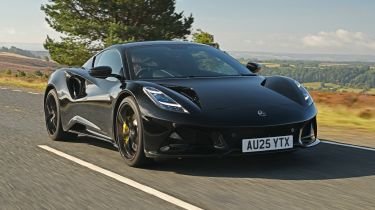
Lotus Emira V6 SE Manual 2026 Review: The Last Great Combustion Lotus
A flawed masterpiece — the combustion Lotus we’ll mourn forever.
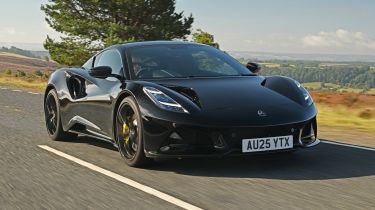
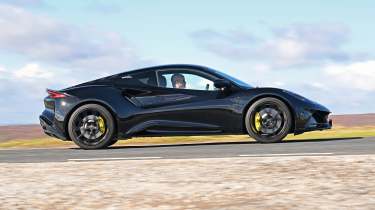
2026 Lotus Emira V6 SE Manual side profile
Price
£96,500 / from US$108,400
0-100 km/h
4.2 s
Power
400 hp @ 6,800 rpm
⚡ Quick Verdict
: The 2026 Lotus Emira V6 SE Manual is the last combustion-powered Lotus, and it goes out swinging. With hydraulic steering, a supercharged V6, and a beautiful manual gearbox, it delivers a driving experience no electrically-assisted rival can match. The price is steep and the daily usability compromise is real, but for the devoted driver, this is a modern classic in the making.
✓ The Good
- +Hydraulic steering feel unmatched by any modern rival
- +Supercharged V6 delivers theatrical, linear power delivery
- +6-speed manual gearbox is one of the finest in any sports car
- +Bonded aluminium chassis offers genuine mid-engined magic
- +Striking design that turns heads more than anything at the price
✗ The Trade-offs
- −Significant price premium over the Porsche Cayman GTS 4.0
- −Infotainment screen washes out badly in direct sunlight
- −Low-speed ride is firm to the point of irritation on broken tarmac
- −Dealer network remains small compared to German rivals
📑 In This Review
- Introduction
- Lotus Emira V6 SE Manual: Key Specs at a Glance
- Design and First Impressions
- On the Road: Steering, Ride and Handling
- The Supercharged V6 and Manual Gearbox
- Performance: Numbers in Context
- Interior, Tech and Daily Usability
- At a Glance: How the Emira V6 SE Manual Stacks Up Against Rivals
- Lotus Emira V6 SE vs Porsche 718 Cayman GTS 4.0: Which Is Better?
- Safety, Warranty and Ownership
- Who Should Buy the Lotus Emira V6 SE Manual?
- Verdict: Is the 2026 Lotus Emira V6 SE Manual Worth It?
- Frequently Asked Questions
Let’s not sugar-coat it: the Emira V6 SE Manual costs serious money, it won’t be comfortable on your commute, and you’ll struggle to fit a proper suitcase in it. But none of that matters when you’re fourth-gear deep into a sweeper and the hydraulic steering is feeding you every ripple in the bitumen through your fingertips. This is the last petrol-powered Lotus, full stop. It delivers a driving experience that no electrically-assisted rival can replicate, and if you care about that sort of thing — really, deeply care — then it’s worth every penny of its asking price. The Cayman GTS 4.0 is the smarter buy. The Lotus is the one you’ll never forget.
Introduction
There’s an uncomfortable truth hanging over every kilometre we drive the 2026 Lotus Emira V6 SE Manual: this is the last time Lotus will build a car like this. As Hethel transitions toward a fully electric future under Geely ownership, the Emira stands as the final petrol-powered monument to everything Colin Chapman’s company has represented since 1952 — lightweight construction, steering feel that borders on telepathic, and a near-religious commitment to the idea that a sports car should talk to its driver.
At £96,500 in the UK and from US$108,400 in the United States, the V6 SE Manual sits at the top of the Emira range. It pairs a Toyota-derived 3.5-litre supercharged V6 producing 400 horsepower with a proper six-speed manual gearbox and rear-wheel drive. This isn’t a car chasing lap times or Nürburgring benchmarks. It’s a car built to make every B-road, every Sunday morning blast, every unnecessary detour feel like an event. And in that brief, it’s extraordinary.
The shadow it must escape, though, is long. The Porsche 718 Cayman GTS 4.0 — with its naturally aspirated flat-six, electrically-assisted steering, and roughly £20,000 lower asking price — is the obvious benchmark. We spent a week with the Emira V6 SE Manual to find out whether the last combustion Lotus justifies its premium, its hype, and its place in sports car history.
Lotus Emira V6 SE Manual: Key Specs at a Glance
| Spec | 2026 Lotus Emira V6 SE Manual |
|---|---|
| Price (UK / US) | £96,500 / from US$108,400 |
| Engine | 3.5L supercharged V6 (Toyota-sourced) |
| Power | 400 hp @ 6,800 rpm |
| Torque | 410 N·m (302 lb-ft) |
| Gearbox | 6-speed manual |
| Drive | Rear-wheel drive |
| 0-100 km/h | 4.2 s |
| Top speed | 290 km/h (180 mph) |
| Fuel economy (combined) | ~9.8 L/100 km (~24 mpg US) |
| Kerb weight | 1,458 kg |
| Boot space | 359 L total |
| Warranty | 3 yrs unlimited mileage |
Porsche 718 Cayman GTS 4.0
The Emira’s closest direct rival — cheaper, polished and PDK-quick, but lacks hydraulic feel
BMW M2 Coupe
More power for less money, but front-engined and far less exotic on the road
Alpine A110 R
Lighter and more delicate than the Emira; closest to a traditional Lotus feel
For the 2026 model year, the V6 SE Manual brings a handful of updates including the new Hethel Yellow paint option and a removable hardtop for the first time. Underneath, the fundamentals remain the same bonded aluminium structure that has defined Lotus engineering for decades. 2026 Lotus Emira V6 SE Manual — £96,500 / from US$108,400 Engine 400 hp @ 6,800 rpm Torque 6-speed manual Drive 4.2 s Top speed ~9.8 L/100 km (~24 mpg US) Kerb weight 359 L total Warranty
Design and First Impressions
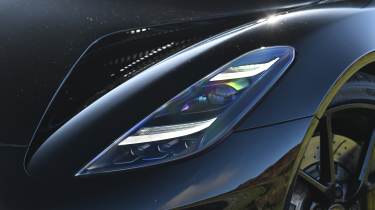
The Emira is, by some margin, the most visually striking car Lotus has ever produced. We’ve seen it in Hethel Yellow — the new-for-2026 hero colour — and in the darker Shadow Grey, and in both finishes the proportions are arresting. The mid-engine layout gives the car a cab-forward stance that recalls a junior McLaren more than any previous Lotus, while the sharp character lines running from the nose through the dihedral doors to the rear haunches lend it an aggression that the Evora, its spiritual predecessor, never quite possessed. Stand next to it in a car park and strangers assume it costs twice the asking price. That’s rare for any car at this level.
The bonded aluminium tub — a technology Lotus has refined since the original Elise — is visible in places where the bodywork meets the structure. For anyone who cares about engineering authenticity, it remains a selling point no stamped-steel rival can replicate. For 2026, the V6 SE now offers a removable hardtop option, which transforms the coupé into something approaching an open-air experience without the weight penalty of a full convertible mechanism. We found the hardtop straightforward to remove and refit, though at just under 12 kg it’s a two-hand job. On the car, it integrates cleanly and adds a different visual character to the roofline.
On the Road: Steering, Ride and Handling
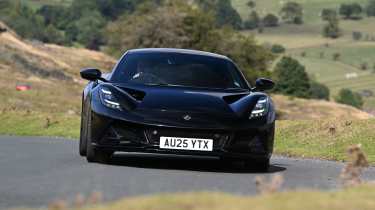
This is where the Emira earns every penny of its asking price, and where it distances itself from every rival in the segment. The steering is hydraulic — not electric, not electro-hydraulic, but old-school hydraulic power assistance acting on a proper rack. In an era where Porsche, BMW, and Alpine have all moved to electric power steering for efficiency and packaging reasons, Lotus is the last volume-adjacent manufacturer still offering hydraulic assistance in a sports car. The difference is night and day.
During our drive on a mix of A-roads and tight country lanes, the steering communicated surface changes, grip levels, and weight transfer with a fidelity that no electrically-assisted system we’ve tested in the past five years can match. There’s no dead zone on-centre. No artificial weighting ramp. The wheel simply tells you what the front tyres are doing, continuously, without filter or delay. It’s the kind of steering feel that reminds you why people fall in love with driving, and it’s the single biggest reason to choose the Emira over the Cayman.
The Tour-spec chassis — the standard setup on the V6 SE, as opposed to the firmer Sport option — strikes a reasonable but imperfect compromise. At motorway speeds, the Emira is genuinely composed; the bonded aluminium structure is rigid enough that scuttle shake is effectively absent, and the Bilstein dampers settle into a rhythm that makes long-distance cruising feasible if not luxurious. Drop below 50 km/h on broken urban tarmac, though, and the ride becomes busy, occasionally brittle. The low-speed secondary ride quality is the one area where the Cayman GTS 4.0, with its adaptive PASM dampers, feels more mature. We found the optional Goodyear Eagle F1 Supersport tyres (fitted to our test car) offered extraordinary dry grip without destroying wet-weather composure, though the Cup 2 option will appeal to buyers planning regular track use.
The chassis balance, once you commit to a B-road, is simply wonderful. The mid-engined layout gives the Emira a natural poise that front-engined rivals like the BMW M2 can only approximate. Turn-in is sharp, the car rotates precisely around the driver’s hip point, and the rear end remains adjustable on the throttle without ever feeling snappy. We pushed hard through a sequence of third-gear corners and found the limit of adhesion to be progressive, communicative, and exploitable without drama. This is a chassis that rewards skill without punishing ambition.
The Supercharged V6 and Manual Gearbox
The 3.5-litre V6 is Toyota-sourced — derived from the same 2GR family that powered everything from the Lotus Evora to the Toyota Camry — but Lotus has fitted an Edelbrock supercharger and retuned the ECU to deliver 400 horsepower at 6,800 rpm and 410 Nm of torque. The result is an engine with a character entirely distinct from the naturally-aspirated flat-six in the Cayman GTS 4.0. Where the Porsche builds power linearly and rewards you for wringing it to the redline, the Lotus delivers a muscular, surging wave of boost from around 3,500 rpm that pulls hard all the way to the limiter. It feels quicker than the numbers suggest, partly because the supercharger whine layered beneath the exhaust note adds a sense of mechanical theatre that a turbocharged engine simply can’t replicate.
The six-speed manual gearbox is a joy. The throw is short, the gate is well-defined, and the clutch take-up is precise enough that heel-and-toe downshifts become second nature within the first twenty minutes of driving. The rev-matching system — which can be toggled on or off — is effective for those who prefer it, but we found ourselves leaving it disabled. The pedal placement is near-perfect for blipping the throttle under braking, and the rhythm of matching engine speed to road speed through the gears is one of the most satisfying tactile experiences available in any modern car. This is, without exaggeration, one of the last new-build supercharged V6 and manual gearbox combinations on sale anywhere in the world, and it feels special in a way that no dual-clutch automatic or torque-converter transmission can emulate.
The exhaust note deserves a mention. In the default setting, the V6 produces a rich, baritone growl that deepens satisfyingly as revs climb. Switch to Sport mode and the bypass valves open, adding a harder edge and occasional overrun crackle that never descends into the artificial pop-and-bang theatrics of some German rivals. It’s an honest, mechanical sound, and it suits the car’s character perfectly.

Performance: Numbers in Context
The headline figures — 0-100 km/h in 4.2 seconds, 290 km/h top speed — place the Emira V6 SE Manual squarely among its rivals. It’s fractionally quicker to 100 km/h than the Cayman GTS 4.0 in manual guise (4.5 seconds) but marginally slower than the twin-turbocharged BMW M2 (4.1 seconds). On paper, the differences are marginal. On the road, the Lotus feels quicker than both, because the seating position is lower, the cabin is narrower, and the engine’s surge arrives with an immediacy that makes every straight feel shorter than it is.
The standard steel brakes — four-piston callipers gripping 370 mm front discs — proved more than adequate during spirited road driving. We experienced no fade across an extended period of hard use on a challenging B-road route, and the pedal feel is firm and progressive. The optional AP Racing six-piston setup, fitted to our test car, adds a further layer of confidence with stronger initial bite and more thermal headroom for track-day use. The Bilstein damping keeps the car stable under heavy braking without the nose diving excessively, and the overall braking performance inspires the kind of confidence you need when covering ground quickly on unfamiliar roads.
Interior, Tech and Daily Usability
The Emira’s cabin represents a quantum leap over any previous Lotus interior. The 10.25-inch central touchscreen runs a reworked infotainment system that supports wireless Apple CarPlay and Android Auto, and the 12.3-inch digital driver display is configurable and crisp. Material quality has improved dramatically — there’s genuine soft-touch surfacing on the dashboard and door cards, Alcantara is used generously on the steering wheel and seat centres, and the overall sense of occasion is heightened by the low-slung driving position and the narrow cockpit width that wraps around you like a single-seater. The optional KEF audio system — a British hi-fi partnership that makes perfect sense for a Norfolk-built sports car — delivers impressive clarity and bass depth, though in a car this focused, we suspect most buyers will prefer the soundtrack of the supercharged V6.
Daily usability, though, remains a compromise. Total luggage capacity is 359 litres, split between 208 litres behind the seats and 151 litres in the rear boot. That’s enough for a weekend bag and a soft holdall, but not for a proper touring holiday for two. Getting in and out over the wide sill requires a degree of flexibility — the dihedral doors help by opening wide, but the sill itself is high and narrow. Visibility rearward is limited by the thick C-pillars and small rear window; you learn to rely on the mirrors and the reversing camera. Our most significant ergonomic complaint is the infotainment screen brightness. In direct sunlight — even on a bright overcast day — the display washes out badly, making navigation prompts difficult to read. This is an issue Lotus needs to address, and we hope a software or hardware revision arrives before long.
At a Glance: How the Emira V6 SE Manual Stacks Up Against Rivals
| Spec | 2026 Lotus Emira V6 SE Manual |
|---|---|
| Price (UK / US) | £96,500 / from US$108,400 |
| Engine | 3.5L supercharged V6 (Toyota-sourced) |
| Power | 400 hp @ 6,800 rpm |
| Torque | 410 N·m (302 lb-ft) |
| Gearbox | 6-speed manual |
| Drive | Rear-wheel drive |
| 0-100 km/h | 4.2 s |
| Top speed | 290 km/h (180 mph) |
| Fuel economy (combined) | ~9.8 L/100 km (~24 mpg US) |
| Kerb weight | 1,458 kg |
| Boot space | 359 L total |
| Warranty | 3 yrs unlimited mileage |
Porsche 718 Cayman GTS 4.0
The Emira’s closest direct rival — cheaper, polished and PDK-quick, but lacks hydraulic feel
BMW M2 Coupe
More power for less money, but front-engined and far less exotic on the road
Alpine A110 R
Lighter and more delicate than the Emira; closest to a traditional Lotus feel
The Emira V6 SE Manual operates in a fascinating competitive set. The Porsche 718 Cayman GTS 4.0 is the closest direct rival on philosophy and power output. The BMW M2 Coupe offers more power and greater daily usability at a lower price. The Alpine A110 R trades outright power for the lightest kerb weight in the class and a singular focus on agility. Lotus Emira V6 SE Manual BMW M2 Coupe — — £96,500 £67,995 3.5 supercharged V6 3.0 twin-turbo I6 400 hp 460 hp 4.2 s 4.1 s 6-spd manual 6-spd manual or DCT Hydraulic Electric 1,458 kg 1,725 kg
Lotus Emira V6 SE vs Porsche 718 Cayman GTS 4.0: Which Is Better?
This is the comparison every potential Emira buyer wants answered, and it deserves a careful treatment. Both the Emira V6 SE Manual and the Porsche 718 Cayman GTS 4.0 are mid-engined, rear-wheel-drive sports cars with manual gearbox options and power outputs separated by just six horsepower. The philosophical overlap is enormous. But a roughly £21,000 price gap in the UK — the Lotus at £96,500, the Porsche at £75,300 — means the Emira must deliver something genuinely extra to justify its premium. As we discovered during our testing, it does — though not without caveats.
The engines could hardly be more different in character despite similar outputs. The Cayman GTS 4.0’s naturally aspirated 4.0-litre flat-six is one of the great internal combustion engines: it rewards you for revving it hard, delivers a metallic, almost racing-car wail above 6,000 rpm, and builds power in a perfectly linear crescendo. The Emira’s supercharged V6, by contrast, has a different personality — more muscular low-down, with a supercharger whine that adds a layer of mechanical texture absent from the Porsche. Where the Cayman asks you to work for its rewards, the Lotus delivers its punch with less effort but arguably less reward at the very top of the rev range. Neither approach is wrong. The Porsche’s engine is the more emotionally rich unit; the Lotus’s is the more immediately thrilling.
The steering comparison is the decisive battle. The Emira’s hydraulic rack is the single most significant differentiator between these two cars. During our back-to-back drives, the Cayman’s electrically-assisted system — which is among the best in the business — felt polished, accurate, and well-weighted. But next to the Lotus, it felt filtered. There was a thin but perceptible layer of digital mediation between the front tyres and the driver’s palms that the Emira simply doesn’t have. If steering feel is your priority — if you judge a sports car first and foremost by what the wheel tells you — the Lotus wins this comparison categorically. If you value a lighter, more effortless steering action for daily driving, the Porsche is the better companion.
Inside, the gap has narrowed but not closed. Porsche’s PCM infotainment system is mature, responsive, and well-integrated into a cabin that has been refined over multiple generations. The Emira’s cabin is a dramatic improvement over any previous Lotus, but the touchscreen washout issue in direct sunlight, the slightly less intuitive menu structure, and the narrower cockpit mean the Porsche feels like the more polished daily environment. For pure material quality and fit-and-finish, the Cayman edges it — though the Emira’s sense of occasion, with its low hip point and driver-focused architecture, is arguably more special.
Ownership is where Porsche pulls decisively ahead. The 718 Cayman benefits from a UK dealer network that dwarfs Lotus’s footprint. Porsche residual values are among the strongest in the industry — a three-year-old Cayman GTS typically retains over 60 percent of its original price. Lotus residuals are less proven historically, though the Emira’s limited production numbers and final-combustion-Lotus status may create a collector’s premium over time. Insurance, servicing costs, and parts availability all broadly favour the Porsche for the pragmatically-minded buyer.
On a track or a demanding B-road, the two cars diverge in feel even when their lap times converge. The Emira’s bonded aluminium tub delivers a sense of structural rigidity and connection to the road surface that the Cayman’s steel-and-aluminium construction matches dynamically but can’t replicate subjectively. The Lotus feels more alive, more theatrical, more mid-engined in the way it rotates and adjusts its attitude on the throttle. The Cayman, particularly in PDK-equipped form, is the faster, more clinical tool. With a manual gearbox, both cars demand engagement — but the Emira demands it with more reward.
| Spec | Lotus Emira V6 SE Manual | Porsche 718 Cayman GTS 4.0 |
|---|---|---|
| Price (UK) | £96,500 | £75,300 |
| Engine | 3.5 supercharged V6 | 4.0 NA flat-six |
| Power | 400 hp | 394 hp |
| Torque | 410 N·m | 430 N·m |
| Gearbox | 6-spd manual | 6-spd manual / 7-spd PDK |
| 0-100 km/h | 4.2 s | 4.5 s (manual) |
| Top speed | 290 km/h | 293 km/h |
| Weight | 1,458 kg | 1,450 kg |
| Steering | Hydraulic | Electric |
| Fuel economy | ~24 mpg US | ~27 mpg US |
<div style="background:linear-gradient(135deg,#f0f9ff,#e0f2fe); border-left:4px solid #2563eb; border-radius:12px; padding:24px 28px; margin:32px 0"> <p style="font-size:12px; font-weight:800; letter-spacing:0.14em; text-transform:uppercase; color:#1e40af; margin:0 0 10px">Which one is better?</p> <p><strong>Buy the Lotus Emira V6 SE Manual if</strong> you crave hydraulic steering feel, mid-engined drama, supercharged V6 theatre, and the rarity of a hand-built British sports car with the last great manual.</p> <p><strong>Buy the Porsche 718 Cayman GTS 4.0 if</strong> residual values, dealer network, fuel economy, and a polished daily-driver feel matter more than exclusivity — and you want to keep £20,000 in the bank.</p> <p><strong>Our pick</strong> is the Emira for the driver who already owns a sensible second car; the Cayman GTS 4.0 for the buyer running it as a primary sports car. Both are special — only one feels exotic.</p> </div>
Safety, Warranty and Ownership
The Emira comes equipped with dual front airbags, side airbags, electronic stability control, traction control, front and rear parking sensors, a reversing camera, and cruise control. The bonded aluminium structure is inherently strong, but Lotus is too low-volume a manufacturer to warrant Euro NCAP crash testing — a fact that applies equally to the Alpine A110 and has never meaningfully deterred buyers in this segment. We suspect most Emira buyers are cross-shopping on chassis pedigree, steering feel, and engine character rather than star ratings.
Standard warranty coverage is three years with unlimited mileage, complemented by an eight-year anti-perforation guarantee. Lotus Care extended warranty and service plans are available through the dealer network, which — while significantly smaller than Porsche or BMW’s — has expanded in recent years and now covers most major UK and European markets. The Toyota-sourced V6 engine is a reliability asset; these units have a proven track record across millions of Toyota and Lexus applications, and the supercharger is a well-understood aftermarket-grade component. Real-world reliability should be strong by sports car standards, though buyers in more remote areas should verify proximity to an authorised Lotus service centre before committing.
Who Should Buy the Lotus Emira V6 SE Manual?
The ideal Emira buyer is a driving enthusiast who already owns a practical daily car and wants a weekend and B-road companion that delivers genuine mechanical theatre. This person values steering feel above infotainment polish, prefers a manual gearbox to any automatic, and is drawn to the idea of owning the final petrol-powered Lotus — a car that will almost certainly appreciate in desirability if not necessarily in monetary value. The Emira isn’t the rational choice in its segment. It’s the emotional one. If you’re cross-shopping purely on price, equipment, and dealer convenience, the Cayman GTS 4.0 is the better buy. If you’re cross-shopping on steering feel, rarity, and the sheer romance of a hand-built British sports car with a supercharged V6 and a proper manual, the Emira stands alone.
Buyers who should look elsewhere include those needing genuine daily practicality — the Emira’s limited luggage space and firm low-speed ride make it a wearing commute companion. Those prioritising resale value should note that Lotus residuals, while im proving, remain less proven than Porsche’s. And buyers who already own a Cayman GT4 or similar will find the Emira’s performance envelope overlapping with what they already have, albeit with a very different character.
Verdict: Is the 2026 Lotus Emira V6 SE Manual Worth It?
A flawed masterpiece — that was our headline, and we stand by it after a week and several hundred kilometres behind the Emira’s Alcantara-wrapped wheel. The flaws are real: the price premium over the Cayman is significant, the infotainment screen is poor in sunlight, the low-speed ride is firm, and the dealer network is thin. These are legitimate reasons for a buyer to hesitate, and we wouldn’t criticise anyone for choosing the Porsche on practical grounds.
But the masterpiece part is real too. The hydraulic steering alone justifies the Emira’s existence in 2026 — it’s a reminder of what we’re losing as the industry moves to electric assistance and, eventually, electric propulsion entirely. The supercharged V6 is theatrical and characterful. The manual gearbox is one of the finest we’ve used in any production car. And the bonded aluminium chassis delivers a mid-engined driving experience that feels fundamentally more connected, more alive, and more special than anything else at or near this price.
We believe the Emira V6 SE Manual will be remembered as one of the great Lotus models — not because it’s perfect, but because it captures the essence of what makes driving rewarding at a time when that essence is vanishing. The last combustion Lotus goes out not with a whimper but with a supercharged howl and a perfectly blipped downshift. If that matters to you, buy one before they’re gone.
Frequently Asked Questions
How much does the 2026 Lotus Emira V6 SE Manual cost?
The 2026 Lotus Emira V6 SE Manual is priced at £96,500 in the UK and from US$108,400 in the United States, placing it at the top of the Emira range.
Is the Lotus Emira V6 really a Toyota engine?
Yes — the 3.5-litre V6 is derived from Toyota’s 2GR engine family, a unit with a strong reliability track record across millions of Toyota and Lexus applications. Lotus adds an Edelbrock supercharger and retunes the ECU to deliver 400 hp. It’s a strength, not a weakness: Toyota’s engineering fundamentals provide the reliability backbone, while Lotus’s calibration delivers the performance character.
How does the Lotus Emira compare to the Porsche 718 Cayman GTS 4.0?
The Emira offers hydraulic steering feel and more mid-engined drama at a roughly £21,000 premium. The Cayman GTS 4.0 counters with a more emotionally rich naturally-aspirated engine, a more polished interior, stronger residual values, and a larger dealer network. For pure driving feel, the Lotus wins; for daily usability and ownership pragmatism, the Porsche is hard to beat.
Is the Emira V6 SE Manual reliable?
The Toyota-sourced 3.5-litre V6 provides strong reliability fundamentals — this engine family has proven itself across millions of vehicles worldwide. Lotus backs the Emira with a 3-year unlimited-mileage warranty and an 8-year anti-perforation guarantee for added peace of mind.
How much luggage space does the Lotus Emira have?
The Emira offers 359 litres of total luggage capacity, split between 208 litres behind the seats and 151 litres in the rear boot — enough for a weekend trip for two, but not extended touring.
Is the Lotus Emira the last petrol-powered Lotus?
Yes. Lotus has confirmed the Emira will be the final combustion-powered model it produces, as the company transitions to a fully electric future. This makes the V6 SE Manual the last chance to own a new petrol-powered Lotus sports car.
Should I buy the Emira V6 manual or auto?
Choose the manual for the fullest engagement — the six-speed gearbox is one of the finest available in any modern sports car, and it makes the Emira feel more special. Choose the auto if the car will see regular commuting duties in heavy traffic, where the self-shifting transmission reduces fatigue on a daily basis.
