

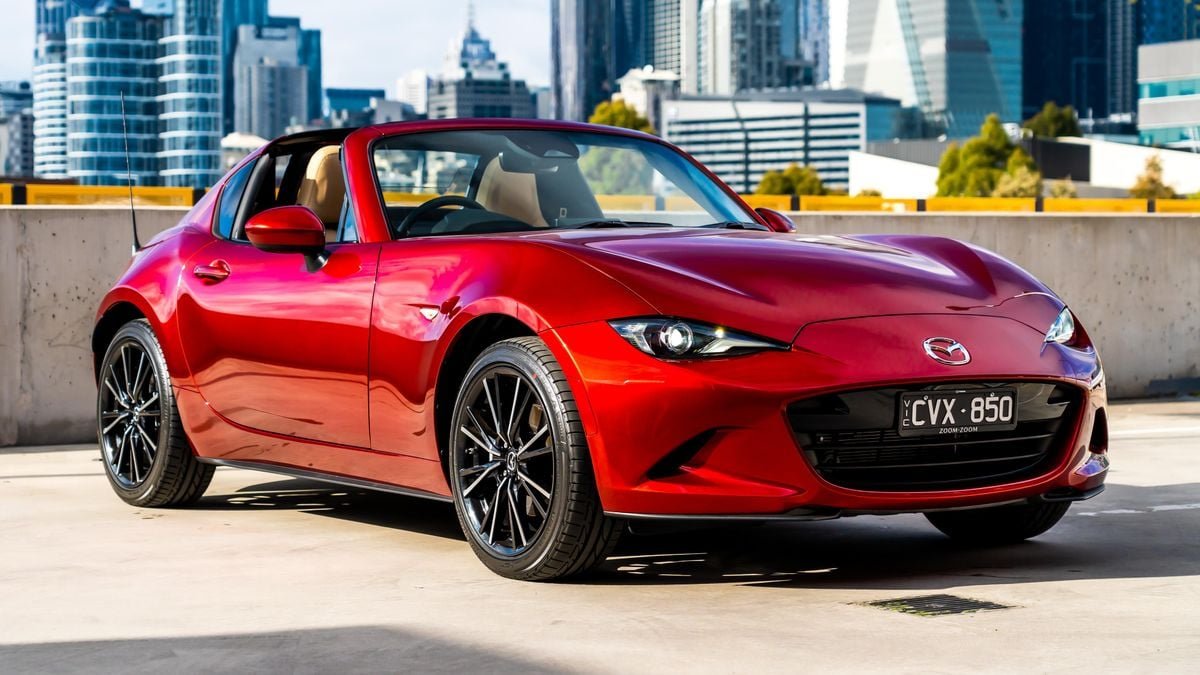
2026 Mazda MX-5 RF GS-P Review: The Sweet-Spot Roadster
The RF roadster that nails the brief.
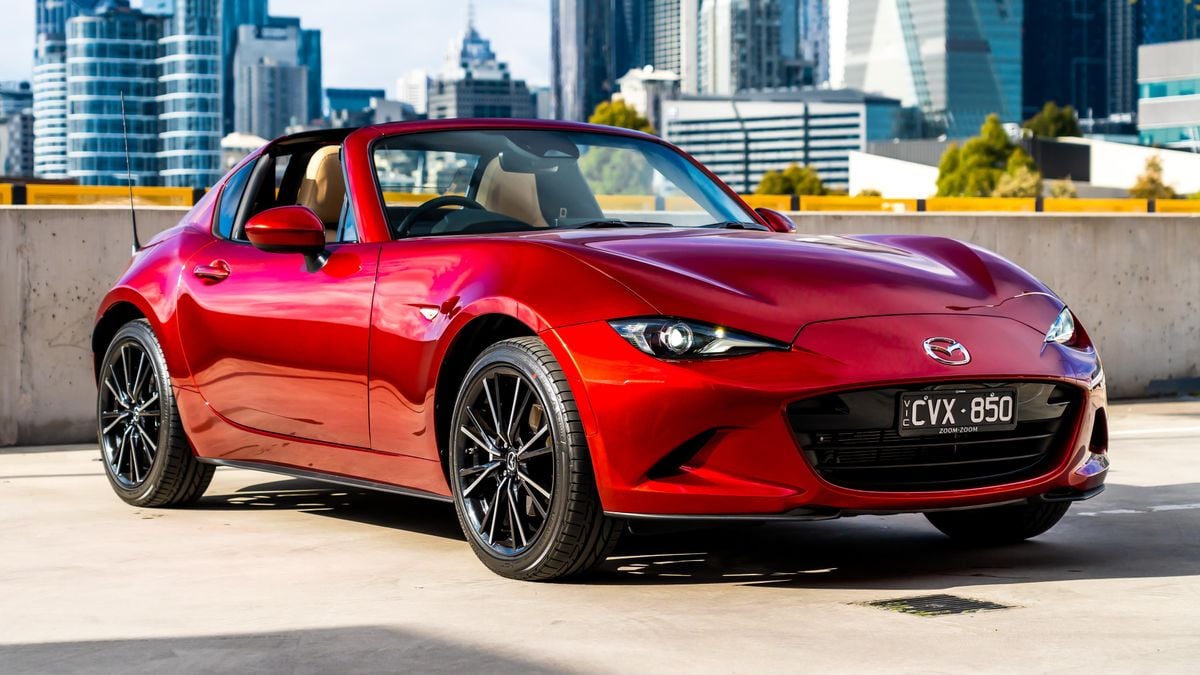
2026 Mazda MX-5 RF GS-P in black, dynamic three-quarter view
Price
~$48,000
0-100 km/h
~6.5 s
Power
135 kW @ 7,000 rpm
⚡ Quick Verdict
The 2026 MX-5 RF GS-P with the six-speed manual is the most joy-per-dollar sports car you can buy in Australia right now. A willing naturally aspirated engine, a sublime gearbox, featherweight dynamics, and a targa roof that lets the sunshine in without the faff of a soft top, it’s a brilliant combination. At roughly $48,000 before on-roads it isn’t cheap, but no rival delivers the same cocktail of involvement, efficiency, and open-top charm. If two seats and a comically small boot are things you can live with, the GS-P is the MX-5 we’d spend our own money on.
## At a Glance: How the MX-5 RF GS-P Stacks Up
✓ The Good
- +One of the best manual gearboxes money can buy — short throws, positive engagement, and a clutch with an easy-to-find bite point
- +Feathery kerb weight of roughly 1,140 kg delivers handling fluency that heavier rivals simply cannot match
- +Retractable hardtop adds refinement and security without destroying the open-air roadster character
- +Bilstein dampers and an asymmetric LSD are standard on the manual GS-P — no sports pack required
- +Outstanding fuel economy for a sports car at 6.9 L/100 km combined on 95 RON
✗ The Trade-offs
- −Strictly a two-seater with a tiny 130-litre boot and awkward behind-the-seat cup holder placement
- −ANCAP safety rating expired January 2024 — there is no current active safety rating on offer
- −Manual GS-P gets fabric bucket seats rather than the sports pack’s Recaros — an option that cannot be paired with the automatic
- −Roof opens and closes only at speeds up to 10 km/h, and the mechanism is noticeably slower than some European rivals
📑 In This Review
- At a Glance: How the MX-5 RF GS-P Stacks Up
- Design and Road Presence
- Inside the Cabin
- What’s It Like to Drive
- Performance and Engine
- 2026 Mazda MX-5 RF GS-P vs Toyota GR86: Which Is Better?
- Safety and Warranty
- Practicality and Ownership
- Who Should Buy the 2026 Mazda MX-5 RF GS-P
- Verdict
- Frequently Asked Questions
The 2026 MX-5 RF GS-P with the six-speed manual is the most joy-per-dollar sports car you can buy in Australia right now. A willing naturally aspirated engine, a sublime gearbox, featherweight dynamics, and a targa roof that lets the sunshine in without the faff of a soft top, it’s a brilliant combination. At roughly $48,000 before on-roads it isn’t cheap, but no rival delivers the same cocktail of involvement, efficiency, and open-top charm. If two seats and a comically small boot are things you can live with, the GS-P is the MX-5 we’d spend our own money on.
At a Glance: How the MX-5 RF GS-P Stacks Up
| Spec | Mazda MX-5 RF GS-P | Toyota GR86 GTS | Subaru BRZ | Ford Mustang EcoBoost |
|---|---|---|---|---|
| Price (AUD, excl. on-roads) | ~$48,000 | $46,140 | ~$43,790 | ~$71,990 |
| Engine | 2.0L NA I4 | 2.4L NA flat-4 | 2.4L NA flat-4 | 2.3L turbo I4 |
| Power | 135 kW @ 7,000 rpm | 174 kW @ 7,000 rpm | 174 kW @ 7,000 rpm | 232 kW @ 5,500 rpm |
| Torque | 205 Nm @ 4,000 rpm | 250 Nm @ 3,700 rpm | 250 Nm @ 3,700 rpm | 475 Nm @ 3,000 rpm |
| 0-100 km/h | ~6.5 s | ~6.1 s | ~6.3 s | ~5.3 s |
| Weight (kerb) | ~1,140 kg | ~1,290 kg | ~1,280 kg | ~1,650 kg |
| Transmission | 6-speed manual (6AT opt.) | 6MT / 6AT | 6MT / 6AT | 10-speed auto |
| Seats | 2 | 2+2 | 2+2 | 4 |
| Fuel (L/100 km, combined) | 6.9 | 9.5 | 9.5 | 10.2 |
| Warranty | 5yr / unlimited km | 5yr / unlimited km | 5yr / unlimited km | 5yr / unlimited km |
Toyota GR86 GTS
Closest direct rival — more power and grip, but 150 kg heavier and no targa roof.
Subaru BRZ tS
GR86 mechanical twin tuned for stability over playfulness — pick this for the chassis composure.
Ford Mustang EcoBoost
Twice the torque and four seats — but a different car entirely, and roughly $24K more.
The lightweight roadster segment keeps shrinking, yet the MX-5 RF GS-P still faces credible rivals, some of which land in the same price bracket almost by accident. Toyota’s GR86 and its Subaru BRZ twin bring more power and a fixed coupe body. Ford’s EcoBoost Mustang, on the other hand, drags muscle-car presence and a turbo engine into the same conversation, if not quite the same postcode. To help you weigh up the options, we’ve laid the key specifications side by side below. Mazda MX-5 RF GS-P Subaru BRZ —— ~$48,000 ~$43,790 2.0L NA I4 2.4L NA flat-4 135 kW @ 7,000 rpm 174 kW @ 7,000 rpm 205 Nm @ 4,000 rpm 250 Nm @ 3,700 rpm ~6.5 s ~6.3 s ~1,140 kg ~1,280 kg 6-speed manual (6AT opt.) 6MT / 6AT 2 2+2 6.9 9.5 5yr / unlimited km 5yr / unlimited km
Design and Road Presence
The ND3-generation MX-5 has been with us since 2024, and its facelift brought subtle but worthwhile styling updates that keep the two-seater looking fresh against newer metal. Up front, Mazda has folded the daytime running lamps into the main headlamp cluster, ditching the separate lower-bumper DRLs from the ND2. The face reads cleaner and more cohesive as a result. The adaptive cruise sensor sits neatly in the lower grille opening, and the bonnet, one of the largest single design elements on the car, carries crisp cuts and creases that channel air toward the windscreen.
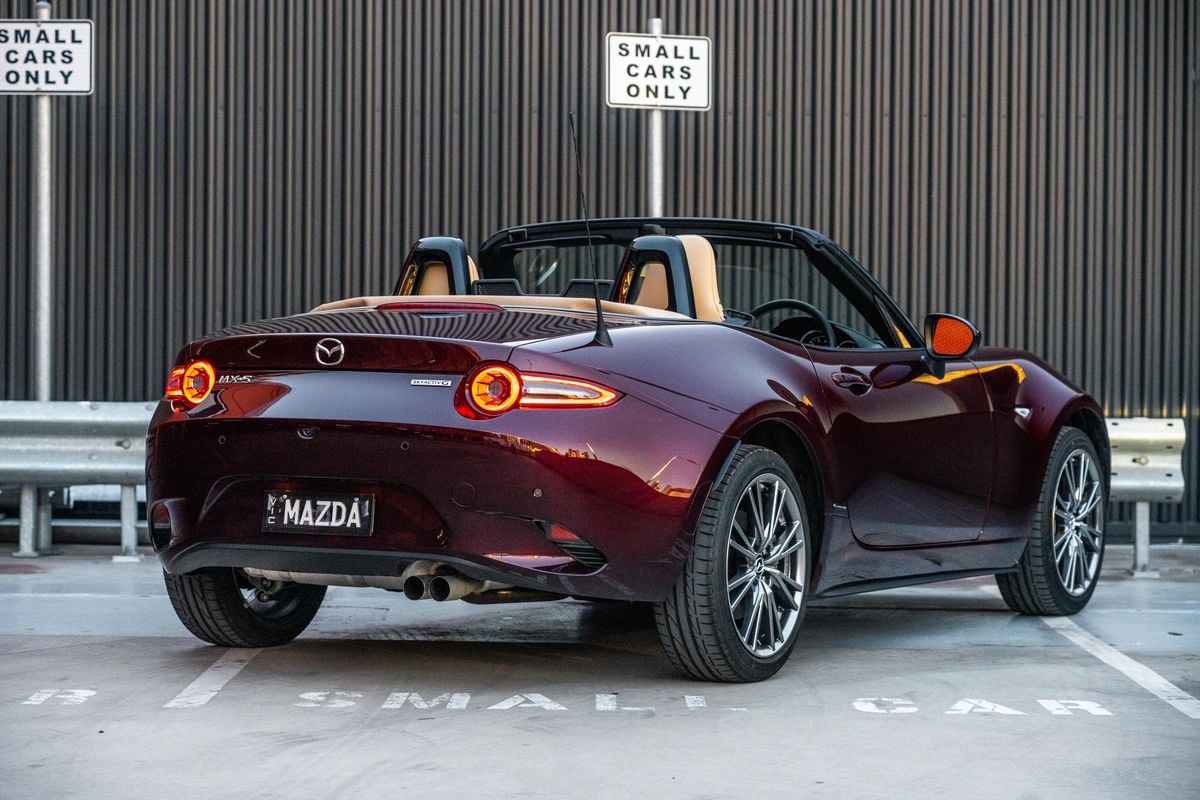
Our test car wore Jet Black Mica. It’s not the colour that grabs you from across a car park the way Crystal Soul Red Metallic or Artisan Red would, but the black finish has a quiet appeal that flatters the RF’s hardtop silhouette. The retractable targa roof gives the car a distinctive coupe-on-demand look, with buttressed C-pillars and flying buttress styling elements unique to the RF. From the side, the MX-5 looks impossibly low and impossibly short. At 3,915 mm in length it’s shorter than a Volkswagen Polo, and it sits just 1,230 mm tall with the roof in place. It’s a car with genuine presence, the sort that draws double-takes from pedestrians and ap proving nods from fellow enthusiasts.
The RF GS-P rides on standard alloy wheels, not the forged BBS items reserved for the sports pack, and does without the red Brembo brake calipers. It’s a cleaner, more understated look, and we reckon it suits the car’s ethos perfectly. The LED tail-lamp update from the ND3 facelift rounds out the rear nicely, giving the car a modern signature that’s recognisable even in low light.
Inside the Cabin
Climb into the MX-5’s cabin and you’re immediately reminded this is a two-seat sports car and nothing else. No rear seats, no token bench behind the front chairs, just a small shelf, a shallow parcel area, and a single cup holder that lives either between the seats or, more accurately, right behind the passenger’s elbow. It’s a quirk owners learn to live with, though it remains one of the MX-5’s most debated interior features.
The GS-P gets Mazda’s fabric bucket seats instead of the GT’s leather-appointed items or the sports pack’s Recaro units. The fabric chairs grip well, are supportive through corners, and come with seat heating as standard, a welcome inclusion during an Australian winter. They lack the aggressive bolstering of the Recaros, but for road driving they’re perfectly judged. The driving position is spot-on: low, close to the centre of gravity, with a steering wheel that adjusts for both reach and rake. Every control falls naturally to hand in a cabin designed around the driver.
The 8.8-inch Mazda Connect infotainment display sits atop the dashboard and runs a clean, responsive interface. Apple CarPlay and Android Auto are included, though the connection type (wired or wireless) depends on the market specification. Climate control is single-zone, which is forgivable in a car this small. What you won’t find in the GS-P is headrest-mounted speakers, those are exclusive to the GT variant. The Bose nine-speaker audio system remains an optional extra on the GS-P, and given the wind noise that accompanies roof-down motoring, it’s worth considering. The RF’s cabin is noticeably quieter than the soft-top’s with the roof in place, which makes the GS-P RF the more liveable daily proposition.
What’s It Like to Drive
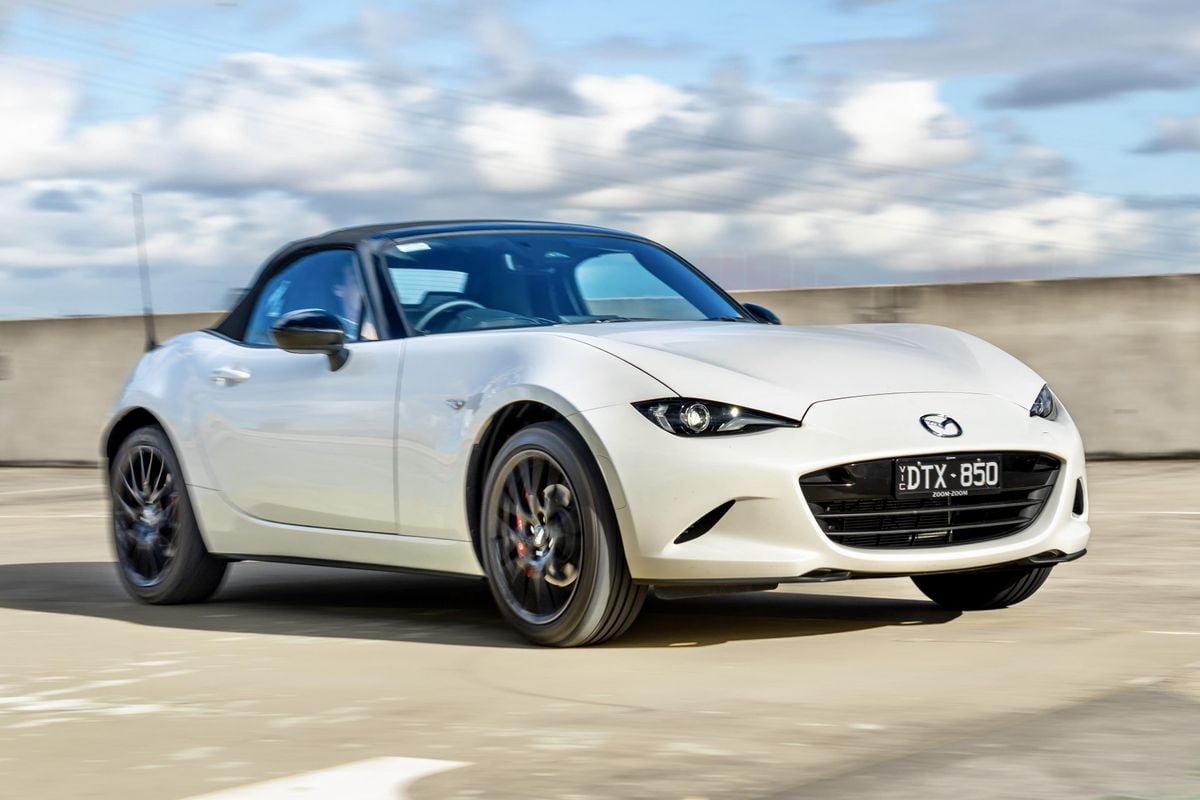
This is where the MX-5 earns its reputation, and the GS-P with the six-speed manual is the purest expression of that philosophy. The gearbox is, in a word, sublime. Short, mechanical throws click between gates with an almost rifle-bolt precision, and the clutch pedal is light enough that an hour in city traffic won’t leave your left leg aching, yet firm enough to feel deliberate. The bite point is easy to locate and consistent. There’s no need to second-guess first gear or hill starts. It’s one of the best manual transmissions on sale at any price, let alone under $50,000.
The Skyactiv-G 2.0-litre naturally aspirated four-cylinder serves up 135 kW at 7,000 rpm and 205 Nm at 4,000 rpm. Those numbers look modest on paper, but in a car weighing roughly 1,140 kg they translate into a genuinely engaging powertrain. No turbo lag to manage, no surge of boost to overwhelm the rear tyres, just a linear, predictable delivery that rewards you for keeping the engine in its sweet spot above 4,000 rpm. Wind it out toward the 7,500 rpm redline and the induction sound enhancer pipes a satisfying mechanical snarl into the cabin. It’s not fast in the way a turbocharged rival is fast, but it’s never slow enough to frustrate, and the way it delivers its power makes you feel like a better driver.
The GS-P manual scores Bilstein dampers, an asymmetric limited-slip differential, and DSC-Track mode as standard, kit that isn’t available on the automatic GS-P. The Bilsteins do an admirable job of controlling body motions without crashing over every bump. The ride is firm, certainly, but it’s far from harsh, and on a typical Australian back road the dampers keep the chassis beautifully composed. The steering is electrically assisted, but Mazda has tuned it to feel remarkably like a hydraulic unit. Turn-in is sharp, the weighting builds naturally, and there’s genuine feedback through the rim. You always know what the front tyres are up to. Chuck the MX-5 into a corner and the light kerb weight, low centre of gravity, and rear-drive layout combine to deliver a level of fluency and adjustability that heavier rivals simply cannot replicate.
With the roof retracted, a process that takes roughly 13 seconds at speeds up to 10 km/h, the driving experience moves up another notch. Wind noise and buffeting are better controlled than in the soft-top version thanks to the RF’s fixed buttress pillars, so motorway cruising is more relaxed, yet the open-air sensory experience remains. You can hear the engine, feel the wind, and enjoy an intimacy with the road that no fixed-roof coupe can match. Even with the roof up, the RF’s cabin is noticeably quieter than the soft-top’s, making it the better choice for daily commuters who also want weekend thrills.
The DSC-Track mode deserves a mention. Engaged via a button on the centre console, it loosens the stability-control intervention enough to allow some slip angle without fully disabling the safety net. It strikes an excellent balance: experienced drivers can explore the chassis’s limits with a safety buffer, while less confident drivers can leave the standard DSC on and enjoy the MX-5’s inherently friendly handling. The car will eventually step out if provoked, it’s rear-wheel drive with a short wheelbase, after all, but the threshold is high and the behaviour predictable.
Performance and Engine
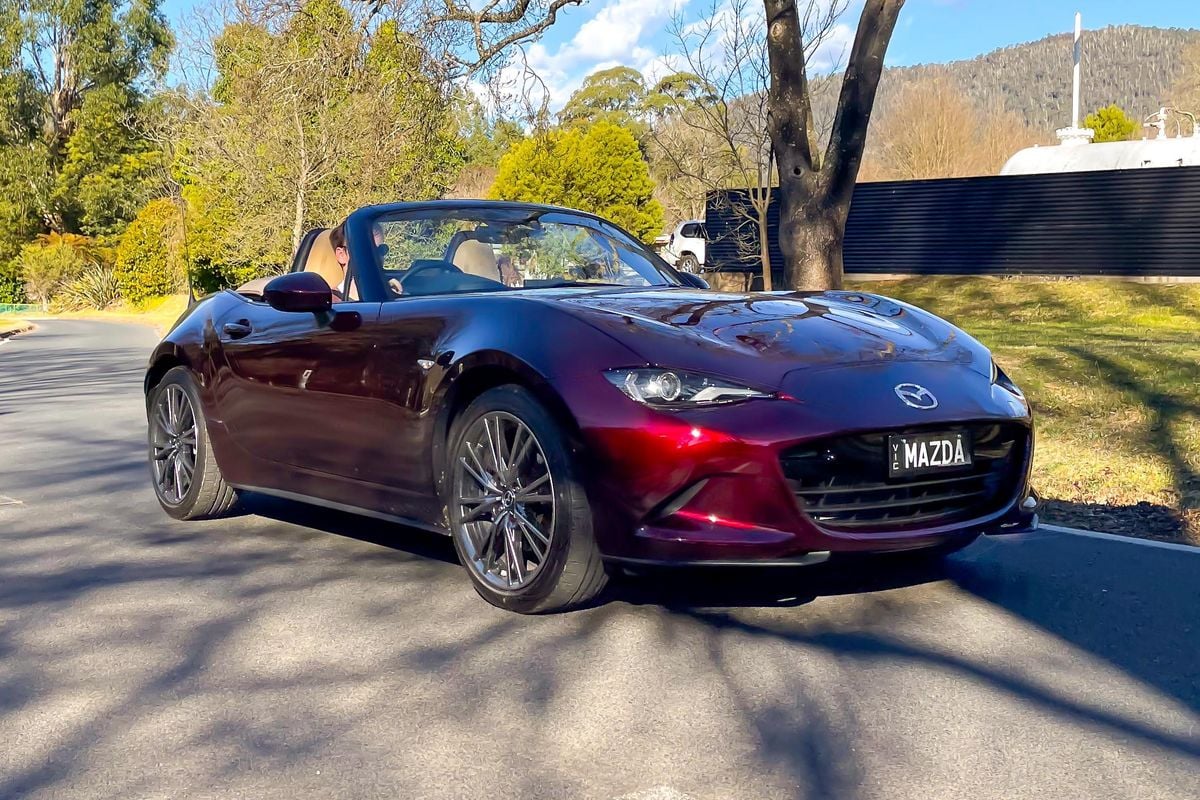
Let’s put the MX-5’s power output into perspective. At 135 kW, the Skyactiv-G 2.0-litre gives away nearly 40 kW to the Toyota GR86’s 2.4-litre flat-four. On a spec sheet, that looks like a significant deficit. Behind the wheel, it matters far less than you might think. The MX-5 is roughly 150 kg lighter than the GR86, and its power-to-weight ratio of approximately 118 kW per tonne is adequate for the kind of driving the car was designed to do. Spirited B-road blasts, not drag-strip sprints. The 0-100 km/h dash is dispatched in around 6.5 seconds, which is brisk enough to merge confidently and entertaining enough to provoke a grin.
The naturally aspirated engine’s character is a key part of the appeal. Power builds progressively, the throttle response is instantaneous, and there’s no torque-steer or turbo-related drama to manage. It’s a powertrain that encourages you to use all of the rev range, and it rewards that engagement with a satisfying mechanical voice. Peak torque arrives at 4,000 rpm, which means you don’t need to wring the engine’s neck to make progress. Short-shifting through the gears delivers easy, relaxed cruising, while holding gears and riding the torque curve delivers genuine excitement.
Fuel economy is one of the MX-5’s unsung strengths. The combined figure of 6.9 L/100 km on 95 RON premium unleaded is genuinely outstanding for a sports car, and we saw figures in the high sixes on a highway run with the roof closed. City driving pushes that closer to 9.0 L/100 km, but even that figure will embarrass many small hatchbacks. The 45-litre fuel tank is small, but given the frugal engine, a realistic range of over 600 km is achievable on a highway cruise. It’s one of those rare sports cars that makes sense as a daily driver from an ownership perspective.
2026 Mazda MX-5 RF GS-P vs Toyota GR86: Which Is Better?
This is the head-to-head every MX-5 buyer asks about, and for good reason. The Toyota GR86 and its Subaru BRZ twin are the MX-5’s closest rivals in spirit, price, and intent. Both prioritise driver engagement over outright speed, both offer a manual gearbox, and both sit in the mid-$40,000 to low-$50,000 bracket in Australia. The question is: which one should you buy?
The numbers favour the GR86 on paper. Its 2.4-litre naturally aspirated flat-four produces 174 kW and 250 Nm, significantly more than the MX-5’s 135 kW and 205 Nm. The GR86 is quicker to 100 km/h, dispatching the sprint in around 6.1 seconds compared to the MX-5’s 6.5. It has a higher power-to-weight ratio of 135 kW per tonne versus the Mazda’s 118. If outright straight-line performance is your priority, the GR86 wins.
The MX-5, though, has its own set of trump cards. At roughly 1,140 kg it’s approximately 150 kg lighter than the GR86, and that weight advantage permeates every aspect of the driving experience. The steering feels lighter and more responsive. The brakes have less mass to haul down. The chassis changes direction with an agility that the GR86, good as it is, cannot quite match. The MX-5 feels like it’s operating on a different plane of nimbleness. It’s the sports car equivalent of a bantamweight boxer, and that lightness is addictive.
The roof is the other major differentiator. The MX-5 RF’s retractable hardtop gives you the option of open-air motoring in roughly 13 seconds, something the GR86’s fixed coupe roof simply can’t offer. If you value the experience of driving with the wind in your hair, the MX-5 is the only choice. The flip side is that the GR86’s fixed roof means better structural rigidity, a more generous 226-litre boot (versus the MX-5’s 130 litres), and token rear seats that can accommodate small children or, more realistically, a bag of groceries. It’s a more practical proposition, if "practical" is a word you want to associate with a two-door sports car.
The manual gearbox in both cars is excellent, but the MX-5’s has the edge. Its throws are shorter, its action more precise, and its feel more mechanical. The GR86’s six-speed is very good, better than most gearboxes at this price, but the Mazda’s is arguably the best manual transmission in the business. If shifting gears is a big part of why you buy a sports car, the MX-5 rewards you more.
Fuel economy swings decisively toward the Mazda. The MX-5 sips 6.9 L/100 km combined; the GR86 drinks 9.5. Over a year of driving, the difference adds up to hundreds of dollars at the pump. For a car that’s supposed to be a guilt-free weekend toy, the MX-5’s frugality is a genuine advantage.
On the road, the character difference is pronounced. The MX-5 feels light on its feet, playful, and accessible. You can explore its limits on a public road without venturing into licence-losing territory. The GR86 is more serious, more aggressive, and faster in a straight line, but it requires more commitment to access its performance. It’s a sharper tool, but the MX-5 is the one you’ll find excuses to drive.
Here is a direct specification comparison:
| Spec | Mazda MX-5 RF GS-P | Toyota GR86 GTS |
|---|---|---|
| Price (AUD, excl. on-roads) | ~$48,000 | $46,140 |
| Engine | 2.0L NA I4 | 2.4L NA flat-4 |
| Power | 135 kW @ 7,000 rpm | 174 kW @ 7,000 rpm |
| Torque | 205 Nm @ 4,000 rpm | 250 Nm @ 3,700 rpm |
| 0-100 km/h | ~6.5 s | ~6.1 s |
| Weight (kerb) | ~1,140 kg | ~1,290 kg |
| Roof | Power retractable hardtop | Fixed coupe |
| Boot | 130 L | 226 L |
| Fuel economy (combined) | 6.9 L/100 km | 9.5 L/100 km |
Buy the Mazda MX-5 RF GS-P if you want top-down driving, the best manual gearbox in the business, sub-1,200 kg featherweight handling, and a roadster you can use as a daily driver.
Buy the Toyota GR86 if you want more power, a fixed coupe with marginal back seats, the best bang-per-dollar performance at this price point, and a sharper edge on track days.
**Our pick** is the MX-5 RF GS-P for sheer joy per kilometre — the GR86 is faster on paper, but the Miata is the one you will keep finding excuses to drive.
Safety and Warranty
The safety picture for the MX-5 is a mixed bag. The pre-update ND model held a five-star ANCAP rating under the 2016 testing criteria, achieving 35.20 out of 37. That rating expired on 1 January 2024, though, and there’s currently no active ANCAP score for the ND3-generation MX-5. Prospective buyers should be aware of this. It doesn’t mean the car is unsafe; it simply means ANCAP hasn’t re-tested it under current protocols.
Standard active safety equipment includes autonomous emergency braking (AEB), blind-spot monitoring, rear cross-traffic alert, lane departure warning, traffic sign recognition, and adaptive cruise control with a radar-based system. There are four airbags, front and side, which is fewer than the six or more found in most modern cars. It’s a reminder that the MX-5 was designed primarily as a driver’s car, not a safety showcase.
Mazda backs the MX-5 with a five-year, unlimited-kilometre warranty, matching the coverage offered by Toyota and Subaru. Five years of roadside assist is included, and Mazda offers a five-year capped-price servicing program. Service intervals are set at 12 months or 15,000 km, whichever comes first. It’s straightforward, predictable ownership coverage that aligns with the car’s low-maintenance philosophy.
Practicality and Ownership
Let’s be honest: if you’re cross-shopping the MX-5 against anything with more than two seats, it’s already off the shortlist. The 130-litre boot is enough for a couple of soft bags or carry-on suitcases, and perhaps a backpack if you pack carefully. There’s no frunk, the front end is entirely occupied by the engine and ancillaries. The cabin offers minimal storage beyond a small glovebox, door pockets, and the aforementioned cup holder that doubles as a passenger-elbow irritant.
For a two-person weekend getaway, the MX-5 copes. For anything more, it doesn’t. That’s by design. Mazda has never tried to make the MX-5 anything other than what it is, and the tight packaging is part of its charm. If you need cargo space, there are other cars. If you need driving joy in a compact package, this is the one.
The RF’s hardtop makes it more liveable as a daily than the soft-top, particularly on motorways where the reduced wind noise and improved security are tangible benefits. With the roof up, the cabin is quiet enough for comfortable commuting, and the heated seats take the edge off winter mornings. Running costs are minimal thanks to the frugal engine, and 12-month or 15,000 km service intervals keep the MX-5 out of the workshop. Insurance is typically affordable for a sports car of this size and power, too, another ownership win.
Who Should Buy the 2026 Mazda MX-5 RF GS-P
The ideal MX-5 buyer prioritises the driving experience above all else. They might be an enthusiast looking for a weekend toy that doubles as a capable commuter. They might be a retiree rewarding themselves after decades of practical family cars. They might be part of a two-car household where the other vehicle handles the heavy lifting and the MX-5 handles the grinning. The GS-P in RF form suits all of these buyers because it balances engagement with livability. The hardtop, the heated seats, the respectable fuel economy, and the polished ride make it easier to live with than a stripped-out track special.
You should skip the MX-5 RF GS-P if you regularly need to carry more than one passenger, if you require meaningful boot space for prams, golf bags, or weekly grocery shops, or if your idea of a sports car is something that pins you to the seat in a straight line. The MX-5 isn’t that car. It won’t win a traffic-light drag race against a turbocharged rival, and its 130-litre boot will frustrate anyone with more than a weekend bag. If straight-line speed and practicality are non-negotiable, the Toyota GR86, Subaru BRZ, or even a used hot hatch will serve you better.
⚡ Our Verdict
The RF roadster that nails the brief.
The GS-P is the sweet spot of the MX-5 RF range. You don’t need the sports pack’s Recaro seats and Brembo brakes to fall in love with this chassis. The standard Bilstein dampers, asymmetric limited-slip differential, and DSC-Track mode deliver a driving experience that’s 95 per cent of the GT RS’s at a considerably lower price. The RF’s retractable hardtop adds a layer of refinement and all-weather security without killing the open-top character that defines the MX-5 experience. It’s the roadster for people who want the best of both worlds. At roughly $48,000 before on-road costs, it isn’t cheap for a small two-seat sports car, and we understand why some buyers would consider a lightly used ND2 instead. But if you’re buying new, the GS-P manual offers the best value equation in the MX-5 range. It undercuts the GT by several thousand dollars, yet you sacrifice very little in terms of equipment or driving involvement. In a market increasingly dominated by crossovers, hybrids, and electric SUVs, the MX-5 RF GS-P is a reminder of what driving was always supposed to be about: connection, engagement, and the simple joy of being behind the wheel. It’s the best driver’s car under $50,000 in Australia, and we suspect it’ll hold that title for some time yet.
Frequently Asked Questions
How much does the 2026 Mazda MX-5 RF GS-P cost in Australia?
The MX-5 RF GS-P manual is priced at approximately $48,000 before on-road costs, including freight and pre-delivery. The automatic version is available at a small premium. That positions it below the RF GT ($53,790) and well below the RF GT RS with the sports pack ($56,790).
What’s the 0-100 km/h time of the MX-5 RF GS-P?
The MX-5 RF GS-P manual covers the 0-100 km/h sprint in approximately 6.5 seconds. The RF is fractionally slower than the soft-top Roadster due to the approximately 50 kg weight penalty of the retractable hardtop mechanism.
Is the GS-P available with the sports pack?
Yes, but only on the manual transmission. The GS-P manual can be optioned with the sports pack for approximately $3,000 to $4,000 extra, adding Recaro seats, Brembo brakes with red calipers, and BBS forged alloy wheels. The GS-P automatic cannot be paired with the sports pack.
How does the MX-5 RF GS-P compare to the Toyota GR86?
The GR86 has more power (174 kW vs 135 kW) and is faster in a straight line (6.1 s vs 6.5 s). The MX-5, though, is roughly 150 kg lighter, more nimble, has a retractable hardtop for open-air driving, and offers what many consider the better manual gearbox. It’s also more fuel-efficient at 6.9 L/100 km versus 9.5 L/100 km.
What’s the warranty on a 2026 Mazda MX-5?
Mazda offers a five-year, unlimited-kilometre warranty on the MX-5, along with five years of roadside assist and access to a five-year capped-price servicing program. Service intervals are set at 12 months or 15,000 km.
Does the GS-P come with the Bose stereo?
The Bose nine-speaker audio system is an optional extra on the GS-P, not standard equipment. The headrest-mounted speakers, which deliver audio directly to the driver and passenger, are exclusive to the GT variant.
Is the MX-5 RF a practical daily driver?
Yes, for one or two people with light luggage. The 130-litre boot accommodates a couple of carry-on bags, and the RF’s hardtop makes it quieter and more weatherproof than the soft-top at highway speed. The tight cabin, single awkwardly placed cup holder, and absence of back seats mean it’s not suited to families or anyone needing serious cargo capacity.
