

2026 Volvo XC90 Review: The Scandinavian Luxury SUV That Refuses to Die
Old-money Scandi charm, updated just enough to stay dangerous.

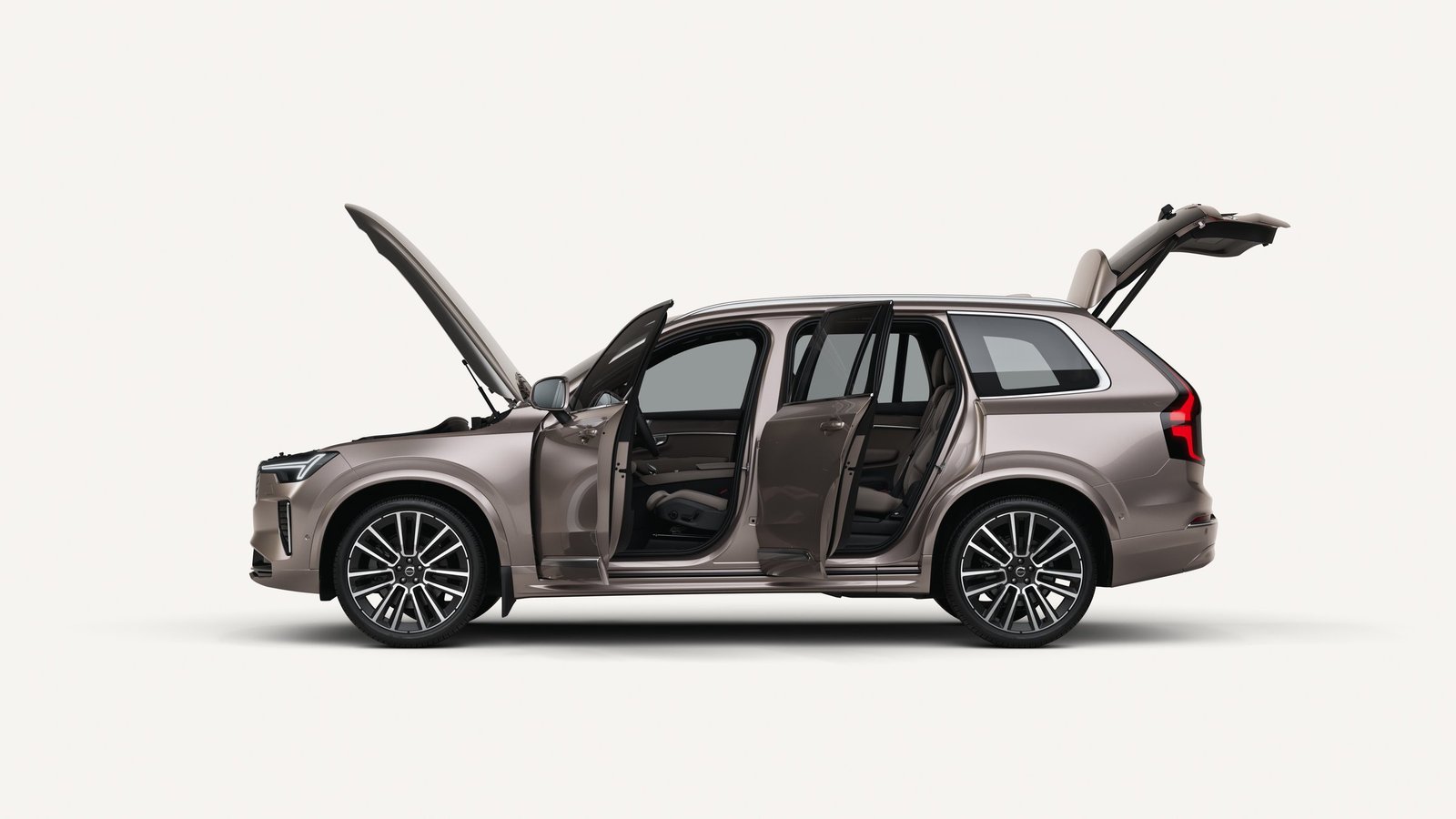
2026 Volvo XC90 T8 plug-in hybrid in profile
Price
~£72,000
0-100 km/h
5.0 s
Powertrain
2.0L turbo PHEV + e-motor
⚡ Quick Verdict
**Yes, you should buy the 2026 Volvo XC90 — provided your priorities are safety, efficiency and Scandinavian calm rather than outright driving thrills.** The T8 plug-in hybrid is the standout powertrain here, pairing 455 hp of combined output with 32 miles of EV range that’ll swallow most school runs on electricity alone. If you’re a UK company-car driver, the Benefit-in-Kind tax saving over a BMW X7 or Mercedes-Benz GLS is staggering.
✓ The Good
- +T8 PHEV delivers 455 hp and 32 mi of EV range — cheapest company-car tax in the class
- +Interior materials and design remain best-in-class for restrained Scandinavian luxury
- +IIHS Top Safety Pick+ and NHTSA 5-star with seven airbags and full active-safety suite standard
- +Refreshed 11.2" infotainment with Google built-in is slick, logical and genuinely usable on the move
- +Integrated booster seat, kick-activated tailgate and clever cargo features nail the family brief
✗ The Trade-offs
- −Third row remains tight for adults — it’s a kid zone, plain and simple
- −Second-row seats require frustratingly high effort to fold and reposition
- −Little driver engagement at the wheel — the chassis cossets but never thrills
- −T8’s two-stage power delivery can feel inelegant when the petrol engine joins under load
- −—
📑 In This Review
- Introduction: The Scandinavian Veteran Refreshed
- Engines, Performance and the T8 Plug-In Hybrid
- On the Road: Ride, Steering and Handling
- Interior and Materials: Scandi Lounge on Wheels
- Infotainment and Tech: Google Built-In Done Right
- Practicality: Boot, Seating and Family Life
- Safety: IIHS Top Safety Pick+ and the Volvo DNA
- 2026 Volvo XC90 vs BMW X7: Which Is the Better Luxury 3-Row?
- Broader Rivals: GLE/GLS, Q7 and the Value Alternatives
- At a Glance: Specs and Rivals Compared
- Buy or Skip: Who Should Choose the XC90?
- Verdict: The Refresh That Keeps the XC90 Relevant
- Frequently Asked Questions
This sits on an eleven-year-old platform, and that age shows in places: the cramped third row, the stiff second-row seat mechanisms, a chassis that never once tempts you down a country lane for the fun of it. But the mid-2025½ refresh, with its bigger screen, Google built-in and tidied-up styling, keeps the technology current, while the cabin materials and overall design philosophy continue to embarrass newer rivals. If substance, safety and a genuinely lovely interior matter more to you than badge prestige or cornering poise, the XC90 warrants a serious look. —
Introduction: The Scandinavian Veteran Refreshed
The Volvo XC90 entered its eleventh year on sale in 2026. Sit with that for a moment: in a segment where the BMW X7 only appeared in 2019 and the Mercedes-Benz GLS was comprehensively redesigned in 2020, Volvo’s big SUV has been soldiering on since 2016 on the same SPA platform. Most cars would be on their third facelift by now and looking rather desperate. The XC90, somehow, still looks entirely at home.
Part of that longevity comes down to a thoughtful mid-cycle refresh applied for what Volvo somewhat confusingly labelled the "2025½" model year, changes that carry directly into the 2026 car we’re testing here. There are modest exterior styling tweaks to the grille, front fascia and headlights, a significantly upgraded infotainment system (more on that shortly), and continued refinement of the T8 plug-in hybrid powertrain that now sits at the heart of the range’s appeal. It isn’t a new car, but it’s a car that’s been deliberately kept current.
The bigger story is one Volvo probably wishes it didn’t have to tell. The XC90 was supposed to bow out gracefully, replaced by the fully electric EX90 — a car meant to take Volvo’s flagship SUV into its next chapter. Sluggish global EV adoption and the EX90’s own rocky launch have conspired to extend the XC90’s life through 2027 and, most likely, beyond. For buyers, that’s actually rather good news: you get a proven, refined platform with a genuinely useful plug-in hybrid powertrain, instead of becoming an early adopter on an unproven electric car.
Against the £80,000-to-£150,000 luxury three-row SUV segment in the UK and Europe, the XC90 T8 starts at roughly £72,000 and tops out around £90,000 with options, comfortably undercutting the BMW X7, Mercedes-Benz GLS and Audi Q7 on list price while offering a powertrain advantage none of those rivals can match in plug-in form. The question isn’t whether it’s old. The question is whether "old" still matters when the fundamentals are this strong.
—
Engines, Performance and the T8 Plug-In Hybrid
Volvo offers three powertrains across the 2026 XC90 lineup, and picking the right one is arguably the single most important decision you’ll make.
The entry point is the B5 mild hybrid — a 247 hp turbocharged 2.0-litre four-cylinder paired with a 48-volt integrated starter-generator. It’s adequate rather than inspiring, covering the 0-100 km/h sprint in around 7.3 seconds. For buyers on a tighter budget who’ll never plug in, it’s a perfectly reasonable choice, though it lacks the effortless shove you’d expect at this price point. The B6 sweetens the deal with 295 hp and an electric supercharger that fills the turbo’s low-rev lag, cutting the sprint to approximately 6.5 seconds. It’s the pick if you want more poke without committing to a plug, and it makes a strong case as the "just drive it and forget it" option.
Then there’s the T8, and it shifts the XC90 from pleasant to genuinely quick. The headline numbers are 455 hp combined — 312 hp from the turbocharged 2.0-litre driving the front wheels and 143 hp from an electric motor driving the rears — good for a 0-100 km/h time of 5.0 seconds flat. That’s proper hot-hatch territory in a seven-seat family bus. But the number alone doesn’t capture the character. Floor the throttle and you get a two-stage surge that’s become a Volvo signature: an immediate, silent electric shove that pins you into the seat from a standstill, followed a heartbeat later by the petrol engine joining the party with its own wave of torque. It’s addictive in a straight line, though there’s an occasional moment of clumsiness when the transition between electric and hybrid modes isn’t quite smooth — a slight pause, then a lurch, as the ICE makes its presence felt under sustained part-throttle. During our drive, we noticed this most when asking for moderate acceleration from low speeds rather than full-bore launches.
The T8’s party trick, of course, is that you can drive it as an EV for meaningful distances. The 18.8 kWh battery delivers an EPA-rated 32 miles (approximately 51 km) of pure-electric range, which is enough to cover the average UK daily commute entirely on electricity. In EV-only mode, acceleration is modest but perfectly adequate for urban driving — you won’t win any traffic-light grands prix, but the instant electric torque makes it feel livelier than the numbers suggest. Combined fuel economy in hybrid mode is 27 mpg (US), jumping to 58 MPGe when you factor in electric running. In B-mode — Volvo’s one-pedal driving setting — the regenerative braking is strong enough to bring the car to a complete stop without touching the brake pedal, and we found it smooth and intuitive after a few minutes of acclimatisation.
Drive modes are accessed through the touchscreen or a persistent physical button, cycling through Comfort, Dynamic (firm steering and sharper throttle), Off-Road and Pure (electric-only) modes. The steering weight changes are welcome in Dynamic, though they don’t add any actual feedback — this remains a car that informs you of what the front wheels are doing only in the vaguest terms. Pilot Assist, Volvo’s hands-on Level 2 driver-assist system, bundles adaptive cruise control with lane-centring and works well enough on the motorway. It’ll keep you centred in your lane and manage traffic without fuss, though you’ll want to keep your hands on the wheel and your attention on the road, as with any such system.
—

On the Road: Ride, Steering and Handling
Our test car was fitted with the optional adaptive air suspension — roughly a £1,500-equivalent add-on — and we’d recommend ticking that box without hesitation. The system allows the XC90 to raise itself for easier ingress or light off-road work, and lower itself at motorway speeds for improved stability and aerodynamics. More importantly, it takes the edge off road imperfections that the standard steel springs can’t quite absorb. Over smooth tarmac, the XC90 floats along with the kind of serene composure you’d expect from a luxury SUV, and the air suspension rounds off expansion joints and minor potholes with genuine elegance.
That said, the system has its limits. Over sharper, harder impacts — the kind you encounter on poorly maintained B-roads or speed bumps taken at anything beyond a crawl — a noticeable jolt still resonates through the structure. It isn’t crashy, exactly, but it’s a reminder that this is a 2016-era platform being asked to compete with 2025 rivals that have had the benefit of fresh development. The underlying chassis is fundamentally sound, but it doesn’t have the depth of composure you’ll find in a newer BMW X7 or Mercedes-Benz GLS.
The bigger criticism, and one we’ve levelled at several Volvos in recent years, is the complete absence of driver engagement. The steering is accurate enough — the XC90 goes where you point it without drama — but there’s no meaningful communication from the front wheels, no progressive build-up of weight that tells you how hard the tyres are working. Even in Dynamic mode, the added resistance is just that: resistance, not feedback. For most buyers, this is irrelevant. You’re choosing a seven-seat family SUV, not a sports car. But if you’re cross-shopping with a Range Rover Sport or even a BMW X7 and you value the connection between driver and machine, the XC90 will leave you cold. The corners get dispatched competently; they just never get dispatched joyfully.
Low-speed manoeuvrability, on the other hand, is genuinely impressive for a car measuring nearly five metres. The turning circle is tight enough to make parking straightforward, and the 360-degree camera system (standard on every trim except the base Core) gives excellent visibility in tight spaces. In everyday urban driving, the XC90 feels more compact than its dimensions suggest — a real advantage in crowded European city centres.
—

Interior and Materials: Scandi Lounge on Wheels
This is where the XC90 has always earned its money, and the 2026 model continues to deliver one of the most distinctive interiors in the luxury SUV segment. Our Ultra-trim test car was finished with the optional navy herringbone textile upholstery — a recycled-polyester fabric that replaces the Nappa leather you might otherwise expect at this level. It sounds like a downgrade on paper; in practice, it’s anything but. The texture is rich and tactile, the herringbone pattern gives it a tailored, mid-century-modern feel, and it’s both dirt-resistant and environmentally responsible. If you’ve ever admired the fabric choices in a Danish furniture showroom, you’ll grasp the vibe immediately.
The rest of the cabin follows the same philosophy. Real wood trim sweeps across the dashboard and door cards. The Orrefors crystal gear selector — a piece of genuine Swedish glassware — catches the light and serves as a tactile centrepiece every time you shift. Metal speaker grilles for the Bowers & Wilkins audio system add industrial elegance. There’s a deliberate restraint to the design that avoids the "look at me" flashiness of German rivals; instead, the XC90’s cabin rewards you with layers of texture and detail that reveal themselves over time. It’s the automotive equivalent of a well-curated home — warm, considered and quietly confident.
Front-seat comfort in the Ultra trim is excellent. The seats are firm in the way that proper Swedish design tends to be — supportive rather than plush — and the lateral bolstering around the shoulders and torso is genuinely effective without feeling restrictive. Adjustability is extensive, including lumbar, thigh extension and seat-cushion angle, and the passenger gets the same treatment. Heated front seats and outboard rear seats are standard across the range, and the four-zone climate control means everyone can set their own temperature.
The second row slides and reclines on both outboard and middle positions, offering genuine flexibility for families. Taller adults will find ample legroom when the seats are set behind a reasonable front-seat position. The middle seat hides one of Volvo’s signature party tricks: an integrated child booster seat that flips up from the seat cushion — a feature that eliminates the faff of carrying a separate booster and has been a Volvo hallmark for years. However, the second-row seats are heavy and high-effort to fold. They require a firm pull to overcome a stiff pivot point, at which point they lurch forward with surprising speed — a combination that, during our testing, nearly resulted in an unfortunate face-meets-headrest incident for a smaller occupant accessing the third row. It’s a genuine usability gripe that Volvo should have addressed by now.
The third row, bluntly, is a kid zone. Adults of average height will find headroom compromised against the headliner and knee clearance marginal, with no recline function to adjust the angle. There’s enough space for short journeys or for children, but if you regularly need to carry seven adults, the Mercedes-Benz GLS is the better bet. Boot space behind the third row is a modest 10.6 cubic feet (300 litres) — enough for a few soft bags — expanding to approximately 35 cubic feet (990 litres) with the third row folded and a useful 80 cubic feet (2,265 litres) with both rear rows down. The third-row seats drop effortlessly via a simple pull strap, creating a flat load floor; the second-row seats, once folded, require more effort to raise again. A kick-activated power tailgate is standard.
—

Infotainment and Tech: Google Built-In Done Right
The mid-2025½ refresh brought the XC90’s infotainment into the modern era. The centre touchscreen has grown from 9 inches to 11.2 inches — large enough that it slightly intrudes on the air vent space on either side — and it’s paired with a crisp 12.3-inch digital instrument cluster. The system runs Google built-in, which means native Google Maps, Google Assistant voice control and access to the Google Play Store for apps. It’s a significant step forward from Volvo’s older Sensus system: the graphics are sharp, the layout is logical and the response times are quick enough that you never find yourself jabbing at an unresponsive screen.
Wireless Apple CarPlay and Android Auto are included, so iPhone users aren’t locked out of the Google ecosystem. In practice, the Google integration is so good that we found ourselves defaulting to the native Maps rather than switching to CarPlay — a first in any test car. The HVAC controls have moved entirely into the touchscreen, which we know is a controversial decision, but Volvo’s implementation is defensible: the climate interface is simple, consistent and easy to operate without taking your eyes off the road for more than a glance. Crucially, physical volume and tune knobs have been retained on the centre console, preserving the tactile control that matters most for everyday driving.
Every XC90 except the base Core trim includes a 360-degree camera system with multiple viewing angles, and the resolution is excellent. Our only gripe is that the view-selection menu disappears from the screen a little too quickly — you need to tap to recall it if you want to switch angles, which adds an unnecessary step in a manoeuvre that’s already attention-intensive. The reversing alert chime, meanwhile, is best described as aggressive — it pulses with a sci-fi urgency that sounds less like a parking aid and more like you’re tracking a xenomorph through the cargo bay of the Nostromo. Functional, certainly. Subtle, absolutely not.
One final detail worth noting: Volvo doesn’t charge extra for paint colours. Every shade on the palette is included in the list price — a small thing, perhaps, but a refreshing change in a segment where German rivals routinely charge four-figure sums for anything beyond basic white or black.
—

Practicality: Boot, Seating and Family Life
The XC90’s practicality credentials are solid rather than spectacular, and they’re largely determined by how you intend to use the third row. As a five-seat SUV with occasional third-row capability, it’s excellent — the boot is flat and usable with the rear-most seats folded, and there’s a handy underfloor storage area that’s particularly useful in the T8 for stowing charging cables and paraphernalia. With all three rows in play, 10.6 cubic feet (300 litres) is tight but sufficient for a weekly shop or a couple of cabin-sized bags.
The cargo area is well thought out. Bag hooks on either side of the boot are a simple but welcome touch, and the third-row seats drop with a single pull to create a broad, flat load floor. Folding the second row requires pulling a lever on the passenger-side hip, and the outboard and middle sections drop independently — useful for carrying longer items while retaining a rear passenger seat. As we noted above, raising the second row after folding is a heavier job than it should be, and the centre section can’t be raised independently of the outboard seats, which limits flexibility.
The optional six-seat configuration — second-row captain’s chairs replacing the three-person bench — costs approximately £400 extra and is worth considering if you value individual comfort and easier third-row access over maximum passenger count. Towing capacity across all powertrains is rated at 5,000 lb (2,268 kg), which is competitive for the class and sufficient for a mid-size caravan or horse trailer.
—
Safety: IIHS Top Safety Pick+ and the Volvo DNA
Safety has been Volvo’s brand equity for decades, and the 2026 XC90 upholds that reputation convincingly. For vehicles built after December 2024, the XC90 earns the IIHS Top Safety Pick+ award — the highest designation available. NHTSA awards five stars overall. Seven airbags are fitted as standard, including a driver’s knee airbag and full-length curtain airbags that cover all three rows.
Every XC90 comes with a comprehensive active-safety suite that includes autonomous emergency braking with pedestrian and cyclist detection, blind-spot warning, rear cross-traffic alert, lane-keeping aid and Pilot Assist — Volvo’s hands-on Level 2 system that combines adaptive cruise control with lane-centring. The 360-degree camera is standard on all but the entry-level Core trim. For families, this standard equipment level is a genuine differentiator; where some rivals charge extra for advanced driver-assistance features or lock them behind subscription packages, Volvo includes them across the range.
The broader point is that Volvo’s safety reputation isn’t just marketing. The XC90’s structure is engineered to protect occupants in the specific crash scenarios that matter most, and the active-safety systems are tuned to intervene conservatively but effectively. In a segment where every vehicle is safe by modern standards, Volvo still manages to lead — and for a significant number of buyers, that alone is reason enough to choose the XC90.
—
2026 Volvo XC90 vs BMW X7: Which Is the Better Luxury 3-Row?
If you’re shopping in the UK or European luxury three-row SUV segment, the BMW X7 is the rival the Volvo XC90 cannot escape. Both target families who want space, prestige and advanced technology in a package that seats six or seven, but they approach the brief from fundamentally different philosophical starting points.
On price, the XC90 holds a significant advantage. In the UK, the XC90 T8 range starts at approximately £72,000, with a well-equipped T8 Ultra arriving around £85,000–£90,000. The BMW X7, by contrast, starts at roughly £92,000 for the xDrive40i and climbs to £130,000-plus for the M60i — a gap that’s hard to ignore, especially when you factor in the XC90 T8’s company-car tax advantage.
Powertrain is where the Volvo genuinely outclasses its rival. The XC90 T8 combines a 312 hp turbocharged engine with a 143 hp electric motor for 455 hp total and, crucially, 32 miles of pure-electric range. The BMW X7 xDrive40i offers 380 hp from a mild-hybrid straight-six — more than adequate, but entirely conventional. The M60i’s 530 hp twin-turbo V8 is magnificent in a straight line but offers no electric-only capability whatsoever. For buyers whose daily commute falls within the Volvo’s EV range, the T8 can run on electricity alone for most of the working week, slashing fuel costs and — for UK company-car drivers — delivering a Benefit-in-Kind tax rate that makes the X7 look punitive.
Size-wise, the X7 is the larger car at approximately 5,200 mm versus the XC90’s 4,950 mm, and that translates into a genuinely more usable third row and a more imposing road presence. The BMW’s interior takes the opposite philosophical approach to Volvo’s Scandinavian restraint — it’s all rich leathers, crystal-effect controls and ambient lighting, designed to impress rather than soothe. Both approaches work, but they attract different buyers.
On the road, the X7 is the sharper, more involving machine. Its steering has genuine weight and progressive feel, the chassis resists body roll more effectively, and the whole driving experience encourages you to take the scenic route. The XC90, as we’ve detailed, cossets beautifully but never engages — it’s a car that wants to be driven in, not driven. For enthusiasts, the BMW is the clear winner here.
Safety is closer than you might expect. Both vehicles carry top-tier ratings — the XC90’s IIHS Top Safety Pick+ and NHTSA five stars versus the X7’s strong Euro NCAP and IIHS results — but Volvo’s track record on standard safety equipment and its brand DNA give the XC90 a slight, subjective edge in the minds of safety-conscious families.
<div style="background:linear-gradient(135deg,#f0f9ff,#e0f2fe); border-left:4px solid #2563eb; border-radius:12px; padding:24px 28px; margin:32px 0"> <p style="font-size:12px; font-weight:800; letter-spacing:0.14em; text-transform:uppercase; color:#1e40af; margin:0 0 10px">Which one is better?</p> <p><strong>Buy the Volvo XC90 if</strong> you value Scandinavian restraint, want the lowest company-car tax via the T8 PHEV, drive a daily commute under 30 miles, and prioritise IIHS-validated family safety over outright performance.</p> <p><strong>Buy the BMW X7 if</strong> you want a more imposing road presence, a sharper, more rewarding driving feel, and the option of a V8 in the M60i — and you do not need plug-in-hybrid commuting.</p> <p><strong>Our pick</strong> is the Volvo XC90 T8 Ultra for the vast majority of family buyers — the running costs over a 3-year ownership cycle make the case on their own, before you even sit in the cabin.</p> </div>
| Spec | 2026 Volvo XC90 T8 | BMW X7 xDrive40i |
|---|---|---|
| Price (£, from) | ~£72,000 | ~£92,000 |
| Powertrain | 2.0L turbo PHEV + e-motor | 3.0L straight-six mild hybrid |
| Total Power | 455 hp | 380 hp |
| 0-100 km/h | 5.0 s | ~5.8 s |
| EV Range | 32 mi / 51 km | None |
| Combined MPG / MPGe | 58 MPGe / 27 mpg (hybrid) | ~28 mpg |
| Length | 4,950 mm (195.0 in) | ~5,200 mm (204.7 in) |
| Boot (3rd up / down) | 300 L / 990 L | ~326 L / 1,376 L |
| Warranty | 4 yr / 50,000 mi + 8 yr HV battery | 3 yr / unlimited mi |
—
Broader Rivals: GLE/GLS, Q7 and the Value Alternatives
Beyond the X7, the competitive landscape includes several strong alternatives. The Mercedes-Benz GLS is the XC90’s most direct rival in terms of third-row usability — its rear bench genuinely accommodates adults — and its cabin technology is a generation ahead. It’s also significantly larger, thirstier and more expensive, positioning it as the choice for buyers who prioritise outright space above all else. The Audi Q7, meanwhile, is closer in size to the XC90 and offers a tech-forward, architecturally clean interior, but it lacks a plug-in hybrid powertrain in its European line-up that’s as competitive as Volvo’s T8, and its third row is equally compromised.
For buyers willing to consider alternatives from outside the German-Swedish mainstream, the Lexus TX offers Toyota-backed reliability and a genuinely usable third row at a lower price point, though it lacks the XC90’s design distinction. The Range Rover Sport is sharper to drive and more visually dramatic, but it’s less practical and considerably more expensive to run. The Genesis GV80 is the value play — generously equipped, attractively styled and priced to undercut — but it can’t match the Volvo’s safety credentials or plug-in hybrid efficiency.
—
At a Glance: Specs and Rivals Compared
| Spec | 2026 Volvo XC90 T8 | BMW X7 xDrive40i |
|---|---|---|
| Price (£, from) | ~£72,000 | ~£92,000 |
| Powertrain | 2.0L turbo PHEV + e-motor | 3.0L straight-six mild hybrid |
| Total Power | 455 hp | 380 hp |
| 0-100 km/h | 5.0 s | ~5.8 s |
| EV Range | 32 mi / 51 km | None |
| Combined MPG / MPGe | 58 MPGe / 27 mpg (hybrid) | ~28 mpg |
| Length | 4,950 mm (195.0 in) | ~5,200 mm (204.7 in) |
| Boot (3rd up / down) | 300 L / 990 L | ~326 L / 1,376 L |
| Warranty | 4 yr / 50,000 mi + 8 yr HV battery | 3 yr / unlimited mi |
BMW X7 xDrive40i
Larger road presence and sharper steering. Pricier on the list, no plug-in option, but the most natural cross-shop
Mercedes-Benz GLS 450
True 7-adult capability and a Hyperscreen cabin. Thirstier, costlier, more imposing — go here if outright space is the brief
Audi Q7 55 TFSI e
Closest in size to the XC90 and the only other PHEV in the set. Tech-forward cabin, but the third row is just as compromised
2026 Volvo XC90 T8 Mercedes-Benz GLS 450 —— ~£72,000 ~£95,000 455 hp 375 hp 5.0 s ~5.9 s 32 mi / 51 km None 300 / 990 L ~355 / 1,215 L 2,268 kg 3,500 kg 4,950 mm ~5,210 mm 4 yr / 50,000 mi 3 yr / unlimited —
Buy or Skip: Who Should Choose the XC90?
Buy the XC90 if you’re a family buyer whose priorities boil down to safety, Scandinavian design and running costs. The T8 plug-in hybrid is the standout choice if your daily commute falls under 30 miles — you’ll do most of your driving on electricity alone, and the resulting company-car Benefit-in-Kind rates are the lowest in the entire luxury three-row SUV segment. Buy it if you value Volvo’s safety brand equity, appreciate cabin materials that reward close inspection rather than impress at a glance, and want a seven-seat SUV that feels genuinely considered rather than simply commodious.
Skip the XC90 if you regularly need to carry seven adults — the third row simply isn’t spacious enough, and the Mercedes-Benz GLS does that job far better. Skip it if driving engagement matters to you; the BMW X7 and Range Rover Sport both offer sharper, more rewarding dynamics. And skip the T8 specifically if you’ll never plug it in — the hybrid mode fuel economy alone doesn’t justify the premium, and you’d be better served by the B6 mild hybrid or a conventional rival altogether.
—
Verdict: The Refresh That Keeps the XC90 Relevant
The 2026 Volvo XC90 is an old car done right. Not old in the sense of outdated or past it — old in the way that a beautifully designed piece of mid-century furniture is old: built on principles that don’t expire, refined over time rather than reinvented, and all the more appealing for having resisted the temptation to chase trends. The refreshed infotainment, Google built-in integration and continued development of the T8 powertrain have bought the XC90 another few years of genuine competitiveness in a segment that has moved on significantly since 2016.
There are real weaknesses here. The third row is tight for adults, the second-row seats are frustratingly heavy to operate, and the chassis never once invites you to enjoy a B-road. These are not trivial complaints, and they matter more for some buyers than others. But for the family buyer whose priorities are safety, efficiency, interior quality and daily usability — and who can live with a third row that’s reserved for children — the XC90 T8 remains a compelling, well-rounded and financially smart choice that consistently undercuts its German rivals on both list price and running costs.
The Volvo XC90 doesn’t need to be new to be the right car. It just needs to be exactly what it is — and right now, that’s still very good indeed.
—
Frequently Asked Questions
How much is the 2026 Volvo XC90 in the UK?
The 2026 Volvo XC90 starts at approximately £72,000 in the UK for the B5 Core, rising to around £90,000 or more for a fully equipped T8 Ultra with options such as the Bowers & Wilkins audio system and adaptive air suspension.
What is the EV-only range of the Volvo XC90 T8 plug-in hybrid?
The XC90 T8 achieves an EPA-rated 32 miles (51 km) of pure-electric range from its 18.8 kWh battery. WLTP estimates put the figure closer to 40 miles (approximately 64 km) under European testing conditions.
Is the 2026 Volvo XC90 a 7-seater?
Yes — the XC90 comes with a standard seven-seat configuration across a 2-3-2 layout. A six-seat version with second-row captain’s chairs is available as a cost option of approximately £400.
How safe is the 2026 Volvo XC90?
Extremely safe. The 2026 XC90 earns the IIHS Top Safety Pick+ award for post-December 2024 builds and a five-star NHTSA overall rating. Seven airbags and a full active-safety suite including AEB, blind-spot warning, rear cross-traffic alert and Pilot Assist are standard across the range.
Is the Volvo XC90 better than the BMW X7?
It depends on your priorities. The XC90 T8 is the better choice for running costs, plug-in efficiency and Scandinavian restraint; the X7 wins on third-row space, driving engagement and road presence. We cover the comparison in detail in our dedicated XC90 vs X7 section above.
When will the Volvo XC90 be replaced by the EX90?
The EX90 launched as a separate, standalone model and was originally intended to replace the XC90. However, slower-than-expected global EV adoption has delayed that transition — the XC90 is confirmed to carry on through at least 2027, with further updates likely.
How long is the warranty on the Volvo XC90?
The XC90 comes with a four-year or 50,000-mile bumper-to-bumper warranty. T8 plug-in hybrid models additionally benefit from an eight-year or 100,000-mile warranty covering the high-voltage battery.
