

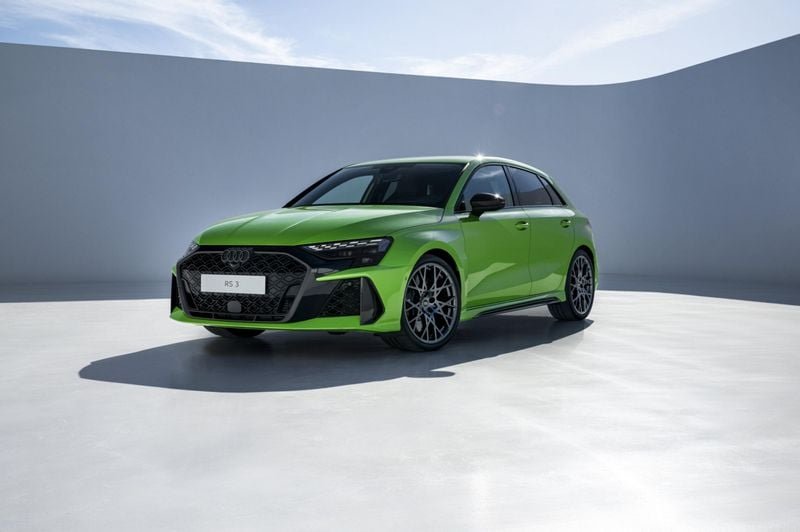
2026 Audi RS3 Review: Five-Cylinder Fury Meets Daily-Driver Polish
The sharpest, most characterful compact sports sedan on sale today
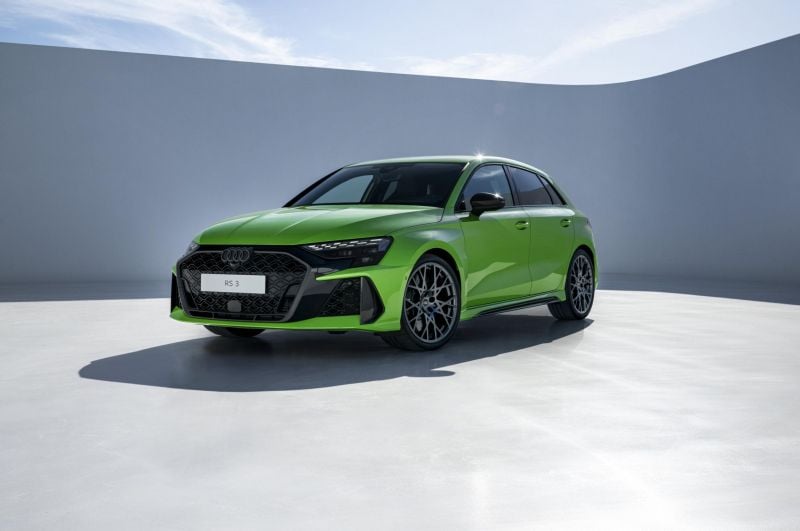
2026 Audi RS3 in studio press shot — front three-quarter view
Price
~A$98,000
Power
294 kW / 394 hp
⚡ Quick Verdict
From around A$98,000 in Australia (US$66,100 / £58,000 for the Sportback in the UK), the 2026 RS3 facelift takes the world’s last five-cylinder performance car and sharpens it with updated torque-splitter software, new digital headlight signatures and a reworked steering wheel — without touching what makes it great. The star of the show is still that turbocharged inline-five: 294 kW (394 hp), an offset 1-2-4-5-3 firing order, and a warbling exhaust note you won’t hear from any rival running four or six cylinders. If you want all-weather usability, everyday comfort and a soundtrack that stops you in your tracks every single morning, this is the compact sports sedan to have.
## What’s New for 2026
✓ The Good
- +Unmatched five-cylinder soundtrack — a baby V10 warble no rival can replicate
- +RS Torque Splitter delivers genuinely playful, drift-friendly rear-axle behaviour
- +Razor-sharp 3.8 s 0–100 km/h despite weighing just 1,570 kg
- +Exceptional cabin build quality with physical climate buttons and RS-specific cluster modes
- +Comfortable enough to daily-drive yet explosive in Dynamic mode
✗ The Trade-offs
- −Half-capacitive climate touch-strip polarises opinion
- −Sedan-only in North America — no Sportback hatch option
- −Previous-generation exterior design arguably cleaner and more cohesive
- −Premium price positions it against larger, more practical grand-touring rivals
📑 In This Review
From around A$98,000 in Australia (US$66,100 / £58,000 for the Sportback in the UK), the 2026 RS3 facelift takes the world’s last five-cylinder performance car and sharpens it with updated torque-splitter software, new digital headlight signatures and a reworked steering wheel — without touching what makes it great. The star of the show is still that turbocharged inline-five: 294 kW (394 hp), an offset 1-2-4-5-3 firing order, and a warbling exhaust note you won’t hear from any rival running four or six cylinders. If you want all-weather usability, everyday comfort and a soundtrack that stops you in your tracks every single morning, this is the compact sports sedan to have.
What’s New for 2026
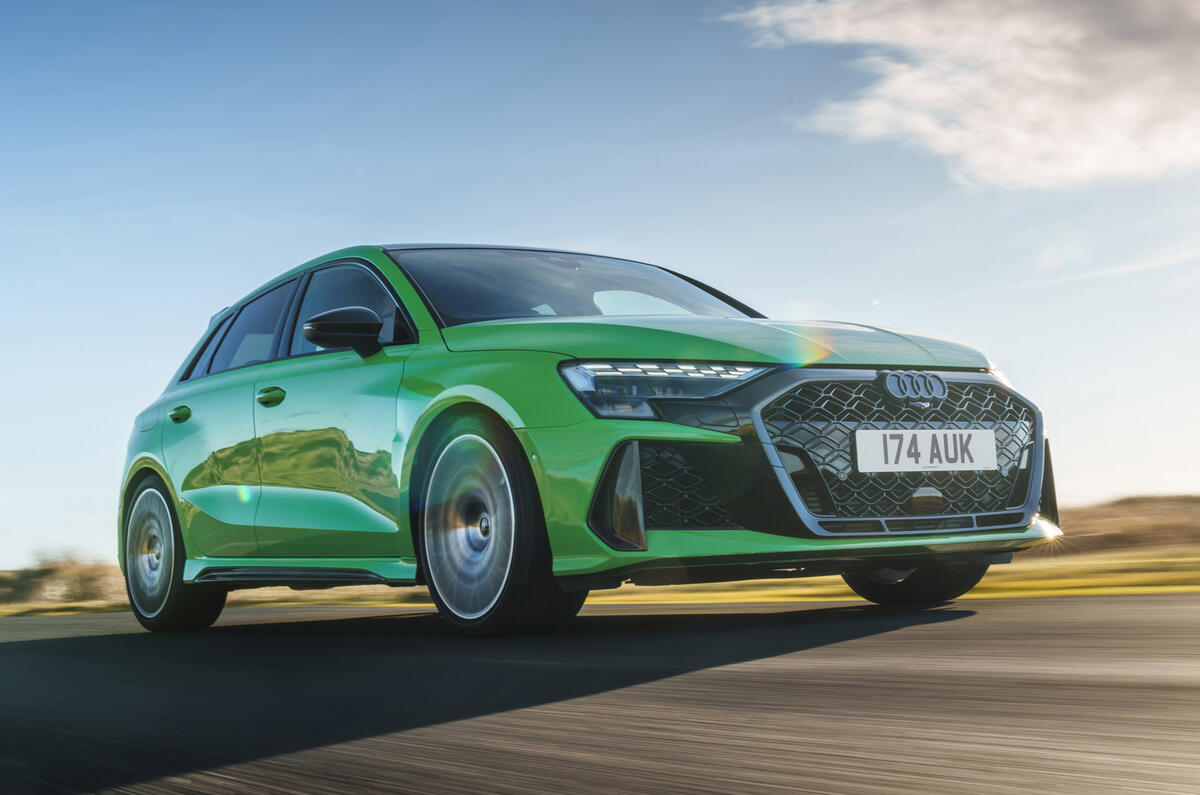
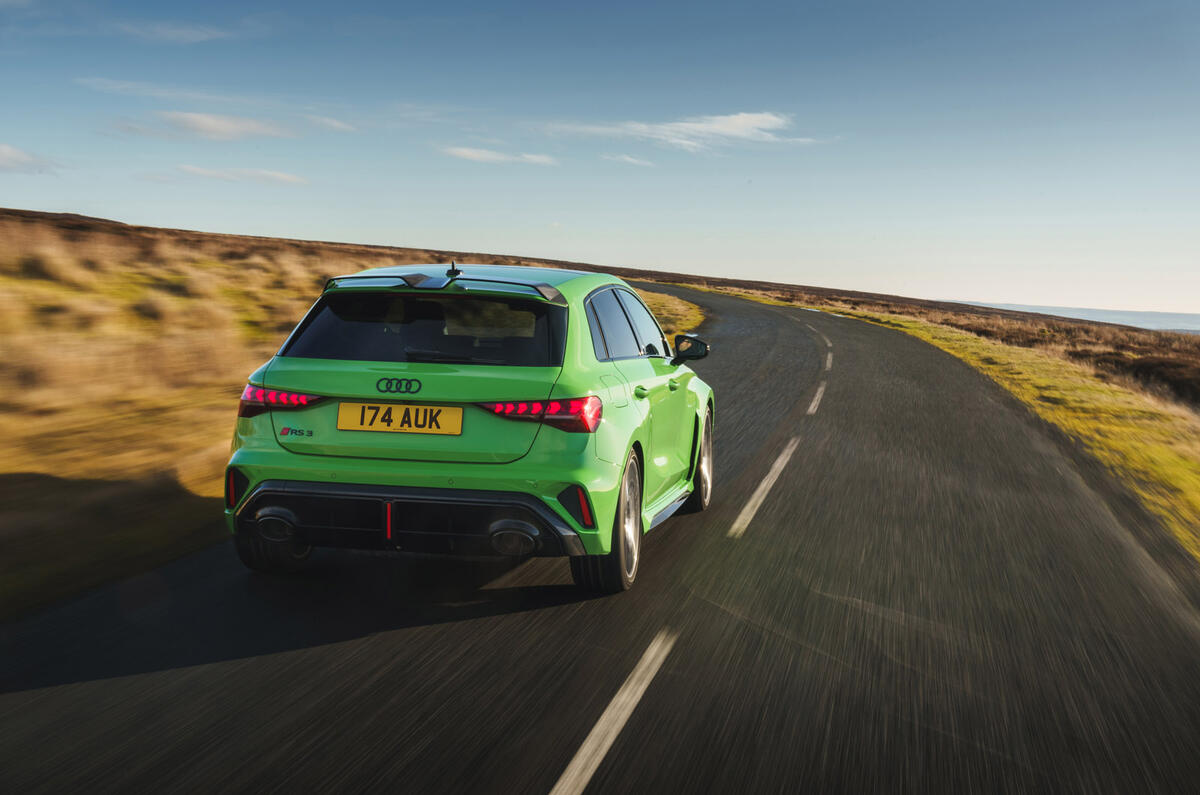
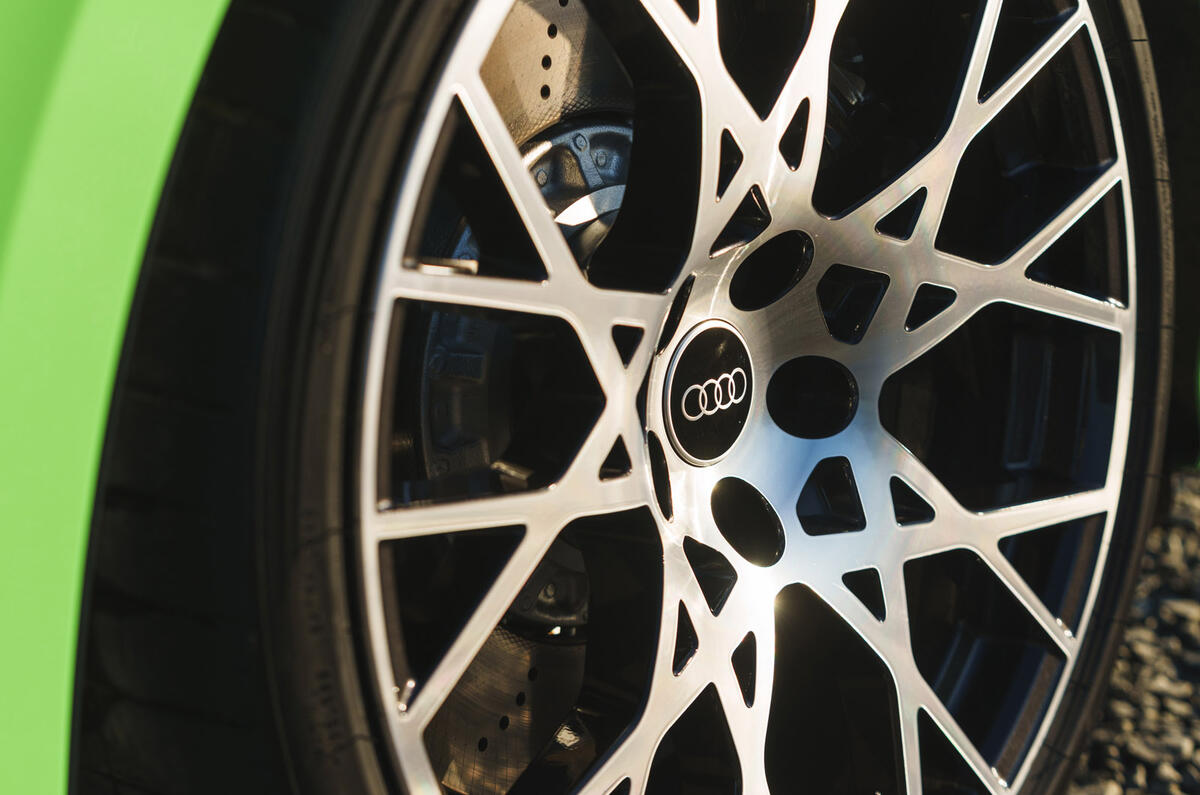
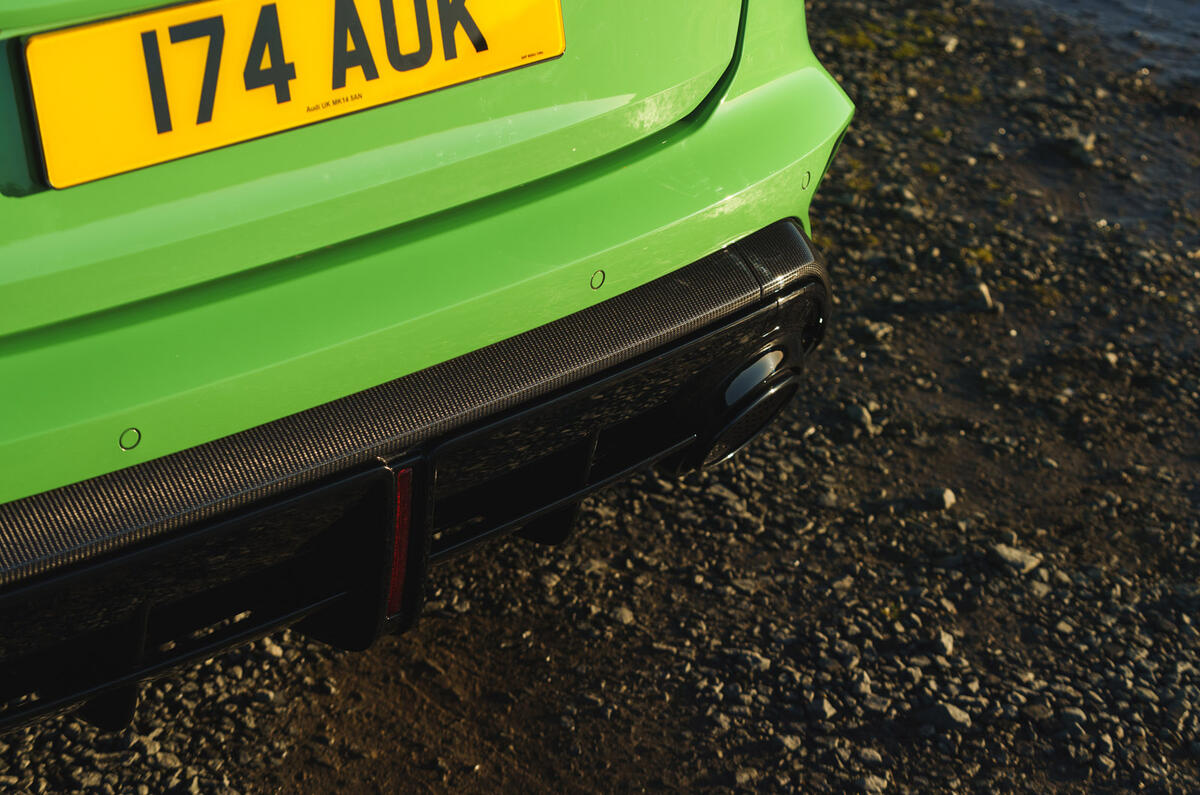
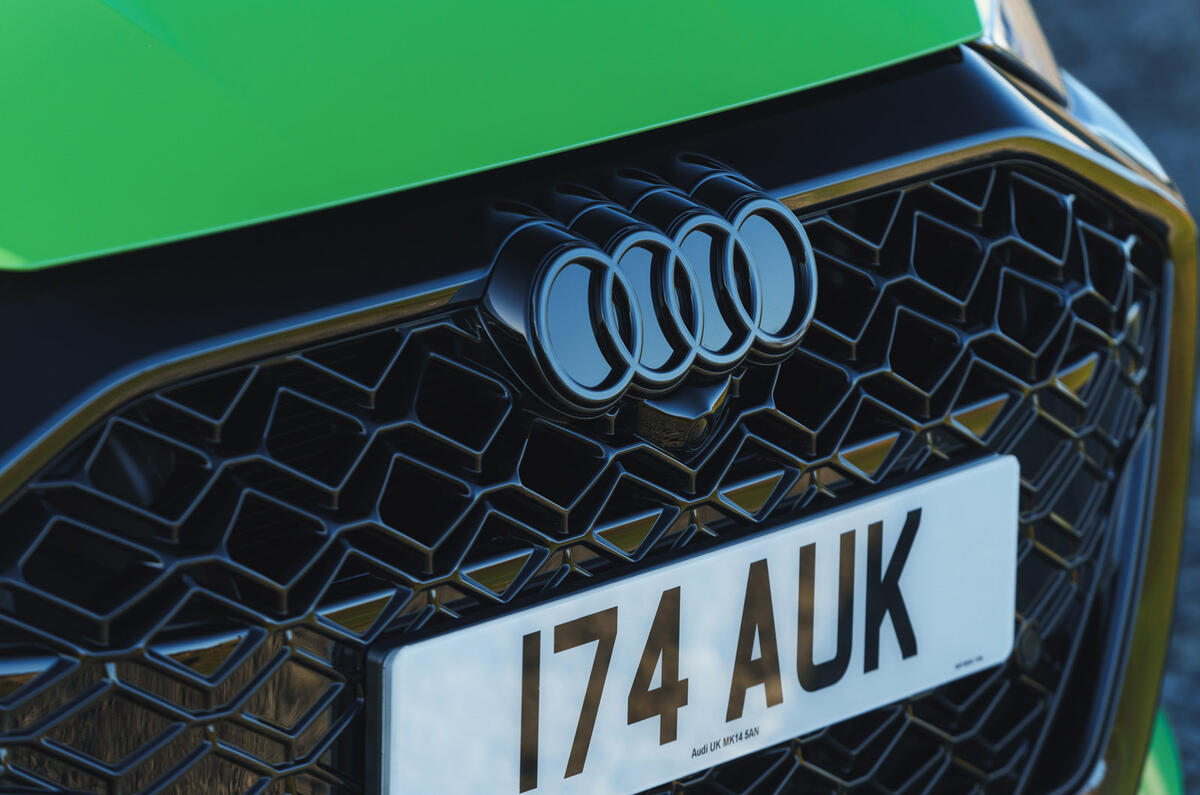
Audi’s mid-life refresh is subtle but it hits all the right spots. The grille wears a more aggressive intake design, and the bumper channels extra air to the radiators keeping that thirsty five-pot fed. The real visual hook, though, is the new digital headlight signatures — four selectable DRL graphics ranging from a sporty triple-stripe to a checkered-flag motif. Out back, a revised diffuser with a red reflector strip gives the tail a racier look, and the taillight graphics borrow their language from the Q6 e-tron family.
Inside, the biggest change is a new flat-top, flat-bottom steering wheel trimmed in Dinamica — Audi’s own Alcantara alternative. It feels brilliant in your hands. A checkered-flag shortcut button on the left spoke lets you jump straight into the most aggressive Dynamic settings: exhaust flaps open, throttle sharpened, dampers firmed. Under the skin, the torque-splitter software has been recalibrated for more progressive, drift-friendly behaviour on corner entry, and brake torque vectoring has been tightened for crisper turn-in and less understeer. Updated damper and stability-control calibrations complete the mechanical changes. New colour options include Daytona Gray, Ascari Blue, Progressive Red and the brilliantly named Kyalami Green.
Performance, Sound and Drive
The engine at the heart of every RS3 is still the 2.5-litre turbocharged inline-five, and the facelift hasn’t messed with its fundamental character. That offset 1-2-4-5-3 firing order gives you a warbling, uneven exhaust note that genuinely sounds like half a Lamborghini V10 — and yes, we’re aware of how high a compliment that is. You blip the throttle in any tunnel and you’ll understand why people are so devoted to this engine layout. It’s the most characterful powerplant in the compact sports sedan segment, full stop. Outputs sit at 294 kW (394 hp) and 500 Nm, sent through a seven-speed S tronic dual-clutch and Audi’s quattro all-wheel-drive system. The claimed 0–100 km/h time is 3.8 seconds, and we found that figure genuinely achievable with a clean launch. Fit the optional RS Dynamic Package and you’ll see 290 km/h flat out.
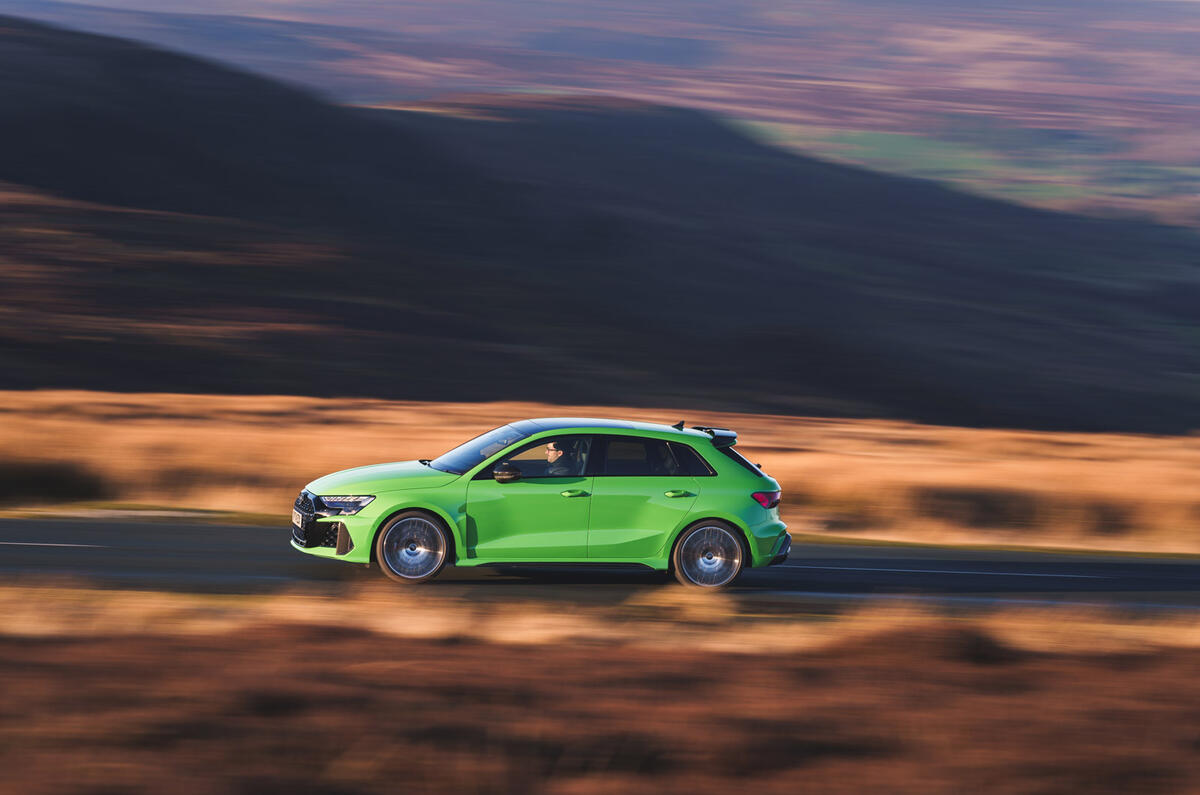
What really separates the RS3 from its peers is the RS Torque Splitter. It’s an electronically controlled rear differential that can shuffle up to 100 per cent of available rear torque to the outside wheel mid-corner, which effectively lets you dial in controlled oversteer whenever you feel like it. The 2026 software update makes the system more progressive — yaw rotation kicks in earlier on corner entry and holds through the apex more naturally. It still feels digitally managed rather than mechanically raw the way a proper rear-drive car does, but the result is undeniably entertaining. Previous RS3 generations simply couldn’t do this. Wider front tyres than rears (carried over from before) help with initial turn-in bite, while the recalibrated brake torque vectoring scrubs speed off the inside wheel to tighten your line further.
Leave it in Comfort mode and the RS3 is genuinely pleasant to live with day-to-day. The adaptive dampers soak up urban imperfections with surprising composure, road noise is well-managed, and the seven-speed box shifts smoothly enough that someone unfamiliar with the RS badge would just think it’s a nice Audi. Flick into Dynamic via that checkered-flag button, though, and the whole character changes. Throttle response sharpens, exhaust flaps open to release the full five-cylinder symphony, steering weights up, and the dampers tighten to a level that’s firm without being punishing. Even in the stiffest setting during our drive, the ride never felt crashy or uncomfortable — a credit to how well Audi has tuned this adaptive setup. That ability to be comfortable on Monday and explosive on Saturday is the RS3’s greatest trick, and the 2026 update only makes it sharper.
Interior, Build Quality and Tech
Drop into the RS3’s cabin and the first thing that hits you is the build quality. Every door card mixes Dinamica suede, carbon-fibre trim and soft-touch plastics exactly where your hands land. There’s a sense of deliberate, almost obsessive craftsmanship here — Audi famously employs smell testers and a team of five chemists to check that every cabin meets the brand’s olfactory standards before a car leaves the factory. It sounds ridiculous until you sit inside one and notice that distinct, consistent "Audi smell" that feels premium in a way few rivals match.
The tech centres on a 12.3-inch Audi Virtual Cockpit Plus digital cluster with three RS-specific display modes. The classic layout gives you a conventional twin-dial arrangement; the "hockey-stick" mode shrinks the tachometer into a sweeping arc with a big digital speed readout; and the runway mode pushes the rev counter to the screen’s edges like a fighter-jet HUD, leaving the middle free for navigation or performance data like real-time power, torque and G-force readings. We found the runway layout the most useful when driving hard — all the critical info sits in your peripheral vision without cluttering the view ahead. The 10.1-inch MMI touchscreen runs wireless Apple CarPlay and Android Auto as standard. It’s clean and logically laid out, though it’s not quite as deeply configurable as BMW’s latest iDrive system.
Below the screen, Audi has sensibly kept physical climate-control buttons. In an era where rivals bury basic HVAC functions inside touchscreen sub-menus, this counts as a genuine quality-of-life win. The buttons are a hybrid capacitive-touch design that divides opinion — they don’t give you the satisfying click of a true mechanical switch — but they’re far more intuitive and safer to use on the move than a purely screen-based solution. The new flat-bottom, flat-top Dinamica steering wheel is a standout tactile improvement. It feels thick, grippy and purposeful, and that checkered-flag shortcut button on the left spoke is a smart ergonomic touch — you can toggle into full attack mode without taking your eyes off the road. Nappa leather sport seats are heated, eight-way power-adjustable and offer generous bolstering for spirited driving without being claustrophobic on longer trips. A 680-watt Sonos Premium 3D sound system with 15 speakers and a 16-channel amplifier rounds out the package — it delivers rich, detailed audio that pairs beautifully with the quiet cabin when you’re cruising in Comfort mode.
2026 Audi RS3 vs BMW M340i: Which Is Better?
This is the comparison that comes up every time someone mentions the RS3’s price bracket, and it’s easy to see why. In Australia, the M340i xDrive lists at approximately A$104,900 — roughly A$3,800 more than the RS3’s estimated A$98,000. Both cars produce similar power (the RS3 edges it by 9 kW), both send drive to all four wheels through sophisticated differentials, and both claim sub-four-second sprints to 100 km/h. On paper they look like near-identical propositions separated by a cylinder count and a badge. In practice, they’re fundamentally different machines aimed at slightly different buyers.
Let’s look at the numbers first. The RS3’s 2.5-litre five-cylinder makes 294 kW and 500 Nm; the M340i’s 3.0-litre straight-six mild-hybrid produces 285 kW and the same 500 Nm. The RS3 weighs 1,570 kg — a 100 kg advantage over the M340i’s 1,670 kg kerb weight. Audi quotes 3.8 seconds to 100 km/h; BMW quotes 3.4 seconds. In real-world testing, though, that gap effectively disappears. The M340i’s mild-hybrid system and launch control deliver strong initial punch, but the RS3’s lighter weight and crisper S tronic gearchanges keep it within touching distance. During roll-race testing, the two cars were remarkably evenly matched, trading tiny advantages depending on gear and driver reaction. The spec sheet says the M340i is quicker. Our seat-of-the-pants assessment says it’s a dead heat.
Where they really part ways is character. The RS3’s five-cylinder warble — that off-beat, baby-V10 throb from the 1-2-4-5-3 firing order — is utterly unique. No amount of speaker-enhanced exhaust synthesiser in the M340i can match the mechanical authenticity of Audi’s five-pot singing at 6,000 rpm through a tunnel. BMW’s straight-six is a magnificent engine — silken, linear and deeply refined — but it sounds like every other great straight-six. The Audi sounds like nothing else.
The chassis philosophies diverge just as sharply. The RS3 turns in with a precision and eagerness the M340i can’t match. Its front end bites harder, steering communicates more, and the RS Torque Splitter gives the rear axle an agility that makes corner exits genuinely entertaining. The M340i, by contrast, is the smoother, more relaxed machine. Its longer wheelbase and softer primary ride make it a better grand-touring companion — it absorbs highway kilometres with a serenity the RS3’s stiffer setup can’t quite match, and rear-seat legroom is meaningfully more generous thanks to the 3 Series’ larger footprint.
Cabin technology tips towards the BMW in some areas. The M340i’s curved display is larger and more visually dramatic, and iDrive’s depth of customisation is arguably best-in-class. But the RS3 counters with sharper RS-specific instrument-cluster modes, superior build-quality rigour (the door shut feel alone tells a story) and those physical climate buttons BMW has increasingly abandoned. The Sonos 680-watt sound system also outperforms the M340i’s Harman Kardon unit in our listening.
On practicality, the M340i wins on space — the 3 Series body offers more rear headroom, legroom and boot volume than the compact RS3 sedan. But the RS3’s smaller footprint makes it easier to park, more nimble in urban traffic and, thanks to that 100 kg saving, more efficient in daily driving. It’s also, crucially, the sharper driver’s car. The front-end grip, the playful rear axle and the immediacy of the S tronic gearbox give it a sense of involvement the M340i can only approximate.
So which is better? That comes down to what you value. If you want a spacious, silken grand tourer with a sublime straight-six, the M340i is an exceptional choice. But if you want the more theatrical, more engaging, more character-rich driving experience in a package that’s lighter, sharper and — remarkably — cheaper, the RS3 takes it.
<div style="background:linear-gradient(135deg,#f0f9ff,#e0f2fe); border-left:4px solid #2563eb; border-radius:12px; padding:24px 28px; margin:32px 0"> <p style="font-size:12px; font-weight:800; letter-spacing:0.14em; text-transform:uppercase; color:#1e40af; margin:0 0 10px">Which one is better?</p> <p><strong>Buy the RS3 if</strong> you want the sharper, lighter, more theatrical sports sedan — that five-cylinder warble has no rival in the segment and the chassis turns in with a precision the M340i can’t match.</p> <p><strong>Buy the M340i if</strong> you want grand-tour smoothness, rear-seat usability, the silken straight-six soundtrack and a slightly more grown-up cabin presence.</p> <p><strong>Our pick</strong> is the RS3 — character-rich engines this distinctive are an endangered species, and the chassis upgrades for 2026 make it the better all-rounder for buyers prioritising driving feel.</p> </div>
| Spec | 2026 Audi RS3 | 2026 BMW M340i |
|---|---|---|
| Engine | 2.5L turbo I5 | 3.0L turbo I6 mild-hybrid |
| Power | 294 kW / 394 hp | 285 kW / 382 hp |
| Torque | 500 Nm / 369 lb-ft | 500 Nm / 369 lb-ft |
| 0–100 km/h | 3.8 s | 4.1 s (real-world) |
| Kerb weight | 1,570 kg | 1,670 kg |
| Drivetrain | quattro AWD | xDrive AWD |
| Transmission | 7-speed S tronic | 8-speed ZF auto |
| Price (AU) | ~A$98,000 | ~A$104,900 |
| Character | Sharp pocket rocket | Smooth grand-tour |
At a Glance: Rivals Compared
| Spec | 2026 Audi RS3 | 2026 BMW M340i |
|---|---|---|
| Engine | 2.5L turbo I5 | 3.0L turbo I6 mild-hybrid |
| Power | 294 kW / 394 hp | 285 kW / 382 hp |
| Torque | 500 Nm / 369 lb-ft | 500 Nm / 369 lb-ft |
| 0–100 km/h | 3.8 s | 4.1 s (real-world) |
| Kerb weight | 1,570 kg | 1,670 kg |
| Drivetrain | quattro AWD | xDrive AWD |
| Transmission | 7-speed S tronic | 8-speed ZF auto |
| Price (AU) | ~A$98,000 | ~A$104,900 |
| Character | Sharp pocket rocket | Smooth grand-tour |
BMW M2
Rear-drive purist with manual option — louder, less practical, more focused
Mercedes-AMG A45 S
Mega hot-hatch with the most powerful production four-cylinder ever
BMW M340i xDrive
Smoother grand-tour straight-six with more cabin space
The RS3 doesn’t exist in a vacuum. Its price and performance envelope puts it squarely in the crosshairs of three distinct rivals, each offering a different flavour of compact performance. The BMW M2 is the closest philosophical match on driving character — a rear-drive, turbocharged straight-six coupe with a manual gearbox option that appeals to purists. The Mercedes-AMG A45 S is the hot-hatch alternative sharing the RS3’s all-wheel-drive traction and compact footprint but packing the most powerful four-cylinder production engine ever made. And the BMW M340i, as we’ve covered in detail above, sits at the grand-touring end of the spectrum with more space, a smoother ride and a silken inline-six. The M2 is the rawest machine here. Its 3.0-litre turbo-six puts out 353 kW (473 hp), it drives only the rear wheels, and in Australia it costs approximately A$129,900 — a substantial A$32,000 premium over the RS3. It rewards skilled drivers with adjustability and feedback the all-wheel-drive RS3 can’t fully replicate, but it also demands more respect in the wet and offers less all-weather security. The AMG A45 S, at around A$110,000 in Australia, matches the RS3’s all-wheel-drive confidence and adds hatchback versatility, but its turbo-four — ferociously potent at 310 kW (421 hp) — lacks the five-cylinder’s aural magic. In European markets the A45 S hatchback body is a genuine practicality advantage over the RS3 sedan; in North America neither hatch is available, making the comparison academic. The RS3’s sweet spot in this competitive set is its blend of compact dimensions, all-weather traction, genuinely unique engine character and a price that undercuts most rivals. It’s not the most powerful car here (the M2 holds that title), not the most practical (the A45 S and M340i both offer more interior volume), and not the most emotionally raw (the M2’s rear-drive purity is unmatched). But it’s the most rounded package — a car that can commute comfortably on Monday, entertain on a canyon road on Saturday, and still make you grin at every cold start thanks to that five-cylinder bark. RS3 AMG A45 S —— 2.5L I5 turbo 2.0L I4 turbo 394 hp 421 hp 3.8 s 3.9 s AWD AWD 7-DCT 9-DCT ~A$98k ~A$110k Pocket rocket Mega hot-hatch
Safety and Warranty
The RS3 doesn’t carry a standalone Euro NCAP or ANCAP safety rating — that’s common for low-volume performance variants that aren’t independently crash-tested. The underlying A3 platform holds a full five-star Euro NCAP rating, though, and the RS3 inherits the same structural architecture, airbag complement and safety cell. Standard driver-assistance systems include adaptive cruise control with stop-and-go, lane-departure warning with active lane assist, blind-spot monitoring (side assist), front and rear parking sensors and a reversing camera. These aren’t class-leading in isolation — many rivals now offer more advanced semi-autonomous highway features — but they cover the essential daily-use bases competently.
Warranty coverage varies by market. In the United States, Audi provides a four-year / 50,000-mile bumper-to-bumper warranty. In the United Kingdom, coverage extends to three years or 60,000 miles. Australian buyers benefit from a five-year unlimited-kilometre warranty, which is competitive with BMW and Mercedes-Benz in the same segment. Service intervals are set at 12 months or 15,000 km, whichever comes first, and Audi offers pre-paid servicing packages that can help reduce long-term ownership costs. We’d recommend checking with your local dealer for the latest service-plan pricing, as costs vary by region.
Running Costs and Efficiency
The EPA rates the 2026 RS3 at 20 mpg city, 29 mpg highway and 23 mpg combined (approximately 11.8 L/100 km combined on the WLTP-equivalent cycle). Those are respectable numbers for a 394-hp all-wheel-drive performance sedan, and during gentle highway cruising we saw consumption figures comfortably in the mid-20s mpg range. Drive the RS3 the way its character invites, though — enthusiastically — and consumption climbs quickly into the mid-teens. The turbocharged five-cylinder demands premium 98-octane fuel (95 RON minimum), which adds to the running-cost equation in markets where premium fuel carries a significant price premium.
Servicing costs sit in the expected Audi premium tier — not outrageous for the performance level, but meaningfully higher than a mainstream-brand sedan. Brake components, tyres and S tronic dual-clutch fluid services are the primary cost items beyond routine oil changes. Pre-paid servicing packages can lock in savings over the first three to five years, and we’d suggest exploring these at the point of purchase. Insurance premiums will vary significantly by market, driver profile and specification, but expect the RS3 to sit in a higher group than a standard A3 or even an S3.
Who Should Buy It
The ideal RS3 buyer wants a compact sports sedan that does triple duty as a comfortable daily commuter, an engaging weekend canyon-carver and a genuinely distinctive piece of automotive theatre. This is a car for the driver who values character over outright numbers — someone who’d rather hear a five-cylinder warble at 7,000 rpm than shave two-tenths off a lap time. It’s for the enthusiast who needs all-weather confidence (maybe you live somewhere with real winters) but refuses to give up driving engagement for traction. And it’s for the buyer who appreciates obsessive build quality — the kind that makes every door close with a vault-like thunk and every surface feel meticulously finished.
If, though, you prioritise rear-drive purity and a manual gearbox above all else, the BMW M2 is the sharper purist’s tool. If you need maximum rear-seat space and grand-touring refinement, the M340i offers a meaningfully larger cabin and a more relaxed highway demeanour. If you want hatchback versatility and live in a market where the AMG A45 S Sportback is available, the Mercedes arguably makes more sense as an only car. And if you’re chasing the absolute quickest machine in this price bracket with no regard for character, a Tesla Model 3 Performance will out-accelerate them all in a straight line — though it’ll do so in near silence, which rather misses the point.
BUY IF:
– You want a compact sports sedan with daily-driver comfort – You love the five-cylinder soundtrack — unique in segment – You need all-weather AWD usability – You want the most theatrical drive in the segment
SKIP IF:
– You want rear-drive purity — get the BMW M2 – You need biggest rear-seat room — choose the M340i – You want a hatchback — North America misses the Sportback – You’re chasing the absolute outright fastest in this price bracket
⚡ Our Verdict
The sharpest, most characterful compact sports sedan on sale today
The 2026 Audi RS3 remains one of the most compelling compact sports sedans on sale — a car that wraps genuine supercar-adjacent straight-line performance, all-weather usability, everyday comfort and one of the most characterful engines ever fitted to a production car into a footprint that’s easy to live with every single day. The facelift’s torque-splitter software updates, sharper brake vectoring and tactile steering-wheel improvement meaningfully elevate the driving experience without compromising the refinement that makes this such an effective daily. We award it 4.6 out of 5, drawing on our hands-on observations and independent publications such as CarExpert, Autocar and Euro NCAP. In an era of increasing automotive sameness, the RS3’s five-cylinder warble alone makes it worth celebrating — and the fact that it happens to be an exceptional all-rounder makes it a genuine modern classic in the making.
Frequently Asked Questions
How much is the 2026 Audi RS3 in Australia?
The 2026 Audi RS3 is estimated at around A$98,000 before on-road costs and options in Australia. Pricing varies by specification and dealer, so check current listings for the latest figures.
Is the 2026 Audi RS3 faster than the BMW M340i?
On paper the M340i claims a slightly quicker 0–100 km/h time, but in real-world testing the two cars are remarkably evenly matched — the RS3’s lighter weight and sharper gearchanges effectively neutralise the gap in a roll race.
Does the RS3 keep the five-cylinder engine?
Yes, the 2026 RS3 retains Audi’s iconic 2.5-litre turbocharged inline-five producing 294 kW (394 hp) and 500 Nm. It’s one of the last five-cylinder engines in production, with a distinctive 1-2-4-5-3 firing order.
What’s new for the 2026 Audi RS3 facelift?
Key updates include reworked front styling, four selectable digital headlight signatures, a new flat-top/flat-bottom Dinamica steering wheel, recalibrated RS Torque Splitter software for more drift-friendly behaviour and sharper brake torque vectoring.
How does the RS3 compare to the Mercedes-AMG A45 S?
The RS3 offers a unique five-cylinder engine and sharper chassis dynamics, while the A45 S delivers a more powerful turbo-four and hatchback practicality in markets outside North America. Both feature all-wheel drive and dual-clutch transmissions.
Is the 2026 Audi RS3 a good daily driver?
Absolutely — in Comfort mode, the adaptive dampers deliver a compliant ride, the cabin is quiet and impeccably finished, and the seven-speed gearbox shifts smoothly. It’s one of the most liveable performance sedans in its class.
Does the 2026 Audi RS3 have a safety rating?
The RS3 doesn’t have a standalone Euro NCAP or ANCAP rating due to its low-volume status. The A3 platform it’s based on holds a full five-star Euro NCAP rating, and the RS3 inherits the same structural safety cell.
