

2026 Kia EV5 Review: The Family EV That Finally Gets It Right
A near-flawless family electric SUV with real-world range to match
2026 Kia EV5 GT Line S in iceberg green, front three-quarter studio shot
⚡ Quick Verdict
: Kia’s nailed the brief with the EV5 GT Line S. You’re getting a spacious, well-built cabin, a real-world 300-mile range, a boot big enough to swallow a family’s worth of gear alongside a domestic V2L socket, and that class-leading seven-year warranty — all for under £48,000.
✓ The Good
- +Exceptional practicality: 566-litre boot, 44-litre frunk, three-pin V2L socket and thoughtful storage throughout
- +Genuine 300-plus mile range with 3-3.5 mi/kWh on the motorway and up to 5 mi/kWh in town
- +Handsome, cohesive design that scales Kia’s EV language perfectly into the mid-size segment
- +Seven-year, 100,000-mile warranty including battery — the best in class by a wide margin
- +Loaded GT Line S kit: heated and ventilated massaging seats, Harman Kardon audio, panoramic sunroof and heads-up display
✗ The Trade-offs
- −Charges at only around 80 kW on Tesla Superchargers, limiting access to the UK’s cheapest rapid network
- −8.4-second 0-62 sprint and 102 mph top speed mean it is not a motorway cruiser for those who live at 90 mph
- −Panoramic sunroof looks impressive but barely opens
📑 In This Review
- Design and Exterior Styling
- Interior, Tech and Practicality
- On The Road — Driving Impressions
- Range, Efficiency and Charging
- At A Glance — How It Compares
- 2026 Kia EV5 vs Skoda Enyaq 85: Which Is Better?
- Safety and Warranty
- Who Should Buy The EV5?
- Verdict — Is The 2026 Kia EV5 The Best Family EV?
- Frequently Asked Questions
Kia’s been on something of an EV roll lately. The EV6 turned heads, the EV9 wowed us with its sheer ambition, and now we have the EV5, the mid-size family SUV that slots right into the sweet spot most buyers are actually shopping in. After spending proper time with the top-spec GT Line S, we reckon Kia might’ve just built the electric family car a lot of people have been waiting for.
Design and Exterior Styling
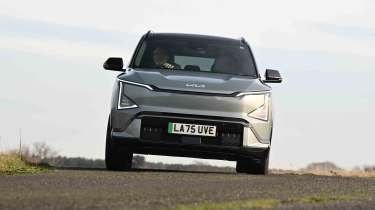
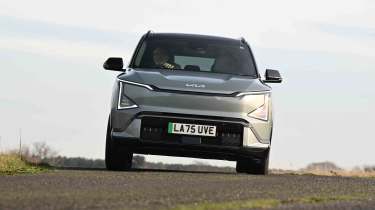
Kia’s design language has come a long way in a few years, and the EV5 is proof it’s matured into something you’d spot across a crowded car park. The front end keeps Kia’s tiger-nose shape but reinterprets it as a largely closed-off, sculpted face with a slim intake underneath for battery cooling. The brushed aluminium Kia badge sits front and centre, flanked by sharp LED daytime running lights that trace a signature you’ll recognise from the EV9 and EV3, just scaled to suit this car’s more compact dimensions. In Kia’s "iceberg green" paintwork, the nose has real presence without the overdone aggression some rivals can’t seem to help themselves with.
That colour deserves a closer look, too. Depending on how the light hits it, iceberg green slides between a muted sage and something richer and deeper. It hides road grime surprisingly well and gives the EV5 a quiet sophistication that the usual white and grey options simply can’t match. Strong creases run back from the headlights along the bonnet, adding a muscularity that balances out the otherwise clean surfacing.
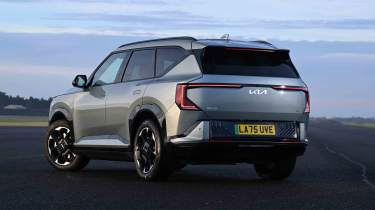
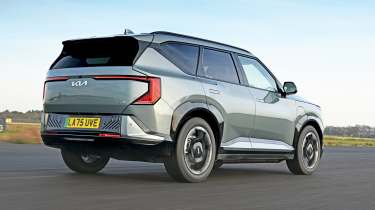
In profile, the EV5 reads like a scaled-down EV9 with a dash of Sportage mixed in for good measure. The 19-inch diamond-cut alloys that come standard on the GT Line fill the arches nicely, and a motorised charge port on the front wing is one of those small conveniences that feels a bit gimmicky right up until you’ve used it a dozen times and start wondering why every EV doesn’t have one. Piano-black trim on the mirror caps, window surrounds, and a slim inlay along the lower doors provides some visual contrast against the green bodywork. The lines sweep cleanly down the side before flaring subtly at the rear haunches, and the whole shape ties into the family look Kia’s established across the EV3, EV6, and EV9. If a design language works, there’s no reason not to repeat it at different scales, and Kia clearly agrees.
Out back, a full-width running light bar connects the tail lamps and gives the EV5 a distinctive after-dark signature. The brushed aluminium treatment continues on the tailgate badging — EV5 in block letters, GT Line below — and a modest roof spoiler crowns the rear glass. The overall effect is aerodynamic, clean, and uncluttered. It’s the sort of design that shouldn’t date quickly, which matters when you’re talking about a car Kia expects families to keep for most of a decade under its warranty.
Interior, Tech and Practicality
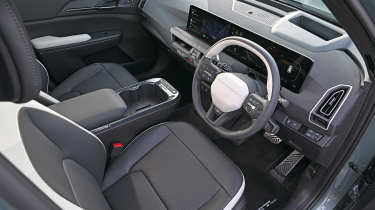
Climb inside and the EV5 delivers exactly the kind of cabin we’ve come to expect from Kia’s recent efforts: solidly built, sensibly laid out, and packed with tech that doesn’t overwhelm. The dashboard is anchored by twin 12.3-inch displays — one serving as the digital instrument cluster, the other as the central infotainment touchscreen — joined by a smaller 5.3-inch screen underneath that handles climate control. Here’s the thing, though: Kia’s resisted the urge to bury everything in sub-menus. The steering wheel keeps physical buttons for media, calls, and driver-assist toggles. Window switches are conventional. You still get actual buttons for the heated and ventilated seat controls. In a market where some makers are ripping out every physical switch in favour of touch-sensitive pads, this feels like a deliberate and welcome choice.
The GT Line S spec piles on the luxury. The front seats are heated, ventilated, and offer a massage function, something you’d normally expect on cars costing twice as much. Kia’s "Rest Mode" reclines the driver’s seat, dims the ambient lighting, and plays calming audio through the Harman Kardon sound system, which is a noticeable step up from the already decent standard stereo. A panoramic glass roof stretches across most of the cabin and floods the interior with light, though it barely opens, which limits its usefulness when the weather’s warm. A colour heads-up display projects speed, navigation prompts, and, cleverly, your average speed through average-speed camera zones onto the windscreen. Blind-spot monitoring and a driver-attention warning round out the GT Line S safety kit.
Family buyers will appreciate how much thought has gone into cabin storage. There are cubby holes in the centre console, deep door bins, and cupholders big enough for the sort of oversized cinema drinks that always seem to end up in a family car. USB-C charging points are scattered throughout both rows, and the rear bench offers enough legroom to keep taller teenagers happy on longer trips. Two child seats fit in easily thanks to clearly marked ISOFIX points, and the fold-down centre armrest gives rear passengers their own cupholders and a flat surface for propping up tablets. Headroom in the back is adequate rather than generous, but nothing that’ll cause any grief in daily use.
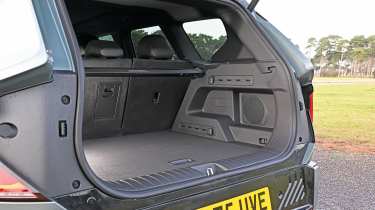
The boot measures 566 litres with the seats up, a genuinely competitive figure, expanding to 1,650 litres with the rear bench folded flat. The load lip sits at a comfortable height for loading pushchairs or the weekly shop, and a variable floor lets you create a hidden underfloor compartment for cables and valuables. A three-pin domestic socket in the boot provides vehicle-to-load capability, meaning you can power a camping kettle, an air pump for a footy, or even a laptop on a long stop. A 44-litre frunk under the bonnet gives you extra lockable storage, perfect for muddy boots or wet coats you’d rather keep separate from the cabin. Kia’s designed this boot as if someone handed them a brief that simply read: "Make it work for every family scenario we can possibly think of." Job done.
On The Road — Driving Impressions
A family EV needs to pull off something that sounds simple but isn’t: it has to feel natural to drive no matter what the owner was piloting before. Whether you’re stepping out of a diesel Sportage or a petrol Tiguan, the changeover should be painless. In our time with it, the EV5 manages this admirably.
The steering is light enough for easy parking but has enough weight and feedback at speed to feel settled on A-roads. The throttle response is, as you’d expect from an electric motor, immediate — 295 Nm of torque arrives the instant you press the pedal, giving the EV5 a briskness around town that belies its 8.4-second 0-62 time. That figure isn’t slow; it’s just unremarkable compared to some of the headline-grabbing EVs out there. For merging onto dual carriageways and overtaking tractors on B-roads, it’s more than enough.
The brakes are a particular standout. So many EVs suffer from an awkward, wooden brake pedal feel as the regenerative and friction systems try to work together. The EV5 sidesteps this almost entirely. The transition between regen and physical braking is smooth and progressive, and the pedal feel is natural enough that you never find yourself lurching to a stop or second-guessing your inputs. It simply doesn’t feel like an EV in this regard, and that’s high praise.
The driver-assistance kit on the GT Line S is well-specced but, importantly, not overbearing. Lane-keep assist intervenes gently rather than wrestling the wheel away from you. The speed-camera warning delivers a pleasant chime, a polite "ding-dong" rather than the aggressive blaring alert some manufacturers seem to prefer. The system does bong at you frequently if you creep over the limit, but it feels like a helpful nudge rather than a telling-off. We drove predominantly in Eco mode, which softens the throttle response slightly and stretches range without making the car feel sluggish. Sportier drive modes are there for those moments when you want a sharper reaction from the motor, but for the everyday school-run-and-motorway routine, Eco is spot on.
Range, Efficiency and Charging
Range anxiety is still the single biggest hurdle for families thinking about going electric, and Kia has clearly taken that to heart. The GT Line S packs an 81.4 kWh battery, of which 78 kWh is usable. On its 19-inch alloy wheels, the official WLTP figure sits at 313 miles — the entry-level Air trim on smaller wheels manages 329 miles. These are honest numbers, and our real-world testing confirmed them with pleasing consistency.
On the motorway, cruising at 70 mph with the air conditioning on and the usual traffic mix, the EV5 returned between 3 and 3.5 miles per kWh. At the lower end, you’re looking at roughly 234 miles from a full charge; at the upper end, around 273 miles. Most families will find those figures perfectly workable for the school run, commuting, and weekend trips without needing to plug in every night. Around town, efficiency climbs sharply. We regularly saw 4 to 5 mi/kWh in urban driving, which translates to over 300 miles of real-world range, comfortably beating the WLTP claim in stop-start conditions. Kia’s decision to fit a heat pump as standard on the GT Line S helps maintain efficiency in the colder months, though the entry Air trim misses out.
Plugging into a DC rapid charger rated at 150 kW or above will take the battery from 10 to 80 percent in approximately 30 minutes. That’s competitive with most rivals in this segment, even if it doesn’t quite match the blistering speeds of 800-volt architectures like the Kia EV6. The onboard AC charger runs at 11 kW, so a full charge from empty on a home wallbox takes roughly seven to eight hours — an overnight job, basically. One important caveat: during our testing, the EV5 appeared to cap its charging speed at around 80 kW when hooked up to Tesla Superchargers. That’s a notable limitation given the Tesla network is one of the most extensive and cost-effective in the UK. On InstaVolt, Ionity, and other compatible networks, full charging speeds were achieved without any issues. If you’re weighing up the EV5 and lean heavily on Tesla Superchargers for longer trips, it’s worth keeping that in mind.

At A Glance — How It Compares
The mid-size electric SUV segment is fiercely contested, and the EV5 enters the ring against some formidable opponents. The Skoda Enyaq 85 is perhaps the most direct rival, offering a similar blend of space, comfort, and value. The Tesla Model Y remains the segment benchmark in terms of sales volume and charging infrastructure. And Kia’s own EV6 provides a sportier, lower-slung alternative within the same showroom. Each of these cars has its strengths, but the EV5’s combination of range, practicality, and pricing gives it a compelling case.
| Price | Power | 0-62 | Range (WLTP) | DC Peak | Boot |
|---|---|---|---|---|---|
| Kia EV5 GT Line S (from £48,000) | 214 bhp | 8.4 s | 313 mi | 150 kW | 566 L |
| Skoda Enyaq 85 (from £40,000) | 282 bhp | 6.7 s | 339 mi | 135 kW | 585 L |
| Tesla Model Y RWD (from £44,990) | 295 bhp | 5.9 s | 311 mi | 170 kW | 854 L (with frunk) |
| Kia EV6 (from £45,575) | 226 bhp | 7.3 s | 328 mi | 240 kW | 490 L |
The EV5 positions itself as the value play with the most generous standard equipment at its price point. It undercuts the Model Y and EV6 on list price while offering a larger, more practical cabin than the EV6 and more kit than the Enyaq at equivalent trim levels. It is not the fastest, nor the most efficient, but for a family that wants the most car for the least money, it makes a very strong case.
2026 Kia EV5 vs Skoda Enyaq 85: Which Is Better?
If you’re shopping for a family-friendly electric SUV in the £40,000-to-£50,000 bracket, these two will almost certainly end up on your shortlist. The Skoda Enyaq 85 has been a consistent recommendation from What Car? and Auto Express since it launched, and for good reason: it’s comfortable, spacious, and pleasant to drive. The Kia EV5, meanwhile, arrives as a newer contender with more kit, a longer warranty, and a price that makes you wonder how Kia’s pulling it off. Putting them side by side tells you a lot.
On price, the Enyaq 85 starts from around £40,000, roughly £2,000 more than the entry-level EV5 Air. But once you start ticking boxes for the equipment that comes standard on the EV5 GT Line S — the Harman Kardon audio, the panoramic roof, the heated and ventilated seats — the Enyaq’s price creeps up and the gap shrinks considerably. At the GT Line S level, the EV5 at £48,000 is arguably the better value because there’s very little left to add from the options list.
Performance is one area where the Enyaq holds a clear advantage. Its 282 bhp motor and 6.7-second 0-62 time make it feel noticeably brisker than the EV5’s more modest 214 bhp and 8.4-second sprint. The Skoda is also rear-wheel drive, which gives it a more engaging, balanced feel through corners. The EV5 is front-wheel drive, and while it handles tidily enough, it doesn’t have the playful rear-driven character of the Enyaq. If driving enjoyment matters to you alongside family duties, the Skoda has the edge.
Charging and efficiency are closer than you might expect. The Enyaq 85 uses a 77 kWh usable battery against the EV5’s 78 kWh, and its WLTP range of 339 miles pips the EV5’s 313 miles. In real-world terms, though, the difference is marginal — both cars return similar miles-per-kWh figures, and the EV5’s slightly higher DC peak of 150 kW against the Enyaq’s 135 kW gives it a marginal speed advantage at the rapid charger. Neither car will match an 800-volt EV6 for top-up speed, but both are perfectly adequate for a 30-minute motorway stop.
Inside, the EV5 pulls ahead on equipment and family-friendly thoughtfulness. The 566-litre boot edges past the Enyaq’s 585 litres when you factor in the variable floor and the V2L three-pin socket, which the Skoda doesn’t offer. The rear seats are heated, the front seats massage you, and the heads-up display is standard. The Enyaq’s cabin is beautifully built — Skoda’s interior quality is excellent — but it doesn’t match the EV5 on sheer volume of standard kit.
On the road, the Enyaq is the sweeter car. Its ride is a touch more composed over broken surfaces, the steering is more communicative, and the rear-drive layout gives it a sense of agility the EV5 can’t quite replicate. The EV5, for its part, is perfectly pleasant and easy to drive — most families won’t have anything to complain about — but if you enjoy the act of driving itself, the Skoda rewards you more.
Kia’s warranty is a significant differentiator. Seven years and 100,000 miles, battery included, versus Skoda’s three-year, 60,000-mile standard cover is a gulf that’s hard to ignore. For a family buying a car they plan to keep long-term, the Kia provides peace of mind the Enyaq simply can’t match.
Starting price: Kia EV5 from £38,000 / Skoda Enyaq 85 from £40,000 Battery (usable): 78.0 kWh / 77.0 kWh WLTP range: 313 mi (GT Line S) / 339 mi 0-62 mph: 8.4 s / 6.7 s DC peak: 150 kW / 135 kW Boot: 566 L / 585 L Length: 4,610 mm / 4,649 mm Drive layout: Front-wheel drive / Rear-wheel drive Warranty: 7 years / 100,000 miles / 3 years / 60,000 miles
VERDICT_BOX_START Buy the Kia EV5 if: You want the most standard equipment for your money, value a seven-year warranty, and need a practical family EV with a domestic V2L socket in the boot. Buy the Skoda Enyaq 85 if: You prioritise driving engagement, prefer rear-wheel-drive handling, and want a slightly longer WLTP range from a proven package. Our pick: Kia EV5. The equipment gap, warranty advantage, and V2L utility tip the scales for a car that families will own for years. VERDICT_BOX_END
Safety and Warranty
The Kia EV5 earned a full five-star Euro NCAP rating in November 2025, scoring 83 percent for adult occupant protection, 85 percent for child occupants, 74 percent for vulnerable road users, and 80 percent for safety assist. Those are strong numbers that put it among the safer cars in its class, and they reflect a body structure and airbag package that should reassure any parent loading kids into the back seat.
Standard active safety kit includes autonomous emergency braking with pedestrian and cyclist detection, lane-keep assist, lane-departure warning, driver-attention monitoring, and rear cross-traffic alert. The GT Line S adds blind-spot monitoring and the heads-up display mentioned earlier, which keeps the driver’s eyes pointed where they should be. None of the systems felt over-intrusive during our testing — a genuine relief, given how many modern cars seem determined to fight the driver at every turn.
Kia’s warranty remains a standout selling point. At seven years and 100,000 miles, including coverage of the high-voltage battery, it comfortably outstrips the three-year, 60,000-mile protection offered by most European rivals and even the five-year cover some competitors provide. For a family committing to their first EV, or their first new car in a decade, knowing the manufacturer stands behind the drivetrain for the better part of a decade is powerful reassurance. It’s one thing to build a good electric car; it’s another to back it with the confidence this warranty implies.
Who Should Buy The EV5?
The EV5 makes the most sense for a specific, and very large, buyer profile: families of four stepping up from a petrol or diesel SUV. If you currently drive a Kia Sportage, a Volkswagen Tiguan, a Nissan Qashqai, or any of the mid-size crossovers that dominate the roads, the EV5 offers a familiar size and shape with the running-cost benefits of electric power. The switch from combustion to electric is about as painless as it gets here — the driving experience is natural, the range is usable for daily life and the occasional longer trip, and the boot swallows a double pushchair and a week’s worth of shopping without complaint.
It also works well as a second car for households that already have a longer-range EV for motorway duties. The EV5 handles a 200-mile round trip without needing to stop for a charge, and for the school run, the weekly shop, or the weekend football match, its town efficiency is impressive. The V2L socket in the boot turns it into a mobile power source, useful for camping, outdoor events, or just charging a laptop in a car park.
For those downsizing from a Kia EV9, the EV5 will feel immediately familiar. The design language, the infotainment system, and the overall philosophy are shared, but in a package that’s easier to park and cheaper to run, not to mention less intimidating on narrow residential streets. The EV9 is a magnificent car, but it’s a lot of car. The EV5 gives you roughly 80 percent of the experience in a more manageable footprint.
Who should look elsewhere? If your driving life involves sustained high-speed motorway cruising — and we’re talking 90 mph on the Continental motorway network, not just the occasional M1 dash — the EV5’s 102 mph top speed and relatively modest motorway efficiency will frustrate. If you depend heavily on the Tesla Supercharger network for long-distance charging, the EV5’s throttled speeds on that network are a genuine practical limitation. And if you want the sharpest-handling car in the segment, the Skoda Enyaq 85 and the Kia EV6 both deliver a more engaging drive.
Verdict — Is The 2026 Kia EV5 The Best Family EV?
After spending plenty of time with the EV5 GT Line S, we’re struggling to find significant fault. It’s not the fastest electric SUV, it’s not the most dynamically engaging, and the panoramic sunroof is more decorative than functional. Those are minor quibbles. What Kia’s built is a car that understands its brief with remarkable clarity: it’s spacious, comfortable, efficient, well-equipped, and backed by a warranty no European rival can match.
The range figures are honest and achievable in daily use. The boot is large, cleverly designed, and fitted with a domestic socket that turns the car from simple transport into a genuine utility tool. The interior is built to handle the rigours of family life without feeling cheap, and the technology package, from the heads-up display to the massaging seats to the Harman Kardon stereo, feels like it belongs in a car costing a good deal more. At £48,000 for the GT Line S, or from £38,000 in entry-level Air form, the value proposition is compelling.
Does it deserve a perfect ten? We’ve given it 9.0 out of 10, which in this segment is about as close to a standing ovation as we’re likely to offer. The EV5 isn’t just a good electric family car; it’s a good family car, full stop. Kia’s taken everything it learned from the EV6, the EV9, and the Sportage, and distilled it into a package that feels complete. If this is where the family EV segment is heading, every other manufacturer should be paying very close attention.
Frequently Asked Questions
How long does the 2026 Kia EV5 take to charge?
On a 150 kW DC rapid charger, the EV5’s 81.4 kWh battery goes from 10 to 80 percent in roughly 30 minutes. Plug into an 11 kW home wallbox and a full charge from empty takes around seven to eight hours — overnight, essentially. One thing to note: charging speeds on Tesla Superchargers are capped at around 80 kW, so rapid-charging stops on that network will take noticeably longer.
What is the real-world range of the Kia EV5?
On the motorway at a steady 70 mph, expect between 3 and 3.5 miles per kWh, giving you a realistic range of 234 to 273 miles from a full charge. Around town, efficiency climbs to 4 to 5 mi/kWh, which can push real-world range past 300 miles in favourable conditions. The WLTP-rated range is 313 miles for the GT Line S on 19-inch wheels.
How big is the boot, and what is the V2L socket for?
The boot measures 566 litres with the rear seats up, expanding to 1,650 litres with them folded flat. A variable floor hides extra underfloor storage for cables and valuables. The three-pin domestic socket in the boot provides vehicle-to-load capability, letting you power appliances like camping gear, laptops, or small kitchen devices directly from the car’s battery.
What warranty does Kia offer on the EV5?
Kia provides a seven-year, 100,000-mile warranty covering the entire vehicle, including the high-voltage battery. It’s the most generous manufacturer warranty available and significantly outperforms the three-year cover offered by most European rivals.
How safe is the Kia EV5?
The EV5 received a five-star Euro NCAP rating in November 2025, scoring 83 percent for adult occupant protection, 85 percent for child occupants, 74 percent for vulnerable road users, and 80 percent for safety assist. Standard safety equipment includes autonomous emergency braking, lane-keep assist, driver-attention monitoring, and a rear cross-traffic alert system.
How does the Kia EV5 compare to the Skoda Enyaq 85?
The Enyaq 85 is slightly faster (6.7 s vs 8.4 s to 62 mph), marginally longer-legged on WLTP range (339 vs 313 miles), and arguably sweeter to drive thanks to its rear-wheel-drive layout. The EV5 counters with more standard equipment at equivalent pricing, a V2L domestic socket in the boot, and a seven-year warranty versus Skoda’s three years. If you’re prioritising kit, practicality, and long-term ownership confidence, the EV5 edges ahead. If driving engagement matters more to you, the Enyaq is the stronger pick.
