

2026 Toyota Camry Review: Hybrid-Only Sedan Tested
A hyper-efficient and polished family sedan, hamstrung by a few ergonomic missteps.

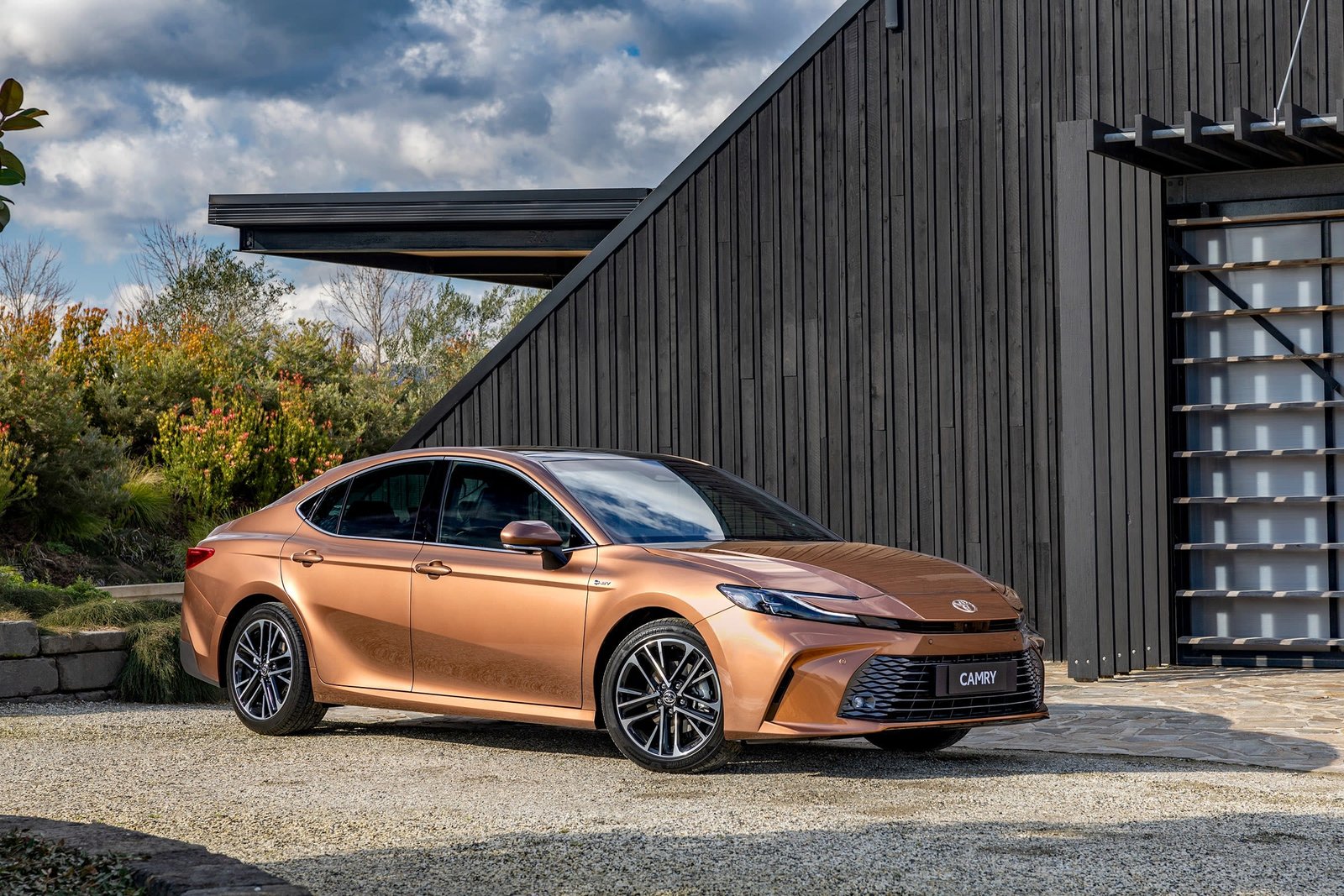
2026 Toyota Camry Hybrid sedan exterior front three-quarter
Price
$39,990
Powertrain
2.5L hybrid
⚡ Quick Verdict
The 2026 Camry Hybrid is a seriously smart piece of kit. It delivers where it counts for Aussie families and commuters—sipping fuel, swallowing luggage, and offering a refined daily drive. It’s a rational, high-value pick, even if a couple of interior quirks stop it from being perfect.
✓ The Good
- +Exceptional claimed 4.0L/100km fuel economy.
- +Spacious 524L boot beats most rivals.
- +Strong 170kW hybrid powertrain feels peppy.
- +Comprehensive Toyota Safety Sense 2.5+ is standard.
- +Available all-wheel drive in some markets.
- +Excellent 5-year unlimited-km warranty.
✗ The Trade-offs
- −Adaptive cruise control buttons are less intuitive.
- −Protruding centre console can intrude on passenger space.
- −EV-only mode is extremely limited in speed.
- −Hybrid inverter recall affects pre-November 2025 builds.
- −Centre console design feels needlessly complex.
- −Infotainment screen layout varies by trim level.
📑 In This Review
- Design and Exterior
- Interior and Cabin
- Hybrid Powertrain and Performance
- Fuel Economy and Real-World Efficiency
- Technology and Infotainment
- On the Road
- Toyota Camry vs Honda Accord Hybrid: Which Is Better?
- At a Glance – Camry vs the Mid-Size Sedan Field
- Safety and Warranty
- Who Should Buy the 2026 Camry – and Who Should Skip
- Verdict
- Frequently Asked Questions
The 2026 Camry Hybrid is a seriously smart piece of kit. It delivers where it counts for Aussie families and commuters—sipping fuel, swallowing luggage, and offering a refined daily drive. It’s a rational, high-value pick, even if a couple of interior quirks stop it from being perfect. In an SUV-obsessed market, the humble mid-size sedan is a bit of a rare breed these days. Toyota’s not giving up on it, though. With the 2026 Camry, they’ve gone all-in on efficiency, making hybrid power the only game in town. It’s a bold move that simplifies the range and makes a compelling promise: you’ll get near-diesel fuel bills without ever needing to plug in. Starting at $39,990 for the Ascent Hybrid, it significantly undercuts a lot of hybrid SUVs. And what you get for that is a proper car-like driving experience and a boot that’s genuinely cavernous. It’s squarely aimed at buyers who care about value, space, and low running costs more than sitting up high. With sharper looks and proven hybrid tech, the 2026 Camry isn’t just hanging on—it’s making a strong case for itself as the sensible choice.
Design and Exterior
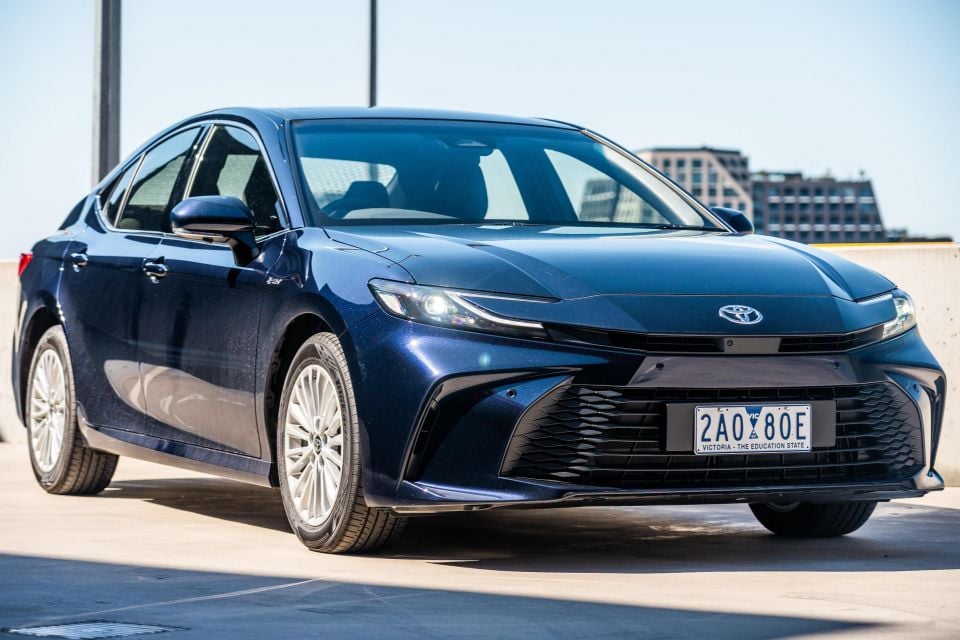
Toyota calls its latest look "Hammer Head," and it gives the new Camry a much more assertive face than before. You get slim, aggressive headlights that blend into a wider, more prominent grille. It’s got real road presence now. The design flows well, with a sleek profile that tapers towards the back, avoiding some of the awkward shapes you see on other sedans.
At 4,920mm long, 1,840mm wide, and 1,445mm tall, it’s a substantial car with a planted, athletic stance. The sculpted panels and sharp character lines along the sides break up its size nicely. It all adds up to a look that feels more premium than ever. Toyota’s managed to shift the Camry from forgettable to genuinely handsome, giving it the style cred to compete in today’s market.
Interior and Cabin
Inside, the cabin is built around the driver with a clear, sensible dashboard. Material quality has taken a step up, with soft-touch stuff in the places you touch most. There are still some harder plastics lower down, though. The big talking point is the centre console. It juts out quite prominently towards the passenger, and for taller folks, it can eat into knee room.
The seats are comfy for a long haul, but the trim level matters. Our SL test car had synthetic leather, which feels plusher initially, but we do wonder about its long-term durability compared to the hard-wearing cloth on the base Ascent. Boot space is still a massive Camry strength. At 524 litres, it’s huge—a figure that would make many mid-size SUVs jealous.

Hybrid Powertrain and Performance
Under the bonnet, you’ll find a 2.5-litre petrol engine working with an electric motor. The combined output is a healthy 170kW, sent to the front wheels through a seamless eCVT. The integration is spot on; power delivery is smooth and linear, with enough punch for safe overtaking and easy merging.
During our drive, we could barely tell when it switched between petrol and electric power. That EV mode button, though, is more of a gimmick than a proper feature. Toyota says it’s only for short, low-speed stints under 30 km/h—think parking garages or bumper-to-bumper traffic. The engine also uses super-thin 0W-8 oil to chase maximum efficiency. Some owners might swap to more common 0W-16 at their first service for peace of mind, but it’s best to stick to the book to keep your warranty happy.

Fuel Economy and Real-World Efficiency
This is the Camry Hybrid’s party trick. Toyota claims a combined figure of just 4.0L/100km for every model. In our real-world mix of city commutes and highway runs, we consistently saw between 4.3 and 4.8L/100km. That’s still brilliant.
You could theoretically crack 1,100 kilometres on a single tank. That absolutely smashes the fuel economy of any regular petrol mid-size sedan, most of which struggle to get below 7.5L/100km. If you do big kays, the fuel savings aren’t just a number—they’re real money in your pocket each week. It’s a huge part of the Camry’s value story.
Technology and Infotainment
The infotainment setup changes with the trim. Our SL had a big, responsive 12.3-inch touchscreen with wireless Apple CarPlay and Android Auto that worked perfectly. Base models get an 8.0-inch screen. The system is a massive improvement on old Toyota gear, with sharper graphics and quicker responses.
However, moving the adaptive cruise control from a simple stalk to a cluster of buttons on the steering wheel feels like a step backwards. It takes more clicks to set up, and the small buttons are hard to find without looking down. It’s less intuitive than before. Other tech bits include standard keyless start and a rear-seat reminder chime on startup. It’s meant to stop you leaving kids or pets in the car, but the loud beep every time might annoy some people.

On the Road
The Camry delivers a smooth, comfortable ride that soaks up rough city streets and highway undulations without fuss. It’s tuned for comfort, so it leans in corners predictably but always feels stable and secure. The electric parking brake is now standard, which helps on hills but makes DIY brake jobs trickier.
While you can get all-wheel drive in places like the US, Australian Camrys are front-wheel drive only. For most conditions, that’s perfectly fine, and the hybrid system’s instant torque helps keep torque steer in check when you accelerate hard. The overall vibe is one of quiet competence—it shields you from road noise and the outside world brilliantly, making it a top-notch long-distance tourer.

Toyota Camry vs Honda Accord Hybrid: Which Is Better?
The Honda Accord Hybrid is the Camry’s natural rival. Both are hybrid-only, quality mid-size sedans, but they go about things differently. The Camry starts at $39,990, which is a fair chunk less than the Accord’s estimated ~$45,000 kick-off in Australia.
Power-wise, the Camry’s 170kW just pips the Accord’s 152kW. The Toyota also beats it on claimed fuel economy—4.0L/100km versus about 4.5L/100km. The Camry’s 524L boot comfortably outsizes the Accord’s 473L, and it offers all-wheel drive overseas, something the Accord doesn’t have at all.
Inside, the Accord fights back with a standard 12.3-inch screen on every model, while the Camry’s big screen is saved for pricier trims. The Honda’s cabin might feel a touch more modern and put-together, without quirks like the Camry’s passenger-side console intrusion. Both have 5-star ANCAP safety and loads of driver aids.
| Spec | 2026 Toyota Camry | 2026 Honda Accord Hybrid |
|---|---|---|
| Starting price (AUD) | $39,990 | ~$45,000 |
| Powertrain | 2.5L hybrid | 2.0L hybrid |
| Combined power | 170kW (225hp) | 152kW (204hp) |
| Fuel economy | 4.0L/100km | ~4.5L/100km |
| Boot capacity | 524L | 473L |
| AWD option | Yes (overseas) | No |
| Warranty (years) | 5 (+7 driveline) | 5 |
| Touchscreen | 8 / 12.3 inch | 12.3 inch standard |
| ANCAP rating | 5 stars | 5 stars |
<div style="background:linear-gradient(135deg,#f0f9ff,#e0f2fe); border-left:4px solid #2563eb; border-radius:12px; padding:24px 28px; margin:32px 0"><p style="font-size:12px; font-weight:800; letter-spacing:0.14em; text-transform:uppercase; color:#1e40af; margin:0 0 10px">Which one is better?</p><p><strong>Buy the Camry if</strong> you prioritise value, maximum fuel efficiency, and the biggest boot space.</p><p><strong>Buy the Accord if</strong> you prefer a slightly more modern interior with a standard large screen and don’t mind paying a premium.</p><p><strong>Our pick</strong> is the Toyota Camry Ascent Sport Hybrid. It offers the best blend of the Camry’s core strengths—price, efficiency, space—without the entry-model’s smaller screen.</p></div>

At a Glance – Camry vs the Mid-Size Sedan Field
| Spec | 2026 Toyota Camry | 2026 Honda Accord Hybrid |
|---|---|---|
| Starting price (AUD) | $39,990 | ~$45,000 |
| Powertrain | 2.5L hybrid | 2.0L hybrid |
| Combined power | 170kW (225hp) | 152kW (204hp) |
| Fuel economy | 4.0L/100km | ~4.5L/100km |
| Boot capacity | 524L | 473L |
| AWD option | Yes (overseas) | No |
| Warranty (years) | 5 (+7 driveline) | 5 |
| Touchscreen | 8 / 12.3 inch | 12.3 inch standard |
| ANCAP rating | 5 stars | 5 stars |
Honda Accord Hybrid
Sharper interior tech, but pricier and FWD only.
Hyundai Sonata Hybrid
Stylish alternative, less efficient than the Camry.
Kia K5 GT-Line
Sportier turbo petrol, but no hybrid efficiency.
Mazda 6 (final-gen)
Premium feel but the segment is moving on.
Beyond the Accord, the Camry faces a handful of remaining rivals in the dwindling mid-size sedan segment. Toyota Camry Kia K5 GT-Line — — $39,990-$53,990 $40,000-$45,000 2.5L hybrid 2.5L turbo petrol 170kW 213kW 4.0L/100km 8.8L/100km 524L 510L Yes (overseas) No 5 stars 5 stars
Safety and Warranty
Safety is a big focus. The 2026 Camry scored a 5-star ANCAP rating, with an exceptional 95% for Adult Occupant Protection—a record for the class. You get Toyota Safety Sense 2.5+ as standard, which includes Autonomous Emergency Braking (with car, pedestrian, cyclist, and junction assist), Lane Keep Assist, and speed sign recognition.
We have to mention the hybrid inverter recall. It affects around 55,000 Camry hybrids built before mid-November 2025 because of a potentially loose high-voltage bolt in the Denso-supplied inverter. In rare cases, this could lead to a loss of power or fire risk. Toyota has issued the recall and is working on a fix. Cars built after that date, like our later-build test car, use a corrected part.
Toyota backs the Camry with a 5-year unlimited-kilometre warranty. That stretches to 7 years on the driveline if you service it on time at a Toyota dealer. Services are due every 12 months or 15,000km, and the first five years are capped at $255 per visit.
Who Should Buy the 2026 Camry – and Who Should Skip
The perfect Camry buyer is a pragmatist. Think high-kilometre commuters who want to slash their fuel bills without the hassle of charging an EV. It’s also great for a small family that needs lots of passenger and boot space but prefers how a car drives over an SUV. The Camry’s efficiency and space are its trump cards.
If you’re after sharp handling and a raw, connected driving feel, you should look elsewhere—the sportier Kia K5 is a good bet. If the hybrid inverter recall has you worried, either confirm any car you’re looking at was built after November 2025, or wait until the issue is fully sorted and any initial quality jitters have passed.
⚡ Our Verdict
A hyper-efficient and polished family sedan, hamstrung by a few ergonomic missteps.
The 2026 Toyota Camry Hybrid earns its 4.2/5 rating. It nails its main job: delivering ultra-low fuel use, a roomy and comfy cabin, and a polished drive in a sharp-looking package. Our headline—"A sharper, more efficient Camry that still plays it safe"—sums it up perfectly. The changes are evolutionary, not revolutionary, focusing on making a good thing even better. Our take is clear. Despite a few ergonomic niggles and the cloud of a recall, the Camry Hybrid makes a powerful, value-packed argument. For most Aussie families after a sensible, efficient, and practical sedan, it’s still the default pick and the benchmark. We’d point you towards the Ascent Sport Hybrid as the sweet spot of the range.
Frequently Asked Questions
Is the 2026 Toyota Camry affected by the hybrid inverter recall?
Yep, a recall was issued for about 55,000 Camry hybrids built before mid-November 2025. It’s a potential issue with a high-voltage bolt in the Denso-made inverter. Toyota is on it with a fix. Cars built after that date use a corrected part. We’d always recommend getting a dealer to check a specific vehicle’s status before you buy.
How much does the 2026 Toyota Camry cost in Australia?
The range kicks off at $39,990 for the Ascent Hybrid. The mid-spec Ascent Sport Hybrid sits in the middle, and the top-shelf SL Hybrid is $53,990. All prices are before on-roads.
What is the real-world fuel economy of the 2026 Camry Hybrid?
Toyota claims 4.0L/100km combined. In our testing, we got between 4.3L and 4.8L/100km, depending on where and how we drove. That’s still outstanding for a mid-size sedan.
Does the 2026 Camry come with all-wheel drive?
No. All Australian-delivered 2026 Camry hybrids are front-wheel drive. All-wheel drive is an option in other markets, like the United States.
How does the Camry compare to the Honda Accord Hybrid?
The Camry is generally cheaper, more fuel-efficient, and has a bigger boot. The Accord hits back with a standard 12.3-inch screen on every model and a cabin that some might find a bit more intuitive. For value and practicality, we’d lean towards the Camry.
What warranty does Toyota Australia offer on the Camry?
Toyota gives you a 5-year, unlimited-kilometre warranty. That can be bumped to 7 years on the drivetrain (engine, gearbox, and hybrid bits) if you service it on time at an authorised Toyota dealer.
Is the Camry Hybrid worth buying in 2026?
For sure. If you’re after low running costs, heaps of space, and a comfortable ride over the high-set stance of an SUV, the 2026 Camry Hybrid is one of the smartest new car buys out there.
