

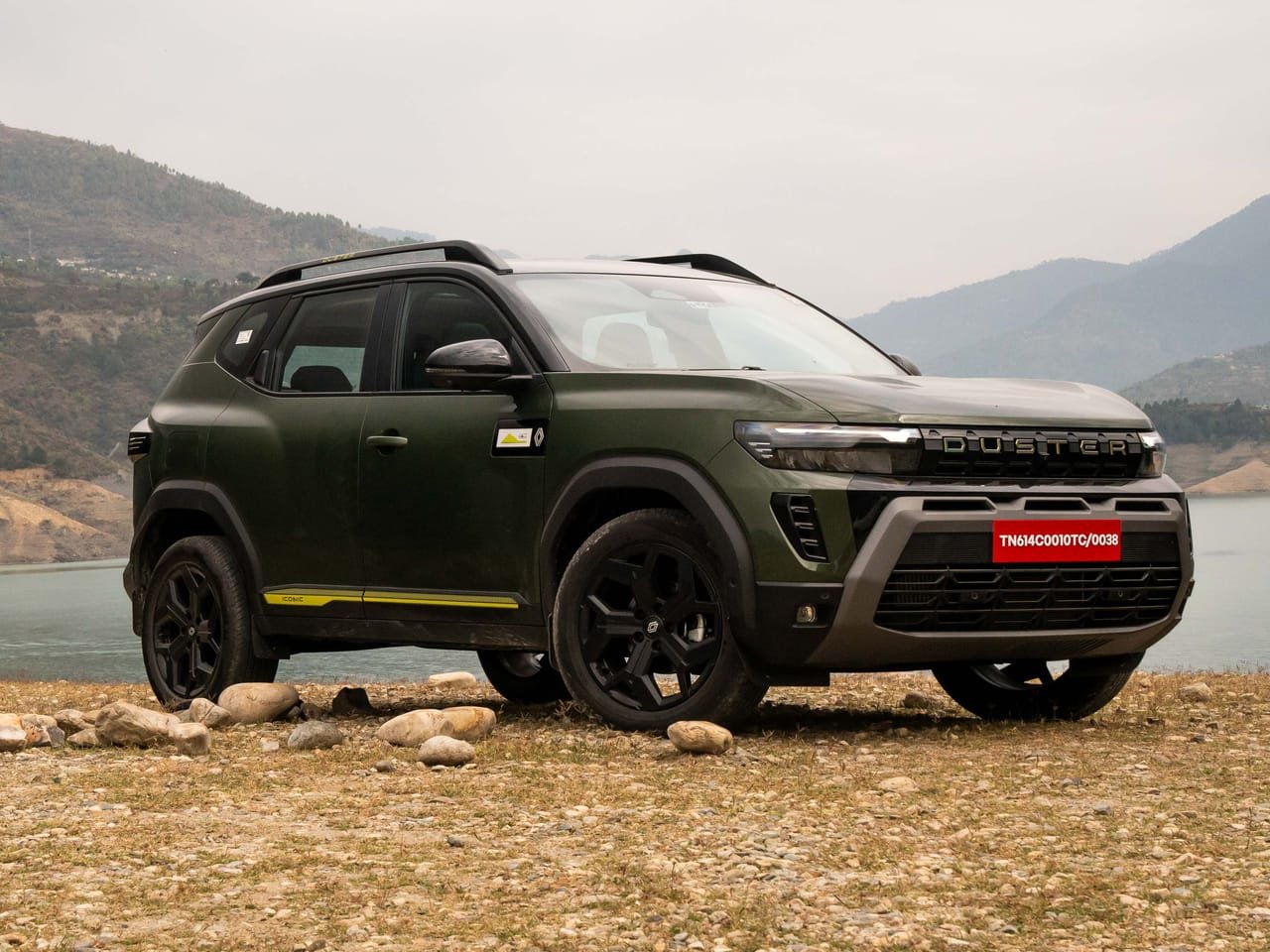
2026 Renault Duster Review: India’s Comeback King Is Finally Properly Premium
The Duster is back, more premium than ever, and still brilliant to drive.
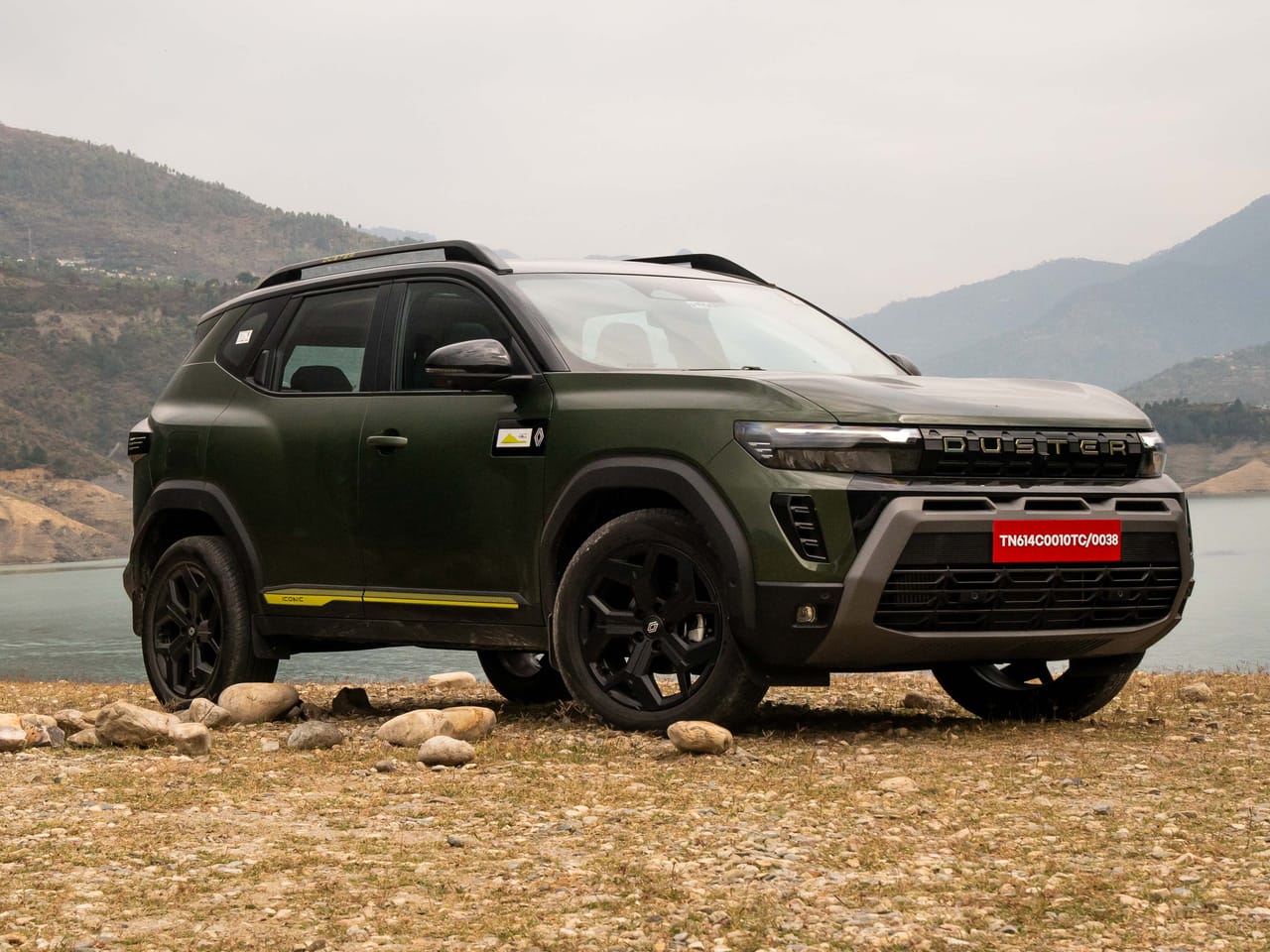
2026 Renault Duster front three-quarter press shot
Price
From Rs. 10.49 lakh
Power
163 hp
⚡ Quick Verdict
: The 2026 Renault Duster is a compact SUV built on the CMF-B platform that Renault has thoroughly re-engineered for India, adding a raised roof, premium cabin materials, dual 10-inch screens, and Level-2 ADAS. It drives with a lightness and composure that genuinely surprised us, backed by a strong 1.3-litre turbo-petrol engine. This is for buyers who want a sporty, adventure-flavoured alternative to the Creta–Seltos mainstream.
—
✓ The Good
- +Punchy 1.3 turbo-petrol with 280 Nm makes effortless work of hills and highways
- +Re-engineered cabin with dual screens, ventilated seats, and a panoramic sunroof
- +Surprisingly composed ride and precise steering for a compact SUV
- +Huge 700-litre boot and a 5-star Bharat NCAP safety rating
- +7-year warranty package and strong value from the Evolution variant onwards
✗ The Trade-offs
- −Rear seat knee room is tight; boot-biased packaging limits family comfort
- −Infotainment menus lack logical organisation; screens are highly reflective
- −No all-wheel-drive option and no diesel; 1.0 base variant is stripped bare
- −Engine note is slightly mechanical compared to larger-displacement rivals
📑 In This Review
- Why the 2026 Renault Duster Matters
- Design and Road Presence
- Inside the Cabin
- Space, Practicality and Boot
- Engine, Gearbox and Driving Experience
- Ride, Handling and Off-Road Capability
- Technology and ADAS
- At a Glance, Where the 2026 Duster Sits Against Its Rivals
- 2026 Renault Duster vs Dacia Bigster: Which Is Better?
- Safety and Warranty
- Pricing and Variants
- Who Should Buy the 2026 Renault Duster
- Buy the 2026 Renault Duster if:
- Skip the 2026 Renault Duster if:
- Verdict: The Duster Is Back, and It Is Properly Premium
- Frequently Asked Questions
The 2026 Renault Duster has landed in India after years away, and it’s brought a re-engineered platform, a properly premium cabin, a punchy 1.3 turbo-petrol, and a 5-star Bharat NCAP safety rating. We spent a day flogging it through the mountains around Dehradun. Here’s what we found.
Why the 2026 Renault Duster Matters
Over a decade ago, the original Renault Duster created an entirely new segment in India. It gave families a way into the SUV lifestyle without paying ladder-frame money. It drove beautifully, it was rugged, and it sold in huge numbers.
Then it disappeared.
The previous-generation Duster couldn’t meet India’s updated crash-safety and emissions regulations, so the nameplate went dark. While it sat dormant, the compact SUV segment it had pioneered turned into the most hotly contested space in the Indian market. Competitors multiplied. Expectations climbed. The bar kept rising.
Globally, Renault’s budget arm Dacia had already launched a new-generation Duster in Europe. But that car was deliberately bare-bones — a utilitarian workhorse. Renault knew shipping it to India unchanged would be a mistake. Indian buyers in this price bracket had moved past the austerity the old Duster was known for.
So they waited. And they re-engineered.
The India-market 2026 Duster is, by Renault’s own admission, the most premium version of the global Dacia/Renault Duster family. The roof was raised by 50 millimetres to fit a panoramic sunroof — a feature Indian buyers now consider non-negotiable. The cabin was overhauled with soft-touch materials, leatherette upholstery, and dual 10-inch screens. The body structure was upgraded to achieve a 5-star Bharat NCAP rating. The whole identity was recalibrated for a market that expects significantly more than it did ten years ago.
This is the Duster’s comeback, and the stakes couldn’t be higher.
Design and Road Presence
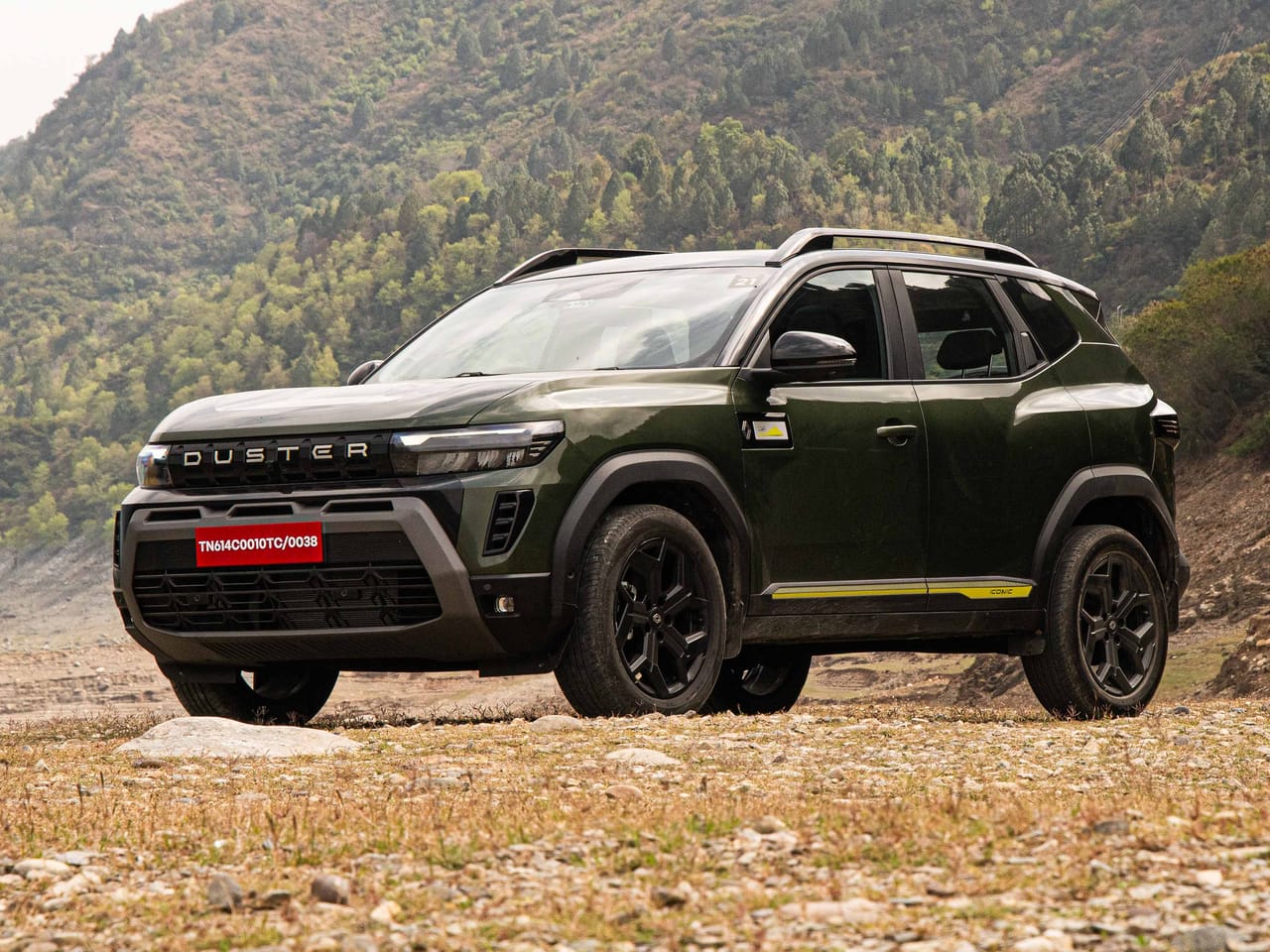
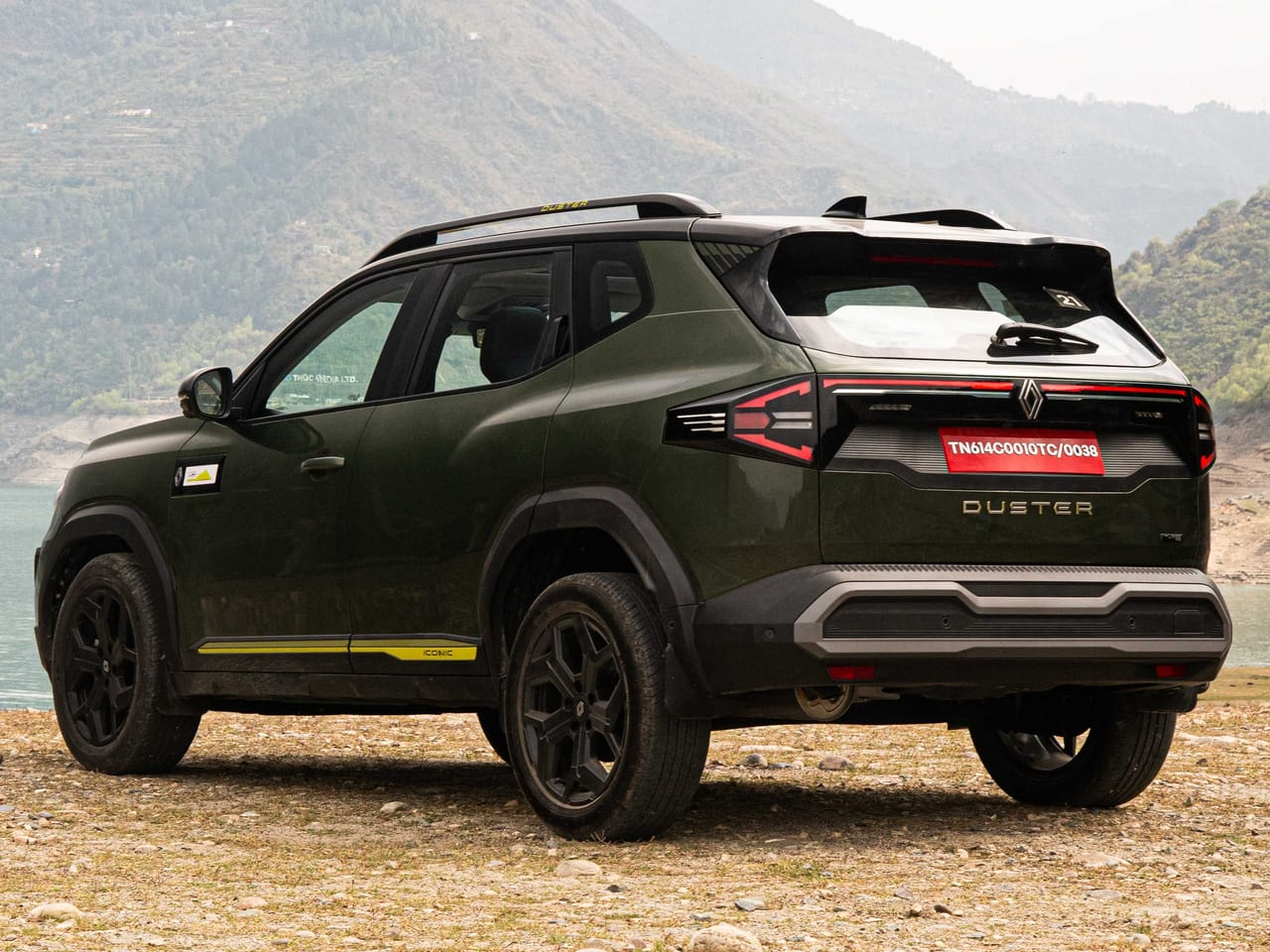
First time we spotted the new Duster — a flash of white against fading evening light — our reaction was immediate: this thing looks good. There’s a chunkiness to its proportions that echoes the original’s rugged stance, but it’s been sharpened into something more modern and purposeful. Squared-off wheel arches, 17-inch alloy wheels, and 212 mm of ground clearance give it a proper SUV silhouette rather than a jacked-up hatchback look.
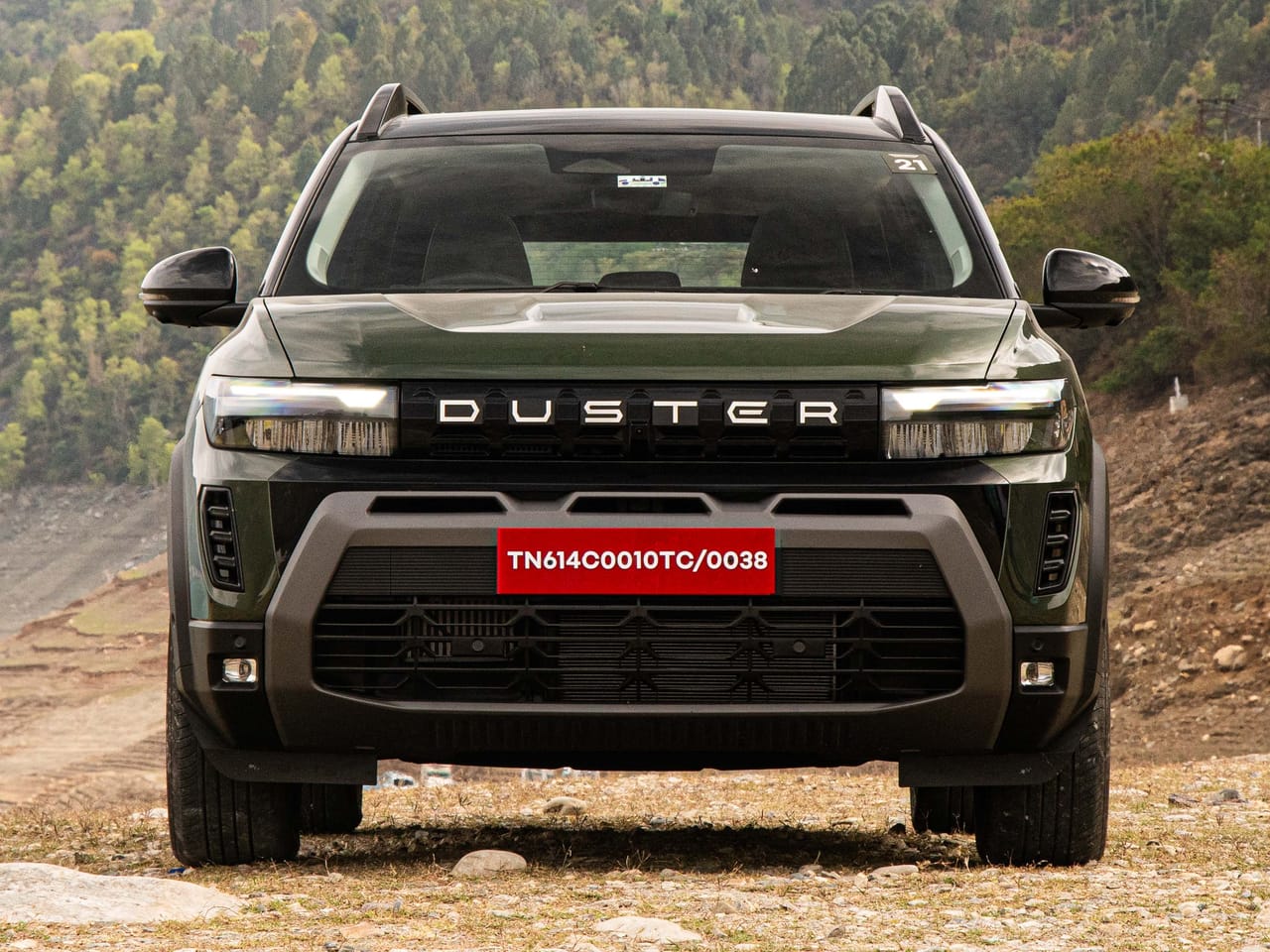
The front end is bold. Renault has leaned into the Duster brand so heavily in India that the grille doesn’t even wear the Renault diamond — just a prominent "DUSTER" lettering across the face. The Renault badge only appears at the rear. It’s a smart move: the Duster name carries far more recognition in India than the parent brand does.
Renault says roughly 90 per cent of the exterior panels differ from the European Dacia Duster. The headlamps, bumpers, tail lamps, and body surfacing have all been revised. Up close, the details reward a second look. Neon-green accent highlights along the side lettering on our mountain-jade-green test car added a subtle pop of personality without crossing into garish territory.
In traffic, the Duster cuts a confident figure. It photographs handsomely in almost any light, and the raised roofline gives it a planted, mature stance that avoids the over-styled busy-ness plaguing some rivals. This is handsome rather than quirky — a design that should age well over the ownership period.
Inside the Cabin
Step inside and the transformation from the old Duster is total. Where the previous car was functional to the point of austerity, the 2026 model feels like a genuinely contemporary compact SUV cabin.
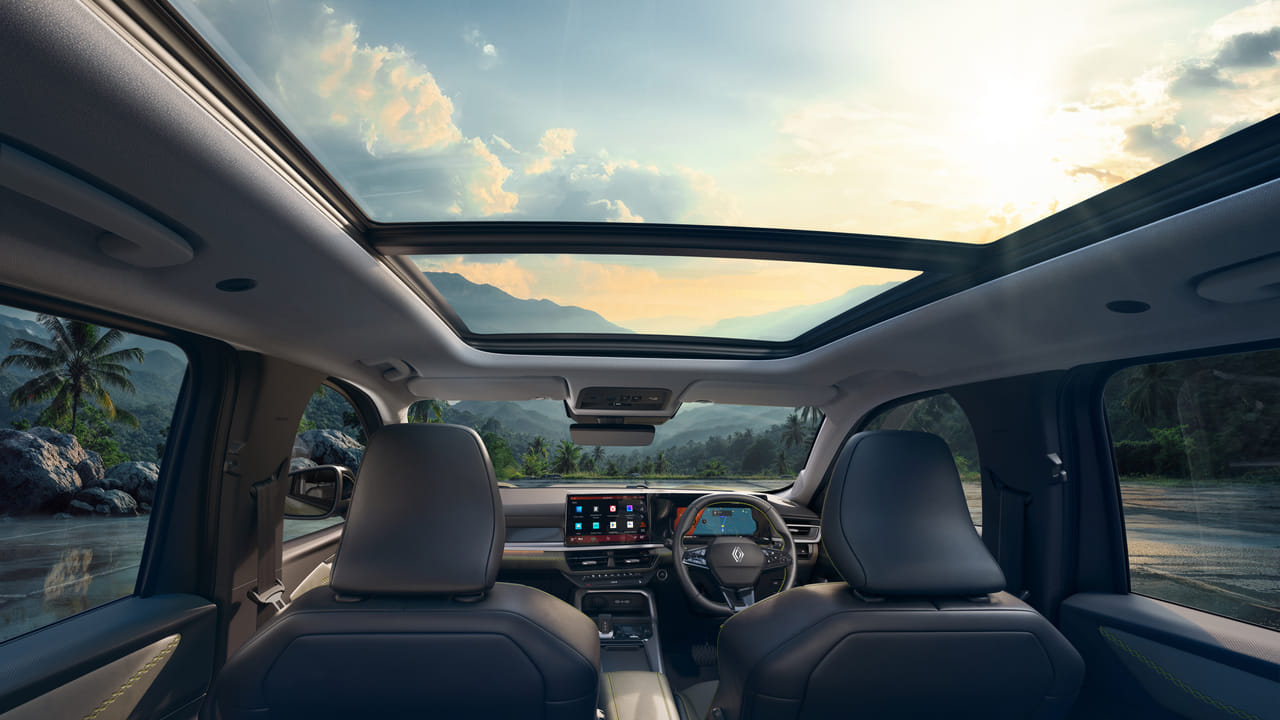
The dashboard is driver-focused, with the centre console angled toward you. The top-spec Iconic variant we drove featured a carbon-finish dashboard insert and a sporty, layered design that feels more purposeful than luxurious. The 10.25-inch digital instrument cluster is rich-looking, and the 10.1-inch touchscreen infotainment system runs Google’s built-in OpenR interface with over 60 connected features and wireless Android Auto and Apple CarPlay. There’s even a Google Maps display integrated into the driver’s cluster, which is genuinely useful day-to-day.
Dual-zone climate control is present with physical knobs retained — a decision we applaud in an era of touch-sensitive everything. The six-way power-adjustable driver and front-passenger seats with lumbar support are comfortable, and ventilated front seats kept us cool during a long day of mountain driving. A wireless charger sits in the raised centre console, and the panoramic sunroof — the reason the roof was raised 50 mm — floods the cabin with light.
Materials are a significant step up. Soft-touch surfaces feature on the upper dashboard and door pads, and the leatherette upholstery on the top variant feels substantial rather than cheap. A chunky leatherette-wrapped steering wheel, tilt and telescopic adjustment, and a commanding SUV seating position all contribute to a cabin that no longer feels budget.
That said, we noted several irritations during our drive. Both screens are highly reflective, making visibility difficult in direct sunlight. The infotainment menus aren’t logically organised — it takes too many taps to find what you need. The information display on the driver’s cluster similarly requires shuffling through sub-menus to access basic data. The A-pillar fabric colour is too light and reflects onto the windscreen. The door pockets are narrow and couldn’t accommodate our usual water bottle.
These are fixable items, and none of them fundamentally undermined our enjoyment of the cabin. In a segment where rivals like the Seltos have nailed interior ergonomics, though, the rough edges are worth flagging.
Space, Practicality and Boot
The 2026 Duster measures 4,343 mm long, 1,815 mm wide, and 1,659 mm tall, with a wheelbase longer than both the Skoda Kushaq and VW Taigun. On paper, that should translate to generous rear legroom. In practice, it doesn’t quite deliver.
The compromise sits in the boot. With no spare wheel housed beneath the floor, the space below the boot is empty, giving the Duster a claimed boot capacity of around 700 litres — enormous for this class. Renault has clearly prioritised cargo volume over rear passenger space, and that bias shows.
The rear bench itself is comfortable enough, with a centre armrest and air-con vents, but knee room is tight, particularly for taller occupants. Under-thigh support is adequate without being generous, and there are no rear sunshades. For a young couple or someone who mostly self-drives, the back seat is perfectly fine. For buyers who regularly carry tall adults in the second row, it’s a compromise worth testing in person before signing on the dotted line.
The boot, though, is a genuine differentiator. If you travel frequently, load up for weekends away, or simply value luggage space, the Duster’s cargo hold is a class leader. Nothing else in the segment comes close to 700 litres.
Engine, Gearbox and Driving Experience
Three powertrains are on offer. The entry-level 1.0-litre three-cylinder turbo-petrol produces 100 hp and 160 Nm with a six-speed manual only — no automatic option at launch. The headline 1.3-litre four-cylinder turbo-petrol delivers 163 hp and 280 Nm — the highest torque figure in the segment — paired with either a six-speed manual or a six-speed wet dual-clutch automatic. Later in the year, a 1.8-litre petrol-hybrid (the E-Tech 160) will arrive with 163 hp, 172 Nm, and an eight-speed DCT, targeting a claimed 29–30 km/L.
We spent the bulk of our time in the 1.3-litre turbo with the DCT, and it impressed straight away. The first thing that struck us was the lightness — not the car’s physical weight, but the effortless way it gathers speed. On steep mountain roads around Dehradun, the 280 Nm of torque made overtaking and climbing feel casual. There was no sense of strain at any point during our drive.
The wet dual-clutch unit shifts smoothly and handles the torque well. It’s not the snappiest DCT on the market, but it never hunts for gears or delivers jerky shifts. In a segment still haunted by dry-clutch reliability concerns, the wet-clutch setup is reassuring. Turbo lag is effectively absent on the automatic — the gearbox manages power delivery so well that you rarely find yourself waiting for boost. On the manual, a slight lag below 2,000 rpm is perceptible, but from 2,200 rpm onwards the engine pulls strongly.
The engine’s character is its one quirk. It’s not the quietest unit; there’s a slightly mechanical, coarse note when worked hard, which is the trade-off for extracting 280 Nm from a 1.3-litre displacement. Larger-displacement rivals sound more refined under load, but the Duster’s engine more than compensates with its eagerness.
The manual gearbox deserves a mention. Gearing is tall — third gear stretches to around 140 km/h — which is fine for highway cruising but means low-rpm drivability in town can feel a touch soft. The clutch has a light action, but finding the bite point requires some acclimatisation. We stalled the car a couple of times in the first few minutes, partly because the auto start-stop system immediately restarts the engine, which catches you off guard.
Fuel efficiency during our mountain drive was surprisingly decent: roughly 10 km/L on the automatic and closer to 11 km/L on the manual through demanding, twisty terrain. The 1.3 MT claims 17.75 km/L and the DCT claims 18.45 km/L under standard test conditions.
Ride, Handling and Off-Road Capability
The Duster has always punched above its weight when it comes to ride composure, and this generation carries on that tradition. The suspension has a hint of firmness at low speeds — not harsh or jittery, but noticeable. It sits somewhere between the Kushaq 1.0’s stiffness and the 1.5’s more pliant setup in terms of initial contact quality.
Where the Duster truly shines is at speed and over rough surfaces. It soaks up imperfections with a confidence that recalls ladder-frame SUVs. Miss a pothole, hit a broken patch of road at speed, or traverse a camber change on a mountain pass — the chassis absorbs it all without drama. Anti-roll bars front and rear are standard, and they deliver a clean, controlled feeling through corners that belies the car’s rugged intent.
The steering surprised us most. On narrow mountain roads, the precision and directness of the helm allowed us to place the car exactly where we wanted through tight bends. It’s not as light or pointy as the Kushaq, but the overall composure — the way the chassis, steering, and tyres work together as a unified package — feels more rounded and more satisfying as an everyday proposition.
There’s no all-wheel-drive option for India, which is worth flagging. The 212 mm of ground clearance and robust suspension mean the Duster will handle broken roads, mild trails, and rutted surfaces with ease, but serious off-roading isn’t on the menu. For most buyers, that’s entirely fine.
Technology and ADAS
The top-spec Iconic variant gets Level-2 ADAS, including adaptive cruise control, lane-keep assist, blind-spot monitoring, and autonomous emergency braking. There’s a clever shortcut button on the steering wheel that lets you switch between personalised ADAS profiles — handy if multiple drivers share the car. You can’t switch off AEB through the shortcut, though, which is a notable omission.
The 360-degree camera, TPMS, front and rear parking sensors, hill-hold control, and all-wheel disc brakes round out the safety and assistance tech. The Google-built-in OpenR infotainment system is a standout, with native Google Maps, voice assistant, and over 60 connected features. Wireless Android Auto and Apple CarPlay are standard across higher trims.
Our only complaint is execution. The screens look rich when viewed head-on but are excessively reflective in practice, and the menu structure on both the touchscreen and driver’s cluster could be more intuitive. These are software-level issues that could be addressed with updates, but as delivered, the user experience lags behind the best in class.
At a Glance, Where the 2026 Duster Sits Against Its Rivals
| Specification | Renault Duster 1.3 DCT | Dacia Bigster 1.2 MHEV | Hyundai Creta 1.5T DCT | Kia Seltos 1.5T DCT |
|---|---|---|---|---|
| Engine | 1.3L turbo-petrol | 1.2L mild-hybrid | 1.5L turbo-petrol | 1.5L turbo-petrol |
| Power | 163 hp | 140 hp | 160 hp | 160 hp |
| Torque | 280 Nm | 230 Nm | 253 Nm | 253 Nm |
| Transmission | 6-spd wet DCT | 6-spd manual | 7-spd DCT | 7-spd DCT |
| Boot Space | ~700 L | 612–677 L | 433 L | 433 L |
| Sunroof | Panoramic | Not standard | Panoramic | Panoramic |
| ADAS | Level-2 (top) | Basic | Level-2 (top) | Level-2 (top) |
| Safety Rating | 5-star Bharat NCAP | 3-star Euro NCAP | 5-star GNCAP | 5-star GNCAP |
| Warranty | 7 years | 3 years | 3 years | 3 years |
| Price (approx.) | From Rs. 10.49 lakh | From ~GBP 25,000 | From Rs. 11 lakh | From Rs. 10.9 lakh |
Dacia Bigster
Bigger and more spacious; budget-focused European sibling.
Hyundai Creta
Polished cabin and stronger brand pull; Duster fights back on safety and warranty.
Kia Seltos
Longest wheelbase in class; Duster matches it on equipment for less.
Skoda Kushaq
European platform feel; Duster offers more boot and better warranty.
The 2026 Renault Duster enters the compact SUV segment with a unique proposition: sporty driving character, strong turbo-petrol performance, and a premium-feel cabin at a price that undercuts many established players. Its closest direct rival from within the Renault-Dacia family is the Dacia Bigster, but in India, it competes primarily against the Hyundai Creta, Kia Seltos, and Skoda Kushaq/VW Taigun. Each brings a different flavour — the Creta and Seltos dominate on cabin space and polish, the Kushaq leads on driving engagement, and the Bigster offers raw value in Europe. The Duster carves its own niche: the adventure-flavoured all-rounder. Renault Duster 1.3 DCT Hyundai Creta 1.5T DCT —— 1.3L turbo-petrol 1.5L turbo-petrol 163 hp 160 hp 280 Nm 253 Nm 6-spd wet DCT 7-spd DCT ~700 L 433 L Panoramic Panoramic Level-2 (top) Level-2 (top) 5-star Bharat NCAP 5-star GNCAP 7 years 3 years From Rs. 10.49 lakh From Rs. 11 lakh
2026 Renault Duster vs Dacia Bigster: Which Is Better?
This is a fascinating head-to-head because both cars share Renault-Dacia DNA, yet they serve entirely different markets with fundamentally different philosophies. Understanding their relationship is key to understanding what makes the India-market Duster special.
Positioning
The Dacia Bigster is Europe’s latest budget hero — a larger, no-nonsense SUV aimed at value-conscious buyers who want space and practicality without paying for premium branding. It starts from just over GBP 25,000 in the UK and deliberately keeps things simple.
The India-market Renault Duster, by contrast, is positioned as a properly premium compact SUV. Renault spent years re-engineering the Duster’s platform, cabin, and equipment levels specifically for Indian expectations. Where the Bigster is a budget product that happens to be good, the Duster is a good product that happens to be well-priced. That distinction matters when you’re cross-shopping.
Size and Packaging
The Bigster is the physically larger vehicle. At roughly 4,570 mm long, it’s about 220 mm longer than the Duster’s 4,343 mm. That extra length translates into a more generous boot (612–677 litres depending on configuration versus the Duster’s claimed 700 litres with the caveat of no spare wheel). The Bigster also offers marginally better rear legroom, which addresses the Duster’s most notable weakness.
The Duster counters with clever packaging, though. The empty space beneath the boot floor (no spare wheel), the panoramic sunroof enabled by the 50 mm roof raise, and the re-engineered cabin trim give it a sense of occasion that the Bigster’s utilitarian interior simply can’t match.
Engines
The Bigster launches in Europe with a 1.2-litre mild-hybrid producing 140 hp and 230 Nm — adequate but unremarkable. The Duster’s 1.3-litre turbo-petrol, with 163 hp and 280 Nm, is a significantly stronger powertrain that delivers real-world performance the Bigster can’t match. The upcoming 1.8-litre E-Tech 160 hybrid will further widen the gap, offering strong-hybrid efficiency that the Bigster’s mild-hybrid system cannot approach.
Equipment Levels
This is where the Duster pulls decisively ahead. The India-spec cabin features dual 10-inch screens, Google built-in, ventilated electric front seats, dual-zone climate with physical controls, leatherette upholstery, and a panoramic sunroof. Top variants add Level-2 ADAS. The Bigster, by design, keeps equipment honest and basic — you won’t find ventilated seats, a panoramic roof, or personalised ADAS profiles in the Dacia lineup.
On-Road Feel
Both vehicles ride on versions of the CMF-B platform, but the Duster’s Indian tune feels more polished. The anti-roll bars, precise electrically assisted steering, and the wet-DCT gearbox give the Duster a driver-focused character that the Bigster — with its more basic suspension tune and simpler powertrain — doesn’t aim to replicate.
Warranty
Renault India offers a 7-year warranty package on the Duster. Dacia’s standard European warranty is typically 3 years. For ownership peace of mind, the Duster wins this category hands down.
Price and Value
This is where context matters. The Duster starts from Rs. 10.49 lakh (approximately GBP 9,500 at current exchange rates) in India, which is dramatically less than the Bigster’s GBP 25,000 starting price in the UK. Adjusted for purchasing power and market norms, both are positioned as strong value plays within their respective markets. The Duster, however, offers significantly more equipment and a stronger powertrain at its price point, making it the better value proposition by any measure.
| Specification | Renault Duster (India) | Dacia Bigster (UK/Europe) |
|---|---|---|
| Price | From Rs. 10.49 lakh | From ~GBP 25,000 |
| Engine | 1.3L turbo-petrol | 1.2L mild-hybrid |
| Power | 163 hp | 140 hp |
| Torque | 280 Nm | 230 Nm |
| 0–100 km/h | ~9.5 sec (est.) | ~10.5 sec (est.) |
| Length | 4,343 mm | ~4,570 mm |
| Boot | ~700 L | 612–677 L |
| NCAP | 5-star Bharat NCAP | 3-star Euro NCAP |
| Warranty | 7 years | 3 years |
Which one is better?
Buy the Renault Duster if you want a premium-feel compact SUV with strong turbo-petrol performance, advanced cabin technology, a panoramic sunroof, Level-2 ADAS, and a 7-year warranty at a genuinely competitive Indian price.
Buy the Dacia Bigster if you are a European buyer who prioritises raw interior space, a no-frills ownership experience, and a lower entry cost without caring about premium equipment or driving finesse.
Our pick is the Renault Duster. It takes the same platform and engineering foundations and turns them into a substantially more complete, more enjoyable, and better-equipped package. The Indian re-engineering effort has paid off handsomely.
Safety and Warranty
The 2026 India-market Renault Duster earned a 5-star Bharat NCAP rating, scoring 30.49 out of 32 for adult occupant protection and 45 out of 49 for child occupant protection. Standard safety equipment across the range includes six airbags, ESC, ABS with EBD, all-wheel disc brakes, hill-hold control, TPMS, and a 360-degree camera on higher trims.
It’s important to understand why the India-spec rating differs so dramatically from the European Dacia Duster’s 3-star Euro NCAP result. The Indian version features a significantly upgraded body structure, additional airbags, and more comprehensive safety equipment than the European model. The platform itself was re-engineered for India to meet stricter requirements. Bharat NCAP tested this car, not the European Dacia version, and the results reflect the India-specific improvements.
The 7-year warranty package is among the longest in the segment and substantially exceeds the 3-year coverage typically offered by European rivals. For buyers who keep their cars long-term, that’s meaningful peace of mind.
Pricing and Variants
The 2026 Renault Duster launches in India from Rs. 10.49 lakh for the base variant, which is positioned as a hook-price entry point. It’s severely under-equipped — missing an infotainment screen, rear wiper and defogger, and several features most buyers now consider standard. It exists to get headlines, not to be genuinely recommended.
The real starting point for most buyers is the Evolution variant, the second rung on the ladder, which adds all the essentials. With the automatic transmission, it comes in at around Rs. 14.5 lakh — the variant Renault has clearly designed as the sweet spot. It’s here that the Duster’s value proposition clicks into focus.
Above that, the Techno and Techno Plus trims layer on additional equipment, and the Iconic top-spec adds the full complement: Level-2 ADAS, ventilated seats, panoramic sunroof, leatherette upholstery, and the 10.25-inch digital cluster. The trim ladder is logical, with each step adding meaningful equipment rather than padding the price with cosmetic add-ons. These are introductory prices, and Renault has signalled they’ll increase as the R Pass early-booking window closes.
Who Should Buy the 2026 Renault Duster
Buy the 2026 Renault Duster if:
– You self-drive and value a punchy, responsive turbo-petrol engine with strong torque for highway and hill duties. – You want a compact SUV that prioritises driving character and chassis composure over sheer rear-seat space. – You need a massive boot for travel and weekend adventures, and you are comfortable with a slightly tighter back seat. – You appreciate a long warranty, 5-star safety credentials, and modern tech like Google built-in and ADAS.
Skip the 2026 Renault Duster if:
– You need generous rear legroom for tall passengers or frequent chauffeur-driven use — the Creta and Seltos do this better. – You prefer a naturally aspirated petrol or a simpler powertrain for maximum peace of mind and lower running costs. – You prioritise interior softness and urban sophistication over a sporty, rugged character — the Seltos and Creta have a more polished cabin ambience.
Verdict: The Duster Is Back, and It Is Properly Premium
The 2026 Renault Duster needed to do two things: honour the driving DNA that made the original a legend, and raise its game enough to compete in a segment that has evolved beyond recognition. It’s done both.
The 1.3-litre turbo-petrol is strong and responsive, the chassis is composed and engaging, and the cabin — while not without its quirks — represents a generational leap over the bare-bones interior Duster owners remember. The 5-star Bharat NCAP rating, 7-year warranty, and clever pricing from the Evolution variant upwards give it a compelling ownership proposition.
The back seat remains a compromise, and there are rough edges in the infotainment and screen execution that need polishing. Judged as a complete package — the way it drives, the way it looks, the value it offers — the Duster is a genuinely impressive comeback. At 4.3 out of 5, it earns its place back at the table.
—
