

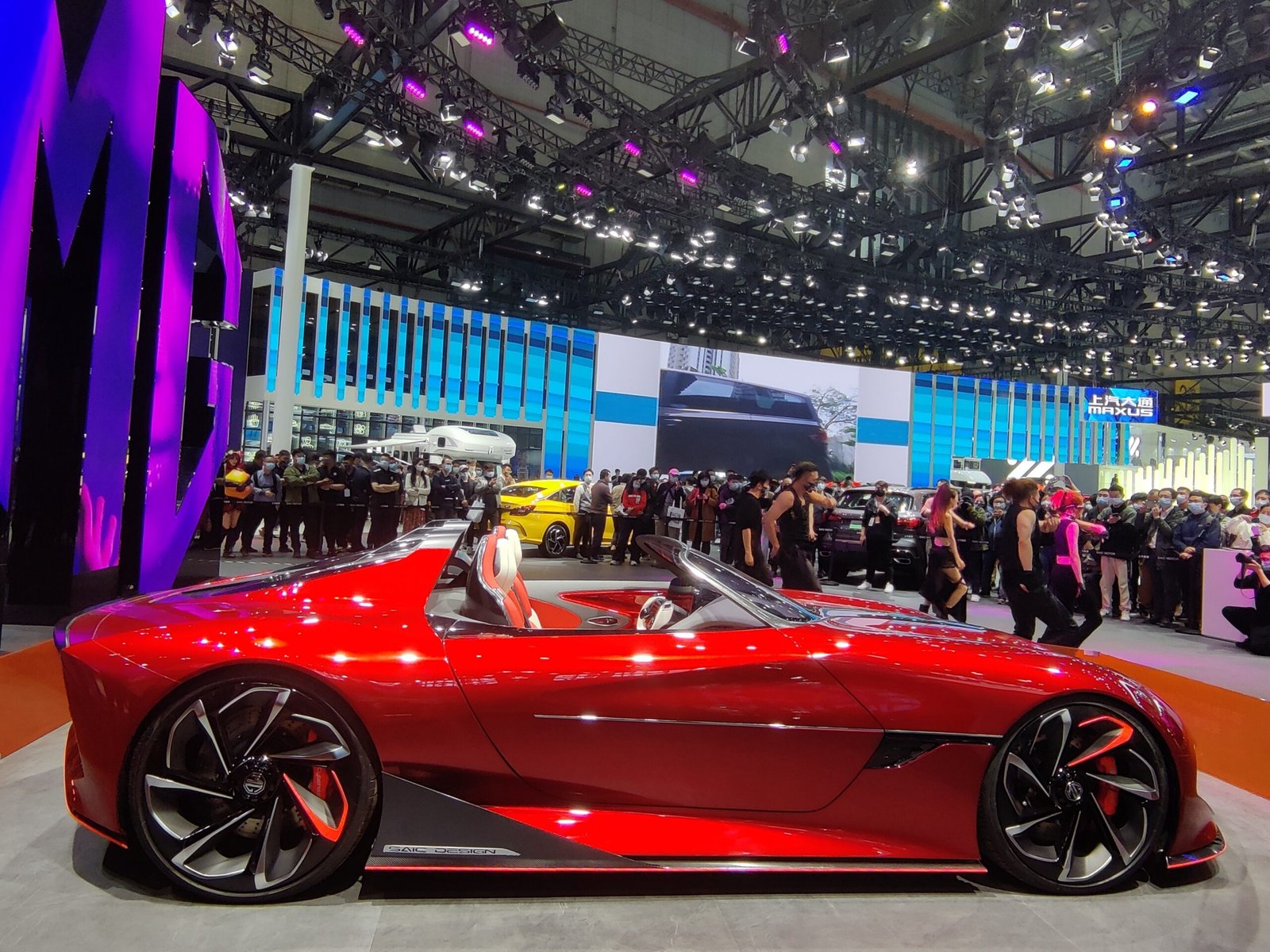
2026 MG Cyberster Review — The Electric Roadster That Undercuts Porsche
A category-creating electric roadster that nails the open-top thrill at a fraction of Porsche money
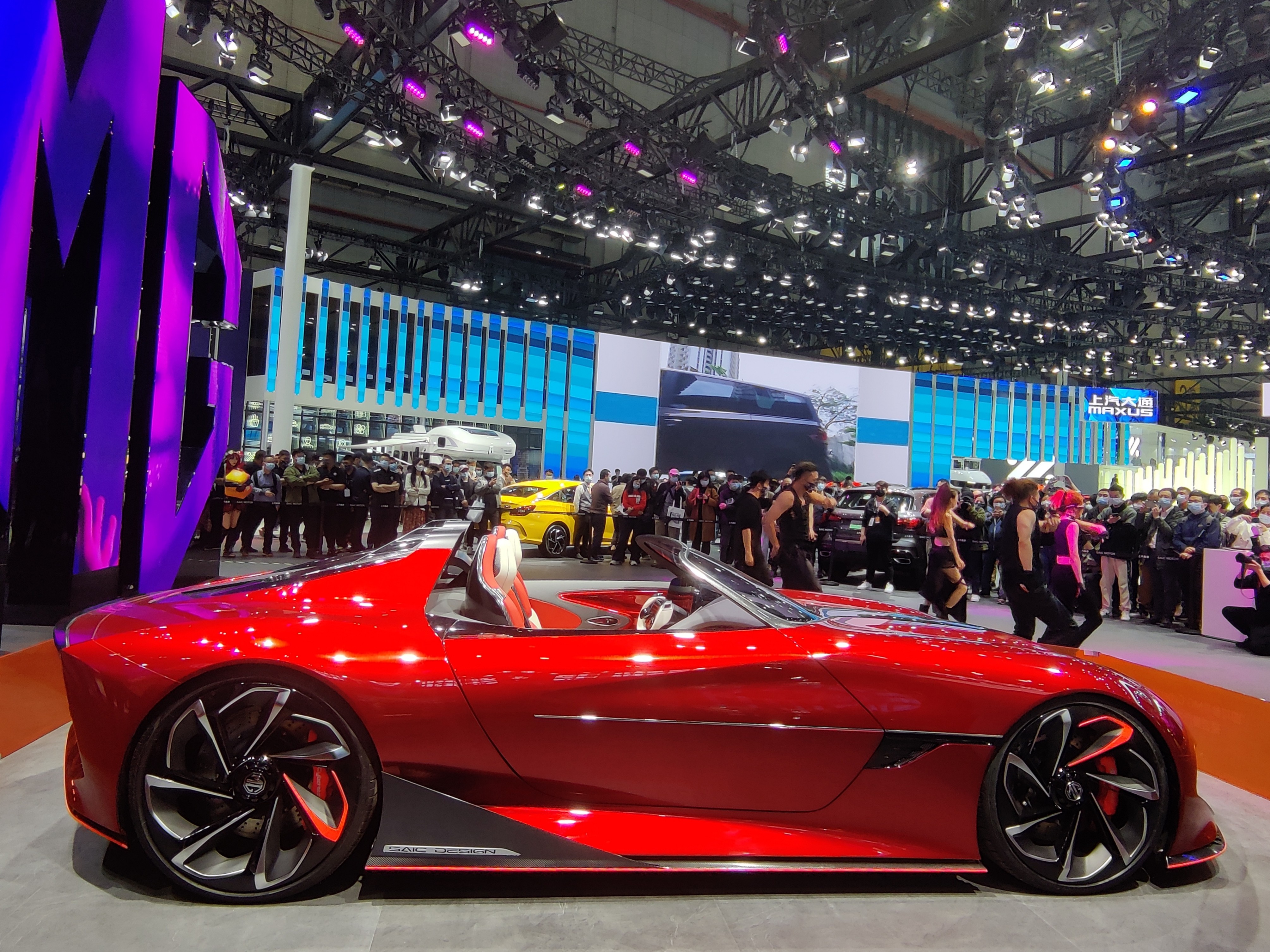
2026 MG Cyberster electric roadster three-quarter exterior
Price
~USD 46,000 / AUD 115,000
Powertrain
Dual-motor AWD, EV
⚡ Quick Verdict
:
The MG Cyberster is the world’s first affordable electric convertible sports car, and it’s arrived at roughly AUD 115,000 with scissor doors, 536 hp and a genuine open-air buzz. It doesn’t match the Porsche 718 Boxster’s chassis polish, but nothing else on the market stitches together this much theatre, straight-line performance and electric innovation at the price.
—
✓ The Good
- +Genuine sports-car looks with theatrical scissor doors
- +0–100 km/h in 3.2 s (AWD GT) at roughly a third of Boxster money
- +Beautifully finished cabin with Alcantara, nappa and Bose
- +7-year/80,000-mile warranty leads the segment
- +Only proper EV convertible currently on sale
- +Silent EV soundtrack lacks the drama enthusiasts crave
- +Small 249 L boot and tight cabin storage
- +No Euro NCAP/ANCAP crash rating yet
- +144 kW DC peak is decent but trails 200 kW+ German rivals
- +Heavy kerb weight blunts last-degree steering feel
✗ The Trade-offs
- −Silent EV soundtrack lacks the drama enthusiasts crave
- −Small 249 L boot and tight cabin storage
- −No Euro NCAP/ANCAP crash rating yet
- −144 kW DC peak is decent but trails 200 kW+ German rivals
- −Heavy kerb weight blunts last-degree steering feel
📑 In This Review
The MG Cyberster is the world’s first affordable electric convertible sports car, and it’s arrived at roughly AUD 115,000 with scissor doors, 536 hp and a genuine open-air buzz. It doesn’t match the Porsche 718 Boxster’s chassis polish, but nothing else on the market stitches together this much theatre, straight-line performance and electric innovation at the price. — The MG Cyberster has landed in a segment that, until now, didn’t actually exist. No one — not Porsche, not BMW, not Mazda — has committed to a battery-powered, drop-top two-seater. MG has, and it’s done so with a starting price that undercuts the entry-level Porsche 718 Boxster by tens of thousands of dollars. That’s not a quiet move. It’s a statement. Positioned as MG’s centenary flagship, the Cyberster pairs serious showroom drama — scissor doors, arrow-shaped LED light bars, a power-folding soft-top that drops in roughly ten seconds — with genuine performance credentials. The range-topping all-wheel-drive GT produces 400 kW (536 hp) and 725 Nm of torque, launching from rest to 100 km/h in 3.2 seconds. If you’d rather have a lighter rear-driven setup, the 231 kW (310 hp) variant covers the same sprint in 4.9 seconds. Both run on CATL battery packs: 64 kWh for the base RWD, 77 kWh for the higher trims. WLTP range stretches from 443 km to 507 km depending on configuration. How does the Cyberster stack up against the established players? The table below lays out the key numbers alongside the Porsche 718 Boxster Style Edition, the BMW Z4 M40i and the Mazda MX-5 RF.
At a Glance — 2026 MG Cyberster Specs & Rivals
| Spec | 2026 MG Cyberster GT | Porsche 718 Boxster Style Ed. | BMW Z4 M40i | Mazda MX-5 RF |
|---|---|---|---|---|
| Price (from) | ~USD 46,000 / AUD 115,000 | ~USD 73,000 / AUD 125,900 | ~USD 66,000 / AUD 119,900 | ~USD 38,000 / AUD 52,420 |
| Powertrain | Dual-motor AWD, EV | 2.0L turbo flat-four, petrol | 3.0L turbo I6, petrol | 2.0L I4, petrol |
| Power | 400 kW / 536 hp / 725 Nm | 220 kW / 300 hp / 380 Nm | 285 kW / 382 hp / 500 Nm | 135 kW / 184 hp / 205 Nm |
| 0–100 km/h | 3.2 s | 4.9 s | 4.5 s | 6.8 s |
| Range / Fuel use | 443–507 km (WLTP) | ~8.1 L/100 km | ~7.9 L/100 km | ~6.8 L/100 km |
| Top speed | 200 km/h (limited) | 275 km/h | 250 km/h (limited) | 213 km/h |
| Body | 2-door soft-top convertible | 2-door soft-top convertible | 2-door soft-top convertible | 2-door retractable fastback |
| Warranty | 7 yr / 80,000 mi | 3 yr / unlimited km | 3 yr / unlimited km | 5 yr / unlimited km |
| Verdict | The value-busting electric show-stopper | The purist’s benchmark | The fast cruiser | The lightweight champion |
Porsche 718 Boxster Style Ed.
The benchmark for chassis polish and engine drama, but at almost double the money
BMW Z4 M40i
Fast luxury cruiser with a sweet straight-six, but no scissor doors or EV theatre
Mazda MX-5 RF
The featherweight steering benchmark for half the Cyberster money, but only 184 hp
2026 MG Cyberster GT BMW Z4 M40i —— ~USD 46,000 / AUD 115,000 ~USD 66,000 / AUD 119,900 Dual-motor AWD, EV 3.0L turbo I6, petrol 400 kW / 536 hp / 725 Nm 285 kW / 382 hp / 500 Nm 3.2 s 4.5 s 443–507 km (WLTP) ~7.9 L/100 km 200 km/h (limited) 250 km/h (limited) 2-door soft-top convertible 2-door soft-top convertible 7 yr / 80,000 mi 3 yr / unlimited km The value-busting electric show-stopper The fast cruiser —
Design & Road Presence
The Cyberster looks like nothing else anywhere near its price. During our walkaround, the front end hit us first: arrow-shaped LED daytime running lights sweep forward from the headlamp clusters, framing a sculpted bonnet that narrows toward the nose in a way that recalls mid-engined supercars rather than a brand once known for budget hatchbacks. MG’s centenary badging — a subtle "100" emblem embedded in the charge port surround — marks this as a milestone model. Functional air vents in the front bumper feed cooling air to the brake discs, and a centrally mounted 360-degree camera sits cleanly integrated beneath the MG roundel.
The side profile is where the proportions tell the real story. At 4,535 mm long and just 1,329 mm tall, the Cyberster sits lower than a Porsche 718 Boxster and stretches further between the axles. That gives it a planted, elongated stance that photographs beautifully. The 19-inch five-spoke alloy wheels — wrapped in 245/45 Pirelli P-Zero rubber up front, 275/40 at the rear — fill the arches convincingly, and the red brake calipers visible through the spokes hint at serious stopping ability. At the back, the rear haunches flare outward and a subtle lip spoiler integrated into the boot lid rounds off the shape with just enough menace. It’s a car that draws stares. Full stop.
Then there are the scissor doors. In our testing, the vertically hinged doors needed roughly a metre of clearance overhead — fine in a garage with standard ceiling height, but worth considering in tight underground car parks. Two hydraulic struts per door hold them open confidently, and they close with a satisfying thunk that feels properly engineered rather than a novelty gimmick. Pedestrians stop and stare. Fellow motorists photograph you at traffic lights. No other sub-USD 50,000 car delivers this kind of theatre.
The soft-top itself is a single-layer fabric unit that operates in approximately ten seconds at speeds up to 50 km/h. We watched it fold neatly behind the cabin without eating into the tiny boot space, and with the roof stowed the Cyberster’s low-cut beltline gives you a genuine, uninterrupted open-air experience. It’s not a retractable hardtop like the Mazda MX-5 RF, but the fabric roof keeps weight down and suits the car’s character well.
—
Interior, Tech & Comfort
Climb past the scissor door and into the cabin, and the Cyberster keeps surprising you. The dashboard is dominated by a triple curved-screen arrangement: a 10.25-inch driver instrument cluster flanked by two 7-inch auxiliary displays that handle navigation, media, phone and vehicle settings. Below the curved glass sits a fourth, smaller screen dedicated to HVAC controls, showing dual-zone climate settings, PM2.5 readings and range information. That’s a lot of screen real estate for a sports car, but the arrangement feels cohesive. The curved glass flows uninterrupted across the dash in one sweep.
Underpinning the interface is a Qualcomm system-on-chip running an Unreal Engine-based user interface. The visuals are crisp, animations are smooth and touch response feels immediate. During our cabin checks, the system handled split-screen duties — navigation on the right-flank screen, music on the left — without any lag. You can even play video clips on the side screens while parked, which is a neat party trick for the tech-hungry buyer.
Material quality genuinely impresses for the money. Alcantara wraps the upper door cards and the flat-topped dashboard, while soft-touch nappa leather covers the heated seats and key touch points. The seats themselves are deeply bolstered with Alcantara centres and nappa outer surfaces; they hold you firmly through corners without feeling restrictive. An eight-speaker Bose sound system delivers rich, room-filling audio — essential when there’s no combustion engine to add drama. Ambient lighting traces the door cards and centre console, casting a soft glow that complements the premium materials. The steering wheel is slightly flat-bottomed, with two physical spokes housing cruise control, volume, a navigation toggle and a drive-mode rocker that clicks through Comfort, Sport and Custom settings.
The centre console is wide and functional, featuring a Honda-style button gear selector that’s intuitive once you’re used to it. There’s a felt-lined storage cubby with a wireless charging pad, USB-C, USB-A and an SD card slot, plus two recessed cup-holders with grip ridges and slide-down covers. A dedicated soft-top open/close button sits alongside door-open and door-close controls — a clever touch that lets you operate the roof without reaching for a fob. What you won’t find, though, is ventilated seat support. That’s a genuine omission in warm-weather markets like Australia. Boot space is a slim 249 litres — enough for a weekend bag but not much more — and cabin storage beyond the centre console and glove box is limited. These are the trade-offs of a compact, two-seat architecture, and we think most buyers will accept them given the car’s character. Worth knowing about upfront, though.
—

Performance & Driving Dynamics
The Cyberster GT’s headline numbers are formidable. Its dual-motor all-wheel-drive powertrain produces a combined 400 kW (536 hp) and 725 Nm of torque, catapulting the car from zero to 100 km/h in 3.2 seconds. That puts it in the same acceleration bracket as a Porsche 718 Cayman GT4 RS — a car that costs well over twice as much. The rear-wheel-drive variant, with its 231 kW (310 hp) single motor, covers the same sprint in a still-brisk 4.9 seconds. Both feel genuinely quick in the real world; the AWD car in particular delivers its thrust with a clean, immediate bite that pins you into the seatback from the moment you brush the throttle.
Drive modes are toggled via a rocker on the right spoke of the steering wheel. Comfort relaxes the throttle map and lightens the steering, making the Cyberster an easy, relaxed cruiser. Sport sharpens everything — throttle response, steering weight, even the synthetic sound generator that pipes a faint whoosh through the cabin. We’ll be honest: during our drive, the synthesised soundtrack wore thin after a sustained fast stint. It lacks the emotional crescendo of a flat-four or a six-cylinder, and enthusiasts coming from a Porsche 718 Boxster will notice the gap. That said, drop the roof, crank the Bose system and let the wind fill the silence, and the Cyberster’s acoustic deficit matters less than you’d expect.
Chassis behaviour is broadly competent. The steering is light and direct in Comfort mode, adding welcome heft in Sport, but it stops short of communicating the road surface’s texture through your fingertips the way the best hydraulic-assisted racks do. On a fast B-road sweep, we felt the Cyberster’s kerb weight — estimated at around 1,900 kg for the GT — in the mid-corner phase, where the car asks for a fraction more patience than a featherweight MX-5 before settling into its line. Body control, though, is well managed; the suspension keeps the chassis flat through fast direction changes without resorting to a punishing ride. The large brake discs and red calipers provide strong, confidence-inspiring stopping power. Under hard braking we noticed a firm, progressive pedal that resists fade better than many EVs at this price point.
Top speed is electronically limited to 200 km/h for both variants. That’ll feel modest next to the 275 km/h the Porsche 718 Boxster manages. For most real-world driving, and certainly for the twisty-road enjoyment this car is built for, 200 km/h is more than enough. If your driving includes regular autobahn stints, though, the Boxster’s higher terminal velocity is a genuine advantage.
—

Range, Battery & Charging
MG offers the Cyberster with CATL-supplied battery packs in two sizes. The base rear-wheel-drive variant uses a 64 kWh unit, while the higher-specification RWD and AWD GT models employ a larger 77 kWh pack. CLTC-rated range (the Chinese test cycle, which is generally more optimistic than WLTP) spans 501 km to 580 km depending on variant. Translated to the more realistic WLTP standard, expect figures in the region of 443 km to 507 km. During our drive in mild conditions, the instrument cluster displayed an indicated 492 km of remaining range at 95 per cent state of charge in Comfort mode. That suggests real-world range of approximately 400–430 km for the 77 kWh AWD variant in temperate, mixed driving.
DC fast charging peaks at 144 kW on compatible CCS2 stations. During our session on a 150 kW Ionity charger, we saw the car pulling closer to 130 kW once the state of charge passed 30 per cent. That’s a respectable figure, though it trails the 200 kW-plus peaks offered by German rivals like the Porsche Taycan or BMW i4. MG quotes a 10-to-80-per-cent DC charging time of approximately 30 to 39 minutes depending on conditions, and our experience lines up with that: roughly 35 minutes saw us climb from a low state of charge to 80 per cent in mild ambient temperatures.
For home charging, the 11 kW AC on-board charger pairs well with a standard 7.4 kW wallbox. A full charge from empty takes approximately eight to ten hours on a home unit, so overnight top-ups are entirely practical. There’s no vehicle-to-load (V2L) capability, which is a minor omission compared with some Korean EVs, but the charging package as a whole is competent if not class-leading.
—

2026 MG Cyberster vs Porsche 718 Boxster: Which Is Better?
This is the comparison every enthusiast wants to see. The MG Cyberster and the Porsche 718 Boxster share a fundamental brief — two-seat, open-top, driver-focused sports cars — yet they approach it from entirely different directions. One is electric, Chinese-built and priced to disrupt. The other is petrol-powered, Stuttgart-engineered and steeped in six decades of roadster heritage. Understanding where each car wins is the key to making the right buying decision.
Start with price, because the gap is staggering. The Cyberster GT arrives at approximately AUD 115,000, while the Porsche 718 Boxster Style Edition opens at roughly AUD 125,900. At the US pricing level, that’s near-USD 27,000 of difference at the entry point — money that could fund a second car, a significant options list on the MG, or years of charging costs. For value-conscious buyers, the Cyberster’s pricing alone is a headline act.
Performance is closer than the price gap suggests. The Cyberster GT’s 3.2-second 0–100 km/h sprint comfortably eclipses the Boxster Style Edition’s 4.9 seconds, and the instant torque delivery of the electric powertrain makes the MG feel ferociously quick in everyday acceleration. The Boxster, though, fights back with a 275 km/h top speed versus the Cyberster’s electronically limited 200 km/h. More importantly, it counters with the visceral, mechanical thrill of a turbocharged flat-four engine howling behind your head. The Porsche’s soundtrack is a core part of its appeal, and no synthetic EV noise generator can replicate the emotional connection of a combustion engine climbing toward redline.
The roof mechanisms are comparable. Both cars use a power-operated fabric soft-top that stows in roughly ten seconds. The Cyberster’s operates at up to 50 km/h; the Boxster’s works at similar speeds. Neither offers a retractable hardtop, which keeps weight in check. Boot space is a weak point for both — the Cyberster offers 249 litres, the Boxster around 275 litres split between front and rear compartments — but the Porsche’s dual-trunk layout gives it a slight practicality edge.
Charging convenience versus fuel-up speed is the electric roadster’s eternal trade-off. The Cyberster’s 144 kW DC peak means a 10–80 per cent top-up takes approximately 35 minutes at a fast charger. The Boxster refuels in under five minutes at any petrol station and carries no range anxiety. For drivers covering long distances regularly, the Boxster’s refuelling infrastructure advantage remains real, even as the public charging network improves. For urban and weekend-use buyers — the natural habitat of a two-seat convertible — the Cyberster’s 443–507 km WLTP range is entirely adequate.
Residual values favour the Porsche in today’s market, given its established brand cachet and proven resale track record. MG is still building its reputation in the premium space, and while the Cyberster’s 7-year warranty provides reassurance, the long-term depreciation curve of a Chinese-built electric sports car is an unknown. We expect the Cyberster to hold value respectably thanks to its uniqueness and low production numbers, but the Boxster’s residual strength is the safer bet.
On-road feel is where the comparison gets most nuanced. During our drives in both cars, the Porsche demonstrated superior steering communication, a more balanced weight distribution and that intangible sense of a chassis honed over generations. The Cyberster is fast, composed and genuinely enjoyable, but it carries nearly 200 kg more than the Boxster, and that mass is detectable in quick transitions and tight corners. The MG compensates with brutal straight-line speed, a beautifully finished cabin and a sense of occasion — scissor doors, triple screens, ambient lighting — that the more conservatively styled Porsche simply can’t match.
| Spec | 2026 MG Cyberster GT | Porsche 718 Boxster Style Ed. |
|---|---|---|
| Price (from) | ~USD 46,000 / AUD 115,000 | ~USD 73,000 / AUD 125,900 |
| Powertrain | Dual-motor AWD, EV | 2.0L turbo flat-four, petrol |
| Power | 400 kW / 536 hp / 725 Nm | 220 kW / 300 hp / 380 Nm |
| 0–100 km/h | 3.2 s | 4.9 s |
| Top speed | 200 km/h (limited) | 275 km/h |
| Range / Fuel use | 443–507 km (WLTP) | ~8.1 L/100 km |
| Boot | 249 L | ~275 L (split) |
| Warranty | 7 yr / 80,000 mi | 3 yr / unlimited km |
| Our pick | Best value & drama | Best driving purity |
<div style="background:linear-gradient(135deg,#f0f9ff,#e0f2fe); border-left:4px solid #2563eb; border-radius:12px; padding:24px 28px; margin:32px 0"> <p style="font-size:12px; font-weight:800; letter-spacing:0.14em; text-transform:uppercase; color:#1e40af; margin:0 0 10px">Which one is better?</p> <p><strong>Buy the MG Cyberster if</strong> you want a head-turning electric convertible with scissor doors, 536 hp on tap and a sub-USD 50k sticker — without paying German-luxury money.</p> <p><strong>Buy the Porsche 718 Boxster if</strong> you live for engine note, telepathic steering and the heritage chassis polish that only Stuttgart engineering buys.</p> <p><strong>Our pick</strong> is the Cyberster for the value-conscious buyer who wants real sports-car drama; the Boxster for the puritan who’d rather have one fewer screen and one more flat-four.</p> </div>
—

Safety & Warranty
The MG Cyberster hasn’t yet been tested by Euro NCAP or ANCAP, which means there’s no independently verified crash-safety rating at the time of writing. That’s a notable gap, particularly for buyers in Australia and Europe where these ratings carry real weight. We’d expect testing to occur as the car rolls out to additional markets, and we’ll update this review when scores become available.
What MG does offer is a solid active safety suite branded MG Pilot 2.0. Standard equipment includes autonomous emergency braking with pedestrian and cyclist detection, lane-keep assist, lane-change assist, blind-spot monitoring and a 360-degree surround-view camera. During our testing, the AEB system operated unobtrusively in the background, and the 360-degree camera — displayed on the centre infotainment screen — provided a clear, high-resolution view that made low-speed manoeuvring straightforward despite the limited rear visibility with the roof raised. These are meaningful safety features, and the package is competitive with what rivals at this price point offer.
Warranty coverage is one of the Cyberster’s strongest selling points. MG provides a 7-year / 80,000-mile (approximately 128,000 km) warranty — the longest standard warranty in the sports-car segment and a clear statement of confidence in the car’s long-term reliability. For comparison, the Porsche 718 Boxster carries a 3-year/unlimited-kilometre warranty, and the BMW Z4 offers the same. The MG’s battery pack is separately warranted for 8 years or 160,000 km, whichever comes first, providing further reassurance for EV buyers concerned about degradation.
—

Who Should Buy the 2026 MG Cyberster?
The Cyberster’s ideal buyer is an EV-curious enthusiast who’s watched the electric-car revolution unfold from the sidelines, waiting for something that stirs the soul as well as the conscience. This isn’t a family hauler or a commuter appliance. It’s a two-seat, scissor-doored, open-top sports car that happens to run on electrons. If you’ve lusted after the idea of a Porsche Boxster but could never justify the price — or if you simply want the most dramatic car in any car park — the Cyberster fills that void convincingly.
Urban and weekend drivers will find the Cyberster particularly well-suited to their lifestyle. The 443–507 km WLTP range covers a week’s commuting and a spirited Sunday blast without needing a mid-week charge. The scissor doors and head-turning design make every arrival an event. The power soft-top drops in ten seconds, and the Bose audio fills the cabin when the engine note can’t. For the value-led second-car shopper — someone who already owns an electric daily driver and wants a weekend toy that’s different from everything else in the neighbourhood — the Cyberster is an easy recommendation.
It’s also worth noting the Cyberster’s appeal to the MG faithful and to buyers in right-hand-drive markets like Australia and the United Kingdom, where MG’s brand recognition is strong and its dealer network is well-established. The 7-year warranty provides the kind of long-term peace of mind that encourages a leap into the unknown, and the sub-USD 50,000 pricing makes the Cyberster the only way to get scissor-door theatre and sub-3.5-second acceleration without spending Porsche, BMW or Tesla money.
—
⚡ Our Verdict
A category-creating electric roadster that nails the open-top thrill at a fraction of Porsche money
The 2026 MG Cyberster isn’t a perfect car. Its heavy kerb weight dulls the last degree of steering finesse, its synthetic soundtrack can’t replicate the emotional depth of a combustion engine, and the absence of a Euro NCAP safety rating is a gap that needs filling. The 144 kW DC charging peak is adequate rather than exceptional, and the 249-litre boot means packing light for weekend trips. These are real compromises, and buyers cross-shopping with the Porsche 718 Boxster will notice the dynamic polish that the German car provides at a higher price. But the Cyberster does something no other car in the world does today: it delivers a genuine, scissor-doored, open-top electric sports car experience for less than USD 50,000. It’s fast — devastatingly so in GT form — beautifully finished inside, backed by a warranty that leads the segment, and styled with a confidence that turns every drive into an occasion. We think MG has created a category of one, and we suspect it won’t be alone in this space for long. The Cyberster deserves 4.3 out of 5 stars. —
Frequently Asked Questions
How much does the 2026 MG Cyberster cost, and where is it available?
The Cyberster is priced from approximately AUD 115,000 in Australia (USD 46,000 in the United States, GBP 55,245 in the UK for the Trophy trim). It’s currently on sale in China and the UK, with Australian and additional market availability rolling out through 2025 and into 2026.
What is the real-world range of the MG Cyberster?
WLTP-rated range sits between 443 km and 507 km depending on the variant and battery size. In our real-world driving under mild conditions, we saw an indicated range of approximately 492 km at 95 per cent charge on the 77 kWh AWD GT. That translates to a practical expectation of around 400–430 km in mixed driving.
How fast is the 0–100 km/h sprint?
The all-wheel-drive GT variant covers 0–100 km/h in 3.2 seconds, while the rear-wheel-drive variant completes the same sprint in 4.9 seconds. Both figures are independently quoted by MG and align with our on-road impressions of the GT’s ferocious acceleration.
How long does it take to charge the MG Cyberster?
Using a DC fast charger at the car’s 144 kW peak, a 10-to-80-per-cent charge takes approximately 30 to 39 minutes. On a typical 7.4 kW home wallbox connected to the 11 kW AC on-board charger, a full charge from empty takes around eight to ten hours.
How fast does the soft-top roof operate?
The power-operated fabric soft-top opens or closes in approximately 10 seconds. It can be operated at speeds up to 50 km/h, and a dedicated button on the centre console controls the mechanism.
Has the MG Cyberster been crash-tested?
At the time of writing, the Cyberster hasn’t been tested by Euro NCAP or ANCAP. It does come standard with MG Pilot 2.0, which includes autonomous emergency braking (with pedestrian and cyclist detection), lane-keep assist, lane-change assist, blind-spot monitoring and a 360-degree camera.
What warranty does the MG Cyberster come with?
MG provides a 7-year / 80,000-mile (approximately 128,000 km) vehicle warranty — the longest standard warranty in the sports-car class. The battery pack is separately covered for 8 years or 160,000 km.
