

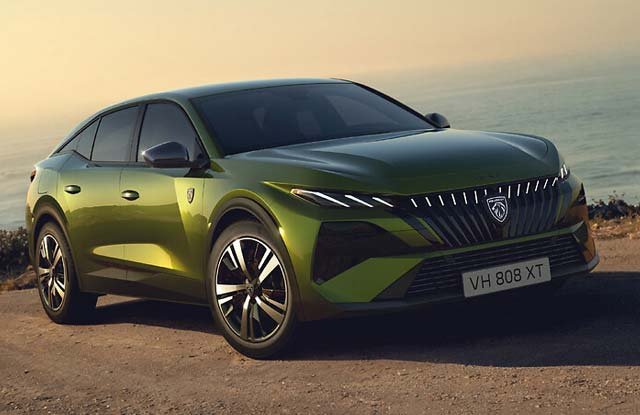
2026 Peugeot e-408 Review: Facelifted French Fastback Tested
Style-led European fastback that charms more than it thrills
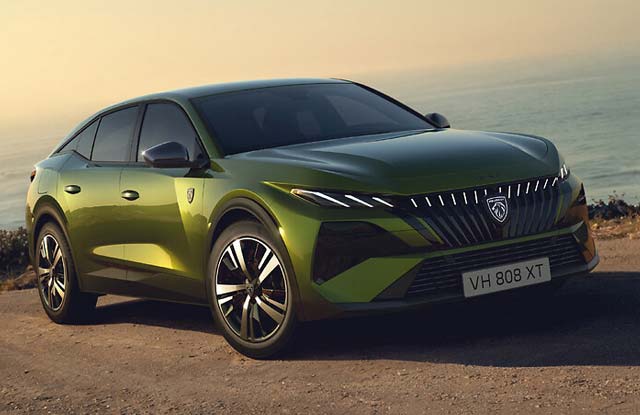
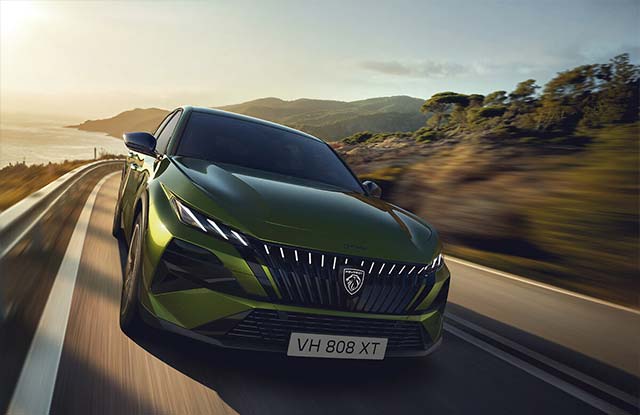
2026 Peugeot e-408 facelift in Flair Green — front three-quarter exterior view
Price
£36,595
DC charging peak
120 kW
Power
213 hp
⚡ Quick Verdict
: The 2026 Peugeot e-408 is built for buyers who’d rather have a car with personality than one that tops a spreadsheet. It’s the kind of EV you buy with your heart — handsome, well-finished inside, and now properly equipped thanks to V2L and battery preconditioning. But if range, charging speed or straight-line grunt sit at the top of your priorities, a Tesla Model 3 or Kia EV6 will serve you better.
—
## Introduction
✓ The Good
- +Striking redesigned front end adds genuine visual impact
- +Unique i-Cockpit with innovative 3D layered driver display
- +New V2L and battery preconditioning boost practicality
- +Comfortable grand-tourer ride quality on all road surfaces
- +Competitive pricing undercuts most direct rivals significantly
✗ The Trade-offs
- −283-mile range trails nearly every direct competitor
- −120 kW DC charging feels dated against 800V rivals
- −Tricky steering wheel position limits binnacle visibility
- −213 hp feels underpowered next to Tesla and Kia
📑 In This Review
- Introduction
- Design and Styling Updates
- Interior, i-Cockpit and Tech
- Practicality, Boot and Rear-Seat Space
- Performance and Driving Impressions
- Range, Battery and Charging
- Peugeot e-408 vs Tesla Model 3: Which Is Better?
- How It Stacks Up Against Other Rivals
- Safety, Warranty and Running Costs
- Who Should Buy the Peugeot e-408 and Who Should Skip
- Verdict
- Frequently Asked Questions
: The 2026 Peugeot e-408 is built for buyers who’d rather have a car with personality than one that tops a spreadsheet. It’s the kind of EV you buy with your heart — handsome, well-finished inside, and now properly equipped thanks to V2L and battery preconditioning. But if range, charging speed or straight-line grunt sit at the top of your priorities, a Tesla Model 3 or Kia EV6 will serve you better. —
Introduction
There’s a peculiar corner of the EV market that’s neither sedan nor SUV — call it the electric fastback crossover. These swoopy five-door machines sacrifice a bit of practicality in the name of visual drama, and buyers can’t seem to get enough of them. The Peugeot e-408 sits squarely in this space, bringing a distinctly French sensibility to the formula with its sharp-edged styling and that divisive i-Cockpit interior.
The e-408 only hit the UK market in mid-2024, yet Peugeot has already applied a fairly thorough facelift for 2026. The bones haven’t changed — same platform, same battery, same motor — but the visual updates, newly added V2L capability and battery preconditioning tackle criticisms that were levelled at the original. Pricing starts from £32,695 after the UK government’s plug-in vehicle grant, which undercuts quite a few key rivals by a meaningful margin.
We spent a week with the updated e-408 across southern France to see whether these changes move the needle in one of the most hotly contested EV segments going. The answer’s more nuanced than you’d expect.
—
Design and Styling Updates
The biggest change for 2026 is the reworked front end, and you’ll notice it straight away. The old body-coloured grid-pattern grille is gone, replaced by a cleaner, more sculpted treatment that gives the nose real presence. On GT and GT Premium trims, vertical LED daytime running light stripes frame the front with intent, and the illuminated lion badge ties it all neatly into Peugeot’s current design language. It’s a genuine step forward — the old car looked good, but this is a cut above.
The previous "lion fangs" flanking the lower bumper have been swapped for gloss-black sculpted elements that flow into the bodywork more naturally. From a distance, the dark detailing nearly disappears into the body colour, giving the front end a cleaner, more cohesive appearance. There’s subtle flaring around the wheel arches at both ends that adds a muscular note to what’s otherwise a very sleek profile. We reckon it’s one of the best-looking cars in its class, full stop.
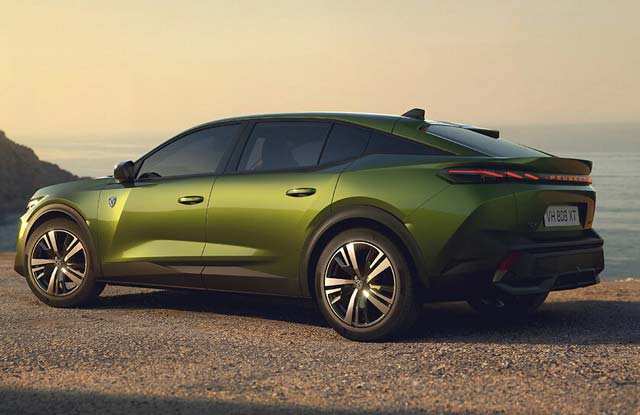
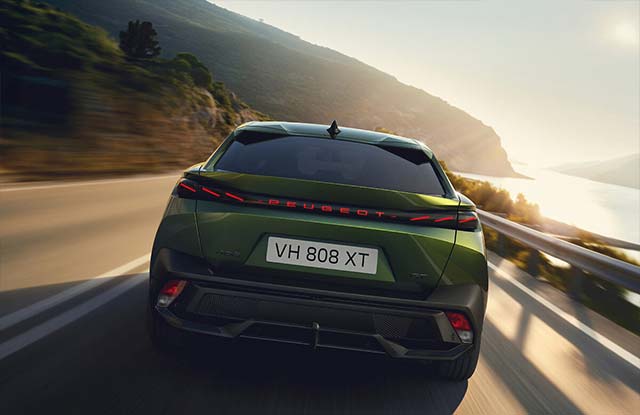
Out back, a full-width light bar with Peugeot’s three-claw LED signature now stretches across the tailgate, replacing the old central badge with illuminated "Peugeot" lettering. It’s a striking touch, especially at night, and gives the e-408 a distinctive after-dark identity. The ducktail spoiler at the fastback’s trailing edge and the cat’s-ear roof spoiler remain, and they still do a fine job of giving the car a sporty, coupe-like stance.
Peugeot has also introduced a new paint colour for the facelift: Flair Green. It’s an iridescent finish that shifts between a yellowy metallic tinge and a rich green depending on the light and angle. It costs nothing extra and, honestly, it’s the pick of the range. The rest of the palette — black, white, grey, and a premium Elixir Red — all cost more. One gripe: the new 19-inch Eradicate and 20-inch Monolith diamond-cut wheels are reserved for the hybrid models only. On the e-408, you’re still rolling on the same 19-inch Graphite alloys as before, which feels like a missed opportunity given the car’s style-first positioning.
—
Interior, i-Cockpit and Tech
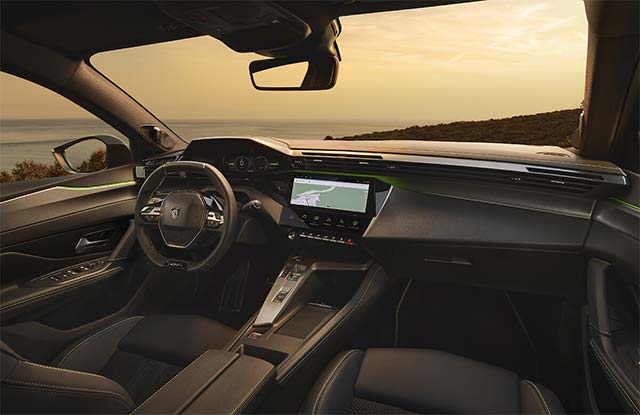
Climb into the e-408 and you’re met with Peugeot’s signature i-Cockpit layout — a setup that divides opinion, but once you gel with it, feels genuinely special. The small, flat-bottomed steering wheel sits low in your hands, and the instrument binnacle is mounted high on the dashboard, creating a layered, driver-focused environment. Peugeot describes it as "sculpted around you," and that’s a fair call. Everything from the angled centre console to the way the dashboard wraps around you reinforces the cockpit-like feel.
The standout change inside is the refreshed 3D layered driver display. The graphics have been reworked to produce an almost holographic effect — information appears to float at different depths within the instrument cluster. We could cycle between navigation, driving data and media on staggered layers, and the clarity was excellent. It’s one of the more inventive takes on driver instrumentation we’ve come across, and it adds a genuine sense of occasion to every drive.
There is, though, a well-known catch with the i-Cockpit that carries over to this facelift. Because the binnacle sits high, drivers who prefer the steering wheel tilted up may find the rim blocking their view of the display. We had to drop the wheel to its lowest position to get a clear sightline, and that won’t suit everyone. You do adapt over time, but it’s a compromise that rival setups from Tesla, Kia or Polestar don’t ask you to make.
Elsewhere, Peugeot has put real effort into lifting material quality. The GT trim gets leatherette, Alcantara, and cloth surfaces with lime-green stitching, aluminium-effect inserts, and a machined aluminium volume knob that feels properly upmarket. There’s still some scratchy black plastic lower down, but the overall impression is of a cabin that punches above its price. The 10-inch central touchscreen carries over with improved graphics and quicker responses, and it keeps physical shortcut buttons below the screen — a welcome contrast to the touchscreen-only approach some rivals favour. Wireless Apple CarPlay and Android Auto are standard, a wireless charging pad sits at the top of the console, and USB-C ports are fitted front and rear.
Comfort kit on higher trims includes massage seats and a Focal premium Hi-Fi system (a £650 option). A panoramic glass roof is listed at £900 across the range — it’s not standard even on the GT Premium, which is a shame given how dark the rear cabin feels under that fastback roofline.
—
Practicality, Boot and Rear-Seat Space
For a fastback, the e-408’s boot is genuinely useful. The GT trim we drove offered 536 litres with the rear seats up, expanding to 1,611 litres with them folded — competitive numbers for this class. The load area is deep and well-shaped, though the sloping roof limits vertical clearance, so taller items will need some creative packing. Under the boot floor you’ll find the charging cable and towing hook, but nothing in the way of meaningful hidden storage.
Rear-seat space is a mixed picture. Legroom is genuinely generous — there’s ample knee room even with the front seats set for a six-foot driver, helped by sculpted seat-backs that free up extra millimetres. Headroom, though, is where the fastback roofline makes itself known. Average-height passengers will be perfectly comfortable, but anyone over six feet might find the sloping glass brushing their hair. It’s a trade-off inherent to the body style, and Peugeot has done a reasonable job managing it.
New for 2026 is vehicle-to-load (V2L) capability, pushing out up to 3.5 kW through an adapter. That means the e-408 can power e-bikes, laptops, power tools, even small camping kit — a practical dimension the old car simply didn’t offer. It’s becoming common across the EV market, and its absence on the original e-408 was a conspicuous gap, so its arrival here is welcome.
—
Performance and Driving Impressions
With 213 hp and 343 Nm from a single front-mounted motor, the e-408 isn’t going to worry anyone at a drag strip. The 0-62 mph sprint takes 7.6 seconds — fine for daily duties but noticeably slower than a Tesla Model 3, Kia EV6 or Polestar 2. On the road, though, it doesn’t feel as sluggish as those numbers might suggest. The motor delivers its torque cleanly from a standstill, and for urban driving, motorway merging and overtaking, there’s enough shove to keep frustration at bay. You just need to recalibrate your expectations if you’re stepping out of a punchier EV.
Three drive modes — Normal, Sport and Eco — adjust steering weight and throttle response, though the differences are subtle. Sport adds noticeably heavier steering, but the power delivery doesn’t change dramatically. We defaulted to Normal for most of our time with the car, which strikes the best balance. The drive mode selector on the console sits a bit too far back — we found ourselves reaching rearward to toggle it, and a placement further forward would’ve felt more natural.
Where the e-408 genuinely shines is ride and handling. The suspension finds an excellent balance between comfort and composure, absorbing rough surfaces without going floaty through bends. During our drive along the Côte d’Azur, the car felt poised and confident on twisting coastal roads, with meaningful feedback through the wheel and a planted, grand-tourer feel that earns the GT badge. At 4.69 metres long, it doesn’t feel oversized in town either — it’s surprisingly manoeuvrable for something this lengthy.
Regenerative braking is managed via paddles on the steering wheel, offering three intensity levels. Lift-off braking is progressive and well-calibrated, and one-pedal driving is entirely achievable once you’ve dialled in the strongest regen setting. The system feels natural and well-mapped — it’s one of the better regen setups we’ve tested at this price. The paddles themselves sit at a comfortable distance from the wheel rim.
—
Range, Battery and Charging
The e-408’s 58.2 kWh usable battery carries over unchanged, delivering a WLTP-rated range of 283 miles — a marginal 2-mile improvement over the outgoing car’s 281-mile figure. In real-world driving, expect somewhere around 220-240 miles in mixed conditions, dropping closer to 200 in cold weather or on sustained motorway runs. That’s adequate for commuting and moderate journeys, but it lags behind competitors like the Tesla Model 3 Long Range (390 miles WLTP), the Kia EV6 (361 miles), and even the Polestar 2 (406 miles in Long Range Single Motor form).
DC fast charging tops out at 120 kW — respectable, but no longer class-leading. A 10-80% charge takes roughly 30 minutes at a suitably powerful charger. Perfectly usable, sure, but behind the 800V architecture in the Kia EV6 (240 kW peak) that can do the same top-up in considerably less time. For owners who primarily charge at home on an 11 kW AC supply, these DC figures will only matter on the occasional road trip.
The big news for 2026 is battery preconditioning across all trims. It warms the battery to its optimal temperature before you arrive at a rapid charger, so you hit peak charging speeds more consistently — something the original e-408 conspicuously lacked, and it genuinely improves the ownership experience. Paired with the new V2L capability, the e-408’s battery package now feels more complete, even if the headline range and charging figures remain modest.
—
Peugeot e-408 vs Tesla Model 3: Which Is Better?
The Peugeot e-408 and Tesla Model 3 sit in a similar price band and both target style-conscious electric car buyers, but they go about it in fundamentally different ways. The e-408 leads with European design flair and cabin character; the Model 3 counters with raw performance, range, and technology. Your choice comes down to what you value most.
**Price** is where the e-408 lands its first blow. The entry-level Allure starts from £32,695 after the UK government’s £1,500 plug-in vehicle grant, and the GT we tested comes in at £36,595. A base Tesla Model 3 RWD costs around £39,990, with the Long Range variant stretching to roughly £44,990. That’s a meaningful saving — enough to cover several years of charging costs — and it makes the e-408 the more accessible proposition for budget-conscious buyers.
**Performance** is less competitive. The e-408’s 213 hp and 7.6-second 0-62 mph time feel pedestrian next to the Model 3 Long Range’s 346 hp and 4.2-second sprint. Even the base Model 3 RWD manages 5.8 seconds. If straight-line acceleration matters to you, the Tesla wins comfortably.
**Range** is where the gap becomes a canyon. The e-408’s 283-mile WLTP figure is dwarfed by the Model 3 Long Range’s 390 miles — a difference of over 100 miles that becomes very real on a long motorway run. Even the base Model 3 RWD claims 318 miles. For anyone who regularly drives beyond 200 miles in a day, the Tesla’s range advantage is substantial.
**Charging speed** further widens the Tesla’s practicality lead. The Model 3’s 170 kW-plus DC charging peak outpaces the e-408’s 120 kW, and the Supercharger network remains the gold standard for public charging reliability and coverage. The e-408’s new battery preconditioning helps narrow the gap on third-party rapid chargers, but it can’t match the end-to-end charging experience Tesla provides.
**Interior quality** is where the e-408 fights back. Peugeot’s cabin is richer, more textured, and more tactile than the Model 3’s stark minimalism. The 3D layered binnacle, machined aluminium controls, Alcantara and leatherette surfaces, physical shortcut buttons — it all creates an environment that feels more crafted, more human. The Model 3’s single central screen and absent instrument binnacle will suit tech-first buyers, but if you care about how materials feel under your fingertips, the Peugeot is the more satisfying place to be.
**Style and street presence** also favour the French car. The e-408’s sharp-edged fastback silhouette, the new Flair Green paint, and the dramatic rear light bar give it an individuality that the ubiquitous Model 3 shape simply can’t match. On any city street, a Model 3 blends in; an e-408 in Flair Green turns heads. For buyers who see their car as an expression of personal taste, that counts.
**Real-world ownership** brings the comparison back to Tesla’s strengths. The Supercharger network is unmatched for reliability and coverage. Tesla’s over-the-air updates keep the car evolving. Insurance can be cheaper. But the e-408 counters with a lower purchase price, Peugeot’s extensive dealer network, and the reassurance of buying from a brand with over two centuries of manufacturing history.
> **Which one is better?** > > **Buy the e-408 if** you want European fastback character, a richer-feeling cabin, and don’t drive far enough for range to be a daily concern. > > **Buy the Tesla Model 3 if** you prioritise range, charging speed, outright performance, and the peace of mind that comes with the Supercharger network. > > **Our pick** is the Tesla Model 3 Long Range — the range, charging and performance advantages are simply too significant to ignore for the majority of EV buyers, even though the e-408 is the more charming car to sit in and look at.
| Spec | Peugeot e-408 GT | Tesla Model 3 LR |
|---|---|---|
| Price (UK, on the road) | £36,595 | ~£44,990 |
| Power | 213 hp | 346 hp |
| 0-62 mph | 7.6 s | 4.2 s |
| WLTP range | 283 miles | 390 miles |
| Battery (usable) | 58.2 kWh | ~75 kWh |
| DC charging peak | 120 kW | 170 kW |
| Boot (seats up) | 536 L | 594 L |
| Drivetrain | FWD single motor | RWD/AWD |
| Warranty | 3 yr / battery 8 yr | 4 yr / battery 8 yr |
—
How It Stacks Up Against Other Rivals
Beyond the Tesla Model 3, the e-408 faces a formidable field of competitors. The Polestar 2 brings Scandinavian minimalism, a longer-range option and a more premium badge for around £44,950. The Kia EV6 counters with 800V architecture and 240 kW charging that makes the e-408’s 120 kW look modest by comparison. The Ford Mustang Mach-E and Skoda Enyaq Coupé offer more space and versatility as slightly larger crossover-SUVs, while the newer Cupra Tavascan and Ford Capri target the same fastback-SUV crossover territory the e-408 occupies.
The e-408’s strongest card against all of these is pricing. At £32,695 for the Allure after the government grant, it undercuts every rival listed above — in some cases by over £13,000. That price advantage buys a lot of forgiveness on range and charging speed. Where the e-408 struggles is in the spec-sheet war: its 58.2 kWh battery and 120 kW charging simply can’t match the 75-82 kWh packs and 175-240 kW charging offered by the Kia, Polestar, Skoda and Cupra. If long-range capability and rapid top-up speeds are your priorities, those rivals are objectively stronger.
But if you value style, cabin quality, and a lower monthly payment, the e-408 makes a compelling case. It’s the most affordable way into a fastback-shaped EV that looks genuinely distinctive, and its interior is more interesting than anything else at this money. It’s a car that rewards emotional decision-making over spreadsheet comparisons.
| Model | Price (from) | Power | WLTP range | DC peak |
|---|---|---|---|---|
| Peugeot e-408 GT | £36,595 | 213 hp | 283 mi | 120 kW |
| Tesla Model 3 RWD | £39,990 | 282 hp | 318 mi | 170 kW |
| Polestar 2 LR SM | £44,950 | 295 hp | 406 mi | 205 kW |
| Kia EV6 RWD | £45,575 | 226 hp | 361 mi | 240 kW |
| Skoda Enyaq Coupé 85 | £45,470 | 286 hp | 359 mi | 175 kW |
| Cupra Tavascan VZ1 | £53,860 | 286 hp | 343 mi | 175 kW |
—
Safety, Warranty and Running Costs
The Peugeot 408 range earned a four-star Euro NCAP rating back in 2022, though that was largely based on testing of the related 308 hatchback rather than the 408 fastback itself. The scores — 76% adult occupant, 84% child occupant, 78% vulnerable road user, and 65% safety assist — are respectable rather than class-leading. The lower safety assist score reflects the outgoing model’s ADAS calibration rather than any structural safety concern.
For 2026, Peugeot has added driver awareness monitoring across the entire range — Allure, GT and GT Premium. The system keeps tabs on driver attention and alerts you if it picks up signs of distraction or drowsiness. It joins the existing lane assist and adaptive cruise control, the latter operated via buttons on the left spoke of the steering wheel. It’s a welcome addition that brings the e-408 more in line with current regulatory expectations.
Peugeot’s warranty covers three years — unlimited mileage for the first two, with a 60,000-mile cap in year three. The battery is separately warranted for eight years or 100,000 miles, which is standard for the segment. Running costs benefit from the usual EV advantages: no road tax under current UK rules for zero-emission vehicles, significantly lower fuel costs than petrol equivalents, and reduced servicing requirements. Insurance group ratings should be competitive given the e-408’s modest performance figures.
—
Who Should Buy the Peugeot e-408 and Who Should Skip
**Buy it if** you’re a design-conscious buyer who wants an electric fastback that looks and feels different from the ubiquitous Tesla, you mostly drive within 200 miles of home, and you value cabin quality and tactile materials over raw performance figures. The e-408 is also a strong pick if you want the most affordable entry into a stylish EV crossover — the Allure at £32,695 post-grant is genuinely compelling value.
**Skip it if** you regularly drive long distances and need the reassurance that comes with 350-plus miles of WLTP range, if you want sub-6-second acceleration, or if you rely on ultra-rapid charging to make road trips viable. The e-408’s 58.2 kWh battery and 120 kW charging ceiling are its weak points, and buyers for whom range anxiety is a genuine concern will be better served by a Tesla, Polestar or Kia.
—
⚡ Our Verdict
Style-led European fastback that charms more than it thrills
The 2026 Peugeot e-408 facelift is a car that rewards you for looking beyond the specification sheet. On paper, its 283-mile range, 120 kW charging, and 7.6-second 0-62 mph time are unremarkable in a segment where competitors routinely offer more. But on the road, and especially from behind the wheel, the e-408 delivers an experience that numbers alone can’t capture. The reworked front end gives the car genuine road presence, the Flair Green paint is stunning, and the 3D layered binnacle display remains one of the most inventive instrument clusters in any car at any price. The cabin feels rich and carefully considered, the ride quality finds an excellent balance between comfort and composure, and the newly added V2L and battery preconditioning address two of the original model’s most obvious omissions. It’s a car that makes you feel good every time you walk up to it, settle in, and drive. Where it falls short is in the fundamentals that matter most to many EV buyers: range, charging speed, and outright performance. A Tesla Model 3 Long Range will cover 100 more miles on a charge, charge faster, and sprint to 62 mph in nearly half the time — and for most buyers, those are the metrics that shape real-world usability. The e-408 needs to be purchased with eyes open, understanding that you’re trading spec-sheet supremacy for character, style, and a lower purchase price. For the right buyer — someone who commutes within the e-408’s range envelope, who values European design over American minimalism, and who wants a fastback that doesn’t look like every other EV on the road — the Peugeot e-408 is a genuinely appealing proposition. It’s a style-led European fastback that charms more than it thrills, and there’s absolutely a market for that. —
Frequently Asked Questions
How much does the 2026 Peugeot e-408 cost in the UK?
The entry-level Allure starts from £34,195 before the UK government’s £1,500 plug-in vehicle grant, bringing it down to £32,695. The mid-range GT is £36,595, and the range-topping GT Premium costs £39,095. PCP finance is available across all trims.
What is the real-world range of the Peugeot e-408?
The WLTP-rated range is 283 miles, but real-world driving will typically deliver around 220-240 miles in mixed conditions. Cold weather or sustained high-speed motorway driving will drop that closer to 200 miles. It’s fine for daily commuting but limited for regular long-distance use.
How fast does the Peugeot e-408 charge?
DC fast charging peaks at 120 kW, enabling a 10-80% charge in roughly 30 minutes at a suitably powerful rapid charger. Home charging on an 11 kW AC supply will take around six hours for a full charge. The new-for-2026 battery preconditioning helps ensure you hit peak DC charging speeds more consistently.
Is the Peugeot e-408 better than a Tesla Model 3?
It depends on your priorities. The e-408 is cheaper, has a more characterful cabin, and brings European design flair. The Tesla Model 3 offers significantly more range (390 vs 283 miles), faster charging, stronger performance, and access to the Supercharger network. For most buyers the Tesla is the more practical choice, but the e-408 is the more charming one.
Does the Peugeot e-408 have a panoramic roof as standard?
No. A panoramic glass roof is a £900 option across all trims, including the range-topping GT Premium. Given how dark the rear cabin feels under that fastback roofline, it’s an option worth considering if rear-seat ambience matters to you.
What warranty does Peugeot offer on the e-408?
The standard Peugeot warranty covers three years — unlimited mileage for the first two years and a 60,000-mile cap in the third year. The battery has a separate eight-year or 100,000-mile warranty, which is broadly in line with industry norms.
Can the Peugeot e-408 power external devices (V2L)?
Yes. New for 2026, the e-408 offers vehicle-to-load (V2L) capability delivering up to 3.5 kW via an adapter. That lets you power external devices like e-bikes, laptops, power tools, or small appliances directly from the car’s battery — a practical addition the outgoing model lacked.
