

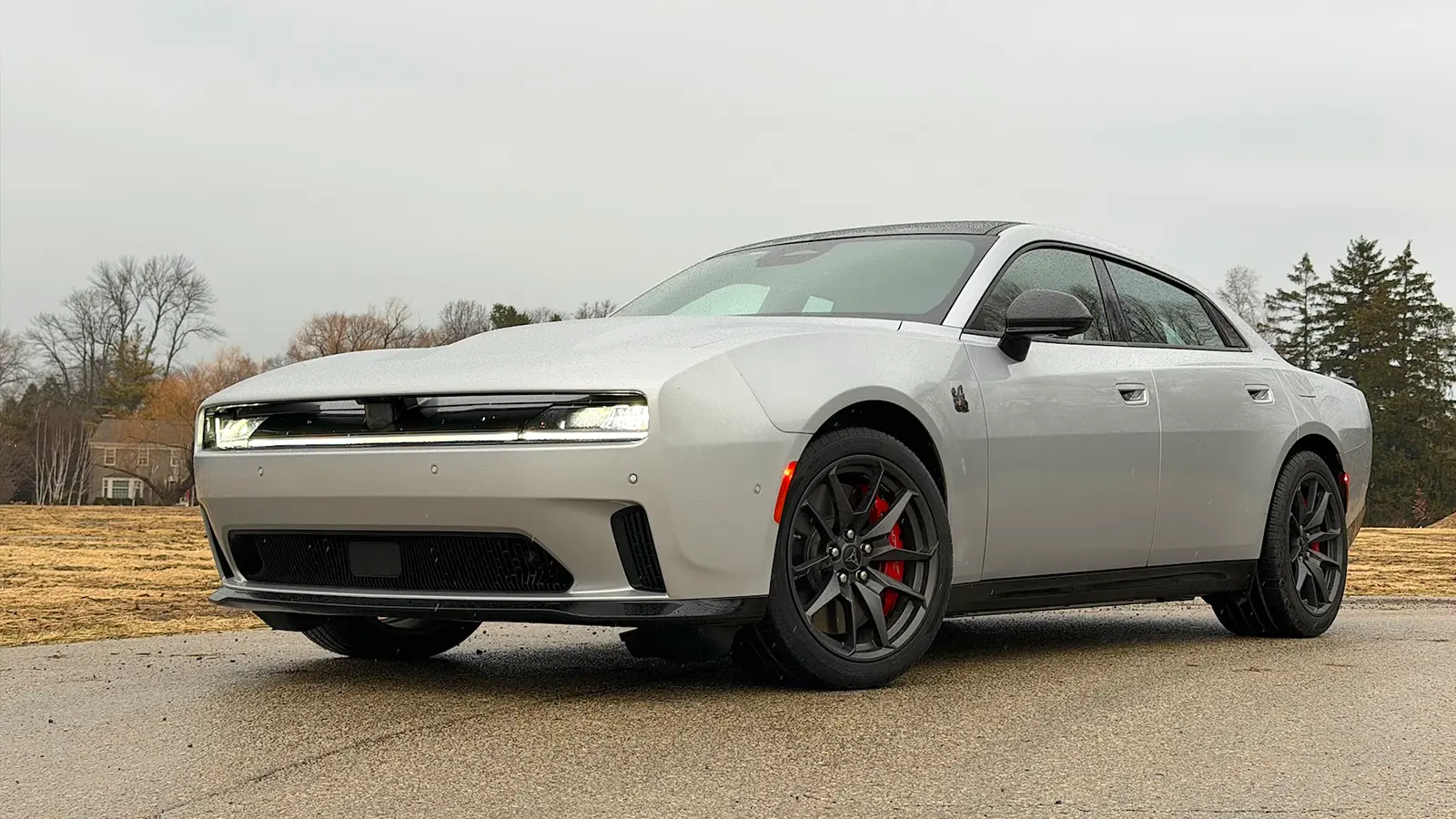
2026 Dodge Charger Daytona Scat Pack Review: Electric Muscle Icon
A theatrical, flawed muscle cruiser for the heart, not the head.
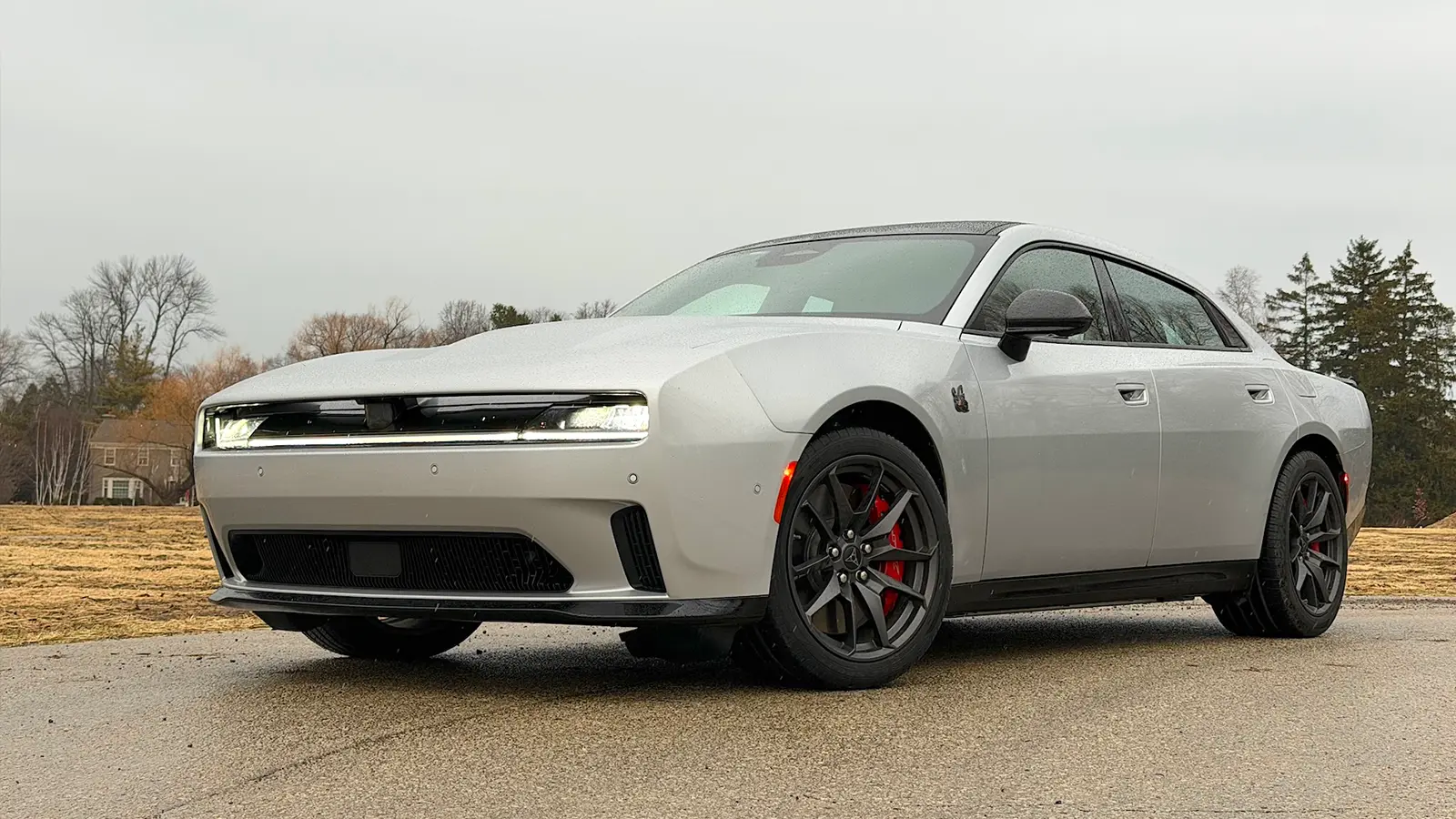
2026 Dodge Charger Daytona Scat Pack electric muscle car front three-quarter
Price
$61,995 (4-dr)
Power
670 hp (Power Shot)
⚡ Quick Verdict
:
The 2026 Dodge Charger Daytona Scat Pack is a 670-hp electric muscle car that starts at $61,995 and puts spectacle above everything else. It’s built for the enthusiast who wants the loudest, most attention-grabbing EV on the road—the person who’ll happily trade efficiency for style. The big caveat? Its appetite for electrons and a 241-mile EPA range mean road-trippers need not apply. This is a show car you can daily, not a daily that happens to put on a show.
## At a Glance: How the Charger Daytona Scat Pack Stacks Up
✓ The Good
- +Unmistakable, show-stopping design that turns every head.
- +Surprisingly spacious and usable 38.5 cu-ft hatchback cargo area.
- +Brutal straight-line acceleration; quicker to 60 than the old Hellcat Redeye.
- +Playful Drift and Donut modes provide genuine, silly fun.
- +Cabin design is a dramatic, textured leap over its predecessor.
✗ The Trade-offs
- −Noticeable throttle hesitation from a stop disrupts the EV experience.
- −Fratzonic sound is loud and unique but drones without synthetic shifts.
- −At ~6,000 lb, it’s heavy, thirsty, and its handling is more cruiser than sports car.
- −Laggy Uconnect 5 infotainment and frustrating haptic climate controls.
- −Tallest drivers will find the seating position high and the rear-view mirror intrusive.
📑 In This Review
- At a Glance: How the Charger Daytona Scat Pack Stacks Up
- What’s New for 2026: The Electric Muscle Pivot
- Powertrain, 0-60 and Power Shot: The Headline Numbers
- Range, Charging and Real-World Efficiency
- On-Road Feel, Handling and the 6,000-lb Reality
- The Fratzonic Soundtrack: Cyberpunk V8 or Loud Drone?
- Interior, Tech and the 12.3-inch Uconnect 5 Mixed Bag
- Practicality: Hatchback Cargo, Rear Seat, Daily-Drive Usability
- 2026 Dodge Charger Daytona Scat Pack vs Tesla Model 3 Performance: Which Is Better?
- Safety and Warranty
- Pricing and Trim Strategy
- Who Should Buy It
- Verdict
- Frequently Asked Questions
The 2026 Dodge Charger Daytona Scat Pack is a 670-hp electric muscle car that starts at $61,995 and puts spectacle above everything else. It’s built for the enthusiast who wants the loudest, most attention-grabbing EV on the road—the person who’ll happily trade efficiency for style. The big caveat? Its appetite for electrons and a 241-mile EPA range mean road-trippers need not apply. This is a show car you can daily, not a daily that happens to put on a show.
At a Glance: How the Charger Daytona Scat Pack Stacks Up
| Spec | 2026 Charger Daytona Scat Pack | Tesla Model 3 Performance | BMW i4 M50 | Hyundai Ioniq 5 N |
|---|---|---|---|---|
| Starting price (US) | $61,995 (4-dr) | $54,990 | $69,895 | $66,200 |
| Power | 670 hp (Power Shot) | 510 hp | 536 hp | 641 hp (boost) |
| 0-60 mph | 3.3 s | 2.9 s | 3.3 s | 3.25 s |
| EPA range | 241 mi | 296 mi | 269 mi | 221 mi |
Tesla Model 3 Performance
Quicker, lighter, longer range and a better charging network for $7k less.
BMW i4 M50
Quieter and more refined cabin, but down on power and missing the Charger’s theatre.
Hyundai Ioniq 5 N
The closest rival on character — has the synthetic gear shifts the Charger is missing.
The 2026 Dodge Charger Daytona Scat Pack doesn’t politely knock on the door of the electric performance sedan segment—it kicks the thing off its hinges. Dodge built this car around a philosophy that’s fundamentally different from what its rivals offer. Where a Tesla Model 3 Performance or a BMW i4 M50 delivers balanced, clinical precision, the Charger throws balance out the window in favor of raw presence and straight-line drama. It asks a question the others don’t bother with: just how much muscle-car theater do you actually want from an EV? 2026 Charger Daytona Scat Pack BMW i4 M50 —— $61,995 (4-dr) $69,895 670 hp (Power Shot) 536 hp 3.3 s 3.3 s 241 mi 269 mi Look at the numbers and a pattern emerges. The Dodge is the heaviest, least efficient, and among the slowest to 60 in this quartet. It ties the BMW and Hyundai in a straight line but surrenders real range to both the Tesla and the BMW. What those columns don’t capture is the Charger’s intangible appeal: it’s the only car here that can legitimately wear the muscle-car badge, and it delivers a level of visual swagger and auditory theater none of its competitors can touch.
What’s New for 2026: The Electric Muscle Pivot
The 2026 model year represents a clean break for the Charger nameplate. Dodge has taken a name synonymous with big-displacement HEMI engines and reimagined it from the ground up as an all-electric performance machine. It’s the brand’s first EV, and the engineering team clearly felt the need to make a statement. The most obvious piece of that statement is the Fratzonic Chambered Exhaust—a 600-watt speaker system that pumps a synthetic, V8-inspired soundtrack into the cabin and out through rear-facing speakers. The silence typical of an EV? Not here.
Underneath the sheetmetal, a dual-motor, all-wheel-drive layout replaces the old rear-drive setup, putting torque to all four corners instantly. Dodge also gives buyers a choice: a two-door coupe or a four-door sedan, honoring the car’s historical two-body-style tradition. Within the electric lineup, the Scat Pack sits at the top. It packs more horsepower, wider rubber (305 front, 325 rear), and sharper tuning than the R/T, which trades punch for extra range. If you’re cross-shopping and your priority is straight-line thrill over maximum miles, the Scat Pack is the one you want.
Powertrain, 0-60 and Power Shot: The Headline Numbers
Two permanent-magnet electric motors sit under the Charger’s skin, fed by a 400-volt electrical architecture. In standard trim, they produce 630 hp and 627 lb-ft of torque. Hit the "Power Shot" button on the steering wheel and you unlock an extra 40 horsepower for 10-second bursts—670 hp total when you need it most. The result is a 0-60 mph sprint in 3.3 seconds and a quarter-mile in the low 11s, all before the car hits its 134-mph top-speed limiter. For perspective, that 0-60 time beats the old 797-hp supercharged Hellcat Redeye.
Those are impressive figures, but the driving experience has an odd wrinkle. Regardless of drive mode, there’s roughly a half-second delay between your right foot hitting the accelerator and the car actually launching. It mimics the lag you’d feel in a turbocharged ICE vehicle—strange and unnecessary in an EV that should deliver instant torque. It’s not enough to ruin the party, but it does blunt the launch slightly, and it’s something we’d love to see Dodge fix with an over-the-air update.
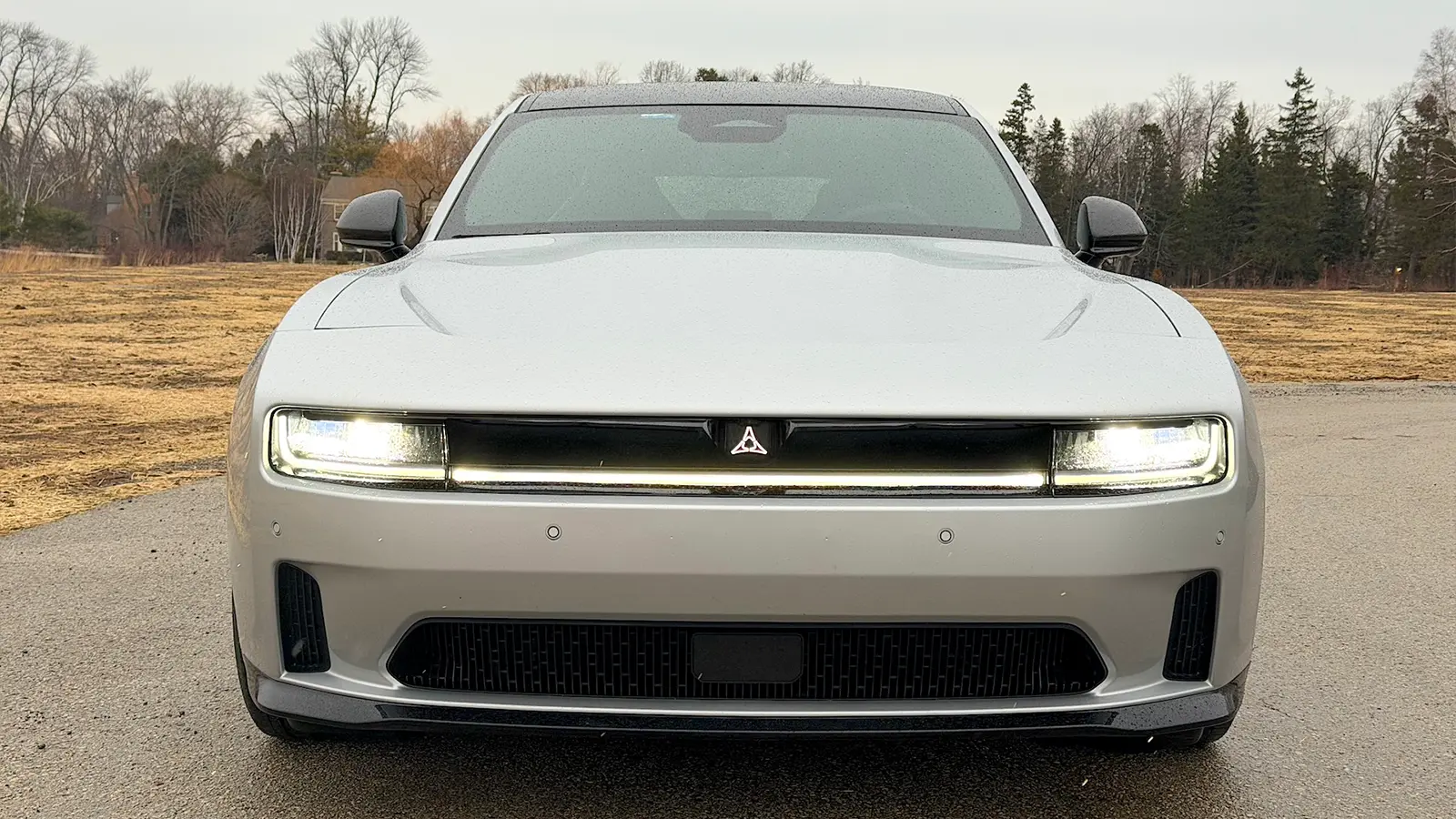
Range, Charging and Real-World Efficiency
A 100.5 kWh battery pack (93.3 kWh usable) stores the Charger’s energy. The EPA pegs range at 241 miles, the lowest of its three main competitors. That’s the price of admission for a 6,000-lb performance car with 670 hp on tap. When you need to plug in, the Scat Pack accepts up to 183 kW on a DC fast charger, good for a 10-to-80-percent session in about 27 minutes. Home charging tops out at 11 kW via the onboard charger. The car uses a CCS Combo port, so you’ll need an adapter for Tesla’s NACS stations.
During our week of mixed driving—city errands, highway stints, and the occasional enthusiastic blast—we saw roughly 3.3 miles per kWh in cooler weather. That’s a reasonable number and suggests the EPA estimate holds up under moderate driving. Lean hard on the Power Shot, though, or stay in Sport mode all day, and that figure drops fast. If you’re the kind of driver who sees a charging schedule as a minor inconvenience, you’ll be fine. If you need 300-plus miles between stops on a regular basis, look elsewhere.
On-Road Feel, Handling and the 6,000-lb Reality
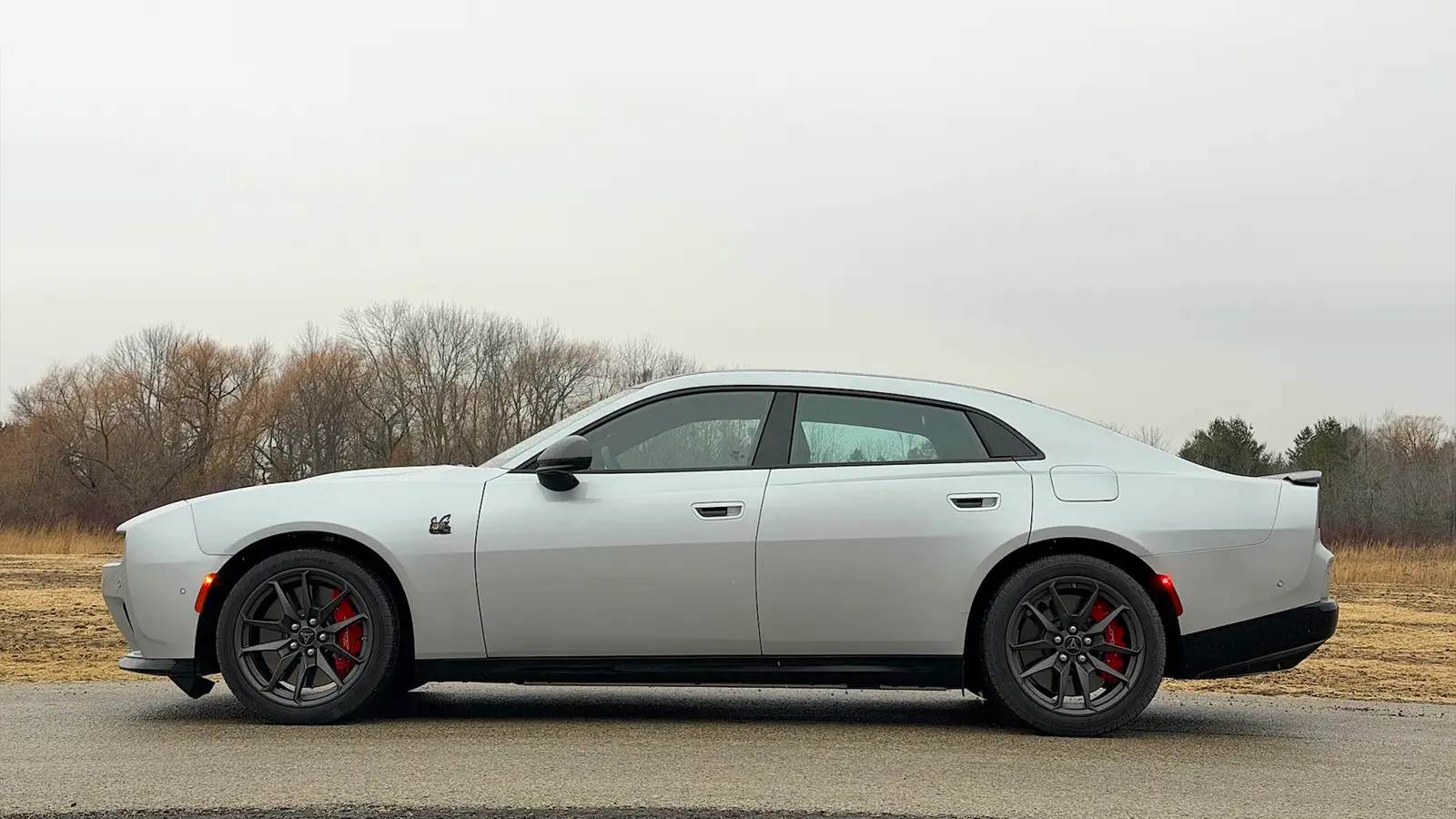
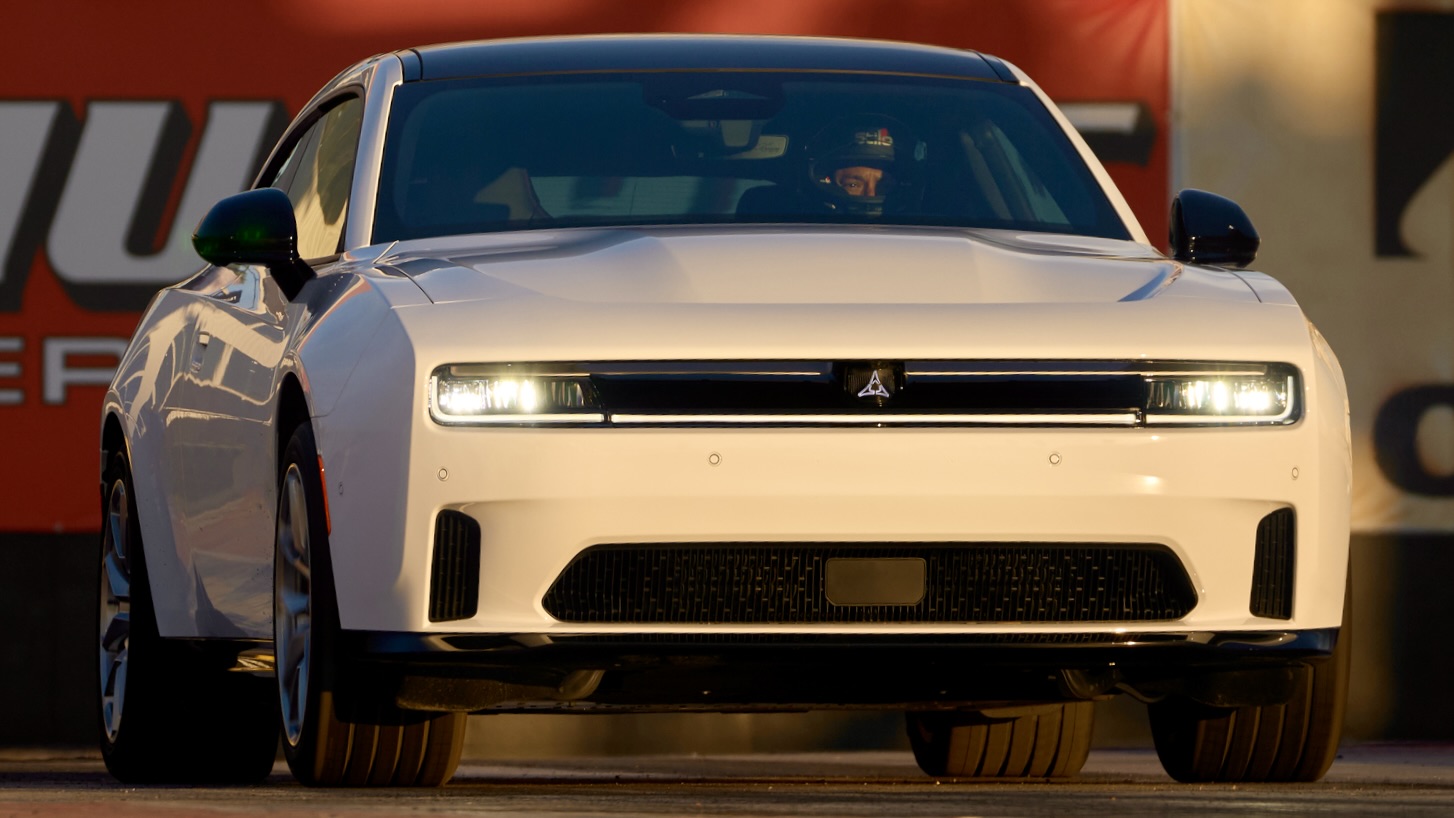
Let’s not sugarcoat it: this car is enormous. It’s nearly 6,000 lb at the curb, heavier than a Jeep Wagoneer S and 17 inches longer than a Ford Mustang. Dodge didn’t design it to be a sports car. It’s a muscle cruiser, and in that role it does well. The adaptive dampers in Auto mode deliver a genuinely comfortable ride, and the cabin stays quiet at highway speeds. You could cover serious ground in this thing—if the range lets you.
Get the Charger into a set of corners and physics makes itself known. The front end, wrapped in 305-section Goodyear tires, hangs on longer than you’d expect, and the rear can be rotated with a deliberate stab of throttle. The Drift and Donut modes are there, and yes, they’re genuinely entertaining. But the steering is vague, the chassis is ponderous, and no amount of tire can hide the mass. The low-speed drivability issue rears its head again in parking lots: the initial throttle tip-in is abrupt, making smooth pullaways tricky until you learn the car’s quirks. It’s a spectacular straight-line weapon and a relaxed highway cruiser, but don’t expect it to dance through canyons like something a thousand pounds lighter.
The Fratzonic Soundtrack: Cyberpunk V8 or Loud Drone?
Fratzonic is Dodge’s name for its synthetic exhaust, and it’s easily the car’s most polarizing piece of hardware. In Stealth mode, the car is dead silent—pure EV. In Auto, there’s a faint hum. Flip into Sport or Track and the cabin fills with a loud, digitally generated roar meant to evoke a high-performance V8. It’s unmistakable and guarantees you won’t fade into traffic anonymously.
The problem is convincingness. After hours behind the wheel, we found the sound settles into a steady, monotone drone that doesn’t really capture the layered complexity of a real combustion engine. What’s missing is synthetic shift mapping—the rise and fall of simulated gears like Hyundai builds into the Ioniq 5 N. Without that rhythmic variation, the soundtrack is just volume tied to throttle position. Some drivers will love the cyberpunk aggression; others will reach for the volume knob after ten minutes. Software updates that add simulated gear changes could transform the experience.
Interior, Tech and the 12.3-inch Uconnect 5 Mixed Bag
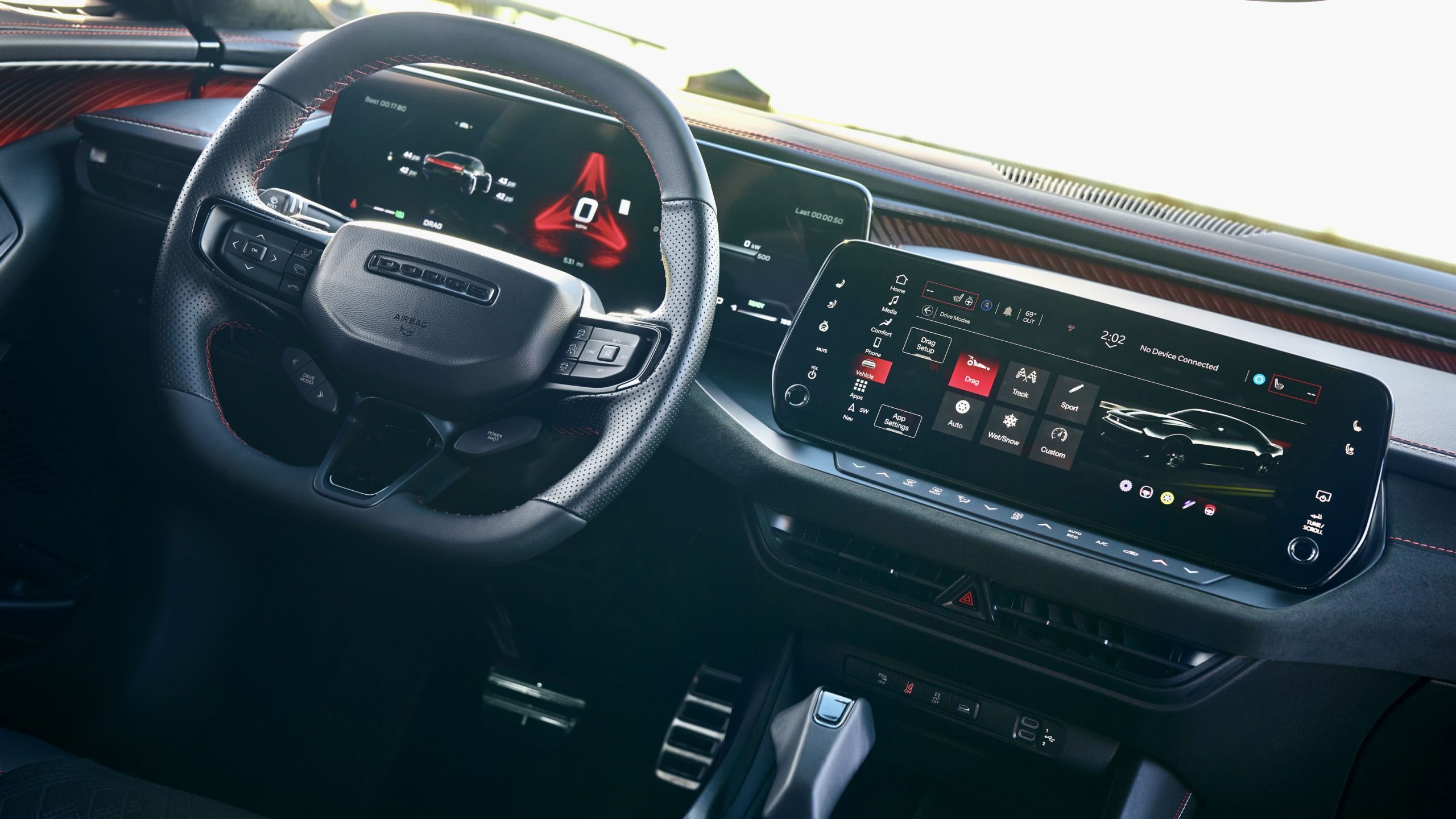
Step inside the Charger Daytona and the improvement over the old car is immediate. The cabin mixes carbon-fiber trim, suede, leather, and Alcantara, all tied together by Dodge’s customizable "Attitude Adjustment" ambient lighting. There are design easter eggs tucked into corners, and the pistol-grip shifter is a perfect retro touch. On the tech front, you get a 16-inch digital instrument cluster, a 12.3-inch Uconnect 5 touchscreen angled toward the driver, a head-up display, wireless Apple CarPlay and Android Auto, and a full 360-degree camera suite.
The execution isn’t perfect, though. Uconnect 5 lags noticeably when you move through menus—it’s sluggish enough to be annoying. The haptic feedback climate buttons are worse: they misread inputs constantly, and you’ll find yourself jabbing the same button three or four times just to turn on the heated seats. Taller drivers will also notice the seating position rides a couple inches too high; the top of the steering wheel and the rear-view mirror both crowd into your sightlines. It’s a cabin that impresses on first look but can frustrate over a week of daily use.
Practicality: Hatchback Cargo, Rear Seat, Daily-Drive Usability
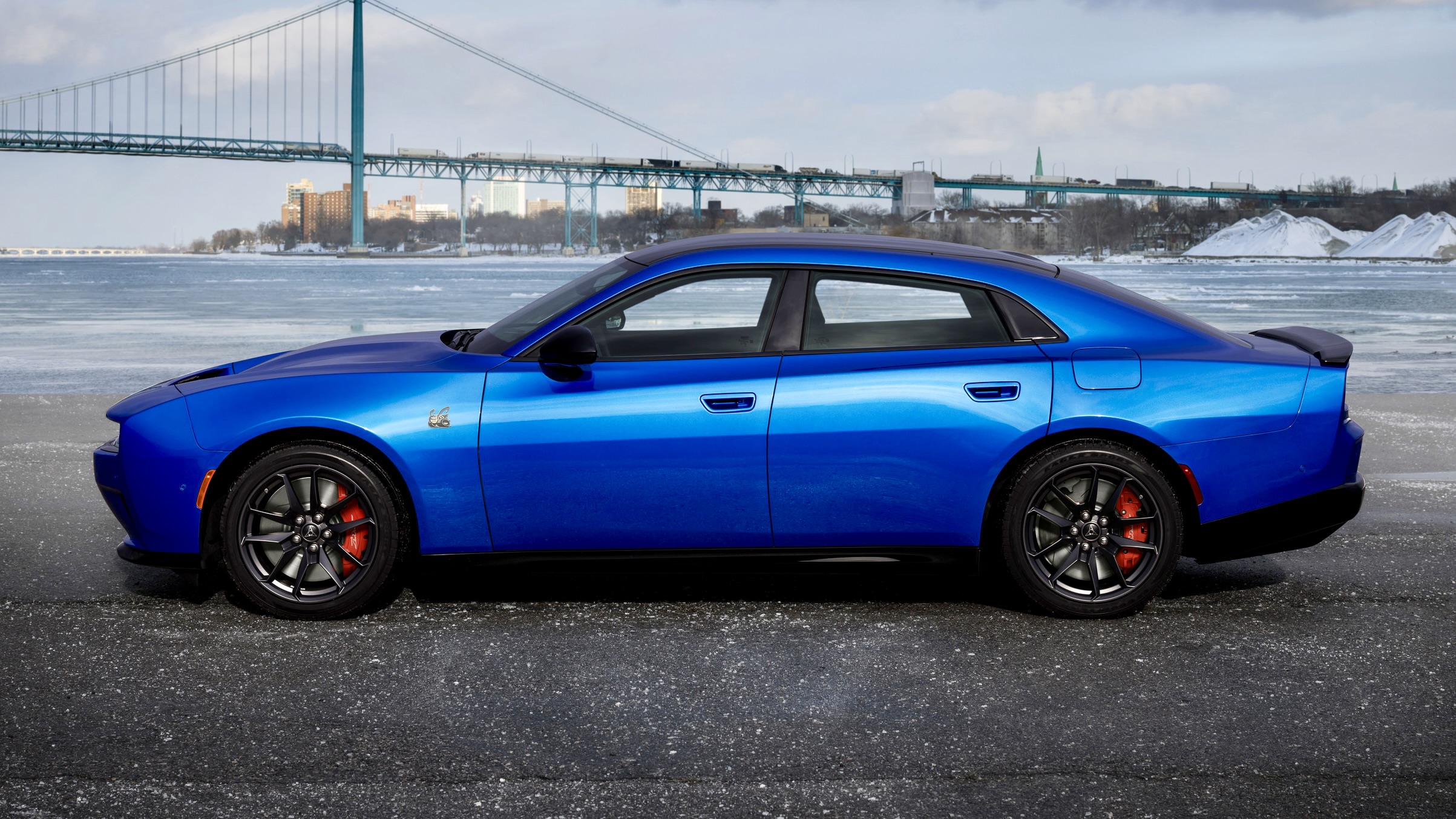
Here’s something we didn’t expect: the Charger Daytona is genuinely practical. That fastback roofline hides a 38.5-cubic-foot hatchback—a rarity among performance sedans. Fold the 60/40 split rear seats and the space grows further, giving you far more versatility than any traditional trunk. In the four-door version, rear-seat legroom is adequate, though anyone over six feet will brush the headliner thanks to the sloping roof.
As a daily driver, it works—provided your circumstances align. The frameless doors look slick, the two-position memory seats are convenient, and the ride in Auto mode is smooth enough for the morning commute. The constant caveat is range. Keep your daily loop inside 200 miles with a reliable fast charger nearby, and the Charger Daytona is a thrilling, head-turning commuter. Start venturing further and you’ll be building your schedule around charging sessions.
2026 Dodge Charger Daytona Scat Pack vs Tesla Model 3 Performance: Which Is Better?
This is the matchup everyone wants to see: the brash newcomer versus the established benchmark. The Tesla Model 3 Performance starts around $54,990, undercutting the Charger Scat Pack by more than $7,000—and our test car, loaded with the Track Package, stickered at roughly $86,000. Performance is close in a straight line but different in feel: the Tesla hits 60 in 2.9 seconds versus 3.3, and it does so while weighing nearly 2,000 lb less. That weight advantage pays dividends in handling and efficiency alike.
Range and infrastructure tilt further toward the Tesla. The Model 3 Performance’s 296-mile EPA estimate crushes the Dodge’s 241 miles, and it plugs natively into Tesla’s massive, reliable Supercharger network. The Dodge uses CCS and needs an adapter. Inside, the philosophies couldn’t be more opposed: Tesla gives you a minimalist, screen-centric space, while Dodge piles on textures, color, and retro-inspired design cues. On the road, the Tesla is a precision tool—quick, efficient, and connected. The Dodge is a wide-body muscle cruiser that trades surgical handling for sensory overload.
| Spec | 2026 Charger Daytona Scat Pack | Tesla Model 3 Performance |
|---|---|---|
| Starting MSRP | $61,995 | $54,990 |
| Power | 670 hp (Power Shot) | 510 hp |
| Torque | 627 lb-ft | 547 lb-ft |
| 0-60 mph | 3.3 s | 2.9 s |
| Battery (usable) | 93.3 kWh | 79 kWh |
| EPA range | 241 mi | 296 mi |
| DC fast-charge peak | 183 kW | 250 kW |
| Curb weight | ~6,000 lb | ~4,054 lb |
| Cargo space | 38.5 cu-ft (hatch) | 21 cu-ft (sedan trunk) |
<div style="background:linear-gradient(135deg,#f0f9ff,#e0f2fe); border-left:4px solid #2563eb; border-radius:12px; padding:24px 28px; margin:32px 0"> <p style="font-size:12px; font-weight:800; letter-spacing:0.14em; text-transform:uppercase; color:#1e40af; margin:0 0 10px">Which one is better?</p> <p><strong>Buy the Charger Daytona Scat Pack if</strong> you want the loudest, longest, most theatrical EV on the road, a true hatchback, and a five-figure presence that turns more heads than a Lamborghini.</p> <p><strong>Buy the Tesla Model 3 Performance if</strong> you want the quicker 0-60, the longer range, the bigger Supercharger network, and the lower total cost of ownership.</p> <p><strong>Our pick</strong> is the Tesla Model 3 Performance for nine of ten buyers — but the Charger Daytona Scat Pack for the one buyer who measures a car by the smile per mile and the look in the rear-view mirror.</p> </div>
Safety and Warranty
The 2026 Charger is a ground-up redesign, which means it hasn’t been crash-tested by the IIHS or NHTSA yet. Don’t look to old Charger scores for guidance—they’re irrelevant to this new platform. Standard advanced driver-assistance features include forward collision warning with automatic emergency braking, active lane management, adaptive cruise control with stop-and-go capability, blind-spot monitoring, rear cross-traffic alert, traffic sign recognition, and a 360-degree camera.
Warranty coverage is competitive without being class-leading. You get a 3-year/36,000-mile basic warranty, a 5-year/60,000-mile powertrain warranty, and an 8-year/100,000-mile battery warranty that matches the federal minimum. Roadside assistance runs 5 years or 60,000 miles. It’s solid protection, though it trails Tesla’s 4-year/50,000-mile bumper-to-bumper coverage.
Pricing and Trim Strategy
Pricing for the 2026 Charger Daytona Scat Pack starts at $59,995 for the two-door coupe and $61,995 for the four-door sedan. Tick the Track Package—Brembo six-piston front calipers, Pirelli P Zero tires, adaptive Bilstein dampers—and the window sticker climbs into the $83,000–$86,000 territory. If the Scat Pack’s thirst and price feel like too much, the R/T trim offers less power but a longer range at roughly $53,000.
Before you sign, check your eligibility for federal EV tax credits. Depending on where the car is assembled and your income, you might shave a meaningful chunk off the purchase price. As it sits, the Scat Pack is positioned as a premium performance play, competing against both luxury sport sedans and high-end EVs.
Who Should Buy It
The ideal Charger Daytona Scat Pack buyer is an enthusiast who cares about style and making a statement more than squeezing out every last mile of range. They’ve got a garage with a charger in it, a commute that stays under 150 miles round trip, and a deep appreciation for neck-snapping acceleration and the kind of attention most EVs never attract. They know they’re buying a piece of automotive theater first and a practical car second.
This isn’t the right machine for anyone who road-trips frequently, regularly hauls tall rear-seat passengers, or prioritizes chassis finesse and efficiency over sheer presence. It’s for the person who wants their EV to be the loudest thing in the parking lot, not a silent appliance that blends in.
⚡ Our Verdict
A theatrical, flawed muscle cruiser for the heart, not the head.
The 2026 Dodge Charger Daytona Scat Pack is a flawed but fascinating machine—a monument to American muscle reimagined for the electric age. Starting at $61,995, it delivers 670 hp and a sensory experience no competitor can match. We give it 3.7 out of 5.0 stars. It earns strong marks for design, drama, and straight-line thrills, but the weight, range penalty, and tech frustrations cost it points. Think of it less as a scalpel and more as a sledgehammer. For a certain kind of buyer, that’s the whole point.
