

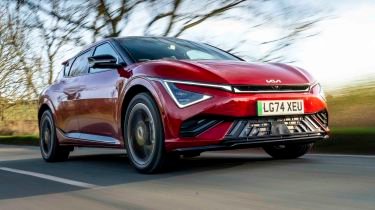
2026 Kia EV6 GT Review: The Electric Gran Turismo Reborn
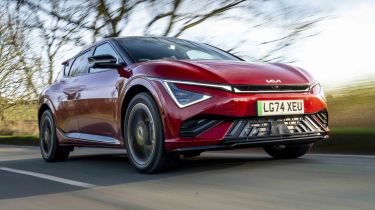
2026 Kia EV6 GT in matte blue, three-quarter exterior view
Price
GBP 60,000
Battery (gross)
84 kWh
Power
641 hp
⚡ Quick Verdict
:
The 2026 Kia EV6 GT is the most convincing electric performance crossover Kia has built to date. It pairs genuine supercar-baiting straight-line pace with a softer, more liveable chassis and clever tech like Virtual Gear Shift. It isn’t cheap, and the range penalty is real, but for buyers after an electric GT that works as a daily driver, it’s among the strongest options on the market right now.
## Introduction
✓ The Good
- +Massive power increase to 641 hp with genuinely engaging GT mode
- +Virtual Gear Shift adds a layer of driving involvement absent from most EVs
- +800V architecture delivers 10-80% in 18 minutes at a 258 kW peak
- +Softened suspension improves daily comfort without sacrificing composure
- +Best-in-class 360-degree camera and remote auto-park feature
✗ The Trade-offs
- −Rear headroom tight for taller passengers on longer journeys
- −Some hard plastics in lower cabin trim undermine the premium positioning
- −Matte blue paint adds GBP 1,500 on top of an already steep price
- −Real-world range of roughly 200 miles falls well short of the 280-mile WLTP claim
📑 In This Review
- Introduction
- Design and Exterior
- Interior, Comfort and Tech
- Battery, Charging and Real-World Range
- Performance and Driving Dynamics
- Virtual Gear Shift and Drive Modes
- Practicality and Everyday Use
- 2026 Kia EV6 GT vs Hyundai Ioniq 5 N: Which Is Better?
- At a Glance: How the EV6 GT Compares to Rivals
- Safety and Warranty
- Should You Buy the 2026 Kia EV6 GT?
- Verdict
- Frequently Asked Questions
The 2026 Kia EV6 GT is the most convincing electric performance crossover Kia has built to date. It pairs genuine supercar-baiting straight-line pace with a softer, more liveable chassis and clever tech like Virtual Gear Shift. It isn’t cheap, and the range penalty is real, but for buyers after an electric GT that works as a daily driver, it’s among the strongest options on the market right now.
Introduction
The electric performance crossover space has moved fast. When the original Kia EV6 GT landed in 2023, it was a bold statement, but one with clear room for improvement in ride quality, power delivery sophistication, and cabin polish. The 2026 facelift takes aim at all three. Aimed squarely at buyers who want sports-sedan punch in a practical crossover wrapper, the updated EV6 GT now churns out 641 horsepower, introduces a simulated gearbox system, and brings a stack of chassis tweaks that shift its character from raw to composed.
Kia’s timing is no accident. The Hyundai Ioniq 5 N has grabbed headlines with track-focused drift modes and theatrical sound effects. Tesla keeps pushing the value story with its Model 3 Performance at lower price points. Against that backdrop, Kia needed the EV6 GT to genuinely evolve, not just get a mild refresh. What we’ve got is a car that trades some of the old model’s rough-edged aggression for something closer to a true grand tourer. It matters because that’s the direction most real-world buyers actually want their fast EVs to head.
Design and Exterior
The facelifted EV6 GT makes its intentions known from the front bumper forward. The new fascia ditches the outgoing model’s somewhat busy grille treatment in favour of a cleaner, wider intake arrangement that visually lowers the car and gives it a more planted stance. The signature daytime running lights remain, now integrated into a slimmer headlamp cluster that stretches into the front fenders. It looks sharper without being overwrought, and in our view it’s the best-looking EV6 variant yet from the front three-quarter angle.
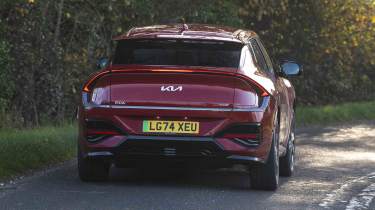
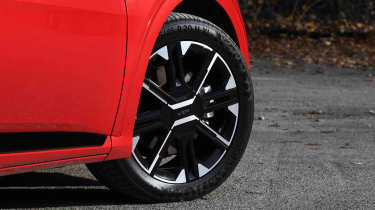
Out back, a new duck-tail spoiler sits above the full-width light bar, adding a subtle but effective visual exclamation mark. The 21-inch wheels, standard on the GT, fill the arches properly and contribute to the car’s aggressive posture. Our test car arrived in the optional matte blue paint, a colour that catches the eye immediately and photographs superbly. It does add GBP 1,500 to the price, which stings, but in a sea of grey and white crossovers the distinction feels worth it if standing out matters to you.
Interior, Comfort and Tech
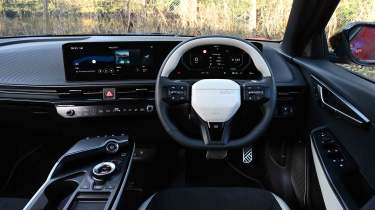
Step inside and the twin 12.3-inch curved screens dominate the dashboard. They run Kia’s latest infotainment software, which feels snappy and logically laid out. Wireless Apple CarPlay and Android Auto come standard, and pairing is straightforward. The new HVAC control panel below the main screen uses a row of physical toggle switches alongside a touch-sensitive strip for temperature adjustment. We prefer this approach over the fully capacitive systems some rivals use, though the touch-sensitive portion can occasionally misread a gloved finger on cold mornings.
The sport bucket seats are now electrically adjustable, a welcome improvement over the manual units in the pre-facelift GT. They hold you well through corners and offer enough bolstering without being punishing on a three-hour motorway run. That said, we did find ourselves fidgeting slightly on longer stints. Material quality is generally strong across the upper dashboard, door cards, and centre console, with soft-touch surfaces and convincing stitching throughout. The lower sections of the cabin, though, below knee level and around the door bins, use harder plastics that feel a grade below what the price suggests. It’s a minor gripe, but worth flagging in a GBP 60,000 car.
The Meridian 14-speaker audio system deserves a call-out. It delivers a rich, detailed sound stage that handles everything from spoken podcasts to bass-heavy electronic music with confidence. Pair that with the 360-degree camera system, which produces some of the sharpest resolution we’ve tested in any car at this price, and the genuinely useful remote auto-park feature that lets you manoeuvre the car in and out of tight spaces via the key fob, and the EV6 GT’s technology package is among the most complete in the segment. Rear headroom is the caveat, though. At six feet three inches, our tester’s head brushed the roofline when seated upright in the back. For average-height passengers it’s fine, but taller adults will want to slouch.
Battery, Charging and Real-World Range
The 2026 EV6 GT runs an 84 kWh gross battery (80 kWh usable), up from 77.4 kWh in the outgoing model, feeding Kia’s proven 800-volt architecture. Peak DC charging tops out at 258 kW, which means a 10 to 80 per cent charge in 18 minutes at a compatible ultra-rapid charger. Across multiple charging stops during our testing, the car held above 200 kW for the majority of the charge curve, and the in-built navigation system usefully calculates state-of-charge targets at each waypoint, which genuinely reduces route-planning anxiety.
The WLTP range claim sits at 279 to 280 miles. In practice, we saw closer to 200 miles when driving with any vigour, with our rolling 1,000-mile average returning 2.8 miles per kWh. On our standard 57-kilometre mixed test route of highway, country road, and city driving, consumption settled at 17.8 kWh/100 km, while a 339-kilometre extended mixed run returned 19.5 kWh/100 km. These figures are honest for a 2,295 kg performance crossover running 21-inch wheels, but they do mean long-distance trips require some planning. The three-level regenerative braking system is well calibrated, with the strongest setting delivering up to 150 kW of regen deceleration alone, rising to 320 kW when the friction brakes are blended in.
Performance and Driving Dynamics
This is where the facelift makes its most dramatic impact. The dual-motor powertrain now produces 641 horsepower and 770 Newton-metres in GT mode, a substantial leap from the outgoing model’s 577 hp. The 0-100 km/h time of 3.5 seconds we recorded on test matches Kia’s factory claim, and the surge is relentless and immediate in the way only electric powertrains can deliver. Top speed is an electronically limited 260 km/h (162 mph), more than enough for the occasional autobahn run but a figure most owners will never approach.
The chassis changes matter just as much. Kia has softened the spring rates for the facelift while keeping adaptive damping, and the difference is immediately apparent. Over broken B-roads, the pre-facelift GT could feel overly stiff, crashing over imperfections and unsettling the car’s composure. The 2026 model absorbs the same surfaces with considerably more grace. The integrated traction control, now managed through the motor controllers rather than relying solely on traditional stability systems, reacts more fluidly and allows a degree of rear-axle squirm in GT mode during damp conditions that makes the car feel alive without ever crossing into nervous territory. Launch control, accessed through GT mode, deploys all 641 horses with minimal wheelspin thanks to the e-LSD on the rear axle.
Compared directly to the pre-facelift car, this EV6 GT is a fundamentally different proposition. Where the old model felt like a hot hatch with too much power, the 2026 version behaves more like a proper grand tourer. The steering has weight and progression. The ride is pliant. The body control is tight. It’s the kind of car that covers 400 miles in a day without exhausting its driver, then still feels quick enough to embarrass far more expensive machinery away from a set of traffic lights.
Virtual Gear Shift and Drive Modes
The headline new feature for 2026 is Virtual Gear Shift (VGS). It simulates a six-speed dual-clutch transmission through software, complete with a rev limiter, a synthesised engine note played through the speakers, and paddle shifters mounted behind the steering wheel. In practice, it’s far more engaging than it sounds on paper. Slotting the car into fifth or sixth gear at 40 mph and then burying the accelerator produces a delayed kickdown sensation that genuinely mimics the behaviour of a torque-converter automatic. It gives you something to interact with beyond just throttle and steering, and for enthusiasts who miss the mechanical involvement of a combustion gearbox, it scratches an itch that most EVs simply can’t reach.
The six drive modes, Eco, Normal, Sport, Snow, GT, and My Drive, each reconfigure the powertrain response, steering weight, suspension firmness, and regenerative braking intensity. Eco softens everything and prioritises range. Normal is the everyday sweet spot. Sport sharpens the throttle and firms the dampers noticeably. GT unleashes the full 641 hp, stiffens the suspension to its maximum setting, and activates launch control. Snow mode dulls the throttle for low-traction surfaces. My Drive allows a custom combination across all parameters. During our time with the car, we toggled between Normal for commuting and GT for spirited weekend driving. The transitions between modes are swift and perceptibly different.
Practicality and Everyday Use
For all its performance credentials, the EV6 GT remains a practical daily tool. The boot offers 480 litres with the rear seats in place, expanding to 1,260 litres when folded flat. A ski hatch in the rear seat backrest lets long items pass through without dropping an entire seat. The small front trunk adds 20 litres of additional storage, handy for muddy charging cables or wet jackets. Towing capacity is rated for light duties, and the rear hatch features a programmable slow-open mode that stops it from swinging up into low garage ceilings.
The 360-degree parking camera system is genuinely excellent, producing crisp, high-resolution images that make tight manoeuvres straightforward. The remote auto-park function, which lets the car drive itself in or out of a parking space while you stand outside with the key fob, works reliably and is arguably the best implementation of this feature available in the segment today. It’s the kind of real-world feature that earns loyalty from owners dealing with tight urban parking on a daily basis.
2026 Kia EV6 GT vs Hyundai Ioniq 5 N: Which Is Better?
This is the comparison that defines the segment, and rightly so. The Kia EV6 GT and Hyundai Ioniq 5 N share the same E-GMP platform, the same 84 kWh battery, and produce identical peak power figures of 641 hp. They’re siblings in every technical sense, yet they’re aimed at markedly different buyers.
On price, the EV6 GT starts at GBP 60,000 in the UK, undercutting the Ioniq 5 N by GBP 5,000. That’s a meaningful gap, and it funds the optional matte blue paint or contributes towards an extended warranty package. Both cars deliver sub-3.6-second 0-62 mph sprints, with the Ioniq 5 N edging ahead at 3.4 seconds versus 3.5 seconds for the Kia, though the difference is imperceptible in the real world. Top speed is identical at 162 mph.
Where the two diverge most is in philosophy. The Ioniq 5 N is the sharper, more track-oriented machine. It features N e-Shift, a more aggressive version of the virtual gearbox concept, N Active Sound+ with louder and more theatrical synthesised engine notes, and dedicated drift modes that allow controlled oversteer on track. Hyundai has engineered the Ioniq 5 N as a hot hatchback for the electric age, biased towards driver engagement at the expense of ride comfort.
The EV6 GT, by contrast, leans into the "GT" part of its name. Its softened suspension, calmer body control, and more restrained Virtual Gear Shift system make it the easier car to live with day to day. Over a 200-mile motorway run, the Kia punishes its occupants less. The seats, while firm, are more comfortable on longer drives. The ride, even in its stiffest setting, doesn’t crash over potholes the way the Ioniq 5 N can.
Interior space is broadly similar, since both cars share the same platform and wheelbase. The Ioniq 5 N’s boxier shape gives it marginally more rear headroom, which matters for taller passengers. The EV6 GT’s sleeker roofline looks sportier but costs a few centimetres of vertical space in the back.
Charging performance is near-identical. The EV6 GT’s 258 kW peak slightly exceeds the Ioniq 5 N’s 240 kW, though the practical difference on a 10-80% charge is measured in seconds rather than minutes. Both charge from 10 to 80 per cent in around 18 minutes at a capable charger.
Both cars come with a 7-year warranty in the UK and an 8-year battery warranty guaranteeing more than 70 per cent capacity to 160,000 kilometres. Kia’s companion app and its remote auto-park feature give the EV6 GT a slight technology edge in everyday usability.
| Specification | Kia EV6 GT | Hyundai Ioniq 5 N |
|---|---|---|
| Starting price (UK) | GBP 60,000 | GBP 65,000 |
| Power | 641 hp | 641 hp (with N Boost) |
| Torque | 770 Nm | 740 Nm |
| 0-62 mph | 3.5 s | 3.4 s |
| Top speed | 162 mph | 162 mph |
| Battery (gross) | 84 kWh | 84 kWh |
| Peak DC charging | 258 kW | 240 kW |
| WLTP range | 279 mi | 278 mi |
| Warranty | 7 years / 160k km | 7 years / 160k km |
Buy the EV6 GT if you want a fast electric crossover that doubles as a relaxed, comfortable daily driver without sacrificing genuine performance punch. Its lower price, plusher ride, and superior parking tech make it the better all-rounder.
Buy the Ioniq 5 N if you prioritise track-day capability, want the drama of drift modes and more theatrical sound effects, and are willing to accept a firmer, more aggressive ride as the price of admission.
**Our pick** is the Kia EV6 GT. It delivers nine-tenths of the Ioniq 5 N’s excitement in a package that is GBP 5,000 cheaper, more comfortable, and easier to live with every single day.
At a Glance: How the EV6 GT Compares to Rivals
| Specification | Kia EV6 GT | Hyundai Ioniq 5 N |
|---|---|---|
| Starting price (UK) | GBP 60,000 | GBP 65,000 |
| Power | 641 hp | 641 hp (with N Boost) |
| Torque | 770 Nm | 740 Nm |
| 0-62 mph | 3.5 s | 3.4 s |
| Top speed | 162 mph | 162 mph |
| Battery (gross) | 84 kWh | 84 kWh |
| Peak DC charging | 258 kW | 240 kW |
| WLTP range | 279 mi | 278 mi |
| Warranty | 7 years / 160k km | 7 years / 160k km |
Hyundai Ioniq 5 N
Sharper track-focused sibling with drift modes — but firmer and pricier
Tesla Model 3 Performance
Quicker straight-line pace and 50 EUR/month cheaper to run, but no charging speed advantage
BMW i4 M50
Traditional sport-sedan feel and luxury cabin, but slowest 0-62 mph here at 3.7 s
Beyond the Hyundai sibling rivalry, the EV6 GT faces stiff competition from the Tesla Model 3 Performance and BMW i4 M50, each offering a distinct blend of performance, range, and brand appeal. The Tesla undercuts on price and range, the BMW counters with a more traditional luxury feel, and the Kia sits between them with a unique crossover body style and the fastest charging in the group. Kia EV6 GT Tesla Model 3 Performance —— GBP 60,000 GBP 60,000 641 hp 510 hp 3.5 s 2.9 s 279 mi 326 mi 258 kW 250 kW Crossover Sedan 7 years 4 years
Safety and Warranty
The Kia EV6 earned a full five-star Euro NCAP rating in 2022, scoring 90 per cent for adult occupant protection and 86 per cent for child occupant protection. ANCAP awarded the same five-star rating for the Australian market. The standard ADAS suite includes forward collision avoidance, lane-keeping assist, blind-spot monitoring, rear cross-traffic alert, and adaptive cruise control. The cruise control system is deliberately less automated than the systems fitted to Mercedes-Benz and Audi models, preferring to keep the driver actively engaged with country-road speed prompts rather than taking over steering and acceleration entirely. We found this approach refreshing rather than limiting.
In the UK and Australia, Kia offers a 7-year unlimited-kilometre warranty that covers the vehicle comprehensively. The battery carries an 8-year, 160,000-kilometre guarantee of at least 70 per cent capacity retention. It’s among the strongest warranty packages in the electric vehicle market, and it gives buyers confidence that the expensive battery pack is protected for the long haul.
Should You Buy the 2026 Kia EV6 GT?
If you’re in the market for a fast, practical electric crossover and your budget sits between GBP 60,000 and GBP 70,000, the EV6 GT deserves a spot on your shortlist. It’s a car that handles the daily commute without complaint, devours weekend back-road drives with genuine enthusiasm, and charges quickly enough to make longer trips feasible without excessive downtime. The Virtual Gear Shift adds a dimension of involvement that few electric cars can match, and the improved ride quality transforms the ownership experience from the occasionally harsh pre-facelift car into something far more rounded.
The caveats are worth knowing. The matte blue paint adds GBP 1,500 to a price that’s already steep. The real-world range of around 200 miles will be a limitation for some buyers. And the GT trim’s availability varies by market, with the US market seeing the EV6 GT placed on hiatus for 2026 and the GT-Line offered at USD 50,245 instead. Running costs sit roughly 50 EUR per month higher than an equivalent Tesla Model Y dual-motor, which adds up over a typical three-year lease. For buyers who prioritise comfort, technology, and a warranty that outlasts nearly every rival, the EV6 GT makes a compelling case. For those who want maximum range per dollar or the sharpest track experience, the competition deserves a closer look.
⚡ Our Verdict
Final Take
The 2026 Kia EV6 GT is the car the original should have been. More power, a smarter chassis, genuinely engaging technology like Virtual Gear Shift, and a suite of practical features that make ownership easy combine to create the most well-rounded electric performance crossover in its price bracket. It isn’t perfect, but it’s exceptionally good, and it proves that the grand tourer concept translates naturally to electric power.
