

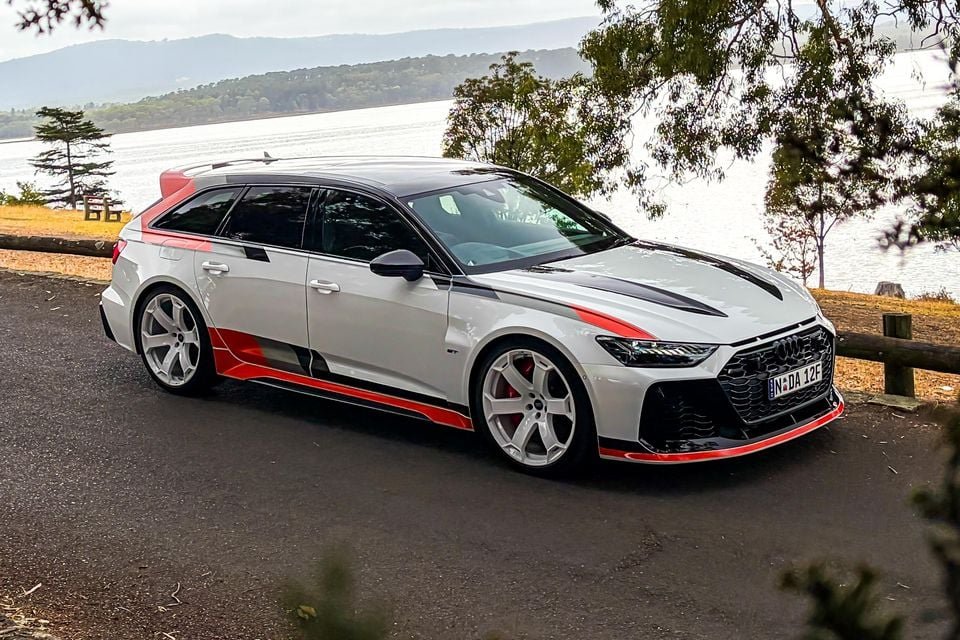
2026 Audi RS6 Avant Performance Review
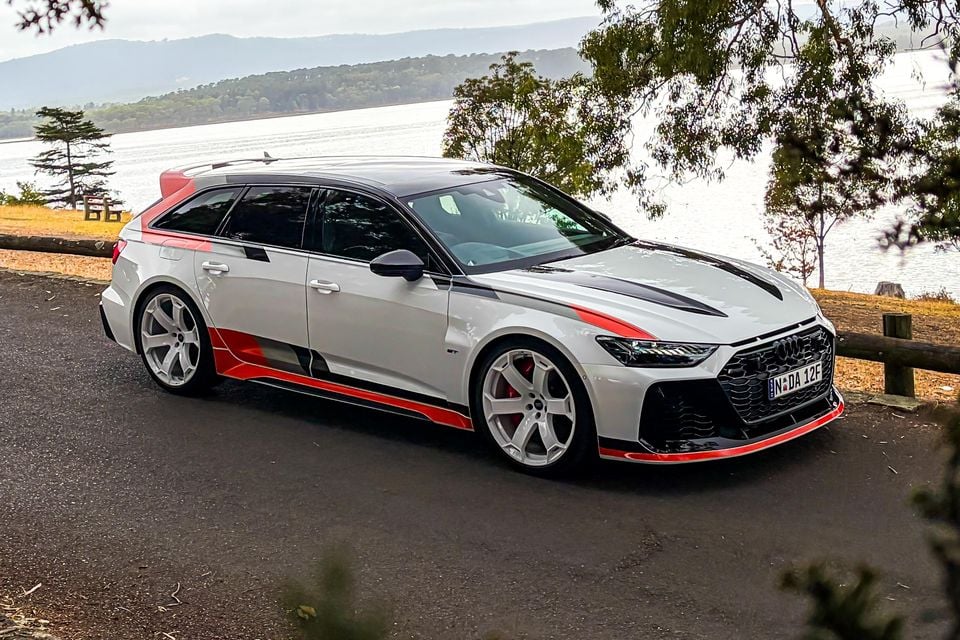
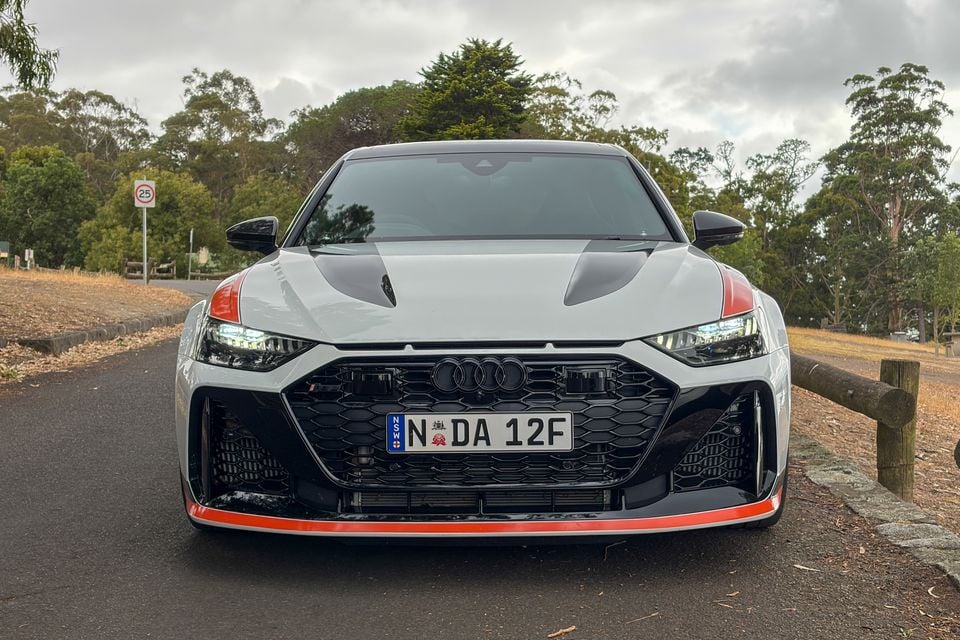
2026 Audi RS6 Avant Performance in Nardo gray, front three-quarter studio shot
Price
~$130,700
Powertrain
4.0L twin-turbo V8
⚡ Quick Verdict
: Right now, the RS6 Avant Performance is the best pure-petrol performance wagon you can buy. Its 621-hp twin-turbo V8 cracks 60 mph in 3.3 seconds, and you’ve still got 59.3 cu ft of cargo space behind the rear seats — a combination no other fast wagon quite manages. Yes, it drinks fuel like you’d expect from a V8 this size, and no, there’s no EV-only mode for quiet suburban running. But if you can live with the asking price and the petrol bill, nothing else nails the daily-car-plus-sports-car brief quite like this.
## Quick Verdict
✓ The Good
- +621 hp twin-turbo V8 hits 60 mph in 3.3 seconds with a genuinely visceral soundtrack
- +Nearly 540 lb lighter than the BMW M5 Touring — feels keener through every corner
- +30 cu ft / 59.3 cu ft cargo capacity beats every direct rival
- +Standard quattro all-wheel drive and rear-axle steering deliver surprising agility for a wagon
- +Refined cabin with acoustic glass, Valcona leather and dual-screen MMI makes daily use effortless
✗ The Trade-offs
- −14 mpg city / 21 mpg highway — annual fuel cost sits around $3,650
- −No plug-in hybrid option; rivals from BMW and Mercedes offer EV-only commuting
- −As-tested price balloons past $146,000 once you add Executive and Driver Assist packages
- −Plastic air vents and mandatory auto stop-start feel beneath a car at this price point
📑 In This Review
- Quick Verdict
- What’s New for 2026
- Performance and Powertrain
- Ride, Handling and Daily Use
- Interior, Tech and Comfort
- Cargo, Practicality and Family Use
- At a Glance: How the RS6 Avant Stacks Up
- 2026 Audi RS6 Avant vs BMW M5 Touring: Which Is Better?
- Safety and Warranty
- Should You Buy It? Buy / Skip Block
- Verdict
: Right now, the RS6 Avant Performance is the best pure-petrol performance wagon you can buy. Its 621-hp twin-turbo V8 cracks 60 mph in 3.3 seconds, and you’ve still got 59.3 cu ft of cargo space behind the rear seats — a combination no other fast wagon quite manages. Yes, it drinks fuel like you’d expect from a V8 this size, and no, there’s no EV-only mode for quiet suburban running. But if you can live with the asking price and the petrol bill, nothing else nails the daily-car-plus-sports-car brief quite like this.
Quick Verdict
After proper seat time in the 2026 RS6 Avant Performance, we’re convinced it sits in a class of one. It’s lighter than the BMW M5 Touring by a meaningful margin, quicker to 60 mph despite giving away nearly 100 hp on paper, and offers more boot space than either of its German rivals. The twin-turbo 4.0-litre V8 is a cracker — responsive, full of character, and mated to an eight-speed Tiptronic that seems to anticipate what you want before you do. It’s that good.
It’s not flawless. Fuel economy is rough, the as-tested price climbs fast once you start ticking option boxes, and there’s no electrified powertrain for silent suburban running. But if you’re after a performance wagon that prioritises driving engagement above all else, the RS6 Avant is unmatched.
We gave it 8.9 out of 10 — a rare score that reflects a car delivering exactly where a performance wagon needs to: behind the wheel.
What’s New for 2026
The 2026 model year carries over the mechanical updates from the 2024 mid-cycle refresh, and that’s no bad thing. The 4.0-litre twin-turbo V8 picked up an extra 30 hp and 37 lb-ft of torque back then, pushing peak output to 621 hp and 627 lb-ft — numbers that still sit right at the pointy end of the segment. There was nothing broken to fix.
Audi also stripped 11 lb of sound-deadening from the body in 2024, and that change carries into 2026. The thinking is straightforward: cut mass, let more of the V8’s natural voice into the cabin, and give the driver a tighter bond with the mechanicals. It works well in practice. The RS6 Avant sounds noticeably more alive inside than its predecessor without becoming tiring on a long highway stint. The acoustic glass still keeps wind and tyre noise nicely suppressed.
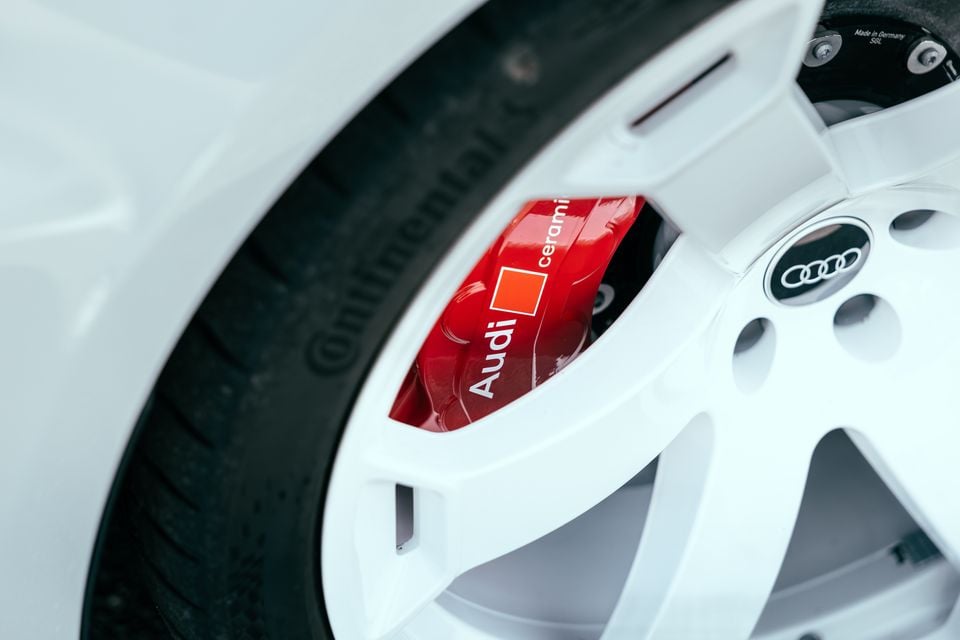
The only genuine 2026-only addition is the option of painted blue brake calipers. It’s a minor cosmetic thing, but a welcome alternative to the standard red or optional black. On a Nardo Grey car, the blue calipers look spot-on — a small detail that lets you pick a 2026 model at a glance. Beyond that, the RS6 Avant Performance enters 2026 as a known quantity: same mechanicals, same styling, same infotainment. Audi clearly reckons the formula doesn’t need fixing.
Performance and Powertrain
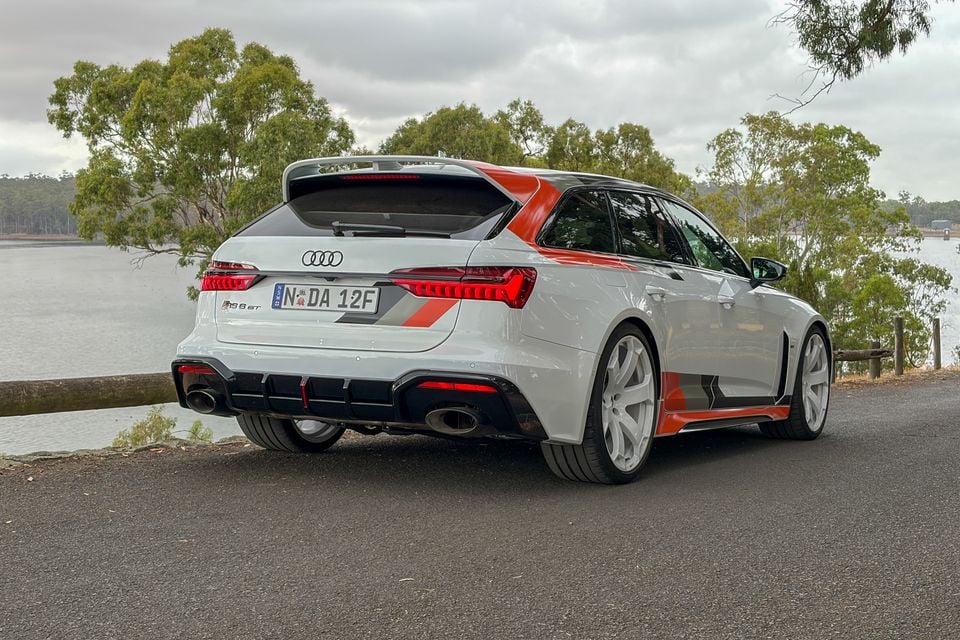
At the RS6 Avant Performance’s core sits Audi’s 4.0-litre twin-turbo V8, producing 621 hp and 627 lb-ft of torque. Drive goes through an eight-speed Tiptronic auto to a standard quattro all-wheel-drive system with a default 40:60 front-to-rear torque split. The result is a claimed 0–60 mph time of 3.3 seconds and a governed top speed of 155 mph, expandable to 190 mph with the optional Dynamic Plus package.
Those numbers only tell part of the story. What makes this engine special isn’t the headline figure — it’s the way it delivers its shove. Throttle response is immediate and linear, with a thick wall of torque arriving from around 2,000 rpm and hanging on well past 6,000 rpm. The eight-speed gearbox is a willing accomplice, snapping off upshifts in Sport mode with real aggression and holding gears smartly on a twisting road. Unlike the turbo V8 in the BMW M5 Touring, which leans on an electric motor to fill gaps in the torque curve, the Audi’s engine doesn’t need that help. It’s a naturally responsive unit that happens to have two turbochargers bolted on.
The exhaust deserves a mention. With 11 lb of sound-deadening removed, more of the V8’s voice reaches the cabin. It starts as a deep, bass-heavy idle and builds to a snarling crescendo as the revs climb. In RS2 drive mode — accessed via the steering-wheel-mounted RS button — the exhaust valves open earlier and stay open longer, adding a percussive crack on overrun that borders on antisocial. RS1 is the more civilised choice for daily duties, offering the same power but with a slightly muted soundtrack and softer shift logic.
Our take on the brakes: the standard setup is excellent and most buyers won’t need anything more. The 10-piston front calipers gripping 16.5-inch discs and single-piston rears on 14.6-inch rotors deliver serious stopping power with a progressive pedal feel. The optional carbon-ceramic brakes cut unsprung mass and resist fade on track, but they add a lot to the price and bring a slightly wooden cold-pedal feel that some drivers find off-putting in the first few stops of a morning. Unless you’re planning regular track days, save the cash and put it towards the Executive package instead.
If you’re considering the Dynamic Plus package for its 190 mph top speed, ask yourself how often you’ll actually use it. On most roads, the answer is never. Our pick: skip it, and redirect the budget towards the 22-inch wheel option, which saves 11 lb per corner over the standard 21-inch set and sharpens steering response noticeably.
Ride, Handling and Daily Use
The RS6 Avant Performance runs an RS-tuned adaptive air suspension setup that we reckon is among the best in the segment. In Comfort mode, it does a convincing impression of a standard A6 Avant — soaking up broken tarmac, speed bumps and expansion joints with a composure that belies the car’s performance credentials. Switch to Dynamic, the dampers firm up, body roll tightens, and the RS6 turns into something that genuinely surprises through corners.
Choosing between the standard 21-inch wheels and the optional 22-inch set is one of the bigger decisions a buyer will face. The 22s are 11 lb lighter each — a meaningful unsprung-mass saving that sharpens turn-in and reduces gyroscopic resistance. They look better too, filling the arches more purposefully. The trade-off is a firmer ride on rough surfaces and a touch more road noise. Our pick: the 22s, but only if your local roads are in reasonable nick. If you regularly drive on surfaces that resemble the moon, stick with the 21s and enjoy the extra compliance.
Rear-axle steering is standard and works brilliantly at both low and high speeds. At parking speeds, the rear wheels turn opposite to the fronts, effectively shortening the wheelbase and making the RS6 feel far more manoeuvrable than its near-five-metre length suggests. Above roughly 50 mph, the rears turn the same direction as the fronts, adding stability during lane changes and high-speed directional shifts. The net effect is a car that shrinks around you. We felt it repeatedly during testing, especially on tight, undulating B-roads where the combination of rear-axle steering, quattro traction and 50-50 weight distribution made the RS6 feel more like a well-sorted sports sedan than a two-tonne wagon.
Visibility is another area where the RS6 Avant quietly outpoints its rivals. The relatively high seating position and roughly five inches of ground clearance give you a commanding view of the road ahead — a practical edge over the lower-slung M5 Touring, particularly in traffic. Highway behaviour is impeccable; the RS6 tracks straight, the adaptive cruise and lane-keep systems work together for roughly 2.3 miles between required interventions, and the cabin stays quiet at highway-legal speeds. The one annoyance is the auto stop-start system, which remains mandatory in 2026. It’s smooth enough in execution but adds an unwanted half-second delay when pulling away from a junction — a delay that feels out of place in a car built to deliver instant responses. Most drivers will hit the off button within the first kilometre.
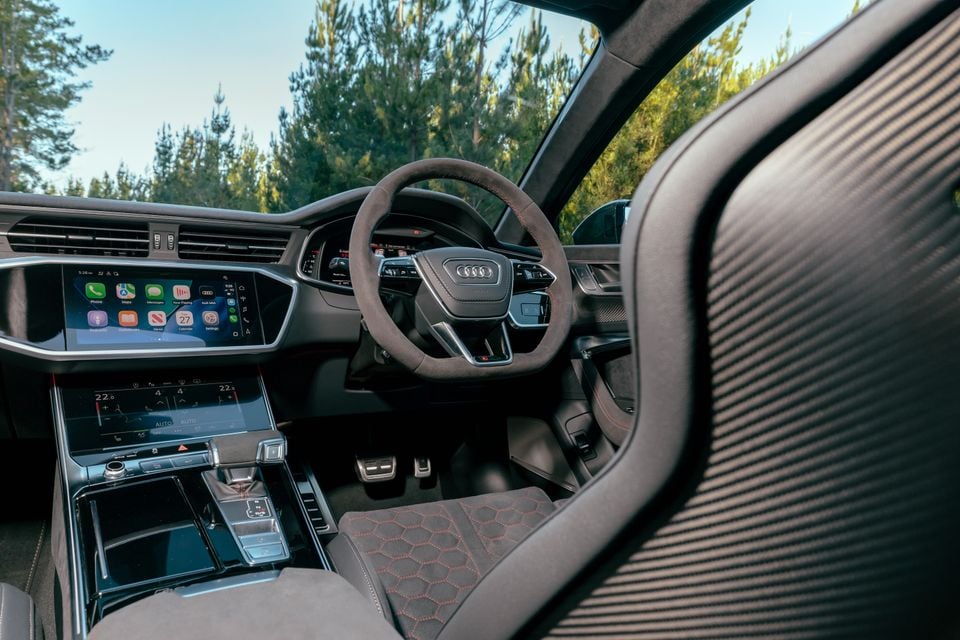
The front seats are supportive and well-bolstered, with 12-way electric adjustment and standard heating and ventilation. They held us securely through long sweeping bends and quick direction changes without feeling confining. The Alcantara-wrapped steering wheel provides excellent grip and a satisfying tactile connection, though we’d prefer it heated as standard rather than bundled into an options package.
Interior, Tech and Comfort
The RS6 Avant’s cabin is a masterclass in material quality and thoughtful design. Audi’s dual-screen MMI layout dominates the dashboard: a 10.1-inch upper touchscreen handling navigation, media and vehicle settings, and an 8.6-inch lower screen for climate control and seat functions. Ahead of the driver sits the 12.3-inch Virtual Cockpit digital instrument cluster, offering RS-specific display modes that prioritise a large central tachometer, g-force meter or lap timer depending on what you’re after. It’s one of the best digital instrument binnacles in the business — clear, configurable, and genuinely useful rather than merely decorative.
Material quality is, for the most part, outstanding. Valcona leather covers the seats with a honeycomb stitch pattern and RS embossing, while Alcantara wraps the steering wheel and parts of the dashboard. Carbon-fibre twill inserts on the centre console, door cards and dashboard add a technical, motorsport-inspired edge. The mix of textures — smooth leather, grippy Alcantara, cool carbon — gives the cabin a layered, premium feel that rewards close inspection.
The standard heated and ventilated 12-way power front seats are among the best in class. Our top pick from the options list is the Bang & Olufsen premium sound system, which adds speakers that physically extend from the dashboard when you power it on — a theatrical touch that also happens to produce genuinely excellent audio. The Executive package is the other must-have, bundling a full-colour heads-up display, soft-close doors and heated rear seats into a single reasonably-priced bundle. It turns the RS6 from a fast wagon into a proper luxury express.
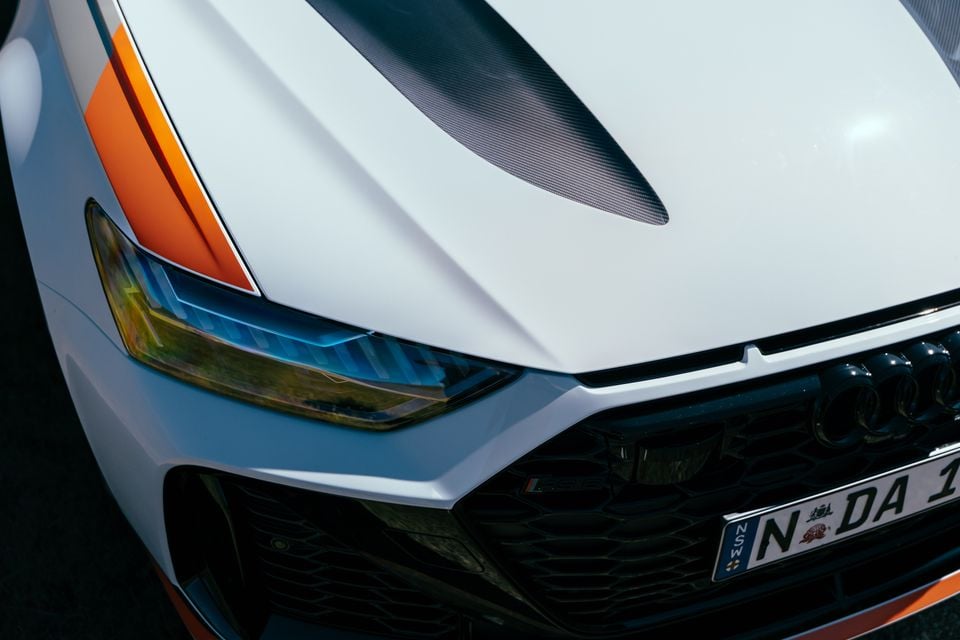
There’s one fly in the ointment, and it’s visible every time you glance at the centre of the dashboard. The air vents are finished in plain plastic — a material choice that feels cheap in a car at this price point. Every other surface, from the leather-wrapped dash top to the Alcantara knee bolsters, has been executed with care and expense. The vents stand out by contrast, and they’re the one thing we’d change if we had Audi’s ear.
Connectivity is well covered: wireless Apple CarPlay and Android Auto, Amazon Alexa integration, SiriusXM satellite radio, a wireless charging pad, two USB-C ports up front and two in the rear, and quad-zone climate control. The panoramic two-pane moonroof floods the cabin with light, and acoustic glass all round keeps the outside world at bay. It’s a modern, comfortable space that makes long-distance driving a pleasure rather than a chore.
Cargo, Practicality and Family Use
This is where the RS6 Avant makes its strongest case against performance SUVs and sedans. With the rear seats up, the boot gives you roughly 30 cubic feet of cargo space — more than the BMW M5 Touring’s 27.2 cu ft and considerably more than any performance sedan. Drop the rear seats flat and that expands to 59.3 cu ft (1,618 litres), a genuinely useful volume that’ll swallow a family’s luggage, a set of golf clubs or a large flat-pack bookcase without fuss.
The rear seats feature a 60/40 split as standard, with the more versatile 40/20/40 arrangement available for those times you need to carry long items — skis, a flat-pack wardrobe, a couple of pushchairs — while still seating two rear passengers. Audi’s included a small but welcome detail in the auto-adjusting cargo cover, which retracts automatically as the power liftgate closes, preventing the common annoyance of a cover jamming against an oversized load.
Rear passenger space is generous enough for adults. With the driver’s seat set for a six-foot-three frame, we found adequate headroom and knee room in the outboard rear positions. The centre seat is narrower and sits over a slightly raised transmission tunnel, but it’s doable for short trips — handy for school runs or quick lifts. Manual rear sun shades are a thoughtful inclusion for families with young children, and a 12-volt socket in the cargo area provides power for accessories. There are also rear LED bag holders integrated into the boot walls — a small touch that stops shopping bags sliding around during spirited driving.
At a Glance: How the RS6 Avant Stacks Up
| Spec | 2026 Audi RS6 Avant | BMW M5 Touring | Mercedes-AMG E53 Hybrid Wagon |
|---|---|---|---|
| Powertrain | 4.0L twin-turbo V8 | 4.0L twin-turbo V8 PHEV | 3.0L inline-6 turbo PHEV |
| Power | 621 hp | 717 hp (combined) | 577 hp (combined) |
| Torque | 627 lb-ft | 738 lb-ft | ~553 lb-ft |
| 0-60 mph | 3.3 s | 3.5 s | ~3.7 s |
| Curb weight | ~4,982 lb | ~5,523 lb | ~5,200 lb |
| Cargo (seats up) | 30 cu ft | 27.2 cu ft | ~24 cu ft |
| EV-only range | None | ~25 miles | 40+ miles |
| Starting MSRP | ~$130,700 | ~$123,900 | ~$90,000 |
| Annual fuel cost (EPA) | ~$3,650 | ~$2,950 | ~$2,200 |
BMW M5 Touring
541 lb heavier with more power on paper but no quicker to 60 mph
Mercedes-AMG E53 Hybrid Wagon
Inline-6 PHEV cheaper to run but trails on outright pace and presence
Porsche Panamera Turbo S E-Hybrid ST
Sharper driver’s car but tighter rear seat and far higher price
The 2026 performance wagon segment is suddenly the most competitive it has been in years. The return of the BMW M5 Touring to North America, the arrival of the Mercedes-AMG E53 Hybrid Wagon, and the continued presence of the Porsche Panamera Sport Turismo mean buyers now have real choice. The RS6 Avant stakes its claim on a combination of power, weight, cargo space and driving purity that no single rival can fully match. The key battleground is the RS6 versus the M5 Touring. The BMW packs more power and costs less at entry, but it is over 500 lb heavier, carries less cargo and cannot match the Audi’s throttle responsiveness without the V8’s electric motor doing some of the work. The Mercedes undercuts both on price and offers meaningful EV-only range, but it lacks a V8 and trails on outright performance. The Porsche is the most driver-focused of the lot, but its lower roofline and tighter rear seat make it less practical for family duty. 2026 Audi RS6 Avant Mercedes-AMG E53 Hybrid Wagon —— 4.0L twin-turbo V8 3.0L inline-6 turbo PHEV Power 717 hp (combined) 627 lb-ft ~553 lb-ft 0-60 mph 3.5 s ~4,982 lb ~5,200 lb Cargo (seats up) 27.2 cu ft None 40+ miles Starting MSRP ~$123,900 ~$3,650 ~$2,200 |
2026 Audi RS6 Avant vs BMW M5 Touring: Which Is Better?
This is the comparison every performance wagon buyer wants answered, and understandably so. The RS6 Avant and the M5 Touring are the two most closely matched fast estates on the market — both German, both running twin-turbo V8 engines, both offering all-wheel drive and seating for five. The differences between them are nuanced but real, and they’ll appeal to subtly different buyers.
Start with price, because it’s more complicated than the base MSRP suggests. The RS6 Avant starts at approximately $130,700, while the M5 Touring opens at around $123,900 — a gap of roughly $7,000 in BMW’s favour. But option them the same way — add the Executive package, the Driver Assist suite, upgraded wheels and premium audio — and the gap narrows considerably, with some configurations putting the Audi slightly cheaper on a like-for-like basis. The RS6’s pricing structure rewards buyers who want the car fully loaded.
The power-versus-weight equation is where things get interesting. The M5 Touring produces 717 combined horsepower and 738 lb-ft of torque — figures that dwarf the Audi’s 621 hp and 627 lb-ft on paper. But the BMW weighs approximately 5,523 lb, a full 541 lb more than the RS6’s 4,982 lb. That weight penalty, largely a consequence of the M5’s plug-in hybrid battery pack, erases its power advantage and then some. The RS6 hits 60 mph in 3.3 seconds; the M5 Touring needs 3.5. In our experience, the weight difference shows up constantly — in direction changes, under braking, and in the general sense of agility that colours every drive.
The powertrain character differs in ways the numbers alone don’t capture. The Audi’s 4.0-litre V8 is a conventional twin-turbo unit with no electric assistance. It delivers its power with a linearity and immediacy that recalls naturally aspirated engines — you press the throttle and the response is instant, with an uninterrupted wave of torque. The BMW’s V8 is augmented by an electric motor that fills in low-end torque and provides EV-only running, but the integration isn’t always smooth. There are moments of hesitation in the power delivery — a fraction of a second where the systems negotiate who does what — that the Audi simply doesn’t have. For a driver who values throttle response and mechanical transparency, the RS6 is the more satisfying car.
Cargo space goes to the Audi. At 30 cubic feet with the rear seats up and 59.3 cu ft with them folded, the RS6 Avant offers meaningfully more volume than the M5 Touring’s 27.2 cu ft and approximately 56 cu ft respectively. For a wagon buyer — someone who chose this body style specifically for its practicality — those extra cubic feet matter. The RS6 swallows a family’s luggage more comfortably and accommodates larger items with less Tetris.
Both interiors are superb, though they excel in different ways. The M5 Touring benefits from BMW’s latest iDrive 8.5 infotainment system, which is arguably more intuitive and visually modern than Audi’s dual-screen MMI setup. The RS6 counters with a richer material mix — the combination of Valcona leather, Alcantara and carbon-fibre twill creates a cabin that feels more special and more bespoke than the BMW’s more uniform approach. It’s a close-run thing, and personal taste will be the deciding factor.
Ride quality and daily-use visibility give the Audi a further edge. The RS6’s roughly five inches of ground clearance — modest by SUV standards but generous for a performance car — provides a commanding seating position and excellent forward sightlines. The adaptive air suspension delivers a suppler ride in Comfort mode than the M5’s adaptive dampers, and the rear-axle steering makes the Audi feel smaller and more manoeuvrable in tight spaces. On a daily commute through mixed urban and highway conditions, the RS6 is the easier car to live with.
Here’s how we see it: these two cars reward different priorities. **The buyer who picks the RS6 Avant** values driving purity, lighter weight, more cargo space and the visceral connection of a conventional petrol V8. They want a performance wagon that feels like a driver’s car first and a technology showcase second. **The buyer who picks the M5 Touring** wants maximum headline power, the ability to commute on electric-only running, lower annual fuel costs and a slightly more accessible entry price. They’re comfortable with the weight penalty in exchange for the PHEV’s broader versatility.
| Spec | 2026 Audi RS6 Avant | 2026 BMW M5 Touring |
|---|---|---|
| Engine | 4.0L twin-turbo V8 | 4.0L twin-turbo V8 PHEV |
| Power | 621 hp | 717 hp |
| Torque | 627 lb-ft | 738 lb-ft |
| 0-60 mph | 3.3 s | 3.5 s |
| Curb weight | ~4,982 lb | ~5,523 lb |
| Cargo seats up | 30 cu ft | 27.2 cu ft |
| EV-only range | None | ~25 miles |
| Starting MSRP | $130,700 | $123,900 |
| Annual fuel cost | ~$3,650 | ~$2,950 |
Which one is better?
Buy the RS6 Avant if you want a pure-petrol V8 wagon, a lighter feel, more cargo space and better daily-use visibility, and you can live with the fuel bill.
Buy the M5 Touring if you want maximum bragging-rights power, EV-only running for the commute, lower annual fuel costs and a slightly cheaper entry price.
Our pick is the RS6 Avant — its lighter chassis, naturally aspirated-feel V8 throttle response and the way it shrinks around the driver edge it ahead for buyers who treat a performance wagon as a driver’s car first.
Safety and Warranty
As a low-volume performance halo car, the 2026 Audi RS6 Avant hasn’t been separately crash-tested by either NHTSA or IIHS. That’s not unusual for vehicles in this price bracket. The standard A6 Avant, on which the RS6 is based, has historically performed well in Euro NCAP testing, and the underlying platform structure is sound.
Standard active safety kit covers all the bases. The RS6 Avant includes automatic emergency braking, blind-spot monitoring, lane-keep assist, adaptive cruise control and a 360-degree top-view camera system. During our testing, the adaptive cruise and lane-keep systems worked together for roughly 2.3 miles between required driver re-engagement on well-marked highways — a figure that places it among the better semi-autonomous systems in the segment. It’s not hands-free driving, but it meaningfully reduces fatigue on long trips.
Audi’s warranty coverage is straightforward and competitive: four years or 50,000 miles of bumper-to-bumper protection, including the powertrain, with no mileage deduction for the powertrain component. Corrosion protection extends to 12 years with unlimited mileage — an industry-leading figure that reflects Audi’s confidence in its body panel treatments and underbody coatings. For a car that’ll likely see year-round use, that corrosion warranty provides genuine peace of mind.
Should You Buy It? Buy / Skip Block
**Buy it if** you want one of the last great pure-petrol performance wagons, you cover real distance, and you want a car that handles family duty Monday-to-Friday and a track day on Saturday without compromise.
**Skip it if** you can’t justify a $146k as-tested price tag, want EV-only running for the commute, or live where the M5 Touring’s slightly lower MSRP and PHEV efficiency would save you thousands per year.
⚡ Our Verdict
Final Take
The 2026 Audi RS6 Avant Performance earns its 8.9 out of 10 rating by excelling at the things that matter most in a performance wagon: straight-line speed, driving engagement, cargo practicality and daily comfort. Its 621-hp twin-turbo V8 is a masterpiece of responsiveness and character. Its sub-5,000-lb kerb weight gives it an agility advantage that no PHEV rival can match. And its 59.3 cu ft of cargo space makes it a genuine family car that happens to hit 60 mph in 3.3 seconds. It’s not cheap to buy or to run, and the absence of any electrified powertrain will be a dealbreaker for some. But for the buyer who wants the purest, most engaging performance wagon on the market, the RS6 Avant stands alone. Looking ahead, the RS6 Avant’s pure-V8 character makes it something of a swan song. As Audi’s RS division moves towards electrified powertrains — the next-generation RS models are expected to feature plug-in hybrid and eventually fully electric architectures — this car represents the peak of a particular kind of performance car. It’ll be remembered. For now, it remains the best of its kind, and we wouldn’t hesitate to recommend it to anyone who values the combination of pace and practicality that only a great petrol-powered wagon can deliver.
FAQ
How much is the 2026 Audi RS6 Avant Performance?
The 2026 RS6 Avant starts at approximately $130,700 in the US market. Tick the Executive package, Driver Assist suite, upgraded wheels and premium audio, and a well-equipped example lands closer to $140,000–$146,000. Our test car, finished in Nardo Grey with the full suite of options, came in at roughly $146,000.
Is the 2026 Audi RS6 Avant faster than the BMW M5 Touring?
Yes. Despite the M5 Touring producing 717 combined horsepower against the RS6’s 621 hp, the Audi reaches 60 mph in 3.3 seconds — two-tenths quicker than the BMW’s claimed 3.5-second sprint. The main reason is weight: the RS6 weighs approximately 540 lb less than the M5 Touring, and that mass advantage more than makes up for the power deficit in a standing-start acceleration test.
What is the cargo capacity of the 2026 Audi RS6 Avant?
With the rear seats in place, the RS6 Avant offers approximately 30 cubic feet of cargo space. Fold the 60/40-split rear seats flat and the capacity grows to 59.3 cubic feet, or 1,618 litres. Both figures beat the BMW M5 Touring and the Mercedes-AMG E53 Hybrid Wagon.
Does the 2026 Audi RS6 Avant come as a plug-in hybrid?
No. The RS6 Avant is powered exclusively by a 4.0-litre twin-turbo V8 paired with a conventional eight-speed automatic transmission and quattro all-wheel drive. There’s no plug-in hybrid, mild-hybrid or electric-only running mode. If EV-only commuting matters to you, the BMW M5 Touring and Mercedes-AMG E53 Hybrid Wagon both offer plug-in hybrid powertrains.
What fuel economy does the 2026 Audi RS6 Avant get?
The EPA rates the 2026 RS6 Avant at 14 mpg in the city and 21 mpg on the highway. Estimated annual fuel cost is approximately $3,650 based on 15,000 miles of mixed driving at current US fuel prices. Those figures are competitive for a 621-hp V8 wagon but significantly higher than plug-in hybrid rivals like the M5 Touring (~$2,950/yr) and the AMG E53 (~$2,200/yr).
What is included in the Executive Package on the RS6 Avant?
The Executive Package adds a full-colour heads-up display projected onto the windscreen, soft-close doors that pull themselves shut from the final latch position, and heated rear seats for outboard passengers. It also typically includes a power rear sunshade. At its asking price, it’s one of the best-value option bundles on the RS6 and we’d consider it essential for any buyer planning to use the car daily.
What is the warranty on the 2026 Audi RS6 Avant?
Audi provides four years or 50,000 miles of bumper-to-bumper warranty coverage, which includes the powertrain with no separate mileage limit. Corrosion protection extends to 12 years with unlimited mileage. This coverage is competitive with BMW and Mercedes-Benz and offers strong long-term peace of mind for a car likely to see year-round use. — *This review draws on hands-on observations and independent publications. Specifications, pricing and measured performance figures have been verified against official manufacturer data and third-party testing sources.*
