

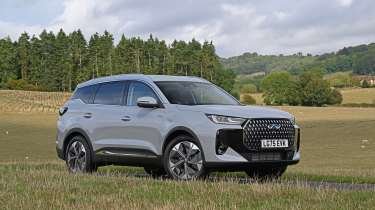
Chery Tiggo 7 PHEV 2026 Review – Britain’s Cheapest Plug-In SUV
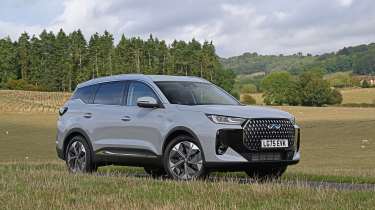
2026 Chery Tiggo 7 PHEV front three-quarter exterior shot
Price
£29,995
Battery
18.4 kWh
Combined power
201 hp
⚡ Quick Verdict
:** You can walk into a Chery dealer today and drive away in a plug-in hybrid SUV for under thirty thousand pounds. That alone is worth pausing over. The Tiggo 7 PHEV bundles a five-star Euro NCAP score, 56 miles of claimed electric range, DC fast-charging that most PHEVs simply don’t offer and a seven-year warranty — all for £29,995. On paper, it’s astonishing value. In reality, the driving experience lets the package down. The steering is vague, the throttle pedal delivers different amounts of shove depending on its mood and the ride fidgets on the sort of broken tarmac you’ll find on any British B-road. If you’re after the most kit per pound and couldn’t care less about cornering feel, the Tiggo 7 is a smart buy. If you want your family SUV to feel properly sorted when you thread it through a roundabout, the MG HS PHEV or BYD Sealion 6 deserve a look first.
—
✓ The Good
- +Cheapest plug-in hybrid SUV on sale in the UK at £29,995, undercutting every major rival.
- +Genuine 56-mile electric range backed by rare 40 kW DC fast-charging support.
- +Seven-year / 100,000-mile warranty with eight years of battery cover is class-leading.
- +Strong Euro NCAP five-star safety rating with a comprehensive suite of standard ADAS.
- +Practical 480-litre boot and genuinely usable rear cabin with a flat floor.
- +50 W wireless phone charger with active cooling is a standout standard feature.
✗ The Trade-offs
- −Vague, lifeless steering and unpredictable throttle response spoil the driving experience.
- −Noticeable body roll through corners and a jiggly low-speed ride over imperfect surfaces.
- −Several build-quality niggles including uneven panel gaps and a boot lid that shudders.
- −Central touchscreen suffers from input lag and sits awkwardly far from shorter drivers.
- −Only white is included as standard; all other body colours cost extra.
- −Tiny rear-wiper sweep severely compromises rearward visibility in wet weather.
- −—
- −—
📑 In This Review
- Design and Exterior Styling
- Cabin Quality and Interior Tech
- Powertrain and Performance
- Electric Range and Charging
- Ride and Handling
- Practicality and Boot Space
- Chery Tiggo 7 vs BYD Sealion 6: Which Is Better?
- How It Stacks Up Against Other Rivals
- Safety, Warranty and Running Costs
- Verdict and Who Should Buy
- BUY IF:
- SKIP IF:
The Chery Tiggo 7 PHEV arrives in the UK with one job: to be the cheapest plug-in hybrid SUV you can buy. At £29,995 it undercuts every direct rival, including the BYD Sealion 6, the MG HS PHEV and even the mechanically related Jaecoo 7. It backs that price tag with a 56-mile claimed electric range, 40 kW DC fast-charging support and a seven-year warranty — figures that would be impressive at ten thousand pounds more. We spent several days with the car on British roads to find out whether the substance matches the specification.
Design and Exterior Styling
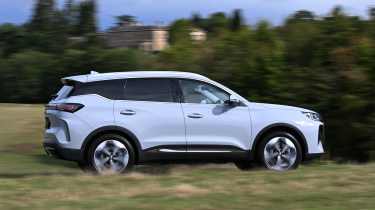
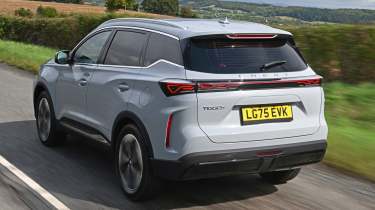
The Tiggo 7 won’t offend anyone, though it probably won’t excite them either. There’s a large chrome-effect grille up front, flanked by slim LED headlamps, giving it the kind of generic crossover face you’d struggle to pick out of a line-up of Far Eastern SUVs. The proportions are tidy enough — a gently rising shoulder line, a modestly raked rear screen and a sensible amount of black cladding around the wheel arches to signal crossover intent without going full off-road cosplay.
Look more closely and the details start to falter. The badge on the bonnet is vinyl-wrapped rather than a proper moulded emblem, and we’d be worried about it peeling after a couple of British winters. The tail-light surround on both sides of our test car had an unfinished panel gap that caught the light in an unflattering way. Only white comes as standard; every other colour — the deep metallic blues and silvers most buyers will actually want — adds to the bill. For a car that trades so heavily on value, that stings.
Park the Tiggo 7 on a driveway and it looks perfectly inoffensive. It avoids the over-styled fussiness some rivals suffer from. But it also lacks the visual confidence that’d make a neighbour lean over the fence and ask what you’re driving. The mechanically related Jaecoo 7 wears the same platform far more convincingly, so if kerb appeal matters to you, it’s worth cross-shopping within the Chery family.
Cabin Quality and Interior Tech
Step inside and the Tiggo 7 pulls off its first real surprise: this cabin feels considerably more expensive than the price tag has any right to expect. The dashboard is trimmed in soft-touch materials with convincing stitching, the switchgear operates with a damped heft that wouldn’t feel out of place in something costing ten grand more and we didn’t detect a single creak or rattle over several days of testing. For a brand that’s only recently landed in the UK, the interior execution is genuinely impressive.
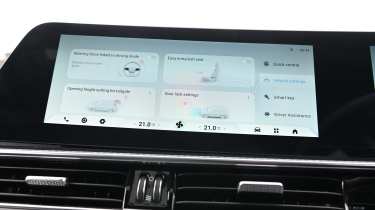
Twin 12.3-inch screens dominate the fascia — one configurable driver display, the other handling infotainment duties. Wireless Apple CarPlay and widescreen Android Auto are both standard, which is welcome, though the central screen suffers from noticeable input lag. Scrolling through menus or pinch-zooming the map produces a visible hesitation that gets under your skin quickly. The screen is also mounted a fraction too far from the driver, which means shorter occupants will find themselves leaning forward to jab at it.
Elsewhere the specification is generous. A 50 W wireless phone charger with active cooling keeps your handset topped up without cooking it, the 540-degree transparent-view camera with a 3D mode takes the stress out of tight car parks and a blind-spot camera feed pops up in the instrument cluster whenever you signal — a trick borrowed from cars costing twice as much. We were particularly grateful for the single swipe-down menu that lets you disable the more irritating driver-assistance warnings — lane-keeping, speed-sign chimes, attention alert — in one go, rather than wading through submenus.
A small but welcome detail: there’s a takeaway-bag hook in the front cubby. Every family driver will use it more than they’d care to admit.
Powertrain and Performance
The Tiggo 7 PHEV pairs a 1.5-litre turbocharged petrol engine with an electric motor for a combined 201 hp and 365 Nm, channelled through a bespoke three-speed PHEV automatic gearbox. The official 0–62 mph time is 8.5 seconds, but during our testing the car recorded 7.35 seconds to 60 mph — comfortably quicker than the claimed figure and more than enough for safe overtakes on single-carriageway A-roads.
Where the powertrain falls short isn’t outright pace but throttle calibration. The same pedal travel can produce noticeably different amounts of acceleration depending on the battery’s state of charge, which drive mode you’ve selected and how the hybrid system is blending petrol and electric power at that precise moment. The result is that smooth progress in traffic is surprisingly hard work. You learn to feather the accelerator, but the inconsistency never fully goes away and it chips away at your confidence in situations that demand precision — pulling out of a junction, say, or merging onto a busy motorway slip road.
The three-speed gearbox is a clever bit of engineering that keeps the engine in its most efficient operating range, and the transitions between electric and petrol power are acceptably smooth most of the time. There’s occasional low-speed shuffling between ratios that you’ll notice, but it’s no worse than the dual-clutch hesitation you’d get in some European rivals. At a kerb weight of 1,795 kg the Tiggo 7 is no lightweight, yet it never feels sluggish. Just occasionally indecisive.
Electric Range and Charging
This is one of the Tiggo 7 PHEV’s strongest cards. The 18.4 kWh battery delivers a claimed 56 miles of pure-electric range on the WLTP cycle, which in real-world mixed driving we’d estimate at somewhere between 40 and 48 miles depending on temperature and how you drive. That’s enough to cover the average UK daily commute — officially 20 miles each way — entirely on electricity.
More unusually for a plug-in hybrid, the Tiggo 7 supports 40 kW DC fast charging. Most PHEV rivals are limited to AC charging, which means a full top-up on a home wallbox takes several hours. Here, a 30-to-80 per cent session at a DC rapid charger takes roughly 20 to 30 minutes, making top-ups on a longer journey genuinely practical. It’s a feature that could reshape the ownership experience for buyers without home charging — a growing demographic in the UK — and we reckon it’s a significant competitive advantage.
The claimed combined fuel economy of 235 mpg WLTP should be taken with a very large pinch of salt, as with all PHEV headline figures. Keep the battery topped up and drive mostly on short urban trips and you could realistically nudge three-figure mpg. Let the battery drain and you’re left with a 1.5-litre turbo SUV returning somewhere in the mid-thirties to low forties per gallon — perfectly acceptable, but nothing remarkable.
Ride and Handling
This is where the Tiggo 7 PHEV reveals the widest gap between its impressive spec sheet and the experience of actually driving it. The steering is the most obvious issue: it offers the same level of resistance regardless of how much lock you wind on, which means there’s virtually no communication about what the front tyres are up to. Navigating a multi-storey car park or threading through a village high street, you’re relying on visual cues alone rather than any feedback through the rim.
Body roll is pronounced in corners, which isn’t unusual for a family SUV carrying nearly 1,800 kg, but paired with the dead steering it makes the Tiggo 7 feel less composed than rivals such as the MG HS PHEV. The ride fidgets over low-frequency undulations and expansion joints, though it avoids crashing into potholes, suggesting the spring and damper rates aren’t fundamentally wrong — just not sorted well enough for the variety of surfaces British roads throw at you.
On a positive note, emergency braking performance is strong. We recorded a 60-to-0 mph stopping distance of 34 metres, comfortably within the target benchmark, which gives reassurance that the fundamentals — tyres and brakes — are competent even if the chassis tuning needs more work. For buyers who spend most of their time on motorways and A-roads in a straight line, the Tiggo 7 is perfectly pleasant. For anyone who values driver engagement on a country lane, it’ll disappoint.
Practicality and Boot Space
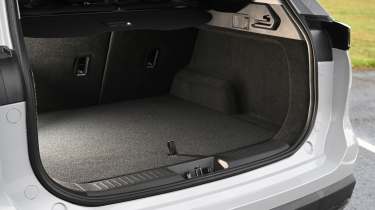
The Tiggo 7 PHEV offers 480 litres of boot space — 90 litres fewer than the petrol model’s 570 litres, a penalty imposed by the battery pack beneath the floor. Fold the rear seats and maximum capacity rises to 1,672 litres, which is competitive for the class and enough for a family’s holiday luggage or a bulky pushchair plus the weekly shop. One practical irritation: the boot opening is relatively low, and taller adults will clout their heads on the trailing edge if they’re not careful — an annoyance that becomes habitual after the third or fourth bruise.
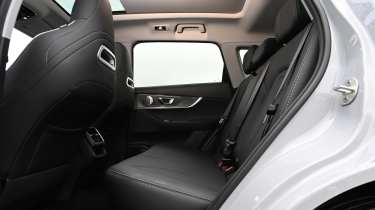
The rear cabin is a genuinely pleasant place to sit. Headroom and knee room are generous even for adults above average height, and the completely flat floor means three-abreast seating on short trips is feasible without the middle passenger straddling a transmission tunnel. The only rear-cabin omission is USB-A ports only — no USB-C — which will frustrate families trying to charge newer devices. Up front, large door bins, twin cupholders, a decent glovebox and that previously mentioned takeaway-bag hook provide ample everyday storage.
Chery Tiggo 7 vs BYD Sealion 6: Which Is Better?
These two Chinese plug-in hybrid SUVs are the most obvious rivals in the segment, so your decision will come down to priorities. On price, the Tiggo 7 wins clearly. Its PHEV range starts at £29,995 — the cheapest plug-in hybrid SUV currently on sale in the UK — while the BYD Sealion 6 DM-i opens at around £32,990. Through CarWow, average discounts of roughly £3,000 bring the Chery closer to £27,000, widening the gap further. For budget-conscious family buyers, that difference is significant.
Performance is broadly similar. Both use a 1.5-litre turbocharged engine paired with an electric motor, both claim 8.5 seconds to 62 mph and both produce combined outputs in the low-200s horsepower. The Tiggo 7 edges the BYD on boot space — 480 litres versus 425 litres — and its 40 kW DC fast-charging capability eclipses the Sealion 6’s 18 kW, making rapid top-ups during longer journeys substantially quicker. The BYD counters with a larger battery option (up to 26.6 kWh) and a claimed electric range stretching to 80 miles, versus the Chery’s 56 miles. For drivers who cover longer electric-only commutes, the BYD will stay in EV mode for considerably longer between charges.
On the road, the BYD is the more polished machine. Its steering offers more progressive weighting, its ride is better controlled over broken surfaces and its throttle response is more predictable. The Tiggo 7’s vague steering and inconsistent accelerator mapping are noticeable back-to-back. Inside, both cabins are well-equipped, but the Chery’s twin 12.3-inch screens feel more contemporary than the BYD’s rotating central display, though the BYD’s system is more responsive. Build quality is comparable — both have minor niggles — but the Chery’s seven-year warranty adds an extra year of peace of mind over the BYD’s six-year unlimited-mileage cover.
In summary, these are closely matched cars that excel in different areas. The Tiggo 7 is the value king and the more practical choice for boot-heavy family duties; the Sealion 6 is the more complete car to drive and the better option for longer EV commuting.
| Spec | Chery Tiggo 7 PHEV | BYD Sealion 6 DM-i |
|---|---|---|
| Starting price (PHEV) | £29,995 | £32,990 |
| Combined power | 201 hp | 215 hp |
| 0–62 mph | 8.5 s claimed | 8.5 s |
| Electric range | 56 miles | 65–80 miles |
| Battery | 18.4 kWh | 18.3 kWh |
| DC charging | 40 kW | 18 kW |
| Boot | 480 L | 425 L |
| Warranty | 7 yr / 100k mi | 6 yr unlimited |
| Euro NCAP | 5 star (2025) | 5 star (2024) |
> **Buy the Chery Tiggo 7 if** value is your number-one priority and you want the longest warranty cushion at the lowest entry price. > **Buy the BYD Sealion 6 if** you do more long electric commutes — that bigger battery and longer EV range stretch further between plug-ins. > **Our pick** is the Chery for buyers under £30,000 and the BYD if you can stretch £3,000 further.
How It Stacks Up Against Other Rivals
The Tiggo 7 PHEV doesn’t exist in a vacuum. The Chinese plug-in hybrid SUV market in the UK is getting crowded, and there are several credible alternatives worth considering. The MG HS PHEV is the most dynamic of the group, reaching 62 mph in just 6.8 seconds and offering a 507-litre boot, but it starts at £31,995 and lacks the Tiggo’s DC fast-charging capability. The mechanically related Jaecoo 7 PHEV shares the same platform, powertrain and 56-mile electric range but wraps it in considerably more attractive bodywork — if you like what the Tiggo 7 offers but wish it looked smarter, the Jaecoo is the obvious answer at around £30,995.
The Geely Starray PHEV is a newer entrant with a claimed 50-mile EV range and roughly 195 hp, positioned at approximately £31,500. It rides on a more modern chassis architecture, but Geely’s UK warranty and after-sales network are less proven than Chery’s. Finally, the Kia Sportage 1.6T PHEV remains the benchmark for chassis polish and interior quality in the broader plug-in SUV class, but at £41,295 it costs nearly a third more than the Tiggo 7 — a different purchase entirely.
| Rival | From | EV Range | Power | Verdict vs Tiggo 7 |
|---|---|---|---|---|
| MG HS PHEV | £31,995 | 75 miles | 220 hp | Faster and bigger boot, but pricier and AC-only charging |
| Jaecoo 7 PHEV | £30,995 | 56 miles | 201 hp | Same bones, prettier styling — worth the £1,000 premium |
| Geely Starray PHEV | £31,500 | 50 miles | 195 mph | Newer chassis, less proven warranty and dealer network |
| Kia Sportage 1.6T PHEV | £41,295 | 43 miles | 252 hp | More polished but 30 per cent more expensive |
Safety, Warranty and Running Costs
The Tiggo 7 earned a full five-star Euro NCAP rating under the stringent 2025 testing protocol: 82 per cent for adult occupant protection, 85 per cent for child occupants, 80 per cent for vulnerable road users and 78 per cent for safety assist. Standard safety equipment includes autonomous emergency braking, emergency lane keeping, front collision warning, integrated cruise assist and the 540-degree transparent-view camera system. For family buyers, those are reassuring numbers.
The warranty package is one of the strongest arguments for choosing the Tiggo 7 over its rivals. A seven-year or 100,000-mile vehicle warranty leads the class, and the PHEV battery carries an eight-year guarantee. Seven years of RAC roadside assistance is included provided the car is serviced annually through the dealer network — a condition worth noting but hardly onerous. BYD offers six years with unlimited mileage; MG offers seven years and 80,000 miles.
Running costs will depend heavily on how you use the car. Keep the battery charged and the Tiggo 7 will cover most daily commutes on electricity alone, reducing fuel expenditure to near zero. Insurance groupings and servicing costs haven’t yet been confirmed for 2026, but early indications suggest they’ll be competitive with other Chinese-market entrants. One budgeting consideration: the standard white paint is the only no-cost colour, so factor in a few hundred pounds for a shade you’ll actually want.
Verdict and Who Should Buy
The 2026 Chery Tiggo 7 PHEV does the big things well and the small things inconsistently. On the objective measures that matter most to family SUV buyers — price, electric range, warranty, safety rating and interior space — it scores strongly. At £29,995 it’s the cheapest plug-in hybrid SUV you can buy in Britain, and the 40 kW DC fast-charging capability gives it a practical edge that most rivals simply can’t match. The seven-year warranty provides a cushion of reassurance that’s particularly valuable for a brand still establishing its reputation here.
The weaknesses are real but mostly confined to the driving experience and minor build-quality details. The vague steering, unpredictable throttle mapping and jiggly ride will frustrate buyers who enjoy driving, while the uneven panel gaps and noisy window motors suggest the production process hasn’t yet reached the consistency of more established manufacturers. These are the areas where the extra money you’d spend on a BYD Sealion 6 or MG HS PHEV buys a tangibly better product.
For families who prioritise specification per pound spent and plan to run the car primarily on electric power for short daily journeys, the Tiggo 7 PHEV is a genuinely smart buy. We award it 3.6 out of 5 — a strong value proposition held back by dynamic polish that still needs work.
—
BUY IF:
– You want the cheapest plug-in hybrid SUV available in the UK and refuse to pay more than £30,000. – You value a long warranty and want seven years of coverage backed by roadside assistance. – You need DC fast-charging capability because you lack a home wallbox. – You prioritise interior specification — wireless CarPlay, a 540-degree camera and a heated-cooled phone charger — over driving dynamics.
SKIP IF:
– You care about steering feel, throttle precision and a composed ride on British B-roads. – You need a larger boot — the MG HS PHEV offers 507 litres to the Tiggo’s 480. – You want more than 56 miles of electric range for a longer daily commute. – You are bothered by minor build-quality imperfections and want showroom-perfect shut lines from day one.
—
**VERDICT:** The Chery Tiggo 7 PHEV makes an audacious pitch: more kit, more warranty and more electric range than anything else at this price. It largely delivers on that promise, and for buyers who treat a family SUV as a tool rather than a source of driving pleasure, it represents outstanding value. The 40 kW DC charging, five-star safety rating and seven-year warranty are genuine differentiators. However, the vague steering, inconsistent throttle calibration and several build-quality niggles prevent it from being a confident recommendation to anyone who enjoys the act of driving. At this price, compromises are inevitable — the question is whether you can live with the Tiggo 7’s specific trade-offs. For the right buyer, the answer is a qualified yes.
—
FAQ
What is the real-world electric range of the Chery Tiggo 7 PHEV?
The claimed WLTP figure is 56 miles. In real-world mixed driving, expect somewhere between 40 and 48 miles depending on ambient temperature, speed and driving style — still enough to cover most UK daily commutes on electricity alone.
Does the Chery Tiggo 7 PHEV support DC fast charging?
Yes, and it’s one of the car’s standout features. It supports 40 kW DC fast charging, which is highly unusual for a plug-in hybrid. A 30-to-80 per cent top-up takes approximately 20 to 30 minutes at a compatible rapid charger.
How long is the warranty on the Tiggo 7 PHEV?
The vehicle warranty runs for seven years or 100,000 miles, whichever comes first, and the PHEV battery is covered for eight years. Seven years of RAC roadside assistance is included provided the car is serviced annually at a Chery dealer.
What real-world fuel economy should I expect?
If you charge the battery regularly and drive short distances, it’s possible to approach three-figure mpg. Once the battery is depleted and you’re running on the 1.5-litre turbo engine alone, expect mid-thirties to low-forties mpg in mixed driving — perfectly normal for a car of this size and weight.
How does the Tiggo 7 PHEV’s price compare to its rivals?
At £29,995 it’s the cheapest plug-in hybrid SUV on sale in the UK. The BYD Sealion 6 DM-i starts at £32,990, the MG HS PHEV at £31,995 and the Jaecoo 7 PHEV at £30,995. Through CarWow, average discounts of around £3,000 can bring the Tiggo 7’s effective price closer to £27,000.
Should I wait for the Chery Tiggo 8 PHEV instead?
The Tiggo 8 is a larger, seven-seat SUV that will sit above the Tiggo 7 in Chery’s range and is expected to cost more. If you need the extra space and third row it’ll be worth waiting for, but if a five-seat family SUV meets your needs the Tiggo 7 is available now at a lower price point.
Are there build-quality concerns with the Chery Tiggo 7?
During our testing we noted several minor issues: trim around the boot that doesn’t sit flush, an unfinished panel gap near the tail lights, a boot lid that shudders when the rear door is shut and audibly noisy electric window motors. The overall cabin quality is good, but exterior fit-and-finish isn’t yet at the level of more established rivals.
