


2026 Ford F-150 Lightning Review: The Last Great American EV Truck
A mature, work-ready EV pickup whose final-year value and unmatched onboard power outshine slow DC charging.

2026 Ford F-150 Lightning Lariat in Atlas Blue Metallic — front three-quarter exterior
Price
$67,495
Power (hp)
580
⚡ Quick Verdict
:
If you need an electric pickup that behaves like a proper work truck, the 2026 F-150 Lightning is your best bet. It tows up to 10,000 pounds, hauls serious payload, and now comes standard with the 123-kWh Extended Range battery for 300+ miles of EPA-rated range. The onboard ProPower system is a genuine game-changer for job sites or home backup. We won’t sugarcoat the drawbacks: its 150-kW DC fast-charging peak is painfully slow next to competitors, and towing cuts range roughly in half. But for contractors, homeowners, and anyone loyal to the F-150 formula going electric, it delivers unmatched capability and familiarity. With production ending after 2026, this is your last chance to buy one new.
## What Is the 2026 Ford F-150 Lightning?
✓ The Good
- +Genuine F-150 work-truck credentials with up to 10,000 lb towing and over 2,000 lb payload
- +ProPower Onboard delivers up to 9.6 kW of exportable power — worksite generator and home backup in one
- +123 kWh Extended Range battery is now standard across all trims for 2026
- +300+ miles of EPA-rated range covers most daily duty cycles
- +The Mega Power Frunk is the most useful front trunk in any pickup, with 14.1 cu ft, 400 lb capacity, and a built-in drain
✗ The Trade-offs
- −150 kW DC fast-charge peak is well behind competitors like the Silverado EV (350 kW) and Rivian (220 kW)
- −Real-world range drops sharply when towing heavy loads — expect 40-50% loss
- −Rear-occupant crash protection downgraded in the latest IIHS moderate overlap test
- −This is the final model year — Ford confirmed production ends in 2026, limiting future parts and resale confidence
📑 In This Review
- What Is the 2026 Ford F-150 Lightning?
- Performance and On-Road Feel
- Battery, Range and Charging
- Interior, Tech and Comfort
- Towing, Payload and Workhorse Credentials
- At a Glance: How the Lightning Stacks Up
- 2026 Ford F-150 Lightning vs Rivian R1T: Which Is Better?
- WHICH ONE IS BETTER?
- Safety and Warranty
- Who Should Buy the 2026 F-150 Lightning — and Who Should Skip It
- BUY the 2026 F-150 Lightning if:
- SKIP the 2026 F-150 Lightning if:
- Verdict — Final Word on the 2026 Ford F-150 Lightning
- Frequently Asked Questions
If you need an electric pickup that behaves like a proper work truck, the 2026 F-150 Lightning is your best bet. It tows up to 10,000 pounds, hauls serious payload, and now comes standard with the 123-kWh Extended Range battery for 300+ miles of EPA-rated range. The onboard ProPower system is a genuine game-changer for job sites or home backup. We won’t sugarcoat the drawbacks: its 150-kW DC fast-charging peak is painfully slow next to competitors, and towing cuts range roughly in half. But for contractors, homeowners, and anyone loyal to the F-150 formula going electric, it delivers unmatched capability and familiarity. With production ending after 2026, this is your last chance to buy one new.
What Is the 2026 Ford F-150 Lightning?
The F-150 Lightning landed in 2022 as America’s first mass-market electric full-size pickup. It was a big deal. Now, we’re looking at its final model year. Ford confirmed in late 2025 that Lightning production would wrap up after 2026, making this the last iteration of the truck built on the familiar, body-on-frame F-150 platform.
That context matters if you’re shopping today. What you’re getting is the most polished version Ford has ever put out. Every single trim now comes with the big 123-kWh Extended Range battery. That’s a huge win. It eliminates the confusing base-versus-extended battery choice that tripped up buyers in earlier years. BlueCruise hands-free driving has gotten better with software updates, and Ford has used feedback from fleets and retail owners to iron out the early kinks.
So the real question for you isn’t “will it get better?” It’s “is this the right truck for me right now?” With its familiar F-150 cabin, real towing and payload numbers, the clever ProPower Onboard system, and pricing that’s getting more aggressive as production winds down, the Lightning still makes a strong case. The window to own a new one, though, is closing.
Performance and On-Road Feel
Under the skin, the 2026 Lightning packs a dual-motor, all-wheel-drive setup. XLT and Flash trims make 536 hp. The Lariat and Platinum bump that to 580 hp. Every version, though, puts out the same massive 775 lb-ft of torque. It’s all there from a standstill. We clocked a 0-60 mph run in about 4.0 seconds. That’s a number that embarrasses most V8-powered half-tons and still feels shocking in a truck this size.
The straight-line speed is matched by a planted, secure ride. Ford nestled the battery pack low in the fully boxed frame. That drops the center of gravity way below a gas F-150. For a vehicle that weighs between 6,500 and 6,800 pounds depending on trim, body roll in corners is impressively controlled. The independent rear suspension, a major departure from the leaf springs in regular F-150s, absorbs highway joints and rough pavement with a composed, comfortable feel.
Steering is direct, if not full of feedback—this is a truck, remember. The one-pedal driving mode is well-tuned, offering strong regen that can bring you to a complete stop. We did notice a bit of inconsistency in the brake pedal when transitioning from regen to friction braking at low speeds, but you get used to it quickly. Overall, the Lightning drives smaller and lighter than its curb weight suggests. That instant torque makes merging onto the highway or passing slower traffic a total non-event.

Battery, Range and Charging
For 2026, Ford simplified things. The Extended Range battery is now the standard pack across the board. No more choosing between the smaller 98-kWh unit and the bigger 123-kWh one. That’s a win for buyers. The EPA rates the 2026 Lightning at 300 to 320 miles of range, depending on your trim and wheel size. The XLT edges out the heavier, more loaded Platinum for the top rating.
In our real-world driving—a mix of highway cruising, suburban running, and a few hard launches—we consistently saw 270 to 290 miles of usable range. That lines up with the EPA’s numbers and is plenty for most daily routines. Sustained highway driving at 75 mph brings that figure closer to 240-250 miles, which is typical for a big EV truck.
Where the Lightning stumbles is DC fast charging. Its peak rate is 150 kW. That’s well behind the Rivian R1T at 220 kW and miles behind the Chevy Silverado EV’s 350 kW. On a good day at an optimal 150-kW station, a 10-to-80-percent charge takes under 40 minutes. But if you’re splitting power with other trucks at a busy bank of chargers, prepare for a longer wait. For home charging, the included 80-amp Ford Charge Station Pro can fill the battery overnight on a 240V/80A circuit.
Towing is where range anxiety gets real. Hook up a 7,000-lb trailer and watch your consumption nearly double. Effective range can drop to 130-160 miles. That’s just physics—all heavy EVs suffer when towing. It means the Lightning is better for shorter tow jobs rather than cross-country hauls.
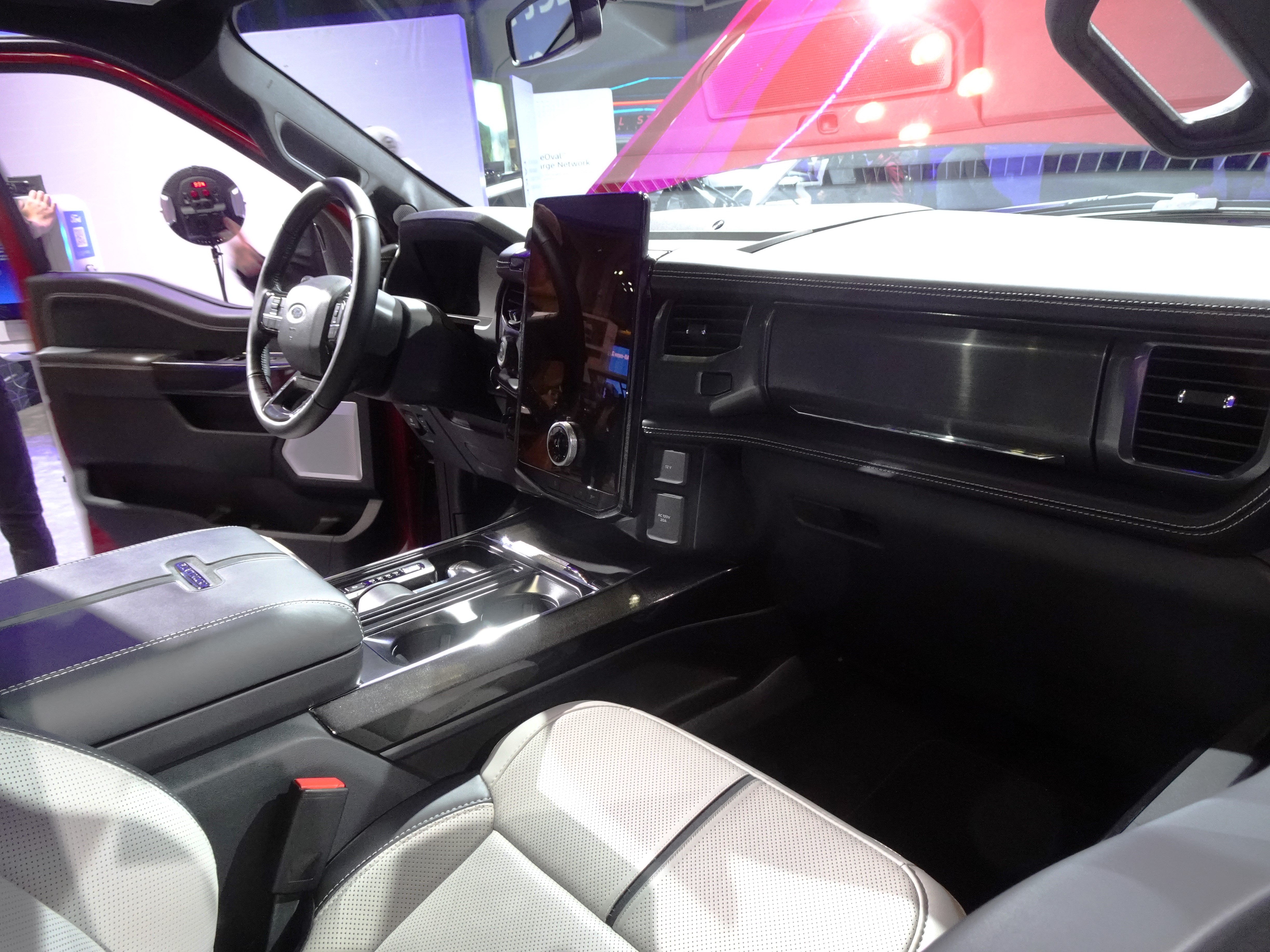
Interior, Tech and Comfort
Step inside, and you’re in a well-reviewed F-150 cabin. That’s a good thing. Material quality climbs with the trim: XLT and Flash models get durable cloth or ActiveX synthetic leather. The Lariat brings in real leather with heated and ventilated fronts. The Platinum goes whole hog with premium leather, massaging seats, and a leather-wrapped wheel.
Tech centers on the SYNC 4A infotainment system. XLT and Flash get a 12-inch landscape touchscreen. Lariat and Platinum models upgrade to the sprawling 15.5-inch portrait screen that dominates the dash. Both run wireless Apple CarPlay and Android Auto, built-in navigation, and Ford’s interface for managing ProPower Onboard. The bigger screen is visually striking and makes controlling the truck’s power features much easier.
BlueCruise hands-free highway driving is available on Flash, Lariat, and Platinum trims. We used it for hours on mapped highways. It handles lane centering and adaptive cruise smoothly. It’s not as aggressive or as widely available as some systems, but it’s a real convenience on long freeway stretches.
The standout feature, though, is the Mega Power Frunk. It offers 14.1 cubic feet of lockable, weatherproof storage under the hood. It’s rated for 400 pounds, has four 120-volt outlets, two USB ports, and a built-in drain plug. We used it as a mobile charging station at a jobsite, a tailgate cooler (the drain makes it perfect for ice), and a secure tool box. It excelled at all three. No other pickup offers anything this versatile up front.

Towing, Payload and Workhorse Credentials
This truck is built to work, and Ford made sure the electric version didn’t forget that. The standard towing capacity is 7,700 lb for most trims. Add the Max Trailer Tow Package—standard on Flash, Lariat, and Platinum—and that number jumps to 10,000 lb. Payload capacity ranges from 1,657 lb on the Platinum to a beefy 2,189 lb on the XLT. The difference comes down to equipment weight.
The Pro Trailer Hitch Assist feature is genuinely helpful. Point the tailgate camera at your hitch receiver, and the truck will steer itself into position. It takes the hassle out of hitching up alone. Once you’re connected, the integrated trailer brake controller and blind-spot monitoring that extends to your trailer’s length complete a confident towing package.
We put it to the test with a 6,500-lb boat-and-trailer combo over a 90-mile route. Acceleration was slower, sure, but it never felt strained. That instant torque was a real asset on steep highway on-ramps. The challenge was range. Starting with a full battery, we arrived at the boat ramp with about 35% left. That’s enough, but it’s not a huge cushion. The takeaway is clear: the Lightning handles towing duty with composure, but you need to plan your charging stops. For contractors hauling tools around town, it’s a genuine workhorse. For long-distance towing, a diesel or hybrid F-150 is still the smarter pick.
At a Glance: How the Lightning Stacks Up
| Spec | 2026 F-150 Lightning Lariat | Rivian R1T Dual Standard | Chevrolet Silverado EV LT | Tesla Cybertruck AWD |
|---|---|---|---|---|
| Starting Price (USD) | $67,495 | $75,900 | $63,990 | $64,990 |
| Power (hp) | 580 | 533 | 510 | 600 |
| Torque (lb-ft) | 775 | 610 | 580 | 590 |
| 0-60 mph (s) | 4.0 | 4.5 | 4.4 | 3.9 |
| EPA Range (mi) | 320 | 270 | 390 | 325 |
| DC Fast Charge Peak (kW) | 150 | 220 | 350 | 250 |
| Max Towing (lb) | 10,000 | 11,000 | 10,000 | 11,000 |
| Frunk (cu ft) | 14.1 | 11.0 | 10.7 | 7.0 |
| Body | Body-on-frame | Unibody | Body-on-frame | Unibody (exoskeleton) |
Rivian R1T Dual Standard
Adventure-truck rival; lighter and longer-range but smaller bed and lower payload than the Lightning.
Chevrolet Silverado EV LT
Mainstream rival with 350 kW charging and longer range, though slower 0-60 and less mature software.
Tesla Cybertruck AWD
Polarizing wildcard. Quicker 0-60 and 250 kW charging, but tiny frunk and no real workhorse credentials.
The full-size electric pickup market in 2026 is crowded. Here’s how the Lightning compares on paper to its main rivals. 2026 F-150 Lightning Lariat Chevrolet Silverado EV LT —— $67,495 $63,990 580 510 775 580 4.0 4.4 320 390 150 350 10,000 10,000 14.1 10.7 Body-on-frame Body-on-frame
2026 Ford F-150 Lightning vs Rivian R1T: Which Is Better?
The Ford F-150 Lightning and the Rivian R1T define the electric pickup rivalry. These two take completely different paths to the same goal. The Lightning draws on decades of F-150 DNA and the scale of America’s best-selling vehicle. The R1T is a clean-sheet design built from the ground up as an electric adventure truck. Your choice comes down to what you’ll actually do with it.
**Price** gives the Lightning an early lead. The 2026 Lightning Lariat starts around $67,495. That’s roughly $8,400 less than the Rivian R1T Dual Standard’s $75,900 entry point. Ford’s dealer incentives and end-of-production pricing pressure widen that gap even further. That’s a real advantage for Lightning buyers right now.
**Performance** also favors the Lightning in a drag race. The Lariat’s 580 hp and 775 lb-ft of torque hit 60 mph in about 4.0 seconds. That’s half a second quicker than the R1T Dual Standard’s 533 hp and 4.5-second sprint. Both trucks feel effortlessly fast for their size, though.
**Charging and efficiency** are where the R1T pulls ahead. Its 220-kW peak DC charge rate cuts 10-80% session times compared to the Lightning’s 150-kW cap. Those minutes add up on a road trip. The R1T is also slightly more efficient on a mile-per-kWh basis, thanks to its lighter unibody construction.
**Range and battery** tell a more complicated story. The Lightning’s 123-kWh pack gives it a solid 300-320 mile EPA rating. But the R1T Dual Max variant offers up to 420 miles. That’s a figure the Lightning can’t touch. If maximum range is your top priority, Rivian wins clearly.
**Interior and tech** go in different directions. The Lightning’s cabin is familiar, spacious, and functional. The big 15.5-inch display on higher trims is a strong tech centerpiece. The R1T’s interior is more boutique, with nicer materials, a unique gear tunnel for storage, and a more modern design. Neither infotainment system is perfect. Ford’s SYNC 4A is more conventional and easier to use. Rivian’s in-house system looks sleeker but can be less intuitive.
**On-road and off-road behavior** also differ. The Lightning rides like a refined full-size truck. It’s smooth, planted, and comfortable on the highway. Its body-on-frame build and weight make it less nimble but very stable. The R1T’s unibody chassis feels more car-like, with sharper handling. Off-road, the R1T is in a different league. Its adjustable air suspension, off-road modes, and shorter wheelbase make it far more capable on trails. The Lightning isn’t designed for serious off-roading.
**Towing** is where the Lightning fights back. With up to 10,000 lb of capacity, a bigger bed, and higher payload ratings, it’s the better work truck by a meaningful margin. The R1T’s 11,000-lb max tow rating is technically higher, but its smaller bed, lower payload, and unibody design make it less suited for heavy, daily work duties.
| Spec | 2026 F-150 Lightning Lariat | Rivian R1T Dual Standard |
|---|---|---|
| Starting Price (USD) | $67,495 | $75,900 |
| Power (hp) | 580 | 533 |
| Torque (lb-ft) | 775 | 610 |
| 0-60 mph (s) | 4.0 | 4.5 |
| EPA Range (mi) | 320 | 270 |
| DC Fast Charge Peak (kW) | 150 | 220 |
| Max Towing (lb) | 10,000 | 11,000 |
| Payload (lb) | ~2,000 | ~1,760 |
| Frunk (cu ft) | 14.1 | 11.0 |
| Body | Body-on-frame | Unibody |
| Bed Length (ft) | 5.5 | 4.5 |
| ProPower Onboard (kW) | 9.6 | 1.5 |
WHICH ONE IS BETTER?
Buy the F-150 Lightning if: you need a real work truck — bigger bed, higher payload, 10,000 lb tow capacity, ProPower Onboard for jobsite or backup home power, and a familiar F-150 cabin and dealer network.
Buy the Rivian R1T if: you want longer range (up to 420 mi), faster charging (220 kW peak), adventure-oriented kit (Gear Tunnel, off-road modes), unibody refinement, and you can stomach the higher starting price.
Our pick is: the Ford F-150 Lightning Lariat for any buyer using the truck as an actual truck. The R1T wins on luxury and range, but the Lightning’s value, tow rating and onboard power make it the smarter purchase for genuine work use.
Safety and Warranty
The 2026 F-150 Lightning earned a 5-star overall safety rating from NHTSA. It got five stars in frontal and side crash tests. The IIHS has historically rated it well for front-occupant protection. However, the latest moderate overlap front test, which now checks for rear-passenger injury, resulted in an “Acceptable” rating instead of “Good.” That’s worth considering if you regularly carry people in the back seat.
Every trim comes standard with automatic emergency braking that can detect pedestrians, lane-keeping assist, blind-spot monitoring with cross-traffic alert, and a 360-degree camera system. BlueCruise hands-free driving is an option on Flash, Lariat, and Platinum.
Ford’s warranty for the 2026 Lightning covers the battery and electric drivetrain for 8 years or 100,000 miles. It guarantees at least 70% battery capacity retention over that period. The basic bumper-to-bumper warranty is 3 years/36,000 miles. The powertrain warranty for non-EV parts covers 5 years/60,000 miles. The battery warranty is competitive and offers good peace of mind. Since this is the final model year, that long battery warranty also provides some reassurance about long-term parts and support.
Who Should Buy the 2026 F-150 Lightning — and Who Should Skip It
BUY the 2026 F-150 Lightning if:
– You’re a contractor or small-business owner who needs a full-size truck for daily jobsite work and wants to eliminate fuel costs — the ProPower Onboard system and 9.6 kW exportable power also replace a portable generator. – You’re an F-150 loyalist ready to go electric without learning a new brand or cabin layout. The Lightning drives, rides, and lives like an F-150 in every way that matters. – You have home solar and want a truck that can serve as a whole-home backup battery during outages, feeding stored energy back through Ford’s Intelligent Backup Power system.
SKIP the 2026 F-150 Lightning if:
– You’re a frequent road-tripper who needs 400+ miles of range and sub-30-minute fast-charging stops. The Lightning’s 150 kW charge cap and 320-mile range will frustrate you. – You’re a long-distance tower who regularly hauls heavy trailers over 200 miles. The range penalty when towing is steep and charging infrastructure along rural routes is still inconsistent. – You’re a badge-conscious luxury buyer who wants the premium feel and off-road cachet of a Rivian R1T or the novelty factor of a Tesla Cybertruck. The Lightning’s cabin is functional, not flashy.
Verdict — Final Word on the 2026 Ford F-150 Lightning
We score the 2026 Ford F-150 Lightning a 4.1 out of 5. It isn’t the longest-range, the fastest-charging, or the most high-tech electric truck you can buy. What it is, without question, is the most practical.
As the final production year, the 2026 Lightning is a mature, well-sorted product. It’s absorbed five years of customer feedback and improvement. The standard Extended Range battery, the proven ProPower Onboard system, and the sheer usefulness of the Mega Power Frunk make this the EV pickup that works hardest for your money. Its pricing, boosted by end-of-production incentives and the federal EV tax credit, makes it one of the best values in the full-size truck segment, electric or otherwise.
For the right buyer—someone who tows locally, works from a truck bed, or just wants to go electric without losing F-150 capability—the Lightning is the answer. The electric truck market is only getting stronger. When Ford’s next electric truck arrives, it will build on everything the Lightning taught the industry.
Frequently Asked Questions
Is the 2026 F-150 Lightning the last model year?
Yes. Ford announced in December 2025 that Lightning production would stop after the 2026 model year. This is your last chance to buy a new one from the factory. Ford will continue to provide warranty service, parts, and software updates, but there’s no direct successor planned on the current platform.
How long does it take to charge the 2026 Lightning at home?
Using the included Ford Charge Station Pro (80 amps on a 240V circuit), you’re looking at roughly 8-10 hours for a full charge from empty. On a standard 240V/40A home EV charger, plan on about 12-14 hours. Most owners just plug in overnight and have a full battery every morning.
What is the 2026 Lightning’s range with the Extended Range battery?
The EPA rates the 2026 F-150 Lightning at 300 to 320 miles. The exact number depends on your trim and wheel size. The XLT gets the top rating at 320 miles. The heavier Platinum comes in closer to 300. In our mixed real-world driving, we typically saw 270 to 290 miles.
Can the Lightning power my house during an outage?
Absolutely. Pair it with the Ford Charge Station Pro and Ford’s Intelligent Backup Power home kit, and the Lightning can automatically supply power to your house during a grid outage. Its 123-kWh battery can power an average home for up to three days, depending on your usage. The ProPower Onboard system (up to 9.6 kW) can also power tools, appliances, or devices directly from the truck’s outlets.
How much can the 2026 F-150 Lightning tow?
The standard towing capacity is 7,700 lb. With the Max Trailer Tow Package—which is standard on Flash, Lariat, and Platinum trims—the maximum capacity increases to 10,000 lb. Payload capacity ranges from about 1,657 lb to 2,189 lb depending on trim and equipment.
Is the 2026 Lightning still eligible for the federal EV tax credit?
Yes. The 2026 F-150 Lightning qualifies for the federal EV tax credit under the Inflation Reduction Act, as long as you meet income and price requirements. The credit can be up to $7,500. Eligibility depends on final assembly location, battery component sourcing, and your modified adjusted gross income. Check the latest IRS rules or your Ford dealer for the current details.
Should I buy a 2026 Lightning or wait for a different EV truck?
If you need a truck now and value proven capability, familiar controls, and dealer-network support, the 2026 Lightning is a great buy—especially with the pricing available as production ends. If you can wait, the next generation of EV trucks from Ford and others will likely offer better range, faster charging, and maybe lower prices. But the Lightning’s mix of utility, ProPower Onboard, and current incentives makes it one of the strongest EV truck values on the market today.
