

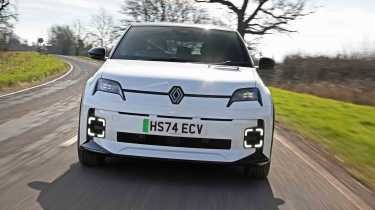
2026 Renault 5 Electric Review: The Retro EV That Gets It Right
Cute, capable retro EV that undercuts the Mini Cooper on price
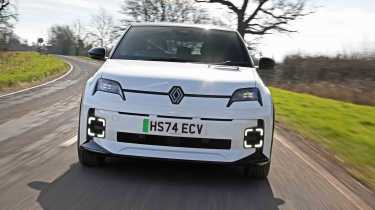
2026 Renault 5 Electric front three-quarter view
Price
£22,995
Battery
40 / 52 kWh
⚡ Quick Verdict
The 2026 Renault 5 Electric nails the retro brief and backs it up with genuine substance. It kicks off at £22,995 in the UK, undercutting key rivals like the Fiat 500e and Mini Cooper Electric by a hefty margin. You get up to 410 km of WLTP range from the 52 kWh battery, and there are three motor options: 95 hp, 120 hp, and 150 hp. We’d skip the base 95 hp model, though, as it can’t use DC fast chargers at all. The 150 hp / 52 kWh version is the one to have—it feels punchy in traffic, can charge to 80% in about half an hour on a 100 kW charger, and wraps it all in a body that puts a genuine smile on your face. The infotainment with Google Built-in is a standout, but the back seat is for kids or short trips only. If you’re a city-based couple or a two-car household after an affordable, characterful electric runabout, the Renault 5 Electric deserves a spot at the top of your list.
## Renault 5 Electric at a Glance
✓ The Good
- +Charming retro design that turns heads without feeling like a novelty act
- +Excellent value — undercuts Mini Cooper Electric by over £7,000
- +Google Built-in infotainment with real-time range-aware navigation
- +Noticeably quieter than most rivals at motorway speeds
- +Three motor options let buyers pick their sweet spot
✗ The Trade-offs
- −Rear seats lack air vents, USB-C ports, and usable legroom for taller adults
- −Base 95 hp model has no DC fast charging at all — only 11 kW AC
- −Euro NCAP four stars falls short of the Mini’s five-star rating
- −Boot is deep but narrow; no frunk and charging cables eat into cargo space
- −Manual seats on lower trims have a wonky angle that may frustrate shorter drivers
📑 In This Review
- Renault 5 Electric at a Glance
- Pricing, Trims and Battery Options
- Performance and Driving Impressions
- Range, Charging and Real-World Efficiency
- Interior, Tech and OpenR Link
- 2026 Renault 5 Electric vs Mini Cooper Electric: Which Is Better?
- Safety and Warranty
- Who Should Buy the Renault 5 Electric?
- Verdict
- SOURCES
The 2026 Renault 5 Electric nails the retro brief and backs it up with genuine substance. It kicks off at £22,995 in the UK, undercutting key rivals like the Fiat 500e and Mini Cooper Electric by a hefty margin. You get up to 410 km of WLTP range from the 52 kWh battery, and there are three motor options: 95 hp, 120 hp, and 150 hp. We’d skip the base 95 hp model, though, as it can’t use DC fast chargers at all. The 150 hp / 52 kWh version is the one to have—it feels punchy in traffic, can charge to 80% in about half an hour on a 100 kW charger, and wraps it all in a body that puts a genuine smile on your face. The infotainment with Google Built-in is a standout, but the back seat is for kids or short trips only. If you’re a city-based couple or a two-car household after an affordable, characterful electric runabout, the Renault 5 Electric deserves a spot at the top of your list.
Renault 5 Electric at a Glance
| Renault 5 E-Tech | Mini Cooper E | Fiat 500e | Peugeot e-208 | |
|---|---|---|---|---|
| UK Price (from) | £22,995 | £30,120 | £28,000 | £28,500 |
| Battery | 40 / 52 kWh | 54.2 kWh | 42 kWh | 50 kWh |
| Range (WLTP) | 310 / 410 km | 305 km | 321 km | 362 km |
| 0–100 km/h | 8.0 s (150 hp) | 7.3 s | 9.0 s | 8.1 s |
| DC Charging | 100 kW | 95 kW | 85 kW | 100 kW |
| Euro NCAP | 4 stars | 5 stars | 4 stars | 4 stars |
Mini Cooper E
Plusher cabin and 5-star NCAP, but firmer ride and over £7k pricier
Fiat 500e
More retro than the R5 but smaller battery and tighter rear cabin
Peugeot e-208
Bigger boot and comfier rear seat, but lacks the R5’s design charm
The Renault 5 isn’t just another small electric hatchback. It’s a piece of rolling nostalgia, and a bloody effective one at that. By drawing heavily from the shape and style of the original 1970s and ’80s R5, Renault’s created an EV that sparks a reaction before you’ve even turned a wheel. It joins the growing pack of retro-styled small electrics with the Fiat 500e and Mini Cooper Electric, but it does so at a price that makes them look a bit rich. The target buyer is pretty clear: urban Europeans wanting an affordable second car, first-time EV adopters put off by bland designs, and anyone after a small hatchback that just happens to run on electrons. This isn’t a family hauler or a long-distance tourer. It’s a city car, through and through, with enough range for a weekend away and enough charm to forgive its rougher edges. Stacked against its main rivals, the Renault 5 is the value play. It arrives with competitive range, modern infotainment, and a design language that genuinely makes people stop and look. Here’s how the headline figures compare. **Renault 5 E-Tech** **Fiat 500e** —— £22,995 £28,000 40 / 52 kWh 42 kWh 310 / 410 km 321 km 8.0 s (150 hp) 9.0 s 100 kW 85 kW 4 stars 4 stars
Pricing, Trims and Battery Options
Renault’s given buyers genuine choice with the 5 Electric’s range, though you’ll want to read the spec sheet carefully to get the right combination.
The line-up starts with a 95 hp motor paired only with a 40 kWh battery. That’s your entry ticket at £22,995 in the UK, or about €28,000 in Germany. It offers 310 km of WLTP range, which is fine for a daily commute. Here’s the big catch, though: the 95 hp model has no DC fast-charging capability. It’s stuck at 11 kW on AC, so a full top-up from near-empty will take hours on a home wallbox and even longer on a public fast charger. If you ever need a quick splash-and-dash on a trip, this one’s off the table.
Move up to the 120 hp motor and you keep the 40 kWh battery but gain 80 kW DC charging. Range stays at 310 km WLTP. This setup turns the Renault 5 from a pure city car into something actually useful for the occasional longer run. It’s the first genuinely sensible option in the line-up.
At the top is the 150 hp motor, paired exclusively with the bigger 52 kWh battery. This combo delivers 410 km of WLTP range and 100 kW DC charging, getting from 10 to 80% in about 30 minutes. It’s the most complete package and the one we’d point most buyers towards.
Trim levels run from Evolution, through Techno and Iconic Five, up to the Roland-Garros. Even the base Evolution comes well-equipped: 18-inch alloy wheels, full LED headlights, climate control, keyless entry, a 10.1-inch touchscreen with Apple CarPlay and Android Auto, and a heat pump for efficient heating. The Techno adds more convenience gear, while the Iconic Five—priced at £28,995 in the UK with the 52 kWh battery—feels properly premium. The Roland-Garros sits at the top at around £30,695, with luxury touches to match its tennis-tournament name.
Our take? For budget-minded buyers who mostly stick to town, the 120 hp / 40 kWh car in Techno trim hits a great balance. If you want the full kit—stronger poke, maximum range, and the best charging speeds—the 150 hp / 52 kWh car in Iconic Five trim is the one to get.
Performance and Driving Impressions
On paper, the 150 hp Renault 5 hits 100 km/h in 8.0 seconds. Our testing on 18-inch wheels with winter tyres saw it do the dash in 8.45 seconds. It felt quicker than that, thanks to the instant electric shove. The 120 hp car does it in about 9.0 seconds, while the base 95 hp model takes a more relaxed 12.0 seconds. All versions top out at 150 km/h.
Out on the road, the Renault 5’s character sits between comfort and agility. It’s not a magic carpet—rough surfaces do send shudders through the cabin, and the ride can feel fidgety on rutted streets. That said, during our drives, it felt noticeably more forgiving than the Mini Cooper Electric. The Mini goes for a firmer, "go-kart" feel that some love and others find tiring on a commute. The Renault sits in a more relaxed zone: composed enough to feel stable, soft enough to soak up the worst of our local B-roads without beating you up.
We were impressed by the noise levels. At 130 km/h on a motorway run, the cabin stayed remarkably quiet for a car this size and price. Wind noise was the main sound—tyre roar was well-suppressed—and the overall feel was of a car that punches above its weight in refinement. For a small, affordable EV, it’s genuinely impressive.
Regenerative braking is controlled via the gear selector: D mode gives no regen, coasting freely when you lift off, while B mode applies a strong regenerative pull. We found the B-mode regen about right—enough for effective one-pedal driving in town without being so aggressive it jerks your passengers around. It won’t please drivers wanting customisable regen paddles, but it’s well-judged for the car’s purpose.
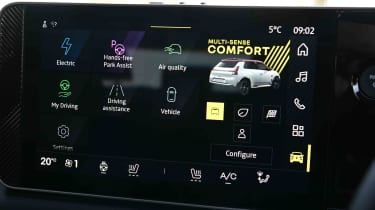
The Multi-Sense drive modes—Comfort, Eco, Sport, and Personal—are on a steering wheel button. Sport sharpens the throttle noticeably, while Eco dulls things to save range. Cruise control and steering assist are standard. During our time with the car, the adaptive cruise felt smooth and the lane-centring assist was unobtrusive. There’s also a dedicated Personal Assist button on the dash. It lets you toggle between your saved safety settings and the full suite of systems, so you can silence persistent warnings without digging through menus.
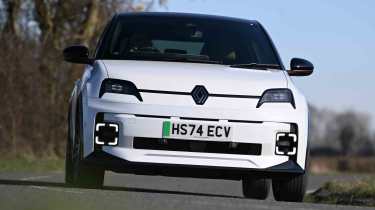
Range, Charging and Real-World Efficiency
The Renault 5 Electric comes with two battery choices that define its range. The 40 kWh pack gives a WLTP-rated 310 km, while the larger 52 kWh unit bumps that to 410 km. In the real world, you’ll get less—probably 240–260 km from the small battery and 320–350 km from the big one, depending on how you drive, the weather, and if the heat pump is doing its job in winter.
That heat pump is standard from the Evolution trim up. It’s a big inclusion that many rivals either leave out or charge extra for, and it makes a real difference to cold-weather efficiency. The car handles battery preheating automatically through its thermal management system—there’s no manual switch—which means it prepares itself for optimal charging when you programme a DC charger into the nav.
DC charging speed depends on the motor. The 150 hp / 52 kWh car takes up to 100 kW and goes from 10 to 80% in roughly 30–32 minutes. The 120 hp / 40 kWh car does 80 kW DC and hits a similar 31–32 minute window to 80%, as its smaller battery has less energy to accept. Both are competitive for the class.
The 95 hp model is the outlier. With no DC charging, limited to 11 kW AC, it’s strictly a home-charging proposition. If that fits your life—a short commute, a garage wallbox, no motorway trips—it’s workable. We’d just urge buyers to think hard before committing to a car that can’t take a fast charge in a pinch.
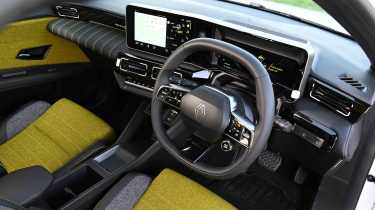
Interior, Tech and OpenR Link
Step inside the Renault 5 and you’ll find a dashboard that mixes retro fun with modern tech. The centrepiece is a pair of 10.1-inch screens: a digital driver’s display and a central touchscreen running OpenR Link, Renault’s Google Built-in infotainment. That means Google Maps as the native nav—it shows your predicted battery level on arrival and suggests charging stops—plus Google Assistant for voice commands and the Google Play Store for apps. It’s a slick, responsive system and one of the best in any small car today.
Below the main screen is a row of physical climate controls for temperature, airflow, defrost, recirculation, and AC max. We’re glad they’re buttons. Too many cars bury these in touchscreens. Wireless smartphone charging sits in a small cubby in the centre console, with two USB-C ports and a 12V outlet next to it. There’s a tiny pocket ahead of the cupholders that fits a phone or wallet.
The steering wheel is busy with buttons but logically laid out: cruise control and distance on the left, Multi-Sense drive modes on the right, and a screen-toggle button for cycling through instrument views (power gauge, Google Maps, driver assists, speed, music, eco monitor, trip data, range, and more).
There are some compromises. The manual seats on lower trims have a base cushion angle we found awkward for shorter drivers—the front edge sits too high, forcing a downward angle that doesn’t feel right. Electric seats on higher trims mostly fix this. The driving position is fine for taller drivers, with good headroom up front.
The back seat is where the city-car limits show up most. With the front seat set for a 180 cm driver, there’s basically no legroom for a tall adult behind. Your feet can’t slide under the front seat when it’s lowered. There are no rear air vents, USB-C ports, armrest, or centre storage. A small door pocket and a reading light are the only concessions. Headroom is okay, but this space is for kids or short trips with smaller adults.
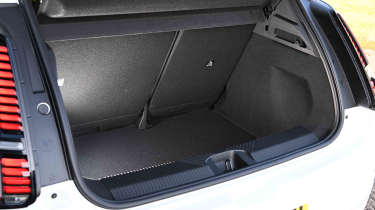
Boot space is deep but narrow. Charging cables live under a false floor in the boot, and a subwoofer sits on the second layer, so there’s no hidden storage. There’s no frunk either. Folding the rear seats frees up more room, but this is a small car with a small boot. Pack light.
2026 Renault 5 Electric vs Mini Cooper Electric: Which Is Better?
The Mini Cooper Electric is the Renault 5’s most direct rival. Both play the retro card, both are small electric hatchbacks for style-conscious European buyers, and both aim to make EV ownership fun. Their approaches—and price tags—are quite different.
Starting with cost: the Renault 5 begins at £22,995 in the UK, while the Mini Cooper E starts at £30,120. That’s a gap of over £7,000—enough to cover years of home charging. Even the top Renault in Iconic Five trim at £28,995 undercuts the base Mini. The value difference is stark.
On the road, they have different personalities. The Mini Cooper E has a firmer, sportier setup that delivers engaging handling on smooth tarmac. On rougher roads, that firmness turns into a jarring ride that can feel punishing over potholes. The Renault 5, in our testing, was more supple. It’s still not a magic carpet—no small, affordable car truly is—but it handles bumps with more composure and less intrusion. For daily city commuting, we’d take the Renault’s ride.
Noise is another area where the Renault surprised us. At motorway speeds, it was quieter than expected, with wind noise the main issue. The Mini, being firmer, tends to let more road noise in. Both are civilised for the class, but the Renault edges it on refinement.
Interior quality favours the Mini. Its cabin materials feel plusher, its switchgear more premium, its overall vibe more upmarket. The Renault 5 fights back with better infotainment: OpenR Link with Google Built-in is more intuitive and feature-rich than Mini’s system, especially the native Google Maps with battery-aware routing. Wireless charging, dual USB-C ports up front, and physical climate controls all count in the Renault’s favour.
Safety is where the Mini pulls decisively ahead. Euro NCAP gave the Mini Cooper Electric five stars; the Renault 5 got four, dinged for lacking a central front airbag and having inconsistent dashboard crash protection. For families or safety-focused buyers, this difference matters.
Here’s how the key specs stack up:
| Renault 5 E-Tech 150 | Mini Cooper E | |
|---|---|---|
| UK Price | £28,995 (Iconic Five) | £30,120 (from) |
| Battery | 52 kWh | 54.2 kWh |
| WLTP Range | 410 km | 305 km |
| 0–100 km/h | 8.0 s | 7.3 s |
| Top Speed | 150 km/h | 170 km/h |
| DC Charging | 100 kW | 95 kW |
| Euro NCAP | 4 stars | 5 stars |
| Boot Space | ~270 litres | ~211 litres |
| Heat Pump | Standard | Optional |
On range, the Renault 5 wins convincingly—410 km against 305 km is a gap that matters in daily use. The Mini is quicker to 100 km/h by seven-tenths and has a 20 km/h higher top speed, but neither figure is critical for a small hatchback. Charging speeds are nearly identical, though the Renault’s better range means fewer stops on longer trips.
<div style="background:linear-gradient(135deg,#f0f9ff,#e0f2fe); border-left:4px solid #2563eb; border-radius:12px; padding:24px 28px; margin:32px 0"> <p style="font-size:12px; font-weight:800; letter-spacing:0.14em; text-transform:uppercase; color:#1e40af; margin:0 0 10px">Which one is better?</p> <p><strong>Buy the Renault 5 E-Tech if</strong> you want the best value in the retro EV segment, prioritise range over outright handling sharpness, and appreciate Google-powered infotainment with real-world battery-aware navigation.</p> <p><strong>Buy the Mini Cooper E if</strong> you demand a five-star Euro NCAP safety rating, prefer a plusher cabin with more upmarket materials, and enjoy a firmer, more sporty driving character.</p> <p><strong>Our pick</strong> is the Renault 5 E-Tech. The £7,000+ price saving, 105 km extra range, and more comfortable ride make it the smarter buy for most small-EV buyers. The Mini remains the more premium-feeling car, but the Renault delivers more where it counts — in the wallet and on the road.</p> </div>
Safety and Warranty
The Renault 5 Electric earned a four-star Euro NCAP rating—respectable, but not class-leading. The score was held back by the lack of a central front airbag to stop front occupants’ heads clashing, and by mixed dashboard crash protection. It’s worth noting that many direct rivals—the Peugeot e-208 and Fiat 500e included—also sit on four stars. The Mini Cooper Electric, with its five-star rating, is the standout in this segment.
On a brighter note, the Renault 5 got a five-star Green NCAP sustainability rating, showing strong environmental credentials over its life. Given that’s a key reason for going electric, that result counts for a lot.
Standard active safety gear includes autonomous emergency braking (AEB), lane-keeping assist, driver attention monitoring, an overspeed warning system, and rear parking sensors. The Personal Assist button on the dash is a handy feature: a double-press swaps between your saved safety settings and the full system suite, so you can quiet persistent warnings without digging through menus.
Warranty coverage is three years or 60,000 miles on the vehicle, with a separate eight-year battery warranty. That’s broadly in line with the industry, though some rivals—Hyundai and Kia come to mind—offer longer vehicle warranties.
Who Should Buy the Renault 5 Electric?
The Renault 5 Electric suits buyers whose needs match its strengths. City dwellers with short commutes who charge at home will find the 40 kWh battery plenty. Those in two-car households will value it as an affordable, characterful second vehicle for school runs, shops, and urban errands.
It’s also a great fit for first-time EV buyers who like the idea of going electric but are put off by the bland design of many affordable EVs. The Renault 5’s retro charm isn’t just skin deep—it genuinely makes ownership more enjoyable, and at £22,995 it’s outstanding value.
But it’s not for everyone. Families who regularly carry rear passengers—especially taller teenagers or adults—will find the cramped back seat a daily frustration. The lack of rear USB-C ports, air vents, and real storage makes those seats feel like an afterthought.
Frequent long-distance drivers should also pause. While the 52 kWh battery’s 410 km WLTP range is strong for the class, it doesn’t match what bigger EVs offer. If you often drive 300+ km in a single hit, you’ll want more range and faster peak charging.
And buyers for whom safety ratings are critical should note the four-star Euro NCAP result. It’s not bad—but if five stars is a must, the Mini Cooper Electric is the alternative.
⚡ Our Verdict
Cute, capable retro EV that undercuts the Mini Cooper on price
The 2026 Renault 5 Electric is one of the most compelling small EVs to hit Europe in recent years. It pairs genuine retro desirability with modern electric tech, competitive range, and a price that significantly undercuts its closest rivals. In 150 hp / 52 kWh form, it’s a genuinely pleasant car to drive—quiet, composed, and quick enough for its job—while the Google Built-in infotainment is among the best in any affordable EV. It’s not perfect. The rear cabin is too tight for regular adult use, the base 95 hp model’s lack of DC charging is a big limitation, and the four-star safety rating leaves room for improvement. But for the buyer who fits its profile—urban, style-conscious, value-driven—the Renault 5 Electric delivers something few rivals can match: a car that makes you smile every time you walk up to it, and every time you drive it. We rate it 4.3 out of 5 and firmly recommend it as one of the best small electric cars of 2026.
FAQ
How much is the 2026 Renault 5 Electric in the UK?
The Renault 5 Electric starts at £22,995 in the UK for the Evolution trim with the 95 hp motor and 40 kWh battery. The Iconic Five trim with the 150 hp motor and 52 kWh battery is £28,995. The range-topping Roland-Garros sits at about £30,695.
What is the WLTP range of the Renault 5 E-Tech?
The 40 kWh battery gives a WLTP-rated range of 310 km. The 52 kWh battery extends that to 410 km. Real-world range will be a bit lower depending on conditions, temperature, and speed—expect roughly 240–260 km and 320–350 km respectively.
Can the Renault 5 Electric fast charge?
The 120 hp and 150 hp models can fast charge via DC. The 150 hp / 52 kWh car takes up to 100 kW and hits 80% in about 30–32 minutes. The 120 hp / 40 kWh car does 80 kW and takes a similar time. The base 95 hp model has no DC fast-charging—it’s limited to 11 kW AC only.
Is the Renault 5 Electric safer than the Mini Cooper Electric?
No. The Renault 5 got a four-star Euro NCAP rating, penalised for lacking a central front airbag and having dashboard protection issues. The Mini Cooper Electric earned a full five-star rating, making it the safer choice by Euro NCAP’s assessment.
What is the Renault 5 Electric warranty?
The Renault 5 Electric comes with a three-year / 60,000-mile vehicle warranty and a separate eight-year battery warranty. That’s broadly comparable with most competitors in the small EV segment.
Does the Renault 5 Electric have Apple CarPlay?
Yes. The 10.1-inch touchscreen supports both Apple CarPlay and Android Auto wirelessly. The system also runs OpenR Link with Google Built-in, which includes Google Maps, Google Assistant, and access to the Google Play Store.
SOURCES
– Auto Express — Renault 5 E-Tech review and pricing data – What Car? — UK pricing and specification details – Euro NCAP — Renault 5 Electric safety rating (4 stars) – Green NCAP — Renault 5 sustainability rating (5 stars) – Carwow — rival comparison pricing and specifications – Top Gear — driving impressions and market context
