

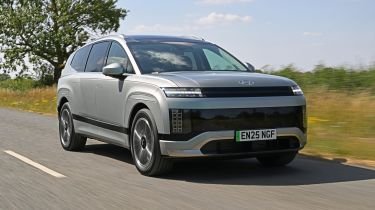
2026 Hyundai Ioniq 9 Review: The Three-Row EV Done Right
The sensible three-row EV the family-car market has been waiting for
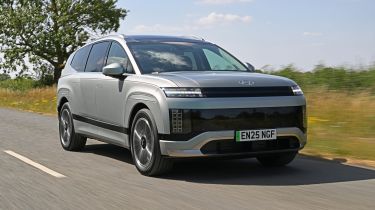
2026 Hyundai Ioniq 9 three-row electric SUV exterior front three-quarter
⚡ Quick Verdict
We’ve driven a lot of three-row electric SUVs, and the 2026 Hyundai Ioniq 9 is the first one that genuinely nails the basics families actually care about. The S RWD trim’s 335-mile EPA range tops the segment, the third row is comfortable enough for adults on real drives, and every version ships with a 110.3 kWh battery, an IIHS Top Safety Pick+ rating, and a native NACS charge port. It won’t launch you into your seat like a 600-plus-hp competitor, and the rear styling splits opinion. But as a daily-driven family hauler? It sets the standard.
—
## At a Glance
✓ The Good
- +335-mile EPA range on the S RWD trim leads the three-row EV segment
- +Genuinely usable third row with generous head, knee and recline room
- +Standard NACS port plus CCS adapter unlocks Tesla and CCS networks
- +IIHS Top Safety Pick+ with 9 airbags and full SmartSense ADAS as standard
- +Outstanding cabin isolation thanks to laminated glass, triple seals and active noise cancellation
✗ The Trade-offs
- −Performance variants are quick rather than thrilling versus the 600+ hp segment leaders
- −Limited and Calligraphy second-row power seats slow down third-row access
- −No spare tyre — just a tyre mobility kit
- −Some front-seat bolsters intrude on arm movement
- −Polarising "Dustbuster" rear three-quarter styling won’t be for everyone
- −—
📑 In This Review
We’ve driven a lot of three-row electric SUVs, and the 2026 Hyundai Ioniq 9 is the first one that genuinely nails the basics families actually care about. The S RWD trim’s 335-mile EPA range tops the segment, the third row is comfortable enough for adults on real drives, and every version ships with a 110.3 kWh battery, an IIHS Top Safety Pick+ rating, and a native NACS charge port. It won’t launch you into your seat like a 600-plus-hp competitor, and the rear styling splits opinion. But as a daily-driven family hauler? It sets the standard. —
At a Glance
| Trim | Drive | Power | EPA Range | Towing | MSRP |
|---|---|---|---|---|---|
| S | RWD | 215 hp / 258 lb-ft | 335 mi | 3,500 lb | $60,555 |
| SE | AWD | 303 hp / 446 lb-ft | ~320 mi | 5,000 lb | $64,365 |
| SEL | AWD | 303 hp / 446 lb-ft | ~311 mi | 5,000 lb | $67,920 |
| Performance Limited | AWD | 422 hp / 516 lb-ft | ~311 mi | 5,000 lb | $72,850 |
| Performance Calligraphy | AWD | 422 hp / 516 lb-ft | ~311 mi | 5,000 lb | $76,590 |
| Performance Calligraphy Design | AWD | 422 hp / 516 lb-ft | ~311 mi | 5,000 lb | $78,090 |
Kia EV9
Same E-GMP platform, sharper turn-in, ~30 mi less range than the Ioniq 9.
Rivian R1S
Best off-road three-row EV, but rides firmer and costs significantly more.
Tesla Model X
Quicker and more aerodynamic, but third row is tighter and pricing climbs past $90k.
Cadillac Vistiq
Premium American three-row EV — more luxury feel but pricier and less range.
The 2026 Hyundai Ioniq 9 is a full-size, three-row electric SUV riding on Hyundai Motor Group’s E-GMP platform — the same bones under the Kia EV9, Ioniq 5, and Ioniq 6. Six trims span the range from the $60,555 S RWD up to the $78,090 Performance Calligraphy Design AWD, all sharing a common 110.3 kWh lithium-ion battery. You get rear-drive efficiency, all-wheel-drive grip for all-weather duty, and a Performance AWD option that puts out 422 hp for buyers wanting more punch. Its closest rivals are the Kia EV9, Rivian R1S, Tesla Model X, and Cadillac Vistiq, and the Ioniq 9 undercuts most on price while matching or beating them on range. Drive EPA Range MSRP ——————— RWD 335 mi $60,555 SE 303 hp / 446 lb-ft 5,000 lb AWD ~311 mi $67,920 Performance Limited 422 hp / 516 lb-ft 5,000 lb AWD ~311 mi $76,590 Performance Calligraphy Design 422 hp / 516 lb-ft 5,000 lb Stacked up against its closest competition, the Ioniq 9’s value argument is clear. The Kia EV9 rides on the same platform and shares much of the same tech, but the Ioniq 9 ekes out roughly 30 more miles of EPA range on comparable trims. The Rivian R1S is far more capable off-road and offers an optional 410-mile battery, though it rides less smoothly on tarmac and starts well above the base Ioniq 9. The Tesla Model X is quicker and slipperier through the air, yet its third row is tighter and pricing pushes past $90,000 before you’ve added any options. We cover the EV9 comparison in depth further down. —
Design and Exterior
Hyundai has gone all-in on its "pixel" design language here, and it pays off. The front and rear lighting signatures both use pixelated LED elements that make the SUV instantly recognisable, day or night. Flush door handles with a pixel-pattern touch sensor keep the sides clean and help achieve a 0.269 drag coefficient — seriously slippery for something this big.
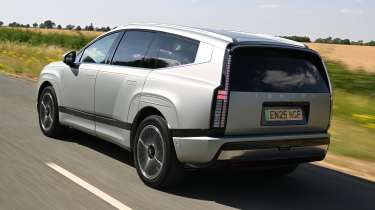
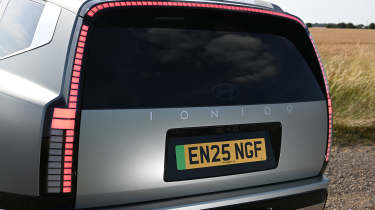
The profile tapers aggressively toward the rear in a fastback-like treatment that helps aero but creates what plenty of people have started calling the "Dustbuster" shape when you catch it from the rear three-quarter angle. Look, we won’t sugarcoat it — this is a love-it-or-hate-it design move. That large metallic-look rear panel reads as futuristic to some eyes and awkward to others. It grew on us over a few days of living with the car, but we completely understand the divided opinions.
One thing buyers in cooler parts of Australia should know: those flush door handles need a touch to pop out. After a cold night or in heavy rain, the sensor surface might need a moment before the handle presents itself. Minor, sure, but worth keeping in mind.
Taken as a whole, though, the Ioniq 9 cuts a confident shape on the road. It looks substantial without being brutish, and the 123.22-inch wheelbase — the longest in the three-row EV class — gives it genuine presence in any car park.
—
Interior and Cabin Tech
Climb inside and the first thing you notice is how thoughtfully Hyundai has treated the materials. The signature pixel motifs carry over into ribbed surfacing across the dashboard and door panels, giving the cabin a modern, tactile feel that avoids coming across as clinical. The design theme is consistent without being overdone.
A pair of 12.3-inch displays sits beneath a single glass panel ahead of the driver, running Hyundai’s infotainment system. It’s familiar, responsive, and easy to work through. Wireless Apple CarPlay and Android Auto come standard on every trim, along with a wireless phone charger. The HVAC controls are mostly capacitive — a choice we know divides people — but they react quickly, and Hyundai has thankfully fitted a physical temperature knob for quick tweaks. A sensible middle ground.
Storage is a genuine highlight. The centre console is a clever bit of engineering: it flips forward so rear passengers can grab snacks or drinks, then flips back toward the driver and front passenger when needed. There’s a dedicated phone tray with adjacent charge ports, extra storage below, and cup holders within easy reach. The door bins swallow both phones and large bottles without fuss.
One thing caught us by surprise, though. The SEL trim looks and feels considerably more premium than its price tag would suggest — the materials and presentation nudge into luxury territory. But there’s no memory seat function on the SEL. For a vehicle that presents this convincingly upmarket, the omission stands out, especially in households where two people share the car. You need to step up to Limited or Calligraphy to get that feature.
—
Three-Row Practicality
This is the section that matters most for the buyers Hyundai is chasing, and it delivers.
The base S, SE, and SEL trims seat seven across three rows in a 2-3-2 layout. Limited and Calligraphy swap the second-row bench for captain’s chairs, dropping capacity to six but adding comfort and a more open walk-through. Behind a 178 cm driving position, the second row offers generous recline and roughly 115 mm of slide travel, so occupants can fine-tune the balance between their own legroom and what the third row gets.
That third row genuinely surprised us. Headroom is generous, the recline angle is comfortable, and the seat geometry works in your favour — your knees don’t end up jammed up near your ears. Average-height adults can sit back there for reasonable stints without complaint. Ceiling-mounted vents cover both rear rows, so climate comfort reaches all the way back.
Getting into the third row is straightforward. A button on the second-row seat triggers a slide-and-fold motion that opens up a wide gap. On the SEL and below, those seats are manual and release immediately — a real plus for families who need third-row access constantly. We tested whether a booster seat could stay installed in the second row while someone climbed into the back, and the opening is wide enough that it’s plausible. There’s also a second button on top of the seatback to help third-row passengers get out.
Here’s the practical reality check: on Limited and Calligraphy, the second-row seats are power-operated, and they motor out of the way slowly. If you’re loading kids into the third row at school drop-off every morning, that lag will do your head in. The manual seats on the SEL and below are genuinely quicker for this specific job. It’s a counterintuitive case where the pricier trim is actually less practical for something families do constantly.
Cargo space measures 21.9 cubic feet behind the third row, expanding to 46.7 cubic feet with row three folded, and maxing out at 86.9 cubic feet with both rear rows down. The third row drops via simple manual straps — one smooth motion, no power-folding fuss. For child seats, top tethers are available in all five rear positions, with lower anchors in the outboard seats of both the second and third rows. A rear-facing infant seat fits in the second row behind a 157 cm front-seat occupant, though the third row won’t take a rear-facing seat without eating into front-row space.
One thing to flag: there’s no spare tyre. Hyundai provides a tyre mobility kit instead. If your family spends a lot of time on regional highways or outback roads, that’s worth factoring into your decision.
—
On the Road
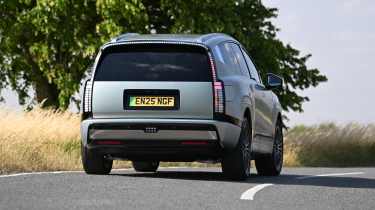
The Ioniq 9 is a big vehicle — 123.22 inches of wheelbase, three rows of seats — yet it doesn’t drive like one. Over broken pavement, the suspension finds a commendable balance between soaking up impacts and keeping the body settled. There’s no wallowing, boat-like sensation even across undulating surfaces. The ride feels composed in a way that gives you confidence on longer trips.
Cabin quietness is the standout. Hyundai has fitted laminated side glass to both the front and rear doors, layered on triple door seals, and fitted active noise cancellation. The result is a remarkably hushed cabin at highway speeds. Road and wind noise are suppressed to a level we’d normally associate with a luxury badge, not a mainstream three-row SUV.
The steering ratio sits on the slower side — this is no sports car — but it’s predictable and well-weighted. Turn-in to corners feels confident rather than nervous, and the Ioniq 9 tracks faithfully through sweeping bends. We never found ourselves sawing at the wheel to keep it on line.
In Sport mode with all four wheels driven, the Performance AWD variant is satisfyingly quick. The 422 hp and 516 lb-ft deliver strong, linear shove that’ll push passengers back in their seats merging onto a motorway. That said, it won’t punch you in the chest the way a 600-plus-hp rival might. The Ioniq 9 prioritises accessible, repeatable thrust over shock value, and honestly, that suits its mission perfectly.
Regenerative braking is adjusted via steering-wheel-mounted paddles, ramping up to Hyundai’s one-pedal i-Pedal mode. In practice, i-Pedal works smoothly and makes stop-and-go traffic nearly effortless. The friction brake pedal itself isn’t perfectly natural — there’s a slight disconnect between pedal effort and deceleration at the top of the travel — but you can stop smoothly with a bit of acclimatisation.
Low-speed manoeuvring is drama-free. The turning circle is manageable for something this size, and the 360-degree camera (standard on SEL and up) gives you a clear bird’s-eye view that takes the stress out of parking. Visibility is generally good, with one exception: the driver’s-side A-pillar can get in the way at certain angles, particularly when looking left through a sweeping bend or at an intersection.
—
Range, Charging and Powertrains
Every 2026 Ioniq 9 runs the same battery: a 110.3 kWh lithium-ion pack. From there, the powertrain branches three ways. The base S RWD pairs a single motor making 215 hp and 258 lb-ft with an EPA-rated 335 miles of range and 92 MPGe combined — the best range in the three-row EV class. The SE and SEL get dual-motor AWD with 303 hp and 446 lb-ft, returning roughly 311 to 320 miles depending on trim and wheel size. The Performance AWD models step up to 422 hp and 516 lb-ft with approximately 311 miles of range and 85 MPGe.
Charging is a real strength, thanks to the E-GMP platform’s 800-volt architecture. Hyundai quotes a peak DC fast-charge rate of 350 kW and a 10-to-80-percent time of roughly 24 minutes on a compatible charger — among the quickest in the segment. On a Tesla V3 Supercharger, which runs at a lower voltage, that same session takes closer to 40 minutes due to voltage conversion limits. Still, the Ioniq 9 comes with a native NACS charge port and a CCS adapter in the glovebox, so owners have instant access to both the Tesla Supercharger network and every CCS station without needing aftermarket kit. Right now, it’s the most frictionless charging setup in the class.
At home, a Level 2 (240-volt) wallbox will top up the battery from empty in just under 10 hours — an overnight job. An optional V2L (vehicle-to-load) adapter lets the Ioniq 9 power external devices, from camping gear to a home circuit during a blackout, adding real versatility beyond just getting from A to B.
Towing capacity sits at 3,500 lb for the RWD S trim and 5,000 lb for all AWD variants — enough for a mid-size boat or a small camper trailer.
—
2026 Hyundai Ioniq 9 vs Kia EV9: Which Three-Row EV Should You Buy?
This is the comparison most shoppers in this space will be making, and for good reason. The Ioniq 9 and Kia EV9 share the same E-GMP platform, the same 110.3 kWh battery, and much of the same underlying tech. They even come off related production lines. Yet they’re not the same vehicle — not in feel, not in space, and not in the details that matter to families.
**Price and positioning.** The Ioniq 9 S starts at $60,555 and the EV9 Light lands in a similar ballpark, putting them neck and neck at the entry point. Climb the trims and the Ioniq 9 tops out at $78,090 for the Performance Calligraphy Design, while the EV9 GT-Line and its own top trims sit in a comparable range. There’s no clear price winner here — the value question comes down to which features matter most to you at each level.
**Range and efficiency.** This is where the Ioniq 9 pulls ahead. On comparable trims, it offers roughly 30 more miles of EPA-rated range than the EV9. The base S RWD’s 335-mile figure has no answer from Kia. For families who road-trip or simply don’t want to think about charging every few days, that gap is meaningful — it’s the difference between reaching the rellies on one charge or stopping mid-route.
**Powertrain and driving character.** Both offer single-motor RWD, dual-motor AWD, and performance-oriented AWD variants. The EV9 GT-Line feels slightly more agile in quick direction changes, with a touch more eagerness in its chassis tuning. The Ioniq 9 leans the other way — it’s more planted and settled at speed, with better cabin isolation. Neither approach is wrong; they reflect different ideas about what a family EV should prioritise. If your driving is mostly urban and suburban, the EV9’s sharper reflexes might suit. If you rack up highway kilometres, the Ioniq 9’s calm demeanour pays off.
**Charging.** Effectively neck and neck. Both use the E-GMP 800-volt architecture, both peak around 350 kW on a compatible DC fast charger, and both deliver that roughly 24-minute 10-to-80-percent session. The Ioniq 9 gains a slight practical edge with its native NACS port, meaning it plugs straight into Tesla Superchargers without an adapter. The EV9 uses CCS natively, though Kia is transitioning to NACS too. For now, the Ioniq 9 is marginally more convenient if the Tesla network is your go-to fast-charging option.
**Interior space and third-row usability.** This is where the Ioniq 9 earns its keep. Its 123.22-inch wheelbase is the longest in the segment, and that extra length shows up directly in third-row legroom and headroom that the EV9 can’t quite match. The Ioniq 9’s third row is genuinely comfortable for adults on moderate drives; the EV9’s works for kids and is tolerable for grown-ups. Second-row space is comparable, but the Ioniq 9’s flip-both-ways centre console and roomier door bins give it a slight edge in daily practicality. Both offer ceiling-mounted rear vents and similar child-seat accommodation.
**Styling.** Purely subjective, but the two take distinctly different paths. The Ioniq 9 leans into Hyundai’s pixel design language with pixelated lighting, a fastback-like rear taper, and that polarising rear three-quarter panel. The EV9 goes with Kia’s angular, hexagonal aesthetic for a more geometric, spaceship-like stance. The Ioniq 9 reads as slightly more conventional up front and more daring out back; the EV9 is consistently dramatic from every angle. Both turn heads in person, but for different reasons.
**On-road feel.** The Ioniq 9 absorbs rough pavement with more composure and lets less noise into the cabin. It feels like a car engineered for long-haul comfort. The EV9 is slightly more entertaining to hustle through a winding back road but gives up some refinement at highway speeds. Brake pedal feel in the Ioniq 9 could be more natural, but one-pedal driving with i-Pedal mode mostly sidesteps that issue. Both manoeuvre well in tight spaces, though the Ioniq 9’s longer wheelbase means a slightly wider turning circle.
| Spec | 2026 Hyundai Ioniq 9 | 2025 Kia EV9 |
|---|---|---|
| Starting price | $60,555 (S RWD) | ~$56,995 (Light RWD) |
| Battery | 110.3 kWh | 99.8 kWh (Light) / 99.8 kWh |
| Best range | 335 mi (S RWD) | ~304 mi (Light Long Range RWD) |
| Peak power | 422 hp (Performance AWD) | 379 hp (GT-Line AWD) |
| 0-60 mph | ~5.0 s (Performance AWD) | ~5.0 s (GT-Line AWD) |
| Charging port | Native NACS + CCS adapter | CCS (NACS adapter available) |
| Max towing | 5,000 lb (AWD) | 4,000 lb (AWD) |
| Cargo behind row 3 | 21.9 cu ft | ~20.2 cu ft |
| Warranty | 5-yr/60k basic; 10-yr/100k powertrain | 5-yr/60k basic; 10-yr/100k powertrain |
<div style="background: linear-gradient(135deg, #e8f4fd, #d6eaf8); border-left: 4px solid #2196F3; padding: 24px 28px; margin: 32px 0; border-radius: 6px;">
<p style="text-transform: uppercase; font-size: 0.8rem; letter-spacing: 0.1em; color: #2196F3; margin: 0 0 8px 0; font-weight: 700;">Which one is better?</p>
<p><strong>Buy the Ioniq 9 if</strong> you prioritise maximum range, a genuinely usable third row for adults, superior highway refinement, and the convenience of a native NACS charge port.</p>
<p><strong>Buy the EV9 if</strong> you prefer slightly sharper handling dynamics, want to save a few thousand dollars at the base trim, or are drawn to Kia’s bolder geometric styling.</p>
<p><strong>Our pick is the Ioniq 9.</strong> The 30-mile range advantage, the more spacious third row, and the quieter cabin add up to a vehicle that better serves the core mission of a three-row family EV. The EV9 is excellent — but for the money, the Ioniq 9 does more of what matters.</p>
</div>
—
Safety and Warranty
The 2026 Ioniq 9 earned an IIHS Top Safety Pick+ designation — the agency’s highest award — making it one of the safest vehicles in its class. NHTSA hadn’t published its rating at the time of our evaluation, but the IIHS result on its own is a strong endorsement.
Every Ioniq 9 comes with nine airbags, including a front centre airbag that helps protect against far-side impacts in a crash. The full Hyundai SmartSense advanced driver-assistance suite is standard across all trims, covering forward collision avoidance, lane-keeping assist, blind-spot monitoring, rear cross-traffic alert, and adaptive cruise control with lane centring. A radar-based rear occupant alert watches for children or pets left in the back seats after the vehicle is locked — a feature we reckon is essential for any family car. Safe exit assist warns occupants before they open a door into oncoming traffic or cyclists.
Hyundai’s warranty coverage is class-leading alongside the Kia EV9: five years or 60,000 miles of basic coverage and ten years or 100,000 miles of powertrain coverage. For an EV, that powertrain warranty includes the battery and electric drivetrain components, giving you long-term peace of mind that few rivals can match.
—
Who Should Buy the 2026 Hyundai Ioniq 9
BUY IF:
– You need a genuinely usable third row that can accommodate adults on longer drives, not just children on short hops – Maximum EV range matters to you — the S RWD’s 335 miles leads the three-row class – You value cabin quietness and ride comfort for highway family road trips – You want seamless access to both Tesla Superchargers and CCS networks with a native NACS port and included CCS adapter
SKIP IF:
– You want neck-snapping, 600-plus-hp acceleration — the Ioniq 9 is quick but not savage – You need a full-size spare tyre and travel regularly in remote areas where a mobility kit will not suffice – You are bothered by the rear three-quarter styling — it will not grow on everyone – You require memory seats but cannot stretch to the Limited trim
—
⚡ Our Verdict
The sensible three-row EV the family-car market has been waiting for
The 2026 Hyundai Ioniq 9 is the three-row electric SUV that gets the hard stuff right. It delivers the longest range in its class, a third row that adults can genuinely use, a cabin that isolates occupants from the outside world with luxury-grade quietness, and a charging setup that works everywhere straight out of the box. It isn’t the quickest EV on sale, its styling won’t suit every taste, and the lack of a spare tyre is a real oversight for road-tripping families. But for the family that wants to go electric without compromise — without sacrificing space, safety, or practicality — the Ioniq 9 makes a compelling, well-rounded case. It’s the sensible three-row EV the family-car market has been waiting for. —
Frequently Asked Questions
How much does the 2026 Hyundai Ioniq 9 cost?
Pricing starts at $60,555 for the S RWD trim and climbs to $78,090 for the Performance Calligraphy Design AWD. Those are US MSRPs before destination. The SE AWD kicks off at $64,365, the SEL AWD at $67,920, the Performance Limited AWD at $72,850, and the Performance Calligraphy AWD at $76,590.
What is the range of the 2026 Hyundai Ioniq 9?
The S RWD trim delivers an EPA-rated 335 miles — the best in the three-row EV segment. AWD SE and SEL trims return roughly 311 to 320 miles, while the Performance AWD variants sit at approximately 311 miles. Every version uses the same 110.3 kWh battery.
Can the Ioniq 9 use Tesla Superchargers?
Yes. The Ioniq 9 ships with a native NACS charge port, so it plugs straight into Tesla Superchargers without any adapter. A CCS adapter is also included in the glovebox for use at non-Tesla DC fast-charging stations. On a Tesla V3 Supercharger, expect roughly 40 minutes for a 10-to-80-percent session due to voltage conversion limits; on a 350 kW CCS charger, the same session takes approximately 24 minutes.
How many seats does the Ioniq 9 have?
The S, SE, and SEL trims seat seven in a 2-3-2 configuration. The Limited and Calligraphy trims seat six, swapping the second-row bench for captain’s chairs. All five rear positions have top tethers for child seats, and the outboard spots in both the second and third rows have lower anchors.
Is the Hyundai Ioniq 9 better than the Kia EV9?
The Ioniq 9 offers roughly 30 more miles of EPA range on comparable trims, a more spacious third row for adults, a quieter highway ride, and a native NACS charge port. The EV9 is slightly more agile dynamically, starts at a marginally lower base price, and has its own distinctive styling. For most families prioritising range, space, and long-distance comfort, the Ioniq 9 is the stronger pick.
What is the warranty on the 2026 Hyundai Ioniq 9?
Hyundai covers the Ioniq 9 with a five-year or 60,000-mile basic warranty and a ten-year or 100,000-mile powertrain warranty, which includes the battery and electric drivetrain. It’s among the best warranty coverage in the EV segment, matched only by the Kia EV9.
Does the 2026 Hyundai Ioniq 9 have a spare tyre?
No. The Ioniq 9 comes with a tyre mobility kit (sealant and inflator) rather than a spare tyre. It’s a common packaging choice in modern EVs to save weight and cargo-floor space, but it’s worth considering if you regularly drive in areas far from tyre service.
