

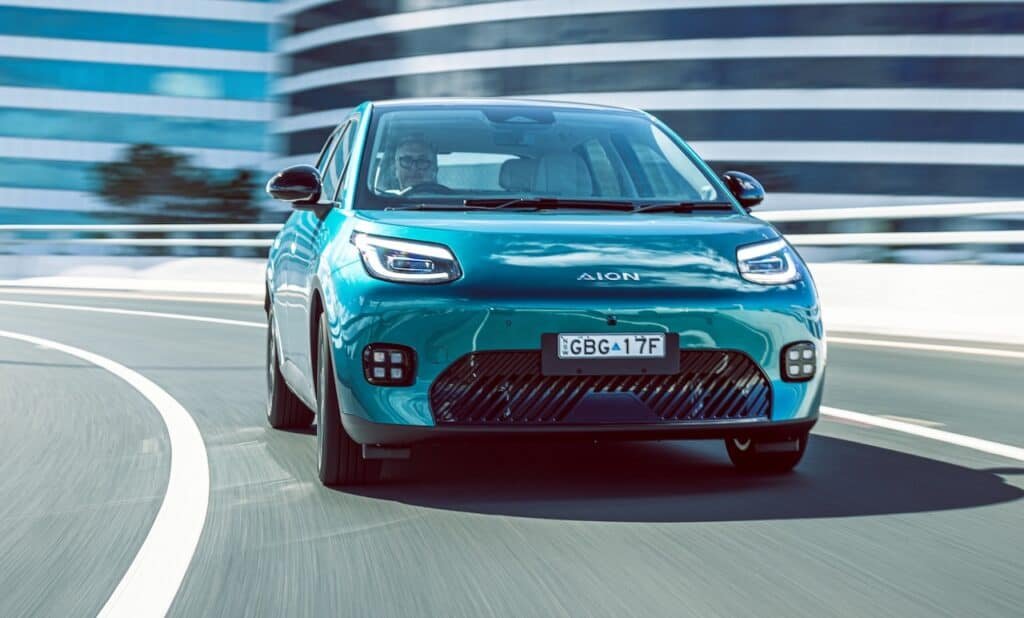
2026 GAC Aion UT Review — The Sub-$31k EV Hatchback to Beat
The Sub-$31k EV Bargain
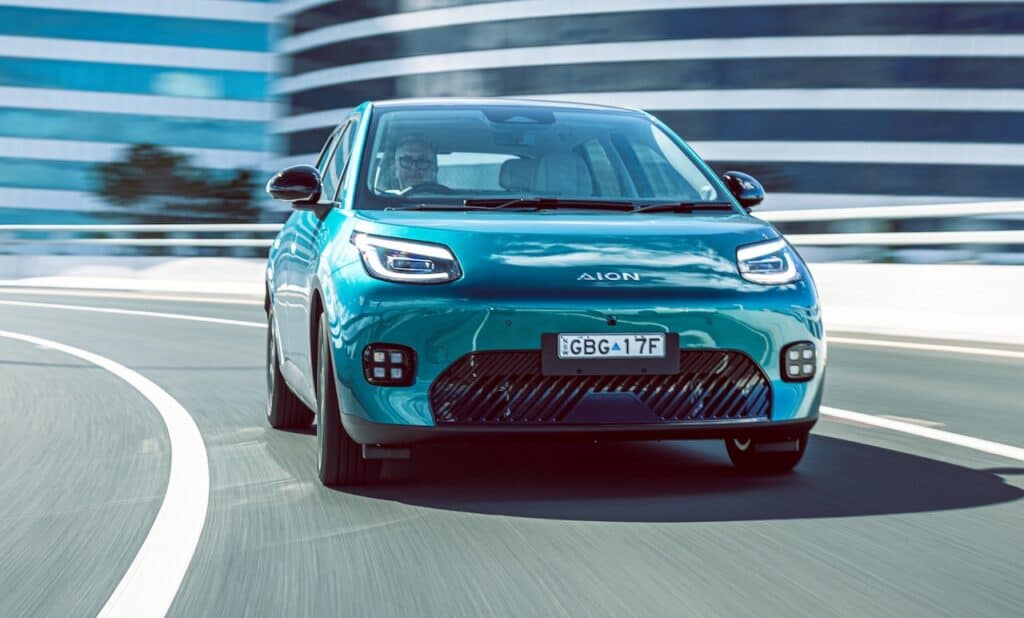
2026 GAC Aion UT Luxury exterior three-quarter view
Price
$30,990
0-100 km/h
7.3 s
Battery
60 kWh LFP
Power / torque
150 kW / 210 Nm
⚡ Quick Verdict
At $30,990 drive-away, the 2026 GAC Aion UT gives you 430 km of WLTP range, a cabin that’s genuinely roomy for its size, and driving dynamics that are properly enjoyable. In a segment where most competitors either ask more money or deliver less range, it’s the most convincing sub-$40k electric hatchback in Australia right now — and honestly, nothing else comes close.
## At a Glance: 2026 GAC Aion UT Specs
✓ The Good
- +Unbeatable drive-away pricing at launch
- +Generous 430 km WLTP range from 60 kWh LFP battery
- +Biggest infotainment screen in the segment at 14.6 inches
- +Surprisingly spacious cabin for a 4.27 m hatchback
- +Solid, predictable driving dynamics with good insulation
✗ The Trade-offs
- −No ANCAP safety rating yet — crash test pending
- −Overspeed warning ADAS is over-sensitive and buried in menus
- −Wireless Apple CarPlay connection can be flaky
- −No true one-pedal driving mode
📑 In This Review
- At a Glance: 2026 GAC Aion UT Specs
- Design and First Impressions
- Interior, Tech and Practicality
- Driving the GAC Aion UT
- Battery, Range and Charging
- Premium vs Luxury: Which Trim Is Worth It?
- GAC Aion UT vs BYD Dolphin: Which Is Better?
- Safety and Warranty
- Who Should Buy the 2026 GAC Aion UT?
- Verdict: 2026 GAC Aion UT
- Frequently Asked Questions
At $30,990 drive-away, the 2026 GAC Aion UT gives you 430 km of WLTP range, a cabin that’s genuinely roomy for its size, and driving dynamics that are properly enjoyable. In a segment where most competitors either ask more money or deliver less range, it’s the most convincing sub-$40k electric hatchback in Australia right now — and honestly, nothing else comes close.
At a Glance: 2026 GAC Aion UT Specs
| Spec | 2026 GAC Aion UT Premium | 2026 GAC Aion UT Luxury |
|---|---|---|
| Price (drive-away launch) | $30,990 | $35,990 + ORC |
| Battery | 60 kWh LFP | 60 kWh LFP |
| WLTP range | 430 km | 430 km |
| Power / torque | 150 kW / 210 Nm | 150 kW / 210 Nm |
| 0-100 km/h | 7.3 s | 7.3 s |
| DC charging | 87 kW | 87 kW |
| AC charging | 11 kW | 11 kW |
| V2L | 3.3 kW | 3.3 kW |
| Warranty | 8 yr / unlimited km | 8 yr / unlimited km |
BYD Dolphin Premium
Like-for-like power and range, but $6k more expensive than the Aion UT at launch.
Hyundai Inster
Quirky urban styling, but smaller battery and noticeably more money than the GAC.
MG4 Urban
Cheapest RWD hatch, yet the Aion UT offers more range, more power, and a longer warranty.
GWM Ora Standard
Retro styling fans only — the Aion UT undercuts on price and adds 120 km of range.
GAC might be a name you haven’t heard before, but the Guangzhou-based manufacturer is one of China’s biggest carmakers. They’ve spent decades building vehicles alongside Toyota and Honda through joint ventures, so there’s serious manufacturing pedigree behind the badge. The Aion UT is their first dedicated electric hatchback for Australia — a compact, city-friendly EV priced to undercut the BYD Dolphin and MG4 while matching or beating both on range and tech. 2026 GAC Aion UT Premium ————————– $30,990 60 kWh LFP 430 km 150 kW / 210 Nm 7.3 s 87 kW 11 kW 3.3 kW 8 yr / unlimited km
Design and First Impressions
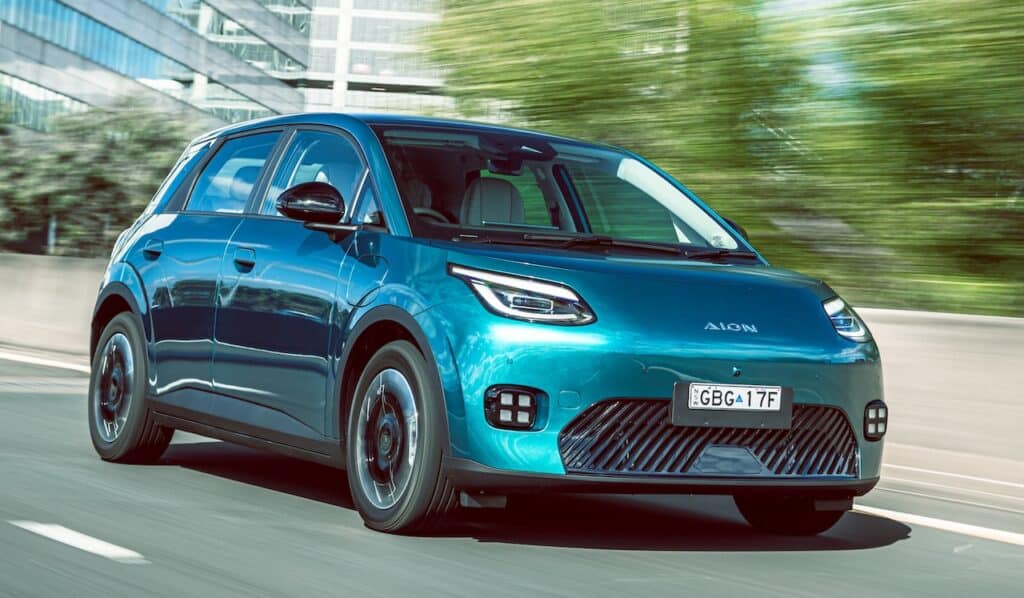
We weren’t expecting to like the Aion UT’s face as much as we did. That short, rounded bonnet — almost like a button nose — gives the whole car a friendly, approachable character that sets it apart from the sharper, more angular hatches in this class. In the two-tone white-and-green paintwork of our Luxury-spec test car, there’s a faint Mini-like quality to the colour blocking, though the overall shape is entirely its own. It’s a city hatchback that knows exactly what it is, and it pulls off that identity with real confidence.
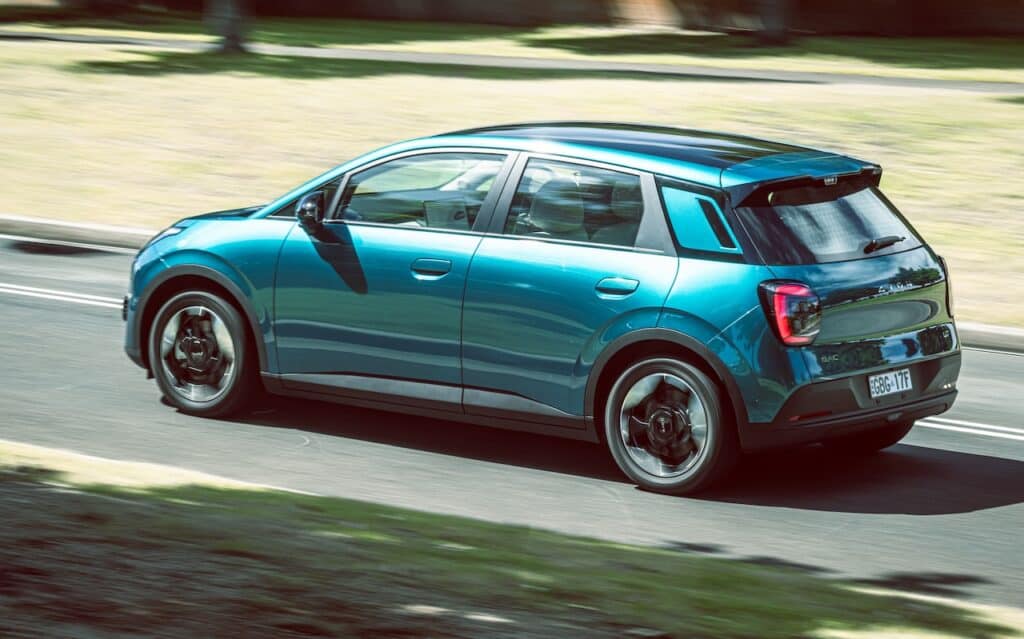
The proportions are smart. At 4,270 mm long and 1,850 mm wide, it’s small enough to slot into those "compact cars only" CBD parking spots every driver covets, yet the 2,750 mm wheelbase stretches the useful footprint exactly where it counts — inside. The charge port sits on the front-right panel, which makes daily AC top-ups painless no matter which way you nose into a garage. One quirk: the reverse light is unusually small and mounted low on the rear bumper. You’ll get used to it, but it’s worth flagging as a minor visibility concern at first.
Colour-wise, you get two standard hues (white and beige) and five premium choices — green, lavender, silver, crimson, and black — plus two-tone combinations. The first 600 customers also receive a portable 10A charger and a 22kW AC wall charger at no extra cost, so you’re essentially sorted for home charging from the moment you drive away.
Interior, Tech and Practicality
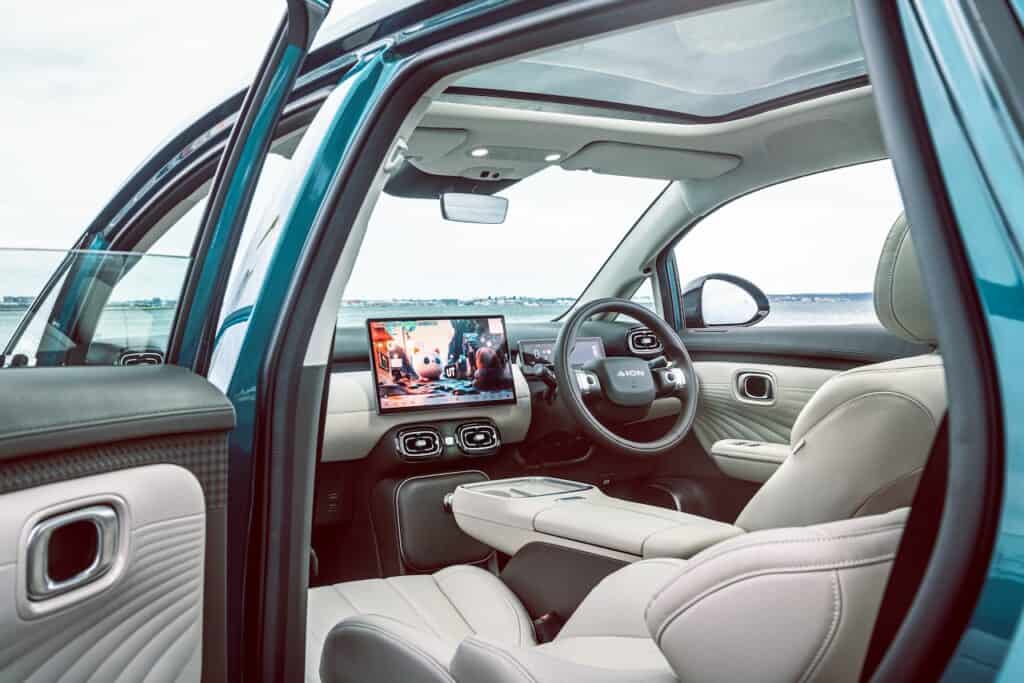
Step inside and the Aion UT punches well above its price tag. The centrepiece is a 14.6-inch infotainment touchscreen — the largest you’ll find in any sub-$40k EV hatchback sold in Australia — paired with a frameless, anti-glare 8.8-inch driver display behind the wheel. The interface is clean and mostly intuitive, with customisable shortcut tiles and native EV trip planning that maps out charging stops for longer drives. Wireless Apple CarPlay and Android Auto come standard, though we did hit occasional connection dropouts with CarPlay during our time with the car. A quick reboot fixed it each time, and a software update should sort it properly down the track.
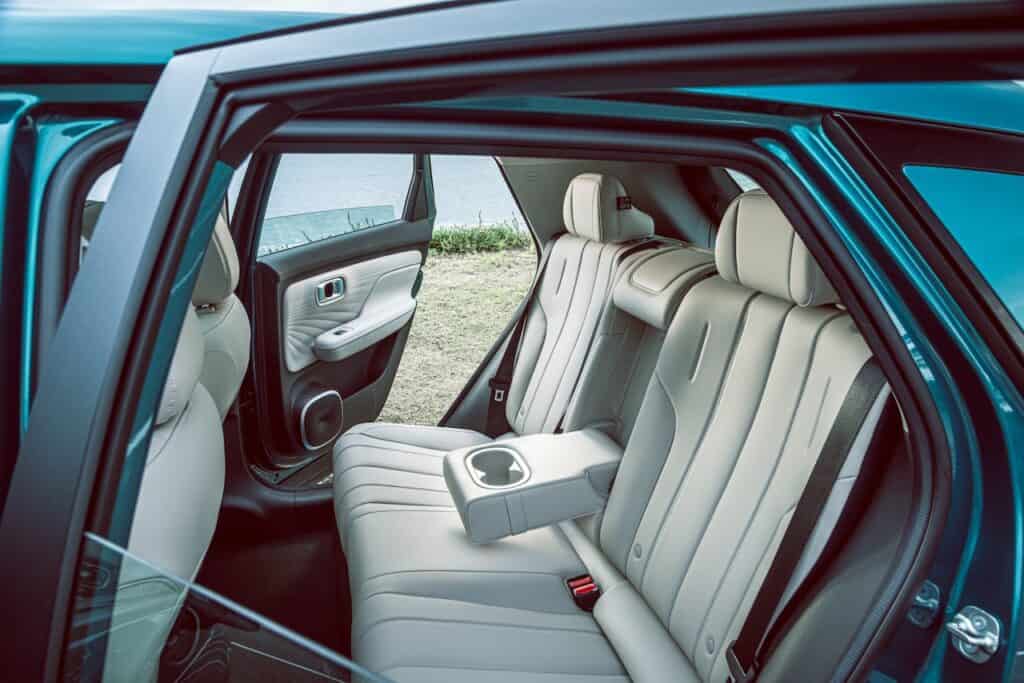
Where the Aion UT really surprises is cabin space. For something just 4.27 metres long, the second row is genuinely usable. The flat floor — a perk of the EV platform — removes the centre tunnel entirely, and rear legroom stretches to 905 mm. Three child-restraint anchor points confirm it works as a legitimate young-family option. The Luxury trim adds a glass moonroof with a power sunshade. It doesn’t reach over the rear seats, but it does wonders for the sense of openness up front. Storage is sensible throughout: a weighted hook rated to 3 kg, a hidden compartment under the centre armrest, a mesh-lined slot perfect for bags or takeaway, and a conventional glovebox. The sound system deserves a mention too — it’s noticeably better than what you’d expect at this money.
Boot space is honest rather than cavernous. With the parcel shelf in place, we squeezed in a 1.2-metre golf club bag — tight, but it worked. Drop the shelf and fold the 60/40 split rear seats, and you’ve got enough room for IKEA flat-packs and weekend gear. It won’t swallow a sofa, but for the weekly shop and the occasional hardware run, it’s perfectly adequate.
Driving the GAC Aion UT
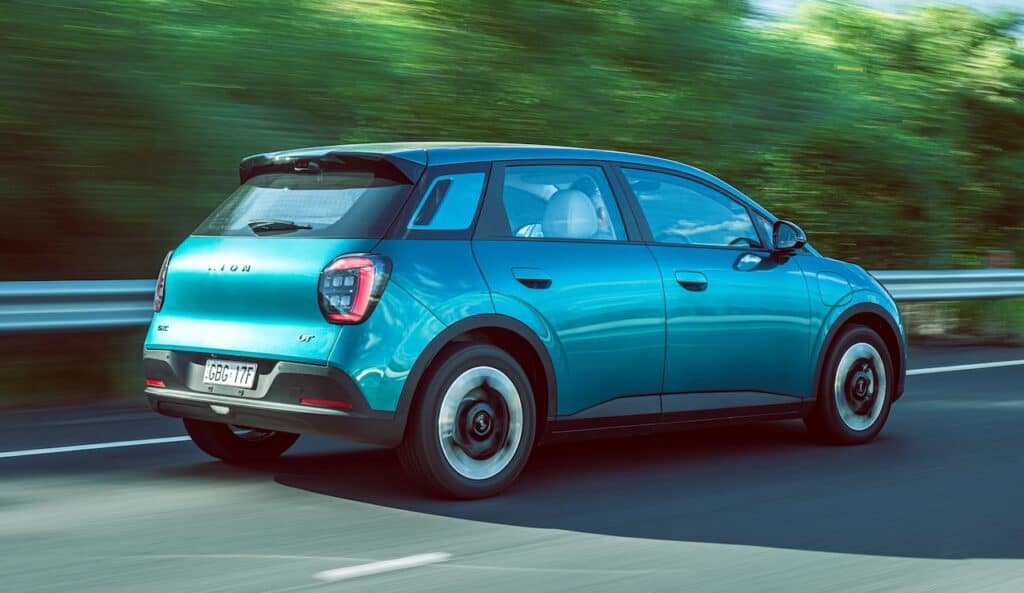
This is where the Aion UT earns its stripes. We spent time threading through tight North Sydney streets, cruising suburban roads, and sitting on the motorway, and the consistent impression was one of composure and predictability. The steering is noticeably heavier than what you’ll find in many Chinese-brand EVs — there’s a reassuring heft to it that feels deliberate rather than vague, and we suspect GAC’s long-running joint-venture work with Toyota and Honda has shaped the calibration. Turn-in is crisp, body roll through corners is minimal for a car this size, and the turning circle is tight enough to U-turn on narrow residential streets without fuss.
The front-wheel-drive powertrain produces 150 kW and 210 Nm, which translates to responsive, zappy acceleration from rest. No turbo lag, no hesitation — just clean, linear thrust that makes darting through urban traffic feel effortless. At 1,670 kg kerb weight, it’s one of the lightest EVs in the class, and you notice that in how willingly the car changes direction. Regen braking is progressive and well-calibrated, with no awkward delay between lifting off the accelerator and the car slowing. There’s no true one-pedal driving mode — you’ll still use the brake pedal as you would in a petrol car — but the transition is smooth enough that anyone stepping out of an ICE vehicle won’t think twice.
A "motion sickness relief" mode is worth knowing about for passengers sensitive to regenerative braking. It dials regen back to a weaker setting and softens the parking assist, and it works exactly as advertised. Cabin insulation impressed us as well: on quieter roads we measured noise levels in the low-to-mid 50s dB, climbing to the mid-60s on the motorway — figures that’d be respectable in a car costing $10,000 more. The ADAS suite is well-stocked, but the overspeed warning is frustratingly over-sensitive and currently requires digging into the driver-assistance menu each time you want to switch it off — there’s no quick shortcut yet. We’d expect a software update to fix this, but for now it’s a minor irritation. The driver-fatigue monitor can also be a touch aggressive, occasionally flagging alertness warnings during a normal conversation.
Battery, Range and Charging
Under the floor sits a 60 kWh lithium-iron-phosphate (LFP) battery — GAC’s own "Magazine Battery 2.0" — rated at 430 km on the WLTP cycle. In real-world driving, you should comfortably see 340–370 km depending on conditions, which covers the vast majority of Australian daily commutes and weekend errands without breaking a sweat. LFP chemistry brings the added reassurance of superior thermal stability and a longer cycle life compared to NMC alternatives, and it’s well suited to Australia’s hot climate.
Charging is competitive for the segment. DC fast-charging peaks at 87 kW, taking the battery from 10 to 80 per cent in roughly 34 minutes — perfectly usable for a highway coffee stop. AC charging at 11 kW via a three-phase connection fills the battery from empty in under 5.5 hours overnight. We tested the Aion UT at a Tesla Supercharger using the Tesla app, and it connected and charged without issue — a big practical plus for buyers wanting access to Australia’s most widespread fast-charging network. Vehicle-to-load (V2L) at 3.3 kW comes standard on both trims, so you can power camping gear, tools, or even a small household appliance straight from the car.
Premium vs Luxury: Which Trim Is Worth It?
The $5,000 jump from Premium to Luxury (at the Luxury’s non-launch price of $35,990 plus on-roads) brings a meaningful list of comfort upgrades: a power tailgate, a glass moonroof with power sunshade, power-folding and auto-anti-glare exterior mirrors, a wireless phone charger, a rear USB-A port, driver-seat ventilation with heating for the passenger, and a heated steering wheel. If you live somewhere summer heat is a regular issue — which covers most of Australia — the ventilated driver seat alone nearly justifies the premium. The moonroof adds genuine ambience, and the power tailgate quickly becomes one of those conveniences you don’t want to give up.
That said, the Premium at $30,990 drive-away is already so well equipped that most buyers won’t feel short-changed. You get the same powertrain, the same 430 km range, the same 14.6-inch screen, and the same 8-year warranty. If the budget’s tight, the Premium is the smarter buy — it’s the value play of the entire segment. If you can stretch to the Luxury, though, you’re picking up genuine upmarket touches that competitors charge a lot more for.
GAC Aion UT vs BYD Dolphin: Which Is Better?
This is the question every sub-$40k EV shopper in Australia is going to ask, so let’s answer it directly. The BYD Dolphin has been the default recommendation in this segment since launch, and for good reason — it’s a well-rounded electric hatchback with a strong feature set. But the GAC Aion UT throws down a serious challenge, and in several key areas it comes out ahead.
Starting with price, the Aion UT Premium launches at $30,990 drive-away — nearly $6,000 less than the comparable BYD Dolphin Premium at $36,890 drive-away. If you don’t need every comfort feature, the entry-level BYD Dolphin Essential starts at $29,990 drive-away, but its smaller 44.9 kWh battery limits range to just 340 km and power to a modest 70 kW. The like-for-like comparison is really the Aion UT Premium against the Dolphin Premium, and on price, the GAC wins convincingly.
On paper, the two cars trade blows on specifications. Both produce 150 kW from a front-mounted motor, and both use LFP battery chemistry — 60 kWh in the GAC, 60.5 kWh in the BYD. Range is virtually identical at 430 km WLTP for the Aion UT versus 427 km for the Dolphin. The Dolphin counters with a significantly stronger 310 Nm of torque versus the Aion UT’s 210 Nm, and it edges the sprint to 100 km/h at 7.0 seconds compared to 7.3 seconds. In practice, that difference is marginal — both cars feel quick and responsive in urban driving, and neither will leave you wanting for merging power on a motorway.
Charging is where the Aion UT pulls ahead. Its 87 kW DC peak outpaces the Dolphin’s 80 kW, and while the difference sounds small on paper, it translates to slightly shorter stops on road trips. Both cars charge at 11 kW on AC. The Aion UT also benefits from confirmed Tesla Supercharger compatibility via the Tesla app — a meaningful practical advantage as the Supercharger network continues to expand across Australia.
Inside, the Aion UT’s 14.6-inch screen is the largest in the segment, compared to the Dolphin’s 12.8-inch rotating display. Both offer wireless Apple CarPlay and Android Auto, and both have their occasional connectivity quirks. The Aion UT’s cabin feels slightly more spacious in the rear, helped by the flat floor and the longer wheelbase relative to its overall length. The BYD counters with its signature rotating screen and the slightly more premium interior trim of its upper spec.
On the road, the two cars have distinct characters. The Aion UT’s steering is weightier and more predictable, which we preferred in spirited urban driving. The Dolphin’s lighter steering suits relaxed cruising but can feel vague by comparison. The Aion UT felt more composed through tight corners, with minimal body roll and a planted, secure feel. The Dolphin, with its extra 100 Nm of torque, has a punchier initial surge off the line, but the Aion UT’s linear power delivery feels more natural and confidence-inspiring day-to-day.
Warranty is the final, and perhaps most significant, differentiator. GAC backs the Aion UT with an 8-year vehicle warranty with unlimited kilometres, plus an 8-year/200,000 km battery warranty. BYD offers 6 years/150,000 km on the vehicle and 8 years on the battery. For buyers who rack up kilometres or plan to keep the car long-term, the GAC’s extra two years of vehicle coverage provides substantially more peace of mind.
<div style="background:linear-gradient(135deg,#f0f9ff,#e0f2fe); border-left:4px solid #2563eb; border-radius:12px; padding:24px 28px; margin:32px 0"> <p style="font-size:12px; font-weight:800; letter-spacing:0.14em; text-transform:uppercase; color:#1e40af; margin:0 0 10px">Which one is better?</p> <p><strong>Buy the GAC Aion UT if</strong> you want the best value in the segment — more range, faster DC charging, a bigger screen, and a longer warranty for significantly less money than the Dolphin Premium.</p> <p><strong>Buy the BYD Dolphin if</strong> you want stronger torque and slightly quicker acceleration, prefer the rotating infotainment display, or value BYD’s more established Australian dealer and service network.</p> <p><strong>Our pick</strong> is the GAC Aion UT. At $30,990 drive-away with 430 km of range, 87 kW DC charging, and an 8-year unlimited-kilometre warranty, it sets a new benchmark for value in the sub-$40k EV hatchback segment.</p> </div>
Safety and Warranty
The Aion UT’s ANCAP safety rating is currently pending, with a crash test scheduled for August 2026. GAC expects a five-star result, and given the extensive Level 2 ADAS suite fitted as standard, that expectation seems reasonable. The list is long: adaptive cruise control, autonomous emergency braking, lane-keep assist and lane-departure warning, blind-spot monitoring, front and rear cross-traffic alert, a 360-degree camera system including a very usable 3D view, front and rear parking sensors, driver and occupant monitoring with child-presence detection, a centre airbag, tyre-pressure monitoring, and pre-tensioning seatbelts. Auto rain-sensing wipers round out the package. The 360-degree cameras are genuinely excellent — we’ve seen worse systems in cars costing twice as much.
Warranty coverage is a standout. GAC offers 8 years with unlimited kilometres on the vehicle, and 8 years/200,000 km on the battery. That’s among the best in the segment and comfortably outpaces the BYD Dolphin’s 6-year/150,000 km vehicle warranty. For Australian buyers who drive high kilometres or simply want long-term reassurance, the GAC warranty package is a meaningful advantage.
Who Should Buy the 2026 GAC Aion UT?
The Aion UT is a car that makes sense on almost every level — and that’s precisely its appeal. It isn’t trying to be a sports car or a luxury cruiser; it’s a thoroughly competent, well-priced electric hatchback that gets the fundamentals right.
**Buy if:** You’re shopping for your first EV, or you want a second car for urban commuting, school runs, and weekend errands without spending more than you need to. The combination of 430 km range, a spacious cabin, strong standard equipment, and an 8-year warranty at $30,990 drive-away is virtually unmatched in Australia today.
**Skip if:** You need a confirmed five-star ANCAP rating before you sign — the test is pending and we can’t verify the result yet. You might also look elsewhere if you prioritise a sportier, rear-drive character or if you’re a heavy one-pedal-driving enthusiast who’ll miss strong regenerative braking on demand.
Verdict: 2026 GAC Aion UT
The 2026 GAC Aion UT arrived in Australia as something of an unknown, and it leaves our first drive as arguably the most convincing argument yet for budget-conscious EV buyers to make the switch. You get more range than most rivals, a cabin that genuinely belies its footprint, driving dynamics that are predictable and confidence-inspiring, and a warranty package few competitors can match — all at a price that undercuts the established players by thousands of dollars. GAC might be new to Australian showrooms, but with a car this well-rounded, it won’t stay unfamiliar for long.
We scored the Aion UT **8.6 out of 10**. It’s the new value benchmark in the sub-$40k electric hatchback segment, and we’d recommend it to any Australian buyer ready to go electric.
Frequently Asked Questions
How much does the 2026 GAC Aion UT cost in Australia?
The Aion UT Premium is priced at $30,990 drive-away for the first 600 customers (launch special; standard MSRP is $31,990 plus on-roads). The Luxury trim is $35,990 plus on-roads, with on-road costs removed for the first 600 buyers. Both introductory offers include a portable 10A charger and a 22kW AC wall charger.
What is the WLTP range of the GAC Aion UT?
The Aion UT has a WLTP-rated range of 430 km from its 60 kWh LFP battery. In real-world conditions, expect roughly 340–370 km depending on driving style, climate, and terrain.
How fast can the Aion UT DC fast-charge?
DC fast-charging peaks at 87 kW, taking the battery from 10 to 80 per cent in approximately 34 minutes. AC charging at 11 kW via three-phase fills the battery in under 5.5 hours.
Does the GAC Aion UT have an ANCAP safety rating?
Not yet. ANCAP crash testing is scheduled for August 2026, and GAC expects a five-star result. The car comes standard with a well-stocked Level 2 ADAS suite including AEB, adaptive cruise, lane-keep assist, blind-spot monitoring, a 360-degree camera, and more.
How does the GAC Aion UT compare to the BYD Dolphin?
The Aion UT Premium undercuts the Dolphin Premium by nearly $6,000 while offering slightly more WLTP range (430 km vs 427 km), faster DC charging (87 kW vs 80 kW), a larger infotainment screen, and a longer vehicle warranty. The Dolphin counters with more torque (310 Nm vs 210 Nm) and a slightly quicker 0–100 km/h time. Overall, the Aion UT offers better value for money.
What is the warranty on the GAC Aion UT?
GAC provides an 8-year vehicle warranty with unlimited kilometres, and an 8-year/200,000 km warranty on the battery. It’s among the best warranty packages in the sub-$40k EV segment.
Is the GAC Aion UT a good first EV?
Absolutely — it’s one of the best first EVs you can buy in Australia. The 430 km range takes the edge off range anxiety, the LFP battery chemistry is thermally stable and long-lasting, the cabin is spacious and easy to live with, and the driving experience is smooth and predictable. At $30,990 drive-away at launch, the barrier to entry is about as low as it gets for a capable, fully-featured electric car.
