

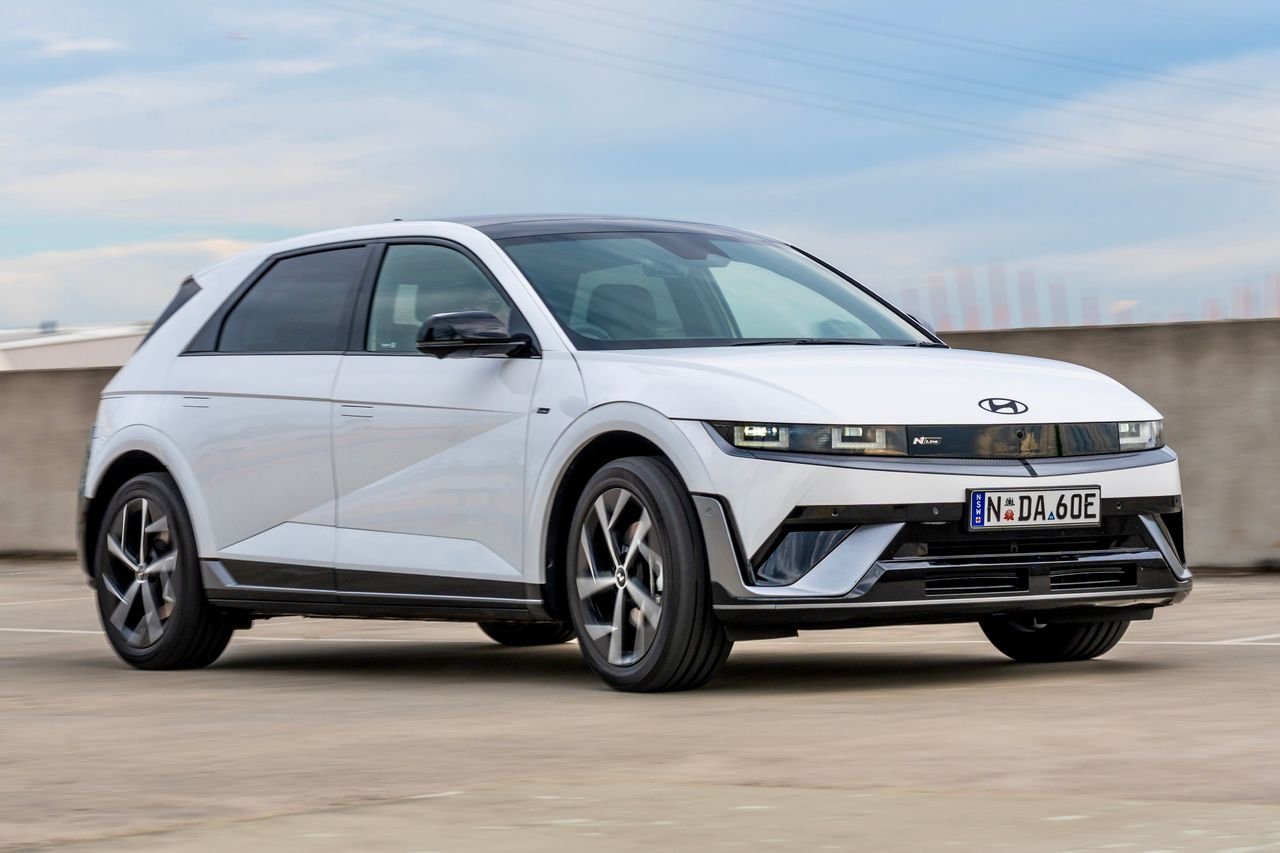
2026 Hyundai Ioniq 5 Review: Still the Smartest EV Buy in Australia?
Mature, refined and better value than ever
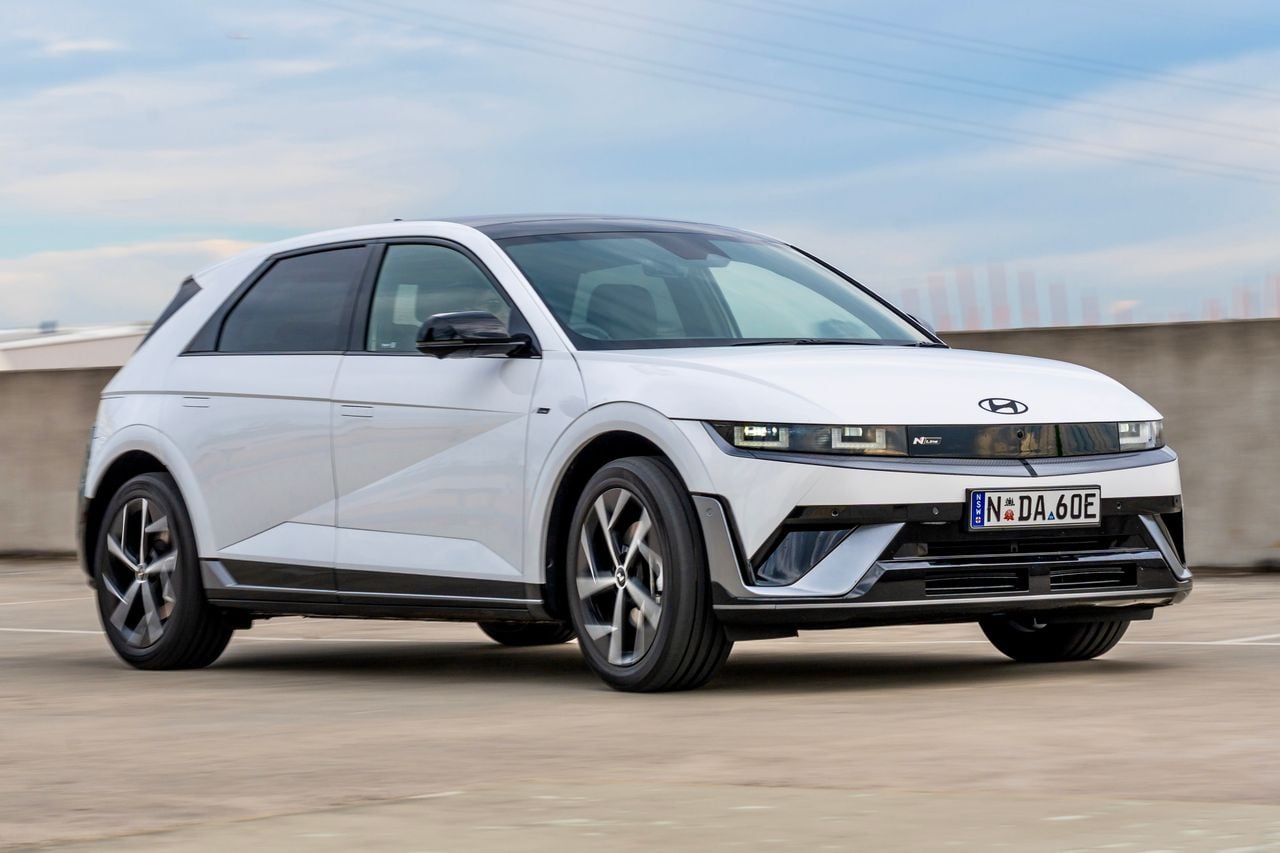
2026 Hyundai Ioniq 5 N Line Premium parked in studio
Price
$71,990
0-100 km/h
~7.5 s
Battery
84 kWh
⚡ Quick Verdict
Hyundai has killed off the smaller battery for 2026, fitting every Ioniq 5 with the 84 kWh pack. That means 570 km WLTP range and 800V charging across the board — a combination no rival matches at this price. At $71,990 before on-roads, or around $72,000 drive-away on current offers, it’s cheaper than the old extended-range model and goes toe-to-toe with the Tesla Model Y on range while leaving it behind on charging speed. It’s still one of the most comfortable and thoughtfully packaged electric SUVs you can buy here. More Australians just need to discover it.
## What’s New for 2026
✓ The Good
- +800V architecture with genuinely rapid 350 kW DC charging across the range
- +84 kWh battery now standard — up to 570 km WLTP range in RWD form
- +One of the most spacious, well-built and intuitively designed EV cabins on the market
- +7-year unlimited-kilometre warranty plus 8-year battery cover
- +Vehicle-to-Load (V2L) at 3.6 kW remains a genuine differentiator
- +Base price at $71,990 before on-roads still feels steep against Chinese and Korean rivals
- +Ride can feel jarring over sharp low-speed imperfections
- +Active safety systems rearm at every startup — an enduring annoyance
- +Internal threat from the new Hyundai Elexio undercuts it on price with similar range
- +—
✗ The Trade-offs
- −Base price at $71,990 before on-roads still feels steep against Chinese and Korean rivals
- −Ride can feel jarring over sharp low-speed imperfections
- −Active safety systems rearm at every startup — an enduring annoyance
- −Internal threat from the new Hyundai Elexio undercuts it on price with similar range
- −—
📑 In This Review
- What’s New for 2026
- Design and Exterior
- Interior, Tech and Practicality
- On the Road
- Battery, Range and Charging
- At a Glance: 2026 Ioniq 5 vs Direct Rivals
- 2026 Hyundai Ioniq 5 vs Tesla Model Y: Which Is Better?
- Safety and Warranty
- Ownership Costs and Value
- Who Should Buy the 2026 Hyundai Ioniq 5
- Verdict
- Frequently Asked Questions
Hyundai has killed off the smaller battery for 2026, fitting every Ioniq 5 with the 84 kWh pack. That means 570 km WLTP range and 800V charging across the board — a combination no rival matches at this price. At $71,990 before on-roads, or around $72,000 drive-away on current offers, it’s cheaper than the old extended-range model and goes toe-to-toe with the Tesla Model Y on range while leaving it behind on charging speed. It’s still one of the most comfortable and thoughtfully packaged electric SUVs you can buy here. More Australians just need to discover it.
What’s New for 2026
Hyundai Australia has trimmed the Ioniq 5 range hard for 2026. The old 63 kWh battery — good for just 440 km and 125 kW peak charging — is gone. Every 2026 Ioniq 5 now runs the 84 kWh gross (80 kWh usable) lithium-ion battery pack that used to sit at the top of the lineup. Put simply, the base RWD is last year’s extended-range model with a new badge. The range jump is substantial: 570 km WLTP for the rear-driver, roughly 90 km more than the old entry-level managed.
The lineup itself has been trimmed from a bewildering fourteen configurations down to three: the base Ioniq 5, the Elite, and the N Line Premium. The confusing Dynamic and Techniq badges are out, replaced by Elite and N Line names borrowed from Hyundai’s petrol range — a sensible move for clarity. You’ll also spot subtle styling changes carried over from the MY25 refresh: updated wheel designs, revised badging, and a new Digital Key 2.0 feature that lets you unlock and start the car with your smartphone or smartwatch. Pricing has shifted accordingly, but with drive-away offers sitting around $72,000 for the base model, it’s sharper than it’s been in years.
Design and Exterior
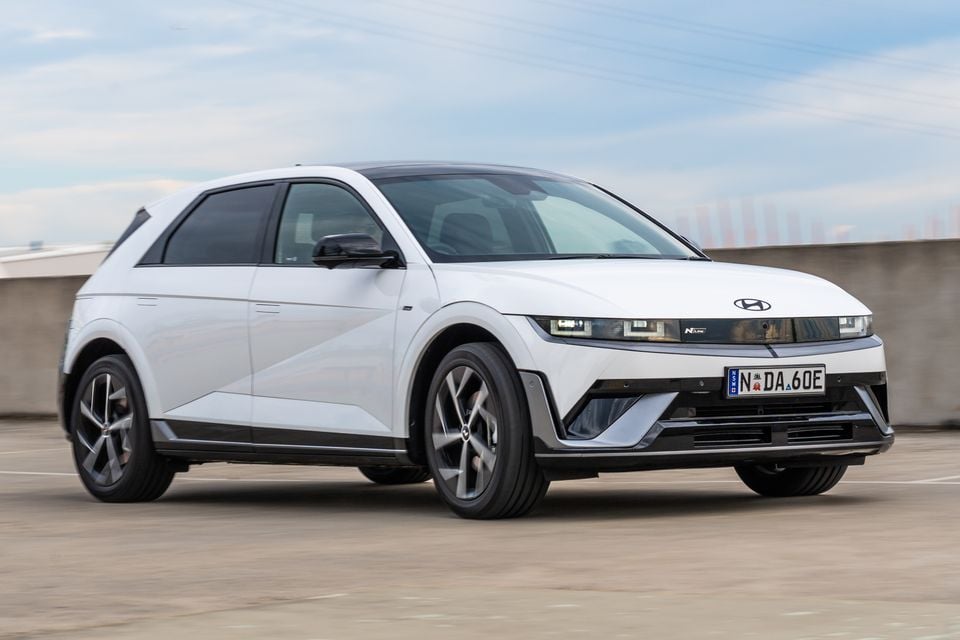
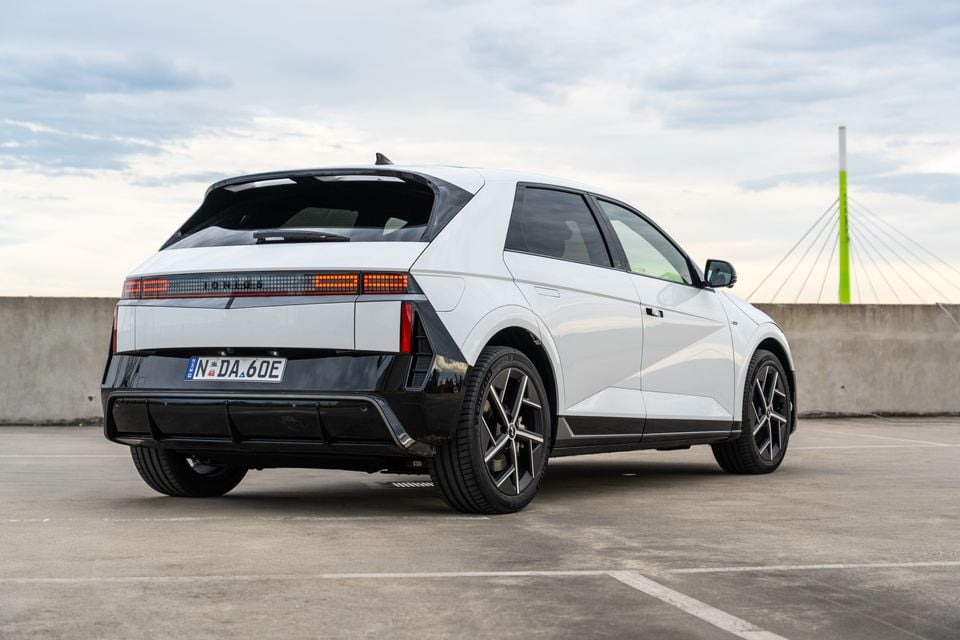
Five years on from its debut, the Ioniq 5’s retro-futuristic look still stops people in the street. Those parametric pixel lights — the distinctive clusters of square LED elements at each end — give it an identity no rival has managed to copy. It’s aged remarkably well, partly because Hyundai’s minor restyling has kept things fresh without messing with the original concept.
The proportions are unusual. This is essentially a plus-sized hatchback with the stance and ride height of a mid-size SUV — 4,655 mm long on a 3,000 mm wheelbase. You can see that generous wheelbase in the side profile, where short overhangs and a cab-forward stance give it a planted, almost concept-car look.
The base RWD sits on 19-inch alloys in a fairly understated design, while the N Line Premium upgrades to 20-inch wheels with a more aggressive spoke pattern. Flush door handles, clean body surfacing, and squared-off wheel arches all help keep aerodynamic drag competitive for the class. Whether you call it a hatchback or an SUV is partly semantic. What’s not up for debate is that it turns heads — something the blob-shaped Model Y can’t claim.
Interior, Tech and Practicality
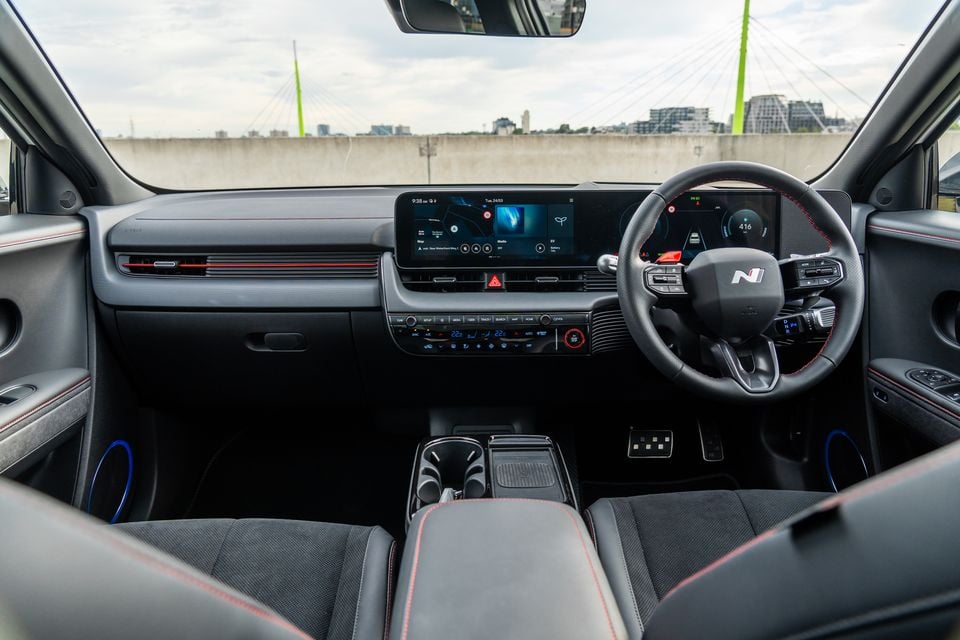
This is where the Ioniq 5 has always justified its price tag. The flat floor from the skateboard platform makes the cabin feel genuinely spacious. Five adults fit comfortably, and the second-row legroom rivals a mid-size Tucson. The dual 12.3-inch displays — one for instruments, one for the central touchscreen — sit within a single visor housing, and the system responds crisply to inputs. Wireless Apple CarPlay and Android Auto pair quickly and stayed stable throughout our testing. A wireless phone charger sits within easy reach on the centre console.
That console is a highlight — it slides 140 mm fore and aft, freeing up a heap of flexible storage between the front seats. Materials are excellent for the money. The base model’s obsidian black interior uses a mix of wool and leather-accent seat trim that feels genuinely premium — a world apart from the synthetic leather in many Chinese competitors. You get 64-colour ambient lighting, rear USB-C outlets, B-pillar air vents, and a V2L power outlet under the rear seat.
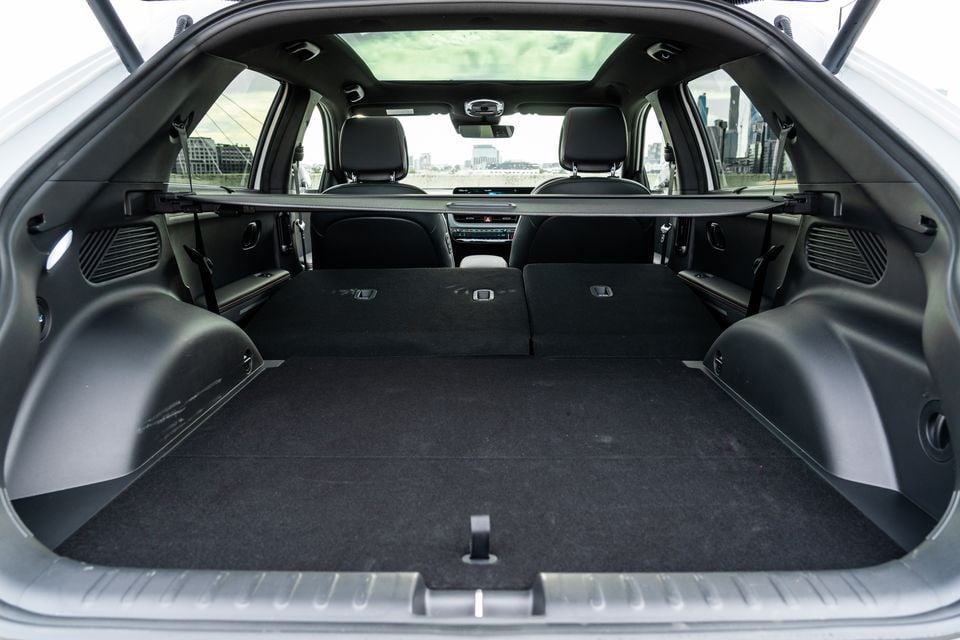
Boot space is 480 litres with the seats up, expanding to 1,580 litres when folded. There’s a 24-litre frunk on the RWD (57 litres on AWD), and the boot floor is a two-layer design with a handy under-floor cubby for charging cables. Higher trims get reclining lounge seats, but even the base car’s sculpted front chairs are comfortable over long distances. Put simply, this is one of the best-packaged cabins in any electric SUV on the Australian market.
On the Road
The base rear-drive Ioniq 5 makes 168 kW and 350 Nm from its single rear motor. On paper, those numbers won’t set the EV world alight. In practice, though, it’s a different story. Around town, instant electric torque makes it feel brisk and responsive, with enough punch for confident merging and motorway overtaking. Hyundai claims 7.5 seconds to 100 km/h for the RWD, and that feels about right — quick enough for family duties without ever feeling slow. Step up to the N Line Premium AWD with its dual-motor 239 kW setup and you’re looking at 5.1 seconds to 100 km/h. That’s a noticeably different driving character.
The suspension is passively damped and sits on the firm side of comfortable. Over smooth motorway surfaces, the Ioniq 5 settles beautifully — planted and composed. That 3,000 mm wheelbase earns its keep here, absorbing undulations with real authority at speed. Where it comes unstuck is at low speed over sharp-edged potholes or broken tarmac. There’s a jarring quality to the impacts that reminds you this is an EV carrying considerable weight. The steering is direct and well-weighted for the class, giving the Ioniq 5 a surprisingly nimble feel despite its 2-tonne-plus kerb weight. It drives like a plus-sized hatchback, and that’s a compliment.
Regen braking is controlled via paddle shifters on the steering wheel, cycling from i-Pedal (full one-pedal driving) through to coasting with virtually no regen. Being able to adjust this on the fly is something we reckon should be standard on every EV. Drive modes — Eco, Normal, Sport, and Snow — alter throttle mapping in a meaningful way, with Sport delivering noticeably sharper responses.
Battery, Range and Charging
This is where the Ioniq 5 really separates itself from most rivals. The 800-volt E-GMP platform isn’t new, but pairing it with the 84 kWh battery across every variant means every buyer gets the full capability. Peak DC fast-charging hits 350 kW on compatible hardware, which gets you from 10 to 80 per cent in around 18 to 20 minutes. That’s class-leading. The Tesla Model Y peaks at 250 kW, the BYD Sealion 7 at 150 kW, and most Chinese-branded rivals sit on 400-volt architectures that can’t come close. On a 50 kW DC charger — the kind you’ll find at plenty of regional Australian sites — you’re obviously limited by the charger, not the car.
WLTP-rated range is up to 570 km for the RWD and approximately 507 km for the AWD N Line Premium. In our week of mixed driving, the base RWD averaged 13.5 kWh per 100 km. Extrapolate that out and you’re looking at roughly 590 km of real-world range — actually beating the WLTP claim, though your results will depend on driving style and conditions. One thing to be aware of: the car’s own range estimator shows an optimistic 670 km when fully charged, before recalibrating to more realistic numbers once you’re driving normally.
Vehicle-to-Load (V2L) at 3.6 kW comes standard, accessible via a supplied adapter from the charge port or the outlet under the rear seat. It’ll run camping gear, electric bikes, laptops, or act as an emergency power source for home appliances. V2L is still surprisingly rare among mainstream EVs at this price, and it genuinely broadens what the car can do.
At a Glance: 2026 Ioniq 5 vs Direct Rivals
| Spec | Hyundai Ioniq 5 RWD | Tesla Model Y RWD | Kia EV5 Air | BYD Sealion 7 Premium |
|---|---|---|---|---|
| Price (from, before on-roads) | $71,990 | $58,900 | $64,770 | $54,990 |
| Battery | 84 kWh | 60 kWh | 60.3 kWh | 82.6 kWh |
| WLTP range | 570 km | 466 km | 490 km | 482 km |
| DC peak charging | 350 kW | 250 kW | 150 kW | 150 kW |
| 0-100 km/h | ~7.5 s | ~6.0 s | ~7.9 s | ~6.7 s |
| Boot (seats up) | 480 L | 425 L | 566 L | 500 L |
| ANCAP | ★★★★★ | ★★★★★ | ★★★★★ | ★★★★★ |
| Warranty | 7 yr / unlimited km* | 8 yr / 192,000 km | 7 yr / unlimited km* | 6 yr / 150,000 km |
Tesla Model Y RWD
Cheaper entry price and Supercharger network, but slower 250 kW charging and a less premium cabin
Kia EV5 Air
Sister-brand sibling with lower price and similar warranty, but smaller 60 kWh battery and 150 kW charging cap
BYD Sealion 7 Premium
Aggressively priced with plush ride, but 400V architecture limits charging to 150 kW
Hyundai Elexio
Internal threat — newer platform, larger 88 kWh battery, undercuts Ioniq 5 by $11k+
The mid-size electric SUV segment in Australia has exploded in the past two years. The Ioniq 5 now faces stiff competition from Tesla’s updated Model Y, Kia’s EV5, and the aggressively priced BYD Sealion 7. Here’s how they compare on the numbers that matter. Hyundai Ioniq 5 RWD Kia EV5 Air —— $71,990 $64,770 84 kWh 60.3 kWh 570 km 490 km 350 kW 150 kW ~7.5 s ~7.9 s 480 L 566 L ★★★★★ ★★★★★ 7 yr / unlimited km* 7 yr / unlimited km* *Subject to on-time dealer servicing; reverts to 5 years otherwise. The Ioniq 5’s price premium over the Model Y and Sealion 7 is significant, but it buys you substantially more range, dramatically faster charging, and the 800-volt architecture that future-proofs the ownership experience. The Kia EV5 is the closest in terms of brand positioning and platform philosophy, but it can’t match the Ioniq 5’s range or charging speed. If outright value is the priority, the Chinese rivals win — but if you want the most capable all-rounder, the Hyundai’s technical credentials remain unmatched.
2026 Hyundai Ioniq 5 vs Tesla Model Y: Which Is Better?
This is the question that dominates every mid-size EV buyer’s shortlist in Australia. The Tesla Model Y outsold the Ioniq 5 by a staggering 35-to-1 ratio in 2025, and the refreshed "Juniper" Model Y has only sharpened Tesla’s appeal. But sales figures don’t always tell the full story, and on paper and on the road, the 2026 Hyundai Ioniq 5 makes a far stronger case than those numbers suggest.
Starting with price, the Model Y RWD undercuts the base Ioniq 5 by a significant margin at $58,900 before on-roads versus $71,990. That’s a gap of roughly $13,000 — real money, and the primary reason the Tesla dominates the sales charts. But compare battery size and range, and the Ioniq 5 pulls ahead decisively: its 84 kWh battery delivers 570 km WLTP compared to the Model Y’s 60 kWh pack and 466 km range. That’s over 100 km more driving distance on a single charge, which matters enormously for buyers who regularly tackle longer Australian distances.
The charging comparison is even more one-sided. The Ioniq 5’s 800-volt architecture enables 350 kW peak DC charging and a 10-to-80 per cent sprint of approximately 18 to 20 minutes. The Model Y’s 400-volt system tops out at 250 kW, and while Tesla’s Supercharger network in Australia is excellent, the car simply cannot absorb energy as quickly as the Hyundai. For road-trip use cases, the Ioniq 5’s charging speed effectively erases much of the range advantage the Model Y holds in terms of network access.
On the road, the two cars offer distinctly different philosophies. The Model Y RWD hits 100 km/h in approximately 6.0 seconds — quicker than the Ioniq 5’s 7.5 seconds — and its ride is generally softer and more comfort-oriented. The Ioniq 5, by contrast, has a firmer, more composed chassis that rewards confident driving, with sharper steering and better body control. Both are quiet and refined at highway speeds, but the Hyundai feels more like a European car in its dynamic character, while the Tesla is more appliance-like in its ease of use.
Inside, the contrast is stark. The Ioniq 5 offers a cabin that is visually striking, materially rich, and intuitively laid out — the dual 12.3-inch screens, physical climate controls, and sliding centre console deliver a user experience that most people find more natural than the Tesla’s single-screen approach. The Model Y’s minimalist interior is divisive: some love the decluttered aesthetic, but others find it frustratingly reliant on touchscreen inputs for even basic functions like adjusting wipers or air vents. The Ioniq 5’s second row is also marginally more spacious thanks to its longer wheelbase and flat floor.
Ownership is where Tesla fights back. The Model Y’s 8-year/192,000 km warranty is marginally longer than Hyundai’s 8-year/160,000 km battery cover, and Tesla’s over-the-air software updates continually add features without a dealer visit. Hyundai’s 7-year/unlimited-kilometre vehicle warranty (with dealer servicing) is the stronger overall proposition, however, and the servicing costs are transparent and predictable at $667 per 24-month/30,000 km interval.
The Ioniq 5 also offers V2L capability — something the Model Y does not — and that 3.6 kW vehicle-to-load function is genuinely useful for camping, tailgating, or emergency power. For buyers who value practicality and versatility alongside driving refinement, this is a meaningful differentiator.
| Spec | Hyundai Ioniq 5 RWD | Tesla Model Y RWD |
|---|---|---|
| Price (from) | $71,990 | $58,900 |
| Battery | 84 kWh | 60 kWh |
| WLTP range | 570 km | 466 km |
| DC peak charging | 350 kW | 250 kW |
| 0-100 km/h | ~7.5 s | ~6.0 s |
| Length | 4,655 mm | 4,751 mm |
| Boot | 480 L | 425 L |
| ANCAP | ★★★★★ | ★★★★★ |
| Warranty | 7 yr / unlimited km* | 8 yr / 192,000 km |
[CALLOUT] Buy the Hyundai Ioniq 5 if: you prioritise range, ultra-fast charging, a premium cabin experience, and V2L versatility over outright value for money. Buy the Tesla Model Y if: you want the lowest entry price, access to the Supercharger network, and prefer a minimalist tech-first ownership experience. Our pick: the Ioniq 5 is the better car in almost every measurable metric — it just costs more to get there. [/CALLOUT]
Safety and Warranty
The 2026 Hyundai Ioniq 5 retains its 5-star ANCAP safety rating, derived from Euro NCAP testing protocols established in 2021. The active safety suite is comprehensive even on the base model, including autonomous emergency braking with car, pedestrian, and cyclist detection, lane-keep assist, driver attention warning, and smart cruise control with stop-and-go functionality. The blind-spot view monitor — which displays a live camera feed in the instrument cluster when you indicate — is fitted to the Elite and above, though the base model still gets conventional blind-spot monitoring with audible and visual alerts.
Higher trims add a surround-view camera system and parking collision avoidance, while rear cross-traffic alert is standard across the range. The base model misses out on the blind-spot camera integration in the driver’s display, but in our experience, the conventional system is more than adequate for everyday use.
Hyundai’s warranty package is one of the strongest in the Australian market: 7 years and unlimited kilometres, provided the vehicle is serviced on time at an authorised Hyundai dealer. Miss a service, and that reverts to 5 years — so disciplined ownership is rewarded. The EV battery is separately warranted for 8 years or 160,000 kilometres, whichever comes first. Five years of complimentary roadside assistance is included when servicing is kept within the Hyundai network. Combined with Hyundai’s extensive Australian dealer footprint, this is a reassuring ownership proposition for first-time EV buyers.
Ownership Costs and Value
Running the numbers on the 2026 Hyundai Ioniq 5 is encouraging, if not revolutionary. On a typical Australian home electricity rate of around 30 cents per kWh, a full charge of the 84 kWh battery costs roughly $25 — delivering over 500 km of real-world range. That equates to approximately $4.50 to $5.00 per 100 km, a fraction of the $15-$20 per 100 km you’d pay to fuel an equivalent petrol mid-size SUV. On public DC fast charging at roughly 60-70 cents per kWh, the economics tighten considerably, but the Ioniq 5’s rapid charging speed means you’re paying for less time at the charger.
Servicing is required every 24 months or 30,000 km, with each visit costing $667 — a figure that’s not cheap, but when amortised over the extended interval, it’s competitive with rivals. Insurance is roughly in line with the segment; median comprehensive premiums for a new Ioniq 5 sit around $1,130 annually, though your specific quote will vary by postcode, driving history, and insurer.
The elephant in the room is the Hyundai Elexio, a new model launching from around $60,000 drive-away with an 88 kWh battery and over 500 km of range. It’s a serious internal competitor that may cannibalise Ioniq 5 sales among value-focused buyers. Resale values for the Ioniq 5 have historically been average for the EV segment — not problematic, but not stellar — and the constant spec changes over the past five years haven’t helped residual confidence. The simplified 2026 lineup should help.
Who Should Buy the 2026 Hyundai Ioniq 5
**BUY IT IF:** You want the fastest-charging electric SUV under $100k in Australia, value a genuinely premium and spacious cabin, need real-world range above 500 km, and appreciate the added versatility of V2L. This is also the EV for buyers who find Tesla’s minimalist interior philosophy frustrating and prefer physical controls, intuitive layouts, and a car that feels hand-crafted rather than software-defined. If you do regular highway trips and charging speed matters as much as range, nothing at this price comes close.
**SKIP IT IF:** Price is your primary concern. At $71,990 before on-roads, the Ioniq 5 is significantly more expensive than a Tesla Model Y, BYD Sealion 7, or even its own sister car, the Kia EV5. If you rarely drive long distances and don’t need 800V charging, the premium may be hard to justify. You should also skip it if you prefer a conventional SUV shape — the Ioniq 5’s hatchback proportions divide opinion, and for some buyers, it simply doesn’t look like enough car for the money.
**WAIT FOR:** The Hyundai Elexio, which is expected to launch in Australia from around $60,000 drive-away with an 88 kWh battery and over 500 km of WLTP range. It promises to deliver much of the Ioniq 5’s core appeal — including 800V architecture — at a significantly lower entry point, and may represent the smarter buy within Hyundai’s own showroom if outright range and value are your priorities.
⚡ Our Verdict
Mature, refined and better value than ever
The 2026 Hyundai Ioniq 5 is a car that continues to punch well above its sales numbers. Hyundai Australia has spent five years quietly refining what was already an excellent electric vehicle, and the result is a machine that feels mature, resolved, and better value than it has ever been. The standardisation of the 84 kWh battery across the range, the unmatched 800V charging capability, and the genuinely premium cabin experience combine to make a compelling case — even at $71,990 before on-roads. Is it perfect? No. The ride can be jarring over poor surfaces, the active safety reminders are a persistent annoyance, and the Hyundai Elexio threatens to eat into its own showroom relevance. But measured on the things that matter most to electric vehicle ownership — range, charging speed, interior quality, practicality, and warranty — the Ioniq 5 remains one of the most complete packages in the electric SUV Australia segment. This is a car that deserves far more attention than the market gives it. If more buyers experienced what 800V charging actually feels like on a road trip, or sat inside a cabin this well-executed, the sales charts might tell a very different story.
Frequently Asked Questions
Has the 2026 Hyundai Ioniq 5 dropped its smaller battery?
Yes. For 2026, the 63 kWh battery option has been entirely discontinued. Every Ioniq 5 variant — from the base RWD to the N Line Premium AWD — now comes standard with the 84 kWh gross (80 kWh usable) lithium-ion battery pack. This simplifies the range significantly and gives every buyer access to the full-range driving experience.
How long does it take to charge the Ioniq 5 from 10 to 80 per cent?
On a compatible 350 kW DC fast charger, the 2026 Ioniq 5’s 800V architecture enables a 10-to-80 per cent charge in approximately 18 to 20 minutes. On lower-powered DC chargers, the time will increase proportionally, but the car’s peak charging capability means it makes the most of whatever power is available.
Is the Ioniq 5 better than the Tesla Model Y?
It depends on what you value. The Ioniq 5 offers more range (570 km vs 466 km), faster charging (350 kW vs 250 kW), a more spacious and premium interior, and V2L capability. The Model Y counters with a significantly lower price, quicker acceleration, and access to Tesla’s Supercharger network. On technical merit alone, the Ioniq 5 is the more capable car — but the Model Y’s value proposition is hard to ignore.
What’s the WLTP range of the 2026 Hyundai Ioniq 5?
The base RWD model achieves up to 570 km WLTP on a full charge. The AWD N Line Premium is rated at approximately 507 km WLTP. Real-world range will vary depending on driving conditions, climate, and driving style, but our testing suggests the RWD comfortably delivers 550-590 km in mixed use.
How much does the 2026 Hyundai Ioniq 5 cost in Australia?
The base Ioniq 5 RWD starts at $71,990 before on-roads, though Hyundai has been offering drive-away pricing around $72,000. The Elite RWD starts from $78,990, while the N Line Premium AWD begins at $87,990 — landing at roughly six figures on the road.
Does the 2026 Ioniq 5 have Vehicle-to-Load (V2L)?
Yes. Every 2026 Ioniq 5 comes equipped with V2L at 3.6 kW, accessible via the charge port with a supplied adapter or through an interior power outlet beneath the rear seat. It can power appliances, camping equipment, laptops, or even charge another EV in an emergency.
What is Hyundai’s EV battery warranty for the Ioniq 5?
Hyundai warrants the Ioniq 5’s EV battery for 8 years or 160,000 kilometres, whichever comes first. The broader vehicle warranty is 7 years with unlimited kilometres, provided the car is serviced on time at an authorised Hyundai dealer. If servicing lapses, the vehicle warranty reverts to 5 years.
